Paragraph 7 · 50% changed
Every version of it
Screener
/
SEC EDGAR
/CIK 0001868159
/10-K filed Feb 25, 2026, compared with Feb 26, 2025
/Numbers from the XBRL of the 10-Ks
Nasdaq
Real estate · REIT
Lineage, Inc. LINE
The 10-K against last year's
276 changes: 29 added, 88 removed, 151 reworded, 8 quiet changes
10-K Feb 25, 2026 vs Feb 26, 2025
Risk Factors
19.3%
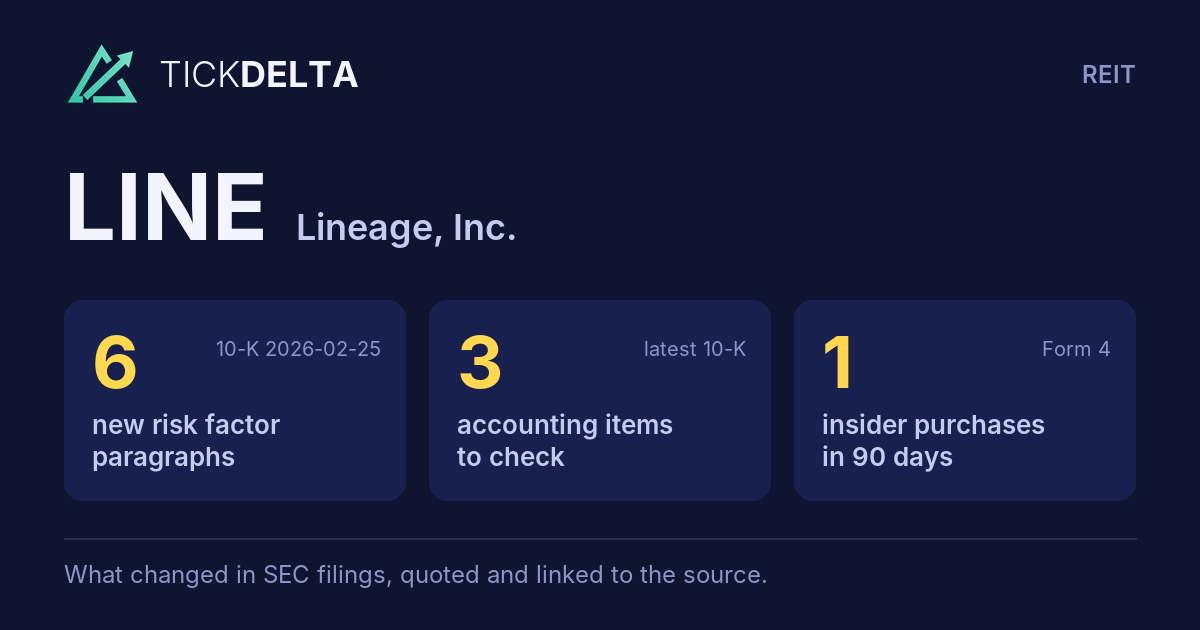
of the text changed · 32,434 words now · 6 new paragraphs, 70 gone
MD&A
29.0%
of the text changed · 15,091 words now · 23 new paragraphs, 18 gone
10-K 0001868159-26-000012 (Feb 25, 2026) vs 10-K 0001868159-25-000011 (Feb 26, 2025) Not compared: Legal Proceedings, Accounting Policies.
Every paragraph, and how much of it changed
One bar per paragraph, in the order of the 10-K. Height and colour show the share of its words not in the closest paragraph a year earlier; the tallest bars are new paragraphs.
Risk Factors
405 paragraphs · 6 new · 137 reworded · 70 gone · 10-K Feb 25, 2026 against Feb 26, 2025
New paragraph
Reworded (5% of its words or more)
Same or nearly
Paragraph 55 · 50% changed
Every version of it
Paragraph 192 · 50% changed
Every version of it
Paragraph 317 · 49% changed
Every version of it
Paragraph 107 · 49% changed
Every version of it
The rapid evolution of AI, including potential government regulation of AI, will require significant resources to develop, test, and maintain our platform, offerings, services, and features to help us implement AI ethically in order to minimize unintended, harmful impact. The use of AI technology in our business processes requires a strong tailored governance framework. The regulatory framework for AI is continuously developing, and our internal governance framework over AI may fail to meet new emerging standards, which could lead to potential loss or misuse of data, or other harmful consequences.
Paragraph 47 · 49% changed
Every version of it
Additionally, inflation may have a negative effect on the construction costs necessary to complete our greenfield development and expansion projects, including, but not limited to, costs of construction materials, labor and services from third-party contractors and suppliers. Higher construction costs could adversely impact our investments in real estate assets and expected yields on our greenfield development and expansion projects, which may make otherwise lucrative investment opportunities less profitable to us. Our reliance on a number of third-party suppliers and contractors may also make such investment opportunities unattainable if we are unable to sufficiently fund our projects due to significant cost increases, or are unable to obtain the resources and materials to do so reasonably due to disrupted supply chains. As a result, our business, financial condition, results of operations, cash flows, liquidity and ability to satisfy our debt service obligations and to pay dividends and distributions to security holders could be adversely affected over time.
Paragraph 19 · 48% changed
Every version of it
Paragraph 24 · 48% changed
Every version of it
Paragraph 7 · 50% changed
Every version of it
10-K Feb 26, 2025•Labor shortages, increased turnover, and work stoppages have in the past, and may in the future, continue to disrupt our or our customers’ operations, increase costs, and negatively impact our profitability.
10-K Feb 25, 2026
•Supply chain disruptions have in the past, and may again in the future, negatively impact our business.
Paragraph 55 · 50% changed
Every version of it
10-K Feb 26, 2025•Labor shortages, increased turnover, and work stoppages have in the past, and may in the future, continue to disrupt our or our customers’ operations, increase costs, and negatively impact our profitability.
10-K Feb 25, 2026
Supply chain disruptions have in the past, and may again in the future, negatively impact our business.
Paragraph 192 · 50% changed
Every version of it
10-K Feb 26, 2025In addition, as a public company, we are required to document and test our internal control over financial reporting pursuant to Section 404 of the Sarbanes-Oxley Act so that our management can certify as to the effectiveness of our internal control over financial reporting. Management’s initial certification under Section 404 of the Sarbanes-Oxley Act will be required with our Annual Report on Form 10-K for the year ending December 31, 2025. In support of such certifications, we will be required to document and make significant changes and enhancements, including potentially hiring additional personnel, to our internal control over financial reporting. Likewise, our independent registered public accounting firm will be required to provide an attestation report on the effectiveness of our internal control over financial reporting as of December 31, 2025. To date, neither our management nor an independent registered public accounting firm has performed an evaluation of our internal control over financial reporting in accordance with the requirements of Section 404 of the Sarbanes-Oxley Act because no such evaluation has been required. In connection with our ongoing monitoring of our internal control over financial reporting or audits of our consolidated financial statements or our management’s assessment of the effectiveness of internal control over financial reporting, we or our auditors may identify additional deficiencies in our internal control over financial reporting that may be significant or rise to the level of material weaknesses. Any failure to maintain effective internal control over financial reporting or to timely effect any necessary improvements to such controls could cause us to fail to meet our reporting obligations (which could affect the listing of our common stock on Nasdaq). Additionally, ineffective internal control over financial reporting could also adversely affect our ability to prevent or detect fraud, harm our reputation, subject us to regulatory scrutiny and cause investors to lose confidence in our reported financial information, which would likely have a negative effect on the market price of our common stock.
10-K Feb 25, 2026
A material weakness is a deficiency, or a combination of deficiencies, in internal control over financial reporting such that there is a reasonable possibility that a material misstatement of our annual or interim consolidated financial statements will not be prevented or detected on a timely basis. If we are unable to remediate the material weakness, or are otherwise unable to maintain effective internal control over financial reporting, it could adversely affect our ability to prevent or detect fraud, harm our reputation, subject us to regulatory scrutiny, and cause investors to lose confidence in our reported financial information, which would likely have a negative effect on the market price of our common stock.
Paragraph 317 · 49% changed
Every version of it
10-K Feb 26, 2025•“control share” provisions that provide that holders of “control shares” of our company (defined as voting shares of stock that, if aggregated with all other shares of stock owned or controlled by the acquirer, would entitle the acquirer to exercise one of three increasing ranges of voting power in electing directors) acquired in a “control share acquisition” (defined as the direct or indirect acquisition of issued and outstanding “control shares”) have no voting rights except to the extent approved by our stockholders by the affirmative vote of at least two-thirds of all of the votes entitled to be cast on the matter, excluding all interested shares.
10-K Feb 25, 2026
rights except to the extent approved by our stockholders by the affirmative vote of at least two-thirds of all of the votes entitled to be cast on the matter, excluding all interested shares.
Paragraph 107 · 49% changed
Every version of it
10-K Feb 26, 2025
significant resources to develop, test, and maintain our platform, offerings, services, and features to help us implement AI ethically in order to minimize unintended, harmful impact.
10-K Feb 25, 2026
The rapid evolution of AI, including potential government regulation of AI, will require significant resources to develop, test, and maintain our platform, offerings, services, and features to help us implement AI ethically in order to minimize unintended, harmful impact. The use of AI technology in our business processes requires a strong tailored governance framework. The regulatory framework for AI is continuously developing, and our internal governance framework over AI may fail to meet new emerging standards, which could lead to potential loss or misuse of data, or other harmful consequences.
Paragraph 47 · 49% changed
Every version of it
10-K Feb 26, 2025
Higher construction costs could adversely impact our investments in real estate assets and expected yields on our greenfield development and expansion projects, which may make otherwise lucrative investment opportunities less profitable to us. Our reliance on a number of third-party suppliers and contractors may also make such investment opportunities unattainable if we are unable to sufficiently fund our projects due to significant cost increases, or are unable to obtain the resources and materials to do so reasonably due to disrupted supply chains. As a result, our business, financial condition, results of operations, cash flows, liquidity and ability to satisfy our debt service obligations and to pay dividends and distributions to security holders could be adversely affected over time.
10-K Feb 25, 2026
Additionally, inflation may have a negative effect on the construction costs necessary to complete our greenfield development and expansion projects, including, but not limited to, costs of construction materials, labor and services from third-party contractors and suppliers. Higher construction costs could adversely impact our investments in real estate assets and expected yields on our greenfield development and expansion projects, which may make otherwise lucrative investment opportunities less profitable to us.
Paragraph 19 · 48% changed
Every version of it
10-K Feb 26, 2025If we fail to implement and maintain an effective system of internal control over financial reporting, we may not be able to accurately determine or disclose our financial results. As a result, our stockholders could lose confidence in our financial results.
10-K Feb 25, 2026
•We identified a material weakness in our internal control over financial reporting as of December 31, 2025. Material weaknesses or a failure to maintain an effective system of internal control over financial reporting could prevent us from
Paragraph 24 · 48% changed
Every version of it
10-K Feb 26, 2025•because a portion of our debt bears interest at variable rates, increases in interest rates could increase our interest expense;
10-K Feb 25, 2026
•Increases in interest rates could increase the amount of our debt payments and interest expense.
MD&A
185 paragraphs · 23 new · 100 reworded · 18 gone · 10-K Feb 25, 2026 against Feb 26, 2025
New paragraph
Reworded (5% of its words or more)
Same or nearly
Paragraph 167 · 50% changed
Paragraph 67 · 49% changed
Paragraph 26 · 49% changed
•Inflation and Customer Rate Increases. In response to significant inflationary impacts in recent years across wages, energy, and other operational costs, we implemented customer rate increases to offset such impacts to our operating results. Offsetting these inflationary price increases, we are continuing to see pricing pressure in certain markets with excess capacity, but overall pricing has remained stable within a range based upon types of services provided, seasonal harvests, and types of customers (local versus export). We believe that higher food costs continue have continued to impact end-consumers’ buying decisions for certain commodities. As commodities, which could negatively impact specific customers; however, overall demand in retail and foodservice has grown recently, according to market data. Inflation overall has progressed toward more normal levels; however, tariff and other trade policies have continued to cause overall uncertainty and aggravated inflation eases, we expect to see relief across operational cost pressures and volumes, both on-hand and throughput. in certain sectors, particularly in North America.
Paragraph 72 · 48% changed
Paragraph 70 · 45% changed
Restructuring, impairment, and (gain) loss on disposals. Restructuring, impairment, and (gain) loss on disposals were a net expense gain of $44 million for the year ended December 31, 2025, as compared to net loss of $57 million for the year ended December 31, 2024, an increase of $25 million compared to a net expense of $32 million for the year ended December 31, 2023. 2024. The net increase was change primarily related to higher impairment impairments of intangible assets and gains or losses on intangible and real estate assets, higher the sale of assets. In addition, both years included net losses on other fixed asset disposals, and higher severance costs. gains associated with a fire that occurred in April 2024 at the Company’s warehouse in Kennewick, Washington, further discussed below.
Paragraph 14 · 45% changed
Cost of operations. Our global warehousing segment cost of operations consists primarily of labor, power, and other warehouse costs. Labor comprises the largest component of the cost of operations from our global warehousing segment and consists primarily of employee wages (both direct and indirect) and benefits, excluding stock-based compensation. Changes in our labor expense are driven by, among other things, changes in headcount, changes in compensation levels and associated performance incentives, the use of third-party labor to support our operations, changes in terms of collective bargaining agreements, changes in customer requirements and associated work content, workforce productivity, labor availability, governmental policies and regulations, and variability in costs associated with employer-provided benefits. Our second-largest cost of operations is power utilized in the operation of our temperature-controlled warehouses. We may, from time to time, hedge our exposure to changes in power prices through fixed rate agreements. In addition, to the extent possible and appropriate, we may seek to mitigate or offset the impact of fluctuations in the price of power on our financial results through rate escalations or power surcharge provisions within our agreements with customers. We also look to implement energy saving alternatives to reduce energy consumption, including the installation of solar panels, state of the art refrigeration control systems, LED lighting, thermal energy storage, motion-sensor technology, variable frequency drives for our fans and compressors, and rapid open/close doors. Additionally, business mix impacts our power expense depending on the temperature zone and type and frequency of freezing required (e.g., blast freezing). Other warehouse costs include utilities other than power, insurance, real estate taxes, repairs and maintenance, rent under real property operating leases where applicable, equipment costs, warehouse consumables (e.g., pallets and shrink-wrap), personal protective equipment, warehouse administration, and other related facility and services costs.
Paragraph 145 · 45% changed
Our net cash provided by financing activities was $320 $14 million for the year ended December 31, 2024. Cash provided by financing activities during 2024 was 2025, which primarily driven by $4,879 consisted of $1,298 million of proceeds from the issuance of common stock in our IPO (net of equity raise costs) and $600 new senior notes. These inflows were offset by $537 million of net borrowings on revolving credit lines, which allowed us to repay $4,631 dividends and other distributions, $231 million of repayments of long-term debt and finance leases and pay $234 ($88 million of dividends and other distributions. Our financing outflows also included $75 which was related to the Houston, Texas lease purchase), $226 million of net payments on revolving credit lines, $144 million for payment of the exercise of Put Options, $82 million for redemption of OPEUs, $46 common stock ($76 million for payment of deferred consideration liabilities, $45 million for financing fees, $46 million for which was the repurchase of common shares stock pursuant to Put Options exercises), and $28 million of redemption of redeemable noncontrolling interest. See Note 2, Capital structure and noncontrolling interests in our consolidated financial statements included in this Annual Report for employee income taxes on stock-based compensation, and other activity. details of Put Options transactions.
Paragraph 28 · 43% changed
Paragraph 167 · 50% changed
10-K Feb 26, 2025Fair values of our reporting units are estimated using a combination of equally weighted income approach and market approach. It is possible that a different weighting methodology, such as 65% income approach and 35% market approach, could result in a partial impairment of one of our reporting units. The income approach is based on discounted future cash flows and requires key assumptions, including the following:
10-K Feb 25, 2026
The income approach is based on discounted future cash flows and requires key assumptions, including the following:
Paragraph 67 · 49% changed
10-K Feb 26, 2025General and administrative expense. General and administrative expenses were $539 million for the year ended December 31, 2024, an increase of $37 million, or 7.4%, compared to $502 million for the year ended December 31, 2023. The increase was primarily due to higher stock-based compensation expense driven by the restructuring of our equity compensation plans in conjunction with becoming a public company, partially offset by decreases in discretionary spending. We expect our general and administrative expenses to stabilize over time and generate operating leverage. For the year ended December 31, 2024 and 2023, general and administrative expenses were 10.1% and 9.4% of total revenues, respectively.
10-K Feb 25, 2026
the consolidated financial statements included in this Annual Report for details). For the year ended December 31, 2025 and 2024, general and administrative expenses were 10.7% and 10.1% of total revenues, respectively, with the increase primarily driven by the stock-based compensation expense mentioned above.
Paragraph 26 · 49% changed
10-K Feb 26, 2025
•Inflation and Customer Rate Increases. In response to significant inflationary impacts in recent years across wages, energy, and other operational costs, we implemented customer rate increases to offset such impacts to our operating results. We believe that higher food costs continue to impact end-consumers’ buying decisions for certain commodities. As inflation eases, we expect to see relief across operational cost pressures and volumes, both on-hand and throughput.
10-K Feb 25, 2026
•Inflation and Customer Rate Increases. In response to significant inflationary impacts in recent years across wages, energy, and other operational costs, we implemented customer rate increases to offset such impacts to our operating results. Offsetting these inflationary price increases, we are continuing to see pricing pressure in certain markets with excess capacity, but overall pricing has remained stable within a range based upon types of services provided, seasonal harvests, and types of customers (local versus export). We believe that higher food costs have continued to impact end-consumers’ buying decisions for certain commodities, which could negatively impact specific customers; however, overall demand in retail and foodservice has grown recently, according to market data. Inflation overall has progressed toward more normal levels; however, tariff and other trade policies have continued to cause overall uncertainty and aggravated inflation in certain sectors, particularly in North America.
Paragraph 72 · 48% changed
10-K Feb 26, 2025Restructuring, impairment, and (gain) loss on disposals. Restructuring, impairment, and (gain) loss on disposals were a net expense of $57 million for the year ended December 31, 2024, an increase of $25 million compared to a net expense of $32 million for the year ended December 31, 2023. The net increase was primarily related to higher impairment losses on intangible and real estate assets, higher net losses on other fixed asset disposals, and higher severance costs.
10-K Feb 25, 2026
The year ended December 31, 2025 included a net gain of $23 million related to the sale of real estate assets, primarily related to the December 2025 sale of a building and certain related assets in the U.S., on which the Company recognized a gain of $27 million. The year ended December 31, 2024 included a net loss of $10 million on the sale of real estate assets.
Paragraph 70 · 45% changed
10-K Feb 26, 2025
Restructuring, impairment, and (gain) loss on disposals. Restructuring, impairment, and (gain) loss on disposals were a net expense of $57 million for the year ended December 31, 2024, an increase of $25 million compared to a net expense of $32 million for the year ended December 31, 2023. The net increase was primarily related to higher impairment losses on intangible and real estate assets, higher net losses on other fixed asset disposals, and higher severance costs.
10-K Feb 25, 2026
Restructuring, impairment, and (gain) loss on disposals. Restructuring, impairment, and (gain) loss on disposals were net gain of $44 million for the year ended December 31, 2025, as compared to net loss of $57 million for the year ended December 31, 2024. The change primarily related to impairments of intangible assets and gains or losses on the sale of assets. In addition, both years included net gains associated with a fire that occurred in April 2024 at the Company’s warehouse in Kennewick, Washington, further discussed below.
Paragraph 14 · 45% changed
10-K Feb 26, 2025
Cost of operations. Our global warehousing segment cost of operations consists primarily of labor, power, and other warehouse costs. Labor comprises the largest component of the cost of operations from our global warehousing segment and consists primarily of employee wages (both direct and indirect) and benefits, excluding stock-based compensation. Changes in our labor expense are driven by, among other things, changes in headcount, changes in compensation levels and associated performance incentives, the use of third-party labor to support our operations, changes in terms of collective bargaining agreements, changes in customer requirements and associated work content, workforce productivity, labor availability, governmental policies and regulations, and variability in costs associated with employer-provided benefits. Our second-largest cost of operations is power utilized in the operation of our temperature-controlled warehouses. We may, from time to time, hedge our exposure to changes in power prices through fixed rate agreements. In addition, to the extent possible and appropriate, we may seek to mitigate or offset the impact of fluctuations in the price of power on our financial results through rate escalations or power surcharge provisions within our agreements with customers. We also look to implement energy saving alternatives to reduce energy consumption, including the installation of solar panels, state of the art refrigeration control systems, LED lighting, thermal energy storage, motion-sensor technology, variable frequency drives for our fans and compressors, and rapid open/close doors. Additionally, business mix impacts our power expense depending on the temperature zone and type and frequency of freezing required (e.g., blast freezing). Other warehouse costs include utilities other than power, insurance, real estate taxes, repairs and maintenance, rent under real property operating leases where applicable, equipment costs, warehouse consumables (e.g., pallets and shrink-wrap), personal protective equipment, warehouse administration, and other related facility and services costs.
10-K Feb 25, 2026
Cost of operations. Our global warehousing segment cost of operations consists primarily of labor, power, and other warehouse costs. Labor comprises the largest component of the cost of operations from our global warehousing segment and consists primarily of employee wages (both direct and indirect) and benefits, excluding stock-based compensation. Changes in our labor expense are driven by, among other things, changes in headcount, changes in compensation levels and associated performance incentives, the use of third-party labor to support our operations, changes in terms of collective bargaining agreements, changes in customer requirements and associated work content, workforce productivity, labor availability, governmental policies and regulations, and variability in costs associated with employer-provided benefits.
Paragraph 145 · 45% changed
10-K Feb 26, 2025
Our net cash provided by financing activities was $320 million for the year ended December 31, 2024. Cash provided by financing activities during 2024 was primarily driven by $4,879 million of proceeds from the issuance of common stock in our IPO (net of equity raise costs) and $600 million of net borrowings on revolving credit lines, which allowed us to repay $4,631 million of long-term debt and finance leases and pay $234 million of dividends and other distributions. Our financing outflows also included $75 million for redemption of OPEUs, $46 million for payment of deferred consideration liabilities, $45 million for financing fees, $46 million for the repurchase of common shares for employee income taxes on stock-based compensation, and other activity.
10-K Feb 25, 2026
Our net cash provided by financing activities was $14 million for the year ended December 31, 2025, which primarily consisted of $1,298 million of proceeds from issuance of new senior notes. These inflows were offset by $537 million of dividends and other distributions, $231 million of repayments of long-term debt and finance leases ($88 million of which was related to the Houston, Texas lease purchase), $226 million of net payments on revolving credit lines, $144 million for payment of the exercise of Put Options, $82 million for redemption of common stock ($76 million of which was the repurchase of common stock pursuant to Put Options exercises), and $28 million of redemption of redeemable noncontrolling interest. See Note 2, Capital structure and noncontrolling interests in our consolidated financial statements included in this Annual Report for details of Put Options transactions.
Paragraph 28 · 43% changed
10-K Feb 26, 2025•Occupancy and Throughput. Coming out of the global pandemic, we experienced higher physical occupancy levels through the first half of 2023, particularly in North America, significantly driven by customers increasing production and inventories in response to supply chain backlogs in recent years. Beginning in the second half of 2023, customers began rationalizing inventory levels in response to continued higher interest rates and inflation, which is driving changes in customer demand. As our customers adjust to these new demand levels, we have seen lower throughput volume across our network. Over the long-term, we believe that end-consumer demand will remain consistent with historic levels. To optimize our global warehousing network and maximize NOI, we review our operations to determine whether it is beneficial to reposition or temporarily idle existing warehouses or consolidate existing operations. If such actions are taken, we strive to relocate customers affected by such activities into other warehouses in our global warehousing network.
10-K Feb 25, 2026
Occupancy, throughput, and related ancillary services are also impacted by import and export activity, and we have seen notable impacts due to tariffs and trade policies. As trade agreements were reached, we saw stabilization in our customers’ business, and end-consumer demand became consistent with historic levels. Additionally, in recent years, new supply of temperature-controlled warehousing capacity has come online, which continues to impact occupancy and throughput in certain markets with excess capacity, although new supply coming online is expected to decline from recent levels in 2026. To optimize our global warehousing network and maximize NOI, we review our operations to determine whether it is beneficial to reposition or temporarily idle existing warehouses or consolidate existing operations. If such actions are taken, we strive to relocate customers affected by such activities into other warehouses in our global warehousing network.
A paragraph is matched with the one last year that shares the most of its words; under half in common makes it new. The paragraphs shown are the 8 reworded the most in each section.
The paragraph that changed most in each section
The redline
Marked against last year's 10-K: cut words struck through, new words highlighted.
Risk Factors223 words changed in this paragraph; it is 51% similar to last year's version.
Our 25 largest customers contributed approximately 32% 33% of our total revenues for the year ended December 31, 2024. 2025. As of December 31, 2024, 2025, we had four customers that each accounted for at least 2% of our total revenues for the year ended December 31, 2024. 2025. In addition, as of December 31, 2024, 2025, approximately 40 50 of our warehouses were single-customer warehouses. If any of our most significant customers were to discontinue or otherwise reduce their use of our warehouses or other services, which they are generally free to do at any time time, unless they are party to a contract that includes a minimum storage commitment, commitment or a long-term lease, we could be materially and adversely affected. While we have contracts with stated terms with certain of our customers, many of our contracts do not obligate our customers to use our warehouses or provide for minimum storage commitments. Moreover, a decrease in demand for certain commodities or products produced by our significant customers and stored in our temperature-controlled warehouses would lower our physical occupancy rates and use of our services, without lowering our fixed costs, which could have a material adverse effect on us. In addition, any of our significant customers could experience a downturn in their businesses which may weaken their financial condition and liquidity and result in their failure to make timely payments to us or otherwise default under their contracts. Cancellation of, or failure of a significant customer to perform under, a contract could require us to seek replacement customers. However, there can be no assurance that we would be able to find suitable replacements on favorable terms in a timely manner or at all or reposition the warehouses without incurring significant costs. Moreover, a bankruptcy filing by or related to any of our significant customers could prevent or delay us from collecting pre-bankruptcy obligations. The bankruptcy, insolvency or financial deterioration of our significant customers, could materially and adversely affect us. In addition, some of our significant customers also utilize our integrated solutions, and a loss of
Source: Item 1A, 10-K 0001868159-26-000012 vs Item 1A, 10-K 0001868159-25-000011
MD&A182 words changed in this paragraph; it is 55% similar to last year's version.
Cost of operations. Our global warehousing segment cost of operations consists primarily of labor, power, and other warehouse costs. Labor comprises the largest component of the cost of operations from our global warehousing segment and consists primarily of employee wages (both direct and indirect) and benefits, excluding stock-based compensation. Changes in our labor expense are driven by, among other things, changes in headcount, changes in compensation levels and associated performance incentives, the use of third-party labor to support our operations, changes in terms of collective bargaining agreements, changes in customer requirements and associated work content, workforce productivity, labor availability, governmental policies and regulations, and variability in costs associated with employer-provided benefits. Our second-largest cost of operations is power utilized in the operation of our temperature-controlled warehouses. We may, from time to time, hedge our exposure to changes in power prices through fixed rate agreements. In addition, to the extent possible and appropriate, we may seek to mitigate or offset the impact of fluctuations in the price of power on our financial results through rate escalations or power surcharge provisions within our agreements with customers. We also look to implement energy saving alternatives to reduce energy consumption, including the installation of solar panels, state of the art refrigeration control systems, LED lighting, thermal energy storage, motion-sensor technology, variable frequency drives for our fans and compressors, and rapid open/close doors. Additionally, business mix impacts our power expense depending on the temperature zone and type and frequency of freezing required (e.g., blast freezing). Other warehouse costs include utilities other than power, insurance, real estate taxes, repairs and maintenance, rent under real property operating leases where applicable, equipment costs, warehouse consumables (e.g., pallets and shrink-wrap), personal protective equipment, warehouse administration, and other related facility and services costs.
Source: Item 7, 10-K 0001868159-26-000012 vs Item 7, 10-K 0001868159-25-000011
Sentences and paragraphs added, removed or reworded
Every change, by type
Sentences and paragraphs of LINE's Risk Factors and MD&A, 10-K Feb 25, 2026 against 10-K Feb 26, 2025. Each links to the text at sec.gov.
Quiet changes are sentences kept from last year with one to four words changed, at least one of them a hedge, a modal or a qualifier (may, could, will, not, significant, material…). A year or date rolling forward is not counted.
The full word list
adverse, adversely, all, although, anticipate, anticipates, any, approximately, believe, believes, can, cannot, certain, could, expect, expects, generally, however, if, intend, intends, largely, likely, many, material, materially, may, might, most, must, never, no, not, possible, primarily, probable, should, significant, significantly, some, substantial, substantially, unlikely, will, would
AddedRisk Factors
As disclosed in Management’s Annual Report on Internal Control over Financial Reporting included in Part II Item 9A. of this Annual Report, as of December 31, 2025, management identified a material weakness related to ineffective information technology general controls (“ITGCs”) in the areas of user access and program change management for certain systems supporting the Company’s financial reporting and related processes. These deficiencies, in aggregate, could impact maintaining effective segregation of duties, as well as the effectiveness of IT-dependent controls (such as automated controls that address the risk of material misstatement to one or more assertions, along with the IT controls and underlying data that support the effectiveness of system-generated data and reports) that could result in misstatements potentially impacting all financial statement accounts and disclosures that would not be prevented or detected. There can be no assurance that the remediation efforts we have committed to will be successful or that we will not identify material weaknesses in our ITGCs in the future.
Read it in 10-K Feb 25, 2026 at sec.gov
AddedRisk Factors
The geopolitical instability could lead to increased inflation, significant volatility in capital markets, increased cyberattacks, challenges in our transportation network, disruptions in global supply chains, specifically within the food supply chain and construction materials, increased exposure to foreign currency fluctuations, and other potential issues that could have an adverse impact on our business.
Read it in 10-K Feb 25, 2026 at sec.gov
AddedRisk Factors
Climate change, including the impact of global warming, creates physical and transition risks that may adversely affect our operations, financial condition and cash flows. As described in our 2025 Task Force on Climate-related Financial Disclosures (“TCFD”) report, as identified through a climate-related risk assessment and scenario analysis, we face exposure to acute physical risks, such as extreme heat, extreme precipitation, flooding, wildfires, and tropical cyclones, and chronic risks associated with long-term shifts in temperature and precipitation. These risks may result in considerable damage to our warehouses, disrupt our operations, and negatively affect our financial performance (whether or not caused by climate change).
Read it in 10-K Feb 25, 2026 at sec.gov
AddedRisk Factors
In addition, climate-driven shifts in agricultural patterns and growing regions may reduce agricultural yields or crop quality and change sourcing regions, which could reduce demand for temperature-controlled storage and transport in specific areas, lower utilization of certain facilities, or require capital reallocation to new geographies. Such changes may increase revenue volatility and necessitate higher operating, transportation, or compliance costs. Additional risks related to our business and operations as a result of climate change include physical and transition risks such as:
Read it in 10-K Feb 25, 2026 at sec.gov
AddedRisk Factors
•in order to service our debt or to meet our covenants, we may be forced to dispose of properties or issue equity, possibly at unfavorable terms;
Read it in 10-K Feb 25, 2026 at sec.gov
AddedRisk Factors
As of December 31, 2025, BG Capital, through its affiliates, including BGLH, beneficially owned approximately 68% of our outstanding shares of common stock, and because of voting and dispositive control, are deemed to beneficially own 100% of
Read it in 10-K Feb 25, 2026 at sec.gov
RemovedRisk Factors
RemovedRisk Factors
Show the other 66
RemovedRisk Factors
RemovedRisk Factors
RemovedRisk Factors
RemovedRisk Factors
RemovedRisk Factors
RemovedRisk Factors
RemovedRisk Factors
RemovedRisk Factors
RemovedRisk Factors
RemovedRisk Factors
RewordedRisk Factors
There can be no assurance that future laws, ordinances, or regulations will not impose new material environmental obligations or costs, including the potential effects of climate change or new climate change regulations, and future changes in environmental laws or in the interpretation of those laws, including stricter requirements affecting our operations, could result in increased capital and operating costs.
Read it in 10-K Feb 25, 2026 at sec.gov
RewordedRisk Factors
Therefore, in the event of our bankruptcy, liquidation or reorganization, our assets and those of our operating partnership and its subsidiaries will be able to satisfy the claims of our stockholders only after all of our and our operating partnership’s and its subsidiaries’ liabilities and obligations have been paid in full.
Read it in 10-K Feb 25, 2026 at sec.gov
RewordedRisk Factors
If the outstanding balance of the indebtedness secured by the mortgage exceeds our tax basis in the property, we would recognize taxable income on foreclosure, but would not receive any cash proceeds, which could materially and adversely affect us, including hindering our ability to meet the REIT distribution requirements imposed by the Code.
Read it in 10-K Feb 25, 2026 at sec.gov
RewordedRisk Factors
We cannot predict when or if any new U.S. federal income tax law, regulation or administrative interpretation, amended law or any amendment to any existing U.S. federal income tax law, regulation or administrative interpretation, will interpretation may be adopted, promulgated issued or become effective and any such law, regulation or interpretation may take effect retroactively.
Read it in 10-K Feb 25, 2026 at sec.gov
RewordedRisk Factors
Additionally, ineffective disclosure controls and procedures could also adversely affect our ability to prevent or detect fraud, harm our reputation and cause investors to lose confidence in our reports filed with, or submitted to, the SEC, which would likely have a negative effect on the market price of our common stock.
Read it in 10-K Feb 25, 2026 at sec.gov
RewordedRisk Factors
RewordedRisk Factors
Some of these possible changes include increasingly stringent fuel emission limits, including potential limits on carbon emissions, changes in the regulations that govern the amount of time a driver may drive or work in any specific period, classification of independent drivers, “restart” rules, limits on vehicle weight and size and other matters including safety requirements.
Read it in 10-K Feb 25, 2026 at sec.gov
RewordedRisk Factors
RewordedRisk Factors
Geopolitical conflicts, including the conflict between Russia and Ukraine and continued instability in the Middle East, including from the Houthi rebels in Yemen, conflicts may adversely affect our business and results of operations.
Read it in 10-K Feb 25, 2026 at sec.gov
RewordedRisk Factors
Pursuant to the coordinated settlement process that will occur for up to three years following our IPO, all of the shares of our common stock outstanding immediately prior to our IPO will transition from the control of BGLH and all of the Legacy OP
Read it in 10-K Feb 25, 2026 at sec.gov
RewordedRisk Factors
Legislative or regulatory tax changes could adversely affect us or our stockholders. stockholders, and challenges to our tax positions could have a material adverse effect on our results of operations and financial position.
Read it in 10-K Feb 25, 2026 at sec.gov
RewordedRisk Factors
We may be limited in our ability to obtain reimbursement from customers under existing contracts for any increases in operating expenses such as labor, electricity charges, maintenance costs, taxes, including real estate and income taxes, or other real estate-related costs. expenses.
Read it in 10-K Feb 25, 2026 at sec.gov
Quiet changesRisk Factors
You will do not have the same protections afforded to stockholders of companies that are subject to such requirements.
Read it in 10-K Feb 25, 2026 at sec.gov
Quiet changesRisk Factors
We will have uncapped expense payment and indemnification obligations with respect to various costs incurred by BGLH, Bay Grove, and their affiliates.
Read it in 10-K Feb 25, 2026 at sec.gov
Quiet changesRisk Factors
Quiet changesRisk Factors
In addition, our IT platform pursuant to which we provide inventory management and other services to our customers may become outdated.
Read it in 10-K Feb 25, 2026 at sec.gov
Quiet changesRisk Factors
We have and expect to continue to incur significantly increased costs as a result of operating as a newly public company, and our management is required to devote substantial time and attention to compliance efforts.
Read it in 10-K Feb 25, 2026 at sec.gov
Quiet changesRisk Factors
We have and expect to continue to incur significant legal, accounting, insurance, and other expenses as a result of becoming a public company following our recent 2024 IPO.
Read it in 10-K Feb 25, 2026 at sec.gov
Quiet changesRisk Factors
Section 404 of the Sarbanes-Oxley Act will require requires our management and independent registered public accounting firm to report annually on the effectiveness of our internal control over financial reporting beginning with our second Annual Report on Form 10-K.
Read it in 10-K Feb 25, 2026 at sec.gov
Quiet changesRisk Factors
We believe that our operating partnership is organized and will be is operated in a manner so as to be treated as a partnership, and not an association or publicly traded partnership taxable as a corporation, for U.S. federal income tax purposes.
Read it in 10-K Feb 25, 2026 at sec.gov
AddedMD&A
Goodwill impairment. Due to the sale of Spain Transportation (see Note 4, Business combinations, asset acquisitions, and divestitures) during the third quarter of 2025, and separately, in connection with the annual goodwill impairment test performed as of October 1, 2025, after considering an increase in the risk free interest rate and overall market decline, the Company performed quantitative impairment assessments. The Company determined that the impacted reporting units more likely than not had fair values below their carrying values. As a result, the Company recorded goodwill impairments of $28 million in the third quarter of 2025 and $20 million in the fourth quarter of 2025. No impairment was identified or recognized for the year ended December 31, 2024. For further detail, see Note 6, Goodwill and other intangible assets, net to the consolidated financial statements included in this Annual Report.
Read it in 10-K Feb 25, 2026 at sec.gov
AddedMD&A
We calculate EBITDA as net income or loss determined in accordance with GAAP, excluding depreciation and amortization expense, interest expense, net, and income tax expense or benefit.
Read it in 10-K Feb 25, 2026 at sec.gov
AddedMD&A
On June 17, 2025, Lineage OP, LP (the “operating partnership” or “OP” issued $500 million aggregate principal amount of 5.25% senior notes due July 15, 2030 (the “5.25% Notes”). Interest on the notes is payable semi-annually on January 15 and July 15 of each year, commencing January 15, 2026. The 5.25% Notes were issued at 98.991% of par. The net proceeds from the 5.25% Notes issuance were approximately $490 million and were used to repay a portion of the outstanding balance on the Revolving Credit Facility.
Read it in 10-K Feb 25, 2026 at sec.gov
AddedMD&A
On November 26, 2025, Lineage Europe Finco B.V., an indirect subsidiary of Lineage, Inc., issued €700 million aggregate principal amount of 4.125% senior notes due November 26, 2031 (the “4.125% Notes”). Interest on the notes is payable annually on November 26 of each year, commencing November 26, 2026. The 4.125% Notes were issued at 99.324% of par. The net proceeds from the 4.125% Notes were approximately $802 million and were used to repay a portion of the outstanding balance on the Revolving Credit Facility.
Read it in 10-K Feb 25, 2026 at sec.gov
AddedMD&A
The 5.25% Notes and the 4.125% Notes (collectively, the “New Senior Unsecured Notes”) are guaranteed by Lineage, Inc., the Operating Partnership, Lineage Europe Finco B.V., Lineage Logistics Holdings, LLC, and certain other subsidiaries of the Company that guarantee or are otherwise obligated in respect of the Credit Agreement (other than the issuing subsidiary and any excluded subsidiaries, collectively, the “Guarantors”). The Company’s other subsidiaries do not guarantee the New Senior Unsecured Notes (collectively, “Non-Guarantor Subsidiaries”).
Read it in 10-K Feb 25, 2026 at sec.gov
AddedMD&A
The Company may redeem the notes in whole or in part, at any time one or two months prior to the respective maturity date (the “Par Call Date”), at a redemption price equal to the greater of: (i) the sum of the present values of the remaining scheduled payments of principal and interest thereon (as calculated pursuant to the terms of the indenture governing the respective notes); and (ii) 100% of the principal amount of the notes being redeemed, plus, in either case, accrued and unpaid interest thereon to, but excluding, the redemption date. On or after the Par Call Date, the Operating Partnership may redeem the respective notes, in whole or in part, at any time and from time to time, at a redemption price equal to 100% of the principal amount of the notes being redeemed plus accrued and unpaid interest thereon to, but excluding, the redemption date.
Read it in 10-K Feb 25, 2026 at sec.gov
AddedMD&A
The greenfield and expansion expenditures related primarily to projects that remained under construction as of the respective period end, with a notable greenfield in Bremerhaven, Germany and an expansion at the Hobart, IN cold storage facility during both the years ended December 31, 2025 and 2024, as well as the construction of a new, fully automated cold storage warehouse in Hazleton, PA during the year ended December 31, 2024. During the year ended December 31, 2025, we have also began construction on a new greenfield in Dallas, TX under our arrangement with Tyson Foods (see Note 4, Business combinations, asset acquisitions, and divestitures for discussion of the Tyson Foods agreements) and an expansion at one of our fully automated cold storage warehouses in the Netherlands.
Read it in 10-K Feb 25, 2026 at sec.gov
AddedMD&A
Energy and economic return initiatives included corporate initiatives and smaller customer-driven growth projects. Information technology transformation and growth initiatives included spending on our patented LinOS technology.
Read it in 10-K Feb 25, 2026 at sec.gov
AddedMD&A
In 2025, the Operating Partnership and Lineage Europe Finco B.V. issued senior notes (“New Senior Unsecured Notes”) which were fully and unconditionally guaranteed by Lineage, Inc., the Operating Partnership, Lineage Europe Finco B.V., Lineage Logistics Holdings, LLC, and certain other subsidiaries of the Company that guarantee or are otherwise obligated in respect of the Credit Agreement (other than the respective issuer and any excluded subsidiaries, collectively, the “Guarantors,” as detailed in Exhibit 22.1 to this Form 10-K). The Company’s other subsidiaries do not guarantee the New Senior Unsecured Notes (collectively, “Non-Guarantor Subsidiaries”). Refer to Note 10, Debt in our consolidated financial statements included in this Annual Report for additional information regarding the New Senior Unsecured Notes.
Read it in 10-K Feb 25, 2026 at sec.gov
AddedMD&A
The following tables present summarized financial information for the Guarantors, including Lineage Europe Finco B.V., and the OP on a combined basis, after the elimination of (a) intercompany transactions and balances between all the Guarantors entities, Lineage Europe Finco B.V., and the OP and (b) equity in earnings from and investments in the Non-Guarantor Subsidiaries.
Read it in 10-K Feb 25, 2026 at sec.gov
AddedMD&A
December 31, December 31, Summarized Balance Sheet Data (in millions) 2025 2024 Total current assets $347 $388 Amounts due from non-guarantor subsidiaries $13,693 $12,764 Total non-current assets $5,157 $4,504 Total current liabilities $562 $713 Amounts due to non-guarantor subsidiaries $12,460 $11,283 Total non-current liabilities $5,708 $4,519 Redeemable noncontrolling interests $— $32 Noncontrolling interests $978 $999
Read it in 10-K Feb 25, 2026 at sec.gov
AddedMD&A
Year Ended Year Ended December 31, December 31, Summarized Statement of Operations Data (in millions) 2025 2024 Net revenues from external customers $ 2,006 $ 1,994 Cost of operations $ (1,496) $ (1,445) Net revenue and cost of operations charges with non-guarantor subsidiaries $ 151 $ 330 Income (loss) from operations $ (94) $ (365) Net income (loss) $ (326) $ (671) Net income (loss) attributable to the combined guarantor entities $ (315) $ (585)
Read it in 10-K Feb 25, 2026 at sec.gov
RemovedMD&A
RemovedMD&A
RemovedMD&A
RemovedMD&A
RemovedMD&A
RemovedMD&A
RemovedMD&A
RemovedMD&A
RemovedMD&A
RemovedMD&A
RemovedMD&A
RemovedMD&A
RewordedMD&A
Year Ended December 31, 2025 2024 2023 Change (in millions except revenue per pallet) Warehouse storage $ 282 200 $ 255 10.6 143 39.9 % Warehouse services 261 212 23.1 211 120 75.8 % Total non-same warehouse revenues 543 467 16.3 411 263 56.3 % Labor 169 89 89.9 % Power 31 27 14.8 % Labor 194 170 14.1 26 17 52.9 % Other warehouse costs 121 107 13.1 96 71 35.2 % Total non-same warehouse cost of operations 346 304 13.8 291 177 64.4 % Non-same warehouse NOI $ 197 120 $ 163 20.9 86 39.5 % Total non-same warehouse margin 36.3 29.2 % 34.9 32.7 % 140 (350) bps Number of non-same warehouse sites(1) 60 54 69 56 Warehouse storage (2) storage(2) Economic occupancy Average occupied economic pallets (in thousands) 1,142 1,024 11.5 765 586 30.5 % Economic occupancy percentage 74.4 67.2 % 76.5 73.3 % (210) (610) bps Storage revenue per economic occupied pallet $ 247.41 259.80 $ 247.87 (0.2) 244.07 6.4 % Physical occupancy Average physical occupied pallets (in thousands) 1,059 970 9.2 724 550 31.6 % Average physical pallet positions (in thousands) 1,534 1,339 14.6 1,139 799 42.6 % Physical occupancy percentage 69.0 63.6 % 72.4 68.8 % (340) (520) bps Storage revenue per physical occupied pallet $ 266.89 275.44 $ 261.77 2.0 260.15 5.9 % Warehouse services (2) services(2) Throughput pallets (in thousands) 7,819 6,112 27.9 6,409 3,557 80.2 % Warehouse services revenue per throughput pallet $ 31.42 32.83 $ 31.91 (1.5) 33.62 (2.3) % (1) Refer to our “Same Warehouse Analysis,” which describes the composition of our non-same warehouse pool.
Read it in 10-K Feb 25, 2026 at sec.gov
RewordedMD&A
Year Ended December 31, 2025 2024 2023 Change (in millions except revenue per pallet) Warehouse storage $ 1,760 1,860 $ 1,816 (3.1) 1,899 (2.1) % Warehouse services 1,584 1,574 0.6 1,679 1,725 (2.7) % Total same warehouse revenues 3,344 3,390 (1.4) 3,539 3,624 (2.3) % Labor 1,329 1,328 0.1 % Power 177 177 — % Labor 1,223 1,232 (0.7) 192 191 0.5 % Other warehouse costs 607 636 (4.6) 654 657 (0.5) % Total same warehouse cost of operations 2,007 2,045 (1.9) 2,175 2,176 — % Same warehouse NOI $ 1,337 1,364 $ 1,345 (0.6) 1,448 (5.8) % Total same warehouse margin 38.5 % 40.0 % 39.7 % 30 (150) bps Number of same warehouse sites 409 409 sites(1) 413 413 Warehouse storage(1) storage(2) Economic occupancy Average occupied economic pallets (in thousands) 7,033 7,268 (3.2) 7,429 7,589 (2.1) % Economic occupancy percentage 84.7 82.7 % 87.5 84.0 % (280) (130) bps Storage revenue per economic occupied pallet $ 250.21 250.25 $ 249.84 0.1 250.32 — % Physical occupancy Average physical occupied pallets (in thousands) 6,510 6,747 (3.5) 6,873 7,019 (2.1) % Average physical pallet positions (in thousands) 8,302 8,303 — 8,980 9,037 (0.6) % Physical occupancy percentage 78.4 76.5 % 81.3 77.7 % (290) (120) bps Storage revenue per physical occupied pallet $ 270.30 270.52 $ 269.13 0.4 270.68 (0.1) % Warehouse services(1) Throughput pallets (in thousands) 44,754 45,489 (1.6) 47,875 49,016 (2.3) % Warehouse services revenue per throughput pallet $ 32.30 31.79 $ 31.73 1.8 32.07 (0.9) % (1) Refer to our “Same Warehouse Analysis,” which describes the composition of our same warehouse pool.
Read it in 10-K Feb 25, 2026 at sec.gov
RewordedMD&A
Year Ended December 31, 2025 2024 2023 Change (in millions except revenue per pallet) Warehouse storage $ 2,060 $ 2,042 $ 2,071 (1.4) 0.9 % Warehouse services 1,890 1,845 1,786 3.3 2.4 % Total global warehousing segment revenues 3,950 3,887 3,857 0.8 1.6 % Labor(1) 1,498 1,417 5.7 % Power 218 208 204 2.0 % Labor(1) 1,417 1,402 1.1 4.8 % Other warehouse costs(2) 750 728 743 (2.0) 3.0 % Total global warehousing segment cost of operations 2,466 2,353 2,349 0.2 4.8 % Global warehousing segment NOI $ 1,484 $ 1,534 $ 1,508 1.7 (3.3) % Total global warehousing segment margin 37.6 % 39.5 % 39.1 % 40 (190) bps Number of warehouse sites 482 469 463 Warehouse storage(3) Average economic occupancy Average occupied economic pallets (in thousands) 8,194 8,175 8,292 (1.4) 0.2 % Economic occupancy percentage 81.0 % 83.1 % 86.0 % (290) (210) bps Storage revenue per economic occupied pallet $ 251.15 $ 249.82 $ 249.59 0.1 0.5 % Average physical occupancy Average physical occupied pallets (in thousands) 7,597 7,569 7,716 (1.9) 0.4 % Average physical pallet positions (in thousands) 10,119 9,836 9,642 2.0 2.9 % Physical occupancy percentage 75.1 % 77.0 % 80.0 % (300) (190) bps Storage revenue per physical occupied pallet $ 270.95 $ 269.82 $ 268.20 0.6 0.4 % Warehouse services(3) Throughput pallets (in thousands) 54,284 52,573 51,601 1.9 3.3 % Warehouse services revenue per throughput pallet $ 31.92 $ 32.17 $ 31.73 1.4 (0.8) % (1) Labor cost of operations excludes $9 million and $1 million of stock-based compensation expense and related employer-paid payroll taxes for the year ended December 31, 2025 and 2024, respectively.
Read it in 10-K Feb 25, 2026 at sec.gov
RewordedMD&A
Net (gain) loss on sale of non-real estate assets 1 (1) 2 5 Other nonoperating (income) expense, net 50 1 19 (2) Acquisition, restructuring, and other 87 542 73 71 Technology transformation 23 22 — — (Gain) loss on property destruction (53) (51) — — Interest expense and tax expense from unconsolidated JVs 5 3 3 Depreciation and amortization expense from unconsolidated JVs 6 5 4 (Gain) loss on foreign currency exchange transactions, net (28) 25 (4) 24 Stock-based compensation expense and related employer-paid payroll taxes 127 215 26 17 (Gain) loss on extinguishment of debt 3 17 — (2) Goodwill impairment 48 — — Impairment of other intangible assets 1 63 7 Impairment of other non-real estate assets 2 — — Allocation related to unconsolidated JVs 11 11 8 Allocation adjustments of noncontrolling interests (1) — (1) — Adjusted EBITDA $ 1,298 $ 1,329 $ 1,278 $ 1,074
Read it in 10-K Feb 25, 2026 at sec.gov
RewordedMD&A
Year Ended December 31, 2025 2024 2023 Change (in millions) Global Integrated Solutions segment revenues $ 1,405 $ 1,453 $ 1,485 (2.2) (3.3) % Global Integrated Solutions segment cost of operations(1) 1,154 1,222 1,241 (1.5) (5.6) % Global Integrated Solutions segment NOI $ 251 $ 231 $ 244 (5.3) 8.7 % Global Integrated Solutions margin 17.9 % 15.9 % 16.4 % (50) 200 bps (1) Cost of operations excludes $5 million and $2 million of stock-based compensation expense and related employer-paid payroll taxes for the year ended December 31, 2025 and 2024, respectively.
Read it in 10-K Feb 25, 2026 at sec.gov
RewordedMD&A
Non-real estate depreciation and amortization 414 411 334 288 Finance lease ROU asset amortization - non-real estate 34 29 23 14 Amortization of deferred financing costs 18 costs, discount, and above/below market debt 12 19 18 Amortization of debt discount / premium 1 2 (1) 21 Deferred income taxes expense (benefit) (16) (105) (58) (42) Straight line net operating rent 1 (3) 6 — Amortization of above / below market leases (1) (1) — 1 Stock-based compensation expense and related employer-paid payroll taxes 127 215 26 17 Recurring maintenance capital expenditures (173) (195) (208) (145) Allocation related to unconsolidated JVs 3 5 3 1 Allocation of noncontrolling interests (1) (1) 1 (1) Adjusted FFO $ 865 $ 705 $ 562 $ 552
Read it in 10-K Feb 25, 2026 at sec.gov
RewordedMD&A
The decrease increase was primarily due to an increase a decrease in net loss, adjusted for most notably from lower interest expense and one-time non-cash items and unfavorable IPO expenses in 2024 which did not reoccur in 2025, along with favorable changes in working capital, most significantly in accounts payable, accrued liabilities, and deferred revenue. revenue, partially offset by the unfavorable change in accounts receivable and non-cash items.
Read it in 10-K Feb 25, 2026 at sec.gov
RewordedMD&A
The average effective interest rate of our outstanding debt was 4.3% for the year ended December 31, 2025, a decrease from 6.1% for the year ended December 31, 2024, an increase from 5.9% for due to lower average borrowings after substantial debt repayments with IPO proceeds during the year ended December 31, 2023, due to higher interest expense prior to substantial debt repayments with IPO proceeds. 2024.
Read it in 10-K Feb 25, 2026 at sec.gov
RewordedMD&A
Year Ended December 31, (in millions) 2025 2024 2023 2022 Net income (loss) $ (113) $ (751) $ (96) $ (76) Stock-based compensation expense and related employer-paid payroll taxes in cost of operations 14 3 — — General and administrative expense 574 539 502 399 Depreciation expense 675 659 552 480 Amortization expense 220 217 208 198 Acquisition, transaction, and other expense 67 651 60 66 Goodwill impairment 48 — — Restructuring, impairment, and (gain) loss on disposals (44) 57 32 15 Equity (income) loss, net of tax 3 6 3 — (Gain) loss on foreign currency transactions, net (28) 25 (4) 24 Interest expense, net 268 430 490 347 (Gain) loss on extinguishment of debt 3 17 — (2) Other nonoperating (income) expense, net 50 1 19 (2) Income tax expense (benefit) (2) (89) (14) 6 Total segment NOI $ 1,735 $ 1,765 $ 1,752 $ 1,455
Read it in 10-K Feb 25, 2026 at sec.gov
RewordedMD&A
Year Ended December 31, 2025 2024 2023 (in millions) Acquisitions, including equity issued and net of cash acquired and adjustments adjustments(1) $ 443 $ 346 $ 289 Greenfield and expansion expenditures 302 270 267 Energy and economic return initiatives 88 89 110 Information technology transformation and growth initiatives 66 55 75 External growth capital investments $ 899 $ 760 $ 741 (1) Excludes buildings and land acquired through exercise of finance lease purchase options, where amount paid did not exceed the finance lease liability.
Read it in 10-K Feb 25, 2026 at sec.gov
RewordedMD&A
Restructuring, impairment, and (gain) loss on disposals were a net expense gain of $44 million for the year ended December 31, 2025, as compared to net loss of $57 million for the year ended December 31, 2024, an increase of $25 million compared to a net expense of $32 million for the year ended December 31, 2023. 2024.
Read it in 10-K Feb 25, 2026 at sec.gov
RewordedMD&A
Net (gain) loss on sale of non-real estate assets 1 (1) 2 5 Finance lease ROU asset amortization - real estate related 71 72 70 75 Goodwill impairment 48 — — Impairment of other intangible assets 1 63 7 Impairment of other non-real estate assets 2 — — Other nonoperating (income) expense, net 50 1 19 (2) Acquisition, restructuring, and other 102 547 73 71 Technology transformation 23 22 — — (Gain) loss on property destruction (53) (51) — — (Gain) loss on foreign currency transactions, net (28) 25 (4) 24 (Gain) loss on extinguishment of debt 3 17 — (2) Core FFO $ 465 $ 331 $ 416 $ 400 Adjustments:
Read it in 10-K Feb 25, 2026 at sec.gov
Sources
The two latest 10-Ks on EDGAR, section by section. Each change links to the text at sec.gov.
Also
New risk factors: paragraphs with nothing like them last year, quoted in full.
Work with it
Excel workbook · CSV. Google Sheet that stays up to date: paste =IMPORTDATA("https://tickdelta.com/company/LINE/export.csv") into a cell.