Screener / SEC EDGAR /CIK 0002052959 /10-K filed May 27, 2026, compared with May 30, 2025 /Numbers from the XBRL of the 10-Ks
NYSE Communication · Motion Picture & Video Tape Production

Lionsgate Studios Corp. LION

Compare with peers Embed
New in the 10-K 28 paragraphs with nothing like them in the 10-K filed May 30, 2025 New in the 10-Q 22 paragraphs not in the 10-Q filed Aug 6, 2026 10-Q against the 10-K 1 risk factor paragraphs and sentences added or reworded

New risk paragraphs, branching off last year

Each branch is a paragraph in Risk Factors with nothing like it in the 10-K filed May 30, 2025. A box jumps to the paragraph as filed, below.

28 new

Paragraphs with nothing like them in last year's 10-K

Quoted exactly

28 paragraphs in Risk Factors of the 10-K filed May 27, 2026 with nothing like them in the 10-K filed May 30, 2025. Quoted exactly. Paragraphs that were only edited are under 10-K change.

Lionsgate faces substantial capital requirements and significant financial risks.

Read in the 10-K

In addition, the comparability of Lionsgate’s results of operations may be affected by changes in accounting guidance or changes in Lionsgate’s ownership of certain assets and businesses. As a result of the foregoing factors, Lionsgate’s results of operations may fluctuate and differ from period to period, and therefore, may not be indicative of the results for any future periods or directly comparable to prior reporting periods.

Lionsgate’s results may be affected by the performance of a limited number of content releases in any given period.

Lionsgate’s operating results in any period may depend significantly on the performance of a limited number of motion pictures or television programs released or licensed during that period. As a result, the underperformance of one or more projects, whether due to audience reception, critical response, competitive releases, marketing execution, timing, or other factors, could have an adverse effect on Lionsgate’s revenues, operating results and profitability for that period.

This concentration risk may be exacerbated by the high upfront capital investment required to produce or acquire content and the inherent unpredictability of audience preferences. Losses or lower‑than‑expected returns from projects may not be offset by the performance of other content within the same period or fiscal year, and the impact of underperformance may extend beyond the initial release window. Any of the foregoing could have a materially adverse effect on Lionsgate’s business, financial condition, operating results, liquidity and prospects.
Read in the 10-K

Lionsgate has not entered into any agreements regarding material acquisitions of titles, renewals, business combinations, joint ventures or sales that have not yet closed.

Read in the 10-K

Lionsgate’s success depends in part on its ability to anticipate and adapt to evolving consumer preferences, content consumption patterns, technological developments and changes in industry business models. The way audiences discover, access and consume content continues to evolve, driven by new distribution platforms and increased competition from new entrants and emerging technologies. These developments have made revenue more difficult to predict and have increased pressure on pricing, release strategies and monetization models. Advances in content delivery technologies and the proliferation of new platforms and services have significantly increased the volume of available video content and altered consumer expectations regarding content availability, pricing and convenience. These changes include continued cord‑cutting, the growth of advertising‑based video‑on‑demand services and free ad‑supported streaming television (FAST) channels, and other evolving distribution models.

Read in the 10-K

In particular, AI technologies, including generative AI, machine learning and large language models, are rapidly evolving and becoming more widely adopted across the entertainment industry. Lionsgate has begun incorporating certain AI‑enabled tools into its operations, and competitors may gain advantages by adopting such technologies more quickly or more effectively.

The use of AI technologies is relatively new and may give rise to operational, legal, regulatory, ethical and reputational risks that are difficult to predict, particularly as their use becomes more integral to Lionsgate’s business. If Lionsgate is unable to successfully leverage emerging technologies or adapt to changing consumer behavior, competitive dynamics, distribution platforms or business models, any of the foregoing could have a materially adverse effect on Lionsgate’s business, financial condition, operating results, liquidity and prospects.
Read in the 10-K
Show the other 10

In response to changes in its business environment, Lionsgate may from time to time adjust its business strategies, including expanding or emphasizing certain lines of business, investing in new or existing operations, or restructuring particular businesses, assets or operations. External factors such as technological developments, changing consumer patterns, changes in the acceptance of theatrical and television offerings, and broader macroeconomic conditions may also adversely affect the value of Lionsgate’s assets or the performance of its businesses. As a result of these strategic changes or external developments, Lionsgate may incur significant costs to implement changes to its business strategy, including restructuring charges, integration costs or other expenses, and may be required to record write‑downs or impairments of assets. In addition, investments in new or existing businesses may generate lower‑than‑expected or negative returns in the short term, and the ultimate prospects of such businesses may be uncertain. Any of these developments could increase Lionsgate’s costs, reduce anticipated returns or result in significant charges, and could have a materially adverse effect on Lionsgate’s business, financial condition, operating results, liquidity and prospects.
Read in the 10-K

•geopolitical conflicts, including ongoing hostilities and regional tensions in Eastern Europe and the Middle East, may adversely affect global economic conditions, financial markets and our business.

Read in the 10-K

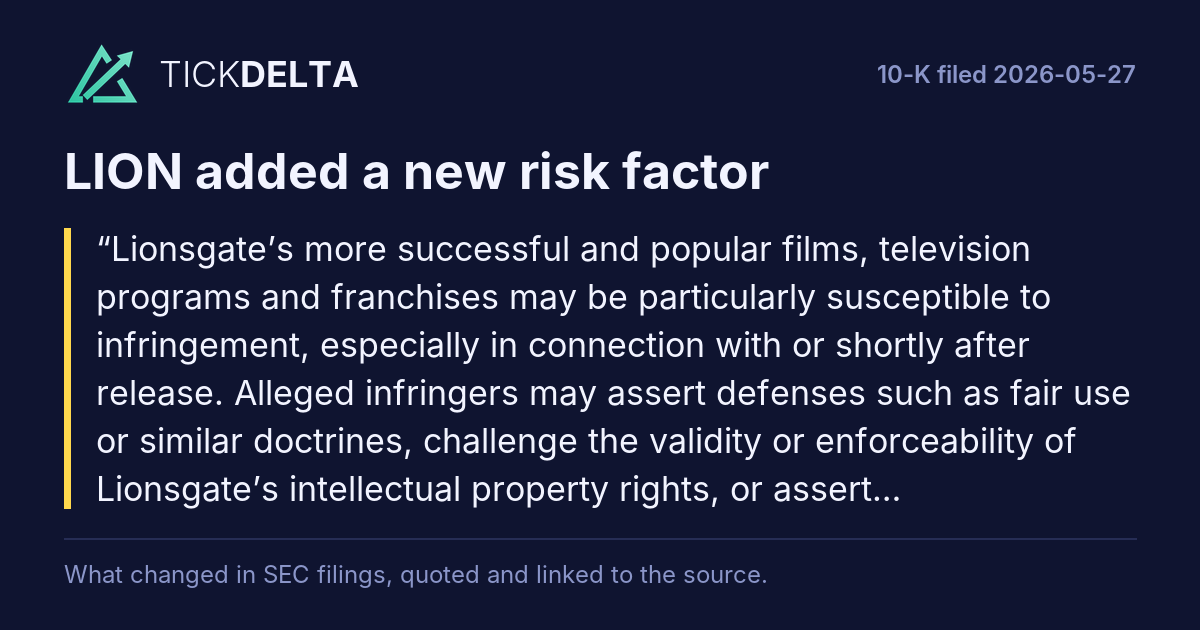
Lionsgate’s more successful and popular films, television programs and franchises may be particularly susceptible to infringement, especially in connection with or shortly after release. Alleged infringers may assert defenses such as fair use or similar doctrines, challenge the validity or enforceability of Lionsgate’s intellectual property rights, or assert counterclaims alleging improper enforcement. Even if such claims lack merit, they may result in adverse publicity, unfavorable interim rulings, significant litigation costs or delays, and there can be no assurance that Lionsgate will prevail in all cases. Conversely, Lionsgate may from time to time be subject to claims alleging that its productions, content or production techniques infringe or misappropriate the intellectual property rights of third parties, including patent rights. Such claims, whether or not meritorious, may require Lionsgate to incur significant legal and management costs, pay damages or license fees, modify business practices or technology, or be subject to injunctions or other restrictions. These risks may be amplified by the increasing number of third parties whose primary business is asserting intellectual property claims.

In addition, Lionsgate may lose or cease to control certain intellectual property rights over time. Certain rights may expire, revert or be terminated under applicable copyright laws, or be subject to transfer or termination rights exercised by third parties. In other cases, Lionsgate may have acquired rights for a limited duration or subject to other restrictions, or the underlying content may enter the public domain. The loss of, or limitations on, Lionsgate’s ability to control or re‑acquire such rights on acceptable terms, if at all, could limit its ability to prevent third‑party exploitation of related content. Any of the foregoing could have a materially adverse effect on Lionsgate’s business, financial condition, operating results, liquidity and prospects.
Read in the 10-K

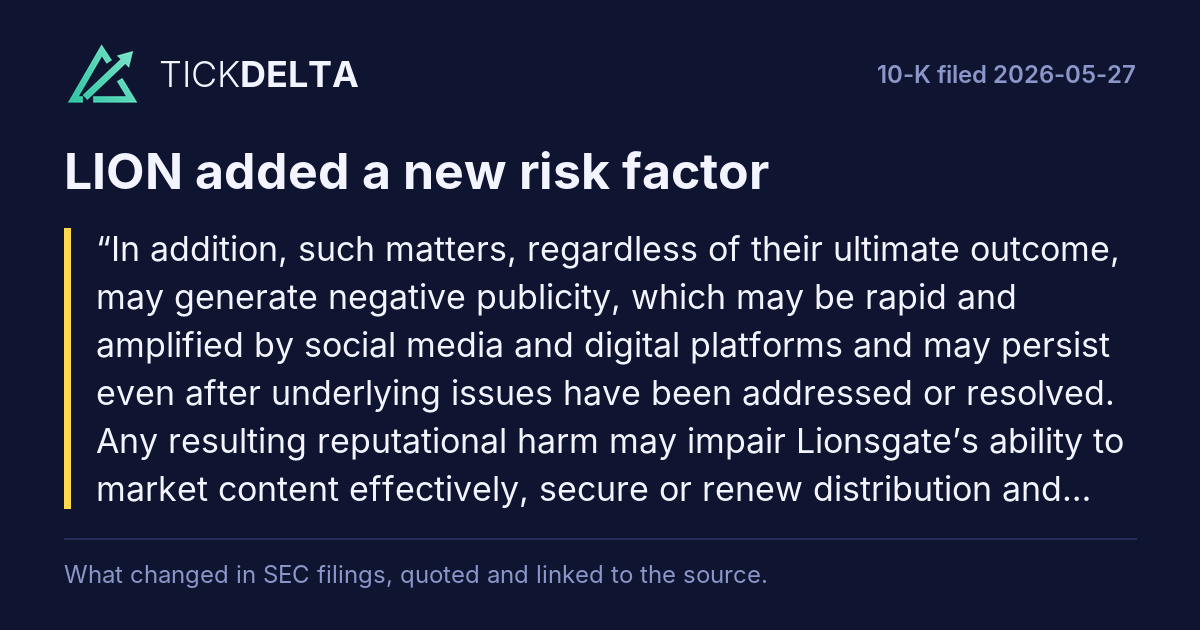
In addition, such matters, regardless of their ultimate outcome, may generate negative publicity, which may be rapid and amplified by social media and digital platforms and may persist even after underlying issues have been addressed or resolved. Any resulting reputational harm may impair Lionsgate’s ability to market content effectively, secure or renew distribution and licensing arrangements, attract or retain creative talent, or maintain audience engagement, and may result in financial losses or increased operating costs.

While Lionsgate maintains insurance coverage for certain liabilities, such coverage may be subject to exclusions, deductibles or coverage limits and may not apply to particular claims. Any liability that is not covered by insurance, or that exceeds available insurance coverage, or any resulting adverse market or commercial effects, could have a materially adverse effect on Lionsgate’s business, financial condition and results of operations.

Read in the 10-K

Lionsgate utilizes cloud‑based computing services to support elements of its technology infrastructure and business operations, including data processing, storage and related services. Lionsgate designs and operates certain software applications and systems to function within the technical architecture and service environment provided by its cloud service providers. As a result, Lionsgate’s operations may be dependent on the continued availability, stability, security and performance of those cloud services. Disruptions, service interruptions, outages or other performance issues affecting Lionsgate’s cloud service providers, whether due to technical failures, cybersecurity incidents, business disruptions, regulatory action, capacity constraints or other factors, could impair Lionsgate’s ability to operate and may result in data loss, service delays or interruptions, reduced operational efficiency, increased costs or reputational harm. In addition, migrating systems to alternative cloud service providers may be complex, time‑consuming and costly and may not be feasible on acceptable terms, if at all. Any of the foregoing could have a materially adverse effect on Lionsgate’s business, financial condition, operating results, liquidity and prospects.
Read in the 10-K

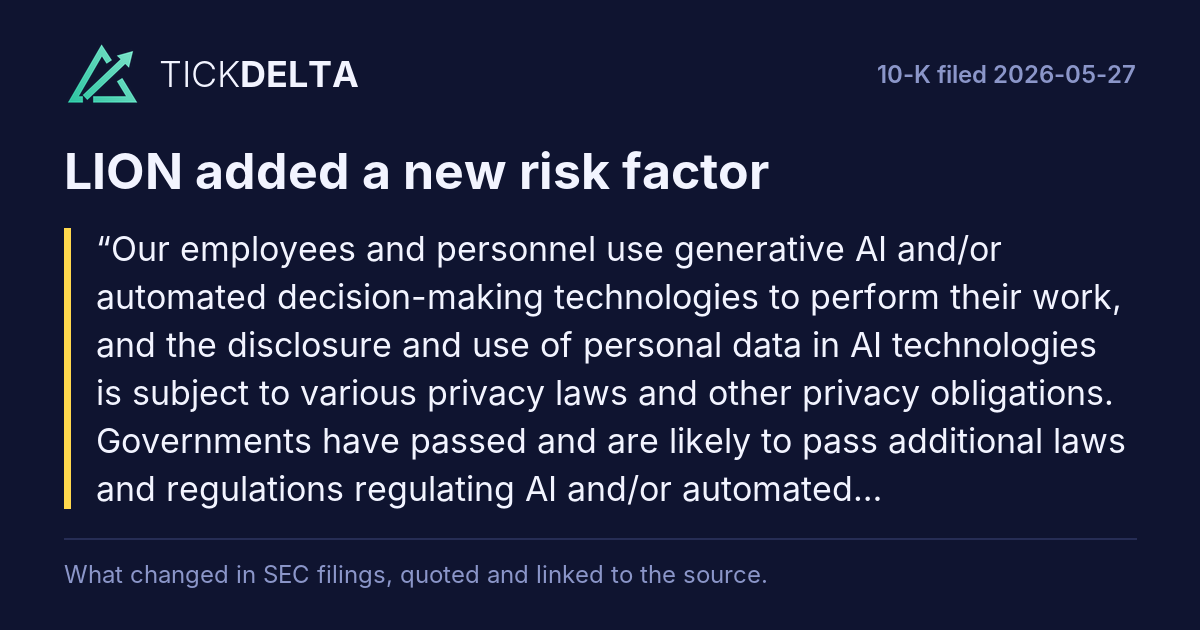
Our employees and personnel use generative AI and/or automated decision-making technologies to perform their work, and the disclosure and use of personal data in AI technologies is subject to various privacy laws and other privacy obligations. Governments have passed and are likely to pass additional laws and regulations regulating AI and/or automated decision-making technologies. Our use of this technology could result in additional compliance costs, regulatory investigations and actions, and lawsuits. If we are unable to use AI and/or automated decision-making technologies, it could make our business less efficient and result in competitive disadvantages.

Read in the 10-K

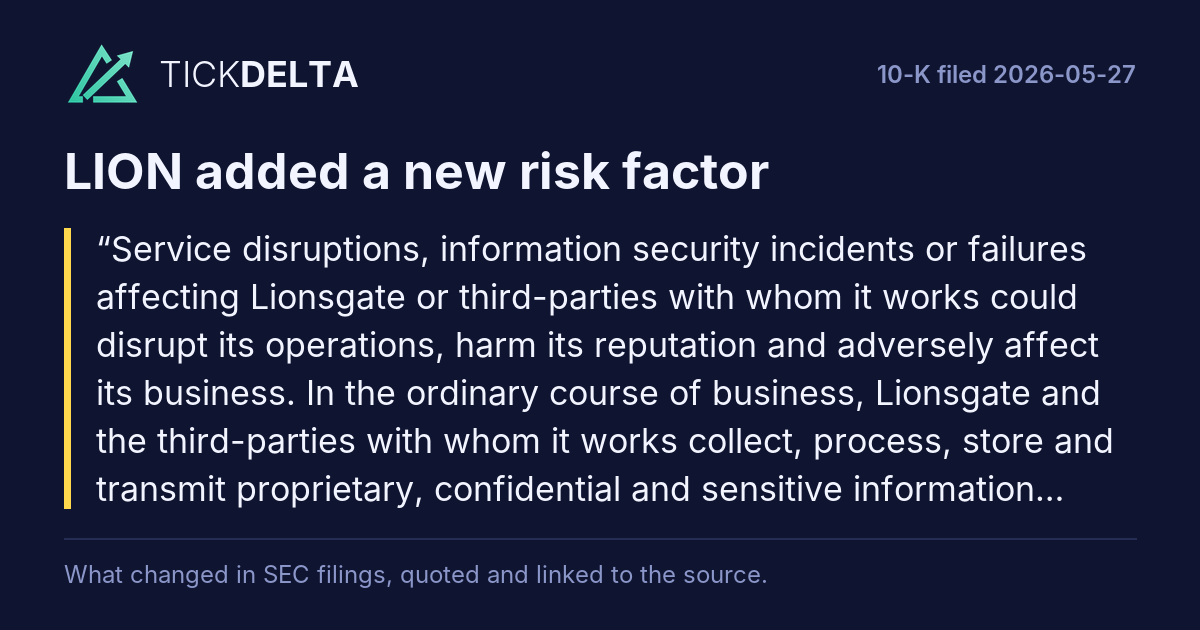
Service disruptions, information security incidents or failures affecting Lionsgate or third-parties with whom it works could disrupt its operations, harm its reputation and adversely affect its business.

In the ordinary course of business, Lionsgate and the third-parties with whom it works collect, process, store and transmit proprietary, confidential and sensitive information, including personal data, intellectual property and trade secrets. Lionsgate’s information technology systems, and those of the third-parties with whom it works, are subject to operational and cybersecurity risks, including cyberattacks, unauthorized access, software or hardware failures, data loss, and other security incidents. These threats are becoming more prevalent and increasingly difficult to detect, and may arise from a variety of sources, including malicious actors, personnel (such as through theft or misuse), organized criminal groups, insiders, hacktivists and nation‑state or nation‑state‑supported actors, and may be heightened during periods of geopolitical conflict or instability.

Lionsgate and third-parties with whom it works face an evolving landscape of cybersecurity threats, including phishing and other social‑engineering attacks (including those incorporating deepfakes), malware, ransomware, denial‑of‑service attacks, credential‑based intrusions, supply‑chain compromises, software bugs and vulnerabilities, server malfunctions, telecommunications failures, attacks enhanced or facilitated by AI and other similar threats. Ransomware and extortion‑based attacks, in particular, have become more frequent across industries and may result in significant business interruptions, loss of data, reputational harm, diversion of management attention, and increased remediation and compliance costs. In certain circumstances, Lionsgate may be unwilling or unable to make extortion payments due to legal, regulatory or policy considerations.

Read in the 10-K

Lionsgate also relies on third‑party service providers, including providers of cloud‑based infrastructure, data hosting, content delivery, communications and other information technology services, to support critical business functions. Lionsgate’s ability to monitor, control and ensure the cybersecurity practices of these third parties is inherently limited, and such providers may experience cybersecurity incidents, operational disruptions or system failures that adversely affect Lionsgate’s operations, data or services. Contractual protections or remedies may be insufficient to fully compensate Lionsgate for resulting losses. In addition, supply‑chain vulnerabilities have increased in frequency and severity, and it may be difficult to identify, assess or remediate in a timely manner. We cannot guarantee that third parties’ infrastructure in our supply chain or that of the third parties with whom we work have not been compromised.

Certain of the previously identified or similar threats have in the past and may in the future cause a security incident or other interruption resulting in the unauthorized, unlawful, or accidental acquisition of Lionsgate’s sensitive information or other adverse consequences, such as unavailability of network or information resources or services. Lionsgate maintains governance, risk management and technical safeguards designed to identify, assess and mitigate cybersecurity risks and to protect its information assets. However, no information security program can eliminate all risks, and vulnerabilities have in the past and may in the future fail to be detected, addressed or remediated in a timely manner. These vulnerabilities can be exploited and result in a security incident Lionsgate has previously experienced, and may continue to experience, attempts to compromise its systems, including phishing and other social‑engineering efforts, and there can be no assurance that future incidents will not be successful or materially disruptive.

A cybersecurity incident or systems disruption could impair Lionsgate’s ability to operate its business, disrupt the production, distribution or licensing of content, require significant expenditures to investigate and remediate, and result in regulatory investigations, reporting obligations, litigation, fines or penalties, contractual liabilities, reputational harm, loss of customers or revenue, or other adverse consequences. Certain data privacy and security obligations may require Lionsgate to notify relevant stakeholders, including affected individuals, customers, regulators, and investors, of security incidents. Such disclosures are costly, and the disclosures or the failure to comply with such requirements could lead to adverse consequences.

Lionsgate’s contracts may not contain limitations of liability, and even where they do, there is no guarantee that the limitations of liability will be sufficient to protect Lionsgate from liabilities, damages, or claims related to its data privacy and security obligations. In addition, Lionsgate’s insurance coverage may not be sufficient to mitigate liabilities arising out of its privacy and security practices, and this coverage may not remain available on commercially reasonable terms.

Read in the 10-K

•making it more difficult to satisfy debt service requirements and other obligations;

Read in the 10-K

The value of the assets securing Lionsgate’s indebtedness, including its intellectual property and content library, may decline, which could adversely affect its borrowing capacity and financial flexibility.

Certain of Lionsgate’s indebtedness is secured by collateral, including intellectual property, distribution rights, receivables and other assets derived from its film and television content library. The value of this collateral may fluctuate based on a variety of factors, including changes in market conditions, performance, consumer demand, technological and distribution developments and assumptions regarding future revenues, as well as impairment charges or other valuation adjustments. A decline in the value of Lionsgate’s intellectual property or content library assets could reduce availability under secured credit facilities, require repayments or additional collateral support, or adversely affect Lionsgate’s ability to refinance or extend indebtedness on acceptable terms. Any of the foregoing could have a materially adverse effect on Lionsgate’s business, financial condition, operating results, liquidity and prospects.
A portion of Lionsgate’s indebtedness will mature or require refinancing from time to time. Lionsgate’s ability to refinance or replace such indebtedness on acceptable terms, or at all, will depend on a number of factors, including its financial condition, operating performance, credit ratings, interest rate environment, capital market conditions and broader economic and industry factors beyond its control. If Lionsgate is unable to refinance maturing indebtedness when required, or can do so only on less favorable terms, its interest expense, liquidity and financial flexibility could be adversely affected, which could have a materially adverse effect on Lionsgate’s business, financial condition, operating results, liquidity and prospects.
Read in the 10-K

Paragraphs in the 10-Q filed Nov 5, 2026 that were not in the one before

New in the latest 10-Q

22 paragraphs in the 10-Q filed Nov 5, 2026 with nothing like them in the 10-Q filed Aug 6, 2026 (at least half the words must differ; new numbers alone do not count). Quoted exactly, grouped by the item heading above them. This is text that changed, not a judgement of how serious it is.

Financial statements and notes

Other comprehensive income (loss) from continuing operations, net of income tax:

Read in the 10-Q

Share-based compensation, post Starz separation 6.1 20.6 — — — — — — 20.6 — 20.6

Read in the 10-Q

(1) Impairments included in direct operating expense are included in the amortization expense amounts as disclosed above.

Read in the 10-Q

(2) Impairments included in restructuring and other represent write-downs in connection with the restructuring of the Motion Picture and Television Production businesses and are not included in segment operating results. See Note 14 for further information.

Read in the 10-Q

• Muchos Amigos Pictures. Muchos Amigos Pictures is a joint venture that invests in feature films in Latin America.

Read in the 10-Q
Show the other 17

On September 29, 2026, the noncontrolling interest holders exercised their put right to sell their remaining 24 % interest to the Company with the sale transaction to close no later than February 1, 2027. The Company expects to acquire the holders’ remaining 24 % interest for an estimated redemption price of approximately $ 175.4 million, as calculated in accordance with the terms of the underlying agreement described above. The holders retain ownership rights through the settlement date and the Company continues to attribute earnings to the noncontrolling interest until such date.

Read in the 10-Q

See Note 19 for information regarding a subsequent transaction in which a third party acquired a noncontrolling interest in a newly formed entity solely holding the Company’s equity interest in 3 Arts.

Read in the 10-Q

March 31, Provision for credit losses Uncollectible accounts September 30, 2026 written-off

Read in the 10-Q

(1) Content and other impairments represent $ 5.9 million and $ 8.6 million of development cost write-downs recognized during the six months ended September 30, 2026 and 2025, respectively, related to the restructuring of the Motion Picture and Television Production businesses. In addition, during the three and six months ended September 30, 2026 and 2025, impairment charges were recognized related to certain operating lease right-of-use and leasehold improvement assets within the Television Production segment for facilities no longer expected to be utilized.

Read in the 10-Q

Unallocated rent costs included in direct operating expenses (4.9) (6.1) (9.9) (11.5)

Read in the 10-Q

Loss from continuing operations before income taxes $ (13.1) $ (109.8) $ (34.6) $ (195.0)

Read in the 10-Q

3 Arts Transaction. In October 2026, the Company completed a transaction with SP Media where SP Media acquired a noncontrolling interest in a newly formed entity solely holding the Company’s equity interest in 3 Arts. The Company still consolidates 3 Arts as it has a controlling interest in this newly formed entity.

Read in the 10-Q

Starz Tax Indemnification Arrangement. In connection with the separation of Starz, the Company retained certain indemnification obligations relating to specified pre-separation tax matters. In October 2026, the Canada Revenue Agency (“CRA”) issued notices of reassessment to Starz relating principally to its Canadian income tax return for fiscal 2019 and a consequential fiscal 2022 adjustment. The notices reflect an aggregate assessed amount and maximum potential loss of approximately $110 million, including interest. Based on management’s evaluation of the matter, including the significant defenses available to the Company and advice of external Canadian tax counsel, the Company does not believe a loss to be probable. Accordingly, the Company has not recorded a contingent loss liability related to the reassessments as of September 30, 2026.

Read in the 10-Q

(1) Content and other impairments for the three months ended September 30, 2026 and 2025 represent $5.9 million and $8.6 million, respectively, of development cost write-downs related to the restructuring of the Motion Picture and Television Production businesses. In addition, amounts for the three months ended September 30, 2025 included impairment charges related to certain operating lease right-of-use and leasehold improvement assets within the Television Production segment for facilities no longer expected to be utilized.

Read in the 10-Q

Six Months Ended September 30, 2026 Compared to Six Months Ended September 30, 2025

Read in the 10-Q

(1) Content and other impairments for the six months ended September 30, 2026 and 2025 represent $5.9 million and $8.6 million, respectively, of development cost write-downs related to the restructuring of the Motion Picture and Television Production businesses. In addition, amounts for the six months ended September 30, 2025 included impairment charges related to certain operating lease right-of-use and leasehold improvement assets within the Television Production segment for facilities no longer expected to be utilized.

Read in the 10-Q

See “Item 2. Management's Discussion and Analysis of Financial Condition and Results of Operations - Results of Operations - Three Months Ended September 30, 2026 Compared to Three Months Ended September 30, 2025”, Segment Results of Operations and Non-GAAP Measures for a definition of the non-GAAP measures and total segment profit.

Read in the 10-Q

See the individual segment results of operations discussed below. The segment results of operations presented below do not include the elimination of intersegment transactions which are eliminated when presenting consolidated results.

Read in the 10-Q

On September 29, 2026, the 3 Arts noncontrolling interest holders exercised their put right to sell their remaining 24% interest to the Company with the sale transaction to close no later than February 1, 2027. The Company expects to acquire the holders’ remaining 24% interest for an estimated redemption price of approximately $175.4 million. See Note 9 to our unaudited condensed consolidated financial statements for details of the transaction.

Read in the 10-Q

(6) Excluded from the amounts above is the estimated redemption price of approximately $175.4 million for the acquisition of the remaining 24% interest in 3 Arts as of September 30, 2026. See Note 9 to our unaudited condensed consolidated financial statements for further information.

Read in the 10-Q

Discussion of Operating, Investing and Financing Cash Flow Activity - Continuing Operations

Read in the 10-Q

Risk Factors

The Company’s business, reputation, results of operations, financial condition and stock price can be affected by a number of factors, whether currently known or unknown, including those described in Part I, Item 1A of the 2026 Form 10-K for the fiscal year ended March 31, 2026 and Part II, Item 1A of the Form 10-Q for the first quarter ended June 30, 2026, in each case under the heading “Risk Factors”. Except for the risk factors disclosed in Part II, Item 1A of the first quarter ended June 30, 2026 Form 10-Q, which is hereby incorporated by reference into Part II, Item 1A of this Form 10-Q, there have been no material changes to the Company’s risk factors as previously reported in the 2026 Form 10-K for the fiscal year ended March 31, 2026.

Read in the 10-Q

The 10-Q's risk factors against the 10-K

Item 1A of the 10-Q filed Nov 5, 2026 against Item 1A of the 10-K filed May 27, 2026. A 10-Q repeats only the risks that changed, so a 10-K paragraph that is missing from it is not counted as removed. Added is a paragraph with nothing like it in the 10-K, Reworded a sentence that is in both with several words changed, Quiet changes a sentence in both where one to four words changed and one is a hedge or a modal (cut words struck through, new words highlighted). Text on the page, not a score; each links to the filing at sec.gov.

Added10-Q Nov 5, 2026 vs 10-K May 27, 2026
The Company’s business, reputation, results of operations, financial condition and stock price can be affected by a number of factors, whether currently known or unknown, including those described in Part I, Item 1A of the 2026 Form 10-K for the fiscal year ended March 31, 2026 and Part II, Item 1A of the Form 10-Q for the first quarter ended June 30, 2026, in each case under the heading “Risk Factors”. Except for the risk factors disclosed in Part II, Item 1A of the first quarter ended June 30, 2026 Form 10-Q, which is hereby incorporated by reference into Part II, Item 1A of this Form 10-Q, there have been no material changes to the Company’s risk factors as previously reported in the 2026 Form 10-K for the fiscal year ended March 31, 2026.

Read it in the 10-Q at sec.gov

Phrases used for the first time

Two-word phrases in Risk Factors of the 10-K filed May 27, 2026 that are in none of the 1 earlier 10-Ks stored, back to May 30, 2025

creative talent ×7impair lionsgate’s ×4market conditions ×4lionsgate’s indebtedness ×4produces distributes ×3retain key ×3lionsgate maintains ×3borrowing costs ×3decision-making technologies ×3circumstances lionsgate ×3content library ×3content require ×2capital investment ×2following release ×2factors lionsgate’s ×2whether due ×2
Where each one is used
  • creative talent: Lionsgate’s success depends upon the continued efforts, abilities and expertise of its executive teams and other key employees, including production, creative and technical personnel, as well as its ability to identify, attract, hire, train and retain such personnel. Although Lionsgate has employment agreements...
  • impair lionsgate’s: Lionsgate’s operations may be vulnerable to service disruptions, outages and other interruptions caused by events or circumstances beyond its control, including fires, floods, earthquakes, power outages, telecommunications failures, software or hardware failures, loss of data, security breaches, cyberattacks,...
  • market conditions: From time to time, Lionsgate may evaluate or pursue acquisitions, disposition of assets, business combinations, joint ventures or other strategic transactions intended to complement or expand its business. Such transactions involve significant risks and uncertainties, and Lionsgate may not realize the anticipated...
  • lionsgate’s indebtedness: Certain of Lionsgate’s indebtedness, including borrowings under its senior secured revolving credit facility and certain film-related obligations, bears, and is expected to bear, interest at variable rates and therefore, exposes Lionsgate to interest rate risk. If interest rates were to increase, Lionsgate’s debt...
  • produces distributes: In addition, evolving technologies such as artificial intelligence (“AI”) may be used in ways that increase access to publicly available free or relatively inexpensive content that may reduce demand for Lionsgate’s products and services. Regulatory frameworks governing AI and other emerging technologies remain...
  • retain key: Lionsgate’s success depends on its ability to attract and retain key personnel and artistic talent.
  • lionsgate maintains: In addition, while Lionsgate maintains business interruption insurance for certain potential losses, including losses related to natural disasters, such insurance may not be sufficient to cover all losses or damages, and may not be available on acceptable terms in the future. Any unrecovered losses, extended...
  • borrowing costs: Global economic uncertainty and volatility resulting from events such as pandemics, wars, inflationary pressures, bank failures, recessions or other financial disruptions may cause a general tightening in the credit markets, reduced liquidity, increases in the rates of default and bankruptcy, heightened government...

The 10-K at sec.gov

Used at least twice, small words left out. Counted, not picked: a phrase can be new because the company renamed something.

What was taken out

15 paragraphs of last year's Risk Factors with nothing like them now. The longest are quoted.

Across all companies
Applicable data privacy and security obligations may require Lionsgate to notify relevant stakeholders, including affected individuals, customers, regulators, and investors, of security incidents. Such disclosures are costly, and the disclosures or the failure to comply with such requirements could lead to adverse consequences. If Lionsgate (or a third party with whom it works) experiences a security incident or is perceived to have experienced a security incident, Lionsgate may experience adverse consequences, such as: government enforcement actions (for example, investigations, fines,...
In the 10-K filed May 30, 2025
Lionsgate works with certain third parties to operate critical business systems and process proprietary, confidential or other sensitive data in a variety of contexts, including, without limitation, cloud-based infrastructure (for more, see the Risk Factor titled “Lionsgate relies upon “cloud’ computing services to operate certain aspects of its service and any disruption of or interference with its use of its “cloud” computing servicer could adversely impact its operations and its business.”), data center facilities, encryption and authentication technology, employee email servers,...
In the 10-K filed May 30, 2025
Notwithstanding Lionsgate’s efforts to obtain all permissions and clearances it deems necessary in relation to the content it will create or distribute, from time to time, Lionsgate may be subject to claims and legal proceedings regarding alleged infringement by it of the intellectual property rights (including patents) of third parties. Such claims, whether or not meritorious, may result in the expenditure of significant financial and managerial resources, require the development of alternative technology or business practices, injunctions against Lionsgate, or payments for licenses or...
In the 10-K filed May 30, 2025
In the ordinary course of Lionsgate’s business, Lionsgate and the third parties with whom it works process proprietary, confidential, and sensitive data, including personal data, intellectual property, and trade secrets (collectively, sensitive information). Threats such as cyberattacks, malicious internet-based activity, and online and offline fraud are becoming more prevalent and are increasingly difficult to detect. These threats come from a variety of sources, including traditional computer “hackers,” threat actors, “hacktivists,” personnel (such as through theft or misuse),...
In the 10-K filed May 30, 2025

Sources

Item 1A of each 10-K and 10-Q on EDGAR, quoted exactly. Each paragraph links to the filing at sec.gov.

Also

10-K change: what was reworded or cut, section by section.

Work with it

Excel workbook · CSV. Google Sheet that stays up to date: paste =IMPORTDATA("https://tickdelta.com/company/LION/export.csv") into a cell.

Next:10-K change
Esc

Type a ticker such as AAPL, a name, an investor such as Buffett, or a topic such as tariffs. ↑ ↓ to move, Enter to open.