tickdelta
Sign in

Tickdelta is free for now. Sign up and get Pro free

← Screener

LITSLite Strategy

Crypto · Financial Services · Nasdaq
Compare with peers → Embed

When the SEC's staff reviews a filing, it writes to the company with numbered questions, and the company answers each one in a letter. SEC publishes the exchange once the review is over, at least 20 business days later. Below: what the staff asked LITS, and the company's answer to each question, quoted from the letters. A question is not an accusation; most reviews end with the company adding detail to its next filing.

Form S-3

2025-08-20 to 2025-08-20 · 2 questions · 1 letter from the SEC, 0 from the company
No closing letter
Risk factors
SEC letter of 2025-08-20 ↗ no reply letter on EDGAR (the company may have answered in an amended filing)
SEC asked (2)
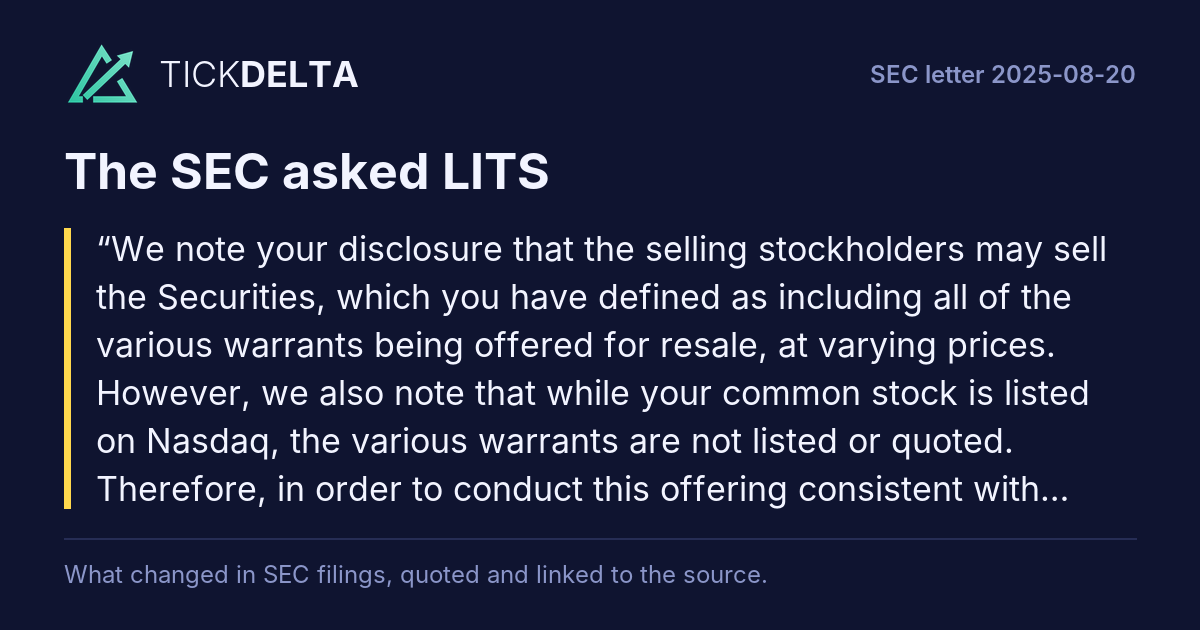
We note your disclosure that the selling stockholders may sell the Securities, which you have defined as including all of the various warrants being offered for resale, at varying prices. However, we also note that while your common stock is listed on Nasdaq, the various warrants are not listed or quoted.
Rest of the question

Therefore, in order to conduct this offering consistent with Rule 415(a)(1)(i) of the Securities Act and Item 501(b)(3) of Regulation S-K, the various warrants may only be resold at an initial fixed price (or a range) unless and until the various warrants are listed or quoted on an exchange or trading market, after which the various warrants may be offered and sold at prevailing market prices or at negotiated prices. Please revise to disclose the fixed price (or range) at which the selling security holders will sell the various warrants until the respective warrants are listed or quoted on an exchange or trading market, after which such warrants may be offered and sold at prevailing market prices or at negotiated prices. Ensure that your "Plan of Distribution" section is revised accordingly.

LITS answered

No reply letter found.

SEC asked (3)
If you are offering the various warrants for resale, please make clear on your cover page and in your prospectus summary that there is no established trading market for the various warrants and that you do not intend to apply to list the various warrants on any securities exchange or nationally recognized trading system. We note your risk factor disclosure on page 8 in this regard.
LITS answered

No reply letter found.

Schedule 14A

2023-09-24 to 2023-10-12 · 5 questions · 1 letter from the SEC, 2 from the company
No closing letter
Preliminary Consent Revocation Statement on Schedule 14A filed September 15, 2023 · General
SEC asked (1)
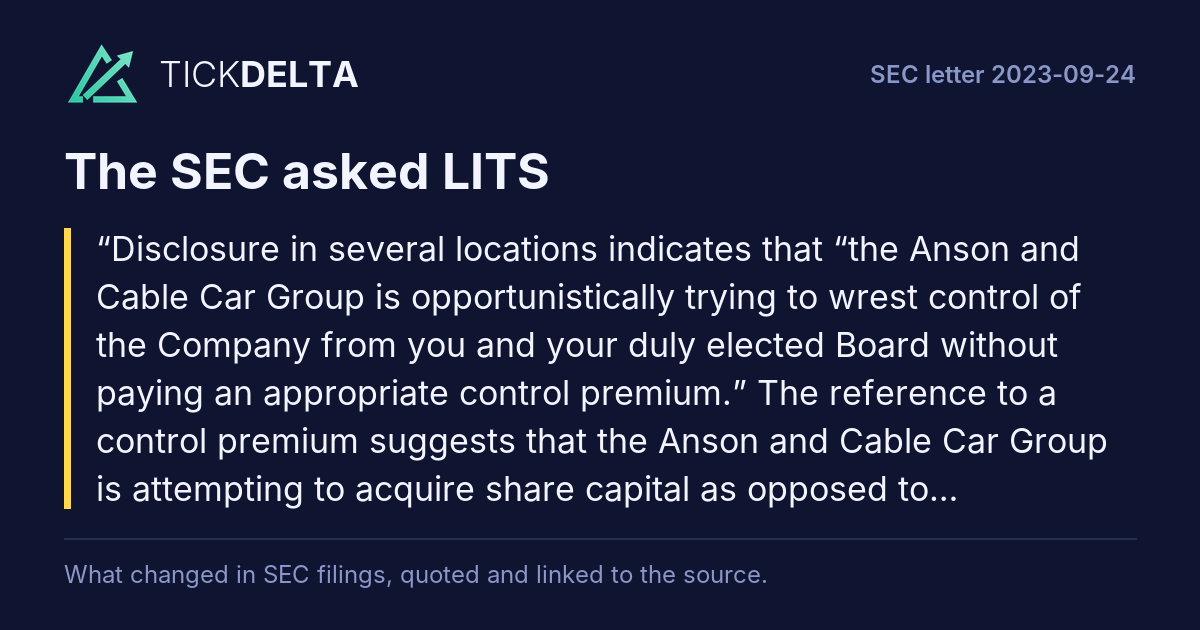
Disclosure in several locations indicates that “the Anson and Cable Car Group is opportunistically trying to wrest control of the Company from you and your duly elected Board without paying an appropriate control premium.” The reference to a control premium suggests that the Anson and Cable Car Group is attempting to acquire share capital as opposed to exercising stockholder rights to seek written consents to remove
Rest of the question

the existing board. We are unaware of any legal requirement that obligates a nonmanagement party to pay a control premium, or any proxy or consent solicitation undertaken in compliance with Section 14(a) and corresponding Regulation 14A in which a person soliciting proxies or written consents paid a control premium or made another payment to security holders, in exchange for a vote or consent in favor of its candidates. Please refrain from creating the impression that a payment is legally or otherwise required in light of the Exchange Rule 14a-9 proscription against omissions of material fact necessary to make the statements made in light of the circumstances under which they are made not false or misleading.

LITS answered
In the Amendment, all references to a control premium have been removed, and there is no other language suggesting that a payment is legally or otherwise required.

Morgan, Lewis & Bockius LLP

1701 Market St. Read in the reply ↗
Preliminary Consent Revocation Statement on Schedule 14A filed September 15, 2023 · General
SEC asked (2)
Disclosure indicates that “[i]f the Anson and Cable Car Group’s director removal proposal was valid and they obtained the required written consents to remove the members of the Board, it would create a sudden and significant disruption in the governance function of the Company and our Company could have no directors to oversee business operations.” We note disclosure in the Anson and Cable Car Group’s revised
Rest of the question

preliminary consent statement filed on August 4, 2023 that were they to “successfully remove some or all of the current directors, [the Anson and Cable Car Group] would expect any remaining directors and/or the removed directors to work constructively with [them] to reconstitute the Board expeditiously.” Please expand the company’s disclosure to explain its understanding as to whether, following a successful consent solicitation by the Anson and Cable Car Group, the current board would be immediately removed, or alternatively, if true, that such directors would remain in place until such time as they had appointed replacement directors in cooperation and in consultation with the Anson and Cable Car Group, as suggested by the Group’s disclosure.

LITS answered
The disclosure in the Amendment contains language making clear that in the event the removal proposal were to be approved, it is unclear as a matter of Delaware law who the directors of the Company would be and how their replacements would be named. The disclosure does indicate that the Anson and Cable Car Group has suggested it should have a role in naming the replacement directors through consultation with the removed and/or remaining directors. Read in the reply ↗
Preliminary Consent Revocation Statement on Schedule 14A filed September 15, 2023 · General
SEC asked (3)
Refer to the following statement in the disclosure: • “The Anson and Cable Car proposals are designed in furtherance of their singleminded agenda to obtain the Company’s cash as quickly as possible regardless of the opportunity cost to the Company’s potential value-creating clinical development programs.” Each statement or assertion of opinion or belief must be clearly characterized as such, and a reasonable factual
Rest of the question

basis must exist for each such opinion or belief. Support for opinions or beliefs should be self-evident, disclosed in the consent revocation statement or provided to the staff on a supplemental basis. If the company is unable to provide support for such statement, please remove it from the disclosure. There currently is no disclosure in the company’s preliminary consent revocation statement that provides any reasonable basis for the statement above.

LITS answered
The referenced statement has been revised in the Amendment to provide disclosure indicating that such statement is a belief of the Company based on the Anson and Cable Car Group’s own public statements regarding their reasons for seeking to remove the current Board members, in which they stress their desire for the Company to prioritize a return of capital to stockholders rather than the Company’s development initiatives. Read in the reply ↗
Preliminary Consent Revocation Statement on Schedule 14A filed September 15, 2023 · General
SEC asked (4)
Disclosure states that “[t]he Consent Solicitation does a disservice to all stockholders…by bypassing processes well-established in law and well-considered in practice to oversee the business strategy and business affairs of the Company.
Rest of the question

The Company has an Annual General Meeting upcoming at which it will again provide stockholders with an established mechanism to exercise oversight and control of the Board pursuant to the established provisions of Delaware law.” It is our understanding that the annual meeting could only result in the replacement of a select number of directors given that the board is classified. As such, the above statement's reference to a “disservice” by “bypassing processes” and that stockholders will be able to “exercise oversight and control of the Board” appears to provide an inaccurate comparison of the impacts and effects of the Anson and Cable Car Group's consent solicitation to remove all current directors on the board and the annual meeting for the election, and potential replacement, of one class of directors. Please revise to clarify or remove this statement.

LITS answered
In the Amendment, the referenced statement has been revised to make clear that the Anson and Cable Car

Group’s nominations for election at the annual meeting are for three candidates only. Read in the reply ↗
Preliminary Consent Revocation Statement on Schedule 14A filed September 15, 2023 · General
SEC asked (5)
Disclose the basis for the company’s belief that the Anson and Cable Car Group’s consent solicitation is invalid under Delaware law.
LITS answered
The Amendment contains disclosure indicating that the basis for the Company’s belief that the consent solicitation is invalid under Delaware law is that the Company believes that the purported grounds for removal put forth by the Anson and Cable Car Group do not constitute valid cause for removal under the applicable principles of Delaware law. Read in the reply ↗

Also in this review: company letter, 2023-10-12

Form S-1

2013-11-18 to 2013-11-19 · 1 question · 1 letter from the SEC, 2 from the company
No closing letter
Incorporation by References, page 1
SEC asked
Please amend your registration statement to incorporate by reference the Form 10-Q filed on November 8, 2013.
LITS answered
Concurrently with this letter, the Company is filing an amendment to its registration statement that incorporates by reference the Form 10-Q filed on November 8, 2013. Read in the reply ↗

Also in this review: company letter, 2013-11-19

Schedule 14C

2012-11-16 to 2012-11-26 · 2 questions · 1 letter from the SEC, 1 from the company
Review closed 2012-11-26
The Reverse Stock Split · Effect on Authorized Shares of Common Stock and Preferred Stock, page 8
SEC asked (1)
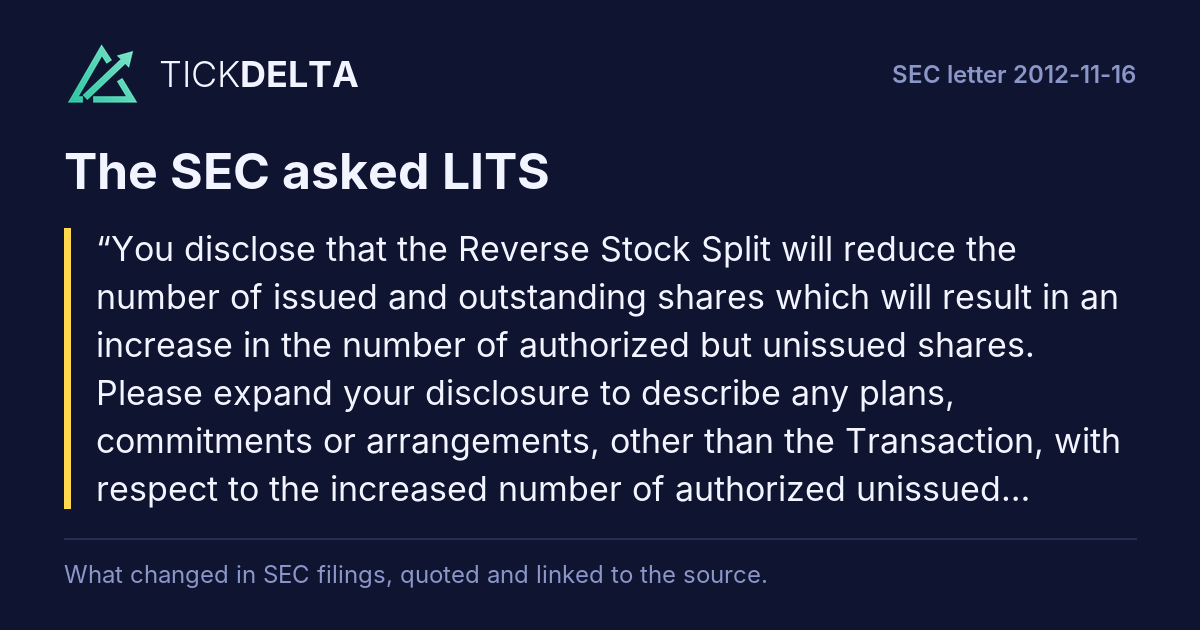
You disclose that the Reverse Stock Split will reduce the number of issued and outstanding shares which will result in an increase in the number of authorized but unissued shares. Please expand your disclosure to describe any plans, commitments or arrangements, other than the Transaction, with respect to the increased number of authorized unissued shares of Common Stock.
Rest of the question

If you do not have any such plans, commitments or arrangements, please so state.

LITS answered
Other than the Transaction, the Company has no plans, commitments or arrangements with respect to the increased number of authorized but unissued shares of the Company’s common stock that will result from the Reverse Stock Split. We will revise the Information Statement to include disclosure to this effect, as shown on pages 6 and 9 of the blackline of the Information Statement that is attached as Appendix A to this letter. Read in the reply ↗
No Going Private Transaction, page 9
SEC asked (2)
Please revise your information statement to disclose the number of record holders before and after completion of the Reverse Stock Split and cash-out of fractional shareholders. If the number of record holders will fall below 300 please revise your disclosure to provide the information required by Rule 13e-3 of the Securities Exchange Act of 1934.
Rest of the question

Alternatively, please provide us with your analysis as to why Rule 13e-3 is not applicable. Please note that we may have further comments after reviewing your revised disclosure and any additional information you provide us supplementally.

LITS answered
According to records obtained from Computershare Inc., the Company’s transfer agent, and from The Depository Trust Company, as of November 16, 2012, there were 338 holders of record of the Company’s common stock, of which nine holders held a number of shares that would result in such holders being only fractional shareholders that would be cashed out in the Reverse Stock Split.
Rest of the answer

Accordingly, the Company does not expect the number of record holders to fall below 300 in connection with the

Reverse Stock Split and will revise the Information Statement to disclose the foregoing record holder information, as shown on pages 6 and 9 of the blackline of the Information Statement that is attached as Appendix A hereto.

* * * * *

In addition, the Company acknowledges that:

• the Company is responsible for the adequacy and accuracy of the disclosure in the filing;

Staff comments or changes to disclosure in response to Staff comments do not foreclose the Commission from taking any action with respect to the filing; and the Company may not assert Staff comments as a defense in any proceeding initiated by the Commission or any person under the federal securities laws of the United States.

Read in the reply ↗

Also in this review: closing letter, 2012-11-26

Form S-3

2012-10-04 to 2012-11-06 · 1 question · 1 letter from the SEC, 2 from the company
No closing letter
SEC asked
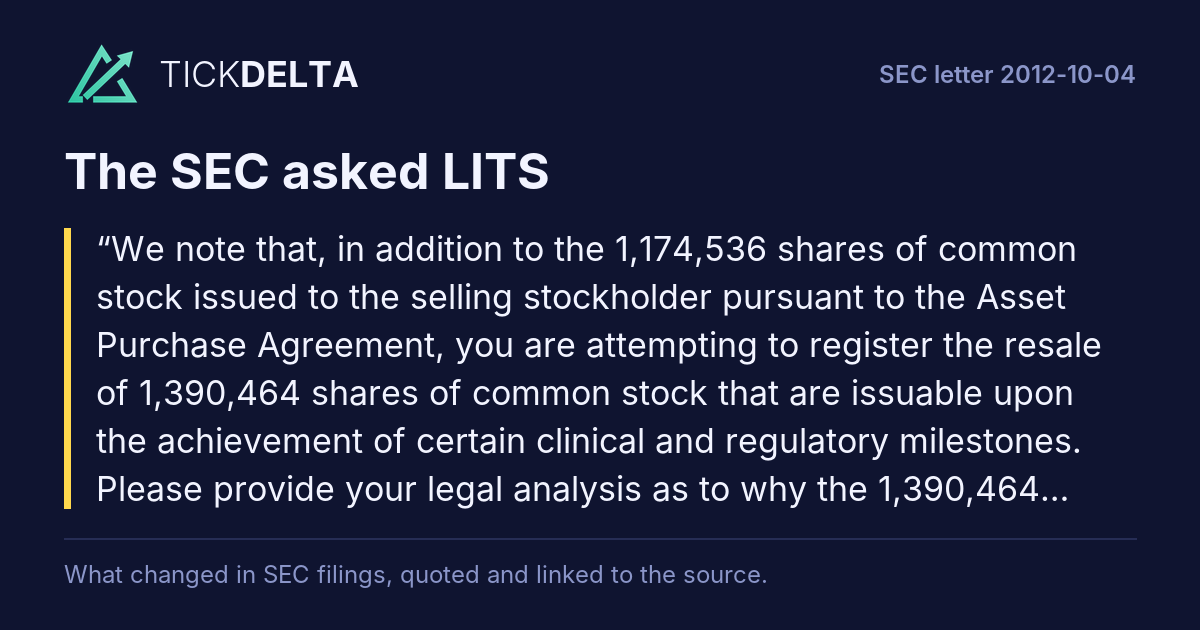
We note that, in addition to the 1,174,536 shares of common stock issued to the selling stockholder pursuant to the Asset Purchase Agreement, you are attempting to register the resale of 1,390,464 shares of common stock that are issuable upon the achievement of certain clinical and regulatory milestones. Please provide your legal analysis as to why the 1,390,464 shares of common stock are ripe for registration.
Rest of the question

We note that you are attempting to register the resale of such shares when they have not yet been issued and may never be outstanding if the clinical and regulatory milestones set forth in the Asset Purchase Agreement do not occur or if you pay the “Phase 3 Milestone Event” payment entirely in cash.

LITS answered
As described in the Registration Statement, on August 22, 2012, the Company consummated its acquisition (the

“Acquisition”) from S*Bio Pte Ltd., a Singapore private limited company (“S*Bio”), of all of S*Bio’s right, title and interest in certain intellectual property and other assets related to compounds SB939,

SB1304, SB1354 and SB1502 (the “Acquired Compounds”), pursuant to the terms of an Asset Purchase Agreement, dated August 7, 2012 (the “Asset Purchase Agreement”).

Jeffrey Riedler

Page

Pursuant to the terms of the Asset Purchase Agreement, as part of the consideration for the
Rest of the answer

Acquired Compounds, the Company agreed to make certain milestone payments to S*Bio upon the achievement of certain clinical, regulatory and net sales-based milestones. Upon the occurrence of the dosing of a patient in a Phase 3 trial (or, under certain circumstances, a Phase 2 trial) of a product containing any of the Acquired Compounds (the “First Milestone Event”), the Company has agreed to pay S*Bio $200,000 in cash as well as shares of Common Stock (the

“Milestone Payment Shares”) having a market value of $500,000, as determined in accordance with the terms of the Asset Purchase Agreement. The Company may pay the $500,000 in Milestone Payment Shares if the Milestone Payment Shares have been registered for resale under the Securities Act of 1933, are listed on Nasdaq and do not require stockholder approval, and such amount is otherwise payable in cash. The Milestone Payment Shares are issuable without the payment by S*Bio of any additional consideration or the performance by S*Bio of any additional acts, and without any investment decision by S*Bio.

General Instruction I.B.3 to Form S-3 provides that an issuer is eligible to use Form S-3 to register “[o]utstanding securities to be offered for the account of any person other than the issuer, . . . if securities of the same class are listed and registered on a national securities exchange or are quoted on the automated quotation system of a national securities association.” In its Compliance and Disclosure Interpretations (“C&DIs”) for the Securities Act Forms, the Staff previously addressed whether shares that are issuable in a merger transaction, but are not yet outstanding, can be registered on Form S-3 pursuant to General Instruction I.B.3. Specifically, Question 116.05 provides:

Question:

In reliance on Securities Act Section 4(2), a merger transaction will not be registered. May resales of earnout shares to be issued in connection with the merger be registered on Form S-3 pursuant to General Instruction I.B.3 after the consummation of the merger, even though the shares have not been earned and are not outstanding at the time the registration statement is filed?

Answer: Yes. [Feb. 27, 2009]

We respectfully submit that the Milestone

Payment Shares that may be issuable under the terms of the Asset Purchase Agreement are eligible for registration on Form S-3 immediately following the closing of the Acquisition because such shares are “earnout” shares in accordance with the Staff’s guidance provided in C&DI Question 116.05. In Question 116.05, the Staff confirmed that earnout shares in a merger context are eligible for registration on Form S-3. Although using different terminology, there is no meaningful legal distinction between “earnout shares” and “milestone shares.” In both cases, the issuer is contractually obligated under the terms of the merger or purchase agreement to issue the shares upon the occurrence of future events, whether the events are based on financial metrics, the receipt of regulatory approvals or some other event. Although the fact pattern envisioned by the Staff in Question 116.05 involves a merger transaction, there is no meaningful distinction between the payment of earnout and milestone shares in an acquisition transaction structured as a merger or as an asset purchase. This is consistent with the equivalent treatment of securities acquired as contingent payments of the purchase price for the sale of an equity interest in a business (as in a merger) or the assets of a business (as in an asset purchase) for purposes of calculating the holding period under Rule 144(d)(3)(iii), which in each case are deemed to have been acquired at the time of such sale if subject only to conditions other than the payment of additional consideration for such securities.

The Milestone Payment Shares are issuable by the Company upon the achievement of the First Milestone

Event relating to the Acquired Compounds under the terms of the Asset Purchase Agreement, without any requirement for S*Bio to provide the Company with any additional consideration or perform any additional acts, nor make any investment decision.

Accordingly, the Milestone Payment Shares are eligible for registration on the Company’s Registration Statement.

Read in the reply ↗

Also in this review: company letter, 2012-11-06

Form S-1

2012-02-28 to 2012-03-22 · 1 question · 1 letter from the SEC, 1 from the company
No closing letter
General
SEC asked
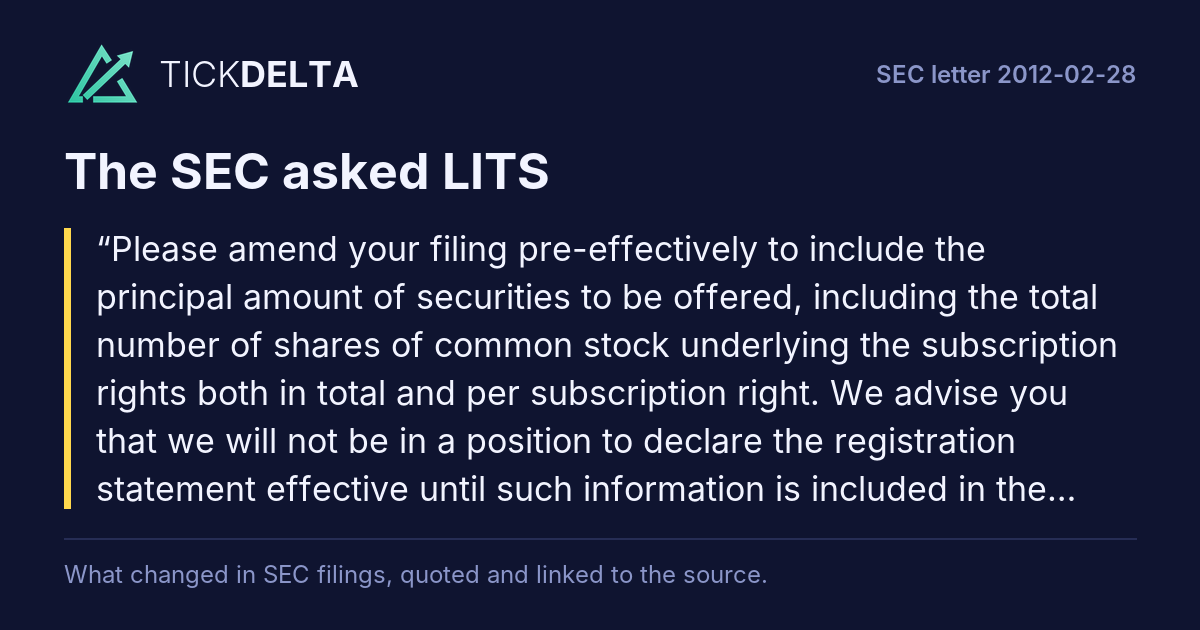
Please amend your filing pre-effectively to include the principal amount of securities to be offered, including the total number of shares of common stock underlying the subscription rights both in total and per subscription right. We advise you that we will not be in a position to declare the registration statement effective until such information is included in the filing.
Rest of the question

See C&DI 227.02, Securities Act Rules, available at www.sec.gov for guidance. In the amendment, please also include any other material non-pricing related information to be inserted prior to effectiveness.

LITS answered
Pursuant to Rule 461 under the Securities Act of 1933, as amended, Marshall Edwards, Inc. (the “Company”) hereby requests acceleration of the effective date of its Registration Statement on Form S-1 (Registration No. 333-179590), as amended, so that the

Registration Statement may become effective at 2:00 p.m.
Rest of the answer

(Washington, DC time) on March 26, 2012, or as soon as practicable thereafter.

In connection with this request, the Company acknowledges that:

• should the Securities and Exchange Commission (the “Commission”) or the staff, acting pursuant to delegated authority, declare the filing effective, it does not foreclose the Commission from taking any action with respect to the filing;

the action of the Commission or the staff, acting pursuant to delegated authority, in declaring the filing effective, does not relieve the Company from its full responsibility for adequacy and accuracy of the disclosure in the filing; and the Company may not assert staff comments and the declaration of effectiveness as a defense in any proceeding initiated by the Commission or any person under the federal securities laws of the United States.

MARSHALL EDWARDS, INC.

By:

/s/ Thomas M. Zech

Name:

Thomas M. Zech

Title:

Chief Financial Officer

Read in the reply ↗

Form S-3

2011-06-21 to 2011-08-11 · 3 questions · 2 letters from the SEC, 3 from the company
No closing letter
General
SEC asked (1)
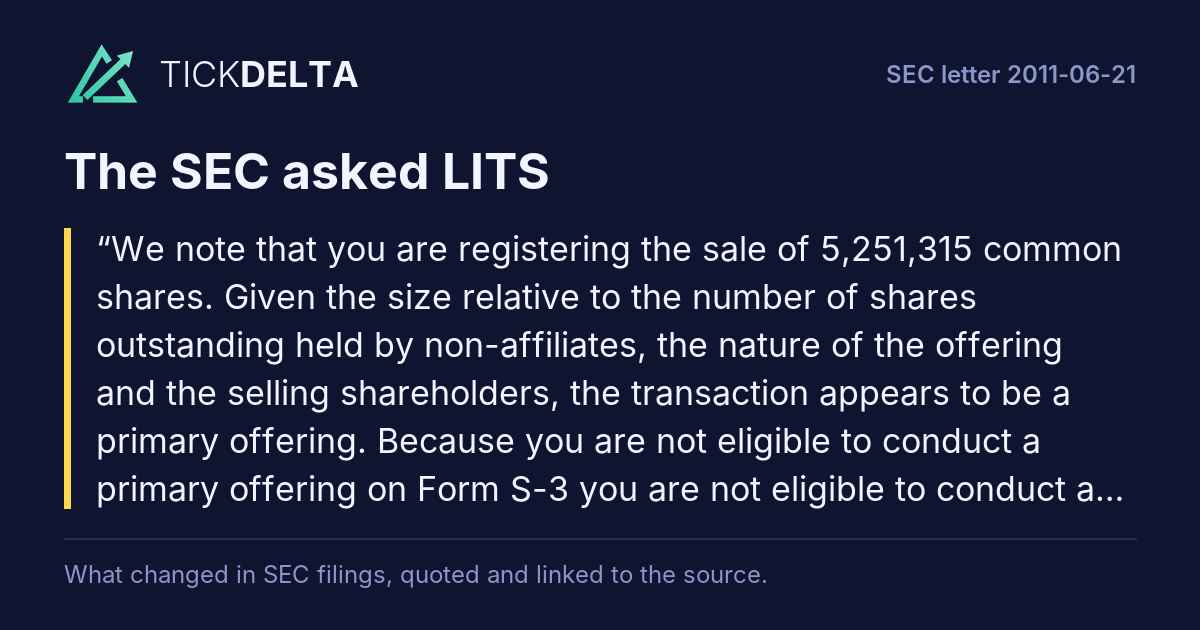
We note that you are registering the sale of 5,251,315 common shares. Given the size relative to the number of shares outstanding held by non-affiliates, the nature of the offering and the selling shareholders, the transaction appears to be a primary offering. Because you are not eligible to conduct a primary offering on Form S-3 you are not eligible to conduct a primary at-the-market offering under Rule 415(a)(4).
Rest of the question

If you disagree with our analysis, please advise the staff of your basis for determining that the transaction is appropriately characterized as a transaction that is eligible to be made under Rule 415(a)(1)(i). In your analysis, please address the following among any other relevant factors:  The number of selling shareholders and the percentage of the overall offering made by each shareholder;  The date on which and the manner in which each selling shareholder received the shares and/or the overlying securities;  The relationship of each selling shareholder to you, including an analysis of whether the selling shareholder is an affiliate;  Any relationships among the selling shareholders;  The dollar value of the shares registered in relation to the proceeds that you received from the selling shareholders for the securities, excluding amounts of proceeds that were returned (or will be returned) to the selling shareholders and/or their affiliates in fees or other payments;  The discount at which the shareholders will purchase the common stock underlying the warrants upon exercise; and  Whether or not any of the selling shareholders is in the business of buying and selling securities.

LITS answered
The Company respectfully submits that the offering is a valid secondary offering under Rule 415(a)(1)(i). Rule 415(a)(1)(i) states that securities may be registered for an offering to be made on a continuous or delayed basis in the future, provided that the registration statement pertains only to “[s]ecurities which are to be offered or sold solely by or on behalf of a person or persons other than the registrant, a subsidiary of the registrant or a person of which the registrant is a subsidiary.”

The Company respectfully submits that the re-characterization of a secondary offering as an
Rest of the answer

offering “by or on behalf of the registrant” has a significant negative impact on the ability of a selling shareholder to effect the resale of its securities.

Accordingly, re-characterization can have a chilling effect on the ability of smaller public companies — like the Company — to raise capital and the Company believes that the Staff should only re-characterize a secondary offering as being on behalf of a registrant after a careful and complete review of the relevant facts and circumstances.

The Staff has previously recognized the complexity of the analysis of certain transactions under Rule 415 and has set forth certain factors that it considers in determining whether an offering styled as a secondary offering should be recharacterized as a primary offering on behalf of an issuer in Compliance and Disclosure Interpretation 612.09 (the “C&DI”):

How long the selling shareholders have held the shares

The circumstances under which the selling shareholders received the shares

The relationship of the selling shareholders to the issuer

The number of shares being sold

Whether the selling shareholders are in the business of underwriting securities

Whether under all the circumstances it appears that the seller is acting as a conduit for the issuer.

As the C&DI also indicates, the question is a “difficult” and “factual” one that involves an analysis of many factors and

“all the circumstances.”

Each of the relevant factors cited in the Staff’s June 21 comment letter, as well as certain additional factors listed in the C&DI, are discussed below in the context of the instant transaction. For the reasons set forth below, the Company believes that, upon proper consideration of all of those factors, the offering of securities to be registered pursuant to the Registration Statement is a secondary offering and not a primary offering and is eligible to be made under Rule 415(a)(1)(i) under the Securities Act of 1933 (the “Securities Act”) as contemplated by the Registration Statement.

Background

In recognition of the need for additional working capital to fund, among other things, clinical development of the Company’s product candidates, early in the second quarter of 2011, the Company engaged an investment bank, Roth Capital Partners, LLC (the “Placement Agent”), to help it identify different financing alternatives. Based on the Company’s stock price on The Nasdaq Capital Market (“Nasdaq”), the state of the capital markets for similarly situated companies and the Company’s need to obtain additional working capital in a timely manner, the Placement Agent and the Company’s management and Board agreed that a private placement of securities targeting institutional investors had the highest likelihood of success. The Placement Agent then began to contact potential investors on behalf of the Company to discuss a proposed private placement of shares of the Company’s common stock, par value $0.00000002 (the “Common Stock”), and warrants to purchase shares of Common Stock.

On May 16, 2011, the Company entered into an Amended and Restated Securities Purchase Agreement (the “Securities Purchase Agreement”) with two accredited investors, Hudson Bay Master Fund Ltd. and Capital Ventures International (the “Investors”), which amended and restated in its entirety the Securities Purchase Agreement, dated May 2, 2011 (the “Original Purchase Agreement”), among the Company and the Investors to address compliance with certain Nasdaq requirements after consultation with Nasdaq staff, including the elimination of series C warrants provided for in the Original Purchase Agreement. As amended, the Securities Purchase Agreement is in full compliance with Nasdaq corporate governance requirements, a factor the staff has deemed relevant to this analysis.1 On May 18, 2011, the Company issued the following securities (the “Transaction”) under the Securities Purchase Agreement:

835,217 shares of Common Stock, at a purchase price of $1.333 per share;

Series A warrants (the “Series A Warrants”), which represent the right to purchase up to 626,413 shares of Common Stock, which number of shares issuable upon exercise of such Series A Warrants shall increase by up to 1,624,151 shares to an aggregate of 2,250,564 shares upon the exercise of the Series B Warrants (as defined below) upon the terms described below; and

Remarks of Thomas Kim, Chief Counsel, Division of Corporation Finance, PLI Securities Regulation Institute (November 2010).

Series B warrants (the “Series B Warrants”, and collectively with the Series A Warrants, the “Warrants”) which represent the right to purchase up to 2,165,534 shares of the Common Stock.

In addition, the Company agreed to issue to the private placement investors, additional shares of the Common Stock (“Adjustment Shares”) to the extent the applicable price, calculated as described below, of the Common Stock is below $1.333 per share on a limited number of specified dates

(“Adjustment Dates”). An Adjustment Date will occur no later than the six-month anniversary of the May 18, 2011 issuance of Common Stock in the Transaction (if the Company fails to maintain the effectiveness of any registration statement covering the shares of Common Stock and shares underlying the Warrants issued in the Transaction or the public information required by Rule 144 during a period of 60 days after the prior Adjustment Date there may be either one or two additional

Adjustment Dates during the period ending June 26, 2012) and an Adjustment Date will occur upon the Company’s issuance of securities at a deemed price below $1.333 during the 12-month period following May 18, 2011). The number of Adjustment

Shares issuable is initially limited to 649,242, subject to proportionate increases to the extent the Series B Warrants have been exercised prior to an applicable Adjustment Date, up to a maximum of 2,332,583 shares. The Adjustment Shares are not included on the Registration Statement.

The shares of Common Stock, the Series A and Series B Warrants and the Adjustment Shares were offered and sold in a private placement transaction exempt from registration under the Securities Act in reliance upon Section 4(2) under the Securities Act and Regulation D promulgated thereunder. Each of the investors represented to the Company that it is an “accredited investor” as defined in Rule 501 of Regulation D. The Company has never engaged in a private placement transaction with the Investors in the past.

Date on which and manner in which each selling shareholder received the shares and/or the overlying securities

As described above, the closing of the issuance of the 835,217 shares of Common Stock under the Securities Purchase Agreement occurred on May 18, 2011, on which date the Investors also acquired

Series A Warrants and Series B Warrants to purchase up to an aggregate of 4,416,098 shares of Common Stock. The Series A Warrants to purchase up to 2,250,564 shares of Common Stock will not be exercisable until six months after the May 18, 2011 issuance and the Series B Warrants to purchase up to 2,165,534 shares of Common Stock will be exercisable only after stockholder approval of the Transaction has become effective, which will occur 20 days after the Company mails a definitive information statement to stockholders giving notice of the May 18, 2011 approval of the Transaction by written consent of the Company’s majority stockholder, and certain other conditions are satisfied or waived by the Investors.

Additionally, the Series A Warrants are initially exercisable for 626,413 shares of Common Stock and only become exercisable for up to 1,624,151 additional shares of Common Stock to the extent the Series B Warrants are exercised. Upon the satisfaction of certain conditions, including the effectiveness of stockholder approval referred to above, the Company can require the Investors to exercise their Series B Warrants.

Under the Staff’s Compliance and Disclosure Interpretation 116.19, the Staff stated that an issuer may be permitted to register securities underlying convertible securities prior to the issuance of the underlying securities if the convertible securities were issued in a valid private placement under Section 4(2) of the Securities Act. Accordingly, there is no minimum holding period during which the Investors must own securities prior to their eligibility for registration in a valid secondary offering. Nevertheless, the Investors have now incurred significant risk as a result of holding the aggregate 835,217 shares of Common Stock and the Warrants exercisable for the balance of the shares of Common Stock included on the Registration Statement for 43 days and will likely be required to hold their shares of Common Stock for an extended period of time.

The Company respectfully submits that registration of the re-sale of the shares of Common Stock issuable in the Transaction should not equate to intent to distribute. As described above, the securities covered by the Registration Statement became issuable in a valid private placement that complied in all respects with Section 4(2) of the Securities Act and Regulation D promulgated thereunder. All of the Investors specifically represented that they were acquiring their securities for investment and not with the purpose or intent of effecting a distribution in violation of the Securities Act.

The Company respectfully further submits that there are a number of reasons why investors want the re-sale of shares registered other than to effect a distribution. For example, many private investment funds are required to mark their portfolios to market. If portfolio securities are not registered, such investors are required to mark down the book value of those securities to reflect an illiquidity discount. That portfolio valuation does not depend on whether investors intend to dispose of their shares or to hold them for an indefinite period. In addition, many investors are fiduciaries of other people’s money and have a common law duty to act prudently. The Company believes that it would be irresponsible for such investors not to have the re-sale of their shares registered. Furthermore, not registering the re-sale of their shares could prevent investors from taking advantage of market opportunities or from liquidating an investment if there is a fundamental shift in such investors’ investment judgment about a company. Finally, shares that are registered for re-sale are generally eligible to be used as margin collateral under the margin regulations of the Federal Reserve. Restricted securities are not “margin stock.”

Number of selling shareholders and the percentage of the overall offering made by each shareholder; Number of shares being sold

Number of Investors; Percentage of Overall Offering

As a result of the relatively low limit on the maximum number of shares of Common Stock issuable prior to effectiveness of stockholder approval of the Transaction under Nasdaq rules, the Transaction was fully subscribed and placed with only two investors. Consequently, there are two selling stockholders, Hudson Bay Master Fund Ltd. and Capital Ventures International, which potentially may sell up to 2,625,658 and 2,625,657 shares of Common Stock, respectively, or in each case approximately 50% of the shares of Common Stock being registered under the Registration Statement. As noted above, the Company has been advised that the Investors acquired their securities for investment purposes and not with the purpose or intent of effecting a distribution in violation of the

Securities Act.

As noted above, there are no affiliations or other relationships between the Investors and there is no evidence that the

Investors have any plan to act in concert to effect a distribution of their shares of Common Stock. Such a plan would make the Investors a “group” under Section 13(d) of the Exchange Act. In similar circumstances, courts have found that investors who merely sign the same investment documents do not constitute a “group” for 13(d) purposes. Accordingly, absent evidence to the contrary, the Company does not believe that there is a valid basis to impute to the Investors any intent to act in concert to effect a distribution of the shares of Common Stock.

Number of Shares being

Sold

Although the Company acknowledges that the 5,251,315 shares included in the Registration Statement represent approximately 216% of the outstanding shares of Common Stock held by non-affiliates immediately prior to the Transaction, it notes that such shares represent less than 66% of the total number of shares of Common Stock outstanding immediately prior to the Transaction and less than 41%, taking into account 4,827,000 shares of Common Stock issuable at any time, for no additional consideration, to Novogen Limited upon conversion of the Company’s outstanding Series A Convertible Preferred

Stock. In addition, the Company submits that in light of the significant ownership position of Novogen Limited and the Company’s stock price (closing bid price of $1.36 per share on the date immediately prior to the consummation of the

Transaction), in order to raise any appreciable amount of capital the Company must necessarily issue a relatively significant number of shares relative to the number of shares of Common Stock held by non-affiliates. Novogen has invested in the

Company as part of a broad-ranging collaboration in connection with its product development efforts. We note that members of the staff of the Division of Corporation Finance have indicated that shares held by strategic investors with respresentation on the Company’s board of directors can be included in the Company’s non-affiliated float for purposes of this analysis.2

In addition, the number of shares being offered is only one of the factors cited in the

C&DI to be considered when determining whether a secondary offering should be considered a primary offering on behalf of the registrant. Where an offering otherwise constitutes a secondary offering, there is nothing inherent in the registration of a large number of shares by a selling shareholder that turns a secondary offering into a primary offering — such fact is just one possible indicator that an offering styled as a secondary offering is actually a primary transaction. For the reasons set forth in this response, we believe that the shares being registered for resale are being registered for the benefit of the selling stockholders.

Relationship of each selling shareholder to us; Affiliate analysis

Neither of the

Investors had any relationship with the Company prior to their investment in the Transaction.

Under Rule 405 promulgated under the Securities

Act, an “affiliate” is defined as any person that directly or indirectly, through one or more intermediaries, controls, or is controlled by, or is under common control with, an issuer.

Remarks of Thomas Kim, Chief Counsel, Division of Corporation Finance, PLI Securities Regulation Institute (November 2010).

Upon the issuance of a total of 835,217 shares of Common Stock on May 18, 2011, each of the selling shareholders became beneficial owners of approximately 4.7% of the Common Stock. Although the Company acknowledges that, as described above, a substantial number of shares of Common Stock are potentially issuable to each of the

Investors upon full exercise of the Series A and Series B Warrants (resulting in total share ownership by each Investor of up to a number equal to approximately 20% of the Company’s outstanding shares of Common Stock (although the Series A and

Series B Warrants are not exercisable to the extent such exercise would cause an Investor to beneficially own in excess of 9.99% of the Company’s then outstanding Common Stock), excluding any Adjustment Shares that may become issuable and assuming no other issuances), Novogen Limited currently owns 5,240,829 shares of the Company’s Common Stock, or 59% of the outstanding shares of Common Stock as of June 30, 2011, and has the right to acquire an additional 4,827,000 (or up to 9,654,000 upon the occurrence of certain milestones in the development of the intellectual property acquired by the Company from Novogen Limited earlier in 2011) shares of common stock at any time, for no additional consideration, upon the conversion of the Company’s Series A Convertible Preferred Stock. Accordingly, any element of control, which as the SEC has indicated is a key factor in the determination of affiliate status, potentially attributable to the stock ownership of the selling shareholders is effectively negated by Novogen’s control of the Company. In addition, none of the Investors nor any of their respective affiliates are officers or directors of the Company, nor do either of the Investors have any board of director appointment or other corporate governance rights or other indicia of control, under the Transaction documentation or otherwise.

Thus, the Investors are not affiliates of the Company and certainly do not have sufficient control to establish a parent/subsidiary relationship that would disqualify them from a resale shelf offering.

Rule 415(a)(1)(i) provides that securities may be registered for an offering to be made on a continuous or delayed basis in the future, so long as the registration statement pertains only to securities which are to be offered or sold solely by or on behalf of a person or persons other than the registrant, a subsidiary of the registrant or a person of which the registrant is a subsidiary. Even though the Investors are not affiliates of the Company, the Company notes that in the SEC’s

Compliance and Disclosure Interpretation 116.15, in response to a question whether parents, subsidiaries or affiliates of the issuer may rely on Rule 415(a)(1)(i) to register secondary offerings, the Compliance and Disclosure Interpretation states that “[a]side from parents and subsidiaries, affiliates of issuers are not necessarily treated as being the alter egos of the issuers. Under appropriate circumstances, affiliates may make offerings that are deemed to be genuine secondaries.” Accordingly, if affiliates can make genuine secondary offerings, then certainly non-affiliates, such as the Investors, can do so.

For the reasons stated herein, the Company believes that Rule 415(a)(1)(i) is available for the selling shareholders of the Company to register their shares on a secondary basis.

Relationship among selling shareholders

As noted above, to the Company’s knowledge there is no affiliation or other relationship among the selling shareholders, and no indication that the Investors are acting as a group with respect to the resale of their securities.

Dollar value of shares registered in relation to proceeds received

As described above, on May 18, 2011, we issued 835,217 shares of Common Stock, as well as Series A Warrants and Series B Warrants to purchase up to

4,416,098 shares of Common Stock, to the Investors, for gross proceeds of $1,113,344.26 or $1.333 per share. The closing price of the Common Stock on the Nasdaq Stock Market was $1.47 per share, on May 13, 2011, the date immediately prior to entry into the Securities Purchase Agreement and $1.61 per share on April 29, 2011, the date immediately prior to entry into the Original Securities Purchase Agreement. As described above, the exercise of the Series A Warrants, which are exercisable on a cash or cash-less basis, and the Series B Warrants, which are exercisable solely on a cash basis, requires the payment of the exercise prices described below by the Investors. If the Series A Warrants were exercised on a cash-less basis, we would not receive any additional cash proceeds. However, the number of shares of Common Stock issuable upon exercise of such Series A Warrants would be reduced.

Assuming the applicable price payable under the Series A Warrants is $1.333 and under the Series B Warrants is $1.1475 (requiring a weighted average trading price of our Common Stock (calculated as described below for the Series B Warrants) of $1.35 per share, which was the closing price of the Common Stock on Nasdaq on May 18, 2011, the date of issuance of the Series A and Series B Warrants) at the time all of the Series A and Series B

Warrants were exercised, the total consideration paid by the selling shareholders upon exercise of the Warrants would be over $5.4 million. Together with the purchase price paid for the shares of Common Stock issued on May 18, 2011, the total consideration for the shares of Common Stock registered under the Registration Statement would be over $6.5 million and the price paid by the Investors per share of Common Stock would be $1.26 per share.

The Company did not pay any fees to the Investors. The Company agreed to reimburse up to $93,000 of legal fees incurred by the Investors in connection with the Transaction. The Company paid to the Placement Agent a cash fee equal to 7% of the gross proceeds of the Transaction and issued warrants for the purchase of an amount of Common Stock (which the Company is not seeking to register under the

Registration Statement) equal to 7% of the 835,217 shares of Common Stock issued on May 18, 2011, which warrants are exercisable on the same terms, including as to the increase in the number of shares of Common Stock issuable upon exercise, as the Series A Warrants.

The Company has also agreed that if the applicable price based on the trading price of its Common

Stock is below $0.75 per share on an Adjustment Date, the Company will, in addition to issuing the applicable number of Adjustment Shares, refund to the Investors an amount in cash per share of Common Stock purchased by such investor in the

Transaction based on the difference between $0.75 and the applicable price of the Common Stock on such Adjustment

Date.3 As a result, for each $0.01 the applicable price is below $0.75 on an Adjustment Date, the Company will pay to the respective Investors $0.01 per share of Common Stock issued on May 18, 2011 or theretofore upon exercise of the Series B Warrants. For example, if the applicable price on an Adjustment Date were $0.65 per share, the Company would incur an

The applicable price with respect to an Adjustment Date will be equal to 85% of the eight lowest volume-weighted average daily prices of the Common Stock during the 20 trading days immediately following the trigger date for such Adjustment Date.

unsecured obligation to pay $0.10 per share, or an aggregate of $83,522 (or $300,075 if all of the Series B Warrants were exercised prior to such Adjustment Date), to the Investors in cash. The

Company is not registering any of the Adjustment Shares on the Registration Statement. As such, there would be no difference in the relationship between the dollar value of shares registered on the Registration Statement and proceeds, net of any refunds, received by the Company from the Investors unless the applicable price of the Company’s Common Stock was below $0.75 on an Adjustment Date.

Discount at which the shareholders will purchase the common stock underlying the warrants upon issuance

The Series A Warrants have an exercise price of $1.57 and, therefore, were issued with an initial exercise price exceeding the market value of the Company’s shares of Common Stock on the date of issuance. The Series B Warrants have an exercise price equal to the lower of $1.333 or 85% of the arithmetic average of the lowest eight weighted average prices of the Common Stock during the 20 consecutive trading day period (a) in the case of a voluntary exercise by the selling shareholders, ending on the trading day immediately preceding the date of delivery of a notice of exercise, and (b) in the case of an exercise that the Company may require upon the satisfaction of certain conditions, immediately following the fifth trading day following the date of delivery of a notice of such required exercise. The Series A Warrants and the Series B Warrants are subject to certain anti-dilution adjustments, including, upon the sale or deemed sale by the Company after the date of the Securities Purchase Agreement of any shares of Common Stock at a price per share below the exercise price of the Series A Warrants or the Series B Warrants, the reduction of the exercise price of the applicable series of warrants to an amount equal to such lower price.

Accordingly, absent a subsequent sale by the Company of its securities below $1.333, the discount, from the closing bid price of the Common Stock on Nasdaq on May 18, 2011 of $1.35 per share, at which Investors would be entitled to purchase shares of Common Stock (1) upon exercise of Series A

Warrants would be less than $0.02 per share (1.5%) and (2) upon exercise of Series B Warrants would be approximately $0.20 per share (15%) assuming the weighted average price of the Common Stock, calculated as, and during the period described above, equals $1.35 per share.

Although the Series B Warrants do have a market-adjusted exercise price, the terms of the Warrants do not resemble the type of “toxic” convertibles that have given rise to concern that the offering is an indirect primary offering. For example, the number of shares of Common Stock issuable upon exercise of the Series B Warrants is not subject to market adjustments, which effectively caps the number of shares issuable thereunder, and the Company may require the holders to exercise their Series B Warrants in the event all of the following conditions are satisfied (or, in the case of clause (ii) or (iii), waived by the holder): (i) the shareholder approval of the Transaction has become effective, (ii) all of the shares of Common Stock issuable upon exercise of the Series B Warrants are able to be resold without restriction or limitation pursuant to an effective registration statement and (iii) all of the 835,217 shares of Common Stock sold in the private placement, the shares of the Common Stock issuable upon exercise of the Series A and Series B

Warrants and the Adjustment Shares are able to be resold without restriction or limitation pursuant to an effective registration statement or Rule 144 under the Securities Act, as well as certain other equity conditions, including certain minimum trading volume requirements, and in consideration of such potential required further cash exercise payment by the Investors the exercise price of the Series B warrants was based on the same market-based formula used to arrive at the sale price of the Common Stock under the Securities Purchase Agreement.

Unless the Company requires an exercise as described above, each selling shareholder will make an independent determination of whether it wants to exercise its Warrants and in all events, if and when, it wants to sell the underlying shares of Common Stock. There is also no requirement that the shares be sold immediately upon exercise of the Warrants. For tax and investment reasons, the holders may decide to exercise the Warrants and hold the shares. Moreover, the lack of a substantial, active trading market for the Company’s Common Stock effectively negates any prospect of the selling shareholders quickly reselling their securities.

Whether or not any of the selling shareholders is in the business of buying and selling securities

As described above, the Investors are accredited institutional investors that buy and sell portfolio securities for their own accounts.

The Company is advised that none of the Investors are in the business of underwriting securities. Nor is any Investor a registered broker-dealer or an affiliate of a registered-broker dealer, other than Capital Ventures International which is affiliated with one or more registered broker-dealers. Each of the Investors, including Capital Ventures International, made extensive representations and warranties in the Securities Purchase Agreement regarding its investment intent, including representations that each Investor was purchasing its securities for its own account, for investment purposes and not for the purpose of effecting any distribution of the securities in violation of the Securities Act.

Whether under all the circumstances it appears that the seller is acting as a conduit for the Issuer

The Company respectfully submits that the facts and analysis provided above do not support a conclusion that the Investors are engaged in a distribution or acting as conduits for the Company. In addition, none of the Investors are in the business of underwriting securities and there is no evidence to suggest that any of the Investors are acting in concert to effect a coordinated distribution of the shares of Common Stock. In these circumstances, the Company respectfully submits that the offering it seeks to register pursuant to the Registration Statement is a valid secondary offering and requests the Staff to concur that it may proceed consistent with Rule 415.

As noted, the Investors have already been at risk with respect to 835,217 shares for a substantial period. There is no assurance that those shares will be registered for resale and if registered, will be able to be sold at a profit. Series B Warrants can only be exercised for cash and only for a limited period of one year and Series A Warrants are only exercisable above the base amount of 626,413 shares if the Series B Warrants are exercised and only at the fixed purchase price. There is no assurance that if exercised, the warrant shares can be sold at a profit into the market. Only limited downside protection is provided by the Company’s agreement to issue Adjustment Shares (which is capped at $0.75 per share) and to make a cash payment for any market price drop below that point (essentially making the Investors unsecured creditors). Thus, the Investors are not acting as a riskless conduit for an indirect offering by the Company.
Read in the reply ↗
Incorporation of Certain Information by Reference, page 23
SEC asked (2)
We note that you are incorporating by reference a Current Report on Form 8-K that was filed on March 16, 2011. As there was no 8-K filed on that date, but there was one filed on March 18, 2011, it appears that this date is in error. Please amend this registration statement to make the appropriate correction.
LITS answered
The Company notes the Staff’s comment and will amend the Form S-3 to refer to the March 18, 2011 Form 8-K filing and delete the reference to May 16, 2011. Read in the reply ↗
General
SEC asked
We note your response to our prior comment 1. Based on the limited time the selling shareholders have held their shares, the large number of shares being registered for resale and the significant reduction of the selling shareholders’ market risk for the securities they purchased, the transaction appears to be a primary offering.
Rest of the question

In regard to the selling shareholders’ market risk, you state in your response that the selling shareholders have “only limited downside protection.” However, we note the following:  the selling shareholders are entitled to receive up to 2,332,583 additional common shares (“Adjustment Shares”) to the extent that the price of the Company’s common stock is below the original purchase price of $1.333 per share, but greater than or equal to $0.75 per share on certain dates;  if the price of the Company’s common stock is below $0.75 on certain dates the Company will refund to the selling shareholders an amount in cash per share of common stock purchased by the selling shareholders equal to the difference between $0.75 and the price of the common stock on such dates; and  the exercise price of the Series A and B Warrants is subject to a full-ratchet adjustment if and when the Company issues or sells shares of common stock at a price less than the exercise price immediately prior to such issue or sale Please provide your analysis why, given that these features appear to substantially mitigate the selling shareholders’ market risk with respect to the shares purchased, that we should not view this offering as an indirect primary offering by the Company. Notwithstanding our comments, in the event you request acceleration of the effective date of the pending registration statement please provide a written statement from the company acknowledging that:  should the Commission or the staff, acting pursuant to delegated authority, declare the filing effective, it does not foreclose the Commission from taking any action with respect to the filing;  the action of the Commission or the staff, acting pursuant to delegated authority, in declaring the filing effective, does not relieve the company from its full responsibility for the adequacy and accuracy of the disclosure in the filing; and  the company may not assert staff comments and the declaration of effectiveness as a defense in any proceeding initiated by the Commission or any person under the federal securities laws of the United States. Please refer to Rules 460 and 461 regarding requests for acceleration. We will consider a written request for acceleration of the effective date of the registration statement as confirmation of the fact that those requesting acceleration are aware of their respective responsibilities under the Securities Act of 1933 and the Securities Exchange Act of 1934 as they relate to the proposed public offering of the securities specified in the above registration statement. Please allow adequate time for us to review any amendment prior to the requested effective date of the registration statement.

LITS answered
In order to comply with the

Commission’s primary offering test for Rule 415, the Company will amend the Registration Statement to reduce the number of shares of common stock to be registered from 5,251,315 shares of common stock to 835,217 shares of common stock. All of these 835,217 shares of common stock were issued in the private placement on May 18, 2011, and no warrants, or shares of common stock issuable upon exercise of warrants, issued in the private placement are proposed to be registered on the

Registration Statement, nor are any of the potentially issuable adjustment shares.

As
Rest of the answer

of May 17, 2011, the date immediately prior to the consummation of the private placement transaction, 2,426,425 shares of the Company’s common stock were held by non-affiliates. As a result, the 835,217 shares proposed to be registered for resale by the selling shareholders on the Registration

Statement equal less than 35% of the shares of the Company’s common stock held by non-affiliates as of such date.

Read in the reply ↗

Also in this review: company letter, 2011-08-11

Form S-4

2011-02-10 to 2011-02-16 · 2 questions · 1 letter from the SEC, 1 from the company
No closing letter
General
SEC asked (1)
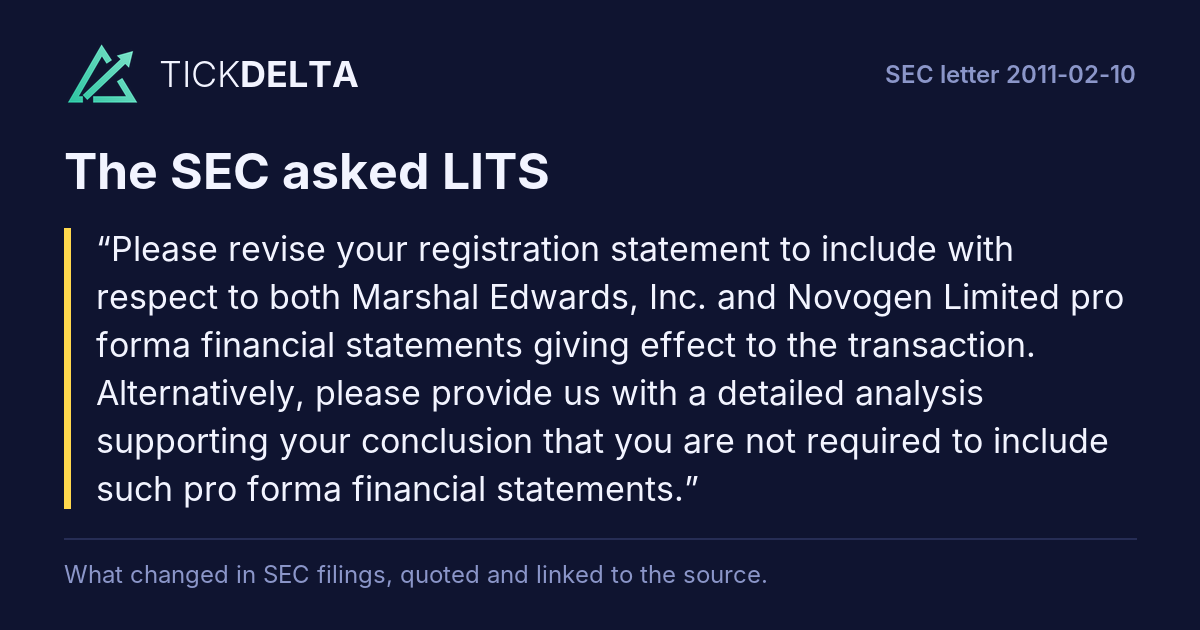
Please revise your registration statement to include with respect to both Marshal Edwards, Inc. and Novogen Limited pro forma financial statements giving effect to the transaction. Alternatively, please provide us with a detailed analysis supporting your conclusion that you are not required to include such pro forma financial statements.
LITS answered
Article 11 of

Regulation S-X requires pro forma financial information to be presented under specified circumstances, including when a significant business combination has occurred or is probable and/or when consummation of other events or transactions has occurred for which disclosure of pro forma financial information would be material to investors.
Rest of the answer

The Company has determined that inclusion of pro forma information is not required in its Form S-4 for the Isoflavone Transaction because the transaction does not constitute a business combination and that disclosure of pro forma financial information would not be material to investors.

As described in the Form S-4, the Isoflavone Transaction involves the Company’s purchase of certain intellectual property (the “Isoflavone-related Assets”) related to isoflavone technology that is currently owned by its majority stockholder Novogen Limited (“Novogen”), and some of which is licensed from Novogen by the Company, in exchange for 1,000 shares of Series A Convertible Preferred Stock, par value $0.01 per share, of the Company. As explained below, the Company has determined that the assets being acquired do not constitute a “business” and therefore the transaction is not a “business combination” under Rule 11-01 of Regulation S-X or under generally accepted accounting principles.

Securities and Exchange

Commission of 4

The Isoflavone-related Assets being acquired by the Company do not constitute a separate entity, a subsidiary or a division of Novogen for which Rule 11-01(d) states that a presumption of being a “business” would exist. Rule 11-01(d) further states that in evaluating whether an acquisition of a lesser component of an entity constitutes a business the following facts and circumstances, among others, should be considered:

(1) Whether the nature of the revenue producing activity of the component will remain generally the same as before the transaction. The Isoflavone-related Assets comprise intellectual property rights relating to a wide range of isoflavone plant compounds, the vast majority of which have not been under development for any use. As such, the Isoflavone-related Assets have not historically produced any revenue for Novogen, other than license fees paid by the Company for limited uses of a small portion of such intellectual property relating solely to the potential development of cancer treatment applications. These license agreements (which are the only license agreements Novogen has entered into for any of the Isoflavone-related Assets) will be terminated upon consummation of the transaction. The Isoflavone-related Assets do not include any products approved for commercial use and the Company does not expect the Isoflavone-related Assets to produce any revenues unless and until the Company is able to obtain regulatory approval for commercial use of drug candidates based on such assets. The Company’s current development plans related to the drug candidates based on certain of the Isoflavone-related Assets are in their pre-clinical stage of development and regulatory approval for commercial use is not expected to be received in the short term. Furthermore, the Company has not entered into any joint development, license or marketing agreements with third parties.

(2) Whether any of the following attributes remain with a component after the transaction: (i) physical facilities,

(ii) employee base, (iii) market distribution system, (iv) sales force, (v) customer base, (vi) operating rights, (vii) production techniques and (viii) trade names. As a collection of intellectual property for which no commercial use has been approved by regulators (nor as described above is any such approval expected in the short term), none of these attributes are applicable to the Isoflavone-related Assets. Specifically, the

Isoflavone-related Assets do not include physical facilities, an employee base, market distribution system, sales force, customer base, operating rights, production techniques or trade names.

Based on the factors discussed above, the Company does not believe that the Isoflavone-related Assets constitute a business and therefore the Company does not believe that the Isoflavone Transaction constitutes a business combination.

In addition, as discussed below, the Company does not believe the presentation of such pro forma financial information would be material to investors in either the Company or Novogen so as to warrant disclosure in accordance with Rule 11-01(a) (8) of Regulation S-X. Rather, the Company intends to add additional narrative discussion in the

Form S-4 in the sections entitled “Summary—Anticipated Accounting Treatment” on page 6 and “The Isoflavone Transaction—Anticipated Accounting Treatment” on page 47 to help readers better understand the impact of this transaction. This is explained below.

Presentation of pro forma financial statements would not be material to investors due to there being no impact on the financial statements of the Company or Novogen for the year ended June 30, 2010 or the six months ended December 31, 2010 other than the elimination of $1,500,000 of license fees expensed and paid to Novogen by the Company during the fiscal year ended June 30, 2010. Furthermore, the Company will record the Isoflavone-related Assets acquired as a result of the Isoflavone Transaction at their historical carrying amounts, as originally recorded by Novogen, which were zero ($0), because the transaction is between entities under common control. The Company will record as a reduction in shareholders equity, the excess of the fair value of the 1,000 shares of the Series A Convertible Preferred Stock to be issued as consideration over the zero ($0) carrying amounts of the assets acquired. The fair value of the 1,000 shares of the Series A Convertible Preferred Stock to be issued as consideration in the transaction will be recorded as an increase in shareholders’ equity, offsetting the reduction in shareholders’ equity recorded on acquisition of the assets and consequently resulting in no overall adjustment to the Company’s balance sheet. Novogen will fully eliminate the effect of the Isoflavone Transaction on consolidation as it is a transaction between entities under common control and therefore no adjustments to assets or liabilities will be required in its financial statements.

The Company therefore believes that pro forma disclosure would not be material to investors in either the Company or Novogen, however, in order to enhance the reader’s understanding of the Isoflavone Transaction the Company proposes to add the following disclosure at the end of the section entitled “Summary—Anticipated Accounting Treatment” on page 6 of the Form S-4 and the section entitled “The Isoflavone Transaction—Anticipated Accounting Treatment” on page 47 of the Form S-4:

If pro forma effect were given to the Isoflavone Transaction, the impact on the statement of operations of Marshall Edwards for the year ended June 30, 2010 would be to reduce operating expenses relating to license fees by $1,500,000 and there would be no impact on the statement of operations for the six months ended December 31, 2010. The impact on the balance sheet of

Marshall Edwards as of June 30, 2010 would be to increase Marshall Edwards’ cash balance by $1,500,000 related to the license fee mentioned above and there would be no other impact on the balance sheet as of December 31, 2010. If pro forma effect were given to the Isoflavone Transaction, there would be no impact on Novogen’s statement of financial position as of June 30, 2010 and December 31, 2010 and no impact on Novogen’s statement of comprehensive income for the year and six months ended June 30, 2010 and December 31, 2010 respectively, as the transaction is between entities under common control and would eliminate on consolidation.

Read in the reply ↗
General
SEC asked (2)
Please revise your registration statement to provide the information required by Part I.C (Information about the Company being Acquired) for Novogen Limited or, alternatively, please provide us with a detailed analysis supporting your conclusion that such information is not required.
LITS answered
The Company does not believe that the information specified in Part I.C of Form

S-4 is required to be included in the Form S-4 relating to the Isoflavone Transaction. Part I.C of Form S-4 (“Information About the Company Being Acquired”) requires certain information regarding a company (“whose securities are”) being acquired by the registrant, including financial statements and other financial and operational information.

In the subject transaction, the Company is not acquiring a company, or the securities of a company, but rather is acquiring certain assets of Novogen consisting of
Rest of the answer

intellectual property relating to isoflavones (the “Isoflavone-Related Assets”). The

Isoflavone-related Assets, and the license agreements that the Company has with Novogen for certain uses of some of these assets, including the license fees historically paid and payable in the future by the Company thereunder, are described in the

Form S-4, including on pages 6, 48, 95 to 100, F-13 to F-16 and F-28 to F-31. As stated on page 29 of the Form S-4, following the consummation of the transaction Novogen will retain isoflavone assets relating to soy and red clover compounds, as well as its consumer health business, majority interest in Glycotex Inc. and other assets, including its equity interests in the Company.

As described above in response to the Staff’s first comment, the Isoflavone-related Assets being acquired by the Company do not comprise an entity or constitute a “business” under Rule 11.01(d) of Regulation S-X and, accordingly, historical financial statements with respect to such assets are not required under Rule 3-05(a) of

Regulation S-X and, as also noted above in response to comment no. 1, pro forma financial information would not be material to investors in any event. In addition, the Company does not believe that the other information called for by Part I.C of Form S-4 is required in its Form S-4 as no company or business is being acquired and, moreover, the information called for by Part I.C of Form S-4 is not material for intellectual property assets such as the Isoflavone-related Assets with no revenue producing activity or integrated operations that would allow the financial information, MD&A or other Part I.C information to be prepared or to render it meaningful.

*****

The Company respectfully advises the Staff that the Company has used Form S-4 in connection with this transaction in accordance with General Instruction A.1 to Form S-4 and Rule 145(a)(3) under the Securities Act of 1933 which requires registration of a transaction involving a vote of the seller’s shareholders and a subsequent distribution of the securities to be issued in the transaction to the voting shareholders of the seller in certain circumstances. As stated on page 6 and elsewhere in the Form S-4, although no determination has been made, the Company understands that among the various strategic alternatives which may be contemplated by Novogen are possible distributions of Company securities held by Novogen, including the shares of common stock issuable upon the conversion of the Series A Convertible Preferred Stock to be issued in the Isoflavone Transaction, to the Novogen shareholders. No distribution of Marshall Edwards securities held by Novogen will be made unless the Novogen board of directors first determines to make such distribution and Novogen shareholders subsequently approve such distribution in the form determined by the Novogen board of directors. Any such distribution would not be subject to the consent of the

Company. Novogen may elect not to, or may be unable, to pursue or consummate any such transaction.

Read in the reply ↗

Schedule 14A

2010-02-16 to 2010-02-19 · 1 question · 1 letter from the SEC, 1 from the company
Review closed 2010-02-19
Proposal No. 1, page 7 · Effects of the Reverse Stock Split, page 8
SEC asked
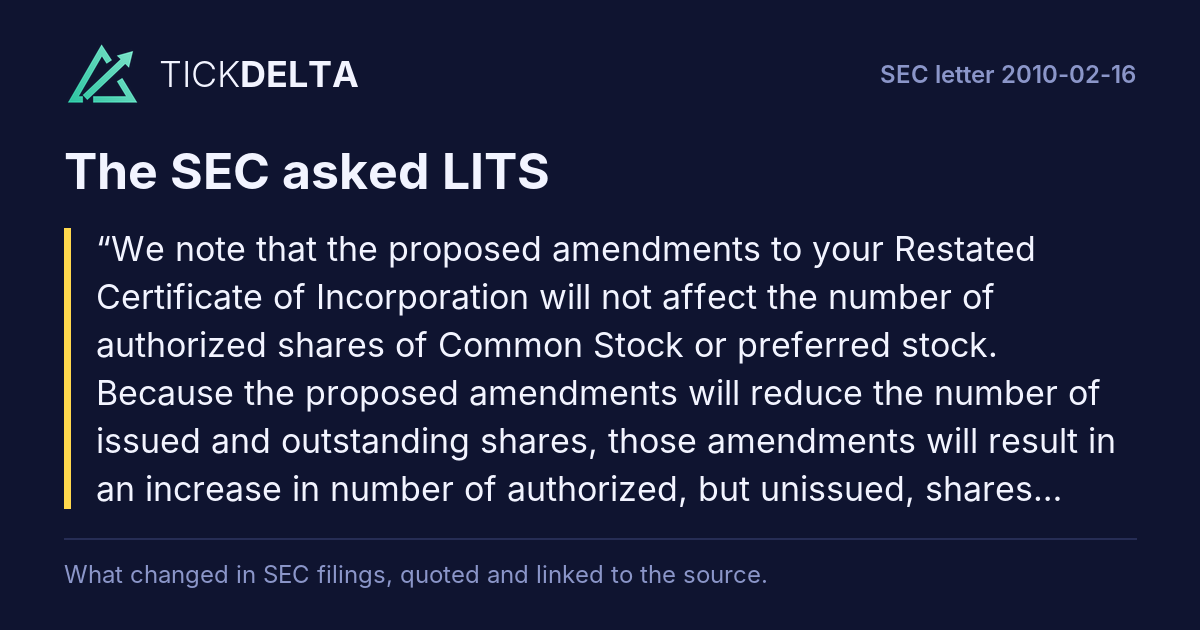
We note that the proposed amendments to your Restated Certificate of Incorporation will not affect the number of authorized shares of Common Stock or preferred stock. Because the proposed amendments will reduce the number of issued and outstanding shares, those amendments will result in an increase in number of authorized, but unissued, shares.
Rest of the question

Please revise your disclosure to discuss any plans to issue newly authorized shares as a result of the reverse stock split. If you have no such plans, please disclose that fact in your revised disclosure. * * * As appropriate, please amend your filing and respond to this comment within 10 business days or tell us when you will provide us with a response. You may wish to provide us with marked copies of the amendment to expedite our review. Please furnish a cover letter with your amendment that keys your response to our comment and provides any requested information. Detailed cover letters greatly facilitate our review. Please understand that we may have additional comments after reviewing your amendment and response to our comment.

LITS answered
#1

The Company will address your comment with the appropriate disclosure under the section captioned “Effects of the Reverse Stock Split — Effect on Authorized Shares of Common Stock and

Preferred Stock” on page 9 by adding the disclosure marked on the attached page of the proxy statement.

Any questions or comments regarding the foregoing should be directed to the undersigned in

Australia at 011 61 2 9878 0088. Read in the reply ↗

Also in this review: closing letter, 2010-02-19

14 other letters: notices that a filing will not be reviewed, requests to declare a registration effective, and the like

From the SEC's correspondence on EDGAR: staff letters (form UPLOAD) and company letters (form CORRESP), 39 letters filed since 2010-02-16. Questions and answers are matched by their numbers; topics come from words in each question. The reports are compared word for word (same form, before the first SEC letter against the first report after the company's reply). No AI.

Next in Owners and insiders Insider trades →

Work on LITS in a spreadsheet: Excel workbook (a sheet per section, ten years by column, charts, links to the filings) · CSV. For a Google Sheet that stays up to date, paste =IMPORTDATA("https://tickdelta.com/company/LITS/export.csv") into a cell.