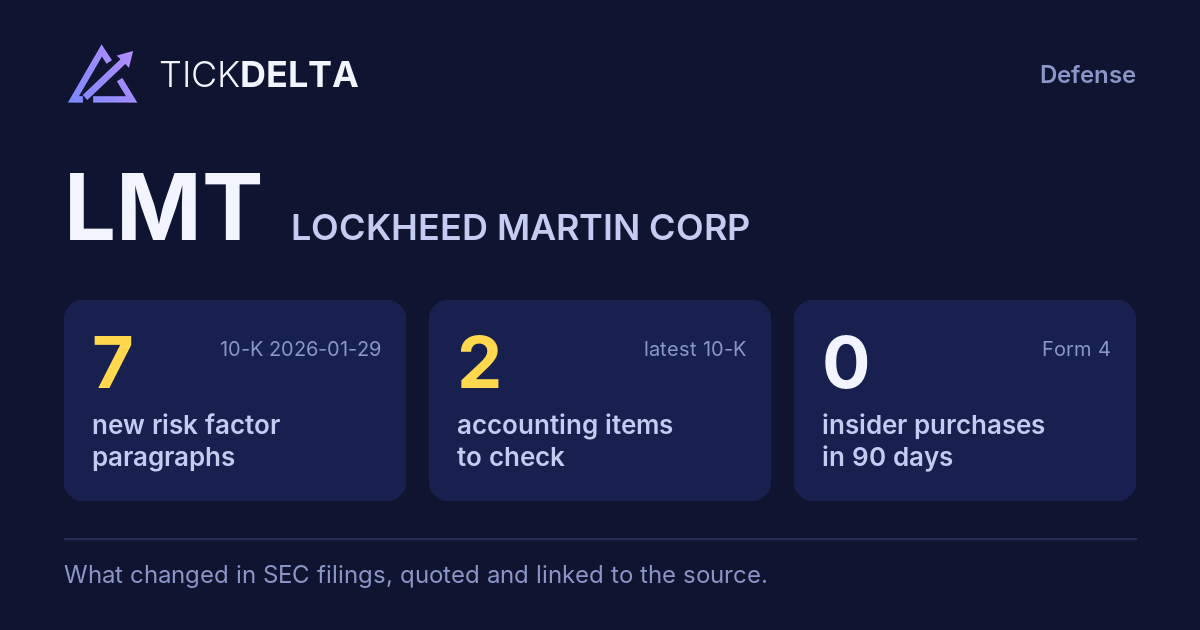
10-K 0001628280-26-004195 (2026-01-29) vs 10-K 0000936468-25-000009 (2025-01-28)
| Section | Compared text | Words now | Changed |
|---|
| Risk Factors | Item 1A | 11,521 |
16.1% |
| MD&A | Item 7 | 13,456 |
36.0% |
| Legal Proceedings | Item 3 | 248 |
3.7% |
| Accounting Policies | Item 8, Note 1 – Organization and Significant Accounting Policies | 8,916 |
23.2% |
The redline: what was cut and what was added
In each section, the paragraph that changed most, marked against last year's 10-K:
cut words struck through, new words highlighted and underlined.
Accounting Policies 295 words changed in this paragraph; it is 42% similar to last year's version.
We also As previously disclosed, we have a number of contracts with Türkish industry for the Türkish Utility Helicopter Program (TUHP), which anticipates co-production with Türkish industry for production of T70 helicopters for use in Türkiye, as well as the related provision of Türkish goods and services under buy-back or offset obligations, to include the future sales of helicopters built obligations. Sanctions imposed in Türkiye for sale globally. In 2020, 2020 by the U.S. Government imposed on Turkey’s defense procurement agency (SSB) and certain sanctions on Türkish entities and persons that have affected our ability to perform under the TUHP contracts, and contracts. During the second quarter of 2025, we have provided force majeure notices under the affected contracts. We partially stopped work on TUHP effective October 5, 2024. We are currently in discussions with our customer regarding the path forward for the program recognized a loss of $95 million in light of the continued impact status of restructuring discussions with our prime customer and the status of the sanctions on our ability to perform under the TUHP contracts and our decision to partially stop work. TUHP. As of December 31, 2024, 2025, cumulative losses related recognized to development work for date on the program remained insignificant at approximately $130 million and the program remains in a contract liability position on the balance sheet. The In the fourth quarter of 2025, we finalized an agreement with our prime contract customer to terminate the existing TUHP contracts may be negotiated and establish new contracts for a reduced scope of work, which became effective in January 2026. Our performance under the new contracts is subject to be restructured or terminated, either in whole or in part, and as a result, we could be at risk the receipt of recording significant reach-forward losses in U.S. export authorizations. However, if our future periods. Additionally, our customer and subcontractor have asserted that we do not have the contractual right to stop work. If we licensing applications are unable to reach an agreement in the near term, we or denied, our customer could elect to pursue other relief or remedies, drawdown on letters of credit, which could result in a further reduction in sales, the imposition negatively affect our cash flows and our ability to recover our costs, and we could incur additional losses of penalties or assessment of damages, and increased unrecoverable costs, which could be material up to our financial results. approximately $115 million.
Source: Item 8, Note 1 – Organization and Significant Accounting Policies, 10-K 0001628280-26-004195 vs Item 8, Note 1 – Organization and Significant Accounting Policies, 10-K 0000936468-25-000009
MD&A 267 words changed in this paragraph; it is 46% similar to last year's version.
Our business We have experienced, and financial performance is also affected by general economic conditions. We continue to experience experience, supply chain challenges, including supplier shortages and performance issues. These issues have delayed While on-time deliveries are improving, pressures remain in certain customer deliveries, have been a limiting factor on areas, and we are proactively working with our ability suppliers to ramp up production in response to customer demand for certain products and have caused out-of-sequence manufacturing, which increases costs and decreases operational efficiency. meet our contract commitments. In addition, macroeconomic conditions including elevated levels of inflation and macroeconomic conditions present risks for us, our suppliers and the stability of the broader defense industrial base. Certain costs, Supply chain challenges, including rising labor rates both the availability and supplier costs, have increased cost of goods, may be further impacted due to the imposition of tariffs and the availability of raw materials including rare earth minerals, as a result of inflation, discussed below under “Recent Developments in Trade and have adversely affected our margins on certain programs. In addition, some suppliers are reducing the duration of pricing validity of their proposals to us or seeking to reopen pricing on existing agreements, which is operationally challenging and increases the risk of cost volatility. We continue to work to mitigate challenges caused by the supply chain or current macroeconomic environment on our business, including by supporting small business and at-risk suppliers, deploying resources to work with our supply chain, securing materials and support by executing long-term contracts, enforcing existing contract terms, identifying alternative sources, collaborating with our customers to address industry-wide challenges, and optimizing our supply chain organization through digital transformation and workforce development. Regulatory Policies.” If we experience significant supply chain issues or high rates of inflation, and are unable to successfully mitigate the impact, our future profits, margins and cash flows, particularly for existing fixed-price contracts, may be adversely affected. Inflation and higher interest rates can also constrain the overall purchasing power of our customers for our products and services potentially impacting future orders, especially in a budget constrained environment. We remain committed to our ongoing efforts to increase the efficiency of our operations and improve the cost competitiveness and affordability of our products and services, which may, in part, offset cost increases from inflation.
Source: Item 7, 10-K 0001628280-26-004195 vs Item 7, 10-K 0000936468-25-000009
Risk Factors 202 words changed in this paragraph; it is 52% similar to last year's version.
We are subject to federal, state, local and foreign requirements for the protection of the environment, including those for discharge of hazardous materials and remediation of contaminated sites. Due in part to the complexity and pervasiveness of these requirements, we are a party to or have property subject to various lawsuits, proceedings, and remediation obligations. These types of matters could result in fines, penalties, cost reimbursements or contributions, compensatory or treble damages or non-monetary sanctions or relief. We have incurred and will continue to incur liabilities for environmental remediation at some of our current and former facilities and at third-party-owned sites where we have been designated a potentially responsible party as a result of our historical activities and those of our predecessor companies. Environmental remediation activities usually span many years, and the extent of financial exposure can be difficult to estimate. Among the variables management must assess in evaluating costs associated with these cases and remediation sites are the status of site assessment, extent of the contamination, impacts on natural resources, changing cost estimates, evolution of technologies used to remediate the site, continually evolving environmental standards, availability of insurance coverage and indemnification under existing agreements and cost allowability issues, including varying efforts by the U.S. Government to limit allowability of our costs in resolving liability at third-party-owned sites. Our environmental remediation related liabilities also could increase significantly because of acquisitions, stricter remediation standards for existing or newly regulated substances, changes in the interpretation or enforcement of existing laws and regulations, or the discovery of previously unknown or more extensive contamination. For information regarding these matters, including current estimates of the amounts that we believe are required for environmental remediation to the extent probable and estimable, see “Critical Accounting Policies – Environmental Matters” in the MD&A and “Note 14 – Legal Proceedings, Commitments and Contingencies” included in our Notes to Consolidated Financial Statements.
Source: Item 1A, 10-K 0001628280-26-004195 vs Item 1A, 10-K 0000936468-25-000009
Legal Proceedings 19 words changed in this paragraph; it is 84% similar to last year's version.
For information regarding the matters discussed above, including current estimates of the amounts that we believe are required for remediation or clean-up to the extent estimable, see “Critical Accounting Policies - Environmental Matters” in “Management’s Discussion and Analysis of Financial Condition and Results of Operations” and “Note 14 – Legal Proceedings, Commitments and Contingencies” included in our Notes to Consolidated Financial Statements, which are incorporated herein by reference.
Source: Item 3, 10-K 0001628280-26-004195 vs Item 3, 10-K 0000936468-25-000009
Every change, by type
Sentences and paragraphs of LMT's Risk Factors and MD&A, 10-K 2026-01-29 against 10-K 2025-01-28.
Each links to the text at sec.gov.
Quiet changes are sentences kept from last year with one to four words changed, at least one of them a hedge, a modal or a qualifier
(may, could, will, not, significant, material…). A year or date rolling forward is not counted.
The full word list
adverse, adversely, all, although, anticipate, anticipates, any, approximately, believe, believes, can, cannot, certain, could, expect, expects, generally, however, if, intend, intends, largely, likely, many, material, materially, may, might, most, must, never, no, not, possible, primarily, probable, should, significant, significantly, some, substantial, substantially, unlikely, will, would
AddedRisk Factors
Executive Orders. The President has issued multiple Executive Orders (EOs), including two that are intended to (i) simplify and accelerate the procurement process through an overhaul of the FAR and (ii) modernize the defense acquisition process by promoting commercial solutions, use of innovative acquisition authorities, and other existing streamlined processes. The Secretary of War recently released the Department’s Acquisition Transformation Strategy that is consistent with these EOs, and also aims to restructure the requirements process, funding authority, and reorganizes the Acquisition workforce. As part of this broader transformation, the U.S. Government is shifting its acquisition strategy toward longer‑term contract structures; some contracts that were previously negotiated on an annual basis may now be executed as a multi‑year procurement. We expect a revision to the DFARS in the next several months as well.
Read it in 10-K 2026-01-29 at sec.gov ↗
AddedRisk Factors
In addition, the President recently issued an EO that could limit certain contractors performing work under critical defense weapons, supplies, and equipment contracts from issuing excessive dividends or owner distributions, making share repurchases, and placing certain restrictions on executive compensation, as well as additional measures. It is expected that this EO will be implemented this year through a new DFARS clause and the EO’s restrictions will apply only after the DoW determines that a contractor has failed to meet identified contract performance requirements.
Read it in 10-K 2026-01-29 at sec.gov ↗
AddedRisk Factors
While the applicability and full impact of these initiatives on our business is uncertain, we are adapting to meet the changes in U.S. Government buying behaviors and expectations. We will continue to monitor and assess their effects on our business and financial results.
Read it in 10-K 2026-01-29 at sec.gov ↗
AddedRisk Factors
Government actions relating to rare earth minerals that are used in certain of our products, including U.S. Government sourcing prohibitions on the import of such minerals and the imposition of export controls on such minerals by China, have
Read it in 10-K 2026-01-29 at sec.gov ↗
AddedRisk Factors
raised concerns about supply availability. The rare earth supply chain continues to be vulnerable to disruption due to increasing scarcity and constrained capacity, and we are developing and executing mitigation plans designed to safeguard supply and meet future delivery commitments. We believe we will continue to meet our production and delivery commitments. However, if we are unable to successfully mitigate disruptions to the availability of rare earth minerals, our future profits, margins and cash flows may be adversely affected.
Read it in 10-K 2026-01-29 at sec.gov ↗
AddedRisk Factors
Certain materials and component parts that go into making our products are imported into the U.S. and are subject to tariffs, sanctions, embargoes, export and import controls, and other trade restrictions. The U.S. Government has increased, expanded, or imposed new tariffs on goods imported from various countries. We also export certain products to other countries, and several countries have increased or imposed additional tariffs in response to U.S. tariffs. The tariff environment has been dynamic in 2025, with changes occurring on an ongoing basis, and it is possible that additional developments will occur in the future, including as a result of negotiations between the U.S. and trade partners and legal challenges to the tariffs. At this time, excluding the near-term cash flow impact, we do not believe that the tariffs announced by the U.S. or actions taken in response to these tariffs by other countries will have a material adverse effect upon our results of operation or financial condition over the long term. The actual impact of the tariffs is subject to a number of factors including the effective date and duration of such tariffs, changes in the amount, scope and nature of the tariffs, any countermeasures that the target countries may take, the result of negotiations between the U.S. and trade partners, how our Tier 1 and Tier 2 suppliers react, possible substitution effects, possible duty-free entry entitlements, the outcome of any legal challenges, and any mitigating actions that may become available.
Read it in 10-K 2026-01-29 at sec.gov ↗
AddedRisk Factors
that our products or services infringe their intellectual property rights, which could result in costly and time-consuming disputes, subject us to damages and injunctions and adversely affect our ability to compete and perform on certain contracts.
Read it in 10-K 2026-01-29 at sec.gov ↗
RemovedRisk Factors
contract exceed total estimates of the transaction price. When this occurs, a provision for the entire loss is determined at the contract level and is recorded in the period in which the loss is evident.
Read it in 10-K 2025-01-28 at sec.gov ↗
RemovedRisk Factors
prevent or lessen the benefit of collaboration. We may not be successful in identifying or developing emerging technologies and may spend significant resources on projects that ultimately are unsuccessful or yield a low return on the amount invested.
Read it in 10-K 2025-01-28 at sec.gov ↗
RemovedRisk Factors
behalf who have access to export controlled, classified or other sensitive information could also adversely affect our business and reputation.
Read it in 10-K 2025-01-28 at sec.gov ↗
RewordedRisk Factors
If we fail in our development projects or projects, if our new products or technologies fail to achieve customer acceptance or acceptance, if competitors develop more capable technologies or offerings or develop new technologies or offerings or deliver existing offerings faster, or if stakeholders perceive our company as being slow to adapt, lacking in innovation or inconsistently delivering results, we may be unsuccessful in obtaining new contracts or winning all or a portion of next generation programs, including in key areas such as hypersonics and classified work, and this could adversely affect our future performance and financial results.
Read it in 10-K 2026-01-29 at sec.gov ↗
RewordedRisk Factors
Government functions as an intermediary in FMS sales, we are reliant on, and could be adversely impacted by, the international customers and the capacity and speed of the DoD’s DoW’s administration of requests from non-U.S. countries to convert requests to sales.
Read it in 10-K 2026-01-29 at sec.gov ↗
RewordedRisk Factors
We monitor developments in climate change-related laws, regulations and policies for their potential effect on us, however, we currently are not able to accurately predict the materiality of any potential costs associated with such developments. us.
Read it in 10-K 2026-01-29 at sec.gov ↗
RewordedRisk Factors
If When appropriations are delayed or a government shutdown were to occur occurs and continue continues for an extended period, we could may be at risk of reduced orders, program cancellations cancellations, nonpayment or payment delays and other disruptions and nonpayment. disruptions.
Read it in 10-K 2026-01-29 at sec.gov ↗
RewordedRisk Factors
Government functions as an intermediary in FMS sales, we are reliant on, and could be adversely impacted by, relations between the capacity and speed of the DoD’s administration of requests from non-U.S. countries to convert requests to sales. U.S.
Read it in 10-K 2026-01-29 at sec.gov ↗
RewordedRisk Factors
The improper conduct of our employees or others working on our behalf who have access to export controlled, classified or other sensitive information could also adversely affect our business and reputation.
Read it in 10-K 2026-01-29 at sec.gov ↗
RewordedRisk Factors
For a description of our current legal proceedings, see Item 3 – Legal Proceedings, “Critical Accounting Policies - Environmental Matters” in Management’s Discussion and Analysis of Financial Condition and Results of Operations Proceedings and “Note 14 – Legal Proceedings, Commitments and Contingencies” included in our Notes to Consolidated Financial Statements.
Read it in 10-K 2026-01-29 at sec.gov ↗
RewordedRisk Factors
Global conflicts, including Russia’s invasion of Ukraine, conflicts in the Middle East, and heightened tensions in the Pacific region, those noted above, have significantly elevated global geopolitical tensions and security concerns and resulted in increased demand for some of our products and services.
Read it in 10-K 2026-01-29 at sec.gov ↗
RewordedRisk Factors
In recent years, we have taken actions intended to mitigate reduce the risk related to size of our defined benefit pension plans including pension risk transfer transactions whereby we purchase group annuity contracts (GACs) from insurance companies using assets from the pension trust. trust and transfer associated pension liabilities to the insurers.
Read it in 10-K 2026-01-29 at sec.gov ↗
RewordedRisk Factors
Many of our employees and retirees participate in defined benefit pension plans, retiree medical and life insurance plans, and other postemployment plans (collectively, postretirement benefit plans). plans.
Read it in 10-K 2026-01-29 at sec.gov ↗
RewordedRisk Factors
The financial stability and viability of our contracting parties or lower-tier subcontractors have and in the future could adversely affect their ability to meet their performance obligation. obligations and result in an impact on our business and results of operations.
Read it in 10-K 2026-01-29 at sec.gov ↗
RewordedRisk Factors
When operating under a undefinitized contract action (UCA), Government, which is when we begin performing our obligations before the terms, specifications or price are finally agreed to between the parties, the U.S. parties.
Read it in 10-K 2026-01-29 at sec.gov ↗
Quiet changesRisk Factors
While we would generally expect to compete and be well positioned as the incumbent on existing programs, we may not be successful and, even if we are successful, the replacement programs may be funded at lower levels or result in lower margins.
Read it in 10-K 2026-01-29 at sec.gov ↗
Quiet changesRisk Factors
Government, international partners, or FMS customer countries to cut spending on this program or reduce or delay planned orders would may have an adverse impact on our business and results of operations.
Read it in 10-K 2026-01-29 at sec.gov ↗
Quiet changesRisk Factors
For example, higher interest rates generally reduce the measure of our gross pension obligations while lower interest rates increase it.
Read it in 10-K 2026-01-29 at sec.gov ↗
AddedMD&A
Recent regional conflicts have demonstrated the integral role Lockheed Martin products play in protecting people, and we are rapidly transforming our business to meet increased demand. We are expanding production capacity to continue delivering at scale, and we are harnessing leading-edge technologies like artificial intelligence and autonomy, open-architecture systems, and advanced networking to make defense forces more agile, adaptive and unpredictable. Our goal is to deliver overwhelming capability and value – quickly, at the needed quantities and with the greatest effectiveness – to enable overmatch and strengthen deterrence today and into the future.
Read it in 10-K 2026-01-29 at sec.gov ↗
AddedMD&A
As previously disclosed, during the second quarter of 2025, we paid $360 million, in cash, for the acquisition of Amentum’s Rapid Solutions business (Rapid Solutions). This acquisition integrates Rapid Solutions’ advanced space and airborne mission capabilities, including intelligence, surveillance and reconnaissance technologies, into Lockheed Martin’s portfolio. Rapid Solutions operates within our Space business segment and the financial results have been included within our
Read it in 10-K 2026-01-29 at sec.gov ↗
AddedMD&A
Our business and financial performance are impacted by general economic conditions including inflationary pressures, delays and disruptions in supply chains, business slowdowns or shutdowns, workforce challenges and labor shortfalls, impacts from technological change, and market volatility. These macroeconomic factors have contributed, and may continue to contribute, to increased costs, delays, disruptions and other performance challenges, as well as competing demands for limited resources to address such increased costs and other challenges, for our company, our suppliers and partners, and our customers.
Read it in 10-K 2026-01-29 at sec.gov ↗
AddedMD&A
Certain materials and component parts that go into making our products are imported into the U.S. and are subject to tariffs, sanctions, embargoes, export and import controls, and other trade restrictions. The U.S. Government has increased, expanded, or imposed new tariffs on goods imported from various countries. We also export certain products to other countries, and several countries have increased or imposed additional tariffs in response to U.S. tariffs. The tariff environment has been dynamic in 2025, with changes occurring on an ongoing basis, and it is possible that additional developments will occur in the future, including as a result of negotiations between the U.S. and trade partners and legal challenges to the tariffs. Tariffs that have been enacted or expanded by the U.S. or other countries had an impact of approximately $485 million on our cash flows during the year ended December 31, 2025. However, we expect a substantial portion of this impact to be recoverable over time. We are closely monitoring the situation and evaluating the potential future impacts of the imposition of the announced tariffs to our business and financial condition. We are pursuing available options to fully or substantially mitigate the impact of the increased tariffs or any future tariffs, including seeking exclusions, through drawbacks, refunds, recovering the costs in the pricing of our products, or securing alternative sources of materials or products. However, these actions may not be successful in fully or substantially mitigating the impact of tariffs, and, even if successful, there could continue to be a near-term volatility in cash flows due to the timing of when tariffs are paid compared to when such costs may be refunded or recovered. Additionally, a substantial amount of our imports qualify for duty-free entry. At this time, excluding the near-term cash flow impact, we do not believe that the tariffs announced by the U.S. or actions taken in response to these tariffs by other countries will have a material adverse effect upon our results of operations or financial condition over the long term.
Read it in 10-K 2026-01-29 at sec.gov ↗
AddedMD&A
Significant changes in tax, trade, or other policies either in the U.S. or other countries, as well as any fluctuation in foreign exchange rates as a result of such activity, could materially increase our tax burden, the price we pay for materials and component parts, the price our customers pay, and result in delays in products received or non-delivery from our vendors as well as impact the availability of materials (including rare earth minerals), which could materially impact our business and financial results.
Read it in 10-K 2026-01-29 at sec.gov ↗
AddedMD&A
In addition, recent government actions relating to rare earth minerals that are used in certain of our products have raised concerns about supply availability. We are monitoring the rare earth minerals supply chain and maintaining active engagement with our suppliers as the regulatory landscape evolves. If we are unable to successfully mitigate disruptions to the availability of rare earth minerals, our future profits, margins and cash flows may be adversely affected.
Read it in 10-K 2026-01-29 at sec.gov ↗
AddedMD&A
See Item 1A - Risk Factors for additional risks to the company related to the geopolitical and economic environment.
Read it in 10-K 2026-01-29 at sec.gov ↗
AddedMD&A
The Administration published its Fiscal Year (FY) 2026 budget request in June 2025. The budget request includes $848.3 billion in the base budget (discretionary) funding, and $113.3 billion in reconciliation (mandatory) funding. The One Big Beautiful Bill Act was signed by the President on July 4, 2025. The bill provides more than $150 billion in mandatory funding (inclusive of the $113.3 billion reconciliation funding) for the DoW available until September 30, 2029.
Read it in 10-K 2026-01-29 at sec.gov ↗
AddedMD&A
The National Defense Authorization Act (NDAA) for FY2026 was signed into law on December 18, 2025. This legislation authorizes $901 billion for Defense which includes an $8 billion increase over the President’s DoW Budget Request. On November 12, 2025, the President signed into law a Continuing Resolution funding the DoW through January 30, 2026. On January 20, 2026, Congress unveiled its final Appropriations package, which includes the Defense Appropriations Act conference report. This legislation provides $839.2 billion in funding for the DoW representing an $8.4 billion increase over the topline in the President’s DoW Budget Request. Congress is working to pass this bill prior to the expiration of the Continuing Resolution on January 30, 2026, but it is possible a short continuing resolution may be needed before final passage.
Read it in 10-K 2026-01-29 at sec.gov ↗
AddedMD&A
precision fire systems, Hellfire, and for Joint Air-to-Surface Standoff Missile (JASSM) from multiple nations, and for our Apache fire control system from Poland.
Read it in 10-K 2026-01-29 at sec.gov ↗
AddedMD&A
On July 4, 2025, the President signed into law the Tax Act. Key provisions include the permanent reinstatement of immediate expensing for domestic research expenditures, the restoration of full expensing for qualified machinery, equipment and other short-lived assets, and several modifications to existing international tax provisions.
Read it in 10-K 2026-01-29 at sec.gov ↗
AddedMD&A
During the second quarter of 2025, the IRS issued a Notice of Proposed Adjustment (NOPA) for 2018‑2020. The proposed adjustments stemmed from a tax‑accounting method change that was adopted in 2018 in connection with our ASC 606 implementation and the 2017 Tax Cuts and Jobs Act. This matter was resolved in the fourth quarter of 2025, and the corresponding uncertain tax position, along with any accrued interest and penalties, recorded in the second and third quarters of 2025 was removed from our December 31, 2025 balance. Also, during the fourth quarter of 2025, we entered into an agreed Revenue Agent Report (RAR) for the 2018-2022 federal income tax returns, resolving the remaining open federal income tax audit issues for those years.
Read it in 10-K 2026-01-29 at sec.gov ↗
RemovedMD&A
Our 21st Century Security® vision is to accelerate the adoption of advanced networking and other leading-edge technologies into the American defense enterprise, while enhancing the performance and value of our platforms and products for our customers. The aim of 21st Century Security is to integrate and continuously upgrade new and existing systems across all domains with advanced, open-architecture networking and operational technologies that make defense forces more agile, adaptive and unpredictable, enabling overmatch and strengthening deterrence today and into the future.
Read it in 10-K 2025-01-28 at sec.gov ↗
RemovedMD&A
21st Century Security guides our strategy and investments. As our growth pillars continue to evolve, we are focusing on advancing all-domain mission solutions through investments in digital technologies such as Artificial Intelligence (AI)/Machine Learning (ML), Autonomy and Crewed/Uncrewed Teaming, Generative Design and other technologies and capabilities enabling Combined Joint All-Domain Command and Control (CJADC2). Innovations in these areas will expand capability, improve interoperability, increase demand for our multi-domain solutions and drive efficient conversion of backlog into growth across our portfolio. We have well established programs across our business segments that continue to experience growth, including F-35 sustainment activity (Aeronautics); increased Patriot Advanced Capability-3 (PAC-3) production rates and increased demand for High Mobility Artillery Rocket System (HIMARS®) and Guided Multiple Launch Rocket Systems (GMLRS) (Missiles and Fire Control); radar surveillance systems and CH-53K King Stallion heavy lift helicopter (Rotary and Mission Systems); and the modernization of and enhancements to the Trident II D5 Fleet Ballistic Missile (FBM) (Space). Additionally, our teams continue to transform our products and rapidly innovate for the future, developing 6th generation air dominance technologies within Skunk Works®, demonstrating autonomous capabilities with the X-62A (F-16) and optionally piloted BLACK HAWK®, creating new Joint All-Domain Operating systems with Defense of Guam and AIR 6500 in Australia, establishing small-to-medium satellite capabilities to support proliferated space constellations and advancing hypersonic capabilities. Finally, we are always in pursuit of new program awards to develop future platforms that enable us to continue to strengthen our national defense and advance deterrence and global security.
Read it in 10-K 2025-01-28 at sec.gov ↗
RemovedMD&A
On September 9, 2024, we completed the sale of our Commercial Engine Solutions (CES) business, which was part of our Aeronautics business segment. We received $170 million in cash from the sale. Gains recognized from the sale in 2024 were not significant. The final gain is subject to certain post-closing adjustments, including final working capital, indemnification, and tax adjustments, which we expect to complete in 2025. This sale did not represent a strategic shift and the impacts to our consolidated results of operation, financial position, and cash were not significant. Accordingly, the operating results and cash flows for the CES business up to the divestiture date have not been reclassified to discontinued operations.
Read it in 10-K 2025-01-28 at sec.gov ↗
RemovedMD&A
On October 30, 2024, we closed our acquisition of Terran Orbital Corporation (Terran Orbital) for a purchase consideration of $314 million, which will be included in our Space business segment. Terran Orbital’s product and service offerings include satellite design, production, launch planning, mission operations, and on-orbit support for the aerospace and defense industries. We believe this acquisition will enable us to broaden our capabilities and offerings, provide additional innovative solutions to meet our customers’ emerging requirements, and provide expanded opportunities for our combined employees. The financial results of Terran Orbital have been included within our operating results in the period post-acquisition. See Note 1 to the consolidated financial statements for further information regarding the acquisition of Terran Orbital.
Read it in 10-K 2025-01-28 at sec.gov ↗
RemovedMD&A
On March 22, 2024, the President signed into law the second Fiscal Year (FY) 2024 Consolidated Appropriations package, which includes the DoD funding. This legislation reflects the Fiscal Responsibility Act of 2023 (FRA) spending limit of $886 billion for National Defense, of which $842 billion was for the DoD base budget.
Read it in 10-K 2025-01-28 at sec.gov ↗
RemovedMD&A
The President’s FY 2025 budget request was submitted to Congress on March 11, 2024, initiating the FY 2025 defense authorization and appropriations legislative process. The request included $895 billion for National Defense, of which $850 billion is for the DoD base budget, in keeping with the limit established by the FRA. While compression on overall requirements driven by the FRA limit is evident, the Office of the Secretary of Defense has stated the FY 2025 budget proposal meets their objectives of keeping National Defense Strategy priorities on track.
Read it in 10-K 2025-01-28 at sec.gov ↗
RemovedMD&A
On April 24, 2024, the President signed a bill providing a total of $95 billion in additional supplemental funding for Ukraine, Israel and Taiwan, including funding for the restock of U.S. munitions capacity. Supplemental funding legislation is not subject to the FRA limits.
Read it in 10-K 2025-01-28 at sec.gov ↗
RemovedMD&A
The House and Senate continue the legislative process on the FY 2025 budget. The National Defense Authorization Act for Fiscal Year 2025, signed by the President on December 24, 2024, is consistent with the FY 2025 President’s Budget Request (PBR) and Congressionally mandated budget caps established by the FRA with a topline of $849.8 billion. The House Appropriations Committee also marked its bill at this same level. The Senate Appropriations Committee, however, did not adhere to the FRA spending caps and marked budgets above the PBR, providing between a $21 billion and $25 billion increase over the PBR level. Regardless of toplines, all four Committees support additional funding for several of our programs, spread across our four business areas.
Read it in 10-K 2025-01-28 at sec.gov ↗
RemovedMD&A
Congress still needs to approve or revise the President’s FY 2025 budget proposal through enactment of appropriations bills and other policy legislation, which would then require final approval from the President in order for the FY 2025 budget process to conclude. A second Continuing Resolution (CR) for FY 2025 passed the House and Senate on December 20, 2024, and was signed by the President on December 21, 2024. The bill funds U.S. Government operations through March 14, 2025. In addition to the Continuing Resolution, the President also signed the Disaster Relief Supplemental Appropriations Act on December 21, 2024, which includes more than $100 billion in supplemental funding. Of note, the final version of the bill did
Read it in 10-K 2025-01-28 at sec.gov ↗
RemovedMD&A
not address the debt ceiling, which is set to expire mid-January 2025 and is expected to cause challenges at the start of the 119th Congressional negotiations. Once the debt ceiling is reached, Treasury may have to use extraordinary measures to prevent default. Treasury’s available cash and any extraordinary measures taken should delay the risk of default for at least several months after the end of the first quarter of 2025. In the upcoming months, the new Congress will return to the task of funding the U.S. Government for the balance of FY 2025. Significant differences that must be resolved include the different allocations as noted above and policy matters that arose during consideration of the CR and the underlying bills.
Read it in 10-K 2025-01-28 at sec.gov ↗
RemovedMD&A
The F-35 program primarily consists of production contracts, sustainment activities, and new development efforts. Production of the aircraft is expected to continue for many years given the U.S. Government’s objective of procuring 2,456 aircraft for the U.S. Air Force, U.S. Marine Corps, and U.S. Navy. We also have commitments from seven international partner countries and twelve FMS customers. We continue to see strong international demand for the F-35, with the Czech Republic signing an LOA in January 2024 to procure 24 F-35s, Singapore announcing in February 2024 its intent to purchase eight additional F-35s, and Greece signing an LOA in July 2024 to procure 20 F-35s. In November 2024, Romania signed an LOA to procure 32 aircraft, becoming the 20th nation to join the F-35 program. We expect international interest to continue to expand in the coming years.
Read it in 10-K 2025-01-28 at sec.gov ↗
RemovedMD&A
The F-35 program is significant and complex and we and our customers continually review aircraft performance, program and delivery schedule, cost and supply chain issues, and requirements as part of our internal program management efforts and the DoD, Congressional and international countries’ oversight and budgeting processes. Areas of particular focus currently include Lockheed Martin’s and our suppliers’ performance, software maturation related to TR-3 capability and software development more generally, flight test execution, cost of life cycle operations, sustainment, inflation-related cost and supply chain-related cost and schedule pressures, and efforts to increase affordability.
Read it in 10-K 2025-01-28 at sec.gov ↗
RewordedMD&A
Keys to enabling success of our strategy include We achieve this by developing and investing in differentiating technologies, forging strategic partnerships, including with commercial companies, executing on our multi-year business transformation initiative to enhance our digital infrastructure and increase efficiencies and collaboration throughout our business and initiative, maintaining fiscal discipline. discipline, and continuing to cultivate the greatest aerospace and defense workforce talent and culture in the world.
Read it in 10-K 2026-01-29 at sec.gov ↗
RewordedMD&A
The increase was primarily attributable to higher net sales of $1.2 approximately $1.4 billion for tactical and strike missile programs due to production ramp up on GMLRS, LRASM increased volume (primarily JASSM, LRASM, Guided Multiple Launch Rocket System (GMLRS) and JASSM; PrSM); and $145 about $450 million for integrated air and missile defense programs due to production ramp up on PAC-3. increased volume (primarily existing PAC-3 contracts).
Read it in 10-K 2026-01-29 at sec.gov ↗
RewordedMD&A
The total FAS/CAS Non-service FAS pension adjustment expense in 2022 reflects 2025 includes a noncash, non-operating pension settlement charge of $1.5 billion ($1.2 billion, $479 million ($377 million, or $4.33 $1.63 per share, after-tax) recognized in connection with the transfer of $4.3 billion $943 million of our gross defined benefit pension obligations and related plan assets to an insurance company companies in the second quarter of 2022. December 2025.
Read it in 10-K 2026-01-29 at sec.gov ↗
RewordedMD&A
The increase was primarily attributable to higher net sales of $1.0 approximately $1.9 billion on for the F-35 program due to higher increased volume on sustainment, production and development sustainment contracts; and $210 about $150 million on for the F-16 program due to the ramp up on production; partially offset by $200 million on increased production volume as this program continues to ramp.
Read it in 10-K 2026-01-29 at sec.gov ↗
RewordedMD&A
The decrease fluctuations in other unallocated, net was primarily for all periods were due to lower gains from the changes in the fair value of assets and liabilities related to deferred compensation plans in 2024 compared to in 2023 and fluctuations in costs associated with various corporate items, none of which were individually significant.
Read it in 10-K 2026-01-29 at sec.gov ↗
RewordedMD&A
Many of our employees and retirees participate in qualified and nonqualified defined benefit pension plans, retiree medical and life insurance plans and other postemployment plans (collectively, postretirement benefit plans - see (reference “Note 11 – Postretirement Benefit Plans” Retirement Benefits” included in our Notes to Consolidated Financial Statements). Statements) representing the majority of our accrued retirement benefit obligations.
Read it in 10-K 2026-01-29 at sec.gov ↗
RewordedMD&A
While Although the United States U.S. has not enacted legislation to adopt implement Pillar 2 and it is uncertain if it will do so in the future, 2, certain countries in which we operate have enacted such adopted legislation, and other countries are in the process of doing so. introducing legislation to implement Pillar 2.
Read it in 10-K 2026-01-29 at sec.gov ↗
RewordedMD&A
We Despite the Administration indicating their desire for a significant increase in defense spending in FY2027, we anticipate the federal budget budget, additional potential tax law changes, and regulatory environment will continue to be subject to debate and compromise shaped by, among other things, the new Administration and Congress, heightened political tensions, the global security environment, inflationary pressures, and macroeconomic conditions.
Read it in 10-K 2026-01-29 at sec.gov ↗
RewordedMD&A
The difference between the expected and actual return affects both the funded status of our benefit plans and the calculation of subsequent period FAS pension expense in subsequent periods. expense, where a market-related value of plan assets is determined using asset gains or losses over the prior three-year period.
Read it in 10-K 2026-01-29 at sec.gov ↗
RewordedMD&A
Net cash used for investing activities increased $98 $185 million in 2024 2025 compared to 2023, 2024, primarily due to a $231 $360 million cash payment for the acquisition of Terran Orbital, partially offset by proceeds of $170 million from the sale of our Commercial Engine Solutions (CES) business. Rapid Solutions.
Read it in 10-K 2026-01-29 at sec.gov ↗
RewordedMD&A
We continue to take actions to reduce the size of our defined benefit pension plans and expect to continue to look for opportunities to manage our pension liabilities through additional pension risk transfer transactions the purchase of group annuity contracts or other actions in future years.
Read it in 10-K 2026-01-29 at sec.gov ↗
RewordedMD&A
In December 2024, addition, during the third quarter of 2025, Lockheed Martin and the Joint Program Office (JPO) reached an agreement for an undefinitized contract action for Lot 18 and Lot 19 F-35 Air Vehicle Production Contract for 145 aircraft. 296 aircraft, followed by definitization on September 29, 2025.
Read it in 10-K 2026-01-29 at sec.gov ↗