Reworded10-Q Nov 5, 2026 vs 10-K Feb 19, 2026
In that case, the value of our securities could decline, and you could lose all or part of your investment. decline substantially.
Each branch is a paragraph in Risk Factors with nothing like it in the 10-K filed Feb 21, 2025. A box jumps to the paragraph as filed, below.
2 paragraphs in Risk Factors of the 10-K filed Feb 19, 2026 with nothing like them in the 10-K filed Feb 21, 2025. Quoted exactly. Paragraphs that were only edited are under 10-K change.
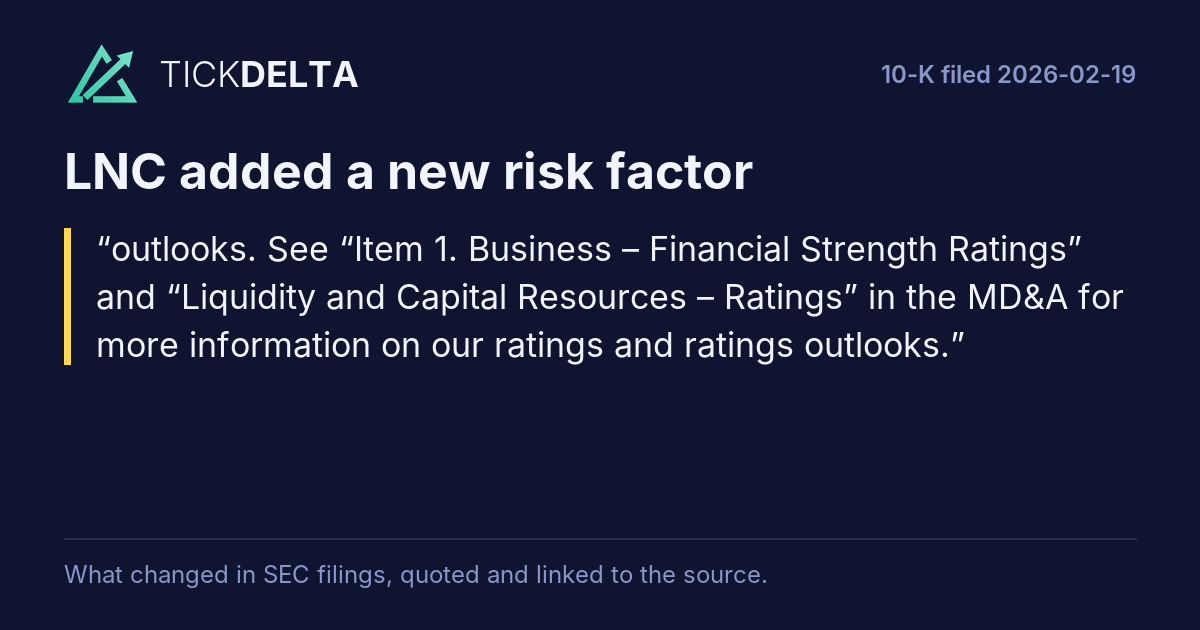
outlooks. See “Item 1. Business – Financial Strength Ratings” and “Liquidity and Capital Resources – Ratings” in the MD&A for more information on our ratings and ratings outlooks.
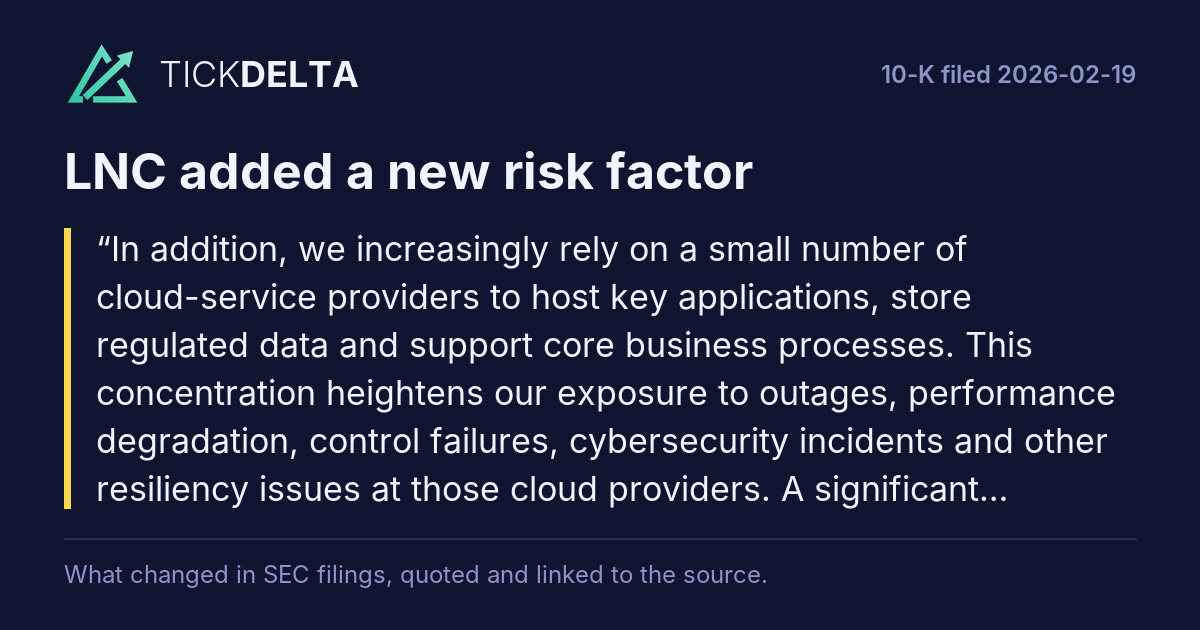
In addition, we increasingly rely on a small number of cloud-service providers to host key applications, store regulated data and support core business processes. This concentration heightens our exposure to outages, performance degradation, control failures, cybersecurity incidents and other resiliency issues at those cloud providers. A significant disruption, prolonged unavailability of cloud services or deficiencies in the effectiveness of their cybersecurity or operational controls could materially affect our operations, financial condition, ability to deliver products and services or ability to satisfy regulatory obligations.
New in the latest 10-Q
64 paragraphs in the 10-Q filed Nov 5, 2026 with nothing like them in the 10-Q filed Jul 30, 2026 (at least half the words must differ; new numbers alone do not count). Quoted exactly, grouped by the item heading above them. This is text that changed, not a judgement of how serious it is.
September 30, 2026 2025 ────────────────────────────────────────────────────────────────────────────────────────────────────────────────────────────────────────────────── Cash Flows from Operating Activities Net income (loss) $ 2,559 $ 423 Adjustments to reconcile net income (loss) to net cash provided by (used in) operating activities: Realized (gain) loss (502) 847 Market risk benefit (gain) loss (1,490) 10 Sales and maturities (purchases) of trading securities, net 273 653 Early extinguishment of debt (gain) loss – (94) Change in: Deferred acquisition costs, value of business acquired, deferred sales inducements and deferred front-end loads 562 482 Accrued investment income (79) (48) Insurance liabilities and reinsurance-related balances (1,104) (2,206) Accrued expenses 3 16 Federal income tax accruals 555 (56) Other (322) (427) Net cash provided by (used in) operating activities 455 (400) Cash Flows from Investing Activities Purchases of available-for-sale securities and equity securities (19,659) (10,935) Sales and maturities of available-for-sale securities and equity securities 17,450 9,751 Purchases of other investments (1,366) (1,556) Sales and repayments of other investments 714 858 Issuance of mortgage loans on real estate (5,176) (2,732) Repayment and maturities of mortgage loans on real estate 2,454 1,705 Repayment (issuance) of policy loans, net 34 (108) Net change in collateral on investments, certain derivatives and related settlements 3,464 2,801 Other 85 116 Net cash provided by (used in) investing activities (2,000) (100) Cash Flows from Financing Activities Payment of long-term debt, including current maturities (550) (300) Issuance of long-term debt, net of issuance costs 744 – Payment related to early extinguishment of debt – (421) Payment related to sale-leaseback transactions (3) (5) Proceeds from certain financing arrangements – 33 Payment related to certain financing arrangements (89) (98) Policyholder account balances: Deposits 15,525 15,394 Withdrawals (11,222) (9,256) Transfers from (to) separate accounts, net (1,696) (490) Repurchase of preferred stock (431) – Preferred stock repurchase premium (32) – Dividends paid to preferred stockholders (80) (80) Issuance of common stock – 825 Common stock issued for benefit plans (24) 4 Repurchase of common stock (50) – Dividends paid to common stockholders (258) (239) Net cash provided by (used in) financing activities 1,834 5,367 Net increase (decrease) in cash and invested cash 289 4,867 Cash and invested cash as of beginning-of-year 9,502 5,801 Cash and invested cash as of end-of-period $ 9,791 $ 10,668
Read in the 10-Q
Remaining Life as of September 30, 2026 Less Than 1 - 5 6 - 10 11 - 30 Over 30 Total
Read in the 10-Q
(2) Consists primarily of the update of fund mapping, volatility and other capital market assumptions.
Read in the 10-Q
For the nine months ended September 30, 2026, Variable Annuities had an unfavorable impact attributable to the annual assumption review driven by updates to policyholder behavior and separate account fee assumptions. For the nine months ended September 30, 2026, Fixed Annuities had a favorable impact attributable to the annual assumption review driven by updates to policyholder behavior assumptions. Retirement Plan Services did not have any significant assumption updates.
Read in the 10-Q
For the nine months ended September 30, 2025, Variable Annuities had an unfavorable impact attributable to the annual assumption review driven by updates to policyholder behavior and capital market assumptions and other items, partially offset by model enhancements and updates to separate account fee assumptions. For the nine months ended September 30, 2025, Fixed Annuities and Retirement Plan Services did not have any significant assumption updates.
Read in the 10-Q
(1) The cash flow assumption impact to the liability is calculated as the present value of expected future policy benefits less the present value of expected net premiums. For the nine months ended September 30, 2026 and 2025, the Traditional Life net effect of changes in cash flow assumptions gross of reinsurance reduced the liability by $ 48 million and $ 168 million, respectively. For the nine months ended September 30, 2026 and 2025, the net effect of changes in cash flow assumptions, net of reinsurance, favorably impacted net income by $ 12 million and $ 102 million, respectively. See “Effect of Annual Assumption Review” below for more information.
Read in the 10-Q
For the nine months ended September 30, 2026, Payout Annuities did not have a significant cash flow assumption impact attributable to the annual assumption review, and Traditional Life had a favorable cash flow assumption impact from updates to mortality assumptions, partially offset by updates to policyholder behavior assumptions.
Read in the 10-Q
For the nine months ended September 30, 2025, Payout Annuities did not have a significant cash flow assumption impact attributable to the annual assumption review, and Traditional Life had a favorable cash flow assumption impact from updates to mortality and policyholder behavior assumptions.
Read in the 10-Q
For the nine months ended September 30, 2026, we had an unfavorable cash flow assumption impact attributable to the annual assumption review from updates to incurred assumptions, partially offset by updates to the claim termination rate assumption.
Read in the 10-Q
For the nine months ended September 30, 2025, we had a favorable cash flow assumption impact attributable to the annual assumption review from updates to the claim termination rate assumption, partially offset by updates to social security and incurred assumptions.
Read in the 10-Q
For the nine months ended September 30, 2026, we had an unfavorable cash flow assumption impact attributable to the annual assumption review from updates to mortality assumptions on UL contracts with secondary guarantees, partially offset by updates to morbidity assumptions on MoneyGuard business.
Read in the 10-Q
For the nine months ended September 30, 2025, we had an unfavorable cash flow assumption impact attributable to the annual assumption review from updates to mortality and policyholder behavior assumptions, partially offset by updates to morbidity assumptions.
Read in the 10-Q
(1) For private placement securities, we use pricing matrices that utilize observable pricing inputs of similar public securities and Treasury yields as inputs to the fair value measurement. Private placement securities are classified as Level 2 when their inputs are derived from, or corroborated by, observable market data. For certain private placement securities, we use a discounted cash flow model that incorporates significant unobservable inputs, which reflect our assumptions about the inputs market participants would use in pricing the security. When these inputs are significant to the fair value measurement, we classify the security as Level 3.
Read in the 10-Q
(12) The impact to fair value can be an increase or decrease depending on the degree of change to the lapse or mortality rate assumptions.
Read in the 10-Q
Other investments on the Consolidated Balance Sheets include residual interests in securitization vehicles for which the fair value option was elected. We elected the fair value option for residual interests to reflect changes in fair value in net income (loss). Changes in fair value of residual interests are reflected in net investment income on the Consolidated Statements of Comprehensive Income (Loss).
Read in the 10-Q
Residual interests are generally valued based on our share of the vehicle’s equity, with consideration given to the terms of the senior tranches issued from the vehicle. Due to lack of observable inputs, residual interests are classified as Level 3 within the fair value hierarchy.
Read in the 10-Q
of a $ 147.5 million pre-tax cash payment for Glover class members (inclusive of all policyholders in Iwanski, TVPX ARS INC. and Vida). On August 11, 2026, the Iwanski court stayed the Iwanski case, and on September 17, 2026, the Iwanski court dismissed all pending motions, permitting leave to refile upon the conclusion of the renewed settlement proceedings in Glover.
Read in the 10-Q
In November 2022, we issued 500,000 depositary shares (“Series C Depositary Shares”), each representing a 1/25th interest in a share of our 9.250 % Fixed Rate Reset Non-Cumulative Preferred Stock, Series C, liquidation preference $ 25,000 per share (the “Series C Preferred Stock”) and in the aggregate representing 20,000 shares of Series C Preferred Stock, for aggregate net cash proceeds of $ 493 million. Dividends, if declared, will accrue and be payable on the first day of March and September each year, in arrears, at an annual rate of 9.250 % on the liquidation preference of $ 25,000 per share. From and including March 1, 2028 (the first “reset date”), the annual rate will reset every five years at a rate equal to the five-year treasury rate as of the most recent reset dividend determination date plus 5.318 %. We may, at our option, redeem our Series C Preferred Stock in whole but not in part within 90 days after certain rating agency events, or a regulatory capital event, or in whole or in part, from time to time, during the three-month period prior to each reset date.
Read in the 10-Q
In November 2022, we issued 20,000,000 depositary shares (“Series D Depositary Shares”), each representing a 1/1000th interest in a share of our 9.000 % Non-Cumulative Preferred Stock, Series D, liquidation preference $ 25,000 per share (the “Series D Preferred Stock”) and in the aggregate representing 20,000 shares of Series D Preferred Stock, for aggregate net cash proceeds of $ 493 million. Dividends, if declared, will accrue and be payable quarterly on the first day of March, June, September, and December each year, in arrears, at an annual rate of 9.000 %. We may, at our option, redeem our Series D Preferred Stock in whole but not in part, at any time prior to December 1, 2027, within 90 days after certain rating agency events, or a regulatory capital event, or in whole or in part, at any time or from time to time, on or after December 1, 2027.
Read in the 10-Q
The Series C Preferred Stock and the Series D Preferred Stock (together, the “Preferred Stock”) rank equally with each other for liquidation preference. The Preferred Stock is senior to our common stock with respect to the payment of dividends, if declared, and distributions of assets upon any liquidation, dissolution or winding-up of the Company. The ability of the Company to declare or pay dividends on, or purchase, redeem or otherwise acquire, shares of its common stock or any shares of the Company that rank junior to, or on parity with, the Preferred Stock is subject to certain restrictions in the event that we do not declare and pay (or set aside) dividends on the Preferred Stock for the last preceding dividend period.
Read in the 10-Q
Except as otherwise provided by law, every holder of Preferred Stock will have the right at every shareholders’ meeting to one vote for each share of Preferred Stock held in their name as of the record date for such meeting. In addition, at any time when six or more quarterly dividends, whether or not consecutive, on one or more series of the Preferred Stock are in default, the holders of all preferred stock at the time or times outstanding as to which such default shall exist shall have certain voting rights with respect to the election of additional directors to the Company’s Board of Directors, as provided in the Articles of Amendment designating each series of Preferred Stock.
Read in the 10-Q
Each share of Preferred Stock is perpetual and has no maturity date. The Preferred Stock is not convertible into, or exchangeable for, any other class or series of stock or other securities of the Company or its subsidiaries and is not subject to any mandatory redemption, sinking fund, retirement fund, purchase fund, or other similar provisions.
Read in the 10-Q
In September 2026, we repurchased through tender offers 265,945 Series C Depositary Shares (representing 10,637 shares of Series C Preferred Stock) and 6,854,214 Series D Depositary Shares (representing 6,854 shares of Series D Preferred Stock) for total cash consideration of $ 462 million (including accrued dividends) to tendering holders. As of the settlement of the tender offers on September 10, 2026, the underlying shares of Preferred Stock had an aggregate liquidation preference of $ 437 million and an aggregate carrying value of $ 431 million net of unamortized issuance costs. We recognized a preferred stock repurchase premium of $ 36 million that equals the amount paid to tendering holders plus excise taxes and transaction costs, less the aggregate carrying value of the underlying Preferred Stock. The repurchase premium was reflected as a reduction to retained earnings and separately reduced net income (loss) available to common stockholders for purposes of calculating earnings per share.
Read in the 10-Q
Group Protection: taxes, licenses and fees; DAC capitalization and amortization; other intangible amortization; and expenses associated with LOCs.
Read in the 10-Q
Retirement Plan Services: DAC capitalization and amortization; taxes, licenses and fees; and expenses associated with LOCs.
Read in the 10-Q
Group Protection: DAC capitalization and amortization; taxes, licenses and fees; other intangible amortization; and expenses associated with LOCs.
Read in the 10-Q
Retirement Plan Services: DAC capitalization and amortization; taxes, licenses and fees; and expenses associated with LOCs.
Read in the 10-Q
Group Protection: taxes, licenses and fees; DAC capitalization and amortization; other intangible amortization; and expenses associated with LOCs.
Read in the 10-Q
Retirement Plan Services: taxes, licenses and fees; DAC capitalization and amortization; and expenses associated with LOCs.
Read in the 10-Q
Other Operations: expenses incurred by Other Operations for its access to a financing facility and issuance of LOCs net of
Read in the 10-Q
Group Protection: taxes, licenses and fees; DAC capitalization and amortization; other intangible amortization; and expenses associated with LOCs.
Read in the 10-Q
Retirement Plan Services: DAC capitalization and amortization; taxes, licenses and fees; and expenses associated with LOCs.
Read in the 10-Q
(1) We generally purchase fixed maturity AFS securities to support our insurance liabilities and other long-term asset-liability management objectives, and we do not typically purchase and sell these securities to generate short-term realized gains. From time to time, we sell securities when we believe the price exceeds the underlying economic value or when we can reinvest the proceeds in a manner that better aligns with our asset-liability management objectives, which may result in realized gains or losses.
Read in the 10-Q
During the third quarter of 2026, the Federal Reserve raised the federal funds rate target range by 25 basis points to 3.75% to 4.00%, as inflation remains elevated. The Federal Reserve noted that economic activity continues to expand at a solid pace and labor market conditions have remained stable, while emphasizing its commitment to returning inflation to its long-term target of 2%.
Read in the 10-Q
and ceded MRB liabilities associated with these reinsurance agreements. We report ceded MRBs associated with these reinsurance agreements in other assets or other liabilities on the Consolidated Balance Sheets.
Read in the 10-Q
The impacts of our annual assumption review were driven primarily by the following:
Read in the 10-Q
• For Annuities, the unfavorable impact was driven by updates to policyholder behavior assumptions.
Read in the 10-Q
• For Life Insurance, the unfavorable impact was driven by updates to mortality assumptions on UL products with secondary guarantees and policyholder behavior assumptions on traditional life insurance business and other items, partially offset by updates to mortality assumptions on traditional life insurance business and morbidity assumptions on MoneyGuard® business.
Read in the 10-Q
• For Group Protection, the unfavorable impact was driven by updates to incurred assumptions and model enhancements, partially offset by updates to the claim termination rate assumption.
Read in the 10-Q
• For Other Operations, the unfavorable impact was driven by updates to the claim termination rate assumption related to certain disability income business.
Read in the 10-Q
• For excluded from income (loss) from operations, the favorable impact, related to net annuity product features, was driven by updates to policyholder behavior assumptions, partially offset by updates to separate account fee assumptions and model enhancements.
Read in the 10-Q
• For Annuities, the unfavorable impact was driven by model enhancements and updates to policyholder behavior assumptions.
Read in the 10-Q
• For Life Insurance, the unfavorable impact was driven by updates to mortality assumptions for our UL products with secondary guarantees and policyholder behavior assumptions, partially offset by updates to mortality assumptions for our traditional life insurance business and morbidity assumptions.
Read in the 10-Q
• For Group Protection, the favorable impact was driven by updates to the claim termination rate assumption, partially offset by updates to social security and incurred assumptions and other items.
Read in the 10-Q
• For excluded from income (loss) from operations, the unfavorable impact, related to net annuity product features, was driven by updates to policyholder behavior assumptions, model enhancements and other items, partially offset by updates to separate account fee assumptions.
Read in the 10-Q
• Improvement in income from operations in our Life Insurance and Retirement Plan Services segments.
Read in the 10-Q
• Higher investment losses primarily related to investments associated with the fourth quarter 2023 reinsurance transaction and the sale of certain fixed maturity AFS securities in 2026, the proceeds of which were reinvested in higher-yielding assets that better align with our asset-liability management objectives.
Read in the 10-Q
• Improvement in income from operations in our Life Insurance and Retirement Plan Services segments.
Read in the 10-Q
• Higher investment losses primarily related to investments associated with the fourth quarter 2023 reinsurance transaction and the sale of certain fixed maturity AFS securities in 2026, the proceeds of which were reinvested in higher-yielding assets that better align with our asset-liability management objectives.
Read in the 10-Q
See “Summary of Critical Accounting Estimates - Annual Assumption Review” above for information on the impacts from our annual assumption review.
Read in the 10-Q
See “Summary of Critical Accounting Estimates - Annual Assumption Review” above for information on the impacts from our annual assumption review.
Read in the 10-Q
(1) Includes net investment income on investments supporting certain reinsurance transactions, which has a corresponding offset in other revenues. Increases or decreases in net investment income on these investments may cause fluctuations in this line item that do not impact income from operations.
Read in the 10-Q
See “Summary of Critical Accounting Estimates - Annual Assumption Review” above for information on the impacts from our annual assumption review.
Read in the 10-Q
(1) Includes net investment income on investments supporting certain reinsurance transactions, which has a corresponding offset in other revenues. Increases or decreases in net investment income on these investments may cause fluctuations in this line item that do not impact income from operations.
Read in the 10-Q
See “Summary of Critical Accounting Estimates - Annual Assumption Review” for information on the impacts from our annual assumption review.
Read in the 10-Q
• Higher benefits and policyholder liability remeasurement driven by the impact from our annual assumption review.
Read in the 10-Q
• Higher benefits and policyholder liability remeasurement driven by the impact from our annual assumption review.
Read in the 10-Q
See “Summary of Critical Accounting Estimates - Annual Assumption Review” for information on the impacts from our annual assumption review.
Read in the 10-Q
borrowings from the cash management program related primarily to liquidity management and had no outstanding lending into the cash management program.
Read in the 10-Q
With respect to the status of the stays in the Iwanski and TVPX ARS INC. cases, the court in these matters stayed both cases on August 11, 2026, and on September 17, 2026, dismissed all pending motions in each case, permitting leave to refile upon the conclusion of the renewed settlement proceedings in Glover.
Read in the 10-Q
(1) Of the total number of shares purchased, no shares were received in connection with the exercise of stock options and related taxes. For the quarter ended September 30, 2026, there were 1,120,523 shares purchased as part of publicly announced plans or programs.
Read in the 10-Q
Per Depositary Share Depositary Shares Total Number of Depositary Shares Purchased (1) Purchase Accrued Dividends Total
Read in the 10-Q
(1) Reflects the repurchase of depositary shares (“Series D Depositary Shares”), each representing a 1/1000th interest in a share of our 9.000% Non-Cumulative Preferred Stock, Series D, through a tender offer that closed on September 10, 2026. For more information about the tender offer, see Note 15 herein.
Read in the 10-Q
10.1* Form of Restricted Stock Unit Award Agreement for Senior Management Committee (other than CEO) (August 2026; new hire/retention, cliff-vesting).*
Read in the 10-Q
Item 1A of the 10-Q filed Nov 5, 2026 against Item 1A of the 10-K filed Feb 19, 2026.
A 10-Q repeats only the risks that changed, so a 10-K paragraph that is missing from it is not counted as removed.
Added is a paragraph with nothing like it in the 10-K, Reworded a sentence that is in both with several words changed,
Quiet changes a sentence in both where one to four words changed and one is a hedge or a modal
(cut words struck through, new words highlighted).
Text on the page, not a score; each links to the filing at sec.gov.
Two-word phrases in Risk Factors of the 10-K filed Feb 19, 2026 that are in none of the 1 earlier 10-Ks stored, back to Feb 21, 2025
Used at least twice, small words left out. Counted, not picked: a phrase can be new because the company renamed something.
5 paragraphs of last year's Risk Factors with nothing like them now. The longest are quoted.
Item 1A of each 10-K and 10-Q on EDGAR, quoted exactly. Each paragraph links to the filing at sec.gov.
10-K change: what was reworded or cut, section by section.
Excel workbook · CSV. Google Sheet that stays up to date: paste =IMPORTDATA("https://tickdelta.com/company/LNC/export.csv") into a cell.