Paragraph 195 · 42% changed
Every version of it
Screener
/
SEC EDGAR
/CIK 0001434588
/10-K filed Feb 18, 2026, compared with Feb 19, 2025
/Numbers from the XBRL of the 10-Ks
Nasdaq
Consumer discretionary · Educational Services
Grand Canyon Education, Inc. LOPE
The 10-K against last year's
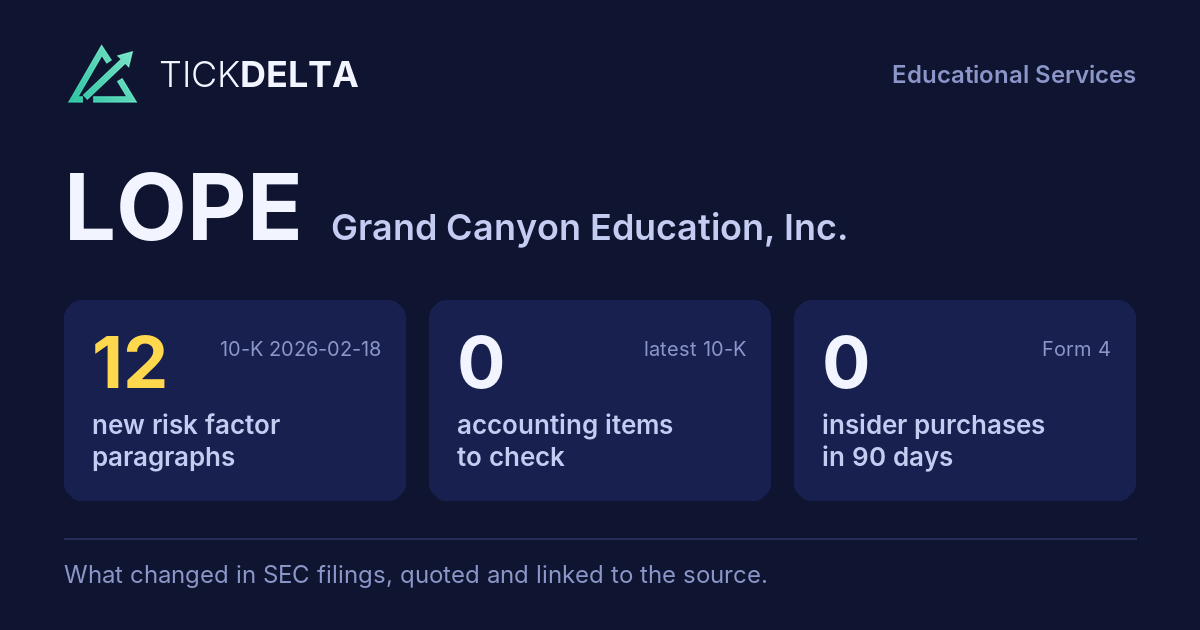
72 changes: 15 added, 5 removed, 52 reworded
10-K Feb 18, 2026 vs Feb 19, 2025
Risk Factors
10.1%
of the text changed · 14,567 words now · 12 new paragraphs, 2 gone
MD&A
20.3%
of the text changed · 5,517 words now · 3 new paragraphs, 3 gone
Legal Proceedings
54.6%
of the text changed · 805 words now
Accounting Policies
4.4%
of the text changed · 4,376 words now
10-K 0001104659-26-017047 (Feb 18, 2026) vs 10-K 0001558370-25-001150 (Feb 19, 2025)
Every paragraph, and how much of it changed
One bar per paragraph, in the order of the 10-K. Height and colour show the share of its words not in the closest paragraph a year earlier; the tallest bars are new paragraphs.
Risk Factors
195 paragraphs · 12 new · 29 reworded · 2 gone · 10-K Feb 18, 2026 against Feb 19, 2025
New paragraph
Reworded (5% of its words or more)
Same or nearly
Paragraph 156 · 39% changed
Every version of it
Paragraph 174 · 38% changed
Every version of it
The increased scrutiny and results-based accountability initiatives in the education sector, as well as ongoing policy differences in Congress regarding spending levels, could lead to significant changes in connection with the reauthorization of the HEA or otherwise. These changes may place additional regulatory burdens on postsecondary schools generally, and specific initiatives may be targeted at or have an impact upon companies like us that provide services to institutions of higher education. The adoption of any laws or regulations that limit our ability to provide our bundled services to our university partners could compromise our ability to drive revenue through their programs or make our platform less attractive to them. Congress could also enact laws or regulations that require us to modify our practices in ways that could increase our costs.
Paragraph 102 · 36% changed
Every version of it
Paragraph 81 · 36% changed
Every version of it
Additionally, university personnel or students, students of our university partners, or our employees or independent contractors, could use our online learning platform to store or process regulated personal information without our knowledge. In the event that our systems experience a data security incident, or an individual or entity accesses information without, or in excess of, proper authorization, we could be subject to data security incident notification laws, which may require prompt remediation and notification to individuals. If we are unaware of the data and information stored on our systems, we may be unable to appropriately comply with all legal obligations, and we may be exposed to governmental enforcement or prosecution actions, private litigation, fines and penalties or adverse publicity that could harm our reputation and business. As a result, we may be required to expend significant resources to protect against the threat of these security breaches or to alleviate problems caused by these breaches. A major breach, theft, or loss of personal information regarding our university partner’s students and their families or our employees that is held by us or our vendors, or a violation of laws or regulations relating to the same, could have a material adverse effect on our reputation and result in further regulation and oversight by federal and state authorities and increased costs of compliance.
Paragraph 162 · 35% changed
Every version of it
Because our university partner institutions operate in a whole, appear highly regulated industry, they are subject to be coordinated in the manner described in the 2021 FTC statement. These actions, or any future actions program reviews, audits, investigations, claims of non-compliance, and lawsuits by ED, FTC or any government agencies, regulatory agencies, students, employees, stockholders, and other federal or state government agencies or accrediting bodies third parties alleging non-compliance with oversight over us or GCU, if ultimately resolved adversely applicable legal requirements, many of which are imprecise and subject to us or GCU, could result in monetary penalties and liabilities, further impact GCU’s non-profit status, and/or cause reputational harm. At this time, interpretation. Similarly, we cannot predict what changes those could be subject to those same reviews. If the result of any such proceeding is unfavorable to our university partners, they may lose or what effect have limitations imposed on their state licensing, accreditation, or Title IV program participation; be required to pay monetary damages (including triple damages in certain whistleblower suits); or be subject to fines, injunctions, or other penalties, any of those outcomes which could have a material adverse effect on our business. their business, prospects, financial condition, and results of operations. Claims and lawsuits, and other regulatory actions, brought or taken against us or our university partners, even if they are without merit, may also result in adverse publicity, negatively affect the market price of our stock, adversely affect student enrollments, and reduce the willingness of third parties to do business with us. Even if we or our university partners adequately address the issues raised by any such proceeding and successfully defend against it, we may have to devote significant financial and management resources to address these issues, which could harm our business. See Part 1, Item 3 – Litigation for a discussion of certain litigation matters to which we are a party.
Paragraph 80 · 33% changed
Every version of it
Due to the sensitive nature of the personal information stored on our servers, our networks may be targeted by hackers seeking to access this data. A user who circumvents security measures could misappropriate sensitive information or cause interruptions or malfunctions in our operations. Although we use security and business controls to limit access and use of personal information, a third party may be able to circumvent those security and business controls, which could result in a breach of student or employee data and privacy. In addition, errors in the storage, use, or transmission of personal information could result in a breach of privacy for current or prospective students or employees. The increased use of mobile devices by our employees, and the employees and students of our university partners, increases the risk of Information Technology (“IT”) threats and vulnerabilities, such as those involving unsecure networks, as well as unintentional disclosure of personal information, such as through the theft of a mobile device, which can lead to a security incident and/or data breach.
Paragraph 74 · 33% changed
Every version of it
Paragraph 195 · 42% changed
Every version of it
10-K Feb 19, 2025You should not rely on an investment in our common stock to provide dividend income. We have not declared or paid cash dividends on our common stock to date. We currently intend to retain our future earnings, if any, to fund the development and growth of our business or to repurchase shares of our common stock. In addition, the terms of our prior credit facility limited, and the terms of any future debt agreements are likely to similarly limit, our ability to pay dividends. As a result, capital appreciation, if any, of our common stock will be your sole source of gain for the foreseeable future. Investors seeking cash dividends should not purchase our common stock.
10-K Feb 18, 2026
dividends. As a result, capital appreciation, if any, of our common stock will be your sole source of gain for the foreseeable future. Investors seeking cash dividends should not purchase our common stock.
Paragraph 156 · 39% changed
Every version of it
10-K Feb 19, 2025administered by the Western Interstate Commission for Higher Education (referred to as W-SARA). There is a yearly renewal for participating in NC-SARA and AZ-SARA and institutions must agree to meet certain requirements to participate. All states other than California are members of SARA.
10-K Feb 18, 2026
institutions must agree to meet certain requirements to participate. As of December 31, 2025, all states other than California are members of SARA.
Paragraph 174 · 38% changed
Every version of it
10-K Feb 19, 2025
The increased scrutiny and results-based accountability initiatives in the education sector, as well as ongoing policy differences in Congress regarding spending levels, could lead to significant changes in connection with the reauthorization of the HEA or otherwise. These changes may place additional regulatory burdens on postsecondary schools generally, and specific initiatives may be targeted at or have an impact upon companies like us that provide services to institutions of higher education. The adoption of any laws or regulations that limit our ability to provide our bundled services to our university partners could compromise our ability to drive revenue through their programs or make our platform less attractive to them. Congress could also enact laws or regulations that require us to modify our practices in ways that could increase our costs.
10-K Feb 18, 2026
The increased scrutiny and results-based accountability initiatives in the education sector, as well as ongoing policy differences in Congress regarding spending levels, could lead to significant changes in connection with the reauthorization of the HEA or otherwise. These changes may place additional regulatory burdens on postsecondary
Paragraph 102 · 36% changed
Every version of it
10-K Feb 19, 2025Recently published regulations could materially and adversely affect our business.
10-K Feb 18, 2026
Rulemaking by ED and Congressional legislation could materially and adversely affect our business.
Paragraph 81 · 36% changed
Every version of it
10-K Feb 19, 2025
Additionally, university personnel or students, or our employees or independent contractors, could use our online learning platform to store or process regulated personal information without our knowledge. In the event that our systems experience a data security incident, or an individual or entity accesses information without, or in excess of, proper authorization, we could be subject to data security incident notification laws, which may require prompt remediation and notification to individuals. If we are unaware of the data and information stored on our systems, we may be unable to appropriately comply with all legal obligations, and we may be exposed to governmental enforcement or prosecution actions, private litigation, fines and penalties or adverse publicity that could harm our reputation and business. As a result, we may be required to expend significant resources to protect against the threat of these security breaches or to alleviate problems caused by these breaches. A major breach, theft, or loss of personal information regarding our university partner’s students and their families or our employees that is held by us or our vendors, or a violation of laws or regulations relating to the same, could have a material adverse effect on our reputation and result in further regulation and oversight by federal and state authorities and increased costs of compliance.
10-K Feb 18, 2026
Additionally, personnel or students of our university partners, or our employees or independent contractors, could use our online learning platform to store or process regulated personal information without our knowledge. In the event that our systems experience a data security incident, or an individual or entity accesses information without, or in excess of, proper authorization, we could be subject to data security incident notification laws, which may require prompt remediation and notification to individuals. If we are unaware of the data and information stored on our systems,
Paragraph 162 · 35% changed
Every version of it
10-K Feb 19, 2025
a whole, appear to be coordinated in the manner described in the 2021 FTC statement. These actions, or any future actions by ED, FTC or any other federal or state government agencies or accrediting bodies with oversight over us or GCU, if ultimately resolved adversely to us or GCU, could result in monetary penalties and liabilities, further impact GCU’s non-profit status, and/or cause reputational harm. At this time, we cannot predict what changes those could be or what effect any of those outcomes could have on our business. Claims and lawsuits, and other regulatory actions, brought or taken against us or our university partners, even if they are without merit, may also result in adverse publicity, negatively affect the market price of our stock, adversely affect student enrollments, and reduce the willingness of third parties to do business with us. Even if we or our university partners adequately address the issues raised by any such proceeding and successfully defend against it, we may have to devote significant financial and management resources to address these issues, which could harm our business. See Part 1, Item 3 – Litigation for a discussion of certain litigation matters to which we are a party.
10-K Feb 18, 2026
Because our university partner institutions operate in a highly regulated industry, they are subject to program reviews, audits, investigations, claims of non-compliance, and lawsuits by government agencies, regulatory agencies, students, employees, stockholders, and other third parties alleging non-compliance with applicable legal requirements, many of which are imprecise and subject to interpretation. Similarly, we could be subject to those same reviews. If the result of any such proceeding is unfavorable to our university partners, they may lose or have limitations imposed on their state licensing, accreditation, or Title IV program participation; be required to pay monetary damages (including triple damages in certain whistleblower suits); or be subject to fines, injunctions, or other penalties, any of which could have a material adverse effect on their business, prospects, financial condition, and results of operations. Claims and lawsuits, and other regulatory actions, brought or taken against us or our university partners, even if they are without merit, may also result in adverse publicity, negatively affect the market price of our stock, adversely affect student enrollments, and reduce the willingness of third parties to do business with us. Even if we or our university partners adequately address the issues raised by any such proceeding and successfully defend against it, we may have to devote significant financial and management resources to address these issues, which could harm our business. See Part 1, Item 3 – Litigation for a discussion of certain litigation matters to which we are a party.
Paragraph 80 · 33% changed
Every version of it
10-K Feb 19, 2025
Due to the sensitive nature of the personal information stored on our servers, our networks may be targeted by hackers seeking to access this data. A user who circumvents security measures could misappropriate sensitive information or cause interruptions or malfunctions in our operations. Although we use security and business controls to limit access and use of personal information, a third party may be able to circumvent those security and business
10-K Feb 18, 2026
Due to the sensitive nature of the personal information stored on our servers, our networks may be targeted by hackers seeking to access this data. A user who circumvents security measures could misappropriate sensitive information or cause interruptions or malfunctions in our operations. Although we use security and business controls to limit access and use of personal information, a third party may be able to circumvent those security and business controls, which could result in a breach of student or employee data and privacy. In addition, errors in the storage, use, or transmission of personal information could result in a breach of privacy for current or prospective students or employees. The increased use of mobile devices by our employees, and the employees and students of our university partners, increases the risk of Information Technology (“IT”) threats and vulnerabilities, such as those involving unsecure networks, as well as unintentional disclosure of personal information, such as through the theft of a mobile device, which can lead to a security incident and/or data breach.
Paragraph 74 · 33% changed
Every version of it
10-K Feb 19, 2025Possession and use of personal information in our operations subjects us to risks and costs that could harm our business. We collect, use, and retain large amounts of personal information regarding our primary university partner’s applicants and students, including social security numbers, tax return information, personal and family financial data, and credit card numbers. We also collect and maintain personal information of our employees in the ordinary course of our business. Our services can be accessed globally through the Internet. Therefore, we may be subject to the application of national privacy laws in countries outside the U.S. from which applicants and students access our services. Such privacy laws could impose conditions that limit the way we market and provide our services.
10-K Feb 18, 2026
our business. Our services can be accessed globally through the Internet. Therefore, we may be subject to the application of national privacy laws in countries outside the U.S. from which applicants and students access our services. Such privacy laws could impose conditions that limit the way we market and provide our services.
MD&A
60 paragraphs · 3 new · 26 reworded · 3 gone · 10-K Feb 18, 2026 against Feb 19, 2025
New paragraph
Reworded (5% of its words or more)
Same or nearly
Paragraph 23 · 43% changed
Paragraph 24 · 36% changed
Paragraph 34 · 35% changed
The increase decrease in cash generated from operating activities between the year ended December 31, 2023 2024 and the year ended December 31, 2024 2025 was primarily due to increased the decline in net income between years due primarily to the litigation settlement and changes in working capital balances, primarily accounts payable and accrued liabilities. balances. Accounts payable increased between December 31, 2023 and December 31, 2024 by $9.7 million compared to the decrease between December 31, 2022 and December 31, 2023 of $3.1 million due to the timing of vendor payments. Accrued liabilities increased by $4.3 million between December 31, 2023 and December 31, 2024 whereas it decreased by $2.0 compared to the decrease of $3.4 million between December 31, 2022 2024 and December 31, 2023 2025, a decline year over year in cash provided by operating activities of $13.1 million due to timing differences of vendor payments. Income tax receivable/payable amounts decreased by $0.9 million between December 31, 2023 and December 31, 2024 compared to the last pay period at decrease of $7.1 million between December 31, 2024 and December 31, 2025, a $6.2 million decrease year over year in cash provided by operating activities due to timing of income tax payments. Deferred tax liability amounts decreased by $0.2 million between December 31, 2023 and December 31, 2024 compared to the end increase of each fiscal year. We define working capital as $14.7 million between December 31, 2024 and December 31, 2025, representing an increase in cash provided by operating activities of $14.9 million due to the acceleration of certain tax deductions and the passage of the
Paragraph 27 · 34% changed
Income tax expense. Income tax expense for the year ended December 31, 2023. 2025 was $63.7 million, a decrease of $1.4 million, or 2.2%, as compared to income tax expense of $65.1 million for the year ended December 31, 2024. Our effective tax rate was 22.8% during the year ended December 31, 2025 compared to 22.3% during the year ended December 31, 2024. The increase in the effective tax rate was primarily due to the tax treatment of the litigation settlement recorded in the year ended December 31, 2025 and changes in state income taxes. The effective tax rate increased year over year increases were partially offset due to higher state income taxes. This was partially offset by an increase in excess tax benefits of $1.5 $2.7 million as compared to $0.9 $1.5 million in the years ended December 31, 2024 2025 and 2023, respectively, and a higher contribution in lieu of state income taxes of $4.5 million in 2024 compared to $3.5 million in 2023. 2024, respectively. The inclusion of excess tax benefits and deficiencies as a component of our income tax expense increases the volatility within our provision for income taxes as the amount of excess tax benefits or deficiencies from share-based compensation awards are dependent on our stock price at the date the restricted awards vest. Our restricted stock vests in March each year so any benefit or expense will primarily impact the first quarter each year.
Paragraph 17 · 32% changed
We opened five sites in the year ended December 31, 2023, six sites in the year ended December 31, 2024 and closed one site increasing opened five new sites in the year ended December 31, 2025 while closing two sites in which we stopped recruiting new students in 2024 and merged two sites that were located in the same market bringing the total number of these sites to 45 47 at December 31, 2024, which 2025. This has also positively impacted the enrollment growth. Enrollments for GCU ground students were 24,678 at December 31, 2025 up from 24,552 at December 31, 2024 down from 25,209 at December 31, 2023 due to a small decline in traditional ground students year over year and the continued decline in professional studies students (working adults attending the university’s traditional campus at night), partially offset by an increase in ABSN students between years. 2024. GCU online enrollments were 107,148 at December 31, 2025, up from 98,597 at December 31, 2024, up from 92,070 at December 31, 2023, an increase of 7.1% 8.7% between years.
Paragraph 46 · 31% changed
development and furniture and equipment to support our increasing employee headcount. See Note 6 - Leases, in Item 8, Consolidated Financial Statements and Supplementary Data. There are no other material contractual obligations or commitments for the Company.
Paragraph 26 · 25% changed
Investment interest and other. Investment interest and other for the year ended December 31, 2024 2025 was $15.9 $13.9 million, an increase a decrease of $5.4 $2.0 million, as compared to $10.5 $15.9 million for the year ended December 31, 2023 2024 due to higher slightly lower investment balances and higher returns on those balances. our investment balances and the recognition of a loss on an equity investment in the second quarter of 2025 of $0.5 million.
Paragraph 28 · 24% changed
Paragraph 23 · 43% changed
10-K Feb 19, 2025Financing activities consumed $173.2 million of cash in the year ended December 31, 2024 compared to $137.1 million in the year ended December 31, 2023.
10-K Feb 18, 2026
Litigation settlement. A litigation settlement of $35.0 million was recorded in the year ended December 31, 2025 related to the settlement of the qui tam lawsuit.
Paragraph 24 · 36% changed
10-K Feb 19, 2025Impairment and other. Impairment and other expenses of $1.9 million for the year ended December 31, 2024 primarily includes the write-off of an internal use software project that the Company had been attempting to develop for its other university partners that has been terminated and costs relating to exiting certain off-campus classroom and laboratory sites.
10-K Feb 18, 2026
Lease termination, impairment and other. We incurred $2.4 million in lease termination and impairment charges in the year ended December 31, 2025 related to leases. In the third quarter of 2025, we agreed to pay $1.3 million to early terminate our Indiana office space lease effective in June 2027. We also entered into a sublease of that space for the period from January 2026 to June 2027 and entered into a new lease for a much smaller space effective January 2026. Additionally, an impairment was recorded in the amount of $1.1 million in the year ended December 31, 2025 for the two off-campus classroom and laboratory sites that were closed during the year. We incurred impairment and other expenses of $1.9 million for the year ended December 31, 2024 due to the write-off of an internal use software project that the Company had been attempting to develop for its other university partners that has been terminated and costs relating to exiting certain off-campus classroom and laboratory sites.
Paragraph 34 · 35% changed
10-K Feb 19, 2025
The increase in cash generated from operating activities between the year ended December 31, 2023 and the year ended December 31, 2024 was primarily due to increased income and changes in working capital balances, primarily accounts payable and accrued liabilities. Accounts payable increased between December 31, 2023 and December 31, 2024 by $9.7 million compared to the decrease between December 31, 2022 and December 31, 2023 of $3.1 million due to the timing of vendor payments. Accrued liabilities increased by $4.3 million between December 31, 2023 and December 31, 2024 whereas it decreased by $2.0 million between December 31, 2022 and December 31, 2023 due to timing differences between the last pay period at the end of each fiscal year. We define working capital as the
10-K Feb 18, 2026
The decrease in cash generated from operating activities between the year ended December 31, 2024 and the year ended December 31, 2025 was primarily due to the decline in net income between years due primarily to the litigation settlement and changes in working capital balances. Accounts payable increased by $9.7 million between December 31, 2023 and December 31, 2024 compared to the decrease of $3.4 million between December 31, 2024 and December 31, 2025, a decline year over year in cash provided by operating activities of $13.1 million due to timing of vendor payments. Income tax receivable/payable amounts decreased by $0.9 million between December 31, 2023 and December 31, 2024 compared to the decrease of $7.1 million between December 31, 2024 and December 31, 2025, a $6.2 million decrease year over year in cash provided by operating activities due to timing of income tax payments. Deferred tax liability amounts decreased by $0.2 million between December 31, 2023 and December 31, 2024 compared to the increase of $14.7 million between December 31, 2024 and December 31, 2025, representing an increase in cash provided by operating activities of $14.9 million due to the acceleration of certain tax deductions and the passage of the
Paragraph 27 · 34% changed
10-K Feb 19, 2025
December 31, 2023. The effective tax rate increased year over year due to higher state income taxes. This was partially offset by an increase in excess tax benefits of $1.5 million as compared to $0.9 million in the years ended December 31, 2024 and 2023, respectively, and a higher contribution in lieu of state income taxes of $4.5 million in 2024 compared to $3.5 million in 2023. The inclusion of excess tax benefits and deficiencies as a component of our income tax expense increases the volatility within our provision for income taxes as the amount of excess tax benefits or deficiencies from share-based compensation awards are dependent on our stock price at the date the restricted awards vest. Our restricted stock vests in March each year so any benefit or expense will primarily impact the first quarter each year.
10-K Feb 18, 2026
Income tax expense. Income tax expense for the year ended December 31, 2025 was $63.7 million, a decrease of $1.4 million, or 2.2%, as compared to income tax expense of $65.1 million for the year ended December 31, 2024. Our effective tax rate was 22.8% during the year ended December 31, 2025 compared to 22.3% during the year ended December 31, 2024. The increase in the effective tax rate was primarily due to the tax treatment of the litigation settlement recorded in the year ended December 31, 2025 and changes in state income taxes. The effective tax rate increases were partially offset due to an increase in excess tax benefits of $2.7 million as compared to $1.5 million in the years ended December 31, 2025 and 2024, respectively. The inclusion of excess tax benefits and deficiencies as a component of our income tax expense increases the volatility within our provision for income taxes as the amount of
Paragraph 17 · 32% changed
10-K Feb 19, 2025
We opened five sites in the year ended December 31, 2023, six sites in the year ended December 31, 2024 and closed one site increasing the total number of these sites to 45 at December 31, 2024, which has also positively impacted the enrollment growth. Enrollments for GCU ground students were 24,552 at December 31, 2024 down from 25,209 at December 31, 2023 due to a small decline in traditional ground students year over year and the continued decline in professional studies students (working adults attending the university’s traditional campus at night), partially offset by an increase in ABSN students between years. GCU online enrollments were 98,597 at December 31, 2024, up from 92,070 at December 31, 2023, an increase of 7.1% between years.
10-K Feb 18, 2026
We opened six sites in the year ended December 31, 2024 and opened five new sites in the year ended December 31, 2025 while closing two sites in which we stopped recruiting new students in 2024 and merged two sites that were located in the same market bringing the total number of these sites to 47 at December 31, 2025. This has also positively impacted the enrollment growth. Enrollments for GCU ground students were 24,678 at December 31, 2025 up from 24,552 at December 31, 2024. GCU online enrollments were 107,148 at December 31, 2025, up from 98,597 at December 31, 2024, an increase of 8.7% between years.
Paragraph 46 · 31% changed
10-K Feb 19, 2025
Consolidated Financial Statements and Supplementary Data. There are no other material contractual obligations or commitments for the Company.
10-K Feb 18, 2026
development and furniture and equipment to support our increasing employee headcount. See Note 6 - Leases, in Item 8, Consolidated Financial Statements and Supplementary Data. There are no other material contractual obligations or commitments for the Company.
Paragraph 26 · 25% changed
10-K Feb 19, 2025
Investment interest and other. Investment interest and other for the year ended December 31, 2024 was $15.9 million, an increase of $5.4 million, as compared to $10.5 million for the year ended December 31, 2023 due to higher investment balances and higher returns on those balances.
10-K Feb 18, 2026
Investment interest and other. Investment interest and other for the year ended December 31, 2025 was $13.9 million, a decrease of $2.0 million, as compared to $15.9 million for the year ended December 31, 2024 due to slightly lower investment balances and returns on our investment balances and the recognition of a loss on an equity investment in the second quarter of 2025 of $0.5 million.
Paragraph 28 · 24% changed
10-K Feb 19, 2025December 31, 2023. The effective tax rate increased year over year due to higher state income taxes. This was partially offset by an increase in excess tax benefits of $1.5 million as compared to $0.9 million in the years ended December 31, 2024 and 2023, respectively, and a higher contribution in lieu of state income taxes of $4.5 million in 2024 compared to $3.5 million in 2023. The inclusion of excess tax benefits and deficiencies as a component of our income tax expense increases the volatility within our provision for income taxes as the amount of excess tax benefits or deficiencies from share-based compensation awards are dependent on our stock price at the date the restricted awards vest. Our restricted stock vests in March each year so any benefit or expense will primarily impact the first quarter each year.
10-K Feb 18, 2026
excess tax benefits or deficiencies from share-based compensation awards are dependent on our stock price at the date the restricted stock awards vest. Our restricted stock awards vest in March each year so any benefit or expense will primarily impact the first quarter each year. The effective tax rate was also favorably impacted by an increase in contributions made in lieu of state income taxes to $5.0 million as compared to $4.5 million in the prior year.
A paragraph is matched with the one last year that shares the most of its words; under half in common makes it new. The paragraphs shown are the 8 reworded the most in each section.
The paragraph that changed most in each section
The redline
Marked against last year's 10-K: cut words struck through, new words highlighted.
MD&A248 words changed in this paragraph; it is 49% similar to last year's version.
classroom and laboratory sites were 4,919, 5,738, an increase of 9.8% 16.6% over enrollments at December 31, 2023, 2024, which includes 1,325 and 913 and 510 GCU students at December 31, 2024 2025 and 2023, respectively, and an increase in revenue per student year over year. 2024, respectively. Excluding sites closing closed in 2024 to new enrollments, total enrollments at our off-campus classroom and laboratory sites increased 14.9% 18.7% between years. The increase Revenue per student was flat between years primarily due to the additional day for leap year in 2024 which added additional service revenue of $1.5 million as compared to the current year, due to contract modifications for some of our university partners in which the revenue share percentage was reduced in exchange for us no longer reimbursing these partners for certain faculty costs, a slight decline year over year in revenue per student between years is primarily for online students due to the continued mix shift to students that have a slightly lower net tuition rate, and due to a slight decline in residential students between years. These decreases were offset by the service revenue per student for ABSN students at off-campus classroom and laboratory sites generating a significantly higher revenue per student than we earn under our agreement with GCU, as these agreements generally provide us with a higher revenue share percentage, the partners have higher tuition rates than GCU and the majority of our partners’ students take more credits on average per semester. The increase in revenue per student in the year ended December 31, 2024 was also due to the additional day for leap year in 2024 which added additional service revenue of $1.5 million as compared to the prior year and we earned revenue in 2024 with a university partner in which we helped the partner develop an ABSN program under a cost plus arrangement. We will earn limited revenue with this partner going forward. Contract modifications for some of our university partners in which the revenue share percentage was reduced in exchange for us no longer reimbursing the partner for certain faculty costs and the termination of one university partner contract at the end of the Spring 2024 semester had the effect of reducing revenue per student.
Source: Item 7, 10-K 0001104659-26-017047 vs Item 7, 10-K 0001558370-25-001150
Risk Factors189 words changed in this paragraph; it is 57% similar to last year's version.
Because our university partner institutions operate in a whole, appear highly regulated industry, they are subject to be coordinated in the manner described in the 2021 FTC statement. These actions, or any future actions program reviews, audits, investigations, claims of non-compliance, and lawsuits by ED, FTC or any government agencies, regulatory agencies, students, employees, stockholders, and other federal or state government agencies or accrediting bodies third parties alleging non-compliance with oversight over us or GCU, if ultimately resolved adversely applicable legal requirements, many of which are imprecise and subject to us or GCU, could result in monetary penalties and liabilities, further impact GCU’s non-profit status, and/or cause reputational harm. At this time, interpretation. Similarly, we cannot predict what changes those could be subject to those same reviews. If the result of any such proceeding is unfavorable to our university partners, they may lose or what effect have limitations imposed on their state licensing, accreditation, or Title IV program participation; be required to pay monetary damages (including triple damages in certain whistleblower suits); or be subject to fines, injunctions, or other penalties, any of those outcomes which could have a material adverse effect on our business. their business, prospects, financial condition, and results of operations. Claims and lawsuits, and other regulatory actions, brought or taken against us or our university partners, even if they are without merit, may also result in adverse publicity, negatively affect the market price of our stock, adversely affect student enrollments, and reduce the willingness of third parties to do business with us. Even if we or our university partners adequately address the issues raised by any such proceeding and successfully defend against it, we may have to devote significant financial and management resources to address these issues, which could harm our business. See Part 1, Item 3 – Litigation for a discussion of certain litigation matters to which we are a party.
Source: Item 1A, 10-K 0001104659-26-017047 vs Item 1A, 10-K 0001558370-25-001150
Legal Proceedings181 words changed in this paragraph; it is 56% similar to last year's version.
Ogdon v. Grand Canyon Education, Inc., et al. This putative class action was filed in May 2020 in federal district court in California and later transferred to United States District Court for the District of Arizona and asserts claims for violations of California’s False Advertising Law, Unfair Competition Law, Consumer Legal Remedies Act; Unjust Enrichment; and purported violations of the federal RICO statute, including a conspiracy claim. The defendants include the Company along with our chief executive officer, chief operating officer and chief financial officer. On May 27, 2022, after significant motions practice, In July 2025, the plaintiff filed a Second Amended Complaint and added an additional plaintiff. The Company filed an amended a motion to dismiss and a motion to strike certain allegations in Plaintiff’s amended complaint. On August 8, 2023, the court presiding over the dispute entered two orders: (1) an order granting in part the Company’s motion to dismiss as to Ogdon’s RICO claim from the case and to dismiss the individual Defendants; and (2) an order granting in part the Company’s motion to strike scandalous and impertinent allegations in Ogdon’s complaint about our business. Shortly thereafter Second Amended Complaint on August 22, 2023, Plaintiff moved the 19, 2025. The court to reconsider its dismissal of the RICO claim. Though discovery had commenced, and the Company substantially completed its discovery obligations has not yet ruled on the state-law claims, discovery was stayed on March 18, 2024, pending mediation motion. Discovery is ongoing, and the disposition of Ogdon’s motion for reconsideration. On March 29, 2024, the court issued an order reinstating Plaintiff’s RICO claim. On September 26, 2024, the court lifted the stay on discovery, and discovery resumed, with class certification briefing to conclude in September 2025. There there is currently no trial date scheduled in this matter.
Source: Item 3, via Note 7 – Commitments and Contingencies, 10-K 0001104659-26-017047 vs Item 3, via Note 7 – Commitments and Contingencies, 10-K 0001558370-25-001150
Accounting Policies75 words changed in this paragraph; it is 52% similar to last year's version.
Source: Item 8, Note 2 – Summary of Significant Accounting Policies, 10-K 0001104659-26-017047 vs Item 8, Note 2 – Summary of Significant Accounting Policies, 10-K 0001558370-25-001150
Sentences and paragraphs added, removed or reworded
Every change, by type
Sentences and paragraphs of LOPE's Risk Factors and MD&A, 10-K Feb 18, 2026 against 10-K Feb 19, 2025. Each links to the text at sec.gov.
Quiet changes are sentences kept from last year with one to four words changed, at least one of them a hedge, a modal or a qualifier (may, could, will, not, significant, material…). A year or date rolling forward is not counted.
The full word list
adverse, adversely, all, although, anticipate, anticipates, any, approximately, believe, believes, can, cannot, certain, could, expect, expects, generally, however, if, intend, intends, largely, likely, many, material, materially, may, might, most, must, never, no, not, possible, primarily, probable, should, significant, significantly, some, substantial, substantially, unlikely, will, would
AddedRisk Factors
a decrease in or perceived low student passage rates for professional licenses and other examinations necessary for students to work in their chosen fields post-graduation;
Read it in 10-K Feb 18, 2026 at sec.gov
AddedRisk Factors
an inability of our university partners’ to recruit, train and retain quality faculty members;
Read it in 10-K Feb 18, 2026 at sec.gov
AddedRisk Factors
In addition, our university partners have in the past, and will in the future, create additional programs to meet the needs of current and prospective students or the employers of their graduates. Even if our university partners are able to develop acceptable new programs that meet market demands, establishing or modifying such programs requires us and our university partners to make investments, incur market expenses and allocate extensive resources. If we and our university partners are unable to do so in a cost-effective manner or are unable to otherwise effectively manage the operations of such programs, our business, financial condition and results of operations could be adversely affected.
Read it in 10-K Feb 18, 2026 at sec.gov
AddedRisk Factors
In addition, we may in the future be subject to litigation under state and federal privacy and data security laws and regulations by governmental authorities and private litigants, including class actions, any of which could have a material adverse effect on our business.
Read it in 10-K Feb 18, 2026 at sec.gov
AddedRisk Factors
We face risks of cyber and other security incidents, which can impact our business, result in harm to our operations, and require costly remediation measures.
Read it in 10-K Feb 18, 2026 at sec.gov
AddedRisk Factors
We and our university partners face an ever-increasing number of cybersecurity threats from a broad range of threat actors. These threats can result in security incidents, including hacking and data breaches, which may be caused by intentional or unintentional actions by our employees, contractors, consultants, students or other third parties, including cyber-attacks by malicious threat actors. Security incidents may take the form of unauthorized activity and access, phishing or spoofing, malicious penetration, system viruses, malicious code, malware, ransomware, denial of service attacks and other organized cyber-attacks that seek to exploit vulnerabilities and threaten the confidentiality, integrity and availability of information.
Read it in 10-K Feb 18, 2026 at sec.gov
AddedRisk Factors
On July 4, 2025, President Trump signed the OBBBA, which makes a variety of changes to federal student aid programs, including loan limits, accountability measures for programs based on low earning outcomes, loan repayment, Pell Grant eligibility, and regulatory changes. As one example, OBBBA creates the “Do No Harm” accountability framework, effective July 2026, that institutions must satisfy at the program level in order for students to continue to receive Federal Direct Loans for such programs. Under this framework, OBBBA requires that an undergraduate program become ineligible for Federal Direct Loans if, in two out of three consecutive years, the median earnings of a cohort of program completers are less than the median earnings of working adults aged 25-34 with only a high school diploma, either in the state where the institution is located or, if fewer than 50% of students at the institution reside in the institution’s state, the national average. OBBBA requires that a graduate or professional program become ineligible for Federal Direct Loans if, in two out of three consecutive years, the median earnings of a cohort of program completers are
Read it in 10-K Feb 18, 2026 at sec.gov
AddedRisk Factors
less than the median earnings of working adults aged 25–34 with only a bachelor’s degree. Both the undergraduate and graduate/professional accountability provisions apply to the cohort of students who completed the program four years prior, are working, are not enrolled at any institution, and who received Federal Direct Loan funds for enrollment in the program. If a cohort is less than 30 students, the Secretary of Education may aggregate additional years of programmatic data. Based on data provided by the ED for students that graduated in 2015-2016, all of the programs that we provide services to our university partners passed this metric except GCU’s Masters in Mental and Social Health programs. GCU is currently analyzing the data related to these programs and it appears that most universities that provide these programs online to working adult students fail this metric. To the extent that these or any other programs offered by our university partners pursuant to our services agreements fail these metrics, then this would have an adverse effect on our university partners and thus an adverse effect on our business. We cannot predict with certainty how all of these regulatory requirements under the OBBBA will be applied or what their ultimate impact on our business will be.
Read it in 10-K Feb 18, 2026 at sec.gov
Show the other 36
AddedRisk Factors
ED has emphasized increased oversight of third-party servicers and has reiterated that institutions participating in Title IV programs remain responsible for the acts and omissions of their third-party service providers. As a result, ED audits, program reviews, investigations, and enforcement actions involving our university partners may also examine our activities, contractual arrangements, and compliance controls, which could require us to devote additional resources to compliance efforts or result in contractual, financial, or reputational impacts.
Read it in 10-K Feb 18, 2026 at sec.gov
AddedRisk Factors
ED has indicated that it may revisit the scope of third-party servicer requirements through future rulemaking or guidance, which could expand compliance obligations and increase our costs.
Read it in 10-K Feb 18, 2026 at sec.gov
AddedRisk Factors
Our success depends upon our ability and our university partners’ ability to recruit and retain key personnel.
Read it in 10-K Feb 18, 2026 at sec.gov
AddedRisk Factors
In addition, our university partners heavily rely on their ability to attract and retain qualified faculty members to effectively educate their students. If our university partners fail to retain sufficient numbers of qualified faculty members, fail to adequately train new faculty members, or allow relations with faculty members to deteriorate, they may be required to reduce the number or scope of classes available to students, which could in turn have a material adverse impact on our business.
Read it in 10-K Feb 18, 2026 at sec.gov
RemovedRisk Factors
RemovedRisk Factors
RewordedRisk Factors
RewordedRisk Factors
We are subject to rapidly changing laws and regulations relating to privacy and data security as a result of our collection and use of personal information, and any violations of failure to comply with such laws or regulations, regulations could lead to government enforcement actions or any breach, theft, private litigation or loss of such information, could adversely affect our reputation and operations.
Read it in 10-K Feb 18, 2026 at sec.gov
RewordedRisk Factors
We are required to perform system and process evaluation and testing of our internal control over financial reporting to allow management to report on the effectiveness of our internal control over financial reporting in our Form 10-K filing for that year, as required by Section 404 of the Sarbanes-Oxley Act.
Read it in 10-K Feb 18, 2026 at sec.gov
RewordedRisk Factors
AI technologies also carry the risk of generating content that is or is alleged to be deficient, biased, factually incorrect or infringing on third-party intellectual property rights. rights, which may in turn make us subject to private lawsuits, regulatory scrutiny, or reputational harm.
Read it in 10-K Feb 18, 2026 at sec.gov
RewordedRisk Factors
Although we use security and business controls to limit access and use of personal information, a third party may be able to circumvent those security and business controls, which could result in a breach of student or employee data and privacy.
Read it in 10-K Feb 18, 2026 at sec.gov
RewordedRisk Factors
GCU, for example, is a member of SARA in Arizona (AZ-SARA), which is administered by the Western Interstate Commission for Higher Education (referred to as W-SARA).
Read it in 10-K Feb 18, 2026 at sec.gov
RewordedRisk Factors
Capacity constraints, system disruptions, or security breaches in our online computer networks and phone systems could have a material adverse effect on our university partners’ ability to attract and retain students. students, which may negatively impact our business.
Read it in 10-K Feb 18, 2026 at sec.gov
RewordedRisk Factors
As of June 30, 2024 2025 and 2023, 2024, GCU’s composite score per GCU’s audited financial statements was 1.9 and 1.8, respectively, for both years, using the proprietary school calculation.
Read it in 10-K Feb 18, 2026 at sec.gov
RewordedRisk Factors
RewordedRisk Factors
In addition to other regulations discussed elsewhere (such as those related to the new Gainful Employment regulations), OBBBA), on July 1, 2024 new regulations became effective covering the areas of financial responsibility, administrative capability, certification standards and procedures, and ability to benefit.
Read it in 10-K Feb 18, 2026 at sec.gov
RewordedRisk Factors
Additionally, university personnel or students, students of our university partners, or our employees or independent contractors, could use our online learning platform to store or process regulated personal information without our knowledge.
Read it in 10-K Feb 18, 2026 at sec.gov
RewordedRisk Factors
To address this issue and to meet new ED requirements many schools have applied and have been approved to be approved institutional participants in the State Authorization Reciprocity Agreement (“SARA”). SARA.
Read it in 10-K Feb 18, 2026 at sec.gov
AddedMD&A
support expense will increase in the future as we continue to invest to meet our partners’ needs and these costs as a percentage of revenue could increase in the future.
Read it in 10-K Feb 18, 2026 at sec.gov
AddedMD&A
statements and the notes to those consolidated financial statements included elsewhere in this Annual Report on Form 10-K.
Read it in 10-K Feb 18, 2026 at sec.gov
AddedMD&A
(c) Reflects regulatory litigation and includes the qui tam settlement of $35.0 million.
Read it in 10-K Feb 18, 2026 at sec.gov
RemovedMD&A
RemovedMD&A
RemovedMD&A
RewordedMD&A
We anticipate that technology and academic services expenses as a percentage of revenue will increase in the future as we open more off-site classroom and laboratory sites and the growing due to increased technology costs and curriculum cost reimbursements although and that these increases might be offset by lower faculty reimbursements if more partners choose to adjust their contracts. costs as a percentage of revenue could grow as these costs grow at rates higher than revenue growth.
Read it in 10-K Feb 18, 2026 at sec.gov
RewordedMD&A
RewordedMD&A
Our marketing and communication expenses as a percentage of revenue decreased slightly increased by 0.5% 0.1% to 20.7% for the year ended December 31, 2025, from 20.6% for the year ended December 31, 2024, from 21.1% for the year ended December 31, 2023, primarily due to our ability to leverage our marketing and communication expenses across an increasing revenue base. 2024.
Read it in 10-K Feb 18, 2026 at sec.gov
RewordedMD&A
Investment interest and other for the year ended December 31, 2024 2025 was $15.9 $13.9 million, an increase a decrease of $5.4 $2.0 million, as compared to $10.5 $15.9 million for the year ended December 31, 2023 2024 due to higher slightly lower investment balances and higher returns on those balances. our investment balances and the recognition of a loss on an equity investment in the second quarter of 2025 of $0.5 million.
Read it in 10-K Feb 18, 2026 at sec.gov
RewordedMD&A
RewordedMD&A
Our general and administrative expenses as a percentage of revenue stayed flat at decreased by 0.2% to 4.3% for the year ended December 31, 2025, from 4.5% for the years year ended December 31, 2024 and 2023 2024, primarily due to our ability to leverage our general and administrative expenses across an increasing revenue base partially offset by the severance costs and the increase in professional fees including legal costs. base.
Read it in 10-K Feb 18, 2026 at sec.gov
RewordedMD&A
RewordedMD&A
The decrease increase in employee compensation and related expenses is primarily due to decreased faculty reimbursements due to changes in our agreements with certain university partners whereby we no longer reimburse these partners for their faculty costs, partially offset by increased headcount to support our 22 20 university partners and their increased enrollment growth, tenure-based salary adjustments, a significant year over year increase in benefit costs and the increased number of off-campus classroom and laboratory sites year over year.
Read it in 10-K Feb 18, 2026 at sec.gov
RewordedMD&A
Our liquidity position, as measured by cash and cash equivalents and investments increased decreased by $80.1 $24.5 million between December 31, 2023 2024 and December 31, 2024, 2025, which was largely attributable to cash flows from operations exceeding expended for share repurchases, investment purchases, net of proceeds repurchases and capital expenditures exceeding our cash provided by operations during the year ended December 31, 2024. 2025.
Read it in 10-K Feb 18, 2026 at sec.gov
RewordedMD&A
This increase was primarily due to increases in other technology and academic costs and costs, in occupancy and depreciation of $8.3 million costs and $4.9 million, respectively, partially offset by a decrease in employee compensation and related expenses, including share-based compensation and benefit costs of $3.0 million. $6.2 million, $1.9 million and $1.9 million, respectively.
Read it in 10-K Feb 18, 2026 at sec.gov
RewordedMD&A
The increase decrease in cash generated from operating activities between the year ended December 31, 2023 2024 and the year ended December 31, 2024 2025 was primarily due to increased the decline in net income between years due primarily to the litigation settlement and changes in working capital balances, primarily accounts payable and accrued liabilities. balances.
Read it in 10-K Feb 18, 2026 at sec.gov
RewordedMD&A
Accounts payable increased by $9.7 million between December 31, 2023 and December 31, 2024 by $9.7 million compared to the decrease of $3.4 million between December 31, 2022 2024 and December 31, 2023 2025, a decline year over year in cash provided by operating activities of $3.1 $13.1 million due to the timing of vendor payments.
Read it in 10-K Feb 18, 2026 at sec.gov
Sources
The two latest 10-Ks on EDGAR, section by section. Each change links to the text at sec.gov.
Also
New risk factors: paragraphs with nothing like them last year, quoted in full.
Work with it
Excel workbook · CSV. Google Sheet that stays up to date: paste =IMPORTDATA("https://tickdelta.com/company/LOPE/export.csv") into a cell.