tickdelta
Sign in

Tickdelta is free for now. Sign up and get Pro free

← Screener

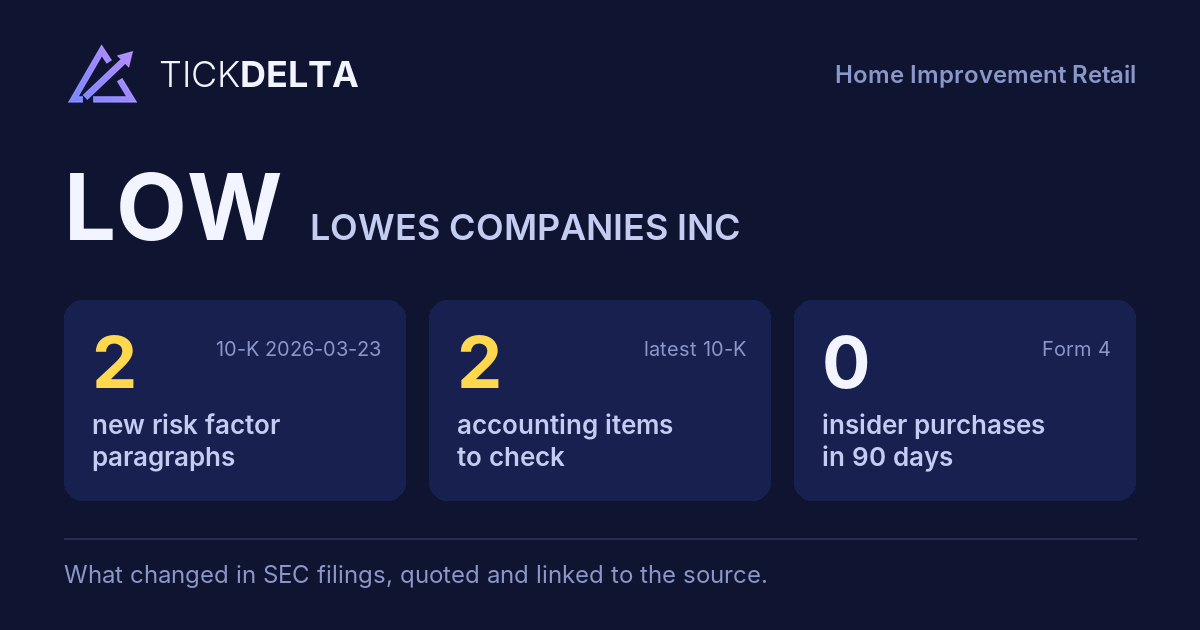
LOWLowe's

Consumer discretionary · Home Improvement Retail · NYSE

Lowe’s Companies, Inc. and subsidiaries (the Company or Lowe’s) is a Fortune® 100 company and the world’s second largest home improvement retailer. 10-K, Item 1

Headquarters
Mooresville, NC
Next results
around Nov 18, 2026
Compare with peers → Embed

When the SEC's staff reviews a filing, it writes to the company with numbered questions, and the company answers each one in a letter. SEC publishes the exchange once the review is over, at least 20 business days later. Below: what the staff asked LOW, and the company's answer to each question, quoted from the letters. A question is not an accusation; most reviews end with the company adding detail to its next filing.

Schedule 14A

2022-09-19 to 2022-10-17 · 3 questions · 1 letter from the SEC, 1 from the company
Review closed 2022-10-17
Controls
Definitive Proxy Statement on Schedule 14A filed May 27, 2022 · General
SEC asked (1)
Please expand your discussion to address how the experience of your Lead Independent Director is brought to bear in connection with your board’s role in risk oversight.
LOW answered
This letter responds to the comments of the staff (the “Staff”) of the Securities and Exchange Commission’s Division of Corporation Finance contained in the Staff’s letter addressed to Mr. Marvin R. Ellison, Chairman, President and Chief Executive Officer of Lowe’s Companies, Inc. (the “Company”), dated September 19, 2022, regarding the above-referenced filing. The Company acknowledges the Staff’s comments and confirms that it will enhance its future proxy disclosures in accordance with the topics discussed in your letter, to the extent applicable and responsive to Item 407(h) of Regulation S-K. One letter for all the questions, without numbered answers. Read the reply ↗
Definitive Proxy Statement on Schedule 14A filed May 27, 2022 · General
SEC asked (2)
Please expand upon the role that your Lead Independent Director plays in the leadership of the board. For example, please enhance your disclosure to address whether or not your Lead Independent Director may: • represent the board in communications with shareholders and other stakeholders; • require board consideration of, and/or override your CEO on, any risk matters; or • provide input on design of the board itself.
LOW answered

See the reply above.

Definitive Proxy Statement on Schedule 14A filed May 27, 2022 · General
SEC asked (3)
Please expand upon how your board administers its risk oversight function. For example, please disclose: • the timeframe over which you evaluate risks (e.g., short-term, intermediate-term, or long-term) and how you apply different oversight standards based upon the immediacy of the risk assessed; • whether you consult with outside advisors and experts to anticipate future threats and trends, and how often you
Rest of the question

re-assess your risk environment; and • how your risk oversight process aligns with your disclosure controls and procedures.

LOW answered

See the reply above.
Also in this review: closing letter, 2022-10-17
Form 10-K

2019-07-12 to 2019-07-30 · 3 questions · 1 letter from the SEC, 1 from the company
Review closed 2019-07-30
Non-GAAP measuresLiquidity and cashInventory
Non-GAAP Financial Measures · Return on Invested Capital, page 25
SEC asked (1)
We note you determine Return on Invested Capital using a non-GAAP financial measure, net operating profit after tax (NOPAT). However, we note you do not present this ratio using the most directly comparable GAAP measure. Please ensure all non-GAAP financial measures you present in future filings, including earnings releases filed under Form 8-K, fully comply with Item 10(e) of Regulation S-K.
LOW answered
We disclose in Item 7 of our 2018 Form 10-K, under the heading Non-GAAP Measures, that the Return on Invested Capital (ROIC) ratio is calculated using a non-GAAP measure of net operating profit after tax (NOPAT) and we provide a tabular reconciliation of net earnings, which is the most directly comparable GAAP measure, to NOPAT for each period ROIC is presented.
Rest of the answer

The denominator for ROIC is Average Debt and Equity, which represents a five-quarter average of the GAAP measures of equity and debt, including current maturities and short-term borrowings, as reported in current and prior annual and interim filings. In future filings, beginning with our next quarterly report filed on Form 10-Q, and including any earnings releases furnished on Form 8-K which include ROIC, the Company will include the most directly comparable GAAP measure for ROIC, which is considered to be the ratio of Net Earnings to Average Debt and Equity, and the Company will present this ratio with equal or greater prominence to the Non-GAAP ROIC ratio.

Read in the reply ↗
In its next report

First report after the company's reply of 2019-07-22: 10-Q filed 2019-09-03 ↗, against the 10-Q filed 2019-06-03 ↗.

Tickdelta does not hold the text of both reports, so they are not compared here.

Financial Condition, Liquidity and Capital Resources · Cash Flows Provided by Operating Activities, page 31
SEC asked (2)
We note your disclosure which states your net cash provided by operating activities for 2018 when compared to 2017 was driven primarily by changes in working capital. Please expand your disclosure to provide a more robust and insightful explanation of the key drivers of your working capital changes and any other factors that impacted your operating cash flows.
Rest of the question

We note significant increases in both the carrying value of your inventory as well as accounts payable, but it is unclear what drove the increases which are not entirely offsetting. We further note you experienced inventory shortages and made efforts to remove inventory clutter and reduced lower-performing inventory, while also increasing your overall level of inventory reflected on your balance sheet. Refer to Section IV. B. of SEC Interpretive Release 33-8350.

LOW answered
Net cash provided by operating activities totaled $6.2 billion in fiscal 2018, an increase of $1.1 billion over fiscal 2017. This year-over-year increase was due primarily to changes in working capital, driven by inventory and accounts payable, which decreased operating cash flow in fiscal 2017 and increased operating cash flow in 2018. In fiscal 2017, cash flows from operations decreased by $883 million due to inventory growth primarily in the first half of the year, which was not offset by growth in accounts payable at year-end due to timing of payments associated with these purchases.
Rest of the answer

In fiscal 2018, cash flow from operations increased by approximately $430 million as the increase in accounts payable exceeded the increase in inventory, and both grew above historical rates. Increases in inventory and accounts payable were driven by the inventory rationalization efforts during the second half of fiscal 2018, and an acceleration of 2019 spring purchases in the fourth quarter of 2018. The Company’s inventory rationalization efforts were designed to reduce inventory clutter in our stores and remove lower-performing inventory, and thereby further enable our ability to increase inventory investments to address out-of-stock issues and to increase minimum on-hand quantities primarily in certain categories requiring job-lot quantities (i.e. quantities necessary to support a customer’s project needs). These combined efforts drove a net increase in inventory, and an even greater increase in accounts payable as previously paid-for, lower performing inventory (i.e. inventory that turned more slowly) was replaced with newly purchased product that improved in-stock levels and on-hand job-lot quantities. In addition, during the fourth quarter of 2018, the Company accelerated its purchasing of seasonal products to prepare earlier for the upcoming

2019 spring season in early-spring markets. This acceleration resulted in an increase in inventory and a commensurate increase in accounts payable, with little impact on liquidity or cash flows for the year. Going forward and beginning with our next quarterly report on Form 10-Q, we will expand our disclosures related to cash flows from operating activities for both current and comparable periods to provide enhanced explanations of material changes in underlying drivers of cash flows including changes in specific components of working capital to enable the reader to better understand these changes and the interrelationships of changes among components such as inventory and accounts payable.

Read in the reply ↗
In its next report

First report after the company's reply of 2019-07-22: 10-Q filed 2019-09-03 ↗, against the 10-Q filed 2019-06-03 ↗.

Tickdelta does not hold the text of both reports, so they are not compared here.

Financial Statements · Cost of Sales and Selling, General and Administrative Expenses, page 52
SEC asked (3)
We note your disclosure regarding the primary costs classified as Cost of Sales. We also note elsewhere your recent change in accounting principle, which appears to have shifted certain depreciation expense to Cost of Sales. Please clarify for us and in your accounting policy disclosure, the extent to which you include depreciation expense in Cost of Sales.
Rest of the question

We further note you separately present depreciation below your measure of gross margin. Please clarify in your document whether the depreciation presented separately relates to costs of selling or otherwise explain to us your depreciation presentation.

LOW answered
We disclose in our significant accounting policies footnote, the significant cost components that distinguish expenses reported in Cost of

Sales versus those reported in Selling, General and Administrative expenses. Within this footnote, we disclose that the costs of product sold includes costs associated with operating the company’s distribution network including occupancy costs.
Rest of the answer

The Company considers depreciation of assets associated with our distribution network to be part of these occupancy costs and capitalizes these costs into the cost of product that flows through the distribution network. These costs are recognized in Cost of Sales in the period in which the associated inventory is sold. Furthermore, within this footnote, we disclose that costs associated with shipping and handling to customers is included in Cost of Sales. Depreciation of assets used in delivering product directly to customers is considered costs associated with shipping and handling to customers and are also classified in Cost of Sales. All other depreciation expense, related primarily to selling and corporate assets, is included in Depreciation and Amortization on the face of the consolidated statement of earnings. In future filings beginning with our next annual report on Form 10-K, the Company will ensure that our significant accounting policies footnote clarifies the components of depreciation expense included within costs of sales.

In addition, we disclose in our property and accumulated depreciation footnote, the amount of total depreciation expense recognized by the Company in each fiscal year presented. This amount includes total amounts presented on the face of the consolidated statement of earnings in Cost of Sales and Depreciation and Amortization, and we will clarify this in future filings. Depreciation expense included in Cost of Sales was less than 0.3% of total Cost of Sales in all periods presented. To the extent this amount becomes material to the users of the financial statements, the Company will ensure the amount of total depreciation reported in Cost of Sales is disclosed in future filings.

Read in the reply ↗
In its next report

First report after the company's reply of 2019-07-22: 10-Q filed 2019-09-03 ↗, against the 10-Q filed 2019-06-03 ↗.

Tickdelta does not hold the text of both reports, so they are not compared here.

Also in this review: closing letter, 2019-07-30

From the SEC's correspondence on EDGAR: staff letters (form UPLOAD) and company letters (form CORRESP), 6 letters filed since 2019-07-12. Questions and answers are matched by their numbers; topics come from words in each question. The reports are compared word for word (same form, before the first SEC letter against the first report after the company's reply). No AI.

Work on LOW in a spreadsheet: Excel workbook (a sheet per section, ten years by column, charts, links to the filings) · CSV. For a Google Sheet that stays up to date, paste =IMPORTDATA("https://tickdelta.com/company/LOW/export.csv") into a cell.