Paragraph 115 · 49% changed
Every version of it
Screener
/
SEC EDGAR
/CIK 0001397911
/10-K filed Feb 23, 2026, compared with Feb 20, 2025
/Numbers from the XBRL of the 10-Ks
Nasdaq
Financials · Exchanges & Brokers
LPL Financial Holdings Inc. LPLA
The 10-K against last year's
97 changes: 12 added, 11 removed, 73 reworded, 1 quiet changes
10-K Feb 23, 2026 vs Feb 20, 2025
Risk Factors
10.3%
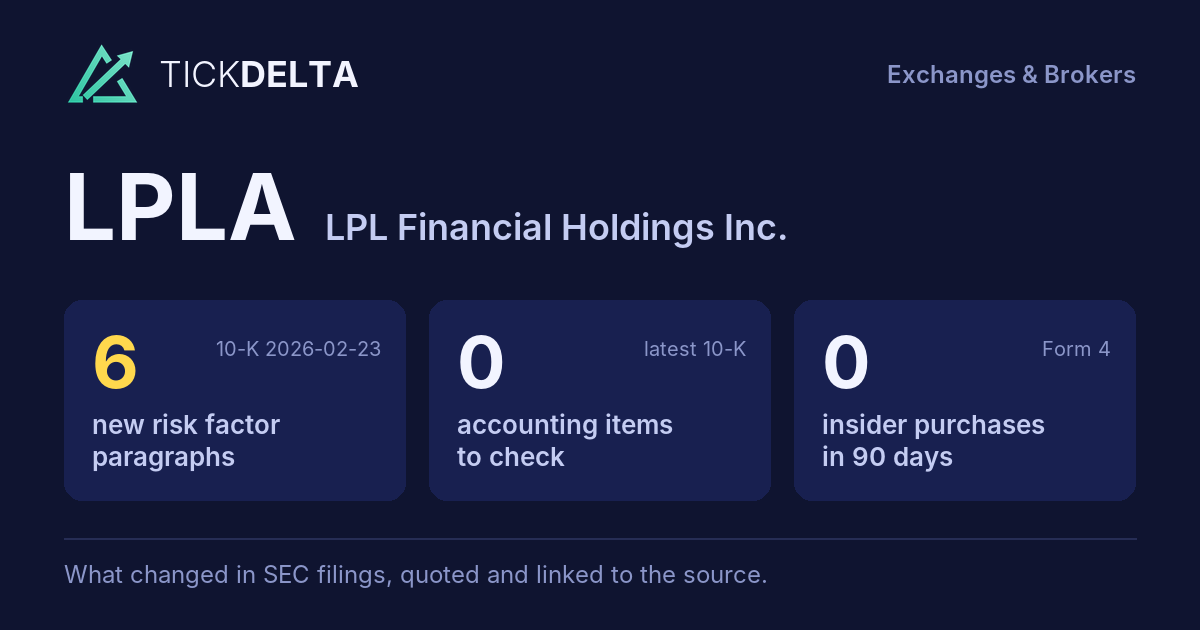
of the text changed · 13,970 words now · 6 new paragraphs, 3 gone
MD&A
11.7%
of the text changed · 10,792 words now · 6 new paragraphs, 8 gone
Legal Proceedings
16.9%
of the text changed · 1,213 words now
Accounting Policies
9.1%
of the text changed · 4,223 words now
10-K 0001628280-26-010705 (Feb 23, 2026) vs 10-K 0001397911-25-000018 (Feb 20, 2025)
Every paragraph, and how much of it changed
One bar per paragraph, in the order of the 10-K. Height and colour show the share of its words not in the closest paragraph a year earlier; the tallest bars are new paragraphs.
Risk Factors
193 paragraphs · 6 new · 43 reworded · 3 gone · 10-K Feb 23, 2026 against Feb 20, 2025
New paragraph
Reworded (5% of its words or more)
Same or nearly
Paragraph 37 · 48% changed
Every version of it
liability relating to actions of their financial advisors. We believe that competition within our industry will intensify as a result of consolidation and acquisition activity and because new competitors face few barriers to entry, which could adversely affect our ability to recruit new advisors and retain existing advisors. Additionally, we expect our current and future competitors to continue to invest in, develop and integrate new technologies, including artificial intelligence and machine learning solutions, to reduce costs associated with providing wealth management services. If we are unable to achieve similar cost reductions our business may become less competitive, which could make it more challenging to retain advisors on our platform or attract new advisors, which could have a material adverse effect on our business. In addition, while we believe that our business is well-positioned to take advantage of technological development, the perception that novel applications of technology could disrupt our business could cause the price of our common stock to fluctuate substantially and result in losses for our investors.
Paragraph 112 · 43% changed
Every version of it
Paragraph 169 · 39% changed
Every version of it
We cannot be certain that our systems and networks will not be subject to successful attacks, despite the measures we have taken and may take in the future to address and mitigate cybersecurity, privacy and technology risks. Additionally, in the course of operations, we rely upon the technology systems of, and share sensitive proprietary information and personal data with, vendors, third parties and other financial institutions. institutions, and our off-shore subsidiary, some of which may store and process data off-shore. Storing data off-shore can lead to increased cybersecurity risks, as international jurisdictions have varying cybersecurity laws, regulations and practices which can result in lower security standards. Additionally, data being stored off-shore can mean that we and the third parties have reduced visibility and control over the security of the data. Transfers of personal data internationally can also trigger certain data protection legal requirements, including to ensure that safeguards are in place in relation to such transfers. We also rely upon software and data feeds from various third parties. Although we have a third party third-party risk management program and conduct due diligence regarding cybersecurity and data protection practices before integrating our systems or sharing sensitive data with third-party vendors, this due diligence may not uncover administrative, technical or electronic gaps or flaws in their processes or systems. In the past, we and third parties on whose systems we rely have experienced Security Events that have resulted in the temporary interruption of our operations, breach notification costs and reputational harm with regulators, current and potential advisors, and advisors’ clients, and we may experience similar or more significant events in the future. Future Security Events involving individual and regulatory notifications could lead to litigation involving other financial institutions, class actions, regulatory investigations or other harm.
Paragraph 158 · 33% changed
Every version of it
We currently, and may in the future, future use, develop, develop and incorporate systems and tools that leverage artificial intelligence and other machine learning and large language models, including generative artificial intelligence (collectively, “AI”), within our technology platform and services. The use of AI presents could exacerbate existing risks or create new and challenges that unpredictable risks to our business, which could adversely impact our business. the markets in which we operate or subject us to increased competition and regulation. The development, adoption, adoption and application of AI technologies are still in their early stages, and ineffective or inadequate AI governance, development or deployment practices by us or by third-party developers or vendors could result in unintended consequences. consequences, and may not yield the benefits, insights and efficiencies that we or others anticipate. For example, AI algorithms that we use may be flawed or may be based on datasets that are biased or insufficient. In addition, insufficient and could produce inaccurate, incomplete, or ineffective results, any of which could result in operational and reputational harm. While we aim to develop and use AI responsibly and attempt to identify and mitigate technological, ethical and legal issues presented by its use, we may be unsuccessful in identifying or resolving such issues before they arise. Any latency, disruption, or failure in our AI and related systems or infrastructure could result in delays or errors in our products and services. services that rely on AI. Developing, testing, and deploying resource-intensive AI systems may require additional investment and increase our costs. There also may be real or perceived social harm, unfairness, or other outcomes that undermine public confidence in the use and deployment of AI. Further, our external third-party service providers may fail to use AI appropriately. Although we conduct diligence on our external service providers and, when appropriate, seek contractual protections from them to mitigate AI-related risks, we are not able to control how our advisors or external service providers develop, maintain or use their AI systems, nor do we have control over their use or disclosure of data with such AI systems, which can include material non-public information or personal identifiable information. Any of the foregoing may result in harm to our business, results of operations, or reputation.
Paragraph 145 · 25% changed
Every version of it
Paragraph 167 · 25% changed
Every version of it
As malicious cyber activity becomes more complex and escalates, including activity that originates outside of the United States, the risks we face relating to transmission of data and our use of service providers outside of our network, as well as the storing or processing of data within our network, intensify. While we maintain cyber liability insurance, this insurance does not cover certain types of potential losses and, for covered losses, may not be sufficient in amount to protect us against all such losses.
Paragraph 170 · 24% changed
Every version of it
Paragraph 115 · 49% changed
Every version of it
10-K Feb 20, 2025Clients of our advisors have control over their assets that are served under our platforms. Poor service or performance of the financial products that we offer, the emergence of new financial products or services from others, harm to our reputation or competitive pressures on pricing of such services or products may result in the loss of clients. In addition, we must monitor the pricing of our services and financial products in relation to competitors and periodically may need to adjust commission and fee rates, interest rates on deposits and margin loans and other fee structures to remain competitive. Competition from other financial services firms, such as reduced or zero commissions to attract clients or trading volume, direct-to-investor online financial services, including so-called “robo” advice, or higher deposit rates to attract client cash balances, could result in pricing pressure or otherwise adversely impact our business. The decrease in revenue that could result from such an event could have a material adverse effect on our business.
10-K Feb 23, 2026
or higher deposit rates to attract client cash balances, could result in pricing pressure or otherwise adversely impact our business. The decrease in revenue that could result from such an event could have a material adverse effect on our business.
Paragraph 37 · 48% changed
Every version of it
10-K Feb 20, 2025
liability relating to actions of their financial advisors. We believe that competition within our industry will intensify as a result of consolidation and acquisition activity and because new competitors face few barriers to entry, which could adversely affect our ability to recruit new advisors and retain existing advisors.
10-K Feb 23, 2026
liability relating to actions of their financial advisors. We believe that competition within our industry will intensify as a result of consolidation and acquisition activity and because new competitors face few barriers to entry, which could adversely affect our ability to recruit new advisors and retain existing advisors. Additionally, we expect our current and future competitors to continue to invest in, develop and integrate new technologies, including artificial intelligence and machine learning solutions, to reduce costs associated with providing wealth management services. If we are unable to achieve similar cost reductions our business may become less competitive, which could make it more challenging to retain advisors on our platform or attract new advisors, which could have a material adverse effect on our business. In addition, while we believe that our business is well-positioned to take advantage of technological development, the perception that novel applications of technology could disrupt our business could cause the price of our common stock to fluctuate substantially and result in losses for our investors.
Paragraph 112 · 43% changed
Every version of it
10-K Feb 20, 2025We maintain voluntary and required insurance coverage, including, among others, general liability, property, director and officer, excess Securities Investor Protection Corporation, business interruption, cyber and data breach, error and omission and fidelity bond insurance. We have self-insurance for certain potential liabilities through a wholly-owned captive insurance subsidiary. While we endeavor to self-insure and purchase coverage that is appropriate based on our assessment of our risk, we are unable to predict with certainty the frequency, nature or magnitude of claims for direct or consequential damages. Assessing the probability of a loss occurring and the timing and amount of any loss related to a regulatory matter or a legal proceeding is inherently difficult, and there are particular uncertainties and complexities involved when assessing the adequacy of loss reserves for potential liabilities that are self-insured by our captive insurance subsidiary. The availability of coverage depends on the nature of the claim and the adequacy of reserves, which in turn depends in part on historical claims experience, including the actual timing and costs of resolving matters that begin in one policy period and are resolved in a subsequent period. Further to the difficulties noted above regarding assessing the probability of a loss occurring and the timing and amount of any loss related to a regulatory matter or a legal proceeding, such assessment requires complex judgments, which may include the procedural status of the matter and any recent developments; prior experience and the experience of others in similar matters; the size and nature of potential exposures; available defenses; the progress of fact discovery; the opinions of counsel and experts; potential opportunities for settlement and the status of any settlement discussions; as well as the potential for insurance coverage and indemnification, if available. In addition, certain types of potential claims for damages cannot be insured. Our business may be negatively affected if in the future unforeseen circumstances cause us to exceed the limits of our insurance coverage or some or all of our insurance proves to be unavailable to cover our liabilities related to legal or regulatory matters. Such negative consequences could include additional expense and financial loss, which could be significant in amount. In addition, insurance claims may harm our reputation or divert management resources away from operating our business.
10-K Feb 23, 2026
progress of fact discovery; the opinions of counsel and experts; potential opportunities for settlement and the status of any settlement discussions; as well as the potential for insurance coverage and indemnification, if available. In addition, certain types of potential claims for damages cannot be insured. Our business may be negatively affected if in the future unforeseen circumstances cause us to exceed the limits of our insurance coverage or some or all of our insurance proves to be unavailable to cover our liabilities related to legal or regulatory matters. Such negative consequences could include additional expense and financial loss, which could be significant in amount. In addition, insurance claims may harm our reputation or divert management resources away from operating our business.
Paragraph 169 · 39% changed
Every version of it
10-K Feb 20, 2025
We cannot be certain that our systems and networks will not be subject to successful attacks, despite the measures we have taken and may take in the future to address and mitigate cybersecurity, privacy and technology risks. Additionally, in the course of operations, we rely upon the technology systems of, and share sensitive proprietary information and personal data with, vendors, third parties and other financial institutions. We also rely upon software and data feeds from various third parties. Although we have a third party risk management program and conduct due diligence regarding cybersecurity and data protection practices before integrating our systems or sharing sensitive data with third-party vendors, this due diligence may not uncover administrative, technical or electronic gaps or flaws in their processes or systems. In the past, we and third parties on whose systems we rely have experienced Security Events that have resulted in the temporary interruption of our operations, breach notification costs and reputational harm with regulators, current and potential advisors, and advisors’ clients, and we may experience similar or more significant events in the future. Future Security Events involving individual and regulatory notifications could lead to litigation involving other financial institutions, class actions, regulatory investigations or other harm.
10-K Feb 23, 2026
We cannot be certain that our systems and networks will not be subject to successful attacks, despite the measures we have taken and may take in the future to address and mitigate cybersecurity, privacy and technology risks. Additionally, in the course of operations, we rely upon the technology systems of, and share sensitive proprietary information and personal data with, vendors, third parties and other financial institutions, and our off-shore subsidiary, some of which may store and process data off-shore. Storing data off-shore can lead to increased cybersecurity risks, as international jurisdictions have varying cybersecurity laws, regulations and practices which can result in lower security standards. Additionally, data being stored off-shore can mean that we and the third parties have reduced visibility and control over the security of the data. Transfers of personal data internationally can also trigger certain data protection legal requirements, including to ensure that safeguards are in place in relation to such transfers. We also rely upon software and data feeds from various third parties. Although we have a third-party risk management program and conduct due diligence regarding cybersecurity and data protection
Paragraph 158 · 33% changed
Every version of it
10-K Feb 20, 2025
We currently, and may in the future, use, develop, and incorporate systems and tools that leverage artificial intelligence and other machine learning and large language models, including generative artificial intelligence (collectively, “AI”), within our technology platform and services. AI presents risks and challenges that could adversely impact our business. The development, adoption, and application of AI technologies are still in their early stages, and ineffective or inadequate AI governance, development or deployment practices by us or by third-party developers or vendors could result in unintended consequences. For example, AI algorithms that we use may be flawed or may be based on datasets that are biased or insufficient. In addition, any latency, disruption, or failure in our AI and related systems or infrastructure could result in delays or errors in our products and services. Developing, testing, and deploying resource-intensive AI systems may require additional investment and increase our costs. There also may be real or perceived social harm, unfairness, or other outcomes that undermine public confidence in the use and deployment of AI. Any of the foregoing may result in harm to our business, results of operations, or reputation.
10-K Feb 23, 2026
We currently, and may in the future use, develop and incorporate systems and tools that leverage artificial intelligence and other machine learning and large language models, including generative artificial intelligence (collectively, “AI”), within our technology platform and services. The use of AI could exacerbate existing risks or create new and unpredictable risks to our business, which could impact the markets in which we operate or subject us to increased competition and regulation. The development, adoption and application of AI technologies are still in their early stages, and ineffective or inadequate AI governance, development or deployment practices by us or by third-party developers or vendors could result in unintended consequences, and may not yield the benefits, insights and efficiencies that we or others anticipate. For example, AI algorithms that we use may be flawed or may be based on datasets that are biased or insufficient and could produce inaccurate, incomplete, or ineffective results, any of which could result in operational and reputational harm. While we aim to develop and use AI responsibly and attempt to identify and mitigate technological, ethical and legal issues presented by its use, we may be unsuccessful in identifying or resolving such issues before they arise. Any latency, disruption, or failure in our AI and related systems or infrastructure could result in delays or errors in our products and services that rely on AI. Developing, testing, and deploying resource-intensive AI systems may require additional investment and increase our costs. There also may be real or perceived social harm, unfairness, or other outcomes that undermine public confidence in the use and deployment of AI. Further, our external third-party service providers may fail to use AI appropriately. Although we conduct diligence on our external service providers and, when appropriate, seek contractual protections from them to mitigate AI-related risks, we are not able to control how our advisors or external service providers develop, maintain or use their AI systems, nor do we have control over their use or disclosure of data with such AI systems, which can include material non-public information or personal identifiable information. Any of the foregoing may result in harm to our business, results of operations, or reputation.
Paragraph 145 · 25% changed
Every version of it
10-K Feb 20, 2025dealers, they are not subject to the Net Capital Rule. However, the ability of our holding companies to withdraw capital from our broker-dealer subsidiaries, including LPL Financial, could be restricted in the event they experience a net capital shortfall, which in turn could limit our ability to repay debt, redeem or repurchase shares of our outstanding stock or pay dividends. A large operating loss or charge against net capital could also adversely affect our ability to expand or maintain our present levels of business.
10-K Feb 23, 2026
In addition, the SEC, FINRA, CFTC, OCC and NFA have extensive rules and regulations with respect to capital requirements. Our registered broker-dealer subsidiaries, including LPL Financial, are subject to the Uniform Net Capital Rule under the Exchange Act, and related requirements of SROs. The CFTC and NFA also impose net capital requirements. The Uniform Net Capital Rule specifies minimum capital requirements that are intended to ensure the general soundness and liquidity of broker-dealers. Because our holding companies are not registered broker-dealers, they are not subject to the Uniform Net Capital Rule. However, the ability of our holding companies to withdraw capital from our broker-dealer subsidiaries, including LPL Financial, could be restricted in the event they experience a net capital shortfall, which in turn could limit our ability to repay debt, redeem or repurchase shares of our outstanding stock or pay dividends. A large operating loss or charge against net capital could also adversely affect our ability to expand or maintain our present levels of business.
Paragraph 167 · 25% changed
Every version of it
10-K Feb 20, 2025
As malicious cyber activity becomes more complex and escalates, including activity that originates outside of the United States, the risks we face relating to transmission of data and our use of service providers outside of our network, as well as the storing or processing of data within our network, intensify. While we maintain cyber liability
10-K Feb 23, 2026
As malicious cyber activity becomes more complex and escalates, including activity that originates outside of the United States, the risks we face relating to transmission of data and our use of service providers outside of our network, as well as the storing or processing of data within our network, intensify. While we maintain cyber liability insurance, this insurance does not cover certain types of potential losses and, for covered losses, may not be sufficient in amount to protect us against all such losses.
Paragraph 170 · 24% changed
Every version of it
10-K Feb 20, 2025We cannot be certain that our systems and networks will not be subject to successful attacks, despite the measures we have taken and may take in the future to address and mitigate cybersecurity, privacy and technology risks. Additionally, in the course of operations, we rely upon the technology systems of, and share sensitive proprietary information and personal data with, vendors, third parties and other financial institutions. We also rely upon software and data feeds from various third parties. Although we have a third party risk management program and conduct due diligence regarding cybersecurity and data protection practices before integrating our systems or sharing sensitive data with third-party vendors, this due diligence may not uncover administrative, technical or electronic gaps or flaws in their processes or systems. In the past, we and third parties on whose systems we rely have experienced Security Events that have resulted in the temporary interruption of our operations, breach notification costs and reputational harm with regulators, current and potential advisors, and advisors’ clients, and we may experience similar or more significant events in the future. Future Security Events involving individual and regulatory notifications could lead to litigation involving other financial institutions, class actions, regulatory investigations or other harm.
10-K Feb 23, 2026
practices before integrating our systems or sharing sensitive data with third-party vendors, this due diligence may not uncover administrative, technical or electronic gaps or flaws in their processes or systems. In the past, we and third parties on whose systems we rely have experienced Security Events that have resulted in the temporary interruption of our operations, breach notification costs and reputational harm with regulators, current and potential advisors, and advisors’ clients, and we may experience similar or more significant events in the future. Future Security Events involving individual and regulatory notifications could lead to litigation involving other financial institutions, class actions, regulatory investigations or other harm, both financial and reputational.
MD&A
157 paragraphs · 6 new · 53 reworded · 8 gone · 10-K Feb 23, 2026 against Feb 20, 2025
New paragraph
Reworded (5% of its words or more)
Same or nearly
Paragraph 59 · 47% changed
Paragraph 134 · 46% changed
•First Line of Defense: This consists of operational business management, which owns and operates processes and manages the risks within their business unit. They are responsible for implementing controls and managing day-to-day risks. Responsibilities include identifying and assessing risks, implementing controls, monitoring compliance, and escalating issues or breaches.
Paragraph 76 · 44% changed
Paragraph 40 · 43% changed
Paragraph 101 · 42% changed
Paragraph 45 · 42% changed
Paragraph 35 · 41% changed
Paragraph 44 · 38% changed
Our business is also sensitive to current and expected short-term interest rates, which are largely driven by Fed Federal Reserve (“Fed”) policy. During the fourth quarter of 2024, 2025, Fed policymakers reduced lowered the target range for the federal funds rate to 4.25% a range of 3.50% to 4.50%. The 3.75%. To the extent they pursue faster easing in monetary policy, the Federal Open Market Committee members may will continue to take into account the weakening job market, the inflation trajectory, evolving economic outlook and global financial conditions as it evaluates whether to pursue faster easing in monetary policy. Please consult the “Risks Related to Our Business and Industry” section within Part I, “Item 1A. Risk Factors” for more information about the risks associated with significant interest rate changes and the potential related effects on our profitability and financial condition. balance of risks.
Paragraph 59 · 47% changed
10-K Feb 20, 2025The increase in trailing commission revenue in 2024 compared to 2023 was primarily driven by increased sales of mutual funds and annuities along with positive market conditions during the period. The increase in sales-based commission revenue in 2024 compared to 2023 was primarily driven by an increase in sales of annuities and fixed income securities as a result of the higher interest rate environment for most of the year, as well as increases in sales of mutual funds and equities.
10-K Feb 23, 2026
The increase in sales-based commission revenue in 2025 compared to 2024 was primarily driven by an increase in sales of annuities due to increased activity with Prudential. The increase in trailing commission revenue in 2025 compared to 2024 was primarily due to continued growth in trail earning assets held by customers.
Paragraph 134 · 46% changed
10-K Feb 20, 2025
•First Line of Defense: This consists of operational management, which owns and manages the risks within their business unit. They are responsible for implementing controls and managing day-to-day risks.
10-K Feb 23, 2026
•First Line of Defense: This consists of business management, which owns and operates processes and manages day-to-day risks. Responsibilities include identifying and assessing risks, implementing controls, monitoring compliance, and escalating issues or breaches.
Paragraph 76 · 44% changed
10-K Feb 20, 2025Promotional expense includes business development costs related to advisor recruitment and retention, costs related to hosting certain advisory conferences that serve as training, sales and marketing events, and other costs that support advisor business growth. Promotional expense for the year ended December 31, 2024 increased by $130.1 million compared to 2023, primarily due to increases in large bank integration labor and increases in recruited assets and advisors that led to higher costs to support transition assistance and retention.
10-K Feb 23, 2026
$147.9 million compared to 2024, primarily due to increases in recruited assets and advisors that led to higher costs to support transition assistance and retention, partially offset by decreases in large institutional onboarding costs.
Paragraph 40 · 43% changed
10-K Feb 20, 2025(5)During the first quarter of 2024, the Company updated its definition of client cash account balances to exclude other client payables. Prior period disclosures have been updated to reflect this change as applicable.
10-K Feb 23, 2026
(18)During the fourth quarter of 2025, the Company updated its definition of Promotional (ongoing) to exclude transition assistance loan amortization. As a result, transition assistance loan amortization is now disclosed as a separate line in Core G&A. Prior period disclosures have been updated to reflect these changes as applicable.
Paragraph 101 · 42% changed
10-K Feb 20, 2025Our primary requirement for working capital relates to funds we loan to our advisors’ clients for trading conducted on margin and funds we are required to maintain for regulatory capital and reserves based on the requirements of our regulators and clearing organizations, which also consider client balances and trading activities. We have several sources of funds that enable us to meet increases in working capital requirements that relate to increases in client margin activities and balances. These sources include cash and equivalents on hand, the committed revolving credit facility of LPL Financial and proceeds from repledging or selling client securities in margin accounts. When an advisor’s client purchases securities on margin or uses securities as collateral to borrow from us on margin, we are permitted, pursuant to the applicable securities industry regulations, to repledge, loan or sell securities, up to 140% of the client’s margin loan balance, that collateralize those margin accounts.
10-K Feb 23, 2026
advisor’s client purchases securities on margin or uses securities as collateral to borrow from us on margin, we are permitted, pursuant to the applicable securities industry regulations, to repledge, loan or sell securities, up to 140% of the client’s margin loan balance, that collateralize those margin accounts.
Paragraph 45 · 42% changed
10-K Feb 20, 2025Our business is also sensitive to current and expected short-term interest rates, which are largely driven by Fed policy. During the fourth quarter of 2024, Fed policymakers reduced the target range for the federal funds rate to 4.25% to 4.50%. The Federal Open Market Committee members may take into account the weakening job market, the inflation trajectory, and global financial conditions as it evaluates whether to pursue faster easing in monetary policy. Please consult the “Risks Related to Our Business and Industry” section within Part I, “Item 1A. Risk Factors” for more information about the risks associated with significant interest rate changes and the potential related effects on our profitability and financial condition.
10-K Feb 23, 2026
Please consult the “Risks Related to Our Business and Industry” section within Part I, “Item 1A. Risk Factors” for more information about the risks associated with significant interest rate changes and the potential related effects on our profitability and financial condition.
Paragraph 35 · 41% changed
10-K Feb 20, 2025(15)The Company recorded an $18.0 million regulatory charge for the year ended December 31, 2024 related to an investigation of the Company’s compliance with certain elements of the Company’s Anti-Money Laundering compliance program. The Company recorded a $40.0 million regulatory charge for the year ended December 31, 2023 related to an investigation of the Company’s compliance with records preservation requirements for business-related electronic communications stored on personal devices or messaging platforms that have not been approved by the Company. See Note 14 - Commitments and Contingencies, within the notes to the consolidated financial statements for additional information.
10-K Feb 23, 2026
(14)The Company recorded an $18.0 million regulatory charge for the year ended December 31, 2024 related to a penalty proposed by the SEC as part of its civil investigation of the Company’s compliance with certain elements of the Company’s anti-money laundering compliance program.
Paragraph 44 · 38% changed
10-K Feb 20, 2025
Our business is also sensitive to current and expected short-term interest rates, which are largely driven by Fed policy. During the fourth quarter of 2024, Fed policymakers reduced the target range for the federal funds rate to 4.25% to 4.50%. The Federal Open Market Committee members may take into account the weakening job market, the inflation trajectory, and global financial conditions as it evaluates whether to pursue faster easing in monetary policy. Please consult the “Risks Related to Our Business and Industry” section within Part I, “Item 1A. Risk Factors” for more information about the risks associated with significant interest rate changes and the potential related effects on our profitability and financial condition.
10-K Feb 23, 2026
Our business is also sensitive to current and expected short-term interest rates, which are largely driven by Federal Reserve (“Fed”) policy. During the fourth quarter of 2025, Fed policymakers lowered the target federal funds rate to a range of 3.50% to 3.75%. To the extent they pursue faster easing in monetary policy, the Federal Open Market Committee members will continue to take into account the evolving economic outlook and balance of risks.
A paragraph is matched with the one last year that shares the most of its words; under half in common makes it new. The paragraphs shown are the 8 reworded the most in each section.
The paragraph that changed most in each section
The redline
Marked against last year's 10-K: cut words struck through, new words highlighted.
Risk Factors200 words changed in this paragraph; it is 48% similar to last year's version.
We cannot be certain that our systems and networks will not be subject to successful attacks, despite the measures we have taken and may take in the future to address and mitigate cybersecurity, privacy and technology risks. Additionally, in the course of operations, we rely upon the technology systems of, and share sensitive proprietary information and personal data with, vendors, third parties and other financial institutions. institutions, and our off-shore subsidiary, some of which may store and process data off-shore. Storing data off-shore can lead to increased cybersecurity risks, as international jurisdictions have varying cybersecurity laws, regulations and practices which can result in lower security standards. Additionally, data being stored off-shore can mean that we and the third parties have reduced visibility and control over the security of the data. Transfers of personal data internationally can also trigger certain data protection legal requirements, including to ensure that safeguards are in place in relation to such transfers. We also rely upon software and data feeds from various third parties. Although we have a third party third-party risk management program and conduct due diligence regarding cybersecurity and data protection practices before integrating our systems or sharing sensitive data with third-party vendors, this due diligence may not uncover administrative, technical or electronic gaps or flaws in their processes or systems. In the past, we and third parties on whose systems we rely have experienced Security Events that have resulted in the temporary interruption of our operations, breach notification costs and reputational harm with regulators, current and potential advisors, and advisors’ clients, and we may experience similar or more significant events in the future. Future Security Events involving individual and regulatory notifications could lead to litigation involving other financial institutions, class actions, regulatory investigations or other harm.
Source: Item 1A, 10-K 0001628280-26-010705 vs Item 1A, 10-K 0001397911-25-000018
MD&A152 words changed in this paragraph; it is 32% similar to last year's version.
Our business is directly and indirectly sensitive to several macroeconomic factors and the state of the financial markets in the United States. According to the most recent estimate from the U.S. Bureau of Economic Analysis, the U.S. economy grew 2.8% in 2024, and at an annualized pace of 2.3% in the fourth quarter of 2024 after growing at an annualized pace of 3.1% in the third quarter of 2024. The U.S. economy added approximately 511,000 jobs in the fourth quarter of 2024, up from 477,000 in the third quarter. The unemployment rate stabilized at approximately 4.2% in the latter half of 2024, up from 4.0% in the second quarter and 3.8% in the first quarter. The equity markets rose modestly as risk appetite increased after the Federal Reserve (“Fed”) cut rates in mid-December by a quarter of a percentage point. The S&P 500 total return index rose 25% for during the year ended December 31, 2024, 2025, reaching new heights, with the S&P 500 and the Bloomberg Barclays U.S. Aggregate Bond Index fell 3.06% during the fourth quarter of 2024. Russell 2000 small cap index rising 17.9% and 11.3%, respectively.
Source: Item 7, 10-K 0001628280-26-010705 vs Item 7, 10-K 0001397911-25-000018
Accounting Policies107 words changed in this paragraph; it is 49% similar to last year's version.
In November December 2023, the FASB issued ASU 2023-07, Segment Reporting 2023-09, Income Taxes (Topic 280): 740): Improvements to Reportable Segment Income Tax Disclosures to improve enhance the transparency of income tax disclosures about reportable segments relating to the rate reconciliation, disclosure of income taxes paid, and include more detailed information about a reportable segment’s expenses. This ASU also requires that a public entity with a single reportable segment, like the Company, provide all of the disclosures required as part of the amendments and all existing disclosures required by Topic 280. certain other disclosures. The ASU should be was applied retrospectively to all prior periods presented in the financial statements prospectively and is effective for fiscal years beginning after December 15, 2023 and interim annual periods within fiscal years beginning after December 15, 2024. The adoption did not have an impact on the Company’s financial condition or results of operations. See Note 20 13 - Segment Information Income Taxes for related disclosures.
Source: Item 8, Note 2 – SUMMARY OF SIGNIFICANT ACCOUNTING POLICIES, 10-K 0001628280-26-010705 vs Item 8, Note 2 – SUMMARY OF SIGNIFICANT ACCOUNTING POLICIES, 10-K 0001397911-25-000018
Legal Proceedings101 words changed in this paragraph; it is 77% similar to last year's version.
The Company is subject to extensive regulation and supervision by U.S. federal and state agencies and various self-regulatory organizations. The Company and its advisors periodically engage with such agencies and organizations, in the context of examinations or otherwise, to respond to inquiries, informational requests and investigations. From time to time, such engagements result in regulatory complaints or other matters, the resolution of which has in the past and may in the future include fines, customer restitution and other remediation. Assessing the probability of a loss occurring and the timing and amount of any loss related to a legal proceeding or regulatory matter is inherently difficult. While the Company exercises significant and complex judgments to make certain estimates presented in its consolidated financial statements, there are particular uncertainties and complexities involved when assessing the potential outcomes of legal proceedings and regulatory matters. The Company’s assessment process considers a variety of factors and assumptions, which may include: the procedural status of the matter and any recent developments; prior experience and the experience of others in similar matters; the size and nature of potential exposures; available defenses; the progress of fact discovery; the opinions of counsel and experts; or the potential opportunities for settlement and the status of any settlement discussions. The Company monitors these factors and assumptions for new developments and re-assesses the likelihood that a loss will occur and the estimated range or amount of loss, if those amounts can be reasonably determined. The Company has established an accrual for those legal proceedings and regulatory matters for which a loss is both probable and the amount can be reasonably estimated.
Source: Item 3, via Note 14 – COMMITMENTS AND CONTINGENCIES, 10-K 0001628280-26-010705 vs Item 3, via Note 14 – COMMITMENTS AND CONTINGENCIES, 10-K 0001397911-25-000018
Sentences and paragraphs added, removed or reworded
Every change, by type
Sentences and paragraphs of LPLA's Risk Factors and MD&A, 10-K Feb 23, 2026 against 10-K Feb 20, 2025. Each links to the text at sec.gov.
Quiet changes are sentences kept from last year with one to four words changed, at least one of them a hedge, a modal or a qualifier (may, could, will, not, significant, material…). A year or date rolling forward is not counted.
The full word list
adverse, adversely, all, although, anticipate, anticipates, any, approximately, believe, believes, can, cannot, certain, could, expect, expects, generally, however, if, intend, intends, largely, likely, many, material, materially, may, might, most, must, never, no, not, possible, primarily, probable, should, significant, significantly, some, substantial, substantially, unlikely, will, would
AddedRisk Factors
earn on cash sweep balances, or changes in client cash or money market accounts that we offer could result in declines in our revenue.
Read it in 10-K Feb 23, 2026 at sec.gov
AddedRisk Factors
hour, discrimination or harassment claims, or matters involving others’ intellectual property or other proprietary rights, including infringement or misappropriation claims.
Read it in 10-K Feb 23, 2026 at sec.gov
AddedRisk Factors
We can provide no assurances that advisors or institutions that join LPL Financial through acquisitions, investments in advisor practices or strategic relationships will remain at LPL Financial. As a general matter, when such advisors and institutions join LPL Financial, their assets under management will transition to our platform, supporting our growth. If such advisors or institutions then separate from LPL Financial, their assets will transition away from our platform, and our business will lose their benefit. Depending on the size and number of the practices or institutions that separate, the offboarding of assets from our platform could be significant, and our financial condition and results of operations may be adversely affected.
Read it in 10-K Feb 23, 2026 at sec.gov
AddedRisk Factors
In addition, our Credit Agreement contains covenants that are currently suspended but become effective if we or our subsidiaries incur or guarantee secured indebtedness in an aggregate principal amount in excess of $350 million. Such covenants would restrict us from:
Read it in 10-K Feb 23, 2026 at sec.gov
AddedRisk Factors
In March 2025, LPL Holdings, Inc. entered into a definitive purchase agreement to acquire Commonwealth. The transaction closed on August 1, 2025, and, as a result, Commonwealth’s broker-dealer subsidiary, CES, became an indirect wholly owned subsidiary of LPL Holdings, Inc. and an affiliate of LPL Financial and LPL Enterprise. Following receipt of FINRA regulatory approval for integration, LPL Holdings, Inc. will convert assets and transfer registered representative licenses from CES to LPL Financial, which is expected to occur in the fourth quarter of 2026. Following conversion, the broker-dealer and RIA operations of Commonwealth will be wound down. Both CES and LPL Enterprise are:
Read it in 10-K Feb 23, 2026 at sec.gov
AddedRisk Factors
subject to litigation, client loss, reputational harm, regulatory sanctions and financial losses that are either not insured or are not fully covered through any insurance we maintain. If any person, including any of our employees or advisors, negligently disregards or intentionally breaches our established controls with respect to confidential client data or other confidential information or non-public personal information, or otherwise mismanages or misappropriates that data or information, we could also be subject to significant monetary damages, regulatory enforcement actions, fines and/or criminal prosecution in one or more jurisdictions.
Read it in 10-K Feb 23, 2026 at sec.gov
RemovedRisk Factors
RemovedRisk Factors
Show the other 40
RemovedRisk Factors
RewordedRisk Factors
Further to the difficulties noted above regarding assessing the probability of a loss occurring and the timing and amount of any loss related to a regulatory matter or a legal proceeding, such assessment requires complex judgments, which may include the procedural status of the matter and any recent developments; prior experience and the experience of others in similar matters; the size and nature of potential exposures; available defenses; the progress of fact discovery; the opinions of counsel and experts; potential opportunities for settlement and the status of any settlement discussions; as well as the potential for insurance coverage and indemnification, if available.
Read it in 10-K Feb 23, 2026 at sec.gov
RewordedRisk Factors
RewordedRisk Factors
Competition from other financial services firms, such as reduced or zero commissions to attract clients or trading volume, direct-to-investor online financial services, including so-called “robo” advice, or higher deposit rates to attract client cash balances, could result in pricing pressure or otherwise adversely impact our business. wealth management services augmented by artificial intelligence,
Read it in 10-K Feb 23, 2026 at sec.gov
RewordedRisk Factors
The expiration of contracts with favorable pricing terms, less favorable terms in future contracts, the inability to place deposits with third-party sweep banks, changes to regulatory rules or changes in client cash or money market accounts that interpretations governing the fees we offer could result in declines in our revenue.
Read it in 10-K Feb 23, 2026 at sec.gov
RewordedRisk Factors
The failure of our advisors and employees to comply with such policies and procedures, either intentionally or unintentionally, could result in the loss or wrongful use of their clients’ confidential information or other sensitive information, as well as result in aspects infiltration of our technology systems malfunctioning, being disabled systems, system failures or failing to work as designed. outages or loss of confidential or proprietary information.
Read it in 10-K Feb 23, 2026 at sec.gov
RewordedRisk Factors
Such determinations will depend upon a number of factors that the Board deems relevant, including future earnings, the success of our business activities, capital requirements, alternative uses of capital, general economic, financial and business conditions, and the future prospects of our business.
Read it in 10-K Feb 23, 2026 at sec.gov
RewordedRisk Factors
Failure to comply with these obligations could result in damage to our reputation and legal liability, censures, penalties and fines, disgorgement of profits, restitution to customers, remediation, the issuance of cease-and-desist orders, or injunctive or other equitable relief against us, as well as the need to continually invest significant management time and expense to improve compliance, which individually or in the aggregate could negatively impact our financial results or adversely affect our ability to attract or retain financial advisors and institutions.
Read it in 10-K Feb 23, 2026 at sec.gov
RewordedRisk Factors
We may also become subject to claims, allegations and legal proceedings related to employment matters, including wage and hour, discrimination or harassment claims, or matters involving others’ intellectual property or other proprietary rights, including infringement or misappropriation claims.
Read it in 10-K Feb 23, 2026 at sec.gov
RewordedRisk Factors
For example, AI algorithms that we use may be flawed or may be based on datasets that are biased or insufficient. insufficient and could produce inaccurate, incomplete, or ineffective results, any of which could result in operational and reputational harm.
Read it in 10-K Feb 23, 2026 at sec.gov
RewordedRisk Factors
Our Board declared quarterly cash dividends on our outstanding common stock in 2024 2025 and has authorized us to repurchase shares of the Company’s issued and outstanding shares of common stock. stock; however, the Company paused share repurchases in early 2025 as a result of the Commonwealth acquisition.
Read it in 10-K Feb 23, 2026 at sec.gov
RewordedRisk Factors
Our approach may make it more challenging for us to comply with our supervisory and regulatory compliance obligations, particularly in light of our limited on-site supervision and the complexity of certain advisor business models.
Read it in 10-K Feb 23, 2026 at sec.gov
RewordedRisk Factors
The development, adoption, adoption and application of AI technologies are still in their early stages, and ineffective or inadequate AI governance, development or deployment practices by us or by third-party developers or vendors could result in unintended consequences. consequences, and may not yield the benefits, insights and efficiencies that we or others anticipate.
Read it in 10-K Feb 23, 2026 at sec.gov
Quiet changesRisk Factors
Similar laws are in force in several other states, and other such laws will are expected to go into force over the next few years.
Read it in 10-K Feb 23, 2026 at sec.gov
AddedMD&A
On August 1, 2025, the Company closed on the acquisition of Commonwealth, a privately-held independent wealth management firm headquartered in Massachusetts, for a cash payment of approximately $2.7 billion. As part of the transaction, Commonwealth will transition its advisory and brokerage assets to the Company’s platform. The Company expects to complete the conversion in the fourth quarter of 2026. Commonwealth's results were included in the Company's consolidated statements of income from August 1, 2025 through December 31, 2025 and consolidated statements of financial condition as of December 31, 2025. See Note 4 - Acquisitions within the notes to the consolidated financial statements for additional information.
Read it in 10-K Feb 23, 2026 at sec.gov
AddedMD&A
On April 2, 2025, the Company completed a public offering of approximately 5.4 million shares of the Company’s common stock at an offering price of $320.00 per share. See Note 15 - Stockholders’ Equity within the notes to the consolidated financial statements for additional information.
Read it in 10-K Feb 23, 2026 at sec.gov
AddedMD&A
(20)The Company incurred $419.0 million of acquisition costs at the Commonwealth closing. This primarily includes $228.4 million of costs related to transaction bonuses and the acceleration of unvested equity awards which were classified as Compensation and benefits and $190.1 million of costs related to certain contract termination fees which were classified as Occupancy and equipment.
Read it in 10-K Feb 23, 2026 at sec.gov
AddedMD&A
Our business is directly and indirectly sensitive to several macroeconomic factors and the state of the financial markets in the United States. The equity markets rose during the year ended December 31, 2025, reaching new heights, with the S&P 500 and Russell 2000 small cap index rising 17.9% and 11.3%, respectively.
Read it in 10-K Feb 23, 2026 at sec.gov
AddedMD&A
short-term and long-term working capital needs, the payment of all of our obligations and the funding of anticipated capital expenditures.
Read it in 10-K Feb 23, 2026 at sec.gov
AddedMD&A
Board and other Board committees with respect to the oversight of risk management and risk assessment guidelines.
Read it in 10-K Feb 23, 2026 at sec.gov
RemovedMD&A
RemovedMD&A
RemovedMD&A
RemovedMD&A
RemovedMD&A
RemovedMD&A
RemovedMD&A
RemovedMD&A
RewordedMD&A
As of and for the Years Ended December 31, 2025 2024 2023 Organic advisory net new assets annualized growth(4) 15.7 % 12.9 % Total organic net new assets annualized growth(4) 10.4 % 9.0 % Client Cash Balances Insured cash account sweep $ 41.0 $ 38.3 $ 34.5 Deposit cash account sweep 15.3 10.7 9.3 Total Bank Sweep 56.3 49.0 43.8 Money market sweep 2.5 4.3 2.4 Total Client Cash Sweep Held by Third Parties 58.8 53.3 46.2 Client cash account(5) account 2.2 1.8 2.0 Total Client Cash Balances $ 61.0 $ 55.1 $ 48.2 Client Cash Balances as a % of Total Assets 2.6% 3.2% 3.6% Net buy (sell) activity(6) activity(5) $ 160.9 $ 153.1 $ 137.6 Business and Financial Metrics (dollars in millions) Advisors 32,178 28,888 22,660 Average total assets per advisor(7) advisor(6) $ 73.7 $ 60.3 $ 59.8 Share repurchases $ 100.0 $ 170.0 $ 1,100.1 Dividends $ 94.4 $ 89.7 $ 92.2 Leverage ratio(8) ratio(7) 1.95 1.89 1.63 Years Ended December 31, Financial Metrics (dollars in millions, except per share data) 2025 2024 2023 Total revenue $ 16,989.5 $ 12,385.1 $ 10,052.8 Net income $ 863.0 $ 1,058.6 $ 1,066.3 Earnings per share (“EPS”), diluted $ 10.92 $ 14.03 $ 13.69 Non-GAAP Financial Metrics (dollars in millions, except per share data) Adjusted EPS(9) EPS(8) $ 20.09 $ 16.51 Gross profit(9) $ 15.72 Gross profit(10) 5,597.9 $ 4,501.3 Adjusted EBITDA(10) $ 4,027.0 Adjusted EBITDA(11) 2,914.9 $ 2,224.4 Core G&A(11) $ 2,073.9 Core G&A(12) 1,852.1 $ 1,515.5 $ 1,369.4
Read it in 10-K Feb 23, 2026 at sec.gov
RewordedMD&A
As of and for the Years Ended December 31, Operating Metrics (dollars in billions)(1) 2025 2024 2023 Advisory and Brokerage Assets(2) Advisory assets $ 1,392.7 $ 957.0 $ 735.8 Brokerage assets 977.9 783.7 618.2 Total Advisory and Brokerage Assets $ 2,370.5 $ 1,740.7 $ 1,354.1 Advisory as a % of total Advisory and Brokerage Assets 58.8 % 55.0 % 54.3 % Net New Assets(3) Net new advisory assets $ 317.4 $ 137.8 $ 76.0 Net new brokerage assets 114.1 97.8 28.1 Total Net New Assets $ 431.5 $ 235.6 $ 104.1 Organic Net New Assets Organic net new advisory assets $ 116.1 $ 115.3 $ 75.0 Organic net new brokerage assets 30.4 25.5 25.4 Total Organic Net New Assets $ 146.5 $ 140.7 $ 100.4 Organic advisory net new assets annualized growth(4) 12.1 % 15.7 % Total organic net new assets annualized growth(4) 8.4 % 10.4 %
Read it in 10-K Feb 23, 2026 at sec.gov
RewordedMD&A
Years Ended December 31, 2025 2024 2023 Adjusted Net Income / Adjusted EPS Reconciliation Amount Per Share Amount Per Share Net income / earnings per diluted share $ 863.0 $ 10.92 $ 1,058.6 $ 14.03 $ 1,066.3 $ 13.69 Regulatory charge(15) charge(14) — — 18.0 0.24 40.0 0.51 Amortization of other intangibles 236.6 2.99 135.2 1.79 107.2 1.38 Acquisition costs(17) costs(16) 740.4 9.37 105.9 1.40 48.1 0.62 Departure of former CEO(18) CEO(17) — — (14.4) (0.19) — — Loss on extinguishment of debt — — 4.0 0.05 — — Tax benefit (251.6) (3.18) (62.1) (0.82) (37.4) (0.48) Adjusted Net Income / Adjusted EPS(†) $ 1,588.4 $ 20.09 $ 1,245.3 $ 16.51 $ 1,224.1 $ 15.72 Weighted-average shares outstanding, diluted 79.1 75.4 77.9
Read it in 10-K Feb 23, 2026 at sec.gov
RewordedMD&A
Instances where operational risk exposure can manifest across our business include, but are not limited to: process or control failures; external or internal fraud resulting from unethical behavior or misconduct of employees and advisors; external events such as a pandemic, theft, or fraud; risks introduced by third-party vendors and/or counterparties; risks introduced by third-party financial institutions that we do not control, such as clearing agents, securities exchanges, clearing houses and other financial intermediaries, including any interruption in their operations; issues stemming from the use of artificial intelligence; AI, including misuse by advisors or third-party vendors or the use of AI by malicious third parties; and inadequate data governance, which could result in data breaches, loss, lack of compliance, or unauthorized access.
Read it in 10-K Feb 23, 2026 at sec.gov
RewordedMD&A
December 31, Credit Agreement Net Debt Reconciliation 2025 2024 2023 Corporate debt and other borrowings $ 7,299.0 $ 5,517.0 $ 3,757.2 Corporate Cash(13) Cash(12) (469.7) (479.4) (183.7) Credit Agreement Net Debt(†) $ 6,829.3 $ 5,037.6 $ 3,573.5 Years Ended December 31, EBITDA and Credit Agreement EBITDA Reconciliation 2025 2024 2023 Net income $ 863.0 $ 1,058.6 $ 1,066.3 Interest expense on borrowings 403.4 274.2 186.8 Depreciation and amortization 393.4 308.5 Provision for income taxes 286.5 334.3 378.5 Depreciation and amortization 308.5 247.0 Amortization of other intangibles 236.6 135.2 107.2 EBITDA(†) $ 2,182.9 $ 2,110.8 $ 1,985.8 Credit Agreement Adjustments:
Read it in 10-K Feb 23, 2026 at sec.gov
RewordedMD&A
Years Ended December 31, EBITDA Reconciliation 2025 2024 2023 Net income $ 863.0 $ 1,058.6 $ 1,066.3 Interest expense on borrowings 403.4 274.2 186.8 Provision for income taxes 286.5 334.3 378.5 Depreciation and amortization 393.4 308.5 247.0 Amortization of other intangibles 236.6 135.2 107.2 EBITDA(†) $ 2,182.9 $ 2,110.8 $ 1,985.8 Regulatory charge(15) charge(14) — 18.0 40.0 Acquisition costs(17) costs excluding interest(16) 732.0 105.9 48.1 Departure of former CEO(18) CEO(17) — (14.4) — Loss on extinguishment of debt — 4.0 — Adjusted EBITDA(†) $ 2,914.9 $ 2,224.4 $ 2,073.9
Read it in 10-K Feb 23, 2026 at sec.gov
RewordedMD&A
The decrease increase in our effective tax rate for the year ended December 31, 2024 2025 was primarily due to a reduction decrease in non-deductible expenses, a release of uncertain tax positions and additional tax benefits for the vesting share-based compensation and exercise of share-based compensation. an increase in reserves for uncertain tax positions.
Read it in 10-K Feb 23, 2026 at sec.gov
RewordedMD&A
Interest income, net for the year ended December 31, 2024 2025 increased by $44.0 million compared to 2023, 2024, primarily due to increases interest earned on overnight investment accounts driven by an increase in average daily balances of bank deposits, short-term U.S. treasury bills and margin loans. balances.
Read it in 10-K Feb 23, 2026 at sec.gov
RewordedMD&A
On May 20, 2024, April 3, 2025, the Company completed the issuance and sale of $500.0 million in aggregate principal amount of 5.700% 4.900% senior unsecured notes due 2027 2028, $500.0 million in aggregate principal amount of 5.150% senior unsecured notes due 2030 and $500.0 million in aggregate principal amount of 6.000% 5.750% senior unsecured notes due 2034. 2035.
Read it in 10-K Feb 23, 2026 at sec.gov
RewordedMD&A
Advisory revenue increased during the year ended December 31, 2024 2025 as compared to the same period in 2023. 2024, primarily due to assets and related revenue from the acquisition of Commonwealth, an increase in advisory asset balances and related market impacts.
Read it in 10-K Feb 23, 2026 at sec.gov
RewordedMD&A
The increase in trailing sales-based commission revenue in 2024 2025 compared to 2023 2024 was primarily driven by increased an increase in sales of mutual funds and annuities along due to increased activity with positive market conditions during the period. Prudential.
Read it in 10-K Feb 23, 2026 at sec.gov
RewordedMD&A
Our payout rate increased for the year ended December 31, 2024 2025 compared to 2023, 2024, primarily due to the effect higher payouts resulting from our acquisition of acquisitions during the year Commonwealth and changes in product mix. strategic relationship with Prudential.
Read it in 10-K Feb 23, 2026 at sec.gov
Sources
The two latest 10-Ks on EDGAR, section by section. Each change links to the text at sec.gov.
Also
New risk factors: paragraphs with nothing like them last year, quoted in full.
Work with it
Excel workbook · CSV. Google Sheet that stays up to date: paste =IMPORTDATA("https://tickdelta.com/company/LPLA/export.csv") into a cell.