Added10-Q Nov 3, 2026 vs 10-K Feb 13, 2026
Our ability to integrate AMI and realize the anticipated benefits of the AMI Acquisition, and risks of other strategic transactions.
Each branch is a paragraph in Risk Factors with nothing like it in the 10-K filed Feb 14, 2025. A box jumps to the paragraph as filed, below.
15 paragraphs in Risk Factors of the 10-K filed Feb 13, 2026 with nothing like them in the 10-K filed Feb 14, 2025. Quoted exactly. Paragraphs that were only edited are under 10-K change.
Fluctuations in foreign currency exchange rates, and our foreign currency risk management and hedging activities.
Our dependence on our highly concentrated distributor model and our end customers.
The effects of inflationary pressures, interest rate fluctuations, and recessionary or economic slowdown risks.
The imposition by the United States of tariffs, sanctions or other restrictions on goods exported from the United States or imported into the United States or countermeasures imposed in response to such government actions could adversely affect our operations or our ability to sell our products globally, which could adversely affect our operating results and financial condition.
These restrictions include measures under United States’ authority under Section 232 of the Trade Expansion Act of 1962 to impose tariffs or other restrictions on imports deemed to threaten national security, including potentially with respect to semiconductors and products incorporating semiconductors. As a fabless semiconductor company that relies on a predominantly non-U.S. manufacturing and supply chain, the imposition of Section 232 measures could increase costs, disrupt supply chains, reduce customer demand, or place us at a competitive disadvantage relative to companies with different manufacturing footprints. Section 232 actions may be imposed with limited notice and could prompt retaliatory measures by other countries, further increasing global trade uncertainty and adversely affecting our business and financial results. In 2025, the U.S. Department of Commerce initiated a Section 232 national security investigation relating to semiconductors and semiconductor manufacturing equipment, and the outcome of that investigation, including any resulting tariffs, quotas, or other restrictions, is uncertain and could be implemented with limited notice. In January 2026, the President issued a proclamation under Section 232 imposing an immediate 25% tariff on certain advanced semiconductor articles and announcing that broader tariffs on semiconductors, semiconductor manufacturing equipment, and derivative products may follow. The United States has also implemented additional Section 232 tariffs on imports of various commodities, including articles of steel, aluminum, copper, and timber, as well as passenger vehicles, trucks, and automotive parts.
Beginning in 2018, the U.S. government imposed significant additional tariffs on many items imported from China, including under Section 301 of the Trade Act of 1974, and the scope and rates of these tariffs have fluctuated significantly, up to 100% on certain products (including a 50% tariff on certain Chinese semiconductor items beginning in early 2025). In late 2025, the U.S. Trade Representative concluded following an additional Section 301 trade investigation that China engaged in unfair trade acts, policies, and practices with respect to the semiconductor industry, and therefore will implement an additional Section 301 tariff on Chinese semiconductors, in addition to the existing 50% Section 301 tariff, beginning on June 23, 2027.
Additional changes or threatened changes in U.S. trade measures have affected and may continue to affect trade involving additional countries, including countries in Europe. Each of these measures or threatened measures may instigate reciprocal countermeasures by affected countries, potentially accelerating further increases in trade measures. Certain announced or proposed tariffs have been delayed, modified, or made subject to negotiations, and there can be no assurance that such measures will not be implemented, expanded, reinstated, or increased. If the affected countries are unable to reach long-term agreements, or if the President were to impose significant new tariffs, the macroeconomic effect of any such tariffs could be significant. Tariffs or restrictions that specifically target imports of semiconductors or products incorporating semiconductors, including measures that could affect key manufacturing regions or supply chain routes (including under Section 232), could seriously and negatively affect our business and the U.S. economy overall. Certain tariffs have been imposed under emergency authorities, including IEEPA, and the legal authority for IEEPA-based tariffs has been the subject of significant litigation. In 2025, the Court of International Trade and the Federal Circuit held that IEEPA did not authorize certain tariffs, and the Supreme Court heard oral argument in November 2025 in consolidated cases addressing IEEPA tariff authority. Depending on the ultimate outcomes and any governmental responses, tariff regimes could change rapidly, including through replacement measures under other legal authorities and potential uncertainty regarding refunds or retroactive treatment.
In addition to restrictions on the sale or shipment of products, U.S. export control laws and regulations may apply to the transfer, sharing, or access of certain technology, software, source code, technical data, or know-how for research, development, engineering, testing, or support purposes, including through electronic access, remote collaboration, or internal development activities outside of the United States. Such transfers or access may be deemed “exports” under applicable regulations, even when no product is sold and the activity is undertaken solely for internal development or cost-reduction purposes. As a result, our ability to expand, relocate, or optimize product development, engineering, or technical support activities in lower-cost or non-U.S. jurisdictions may be constrained by export licensing requirements, including requirements that are time-consuming, uncertain, subject to conditions, or subject to a policy of denial. If required licenses are delayed, denied, or granted only with restrictive conditions, we may be required to limit the scope of, delay, restructure, or forego certain development initiatives, incur additional compliance and administrative costs, or reallocate engineering resources to higher-cost locations. Any such limitations could reduce the expected benefits of our global development strategy, slow innovation, delay product development timelines, or adversely affect our operating efficiency and results of operations.
Fluctuations in foreign currency exchange rates, and our foreign currency risk management and hedging activities, could adversely affect our results of operations .
We have significant global operations, including foreign sales and service activities and international operating and research and development sites, and we rely on foreign suppliers and service providers. As a result, financial results may be exposed to fluctuations in foreign currency exchange rates. Foreign currency movements may affect, among other things, the U.S. dollar cost of operating expenses and headcount in foreign locations, the pricing and cost of goods and services purchased from non-U.S. suppliers, the competitiveness of our products in certain markets, and the U.S. dollar value of foreign currency denominated assets and liabilities. These impacts can be difficult to predict, may occur rapidly, and may adversely affect our gross margin and operating results. We may from time to time enter into foreign currency risk management transactions, including derivative instruments, in an effort to reduce the impact of foreign currency fluctuations on our financial results. However, these activities may not be effective, may be costly to implement and maintain, and may expose us to additional risks, including: (i) hedges that do not offset underlying exposures due to forecasting error, timing mismatches, changes in exposure profile, or market illiquidity; (ii) adverse accounting impacts, including additional earnings volatility due to ineffectiveness or changes in hedge accounting treatment; (iii) counterparty credit risk, settlement risk, collateral or liquidity requirements, and operational risk in executing, monitoring, and governing a hedging program; and (iv) reduced ability to benefit from favorable foreign currency movements. Even if we pursue hedging strategies, foreign currency fluctuations could still have a material adverse effect on our financial condition and results of operations.
The adoption of AI solutions and other emerging technologies may not develop in the manner or in the time periods we anticipate and as these markets are still developing and continue to evolve, demand for products and solutions related to or that support such technologies may be unpredictable and may vary significantly from one period to another. In addition, market enthusiasm and capital spending for AI-related infrastructure and applications may be cyclical or volatile. If customers or end markets materially reduce, delay or redirect spending (including due to macroeconomic conditions, budget constraints, changes in technology architectures, or a perceived overbuild of AI capacity), demand for our products, including companion products used in AI solutions, could be adversely affected.
These markets may also not develop as anticipated if AI training and inference costs drop materially due to customer adoption of less expensive alternative technologies or approaches, or if customers achieve desired performance using alternative solutions that reduce the need for certain components. Even if these markets evolve in the manner we anticipate, if we do not have timely, competitively priced and market-accepted products available to meet customer needs in these areas, we may miss significant opportunities and our business, financial condition and results of operations could be materially and adversely affected.
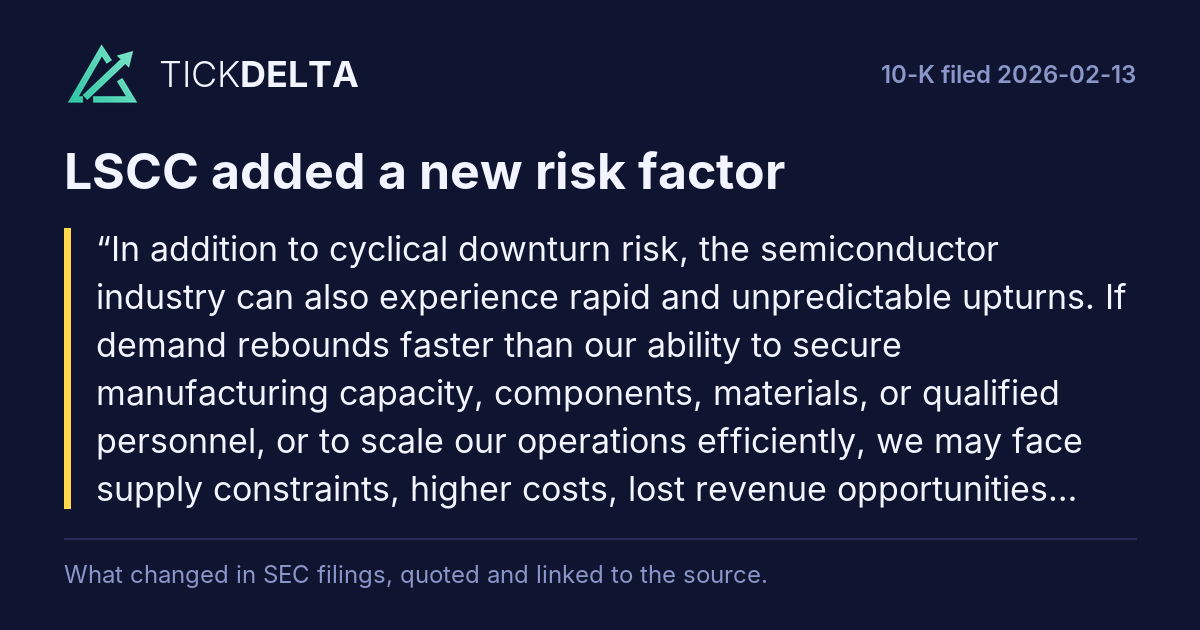
In addition to cyclical downturn risk, the semiconductor industry can also experience rapid and unpredictable upturns. If demand rebounds faster than our ability to secure manufacturing capacity, components, materials, or qualified personnel, or to scale our operations efficiently, we may face supply constraints, higher costs, lost revenue opportunities, competitive disadvantage, or an inability to meet customer requirements or delivery schedules.
In addition, expectations and front-loaded investment related to AI may increase the magnitude and volatility of semiconductor industry cycles, making downturns more abrupt or recoveries more uneven. Recent industry investment and customer spending patterns have been influenced by heightened interest in AI and AI-related applications. To the extent that current levels of investment in AI-related infrastructure, products, or end-market demand reflect expectations that are not ultimately realized, or if customer spending related to AI moderates, is delayed, or declines more rapidly than anticipated, the semiconductor industry could experience an accelerated or more pronounced downturn.
We a re subject to the effects of inflationary pressures, interest rate fluctuations, and recessionary or economic slowdown risks .
New in the latest 10-Q
236 paragraphs in the 10-Q filed Nov 3, 2026 with nothing like them in the 10-Q filed Aug 4, 2026 (at least half the words must differ; new numbers alone do not count). Quoted exactly, grouped by the item heading above them. This is text that changed, not a judgement of how serious it is.
Delaware (State or other jurisdiction of (I.R.S. Employer incorporation or organization) Identification No.) 5555 NE Moore Court, Hillsboro, 97124 OR (Address of principal executive offices) (Zip Code)
Read in the 10-Q
Title of each class Trading Name of each exchange Symbol on which registered Common Stock, $.01 par value LSCC Nasdaq Global Select Market ──────────────────────────────────────────────────────────────────────────────
Read in the 10-Q
revenue; our ability to successfully pursue and execute acquisitions and inorganic growth, and to successfully integrate acquired businesses and achieve the anticipated benefits of acquisition transactions, including with respect to our acquisition of AMI completed in July 2026; the impact of laws and regulations addressing privacy, data protection, and cybersecurity and our ability to comply with the same; our ability to comply with other laws and regulations, the costs of such compliance, and costs incurred if we fail to comply with such laws and regulations; our beliefs regarding legal or administrative proceedings; and impacts of global pandemics, epidemics, and other public health matters and actions of governments, businesses, and individuals in response to these situations.
Read in the 10-Q
These forward-looking statements are based on estimates and assumptions that are subject to risks and uncertainties that could cause actual results to differ materially from those statements expressed in the forward-looking statements. The key factors, among others, that could cause our actual results to differ materially from the forward-looking statements include: global economic conditions and semiconductor industry cyclicality; customer and distributor purchasing patterns, inventory levels and order timing; pricing and inflationary pressures; competition, including customers’ internal development efforts and open-source or other alternative firmware and software solutions; international trade disputes, sanctions, tariffs, export controls and license requirements; our ability to successfully integrate AMI and realize the anticipated benefits of the AMI Acquisition; risks relating to our indebtedness, including our ability to service and reduce that debt, restrictions under our debt agreements and changes in interest rates; potential impairment of goodwill or acquired intangible assets; concentration of demand among a limited number of customers, distributors and end markets, including AI and data-center infrastructure, and the risk that anticipated demand does not materialize or is not sustained; our dependence on third-party foundry, assembly and test providers and our ability to obtain sufficient manufacturing and test capacity and supply; risks associated with long-term supply arrangements or minimum purchase or volume commitments; retention of key employees; cybersecurity incidents and risks relating to the security of our products and firmware; technological change and our ability to timely develop and introduce products, firmware and software; and other factors more fully described herein and that are otherwise described from time to time in our filings with the Securities and Exchange Commission (“SEC”), including, but not limited to, the items discussed in Part II, Item 1A, “Risk Factors,” and elsewhere in this Quarterly Report on Form 10-Q.
Read in the 10-Q
On July 27, 2026, we completed our acquisition of AMI TopCo, Inc. and Subsidiaries (“AMI”) in a cash-and-stock transaction for total consideration of approximately $1.6 billion, subject to customary adjustments for AMI’s working capital, transaction expenses, cash, and indebtedness as of the closing. AMI is a leading provider of platform firmware and infrastructure manageability for cloud and AI infrastructure, servers, clients, and embedded devices. We acquired AMI to combine our FPGA products with AMI’s platform firmware and infrastructure manageability solutions, expanding our capabilities and addressable opportunities in cloud and AI data center infrastructure as well as the other markets we serve. The results of operations for AMI commencing July 27, 2026 are included in our unaudited Consolidated Financial Statements. See “Note 4 - Business Combination and Goodwill” for additional information.
Read in the 10-Q
Under the terms of ASC 606, “Revenue from Contracts with Customers,” we recognize revenue when we satisfy performance obligations as evidenced by the transfer of control of our products or services to customers. We generate revenue primarily from sales of silicon-based products, including FPGAs and related solutions, and from intellectual property (“IP”) licensing, royalties and related support services. We also generate revenue from professional and other services.
Read in the 10-Q
For sales to distributors, we have concluded that our contracts are with the distributor, rather than with the distributor’s end customer, as we hold a contract bearing enforceable rights and obligations only with the distributor. We consider customer purchase orders, which in some cases are governed by master sales agreements, to be the contracts with a customer. For each contract, we consider our promise to transfer each distinct product to be the identified performance obligation. We recognize silicon-based product revenue from sales to direct customers and distributors when control transfers to the customer.
Read in the 10-Q
Our IP licensing revenue is comprised of revenue from AMI firmware licensing, FPGA IP core licensing, and patent monetization activities. We consider licensing arrangements with our customers and agreements with the standards consortia of which we are a member to be the contracts. For each contract, we consider the promise to deliver a license that grants the customer the right to use the IP as a distinct performance obligation. We recognize license revenue at the point in time that control of the license transfers to the customer, which is generally upon delivery. Certain contracts also include sales-based or usage-based royalties. We recognize royalty revenue at the later of when the subsequent sale or usage occurs and when the performance obligation to which the royalty relates has been satisfied.
Read in the 10-Q
Support services revenue consists primarily of AMI firmware support, updates and quality-assurance services. We recognize revenue from these stand-ready services ratably over the contract term.
Read in the 10-Q
Professional and other services consist of non-recurring engineering (“NRE”) arrangements, technology integration and consulting services. Revenue from these arrangements is generally recognized as the services are performed based on a fixed fee or the time and resources incurred.
Read in the 10-Q
Substantially all of our performance obligations are satisfied within twelve months, except for certain AMI firmware support arrangements that extend beyond twelve months.
Read in the 10-Q
We allocate the transaction price to each performance obligation based on its relative Standalone Selling Price (“SSP”). We determine SSP using observable standalone sales when available. When observable standalone sales are not available, we estimate SSP using relevant information, which may include expected costs, market conditions, pricing practices and other entity- and customer-specific factors.
Read in the 10-Q
We measure revenue based on the amount of consideration we expect to be entitled to in exchange for products or services. Variable consideration is estimated and reflected as an adjustment to the transaction price. We determine variable consideration, which consists primarily of various sales price concessions, by estimating the most likely amount of consideration we expect to receive from the customer based on an analysis of historical rebate claims over a period of time considered adequate to account for current pricing and business trends. Sales rebates earned by customers are offset against their receivable balances. Rebates earned by customers when they do not have outstanding receivable balances are recorded within Accrued liabilities.
Read in the 10-Q
We generally provide an assurance warranty that our products will substantially conform to the published specifications for twelve months from the date of shipment. In some cases, the warranty period may be longer than twelve months. We do not separately price or sell the assurance warranty. Our liability is limited to either a credit equal to the purchase price or replacement of the defective part.
Read in the 10-Q
Contract Balances Our contract assets relate primarily to our rights to consideration for (1) AMI firmware licensing and related royalties, and (2) for licenses and royalties due to us as a member of the HDMI Founders consortium. The balance results primarily from (1) the amount of revenue recognized for AMI firmware licenses and estimated royalties not yet invoiced or received, and (2) the amount of estimated revenue related to HDMI licenses and royalties that we have recognized to date, but which has not yet been distributed to us by the HDMI licensing agent. Contract assets are included in Prepaid expenses and other current assets on our Consolidated Balance Sheets. The following table summarizes activity during the first nine months of fiscal 2026: (In thousands) ───────────────────────────────────────────────────────────────── Contract assets as of January 3, 2026 $7,669 Contract assets acquired in AMI acquisition 16,123 Revenues recorded during the period 15,828 Transferred to Accounts receivable or collected (18,457) Contract assets as of October 3, 2026 $21,163 Contract liabilities are included in Accrued liabilities and Other long-term liabilities on our Consolidated Balance Sheets. The following table summarizes activity during the first nine months of fiscal 2026: (In thousands) ───────────────────────────────────────────────────────────────────────────────────────────────────── Contract liabilities as of January 3, 2026 $4,006 Contract liabilities assumed in AMI acquisition 24,668 Unperformed performance obligations 14,552 Revenue recognized from satisfied performance obligations (9,229) Accruals for estimated future stock rotation and scrap returns 6,452 Less: Release of accruals for recognized stock rotation and scrap returns (3,378) Contract liabilities as of October 3, 2026 37,071 Less: Current portion of contract liabilities (included in Accrued liabilities) (35,020) Long-term portion of contract liabilities (included in Other long-term liabilities) $2,051 Remaining Performance Obligations As of October 3, 2026, the aggregate transaction price allocated to unsatisfied or partially unsatisfied performance obligations for our non-cancellable contracts was $ million. The amount primarily relates to fixed considerations allocated to AMI firmware support, updates and quality-assurance services. As a practical expedient, we have not included contracts that have an original duration of one year or less, nor have we included contracts with sales-based or usage-based royalties promised in exchange for a license of IP. The Company expects to recognize the majority of the unsatisfied performance obligations within the next two years. Note 4 - Business Combination and Goodwill On July 27, 2026 (the “Closing Date”), the Company and AMI TopCo, Inc. (“AMI”) consummated the transactions contemplated by the Agreement and Plan of Merger and Reorganization, dated as of May 4, 2026 (the “Merger Agreement”). Under the terms of the Merger Agreement, the Company acquired all of the issued and outstanding shares of AMI (the “AMI Acquisition”), for consideration of cash and shares of Lattice common stock transferred to the holders of AMI common stock and holders of vested AMI options to purchase AMI common stock on the Closing Date as well as additional cash payable for favorable changes to working capital from the estimated amount used as of the Closing Date as compared to the actual amount as of the Closing Date.
Read in the 10-Q
(In thousands) ───────────────────────────────────────────────────────────────────────────────────────────────────────────────── Fair value of Lattice common stock issued for outstanding AMI common stock $582,760 Cash paid for outstanding AMI common stock and vested options to purchase AMI common stock 733,492 Cash payable for outstanding AMI common stock and vested options to purchase AMI common stock 1,188 Cash paid by Lattice to retire AMI’s credit agreement 272,224 Total purchase consideration $1,589,664 We allocated the purchase price to tangible and identified intangible assets acquired and liabilities assumed based on their estimated fair values. These fair values were based on estimates and assumptions made by management at the time of the AMI Acquisition, as well as additional information available as of the date of issuance of these financial statements. As further additional information becomes available, we may further revise our purchase price allocation during the remainder of the measurement period, which will not exceed 12 months from the Closing Date. Any such revisions or changes may be material. While all aspects of the accounting for the AMI Acquisition remain preliminary, the areas with the most significant preliminary amounts pertain to the fair values of intangible assets and goodwill, and the related effect of the transaction on income tax related accounts, including deferred taxes, as well as the determination of net working capital as calculated under the terms of the Merger Agreement as of the Closing Date. The Company will continue to adjust the provisional estimates as additional information becomes available and final valuation and analyses are completed.
Read in the 10-Q
The following table presents our preliminary allocation of the total purchase price:
Read in the 10-Q
Value ──────────────────────────────────────────────────────────────────────────────────────────────────── Assets acquired: Cash and cash equivalents $ 34,370 Accounts receivable 48,328 Contract assets 16,123 Inventories 170 Prepaid expenses and other current assets 3,996 Property and equipment 5,326 Operating lease right-of-use assets 20,025 Intangible assets 551,000 Goodwill 1,054,139 Other long-term assets 986 Total assets acquired 1,734,463 Liabilities assumed: Accounts payable 6,597 Accrued liabilities 33,920 Current portion of contract liabilities 22,957 Long-term operating lease liabilities, net of current portion 17,146 Deferred income taxes 59,619 Other long-term liabilities 4,560 Total liabilities assumed 144,799 Fair value of net assets acquired $ 1,589,664
Read in the 10-Q
The goodwill recognized in the AMI Acquisition is primarily attributable to the assembled workforce, future growth opportunities, and economies of scale expected from the integration of the AMI business.
Read in the 10-Q
The following table presents details of the identified intangible assets acquired through the AMI Acquisition:
Read in the 10-Q
(In years) (In thousands) ────────────────────────────────────────────────────────────────────────────────────────────────────────────────────────── Developed technology 7.0 $ 258,000 Customer relationships 10.0 256,000 Trade name / trademarks 7.0 37,000 Total identified intangible assets subject to amortization $ 551,000 At the Closing Date, the aggregate tax basis of the acquired identifiable intangible assets and goodwill was $ million, consisting of $ The operations of AMI and its subsidiaries have been included in the Company’s Consolidated Statements of Operations and Comprehensive Income from the Closing Date. From the Closing Date through October 3, 2026, AMI contributed revenue Pro Forma Information The following unaudited pro forma financial information gives effect to the AMI Acquisition as if it had been completed on December 29, 2024. The unaudited pro forma information was prepared in accordance with the requirements of ASC 805, which is a different basis than pro forma information prepared under Article 11 of Regulation S-X (“Article 11”). As such, it is not directly comparable with historical results for the Company on a stand-alone basis prior to July 27, 2026, historical results for the Company from July 27, 2026 that reflect the AMI Acquisition and are inclusive of the results and operations of AMI, nor our previously provided pro forma financials prepared in accordance with Article 11. The pro forma results for the three and nine months ended October 3, 2026 and September 27, 2025, include the impact of several adjustments to previously reported operating results. The pro forma adjustments are based on historically reported transactions by the respective companies. The pro forma results do not include any anticipated synergies or other expected benefits of the AMI Acquisition. Significant nonrecurring pro forma adjustments include: Transaction costs of $21.7 million and $8.6 million of one-time compensation expenses paid to certain AMI employees are assumed to have occurred on December 29, 2024, and are recognized as if incurred in the first quarter of 2025; Permanent financing issued and debt redemptions occurring in connection with the closing of the AMI Acquisition are assumed to have occurred on December 29, 2024, and historical interest expense associated with repaid borrowings is removed; ──────────────────────────────────────────────────────────────────────────────────────────────────────────────────────────────────────────────────────────────────────────────────────────────────────────────────────────────────────────────────── Tangible and intangible assets are assumed to be recorded at their assigned fair values as of the pro forma close date of December 29, 2024 and are depreciated or amortized over their estimated useful lives; and ─────────────────────────────────────────────────────────────────────────────────────────────────────────────────────────────────────────────────────────────────────────────────────────────────────────────────────── Revenue accounting policies of AMI are conformed to those of the Company. The selected unaudited pro forma condensed combined financial information is provided for illustrative purposes only and does not purport to represent what the actual consolidated results of operations would have been had the AMI Acquisition actually occurred on December 29, 2024, nor do they purport to project the future consolidated results of operations.
Read in the 10-Q
The 2026 Credit Agreement contains customary affirmative and negative covenants, including covenants limiting the ability of the Company to, among other things, incur debt, grant liens, undergo certain fundamental changes, make investments, make certain restricted payments, dispose of assets, enter into transactions with affiliates, and enter into burdensome agreements, in each case, subject to limitations and exceptions set forth in the 2026 Credit Agreement. We are also required to maintain compliance with a consolidated total net leverage ratio and a consolidated interest coverage ratio, in each case, determined in accordance with the terms of the 2026 Credit Agreement. At October 3, 2026, we were in compliance with all covenants under the 2026 Credit Agreement. Loans under our 2026 Credit Agreement accrue interest at a per annum rate based on ranges determined by our consolidated total leverage ratio. At our option, interest accrues at either (a) the base rate (as defined in the 2026 Credit Agreement) plus a margin ranging from 0.00 % to 0.75 %, or (b) a term Secured Overnight Financing Rate (“SOFR”) for interest periods of 1, 3 or 6 months plus a margin ranging from 1.00 % to 1.75 %. Interest is payable quarterly in arrears with respect to borrowings bearing interest at the base rate or on the last day of an interest period, but at least every three months, with respect to borrowings bearing interest at the term SOFR rate. We account for debt issuance costs as a reduction to the carrying value of our long-term debt on our Consolidated Balance Sheets. We amortize the debt issuance costs to Interest (expense) income, net in our Consolidated Statements of Operations over the contractual term using the effective interest method. Discretionary prepayments of long-term debt are accounted for as partial retirements, and the portion of the unamortized debt issuance costs related to the discretionary prepayments are expensed and included in Other (expense) income, net on our Consolidated Statements of Operations. In the third quarter of fiscal 2026, we expensed $ 0.4 million of unamortized debt issuance costs associated with the 2026 Credit Agreement upon discretionary payments made on our long-term debt. We determine the Current portion of long-term debt as the sum of the required quarterly installments to be made over the next twelve months, reduced by the debt issuance costs to be amortized over the next twelve months. During the third quarter of fiscal 2026, we made principal payments totaling $ (In thousands) October 3, January 3, 2026 2026 Principal amount $875,000 $ Unamortized original issuance discount and debt costs (5,920) Long-term debt, net of unamortized debt issue costs $869,080 $ ───────────────────────────────────────────────────────────────────────────────────────── As of October 3, 2026, the effective interest rate on the term loan was Three Months Ended Nine Months Ended (In thousands) October 3, September 27, October 3, September 27, 2026 2025 2026 2025 Contractual interest $ 9,822 $ - $ 9,822 $ - ────────────────────────────────────────────────────────────────────────────────────────────────────────────────────────────────────────────────────────────────────────────────── Amortization of debt issuance costs 411 67 1,325 200 Total interest expense related to long-term debt $ 10,233 $ 67 $ 11,147 $ 200 Expected future principal payments are based on the schedule of required quarterly installments. With the discretionary prepayments we made during the third quarter of fiscal 2026, our next required quarterly installment is due in the fourth quarter of fiscal 2027. As of October 3, 2026, expected future principal payments on our long-term debt were as follows: Fiscal year (in thousands) 2026 (Remaining quarter) $ - ───────────────────────────────────────────────────────────── 2027 13,594 2028 69,375 2029 75,156 2030 92,500 Thereafter 624,375 $ 875,000 Prior to entering into the 2026 Credit Agreement and for the period in which the amendment was being prepared, we arranged for a commitment letter for a 1 -year Senior Secured Bridge Facility (the “bridge facility”). Fees associated with the bridge facility commitments totaled $ 5.6 million, of which $ 0.9 million was amortized to Interest income (expense), net on our Consolidated Statements of Operations. With the execution of the 2026 Credit Agreement, the remaining $ 4.7 million of unamortized debt issuance cost s associated with the bridge facility and $ 0.2 million of unamortized debt issuance costs associated with the 2022 Credit Agreement were expensed and are included in Other (expense) income, net on our Consolidated Statements of Operations. Note 7 - Balance Sheet Components Accounts Receivable Accounts receivable do not bear interest and are shown net of an allowance for expected lifetime credit losses, which reflects our best estimate of probable losses inherent in the accounts receivable balance, as described in our 2025 10-K. (In thousands) October 3, January 3,
Read in the 10-Q
Maturities of operating lease liabilities as of October 3, 2026 are as follows: Fiscal year (In thousands) ──────────────────────────────────────────────────────────────────────── 2026 (Remaining quarter) $ 987 2027 11,800 2028 10,691 2029 7,807 2030 8,207 Thereafter 29,060 Total lease payments 68,552 Less: amount representing interest (12,324) Present value of lease liabilities $ 56,228 Note 9 - Segment Reporting As of October 3, 2026, we have determined that the Company now operates in two operating and reportable segments: the FPGA business (which includes silicon-based and silicon-enabling products, evaluation boards, development hardware, and related intellectual property licensing, services, and sales), and the acquired AMI business (which includes products and services for the Boot Firmware and Manageability & Security groups). Our segments are strategic business units that offer distinct products and services that are managed accordingly. At this time, there are no internal revenue transactions between our reportable segments. The accounting policies of the segments are consistent with those described in our significant accounting policies and practices. The Company’s Chief Operating Decision Maker (“CODM”) is its Chief Executive Officer. Each segment has separate financial information that is utilized on a regular basis by the CODM in determining how to allocate resources and evaluate performance. Our CODM assesses the performance of each segment and allocates resources to each segment based on operating profit results and financial information of the two reportable segments and does not evaluate each segment using discrete asset information. Operating results by segment include items that are directly attributable to each segment and also include shared expenses such as marketing, general and administrative activities, facilities, and information technology expenses. Shared expenses are primarily allocated based on percentage of operating expenses or headcount. We report the results of our remaining business activities in Unallocated, which includes certain expense items that are not used in evaluating the results of or in allocating resources to our segments. Unallocated does not include any revenue amounts. Specifically, the items in Unallocated include stock-based compensation expense, amortization of acquired intangible assets, acquisition related costs, and restructuring. The following tables set forth the Company’s revenue, significant expenses, and operating income by its two operating and reportable segments for the periods indicated:
Read in the 10-Q
Three Months Ended Nine Months Ended (In thousands) October 3, September 27, October 3, September 27,
Read in the 10-Q
period based on the Company’s total shareholder return (“TSR”) relative to the Russell 3000 index. The awards may vest at
Read in the 10-Q
percentile. Vesting is interpolated on a straight-line basis for market condition achievement between the
Read in the 10-Q
In connection with the acquisition of AMI in the third quarter of fiscal 2026, we granted awards of RSUs with a market condition to certain former employees of AMI. Under the terms of these grants, the RSUs with a market condition vest over a
Read in the 10-Q
period based on the Company’s TSR relative to the Russell 3000 index. The awards may vest at
Read in the 10-Q
percentile. Vesting is interpolated on a straight-line basis for market condition achievement between the
Read in the 10-Q
The amount of deferred tax assets that are more likely than not to be realized increased by $1.2 million related to a valuation allowance release resulting from the acquisition of AMI.
Read in the 10-Q
We recognize revenue upon satisfaction of performance obligations when control of promised goods or services has been transferred to our customers. We measure revenue based on the amount of consideration we expect to be entitled to in exchange for products or services. See “Note 1 - Basis of Presentation and Significant Accounting Policies” to our Consolidated Financial Statements in Part I, Item 1 of this report for further information on our recognition of revenue.
Read in the 10-Q
Distributor and royalty estimates. For revenue recognized on sales to distributors and on royalties, the amount of consideration we expect to be entitled to receive is based on estimates that require assumptions and judgments relating to trends in recent and historical activity and, for usage-based royalties where licensee reports are not yet available, estimates of licensee sales or usage. Sales to most distributors are made under terms allowing certain price adjustments upon sale to their end customers and limited rights of return of our products held in their inventory. The revenue recognized based on estimated price adjustments and stock rotation reserves may be materially different from the actual consideration received if actual distributor price adjustments and stock rotation returns differ significantly from the historical trends used in the estimates.
Read in the 10-Q
The fair value of the consideration the Company pays in an acquisition is allocated to tangible assets and identifiable intangible assets, liabilities assumed, and goodwill. The accounting for acquisitions involves a considerable amount of judgment and estimation, including the fair value of acquired intangible assets involving projections of future revenues and cash flows that are then either discounted at an estimated discount rate or measured at an estimated royalty rate; fair value of other acquired assets and assumed liabilities, including potential contingencies; and the useful lives of the acquired assets. The assumptions used are determined at the time of the acquisition in accordance with accepted valuation models. Projections are developed using internal forecasts, available industry and market data, and estimates of long-term rates of growth for the business. The judgments and estimates used in accounting for an acquisition have a significant impact on the values assigned to identified intangible assets and goodwill.
Read in the 10-Q
Results of operations for the third quarter and first nine months of fiscal 2026 include AMI only from the July 27, 2026 Closing Date, which affects period-over-period comparisons.
Read in the 10-Q
Three Months Ended Nine Months Ended (In thousands) October 3, September 27, October 3, September 27,
Read in the 10-Q
AMI: AI infrastructure build-out, data center security, control and manageability, hyperscaler; data center OEM, and ODM.
Read in the 10-Q
Three Months Ended Nine Months Ended (In thousands) October 3, September 27, October 3, September 27,
Read in the 10-Q
Revenue from the AMI end market is primarily driven by the ongoing buildout of general purpose and AI server infrastructure, as hyperscalers, OEMs, and ODMs continue to expand their global data center footprints.
Read in the 10-Q
Three Months Ended Nine Months Ended (In thousands) October 3, September 27, October 3, September 27,
Read in the 10-Q
Three Months Ended Nine Months Ended (In thousands) October 3, September 27, October 3, September 27,
Read in the 10-Q
Three Months Ended Nine Months Ended (In thousands) October 3, September 27, % change October 3, September 27, % change
Read in the 10-Q
Three Months Ended Nine Months Ended (In thousands) October 3, September 27, % change October 3, September 27, % change
Read in the 10-Q
Three Months Ended Nine Months Ended (In thousands) October 3, September 27, % change October 3, September 27, % change
Read in the 10-Q
Three Months Ended Nine Months Ended (In thousands) October 3, September 27, % change October 3, September 27, % change
Read in the 10-Q
Three Months Ended Nine Months Ended (In thousands) October 3, September 27, % change October 3, September 27, % change
Read in the 10-Q
Three Months Ended Nine Months Ended (In thousands) October 3, September 27, % change October 3, September 27, % change
Read in the 10-Q
Three Months Ended Nine Months Ended (In thousands) October 3, September 27, % change October 3, September 27, % change
Read in the 10-Q
Three Months Ended Nine Months Ended (In thousands) October 3, September 27, % change October 3, September 27, % change
Read in the 10-Q
Three Months Ended Nine Months Ended (In thousands) October 3, September 27, October 3, September 27,
Read in the 10-Q
On July 27, 2026, we completed the AMI Acquisition, and we are in the process of integrating AMI’s operations, including its internal control over financial reporting, into our internal control over financial reporting. In connection with this integration, we are implementing and, in certain cases, revising controls, processes and procedures relating to the acquired business. We will continue to evaluate and monitor our internal control over financial reporting and will continue to evaluate the operating effectiveness of related key controls.
Read in the 10-Q
Our ability to integrate AMI and realize the anticipated benefits of the AMI Acquisition, and risks of other strategic transactions.
Read in the 10-Q
Our indebtedness, including the restrictions and variable interest rate exposure under the 2026 Credit Agreement.
Read in the 10-Q
The impact of tariffs, trade restrictions, export controls, sanctions or similar actions on our global business.
Read in the 10-Q
Geopolitical exposure of our subcontractors that we rely on to supply silicon wafers, packaging, and testing to manufacture our semiconductor products.
Read in the 10-Q
Our achievement of continued yield and quality improvements, cost reductions, the availability and costs of wafers and other materials, risks associated with supply and purchase commitments, and changes in the mix of our business.
Read in the 10-Q
Potential warranty claims, product security vulnerabilities and other costs related to our products.
Read in the 10-Q
Fluctuations in our revenue and margins caused by the intellectual property and firmware licensing components of our business.
Read in the 10-Q
Material fluctuations in our revenue and gross margins caused by intermittent sales of patents and significant licensing transactions.
Read in the 10-Q
Our ability to protect our intellectual property rights, and our use of third-party and open-source technology.
Read in the 10-Q
Proper functioning of our information technology systems, including in response to data breaches, cyberattacks, or cyber-fraud, and the integration of AMI’s systems.
Read in the 10-Q
Accounting estimates and judgments, including for AMI’s firmware licensing and related service arrangements, and changes to accounting standards.
Read in the 10-Q
Exposure to unanticipated tax consequences as a result of changes in effective tax rates, tax laws, and our global organizational, intellectual property and intercompany structure.
Read in the 10-Q
Fluctuations in foreign currency exchange rates, and our foreign currency risk management and hedging activities.
Read in the 10-Q
Our internal control over financial reporting and business processes, including as we integrate AMI.
Read in the 10-Q
Our ability to compete with others to attract and retain key personnel, including personnel with specialized firmware and software expertise.
Read in the 10-Q
Our failure to adequately foresee and insure against risks related to our business.
Read in the 10-Q
Market conditions and investor sentiment relating to AI, and risks relating to the adoption, use or application of AI and other emerging technologies.
Read in the 10-Q
The impact of climate and climate-related policies and regulations on our business.
Read in the 10-Q
Cyclical market patterns and potential downturns in our industry, our end markets or our segments.
Read in the 10-Q
Our ability to develop and introduce new products, including firmware and software, that achieve customer and market acceptance.
Read in the 10-Q
Our increasing use of and participation in open-source software, particularly in our AMI business, and competition from open-source and other alternative solutions.
Read in the 10-Q
Competition with companies that have significantly greater resources than us and numerous other product solutions.
Read in the 10-Q
Our reliance on independent contractors and third parties to provide key services in our product development and operations.
Read in the 10-Q
Our dependence on our concentrated distribution model and on a limited number of significant customers.
Read in the 10-Q
The effects of inflationary pressures, interest rate fluctuations, and recessionary or economic slowdown risks.
Read in the 10-Q
Disruptions to our worldwide operations and supply chain due to natural or human-induced disasters.
Read in the 10-Q
Volatility in the trading price of our common stock, including as a result of sales of shares issued in the AMI Acquisition.
Read in the 10-Q
The impact of actual and potential litigation and unfavorable results of legal proceedings on our business.
Read in the 10-Q
On July 27, 2026, we completed the AMI Acquisition for total consideration of approximately $1 billion in cash and approximately 5.2 million shares of our common stock and restricted stock units, subject to adjustments set forth in the Merger Agreement. AMI’s results have been included in our consolidated financial statements since the acquisition date, and beginning in the third quarter of fiscal 2026, we report our results in two reportable segments, FPGA and AMI. AMI is a significant business relative to our historical operations and provides platform firmware and infrastructure manageability solutions, with offerings, contract terms, pricing arrangements, sales models and support obligations that differ from those of our historical FPGA business.
Read in the 10-Q
We are integrating AMI’s operations, products, technology, personnel, customer relationships, information technology systems, financial reporting processes, internal controls, legal entities, intellectual property ownership and tax arrangements with our own. This integration is complex and will require significant management attention and resources over an extended period. Our ability to realize the anticipated benefits of the AMI Acquisition, including expected revenue opportunities, synergies and cost savings, within the expected timeframe or at all, depends on a number of factors, including our ability to:
Read in the 10-Q
retain and motivate key AMI employees, many of whom have specialized firmware and software expertise and long-standing customer relationships;
Read in the 10-Q
maintain and expand AMI’s relationships with its customers, suppliers and partners, some of whom compete with our FPGA business and may delay, reduce or change their purchasing or partnering decisions as a result of the acquisition;
Read in the 10-Q
coordinate product roadmaps and go-to-market activities across businesses that have historically operated with different sales models;
Read in the 10-Q
integrate, where appropriate, AMI’s legal entities, intellectual property arrangements and intercompany relationships with our global organizational and tax structure;
Read in the 10-Q
incorporate AMI’s processes, which were designed for a privately held company, into our public-company reporting and control environment; and
Read in the 10-Q
manage the increased size, geographic scope and complexity of the combined business.
Read in the 10-Q
Our plans for AMI remain subject to significant execution risk, and we may not realize anticipated revenue growth, cross-selling opportunities, customer adoption, product integration, operating efficiencies, margins or other strategic or financial benefits on the timing or to the extent anticipated, or at all. Customer interest or engagement with our combined offerings may not result in design wins, production deployments or revenue, and we may not successfully execute our combined product roadmap or commercial strategy.
Read in the 10-Q
We have incurred, and expect to continue to incur, significant acquisition-related and integration costs, and these costs may be greater than we anticipate. As we continue to integrate AMI and evaluate the combined business, we may identify opportunities to further align our cost structure, operations and resources with our strategic priorities. Any resulting restructuring or other integration actions could result in additional costs or charges, disrupt our operations, affect employee retention or morale, and may not achieve the anticipated operating efficiencies or other benefits. We may also discover liabilities relating to the acquired business, including liabilities relating to
Read in the 10-Q
intellectual property, product security, litigation, regulatory compliance or taxes, that were unknown to us or are greater than we anticipated. Our rights to escrow and indemnification under the Merger Agreement are limited in amount and duration and may not be sufficient to protect us. For additional risks relating to the AMI Acquisition, see the risk factors below relating to our indebtedness, goodwill and intangible assets, internal control over financial reporting, accounting estimates and judgments, and taxes.
Read in the 10-Q
More generally, we actively evaluate and may continue to pursue growth opportunities through acquisitions, strategic investments and strategic partnerships, and we may divest non-core assets. Identifying, evaluating, negotiating and completing these transactions requires significant management time and attention and involves substantial costs, whether or not a transaction is completed, and our indebtedness may limit our ability to finance future transactions on favorable terms or at all. Any strategic transaction may not strengthen our competitive position, may increase some of our risks, may result in charges against earnings, and may be viewed negatively by our customers, partners or investors. We may also receive unsolicited acquisition or business combination offers, and reviewing and responding to them can be costly and complex and may divert the attention of management. If we fail to integrate AMI or any other acquired business successfully, or fail to realize the anticipated benefits of a strategic transaction, our business, financial condition, results of operations and stock price could be materially adversely affected.
Read in the 10-Q
In connection with the completion of the AMI Acquisition, we borrowed $925 million of delayed draw term loans under the 2026 Credit Agreement. As of October 3, 2026, we had $875 million of term loans outstanding under the 2026 Credit Agreement. The 2026 Credit Agreement also provides for a revolving credit facility of up to $200 million. As of October 3, 2026, we had no outstanding borrowings under the revolving credit facility. The term loans amortize quarterly, and the term loans and any revolving loans mature on June 30, 2031. The term loans and the revolving credit facility are senior secured obligations. Our obligations under the 2026 Credit Agreement are guaranteed by certain of our U.S. subsidiaries meeting materiality thresholds set forth in the 2026 Credit Agreement and are secured by substantially all of our assets and the assets of those subsidiary guarantors, subject to customary exceptions.
Read in the 10-Q
Borrowings under the 2026 Credit Agreement bear interest at variable rates based on term SOFR or a base rate, plus a margin that varies with our total net leverage ratio. As a result, increases in prevailing interest rates, or an increase in our leverage ratio, will increase our interest expense and reduce the cash available for other purposes.
Read in the 10-Q
We have recorded a significant amount of goodwill and acquired intangible assets, primarily in connection with the AMI Acquisition, and we may be required to record impairment charges that could adversely affect our results of operations.
Read in the 10-Q
As of October 3, 2026, we had goodwill of $1,369.5 million and net identifiable intangible assets of $559.7 million, a substantial majority of which arose from the AMI Acquisition. The identifiable intangible assets acquired in the AMI Acquisition principally consist of developed technology, customer relationships and trade names. The amounts recorded are based on our preliminary allocation of the purchase price, which required significant estimates and assumptions, including with respect to projected financial information, discount rates and useful lives, and which may be adjusted during the measurement period of up to one year from the acquisition date.
Read in the 10-Q
We are required under U.S. GAAP to test goodwill for impairment at least annually, and to test goodwill and long-lived assets, including amortizable intangible assets, for impairment whenever events or circumstances indicate that their carrying value may not be recoverable.
Read in the 10-Q
We test goodwill for impairment at the reporting-unit level. Following the AMI Acquisition and the resulting changes to our organizational and segment-reporting structure, we have two reporting units for purposes of goodwill impairment testing. If the AMI business or any other reporting unit does not perform as expected, if the assumptions used to value acquired intangible assets change unfavorably, or if industry, economic or market conditions deteriorate, we may be required to record impairment charges or otherwise revise our estimates relating to these assets, which could increase future expense. We recorded impairment charges of approximately $13.9 million in fiscal year 2024 related to amortizable intangible assets from our acquisition of Mirametrix, Inc. Because the amount of goodwill and intangible assets arising from the AMI Acquisition is significant, any future impairment charge could be material. Although an impairment charge would be non-cash when recognized, it would reduce our reported results and stockholders’ equity and could adversely affect the trading price of our common stock.
Read in the 10-Q
Our global business operations expose us to various economic, political, and business risks, which could impact our business, operating results and financial condition.
Read in the 10-Q
We have significant domestic and international operations. Our international operations include foreign sales offices to support our international customers and distributors, which account for the majority of our revenue, and operational and research and development sites in China, the Philippines, Malaysia, India and other locations in Asia and elsewhere. The AMI Acquisition has expanded our operations and employee presence in several countries where we previously operated, including India and China, and added or expanded operations in Taiwan and other jurisdictions. In addition, we purchase our wafers from foreign foundries; have our commercial products assembled, packaged, and tested by subcontractors located outside of the United States; and rely on international service providers for a variety of services, including inventory management, lead time management, technical support, factory engagement meetings, and order fulfillment.
Read in the 10-Q
Worldwide political and economic conditions and events can have indirect and unpredictable effects on global economic conditions, customer demand, currency exchange rates, capital markets, and the operations of our customers, suppliers, and logistics partners. Any escalation of political unrest, deterioration in diplomatic relations, or expansion of regional or global sanctions could adversely affect global trade flows and supply chains and, in turn, negatively impact our business, operating results, and financial condition. For example, conflict in the Middle East, the continuing military conflict between Ukraine and Russia, as well as the financial and trade-related restrictions associated with Russia and Belarus and economic sanctions on certain individuals and entities in Russia and Belarus, and recent political developments and heightened uncertainty in Latin America, have increased geopolitical and economic volatility globally. These developments may result in new or expanded sanctions, trade restrictions, financial market disruptions, volatility in energy and commodity prices, and broader macroeconomic instability, and may further disrupt global supply chains and could result in shortages of key materials that our suppliers and foundry partners require to satisfy our needs. Additionally, the U.S. government has continued, and may increase, restrictions on the export of semiconductor-and supercomputer-related products, including semiconductor manufacturing equipment, which may restrict the ability to export, reexport, or otherwise transfer U.S.-controlled certain chips, products containing those chips, chip-related technology and software, and items related to semiconductor manufacturing worldwide without export authorization. In many cases, specific export licensing will be required and these licenses are subject to a policy of denial. China has responded by implementing additional export controls on products exported from China. These increasing restrictions, as well as additional future controls impacting the semiconductor ecosystem, may impact the global supply chain and could result in shortages of key materials that our suppliers and foundry partners require to satisfy our needs. Any deterioration in the relations between Taiwan and China, and other factors affecting military, political or economic conditions in Taiwan or elsewhere in Asia, could adversely impact our third-party manufacturing partners and suppliers located in the region, which could disrupt our business operations. The outbreak of new, or expansion or prolongation of current, military conflicts could disrupt global trade, transportation routes, energy and commodity markets, and supply chains, increase macroeconomic volatility, and adversely affect demand for our products, the operations of our customers and suppliers, and our business and financial results. Furthermore, adverse macroeconomic conditions, such as inflation and labor shortages, may affect demand for our products or increase our product or labor costs, negatively impacting our revenues, gross margins, and overall financial results.
Read in the 10-Q
Our domestic and international business activities are subject to economic, political and regulatory risks, including: increased inflation; volatility in financial markets; fluctuations in consumer liquidity; changes in interest rates; price increases for materials and components; trade barriers or changes in trade policies; political instability; acts of war or terrorism; natural disasters; economic sanctions; weak economic conditions; environmental regulations; labor regulations; disruptions to labor markets; import and export regulations; tax or freight rates; duties; trade restrictions; interruptions in transportation or infrastructure; anti-corruption laws; domestic and foreign governmental regulations; potential vulnerability of and reduced protection for intellectual property; disruptions or delays in production or shipments; and instability or fluctuations in currency exchange rates, any of which could lead to decreased demand for our products or a change in our results of operations. Supply chain constraints, inflation, or labor market disruptions, events outside of our control could have a material adverse impact on our business, operating results, and financial condition in the future. Uncertainty about future political and economic conditions makes forecasting demand and providing guidance difficult. Accordingly, our expectations are subject to change without warning and investors are cautioned not to place undue reliance on them.
Read in the 10-Q
Our business could suffer as a result of tariffs, trade restrictions, export controls, sanctions or similar actions.
Read in the 10-Q
The imposition by the United States of tariffs, sanctions or other restrictions on goods exported from the United States or imported into the United States or countermeasures imposed in response to such government actions could adversely affect our operations or our ability to sell our products globally, which could adversely affect our operating results and financial condition.
Read in the 10-Q
These restrictions include measures under United States’ authority under Section 232 of the Trade Expansion Act of 1962 to impose tariffs or other restrictions on imports deemed to threaten national security, including potentially with respect to semiconductors and products incorporating semiconductors. As a fabless semiconductor company that relies on a predominantly non-U.S. manufacturing and supply chain, the imposition of Section 232 measures could increase costs, disrupt supply chains, reduce customer demand, or place us at a competitive disadvantage relative to companies with different manufacturing footprints. Section 232 actions may be imposed with limited notice and could prompt retaliatory measures by other countries, further increasing global trade uncertainty and adversely affecting our business and financial results. In 2025, the U.S. Department of Commerce initiated a Section 232 national security investigation relating to semiconductors and semiconductor manufacturing equipment, and the outcome of that investigation, including any resulting tariffs, quotas, or other restrictions, is uncertain and could be implemented with limited notice. In January 2026, the President issued a proclamation under Section 232 imposing an immediate 25% tariff on certain advanced semiconductor articles and announcing that broader tariffs on semiconductors, semiconductor manufacturing equipment, and derivative products may follow. The United States has also implemented Section 232 tariffs on imports of various additional commodities, including articles of steel, aluminum, copper, and timber, as well as passenger vehicles, trucks, and automotive parts.
Read in the 10-Q
Beginning in 2018, the U.S. government imposed significant additional tariffs of 7.5% to 25% on many items imported from China, including under Section 301 of the Trade Act of 1974, and the scope and rates of these tariffs have generally increased up to 100% on certain products (including a 50% tariff on certain Chinese semiconductor items beginning in early 2025). In late 2025, the U.S. Trade Representative concluded following an additional Section 301 trade investigation that China engaged in unfair trade acts, policies, and practices with respect to the semiconductor industry, and therefore announced an intention to implement an additional Section 301 tariff on Chinese semiconductors, in addition to the existing 50% Section 301 tariff, beginning on June 23, 2027.
Read in the 10-Q
In addition, the U.S. government has imposed additional duties under other legal authorities, and applicable duties may be increased, reduced, suspended, reinstated, or otherwise changed from time to time, and in some cases may be cumulative with other applicable duties or trade remedies. These measures include tariffs imposed between February 2025 and February 2026 pursuant to authorities asserted under the International Emergency Economic Powers Act (“IEEPA”), which were subsequently determined to be unauthorized by the U.S. Supreme Court; tariffs imposed between February 2026 and July 2026 pursuant to authorities asserted under Section 122 of the Trade Act of 1974; and tariffs imposed since July 2026 pursuant to authorities asserted under Section 301 of the Trade Act of 1974. In response to these measures and related threats and actions, China and other countries have responded by imposing or threatening to impose significant trade measures, including tariffs on many items imported from the United States and export controls restricting the export of gallium, germanium, and other rare earth materials to the United States. While these risks have been partially mitigated based on bilateral trade deals reached between the U.S. and China, which are currently in effect, these agreements are temporary and may be unstable. Such escalations in trade measures may directly impair our business by increasing trade-related costs or disrupting established supply chains and may indirectly impair our business by causing a negative effect on global economic conditions and financial markets. The ultimate impact of these trade measures is uncertain and may be affected by various factors, including whether and when such trade measures are implemented, the timing when such measures may become effective, and the amount, scope, or nature of such trade measures.
Read in the 10-Q
Additional changes or threatened changes in U.S. trade measures have affected and may continue to affect trade involving additional countries, including countries in Europe. Each of these measures or threatened measures may instigate reciprocal countermeasures by affected countries, potentially accelerating further increases in trade measures. Certain announced or proposed tariffs have been delayed, modified, or made subject to negotiations, and there can be no assurance that such measures will not be implemented, expanded, reinstated, or increased. If the affected countries are unable to reach long-term agreements, or if the President were to impose significant new tariffs, the macroeconomic effect of any such tariffs could be significant. Tariffs or restrictions that specifically target imports of semiconductors or products incorporating semiconductors, including measures that could affect key manufacturing regions or supply chain routes (including under Section 232), could seriously and negatively affect our business and the U.S. economy overall. Depending on the ultimate outcomes and any governmental responses, tariff regimes could change rapidly, including through replacement measures under other legal authorities and potential uncertainty regarding refunds or retroactive treatment.
Read in the 10-Q
The materials subject to these tariffs may impact the cost or availability of raw materials used by our suppliers or in our customers’ products. The imposition of further tariffs by the United States on a broader range of imports, or further retaliatory trade measures taken by other countries in response to additional tariffs, could increase costs in our supply chain or reduce demand of our customers’ products, either of which could adversely affect our results of operations. Any increase in trade-related costs associated with such measures may impair the profitability of such international production, may strain our suppliers’ ability to reliably provide inputs necessary to produce these items, may otherwise affect our partners’ abilities to provide our products at previously contracted prices, and may limit our ability to absorb increased costs without raising prices to our customers. Any such price increases could reduce customer demand, delay or cancel customer orders, or cause customers to seek alternative solutions, which could adversely affect our revenue, market share, and operating results. Our business and financial results could be negatively affected as a result.
Read in the 10-Q
Our customers or suppliers could also become subject to U.S. regulatory scrutiny or export restrictions. For example, the U.S. Justice Department has in the past filed criminal charges against one of our customers in China and imposed a licensing requirement on this customer with a policy of denial for some items, which has limited our ability to do business with this customer. If any of our current or future customers or suppliers become subject to similar actions, whether through criminal enforcement, inclusion on restricted-party lists, or expanded licensing requirements, our ability to conduct business with them could be limited or eliminated.
Read in the 10-Q
Our AMI segment licenses platform firmware and infrastructure manageability software to, and provides updates and support for, server and other hardware manufacturers worldwide, including in China. If any of these customers become subject to export restrictions,
Read in the 10-Q
sanctions or restricted-party designations, or if export controls or sanctions are expanded to cover the firmware, software, updates or technical support we provide, we may be required to suspend or terminate licensing, update or support relationships with those customers, which could adversely affect our revenue and customer relationships and expose us to compliance costs and liabilities.
Read in the 10-Q
In 2020, the U.S. imposed additional regulatory restrictions on the sale of U.S. controlled technology to customers in China. These restrictions include establishing additional licensing requirements in order to sell U.S.-originated technology for certain applications or to companies that participate in the Chinese national security supply chain. These restrictions also limit the fabrication of devices for certain Chinese companies where U.S. technology is involved in the fabrication process. Furthermore, in August 2020 the U.S. established additional licensing requirements for one of our China customers and its affiliates that limit any sales of products to that customer or for that customer’s products absent a license. The U.S. government has continued to and is likely to continue to add additional Chinese companies to restricted or prohibited party lists or impose additional licensing requirements that we may be unable to meet in a timely manner or at all. For example, the U.S. Department of Commerce’s Bureau of Industry and Security (“BIS”) has adopted, and then temporarily suspended, an interim final rule (the “Affiliates Rule”) that would extend certain entity-based licensing requirements to foreign entities owned 50% or more, directly or indirectly, individually or in the aggregate, by listed parties, whether or not those entities are themselves listed.
Read in the 10-Q
Additionally, the U.S. government continued, and may expand, controls enacted in October 2022 restricting the ability to send certain products and technology related to semiconductors, semiconductor manufacturing, and supercomputing to China without an export license. In 2023 and 2024, the U.S. government expanded the list of advanced integrated circuits subject to heightened export controls, including certain hardware containing these specified integrated circuits, expanded the list of destinations requiring export authorization for such items, and added new restrictions based on the headquarters location of the parties involved. The U.S. government also continued, and may expand, the scope of restrictions on the development or production of advanced integrated circuits and certain semiconductor manufacturing equipment, certain AI-related computing technologies, and supercomputing in China and other countries, and may continue to expand or revise these controls, including through worldwide licensing requirements, outbound investment restrictions, end-use or end-user restrictions, reporting requirements, or enhanced due diligence expectations. The scope, implementation timing, and enforcement posture of such controls may change rapidly and with limited notice. Proposed regulations would expand these controls further and impose additional reporting requirements. Other foreign governments may in turn impose similar or more restrictive controls. These controls or any additional restrictions may impact our ability to export certain products to China or other countries, prohibit us from selling our products to certain of our customers, or impact our suppliers who may utilize facilities or equipment described in these controls. It also is possible that the Chinese government or other governments will retaliate in ways that could impact our business.
Read in the 10-Q
In addition to restrictions on the sale or shipment of products, U.S. export control laws and regulations may apply to the transfer, sharing, or access of certain technology, software, source code, technical data, or know-how for research, development, engineering, testing, or support purposes, including through electronic access, remote collaboration, or internal development activities outside of the United States. Following the AMI Acquisition, these requirements may apply to additional firmware, software, source code, encryption functionality and related technical data used in our global research, development, engineering, testing and support activities. Such transfers or access may be deemed “exports” under applicable regulations, even when no product is sold and the activity is undertaken solely for internal development or cost-reduction purposes. As a result, our ability to expand, relocate, or optimize product development, engineering, or technical support activities in lower-cost or non-U.S. jurisdictions may be constrained by export licensing requirements, including requirements that are time-consuming, uncertain, subject to conditions, or subject to a policy of denial. If required licenses are delayed, denied, or granted only with restrictive conditions, we may be required to limit the scope of, delay, restructure, or forego certain development initiatives, incur additional compliance and administrative costs, or reallocate engineering resources to higher-cost locations. Any such limitations could reduce the expected benefits of our global development strategy, slow innovation, delay product development timelines, or adversely affect our operating efficiency and results of operations.
Read in the 10-Q
Where license requirements are imposed, there can be no assurance that the U.S. government will grant licenses to permit the continuation of business with these customers and our other operations. Future sanctions similar to those imposed in the past and to those recently imposed could adversely affect our ability to earn revenue from these and similar customers. In addition, the imposition of sanctions or other restrictions on customers in China may cause those customers to seek domestic alternatives to our products and those of other United States semiconductor companies. Further, the Chinese government has developed an unreliable entity list, which limits the ability of companies on the list to engage in business with Chinese customers. We cannot predict what impact these and future actions, sanctions or criminal charges could have on our customers or suppliers, and therefore our business. If any of our other customers or suppliers become subject to sanctions or other regulatory scrutiny, if our customers are affected by tariffs or other government trade restrictions, or if we become subject to retaliatory regulatory measures, our business and financial condition could be adversely affected.
Read in the 10-Q
Our global business operations expose us to various legal and regulatory risks, which could impact our business, operating results and financial condition.
Read in the 10-Q
If we fail to comply with the many laws and regulations to which we are subject, both within the United States and internationally, we may be subject to significant fines, penalties or liabilities for noncompliance, which could harm our business and financial results. For example, we are subject to federal, state and foreign laws and regulations concerning data privacy and security, including the EU General Data Protection Regulation (“GDPR”), and U.S. state and local laws that govern the privacy and security of information, such as the California Consumer Privacy Act (“CCPA”). Other countries outside of the European Union, including the United Kingdom and China, also have enacted robust legislation addressing privacy, data protection, and cybersecurity and providing for substantial penalties for noncompliance. We are also subject to a wide range of other U.S. and international laws and regulations applicable to us, including anti-corruption and anti-bribery laws (such as the U.S. Foreign Corrupt Practices Act (“FCPA”)), export controls and economic sanctions,
Read in the 10-Q
customs and trade compliance requirements, environmental, health and safety laws, product compliance and environmental regulations (such as restrictions on hazardous substances and electronic waste), conflict minerals and responsible sourcing requirements, competition and antitrust laws, employment and labor regulations, and tax laws and regulations. The AMI Acquisition has increased the number of jurisdictions in which we operate, and we are working to incorporate AMI’s operations into our compliance programs. The aforementioned regulatory frameworks and others around the world are evolving rapidly, and we anticipate that our efforts to comply with evolving laws and regulations addressing privacy, data protection, and cybersecurity will be a rigorous and time-intensive process that may increase our cost of doing business and may require us to change our policies and practices. Additionally, as a public company, we are subject to the requirements of federal securities laws, requirements of the Sarbanes-Oxley Act, the Dodd-Frank Wall Street Reform and Consumer Protection Act, the rules and regulations of the SEC, and the listing standards of the Nasdaq Stock Market. Noncompliance with these requirements could result in penalties, fines, liabilities, or reputational harm, which could harm our business or financial results. We are also subject to import/export regulations, rules regarding bulk data transfers, and applicable executive orders. These laws, regulations, and orders are complex, may change frequently and with limited notice, and have generally and may continue to become more stringent over time. Additionally, these local, national, and international regulatory frameworks and underlying rules and regulations may conflict with each other, resulting in uncertainty in their application or interpretation.
Read in the 10-Q
Any inability or perceived inability to adequately comply with applicable laws or regulations could result in claims, demands, and litigation by private actors or governmental authorities, investigations and other proceedings by governmental authorities, injunctive relief, fines, penalties, and other liabilities, any of which may harm our reputation and market position and could adversely affect our business, financial condition, and results of operations.
Read in the 10-Q
We rely on subcontractors to supply and fabricate silicon wafers and to perform assembly and test operations for our semiconductor products. If they are unable to do so on a timely and cost-effective basis in sufficient quantities and using competitive technologies, we may incur significant costs or delays.
Read in the 10-Q
We operate a primarily outsourced manufacturing business model that principally utilizes contract manufacturers, such as third-party wafer foundries. We rely on foundries in Japan, Korea and Taiwan to supply and fabricate silicon wafers for our semiconductor products, including Taiwan Semiconductor Manufacturing, Samsung Semiconductor, United Microelectronics Corporation, and Seiko Epson. We rely on our OSATs in Malaysia, Taiwan and Japan to support the packaging and test of our products, including Advanced Semiconductor Engineering and Amkor Technology. Our success is dependent upon our ability to successfully partner with our foundry and OSAT suppliers and their ability to produce wafers and finished semiconductor products with competitive prices and performance attributes, including smaller process geometries, which ability may be impacted by labor market disruptions and rising inflation. Further, geopolitical tensions in East Asia, including heightened tensions between China and Taiwan, present additional and significant risks to our outsourced manufacturing model, and any escalation of military conflict, trade restrictions, sanctions, blockades, or other disruptions in the region could adversely affect our foundry and OSAT partners, regional logistics and transportation networks, or the availability of materials, equipment, and labor necessary to support semiconductor manufacturing and testing.
Read in the 10-Q
We have recently faced constraints in portions of our supply chain that limit our ability to fully satisfy customer demand. These constraints have limited, and may continue to limit, our ability to fulfill customer orders and recognize revenue in the amounts or periods we otherwise might have achieved. Our efforts to increase supply include working with our third-party manufacturing and test providers to secure additional capacity, as well as acquiring additional test equipment. These efforts are subject to capacity limitations, equipment availability, extended lead times and other constraints.
Read in the 10-Q
When our supply is constrained, we must allocate available product supply and available manufacturing capacity from our third-party manufacturing and test providers among customers based in part on anticipated customer requirements. Customer forecasts and indications of demand may change and may not accurately reflect customers’ ultimate requirements or timing. As a result, the timing, product mix or allocation of our available supply may not correspond to actual customer demand. Our inability to provide particular products when and where customers require them has resulted, and may continue to result, in delayed or lost sales, reduced customer satisfaction, changes in purchasing behavior or customers seeking alternative suppliers.
Read in the 10-Q
Establishing, maintaining and managing multiple foundry and OSAT relationships requires the investment of management resources and costs, and we have limited ability to mitigate disruptions in the near term through alternative sourcing or internal production. Qualifying and establishing reliable production at acceptable yields with a new contract manufacturer is a lengthy and often expensive process, and there is no guarantee we could timely find alternative contract manufacturers or at all. If we fail to maintain our foundry and OSAT relationships, if these partners do not provide facilities and support for our development efforts, if they are insolvent or experience financial difficulty, if their operations are interrupted by a widespread public health hazard, or if we elect or are required to change foundries or OSATs, we may incur significant costs and delays. If our foundry or OSAT partners are unable to, or do not, manufacture sufficient quantities of our products at acceptable yields, we may be required to allocate the affected products among our customers, prematurely limit or discontinue the sales of certain products, or incur significant costs to transfer products to other foundries or OSATs, which could adversely affect our customer relationships and operating results. Further, our subcontractors are themselves subject to many of the same operational and business risks that we face and describe herein, including many operating in regions with significant geopolitical risk, that, if they occur and are disruptive to their operations, could adversely affect us.
Read in the 10-Q
Our margins are dependent on our achieving continued yield and quality improvements, cost reductions, the supply and cost of wafers and materials, and the mix of our business.
Read in the 10-Q
We rely on obtaining yield, quality, productivity, and logistic improvements and corresponding cost reductions in the manufacture of existing products and on introducing new products that incorporate advanced features and other price/performance factors that enable us to increase revenues while maintaining acceptable margins. To the extent that such cost reductions and new product introductions do not occur in a timely manner, because of inflation, increases in personnel costs, employee turnover, or other factors, or that our products experience significant quality or reliability issues, or do not achieve market acceptance or market acceptance at acceptable pricing, our margins, operating results, and financial condition could be materially adversely affected.
Read in the 10-Q
Our anticipated growth also depends in part on increases in future manufacturing and test capacity available from our third-party manufacturing and test providers, including capacity that is not yet available and whose successful development, qualification and ramp depends substantially on those providers and their equipment suppliers. New or expanded third-party manufacturing and test capacity, production lines and related equipment may not become available when expected, may experience construction, equipment, qualification, yield, quality or ramp delays, or may fail to provide the capacity, performance or economics we anticipate. Our revenue forecasts and growth expectations depend in part on assumptions regarding the availability and timing of this additional third-party capacity.
Read in the 10-Q
Furthermore, worldwide manufacturing capacity available for the production of our products may be impacted by many factors which may impact availability and cost. If the demand for silicon wafers or assembly material exceeds market supply, or if suppliers increase prices to cover the cost of rising inflation, our supply of silicon wafers or assembly material could quickly become limited or prohibitively expensive. A shortage in third-party manufacturing or test capacity available to us could hinder our ability to meet product demand and therefore reduce our revenue. Silicon wafers constitute a material portion of our product cost, and if we are unable to purchase wafers at favorable prices, due to supply constraints, inflation, or other factors, our margins, results of operations, and financial condition may be adversely affected.
Read in the 10-Q
In order to secure sufficient supply, we may enter into long-term supply arrangements or make minimum purchase, volume or other commitments to our suppliers. Although these arrangements may improve our access to supply, they may reduce our ability to adjust purchases in response to changes in customer demand, product mix, market conditions or our business strategy. If actual demand is lower than we anticipate, or if our product or technology requirements change, these commitments could result in excess or obsolete inventory, inventory write-downs, increased working capital requirements, or obligations to purchase products or capacity that we are unable to use or sell on favorable terms, which could adversely affect our results of operations and financial condition.
Read in the 10-Q
Our consolidated gross margin also depends on the relative contribution of our FPGA and AMI segments, which have different cost structures and margin profiles, and on the mix of products, licenses and services within each segment. Changes in this mix could cause our consolidated gross margin to fluctuate from period to period.
Read in the 10-Q
We may be subject to warranty claims, costs relating to product security vulnerabilities, and other costs related to our products.
Read in the 10-Q
In general, we warrant our products for varying lengths of time against non-conformance to our specifications and certain other defects. From time to time, we may be subject to warranty and/or epidemic failure claims, disputes, or other assertions of product non-conformance by customers. Because our products, including hardware, software, and intellectual property cores, are highly complex and increasingly incorporate advanced technology, our quality assurance programs may not detect all defects, whether these are specific manufacturing defects affecting individual products or these are systemic defects that could affect numerous shipments. Our inability to detect a defect could result in a diversion of our engineering resources from product development efforts, increased engineering expenses to remediate the defect, and increased costs due to customer accommodation or inventory impairment charges. On occasion, we have also repaired or replaced certain components, made software fixes, or refunded the purchase price or license fee paid by our customers due to product or software defects. Our insurance may be inadequate to protect against these issues. If there are significant product defects, the costs to remediate such defects, net of reimbursed amounts from our vendors, if any, or to resolve warranty claims may adversely affect our financial condition and results of operations and may harm our reputation.
Read in the 10-Q
Our AMI segment’s platform firmware and infrastructure manageability solutions are incorporated into servers and other computing systems. Security vulnerabilities or defects in these products, including vulnerabilities arising from third-party or open-source components, could adversely affect our customers’ systems and require us to develop and distribute updates, provide remediation support, respond to customer or regulatory claims, or incur other costs. Any actual or perceived vulnerability could harm our reputation and customer relationships.
Read in the 10-Q
The intellectual property and firmware licensing components of our business increase our business risk and the fluctuation of our revenue and margins.
Read in the 10-Q
Our business strategy includes licensing our intellectual property, and, following the AMI Acquisition, licensing firmware and related software, to companies that incorporate it into their technologies that address multiple markets, including markets where we participate and compete. Our licensing and services revenue may be impacted by the introduction of new technologies by customers in place of the technologies we license, changes in the law that may weaken our ability to prevent the use of our patented technology by others, the expiration of our patents, and changes of demand or selling prices for products using licensed patents. We cannot assure that our licensing customers will continue to license our technology on commercially favorable terms or at all, or that these customers will introduce and sell products incorporating our technology, accurately or timely report royalties owed to us, pay agreed upon royalties, honor agreed upon market restrictions, or maintain the confidentiality of our proprietary information, or will not infringe upon or misappropriate our intellectual property. Our intellectual property and firmware licensing agreements are complex and may depend upon many factors that require significant judgments, including completion of milestones, allocation of values to delivered items and customer acceptance.
Read in the 10-Q
Our sale of patents and intermittent significant licensing transactions can cause material fluctuations in our revenue and gross margins.
Read in the 10-Q
We have generated revenue from the sale of certain patents from our portfolio in the past, generally for non-core technology that we are no longer actively developing. Any future efforts to monetize our patent portfolio through sales of non-core patents may not realize adequate interest or prices for those patents. Accordingly, we cannot provide assurance that we will continue to generate revenue from these sales. In addition, although we seek to be strategic in our decisions to sell patents, we might incur reputational harm if a purchaser of our patents sues one of our customers for infringement of the purchased patent, and we might later decide to enter a space that requires the use of one or more of the patents we sold. In addition, as we sell groups of patents, we no longer have the opportunity to further sell or to license those patents and receive a continuing royalty stream.
Read in the 10-Q
Our licensing and services revenue fluctuates, sometimes significantly, from period to period because it is heavily dependent on a few key transactions being completed in a given period, the timing of which is difficult to predict and may not match our expectations. licensing and services revenue may include revenue from the sales of patents, which may be difficult to complete and which may have complex terms for the payment which affects revenue recognition. Because of its high margin, the licensing and services revenue portion of our overall revenue can have a disproportionate impact on gross profit and profitability. In addition, generating revenue from patent sales and intellectual property licenses is a lengthy and complex process that may last beyond the period in which our efforts begin, and the accounting rules governing the recognition of revenue from patent sales and intellectual property licensing transactions are increasingly complex and require significant judgment. As a result, the amount of license revenue recognized in any period may differ significantly from our expectations.
Read in the 10-Q
If we are unable to adequately protect our intellectual property rights globally, or if our use of third-party or open-source technology is challenged, our financial results and our ability to compete effectively may suffer.
Read in the 10-Q
Our success depends in part on our proprietary technology, and we rely upon patent, copyright, trade secret, mask work, and trademark laws to protect our intellectual property globally. We intend to continue to protect our proprietary technology, however, we may be unsuccessful in asserting our intellectual property rights or such rights may be invalidated, violated, circumvented, or challenged. From time to time, third parties, including our competitors, have asserted against us patent, copyright, and other intellectual property rights to technologies that are important to us. Third parties may attempt to misappropriate our intellectual property through electronic or other means or assert infringement claims against us in the future. Such assertions by third parties may result in costly litigation, indemnity claims, or other legal actions, and we may not prevail in such matters or be able to license any valid and infringed patents from third parties on commercially reasonable terms. This could result in the loss of our ability to import and sell our products or require us to pay costly royalties to third parties in connection with sales of our products. Any infringement claim, indemnification claim, or impairment or loss of use of our intellectual property could materially adversely affect our financial condition and results of operations.
Read in the 10-Q
Our products, including our AMI segment’s firmware and software, incorporate technology licensed from third parties and open-source software. If these licenses become unavailable on commercially reasonable terms, or if we fail to comply with their terms, including open-source license obligations, we could be required to re-engineer products, cease distributing certain products, release proprietary source code, or pay damages or royalties. Our agreements with customers often include intellectual property indemnification obligations, which could require us to incur significant costs to defend or settle claims made against our customers.
Read in the 10-Q
Our business depends on the use of information technology systems. A failure of these systems, cybersecurity incidents, or cyber-fraud may cause business disruptions, compromise our intellectual property or other sensitive information, or result in losses.
Read in the 10-Q
We rely on information technology (“IT”) networks and systems to collect, process, maintain, use, share, disseminate, and dispose of our information and manage our operations, including financial reporting. Our IT systems are subject to power and telecommunication outages and other system failures and disruptions. Further, despite our security measures, our IT systems may be vulnerable to cybersecurity threats and suffer cybersecurity incidents. The frequency, sophistication and impact of cybersecurity threats continue to evolve, including through the use of AI-enabled tools by threat actors, which may increase the effectiveness of phishing, social engineering, fraud and other attacks. These systems are also supported by subcontractors and third-party providers who may also be subject to power and telecommunication outages or other general system failures and disruptions and cybersecurity threats and cybersecurity incidents. The legal, regulatory and contractual environments surrounding information security, data privacy, and data protection are complex and evolving. We continue to commit significant resources to implementing new systems to standardize our processes worldwide and to develop our capabilities in these areas. We are focused on realizing the full analytical functionality of these conversions, which can be extremely complex, in part, because of the wide range of legacy systems and processes that must be integrated.
Read in the 10-Q
In the normal course of business, and as we integrate AMI’s IT systems, networks and applications with our own, we may implement new or updated IT systems and, as a result, we may experience delays or disruptions in the integration of these systems, or the related procedures or controls. The policies and security measures established with our IT systems may be vulnerable to cybersecurity incidents such as security breaches and cyberattacks, or cyber-fraud. We may also encounter corruption or loss of data, an inability to accurately process or record transactions, and security or technical reliability issues. All of these could harm our ability to conduct core operating
Read in the 10-Q
functions such as processing invoices, shipping and receiving, recording and reporting financial and management information on a timely and accurate basis, and could impact our internal control compliance efforts. If the technical solution or end user training are inadequate, it could limit our ability to manufacture and ship products as planned. Moreover, the proper functioning of the internal processes that the IT systems and networks support relies on qualified employees. Competition for qualified employees is intense, global, and has increased across the global economy, and in particular in the United States. Employee turnover could lead to disruptions in our processes, inadequate end user training or difficulty updating our IT systems and networks.
Read in the 10-Q
We maintain sensitive data on our networks and on the networks of our business partners and third-party providers, including proprietary and confidential information relating to our intellectual property, personnel, and business, and that of our customers and third-party providers. Companies have been increasingly subject to a wide variety of cybersecurity incidents such as cyberattacks, hacking, phishing, malware, ransomware, and other attempts to gain unauthorized access to systems or data, or to engage in fraudulent behavior. Cyberattacks have become more prevalent, sophisticated and much harder to detect and defend against and it is often difficult to anticipate or detect such incidents on a timely basis and to assess the damage caused by them. In addition, our agreements with third-party providers, including but not limited to the liability limitations and insurance provisions contained in such agreements, may be inadequate to cover the liability, if any, associated with any security breaches. Increasing geopolitical tensions or conflicts have also created, and may continue to create, a heightened risk of cyberattacks. Further, AI and other evolving technologies, including AI technologies that may be used to identify and exploit security vulnerabilities, may also increase the prevalence and impact of cyberattacks. Our policies and security measures cannot guarantee security, and our IT infrastructure, including our networks and systems, may be vulnerable to security breaches and cybersecurity incidents, cyberattacks, or cyber-fraud. In the past, third parties have attempted to penetrate and/or infect our network and systems with malicious software and phishing attacks in an effort to gain access to our network and systems. In addition, we are subject to the risk of third parties falsifying invoices and similar fraud, including by obtaining unauthorized access to our vendors’ and business partners’ networks. Although past threats and incidents have not resulted in a material adverse effect, we may incur material losses related to cybersecurity and other threats or incidents in the future.
Read in the 10-Q
In some circumstances, we may partner with third-party providers and provide them with certain data, including sensitive data, or the ability to access or otherwise process such data. These third parties also face substantial security risks from a variety of sources. There can be no assurance that any security measures that we or our third-party service providers have implemented will be effective against current or future security threats, and we cannot guarantee that our systems and networks or those of our third-party service providers have not been breached or otherwise compromised, or that they and any software in our or their supply chains do not contain bugs, vulnerabilities, or compromised code that could result in a breach of or disruption to our systems and networks or the systems and networks of third parties that support us and our services. If any of our third-party providers fails to adopt or adhere to adequate data security practices, or suffers a security breach or incident, any data, including sensitive data, that we provide them or that they otherwise may access or process for us may be improperly accessed, used, disclosed, modified, lost, destroyed, or rendered unavailable. Any security breaches or incidents that we or our third-party providers may suffer could compromise our intellectual property, expose sensitive business information and otherwise result in unauthorized access to or disclosure, modification, misuse, loss, destruction, or other processing of sensitive information. We may need to expend significant financial and development resources to analyze, correct, eliminate, or work around errors or defects or to eliminate or otherwise address security vulnerabilities, and we and our third-party service providers may face difficulties or delays in identifying or otherwise responding to any potential security breach or incident. Third parties and supply chain participants also may be targeted with AI-enhanced attacks, and vulnerabilities in third-party software, services, or technology supply chains could provide additional avenues for compromise.
Read in the 10-Q
Further, the increase in cyberattacks has resulted in an increased focus on cybersecurity by certain government agencies. Any cyberattack or other security breach or cybersecurity incident that we or our third-party providers may suffer, or the perception that any such attack, breach, or incident has occurred, could result in a loss of customer confidence in our security measures, damage to our brand, reputation, and market position, result in unauthorized access to or disclosure, modification, misuse, loss, corruption, unavailability, or destruction of our data or other sensitive data that we or our third-party providers process or maintain, disrupt normal business operations, require us to spend material resources to investigate or correct any breach or incident and to prevent future security breaches and incidents, expose us to legal claims and liabilities, including litigation, regulatory investigations and enforcement actions, and indemnity obligations, and adversely affect our revenues and operating results. Further, any such actual or perceived breach or incident, and any claims, demands, litigation, or investigations or enforcement actions related to cybersecurity could cause us to incur significant remediation costs, result in product development delays, disrupt key business operations, and divert attention of management and key IT resources. In addition, we may incur loss as a result of cyber-fraud, such as those experienced by other companies by making unauthorized payments irrespective of robust internal controls.
Read in the 10-Q
Failure or disruptions of our IT systems or difficulties or delays in maintaining, managing, and integrating them could adversely affect our controls and procedures and could impact our ability to perform necessary operations, which could materially adversely affect our business.
Read in the 10-Q
The costs of maintaining our cybersecurity risk management program, as well as the costs of mitigating cybersecurity risks, are significant and are likely to increase in the future. These costs include, but are not limited to, maintaining software and services to prevent and detect cybersecurity threats and incidents, retaining the services of cybersecurity providers; compliance costs arising out of existing and future cybersecurity, data protection and privacy laws and regulations; and costs related to maintaining redundant networks, data backups and other damage-mitigation measures. We cannot be certain that our insurance coverage will be adequate for cybersecurity liabilities incurred and, will cover any indemnification claims against us relating to any incident, that insurance will continue to be available to us on economically reasonable terms, or at all, or that any insurer will not deny coverage as to any future claim.
Read in the 10-Q
Our financial results depend on accounting estimates and judgments, including with respect to revenue from AMI’s firmware licensing and related service arrangements, and changes in accounting standards could affect our results of operations and business practices.
Read in the 10-Q
We prepare our consolidated financial statements in conformity with U.S. GAAP, which requires us to make estimates, judgments and assumptions that affect the amounts reported in our financial statements. The AMI Acquisition has added revenue arrangements and purchase-accounting matters that require additional estimates and judgments. AMI’s arrangements include firmware licenses and related support and other services, which often involve multiple performance obligations. Accounting for these arrangements requires judgment in identifying performance obligations, determining standalone selling prices, including through estimation methods when observable standalone sales are not available, allocating transaction consideration among the performance obligations, and determining the timing of revenue recognition. Certain arrangements may also depend on the accuracy and timeliness of usage or royalty reports provided by customers.
Read in the 10-Q
Changes in our estimates or judgments, or new information about our arrangements, could cause the amount or timing of the revenue we recognize to differ from our expectations and could cause our results to fluctuate from period to period. Our accounting for the AMI Acquisition also required significant estimates, including in the allocation of the purchase price to the assets acquired and liabilities assumed. See also “We have recorded a significant amount of goodwill and acquired intangible assets, primarily in connection with the AMI Acquisition, and we may be required to record impairment charges that could adversely affect our results of operations” above.
Read in the 10-Q
Accounting principles are subject to interpretation by the American Institute of Certified Public Accountants, the SEC and various bodies formed to interpret and create accounting rules and regulations. Changes in these rules have occurred in the past and future changes to these rules, or in the guidance relating to interpretation and adoption of the rules, could have a material effect on our financial results and could affect portions of our business differently.
Read in the 10-Q
Changes in effective tax rates, tax laws, and our global organizational, intellectual property, and intercompany structure, including as a result of the integration of AMI, could expose us to unanticipated tax consequences.
Read in the 10-Q
We are subject to taxation in the United States and other countries. Certain tax positions may remain open to examination for several years. Challenges by tax authorities to our previous tax positions and intercompany transfer pricing arrangements, and continuing assessments of our tax exposures may have an adverse effect on our provision for income taxes and cash tax liability. We operate legal entities in multiple countries and maintain intercompany cost-sharing, licensing, and other transfer pricing arrangements, that are intended to align our corporate structure with our global business operations. Following the AMI Acquisition, we are evaluating how to integrate AMI’s legal entities, intellectual property ownership, and intercompany arrangements with our existing global organizational and tax structure. This evaluation may result in changes to the ownership or location of our intellectual property, our legal entity structure, or our intercompany cost-sharing, licensing and other transfer pricing arrangements. Implementing any of these changes could result in significant tax costs or affect our effective tax rate. Tax authorities may also challenge the tax treatment of these changes or the pricing of our intercompany arrangements, and any integration we complete may fail to produce the anticipated benefits. Changes in the composition of our earnings among jurisdictions with different tax rates, including as a result of the AMI Acquisition, and limitations on our ability to deduct interest expense on our indebtedness, may also affect the taxes we pay or the tax provision we record, which could adversely affect our results of operations. Our ability to transfer cash among jurisdictions and legal entities may also be subject to tax costs, legal restrictions, and other limitations, which could affect the availability of cash for debt service or other corporate purposes.
Read in the 10-Q
We also may be impacted by changes in the tax laws of the United States and foreign jurisdictions. U.S. and foreign tax legislation may be enacted, amended, or repealed from time to time, and such changes may have retroactive or prospective effects and may require significant interpretation or judgment in their application. A number of countries, as well as organizations such as the Organisation for Economic Co-operation and Development (“OECD”), which represents a coalition of member countries, support the 15% global minimum tax initiative, and have adopted or intend to adopt laws to implement this initiative. On January 5, 2026, the OECD announced a “side-by-side” elective safe harbor that may provide qualifying U.S.-parented multinational groups relief from certain aspects of the global minimum tax regime for taxable years beginning on or after January 1, 2026. The safe harbor does not eliminate qualified domestic minimum top-up taxes or similar domestic minimum taxes that may be imposed by individual jurisdictions. Such changes, as well as changes in taxing jurisdictions’ administrative interpretations, decisions, policies, and positions, could have a material adverse effect on our business, results of operations, or financial condition. In addition, future effective tax rates could be affected by changes in the valuation of deferred tax assets and liabilities.
Read in the 10-Q
Fluctuations in foreign currency exchange rates, and our foreign currency risk management and hedging activities, could adversely affect our results of operations.
Read in the 10-Q
We have significant global operations, including foreign sales and service activities and international operating and research and development sites, and we rely on foreign suppliers and service providers. As a result, financial results may be exposed to fluctuations in foreign currency exchange rates. Foreign currency movements may affect, among other things, the U.S. dollar cost of operating expenses and headcount in foreign locations, the pricing and cost of goods and services purchased from non-U.S. suppliers, the competitiveness of our products in certain markets, and the U.S. dollar value of foreign currency denominated assets and liabilities. These impacts can be difficult to predict, may occur rapidly, and may adversely affect our gross margin and operating results. In fiscal 2026, we began entering into foreign currency forward contracts, which we designate as cash flow hedges, to reduce the impact of exchange rate fluctuations on certain operating expenses denominated in currencies other than the U.S. dollar, and we may from time to time enter into other foreign currency risk management transactions. However, these activities may not be effective, may be costly to implement and maintain, and may expose us to additional risks, including: (i) hedges that do not offset underlying exposures due to forecasting error,
Read in the 10-Q
Timing mismatches, changes in exposure profile, or market illiquidity; (ii) adverse accounting impacts, including additional earnings volatility due to ineffectiveness or changes in hedge accounting treatment; (iii) counterparty credit risk, settlement risk, collateral or liquidity requirements, and operational risk in executing, monitoring, and governing a hedging program; and (iv) reduced ability to benefit from favorable foreign currency movements. Even if we pursue hedging strategies, foreign currency fluctuations could still have a material adverse effect on our financial condition and results of operations.
Read in the 10-Q
If we fail to maintain effective internal control over financial reporting and business processes, including as we integrate AMI, our ability to report our financial results accurately and on time could be impaired.
Read in the 10-Q
We are required to maintain internal controls over financial reporting. We review these controls regularly and deficiencies may be identified from time to time. In the future, we may identify material weaknesses in our internal controls over financial reporting. Any failure to maintain an effective system of internal controls over financial reporting could limit our ability to report our financial results accurately and timely, which could adversely affect our business, financial results, and stock price.
Read in the 10-Q
Before the AMI Acquisition, AMI was privately held and was not required to maintain internal control over financial reporting in accordance with Section 404 of the Sarbanes-Oxley Act. We have begun integrating AMI’s accounting, financial reporting and information technology processes into our control environment. As permitted by SEC guidance for recently acquired businesses, we expect to exclude AMI from the scope of management’s assessment of the effectiveness of our internal control over financial reporting as of the end of fiscal 2026 and to continue implementation, documentation, testing and training of controls across AMI’s operations during fiscal 2027. Incorporating AMI into our control environment increases the complexity of our financial reporting, and if we are unable to implement and maintain appropriate controls across the combined company in a timely manner, our ability to report our financial results accurately and on time could be impaired.
Read in the 10-Q
We must also maintain high quality business processes, and we also use third-party IT vendors and their business processes. We rely on our and their business processes to, among other things, coordinate with our suppliers, manage our supply chain efficiently, manufacture high quality products and comply with various laws and regulations. Any failure by us, or by our third-party IT vendors, to maintain high quality business processes, or to effectively adjust our or their business processes to changing circumstances and needs, including in connection with the integration of AMI, could limit our ability to meet our business needs, which could adversely affect our business, financial results, and stock price.
Read in the 10-Q
We compete with others to attract and retain key personnel, and any loss of, or inability to attract, such personnel could adversely affect our ability to compete effectively.
Read in the 10-Q
We depend on the efforts and abilities of certain key members of management and other technical personnel. Our future success depends, in part, upon our ability to retain such personnel and attract and retain other highly qualified personnel, particularly product engineers who can respond to market demands and required product innovation. Following the AMI Acquisition, our workforce is larger and more geographically dispersed and includes employees with specialized firmware and software expertise, for whom competition is intense. Equity awards are an important component of our compensation, and declines or volatility in the trading price of our common stock may reduce their retention value. Competition for such personnel has been increasing generally throughout the economy, and we may not be successful in hiring or retaining new or existing qualified personnel. In recent years, we have conducted worldwide reductions in force, and we periodically conduct targeted workforce reductions, which could cause disruptions in our operations, negatively affect employee morale, and make us a less attractive employer in the market for new talent. If we lose existing qualified personnel or are unable to hire new qualified personnel, as needed, we could have difficulty competing in our highly competitive and innovative environment.
Read in the 10-Q
Further, changes in immigration laws and regulations, or their administration or enforcement, may impair our ability to attract and retain qualified engineering personnel. In the U.S., where a portion of our research and development teams are located, tightening of immigration controls may adversely affect the employment status of non-U.S. engineers and other key technical employees or further impact our ability to hire new non-U.S. employees. Moreover, certain immigration policies in the U.S. may make it more difficult for us to recruit and retain highly skilled foreign national graduates of universities in the U.S., additionally limiting the pool of available talent, including in certain international markets where we operate and where competition for skilled engineering and technical talent is particularly strong, such as parts of Asia.
Read in the 10-Q
Our success also depends significantly on the contributions of our senior management team. We have undergone senior management transitions in the past, and may experience such transitions in the future. Effective succession planning is important for our long-term success. Failure to ensure effective transfers of knowledge and smooth transitions involving senior management could hinder our strategic planning and execution. None of our senior management is bound by written employment contracts. The loss of any of our senior management or any inability to find suitable replacements could harm our ability to implement our business strategy and respond to the rapidly changing market conditions in which we operate.
Read in the 10-Q
Our insurance may not adequately cover certain risks and, as a result, our financial condition and results may be adversely affected.
Read in the 10-Q
We carry insurance customary for companies in our industry, including, but not limited to, liability, property, and casualty; workers’ compensation; cyber liability; and business interruption insurance. We also insure our employees for basic medical expenses. In addition, we have insurance contracts that provide director and officer liability coverage for our directors and officers. Other than the specific areas mentioned above, we are self-insured with respect to most other risks and exposures, and the insurance we carry in many cases is subject to a significant policy deductible or other limitation before coverage applies. Based on management’s assessment and judgment,
Read in the 10-Q
we have determined that it is more cost effective to self-insure against certain risks than to incur the insurance premium costs. The risks and exposures for which we self-insure include, but are not limited to, certain natural disasters, certain product defects, certain matters for which we indemnify third parties, political risk, certain theft, patent infringement, and employment practice matters. Should there be a catastrophic loss due to an uninsured event (such as an earthquake) or a loss due to adverse occurrences in any area in which we are self-insured, our financial condition or operating results could be adversely affected.
Read in the 10-Q
Our growth expectations depend in part on significant and rapidly evolving investment in AI and data-center infrastructure, and volatility in these markets, changes in investor sentiment relating to AI, and risks associated with AI and other emerging technologies may adversely affect our business, results of operations and the trading price of our common stock.
Read in the 10-Q
Demand for a portion of our products, including products sold into data center and server applications in our Compute and Communications end market and our AMI segment, depends on capital spending by cloud service providers, data center operators and other participants in AI infrastructure. The adoption of AI solutions and other emerging technologies may not develop in the manner or in the time periods we anticipate, and demand for products that support these technologies may be unpredictable and may vary significantly from period to period. Capital spending on AI-related infrastructure may fluctuate significantly and may be reduced or delayed. Our customers or end markets may reduce, delay or redirect their spending, including because of concerns about the cost of AI infrastructure or the returns on AI investments, a perceived or actual overbuild of AI capacity, limits on their ability to finance large infrastructure commitments, constraints on the availability of power and other resources needed for data center deployment, or changes in technology architectures, including the adoption of more efficient AI models, that reduce the need for certain components. Because a portion of our anticipated growth depends on these markets, any slowdown or change in investment could materially affect our growth rates, revenue and operating results.
Read in the 10-Q
In addition, investor sentiment toward AI and companies that supply products used in AI infrastructure has been volatile, and changes in that sentiment may cause the trading price of our common stock to fluctuate significantly, regardless of our operating performance.
Read in the 10-Q
Even if these markets evolve in the manner we anticipate, if we do not have timely, competitively priced and market-accepted products available to meet customer needs in these areas, we may miss significant opportunities and our business, financial condition and results of operations could be materially and adversely affected.
Read in the 10-Q
Our efforts to comply with laws and regulations worldwide relating to AI, data use, privacy, cybersecurity and product safety, and changes in those laws and regulations, may increase the costs of developing, marketing and supporting products used in AI applications and may limit their adoption.
Read in the 10-Q
Concerns regarding the accuracy, security, bias, privacy, intellectual property implications or misuse of AI systems may reduce adoption, result in additional or expanded legal or regulatory requirements, or expose us or our customers to claims, investigations, reputational harm or additional compliance costs. In addition, regulatory and investor scrutiny of public statements regarding AI capabilities and plans continues to evolve, and any inaccurate or incomplete statements could result in litigation, regulatory inquiries, reputational harm and additional compliance costs.
Read in the 10-Q
We also develop and offer AI-assisted tools that support semiconductor design and development workflows. These tools may generate inaccurate, incomplete or otherwise unreliable outputs, and their performance may depend in part on third-party AI models, software and services that we do not control. Although our tools may incorporate validation processes and allow users to review and verify outputs, these measures may not prevent errors or unintended results. Actual or perceived failures of our AI-assisted tools, or security, confidentiality, intellectual property or other concerns arising from their use or integration with third-party AI technologies, could adversely affect customer adoption, our reputation and our relationships with customers, or expose us to claims or additional regulatory requirements.
Read in the 10-Q
We and our employees, consultants and partners use third-party AI tools, and the governance of that use can be challenging. The use of these tools could expose our proprietary or confidential information, result in claims of intellectual property infringement or noncompliance with open-source requirements, introduce security vulnerabilities, or produce inaccurate outputs that lead to errors in our decision-making, product development or other business activities. Our ability to mitigate these risks will depend on maintaining, monitoring and enforcing appropriate policies governing the use of AI tools.
Read in the 10-Q
Climate and climate-related policies and regulations may have a long-term impact on our business.
Read in the 10-Q
Climate-related risks are inherent wherever our business is conducted. Global climate causes, and is projected to continue to cause, an increase in the frequency and intensity of certain natural disasters and adverse weather, such as power outages and grid instability, drought or other water scarcity, wildfires, storms, sea-level rise, flooding, severe heat, and severe cold, occurring more frequently or with greater intensity. Such extreme events are driving changes in market dynamics, stakeholder expectations, and local, national and international climate policies and regulations, any of which could result in disruptions to us, our suppliers, vendors, customers and logistics hubs, and may impact employees’ abilities to commute or to work from home effectively. These disruptions could make it more difficult and costly for us to deliver our products and services, obtain components or other supplies through our supply chain, maintain, or resume operations or perform other critical corporate functions, and could reduce customer demand for our products and services.
Read in the 10-Q
The increasing concern over climate could also result in transition risks such as shifting customer preferences. Changing customer preferences may result in increased expectations regarding our solutions, products, and services, including the use of packaging materials and other components in our products and their environmental impact. These expectations may cause us to incur additional costs or make other changes to our operations to respond to them, which could adversely affect our financial results. If we fail to manage transition
Read in the 10-Q
risks and customer expectations in an effective manner, customer demand for our solutions, products, and services could diminish, and our profitability could suffer. Concerns over climate, as well as the adoption of new laws or regulations, may also impact market dynamics and may result in shifts in customer expectations, preferences, or requirements, which may require us to change our practices or incur increased costs or adversely impact customer demand for our products and services.
Read in the 10-Q
Additionally, concerns over climate have resulted in, and are expected to continue to result in, the adoption of legal and regulatory requirements designed to address climate, as well as legal and regulatory requirements requiring certain climate-related disclosures. Where new laws or regulations are more stringent than current legal or regulatory requirements, we may experience increased compliance burdens and costs to meet such obligations. These laws could cause us to incur additional direct costs for compliance, as well as indirect costs resulting from our customers, suppliers or both incurring additional compliance costs that are passed on to us. These legal and regulatory requirements, as well as investor expectations, on corporate environmental and social responsibility practices and disclosure, are subject to change, can be unpredictable, and may be difficult and expensive for us to comply with, given the complexity of our supply chain and our significant outsourced manufacturing. If we are unable to comply, or are unable to cause our suppliers or subcontractors to comply, with such policies or provisions or meet the requirements of our customers and investors, customers may stop purchasing products from us or an investor may sell their shares, and may take legal action against us, which could harm our reputation, revenue, and results of operations.
Read in the 10-Q
Climate dynamics also may reduce the availability or increase the cost of insurance for these negative impacts of natural disasters by contributing to an increase in the incidence and severity of such natural disasters. Ultimately, the impacts of climate, whether involving physical risks (such as disruptions resulting from climate-related events or rising sea levels) or transition risks (such as regulatory changes, changes in market dynamics or increased operating costs, including the cost of insurance) are expected to be widespread and unpredictable and may materially adversely affect our business and financial results.
Read in the 10-Q
The semiconductor industry routinely experiences cyclical market patterns and our products are used across different end markets. A significant downturn in the industry or in any of these end markets could cause a meaningful reduction in demand for our products and adversely affect our operating results.
Read in the 10-Q
The semiconductor industry is highly cyclical and subject to downturns, such as we have seen recently, and our revenue and gross margin can fluctuate significantly due to such downturns. These downturns can be severe and prolonged and can result in price erosion and weak demand for our products. Weak demand for our products resulting from general economic conditions affecting the end markets we serve, or the semiconductor industry specifically, and reduced spending by our customers can result, and in the past has resulted, in diminished product demand, high inventory levels, erosion of average selling prices, excess and obsolete inventories and corresponding inventory write-downs. Our expense levels are based, in part, on our expectations of future sales. Many of our expenses, particularly those relating to facilities, capital equipment, and other overhead, are relatively fixed. We might be unable to reduce spending quickly enough to compensate for reductions in sales. Accordingly, shortfalls in sales could adversely affect our operating results. Furthermore, any significant upturn in the semiconductor industry could result in increased competition for access to raw materials and third-party service providers.
Read in the 10-Q
In addition to cyclical downturn risk, the semiconductor industry can also experience rapid and unpredictable upturns. If demand rebounds faster than our ability to secure manufacturing capacity, components, materials, or qualified personnel, or to scale our operations efficiently, we may face supply constraints, higher costs, lost revenue opportunities, competitive disadvantage, or an inability to meet customer requirements or delivery schedules.
Read in the 10-Q
Additionally, our products are used across different end markets, and demand for our products is difficult to predict and may vary within or among our Compute and Communications and Industrial and Embedded end markets. Following the AMI Acquisition, a larger portion of our business depends on demand for servers and other computing systems, and the performance of our AMI segment may be affected by cycles in server and data center spending that differ from those affecting our FPGA segment. Our target markets may not grow or develop as we currently expect, and demand may increase or change in one or more of our end markets, and changes in demand may reduce our revenue, lower our gross margin and affect our operating results. We have experienced concentrations of revenue at certain customers and within certain end markets, and we regularly compete for design opportunities at these customers and within these markets. Any deterioration in these end markets, reductions in the magnitude of revenue streams, our inability to meet design and pricing requirements, or volatility in demand for our products could lead to a reduction in our revenue and adversely affect our operating results. Our success in our end markets depends on many factors, including the strength or financial performance of the customers in our end markets, our ability to timely meet rapidly changing product requirements, market needs, and our ability to maintain design wins across different markets and customers to dampen the effects of market volatility. The dynamics of the markets in which we operate make prediction of and timely reaction to such events difficult.
Read in the 10-Q
Investment related to AI infrastructure may increase volatility in semiconductor demand. If current investment levels or customer expectations are not sustained, reductions or delays in AI-related spending could contribute to a downturn in portions of the semiconductor industry or the end markets we serve.
Read in the 10-Q
Due to these and other factors, our past results may not be reliable predictors of our future results. If we are unable to accomplish any of the foregoing, or to offset the volatility of cyclical changes in the semiconductor industry or our end markets through diversification into other markets, these factors could materially and adversely affect our business, financial condition, and operating results.
Read in the 10-Q
Our success and future revenue depend on our ability to develop and introduce new products that achieve customer and market acceptance.
Read in the 10-Q
We compete in a dynamic environment characterized by rapid technology and product evolution, generally followed by a relatively longer process of ramping up to volume production on advanced technologies. Our end customers’ continued use of our products is frequently reevaluated, as certain of our customers’ product life cycles are relatively short and they continually develop new products. The selection process for our products to be included in our customers’ new products is highly competitive. There are no guarantees that our products will be included in the next generation of products introduced by these customers. Additionally, our markets are also characterized by evolving industry standards and increased demand for more features and performance, which requires higher levels of integration and more advanced process technology. Our competitive position and success depend on our ability to innovate, develop, and introduce new products that compete effectively on the basis of price, density, functionality, power consumption, form factor, and performance, and our ability to address the evolving needs of the markets we serve, among other things. With increased introduction of new products, we expect revenue related to mature products to decline over time in a normal product life cycle. As a result, we may be increasingly dependent on revenue derived from our newer products.
Read in the 10-Q
Our future growth and the success of new product introductions depend upon numerous factors, including:
Read in the 10-Q
ability to generate new design opportunities and design wins, including those which result in sales of significant volume;
Read in the 10-Q
availability of specialized field application engineering resources supporting demand creation and customer adoption of new products;
Read in the 10-Q
achieving acceptable yields and obtaining adequate production capacity from our wafer foundries and assembly and test subcontractors;
Read in the 10-Q
our ability to develop, update and support firmware and software that remains compatible with evolving processor, server and data center architectures and industry standards;
Read in the 10-Q
our ability to adapt AMI’s business model, product and service offerings and commercial arrangements in a timely manner as customer requirements, technology and markets evolve; and
Read in the 10-Q
The failure of any of these factors, among others, could adversely affect our product innovation, development and introduction efforts and our financial condition and results of operations.
Read in the 10-Q
The success of our AMI segment depends in part on our ability to continually develop and release firmware and software updates, including security updates, to support new platforms and customer requirements. Delays or defects in these releases, or our inability to keep pace with changes in the architectures and standards on which our customers’ systems are based, could adversely affect demand for our products and our customer relationships.
Read in the 10-Q
We compete against companies that have significantly greater resources than us and numerous other product solutions.
Read in the 10-Q
The semiconductor industry is highly competitive and many of our direct and indirect competitors have substantially greater financial, technological, manufacturing, marketing, and sales resources than us. While consolidation has occurred and may continue to occur in our industry, resulting in some competitors having greater scale, resources, or synergies, the industry has also experienced, and may continue to experience, restructurings, divestitures, or spin-offs of business units into independent companies. Such transactions may result in competitors that are more focused on particular markets or product lines, have increased strategic flexibility, or are more willing to invest aggressively or compete on pricing, which could intensify competition in certain segments. Whether through consolidation or deconsolidation, these industry dynamics could place us at a competitive disadvantage, including the ability to attract qualified employees, invest in product development, or absorb increased costs without raising prices. We also expect to face additional competition from new entrants in our markets, which may include both large domestic and international semiconductor manufacturers, as well as smaller, emerging companies. We currently compete directly with companies that have licensed our technology or have developed similar products, as well as numerous semiconductor companies that offer products based on alternative solutions, such as applications processor, application specific standard product, microcontroller, analog, and digital signal processing technologies. Competition from these semiconductor companies may intensify as we offer more products in any of our end markets. These competitors include established, multinational semiconductor companies, as well as emerging companies. Our AMI segment competes with other providers of platform firmware and infrastructure manageability solutions, internal development efforts by customers and potential customers, and open-source or other alternative solutions, some of which may be available at little or no direct cost. Additionally, our competitors may operate under more favorable regulatory environments or benefit from economic policies (such as subsidies or other protectionism) that provide them with additional competitive advantages.
Read in the 10-Q
Our increasing use of and participation in open-source software, particularly in our AMI business, subjects us to competitive, commercial, intellectual property and compliance risks.
Read in the 10-Q
Certain of our products and solutions, particularly within our AMI business, incorporate, interact with or are developed using open-source software, and AMI participates in and contributes to open-source firmware ecosystems. Open-source firmware and software solutions are an increasingly important part of the markets in which AMI competes, and customers, silicon providers, original equipment manufacturers, original design manufacturers and other industry participants may increasingly develop, customize, deploy or support open-source solutions internally or through third parties rather than purchase proprietary products, licenses or services from us. Open-source alternatives may be available at little or no direct cost and may reduce demand for, or place pricing pressure on, our proprietary firmware, software, support and services.
Read in the 10-Q
Our strategy includes developing commercial products and services that incorporate or operate with open-source technologies while seeking to differentiate our offerings through proprietary technology, integration, validation, security, performance, support and other capabilities. There can be no assurance that we will be successful in maintaining sufficient differentiation or in developing and adapting our business and pricing models to monetize products and services based on or used with open-source technologies. Changes in customer preferences, industry standards, community-developed technologies or the level of investment by customers and other industry participants in open-source solutions could reduce our competitive differentiation, revenue or margins.
Read in the 10-Q
In addition, the use, modification and distribution of open-source software may subject us to license terms that impose obligations regarding attribution, redistribution, availability of source code, modification or licensing of derivative works. Our products may combine open-source components with proprietary technology, and interpreting and complying with applicable open-source licenses can be complex. If we or third parties acting on our behalf fail to comply with applicable license requirements, or if proprietary technology is determined to be subject to open-source licensing obligations, we could be required to make source code available, modify or discontinue affected products, obtain alternative technology or licenses, incur remediation costs, or face claims, reputational harm or other adverse consequences. Open-source components may also contain defects, vulnerabilities or other issues that we do not control and that may be difficult or costly to identify and remediate. Any of these developments could adversely affect our business, competitive position, results of operations and financial condition.
Read in the 10-Q
We depend on independent contractors and third parties to provide key services in our product development and operations, and any disruption of their services, or an increase in cost of these services, could negatively impact our financial condition and results of operations.
Read in the 10-Q
We depend on subcontractors to provide cost effective and efficient services in our product development and supply chain functions, including test and assembly services, software and hardware development, support of intellectual property cores, inventory management, lead time management, technical support, and order fulfillment.
Read in the 10-Q
Our growth plans may depend on third parties successfully completing development, manufacturing, qualification, platform-launch or other activities on schedules we do not control. Delays or changes in those activities can affect the timing or amount of demand for our products even where we have executed our own obligations as planned.
Read in the 10-Q
Our operations and operating results may be adversely affected if we experience problems with our subcontractors that impact the delivery of product to our customers. These problems may include: schedule delays or defects in software or hardware development deliverables; prolonged inability to obtain wafers or packaging materials with competitive performance and cost attributes; inability to achieve adequate yields or timely delivery; inability to meet customer timelines or demands; disruption or defects in assembly, test, or shipping services; or delays in stabilizing manufacturing processes or ramping up volume for new products. If our third-party supply chain providers were to reduce or discontinue services for us or their operations are disrupted as a result of a fire, earthquake, act of terrorism, political unrest, governmental uncertainty, war, disease, or other natural disaster or catastrophic event, weak economic conditions, inflation, recession, labor market disruptions, or any other reason, our financial condition and results of operations could be adversely affected.
Read in the 10-Q
Our revenues depend on a highly concentrated distribution model and on a limited number of significant customers. An adverse change in these relationships, or in the performance or financial condition of these distributors or customers, could adversely affect our business and results of operations.
Read in the 10-Q
We depend on a highly concentrated distribution model to sell our products to end customers, complete order fulfillment, maintain sufficient inventory of our products and provide services to our end customers. In fiscal 2025, revenue attributable to sales to distributors accounted for 84% of our total revenue, and two distributors accounted for approximately 69% of total revenue. In the third quarter of fiscal 2026, following the AMI Acquisition, revenue attributable to sales to distributors accounted for 81% of our total revenue. Our AMI segment sells primarily through direct customer relationships, which differ from our historical distribution-based model. Notwithstanding the addition of AMI’s direct-sales model, a substantial portion of our consolidated revenue continues to depend on a limited number of distributors and significant direct customers. As a result, our business is particularly dependent on the continued performance, financial condition, operational capabilities, and strategic priorities of a limited number of distributors. We have significant outstanding receivables with our top distributors, and expect our distribution model to generate a significant portion of our revenue in the future. Any adverse change to our relationships or agreements with our distributors, a failure by one or more of our distributors to perform its obligations to us, a reduction in a distributor’s business volume with us, any reduction in pricing on products sold to any key customer or distributor, or consolidation in the distribution industry, could have a material impact on our business, including a reduction in our access to certain end customers, our ability to sell our products, or our financial results.
Read in the 10-Q
Our anticipated growth may depend disproportionately on a relatively limited number of customers, platforms, programs or ecosystem participants, even where those parties do not currently account for a similarly significant percentage of our reported revenue. Changes in the timing, scope, requirements or commercial success of these programs, or decisions by customers or ecosystem partners to change their product roadmaps, production schedules or suppliers, could cause our future results to differ materially from our expectations.
Read in the 10-Q
If our relationships with any material customers were to diminish, if these customers were to develop their own solutions or adopt alternative solutions or competitors’ solutions, if any one or more of our material customers were to experience significantly adverse financial conditions, including as a result of inflation, economic slowdown or recession, or labor market disruptions, or if as a result of trade disputes or sanctions these customers were restricted from purchasing our products, our results could be adversely affected.
Read in the 10-Q
In addition, the inability of customers to obtain credit, the insolvency of one or more customers, or tariffs applicable to our customers’ products, could impact our sales. Any of these effects could impact our ability to effectively manage inventory levels and collect receivables, require additional restructuring actions, and decrease our revenue and profitability.
Read in the 10-Q
The nature of our business and length of our sales cycle makes our revenue, gross margin, net income, and inventory subject to fluctuation and difficult to accurately predict.
Read in the 10-Q
A number of factors, including how products are manufactured to support end markets, yield, wafer pricing, cost of packaging raw materials, product mix, market acceptance of our new products, competitive pricing dynamics, product quality, geographic and/or end market mix, and pricing strategies, can cause our revenue, gross margins, net income, and inventory to fluctuate significantly either positively or negatively from period to period.
Read in the 10-Q
Our forecasts and expectations regarding future growth depend in part on bookings, backlog, design wins, customer forecasts, anticipated production ramps and other indications of future demand. These indicators are not necessarily predictive of future revenue and may be revised, delayed or canceled. A design win does not necessarily result in a customer order or significant revenue, and orders and backlog may not result in revenue in the amounts or periods anticipated. Customer forecasts similarly may change materially as customers adjust their inventories, product plans, capital spending or production schedules. Accordingly, actual demand, product ramps and revenue may differ materially from our expectations even when bookings, backlog, design-win activity or customer forecasts appear strong.
Read in the 10-Q
We have limited visibility into the demand for our products, particularly new products, because demand for our products depends upon our products being designed into our end customers’ products and those products achieving market acceptance. During our sales cycle, our customers typically test and evaluate our products prior to deciding to include our products into the design of their own products, and then require additional time to begin volume production of their products. This lengthy sales cycle may cause us to incur significant expenses, which could be exacerbated by rising inflation, significant production delays, or additional inventory costs before we receive a customer order that may be delayed or never get placed. A key strategic customer may demand certain design or production resources to meet their requirements or work on a specific solution, which could cause delays in our normal development schedule and result in significant investment of our resources or missed opportunities with other potential customers. We may incur these expenses without generating revenue from our products to offset the expenses.
Read in the 10-Q
While our sales cycles are typically long, our average product life cycles can be short as a result of the rapidly changing technology environment in which we operate. From time to time, our inventory levels may be higher than historical norms due to inventory build decisions aimed at meeting expected demand, ramping for new products, reducing direct material cost, or enabling responsiveness to expected demand. In the event the expected demand does not materialize, or if our short product life cycle does not generate sufficient revenue, we may be subject to incremental excess and obsolescence costs.
Read in the 10-Q
In addition, the timing of revenue from AMI’s firmware licensing and related service arrangements depends on contract terms, customer platform launches and customer reporting, which may not align with our expectations. These factors make it difficult for us to accurately forecast future sales and project quarterly revenues. The difficulty in forecasting future sales weakens our ability to meet customer product demands in a timely manner. While we may issue guidance, difficulty in forecasting financial performance, relative customer and product mix, and the unpredictability of unknown variables and their impact on our financial performance may impair the accuracy of our forward-looking financial measures.
Read in the 10-Q
Accounting requirements related to sales through our distribution channel could result in our reporting revenue in excess of demand.
Read in the 10-Q
Revenue recognition standards require recognition of revenue based on estimates and may require us to record revenue from distributors that is in excess of actual end customer demand. Because we have limited ability to forecast inventory levels of our end customers, we depend on the timeliness and accuracy of resale reports from our distributors. Late or inaccurate resale reports could reduce the quality or timeliness of information available to us for forecasting channel inventory and end-customer demand, mask significant build-up of inventories in our distribution channel, and impact our ability to accurately forecast future sales. An inventory build-up in our distribution channel could result in a slowdown in orders, requests for returns from customers, or requests to move out planned shipments. If actual end-customer demand or distributor inventory levels differ from our estimates, future recorded revenue and operating results could be adversely impacted and we may be required to adjust shipment volumes, pricing, or channel terms in subsequent periods. Any failure to manage these challenges could disrupt or reduce sales of our products and adversely affect our financial results.
Read in the 10-Q
We are subject to the effects of inflationary pressures, interest rate fluctuations, and recessionary or economic slowdown risks.
Read in the 10-Q
Global economic conditions have recently experienced historically high levels of inflation, and there is ongoing concern about the potential for recession and/or economic slowdown. While inflation has moderated in certain regions and categories, cost pressures remain uneven and persistent, particularly for labor, energy, transportation, and certain materials and services. Recent inflation caused by global supply chain disruptions, strong economic recovery and associated widespread demand for goods, and government stimulus packages, among other factors, continues to impact our business. For instance, global supply chain disruptions have resulted in shortages in materials and services. Such shortages have resulted in inflationary cost increases for labor, materials, and services across the economy, and could continue to cause costs to increase as well as scarcity of certain products. In addition, the cumulative effects of prior inflation and related monetary policy responses, including higher interest rates and tighter credit conditions, continue to affect global economic conditions and customer spending behavior. To the extent inflation, or government responses to inflation, results in rising interest rates and has other adverse effects on the market, including the possibility of recession, it may adversely affect our consolidated financial condition and results of operations. Because borrowings under the 2026 Credit Agreement bear interest at variable rates, increases in interest rates will also increase our interest expense.
Read in the 10-Q
Business disruptions could seriously harm our future revenue, cash flows, and financial condition and increase our costs and expenses.
Read in the 10-Q
Our worldwide operations and supply chain could be disrupted by natural or human-induced disasters including, but not limited to, earthquakes, tsunamis, or floods; hurricanes, cyclones, or typhoons; fires, or other extreme weather conditions; power or water shortages; telecommunications failures; materials scarcity and price volatility; manufacturing equipment failures; IT system failures; cybersecurity attacks; data breaches; medical epidemics or pandemics; terrorist acts, civil unrest, military actions, conflicts, or wars; or other natural or man-made disasters or catastrophic events.
Read in the 10-Q
The occurrence of any of these business disruptions could adversely affect our competitive position and result in significant losses, decrease demand for our products, seriously harm our revenue, profitability and financial condition, increase our costs and expenses, make it difficult or impossible to provide services or deliver products to our customers or to receive components from our suppliers, create delays and inefficiencies in our supply chain, result in the need to impose employee travel restrictions, and require substantial expenditures and recovery time in order to fully resume operations. The impacts and frequency of any of the above could furthermore be exacerbated by climate dynamics, particularly in countries where we, or our suppliers or customers, operate that have limited infrastructure and disaster recovery resources.
Read in the 10-Q
Our operations and those of our significant suppliers and distributors could be adversely affected if manufacturing, logistics, or other operations in key locations, including logistics hubs in Asia, are disrupted for any reason, such as those described above or other economic, business, labor, environmental, public health, regulatory or political reasons. In addition, even if our operations are unaffected or recover quickly, if our customers cannot timely resume their own operations due to a catastrophic event, they may reduce or cancel their orders, or these events could otherwise result in a decrease in demand for our products.
Read in the 10-Q
The trading price of our common stock has been and may continue to be subject to volatility, and sales of substantial amounts of our common stock, including shares issued in the AMI Acquisition, could cause our stock price to decline.
Read in the 10-Q
Our common stock has experienced particularly substantial price volatility in the past, including price movements that have been more pronounced than those of the broader market, and may continue to do so in the future. Additionally, the technology industry and the stock market as a whole have experienced extreme volatility that often has been unrelated to the performance of particular companies. The trading price of our common stock has and may continue to fluctuate widely and rapidly due to various factors, including, but not limited to, actual or anticipated fluctuations in our financial condition and operating results; differences between our actual or anticipated results and our financial guidance, long-term expectations or the expectations of analysts or investors; changes in financial estimates by us or financial or other market estimates and ratings by securities and other analysts; our ability to develop new products, enter new market segments, gain market share, manage cybersecurity and litigation risk, diversify our customer base, and successfully secure manufacturing capacity; news regarding our products or products of our competitors; any mergers, acquisitions or divestitures of assets undertaken by us, including our ability to integrate AMI; our indebtedness; inflationary conditions, interest rate changes, and recessionary concerns; regulatory changes to international trade policies, economic sanctions, or export controls, such as new licensing requirements for exporting certain chip-related technology to China; terrorist acts or acts of war, including the ongoing conflict between Ukraine and Russia; epidemics and pandemics; trading activity in our common stock, including stock repurchases, actions by institutional or other large stockholders, or our inclusion in market indices; or general economic, industry, and market conditions worldwide. In addition, investor expectations and sentiment regarding emerging technology trends, including AI, anticipated changes in industry cycles, or potential strategic transactions, whether or not ultimately realized, may contribute to heightened volatility in our stock price.
Read in the 10-Q
The volatility of our stock may cause the value of a stockholder’s investment to change rapidly. Investors in our common stock may not realize any return on their investment in us and may lose some or all of their investment. Additionally, if our stock price declines, it may be more difficult for us to raise capital and may have other adverse effects on our business. Stock price fluctuations could impact the value of our equity compensation and the carrying value of our goodwill, which could affect our ability to recruit and retain employees. Volatility in the trading price of our common stock could also result in the filing of securities class action litigation matters, which could result in substantial costs and the diversion of management time and resources. For these reasons, investors should not rely on recent or historical trends to predict future trading prices of our common stock, financial condition, results of operations, or cash flows.
Read in the 10-Q
From time to time, we are subject to various legal proceedings and claims that arise out of the ordinary conduct of our business. Certain claims may not yet be resolved, including but not limited to any that are discussed under Note 14 - Contingencies to our Consolidated Financial Statements in Part I, Item 1 of this report, and additional claims may arise in the future. Results of legal proceedings cannot be predicted with certainty. Regardless of merit or outcome, claims or litigation may be both time-consuming and disruptive to our operations and cause significant expense and diversion of management attention and we may enter into material settlements to avoid these risks. Should we fail to prevail in certain matters or enter into a material settlement, we may be faced with significant monetary damages or injunctive relief against us that could materially and adversely affect our financial condition and operating results and certain portions of our business, and any insurance coverage we maintain may be insufficient to cover all costs, damages, or liabilities associated with such matters.
Read in the 10-Q
Pandemics or other widespread public health problems could adversely affect our business, results of operations, and financial condition in a material way.
Read in the 10-Q
Pandemics, epidemics or other widespread public health problems could negatively impact our business. Outbreaks have resulted, and could again result, in significant government measures to control the spread of disease, including, among others, restrictions on travel, manufacturing, and the movement of employees. Jurisdictions in which we operate have had varying responses to pandemic and other widespread public health problems and the impact of such responses is difficult to anticipate. If, for example, pandemics were to occur in ways that significantly disrupt the manufacture, shipment, and buying patterns of our products or the products of our customers, this may materially negatively impact our operating results, including revenue, gross margins, operating margins, cash flows and other operating results, and our overall business. Disruptions to manufacturing and shipping could also constrain our supplies, leading to operational delays, disruptions and inflationary pressures. Our customers may also experience closures of their manufacturing facilities or inability to obtain other components, either of which could negatively impact demand for our solutions.
Read in the 10-Q
The ultimate impact of a pandemic on our operations and financial performance depends on many factors that are not within our control, including, but not limited, to: governmental, business, and individuals’ responses; general economic uncertainty in key global markets; volatility in financial markets, labor markets, and supply chains; global economic conditions and levels of economic growth; and the pace of recovery when the pandemic subsides. Pandemics may negatively impact the overall economy and, as a result of the foregoing, could negatively impact our operating results and may do so in a material way. In particular, pandemics or other widespread public health problems may increase or change the severity of our other risks reported in this Quarterly Report on Form 10-Q.
Read in the 10-Q
Item 1A of the 10-Q filed Nov 3, 2026 against Item 1A of the 10-K filed Feb 13, 2026.
A 10-Q repeats only the risks that changed, so a 10-K paragraph that is missing from it is not counted as removed.
Added is a paragraph with nothing like it in the 10-K, Reworded a sentence that is in both with several words changed,
Quiet changes a sentence in both where one to four words changed and one is a hedge or a modal
(cut words struck through, new words highlighted).
Text on the page, not a score; each links to the filing at sec.gov.
The first 24 of 103 are shown (at most 12 of each type).
Two-word phrases in Risk Factors of the 10-K filed Feb 13, 2026 that are in none of the 1 earlier 10-Ks stored, back to Feb 14, 2025
Used at least twice, small words left out. Counted, not picked: a phrase can be new because the company renamed something.
5 paragraphs of last year's Risk Factors with nothing like them now. The longest are quoted.
Item 1A of each 10-K and 10-Q on EDGAR, quoted exactly. Each paragraph links to the filing at sec.gov.
10-K change: what was reworded or cut, section by section.
Excel workbook · CSV. Google Sheet that stays up to date: paste =IMPORTDATA("https://tickdelta.com/company/LSCC/export.csv") into a cell.