Paragraph 97 · 42% changed
Every version of it
Screener
/
SEC EDGAR
/CIK 0000855658
/10-K filed Feb 13, 2026, compared with Feb 14, 2025
/Numbers from the XBRL of the 10-Ks
Nasdaq
Technology · Semiconductors
Lattice Semiconductor Corp LSCC
The 10-K against last year's
86 changes: 22 added, 11 removed, 51 reworded, 2 quiet changes
10-K Feb 13, 2026 vs Feb 14, 2025
Risk Factors
14.1%
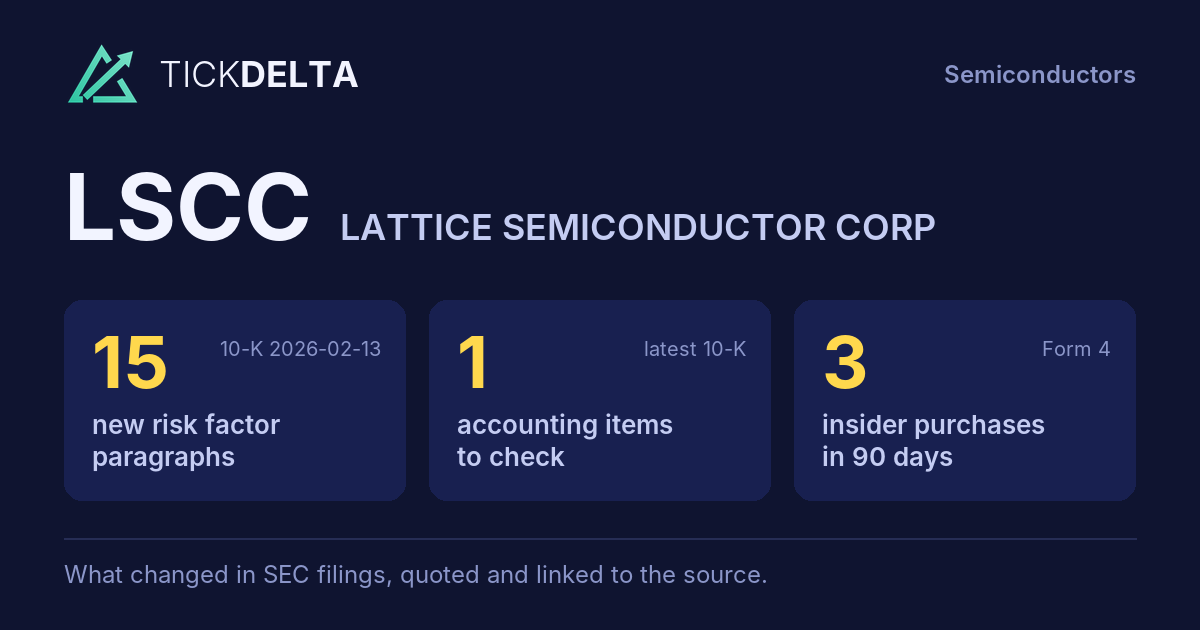
of the text changed · 15,120 words now · 15 new paragraphs, 5 gone
MD&A
13.6%
of the text changed · 4,572 words now · 7 new paragraphs, 6 gone
Accounting Policies
6.3%
of the text changed · 3,556 words now
10-K 0001437749-26-004100 (Feb 13, 2026) vs 10-K 0001437749-25-003987 (Feb 14, 2025) Not compared: Legal Proceedings.
Every paragraph, and how much of it changed
One bar per paragraph, in the order of the 10-K. Height and colour show the share of its words not in the closest paragraph a year earlier; the tallest bars are new paragraphs.
Risk Factors
149 paragraphs · 15 new · 43 reworded · 5 gone · 10-K Feb 13, 2026 against Feb 14, 2025
New paragraph
Reworded (5% of its words or more)
Same or nearly
Paragraph 36 · 37% changed
Every version of it
Paragraph 34 · 34% changed
Every version of it
Paragraph 72 · 25% changed
Every version of it
We also may be impacted by changes in the tax laws of the United States and foreign jurisdictions. The Inflation Reduction Act of 2022 implemented certain U.S. and foreign tax provisions, including a 1% excise tax on certain stock repurchases made by publicly traded corporations after December 31, 2022, legislation may be enacted, amended, or repealed from time to time, and provided for various incentives such changes may have retroactive or prospective effects and tax credits. may require significant interpretation or judgment in their application. A number of countries, as well as organizations such as the Organisation for Economic Co-operation and Development, Development (“OECD”), which represents a coalition of member countries, support the 15% global minimum tax initiative, and have adopted or intend to adopt laws to implement this initiative. On January 5, 2026, the OECD announced a “side-by-side” elective safe harbor that would exempt electing U.S.-parented multinational entities from the fifteen percent global minimum tax for taxable years beginning on or after January 1, 2026. Such countries and organizations are also actively considering changes to existing laws or have proposed or enacted new laws with changes to numerous long-standing tax principles. Such changes, as well as changes in taxing jurisdictions’ administrative interpretations, decisions, policies, and positions, could have a material adverse effect on our business, results of operations, or financial condition. In addition, future effective tax rates could be affected by changes in the valuation of deferred tax assets and liabilities.
Paragraph 98 · 23% changed
Every version of it
Concerns relating to the responsible use of new and evolving technologies, such as AI, in our and our customers’ products and services may result in reputational and financial harm and liability. We and our customers are increasingly building AI capabilities into many products and services. AI poses emerging ethical issues and presents risks and challenges that could affect its adoption, and therefore our business. These concerns may include alleged bias or inaccuracies, security vulnerabilities, misuse by end users or third parties, or impacts on privacy, intellectual property or other legal rights. In addition, regulatory and investor scrutiny of public statements regarding AI capabilities and plans continues to evolve, and any actual or perceived deficiencies in our AI governance, or any inaccurate or incomplete statements, could result in litigation, regulatory inquiries or enforcement actions, reputational harm and additional compliance costs. If we or our customers enable or offer solutions that draw controversy due to their perceived or actual impact on society, such as AI solutions that have unintended consequences or are controversial, we may experience reputational harm, competitive harm or legal liability.
Paragraph 144 · 22% changed
Every version of it
We actively evaluate and may continue to pursue growth opportunities by acquiring complementary businesses, solutions or technologies through strategic transactions, investments or partnerships. The identification identification, evaluation, negotiation, and pursuit of suitable acquisition, such transactions, strategic investment investments or strategic partnership candidates can be costly requires significant management time and time consuming attention and can distract our management team from our current operations. involves substantial costs, including fees paid to financial advisors, consultants, legal counsel, and other third parties, regardless of whether any transaction is ultimately consummated. If such strategic transactions require us to seek additional debt or equity financing, we may not be able to obtain such financing on terms favorable to us or at all, and such transaction may adversely affect our liquidity liquidity, capital structure, and capital structure. overall financial flexibility. We may also choose to divest certain non-core assets, which divestitures could lead to charges against earnings and may expose us to additional liabilities and risks. Any strategic transaction might not strengthen our competitive position, may increase some of our risks, and may be viewed negatively by our customers, partners or investors. Even if we successfully complete a strategic transaction, we may not be able to effectively integrate the acquired business, technology, systems, control environment, solutions, personnel or operations into our business or global tax structure. We may experience unexpected changes in how we are required to account for strategic transactions pursuant to U.S. GAAP and may not achieve the anticipated benefits of any strategic transaction. We may incur unexpected costs, obligations, claims or liabilities that we incur during the strategic transaction or that we assume from the acquired company, or we may discover adverse conditions post acquisition for which we have limited or no recourse. recourse, including but not limited to those related to intellectual property, litigation, regulatory compliance, taxes, indemnification obligations, or accounting treatment, each of which may require us to make significant judgments and estimates under U.S. GAAP that could affect our reported financial results. In addition, we may be required to incur restructuring charges, impairment charges, or other costs in connection with any transaction. We may also be subject to increased scrutiny by regulators, customers, partners, and investors in connection with strategic transactions, and any perceived failure to execute effectively could adversely affect our reputation and market position. We may also be a target for unsolicited acquisition or business combination offers. Appropriately reviewing and responding to any such offer can be costly and complex, and diverts the efforts and attention of management.
Paragraph 44 · 21% changed
Every version of it
We operate a primarily outsourced manufacturing business model that principally utilizes contract manufacturers, such as third-party wafer foundries. We rely on foundries in Japan, Korea and Taiwan to supply and fabricate silicon wafers for our semiconductor products, including Taiwan Semiconductor Manufacturing, Samsung Semiconductor, United Microelectronics Corporation, and Seiko Epson. We rely on our OSATs in Malaysia, Taiwan and Japan to support the packaging and test of our products, including Advanced Semiconductor Engineering and Amkor Technology. Our success is dependent upon our ability to successfully partner with our foundry and OSAT suppliers and their ability to produce wafers and finished semiconductor products with competitive prices and performance attributes, including smaller process geometries, which ability may be impacted by labor market disruptions and rising inflation. Establishing, maintaining Further, geopolitical tensions in East Asia, including heightened tensions between China and managing multiple Taiwan, present additional and significant risks to our outsourced manufacturing model, and any escalation of military conflict, trade restrictions, sanctions, blockades, or other disruptions in the region could adversely affect our foundry and OSAT relationships requires partners, regional logistics and transportation networks, or the investment availability of management resources materials, equipment, and costs. labor necessary to support semiconductor manufacturing and testing.
Paragraph 133 · 21% changed
Every version of it
Revenue recognition standards require recognition of revenue based on estimates and may require us to record revenue from distributors that is in excess of actual end customer demand. Since Because we have limited ability to forecast inventory levels of our end customers, we depend on the timeliness and accuracy of resale reports from our distributors. Late or inaccurate resale reports could reduce the quality or timeliness of information available to us for forecasting channel inventory and end-customer demand, mask significant build-up of inventories in our distribution channel, have a detrimental effect on our ability to properly recognize revenue, and impact our ability to accurately forecast future sales. An inventory build-up in our distribution channel could result in a slowdown in orders, requests for returns from customers, or requests to move out planned shipments. If actual end-customer demand or distributor inventory levels differ from our distributors do not ultimately sell the inventory estimates, future recorded revenue and our estimates change, operating results could be adversely impacted and we could may be required to materially correct our recognized revenue adjust shipment volumes, pricing, or channel terms in a future period, depending on actual results. subsequent periods. Any failure to manage these challenges could disrupt or reduce sales of our products and unfavorably impact adversely affect our financial results.
Paragraph 97 · 42% changed
Every version of it
10-K Feb 14, 2025The adoption of AI solutions may not develop in the manner or in the time periods we anticipate and as the markets for AI solutions are still developing, demand for these products may be unpredictable and may vary significantly from one period to another. These factors may adversely impact demand for our AI related products including our products that support AI solutions. In addition, compliance with government regulations and unfavorable developments with evolving laws and regulations worldwide related to these products and suppliers may increase the costs related to the development of AI products and solutions and limit global adoption, which may also adversely impact demand for our AI related products. For example, numerous U.S. states have proposed, and in certain cases enacted, legislation restricting the use of AI or imposing obligations in connection with its use, including by addressing forms of automated decision making.
10-K Feb 13, 2026
Our efforts to comply with applicable laws and regulations worldwide related to AI, data use, privacy, cybersecurity, product safety and related topics, and unfavorable developments in evolving laws and regulations worldwide relating to these matters, may increase the costs associated with developing, marketing and supporting products and solutions used in AI applications and may limit adoption. For example, various jurisdictions have proposed, and in certain cases enacted, legislation restricting the use of AI or imposing obligations in connection with its use, including by addressing forms of automated decision-making.
Paragraph 36 · 37% changed
Every version of it
10-K Feb 14, 2025Additional changes or threatened changes in U.S. trade measures have affected and may continue to affect trade involving additional countries as well, including Mexico, Canada, Colombia, Taiwan, the United Kingdom, and the member countries of the European Union. Each of these measures or threatened measures may instigate reciprocal countermeasures by affected countries, potentially accelerating further increases in trade measures. Significant new tariffs scheduled to be imposed by the United States on imports of Mexican and Canadian origin goods have been temporarily delayed for a period of 30 days pending further negotiations between these countries. If the United States and Mexico or the United States and Canada are unable to reach long-term agreements, or if the President were to impose significant new tariffs against the European Union, Taiwan, or any other country or countries, the macroeconomic effect of any such tariffs could be significant. The tariff threatened against Taiwan may specifically target imports of semiconductor products, which, if imposed, could seriously and negatively affect our business and the U.S. economy overall. The materials subject to these tariffs may impact the cost or availability of raw materials used by our suppliers or in our customers’ products. The imposition of further tariffs by the United States on a broader range of imports, or further retaliatory trade measures taken in response to additional tariffs, could increase costs in our supply chain or reduce demand of our customers’ products, either of which could adversely affect our results of operations. Any increase in trade-related costs associated with such measures may impair the profitability of such international production, may strain our suppliers’ ability to reliably provide inputs necessary to produce these items, and may otherwise affect our partners’ abilities to provide our products at previously contracted prices. Our business and financial results could be negatively affected as a result.
10-K Feb 13, 2026
The materials subject to these tariffs may impact the cost or availability of raw materials used by our suppliers or in our customers’ products. The imposition of further tariffs by the United States on a broader range of imports, or further retaliatory trade measures taken in response to additional tariffs, could increase costs in our supply chain or reduce demand of our customers’ products, either of which could adversely affect our results of operations. Any increase in trade-related costs associated with such measures may impair the profitability of such international production, may strain our suppliers’ ability to reliably provide inputs necessary to produce these items, may otherwise affect our partners’ abilities to provide our products at previously contracted prices, and may limit our ability to absorb increased costs without raising prices to our customers. Any such price increases could reduce customer demand, delay or cancel customer orders, or cause customers to seek alternative solutions, which could adversely affect our revenue, market share, and operating results. Our business and financial results could be negatively affected as a result.
Paragraph 34 · 34% changed
Every version of it
10-K Feb 14, 2025The imposition by the United States of tariffs, sanctions or other restrictions on goods exported from the United States or imported into the United States or countermeasures imposed in response to such government actions could adversely affect our operations or our ability to sell our products globally, which could adversely affect our operating results and financial condition. Beginning in 2018, the U.S. government imposed significant additional tariffs on many items imported from China, which have since been raised to between 7.5% and 100% on certain products. China responded by imposing significant tariffs on many items imported from the United States, among other measures which include export controls restricting the export of gallium and germanium to the United States. Recently, U.S. government leaders have increased their frequency of discussion of the imposition of stronger tariffs, sanctions, and other restrictions on goods exported from the United States or imported into the United States, and non-U.S. government leaders have increased their discussion of countermeasures. For example, in February 2025, the United States imposed an additional 10% tariff on imports of Chinese-origin goods and steel and aluminum imports. China announced plans to impose retaliatory tariffs on certain U.S.-origin goods and implemented new trade controls restricting the export of tungsten, tellurium, bismuth, molybdenum, and indium. As the February 2025, U.S. executive order contains provisions allowing for further increases in the scope and amount of tariffs in the event of retaliatory countermeasures, and the future of existing tariffs, and the possibility for new tariffs, remains very uncertain. Such escalations in these trade measures may directly impair our business by increasing trade-related costs or disrupting established supply chains and may indirectly impair our business by causing a negative effect on global economic conditions and financial markets. The ultimate impact of these trade measures is uncertain and may be affected by various factors, including whether and when such trade measures are implemented, the timing when such measures may become effective, and the amount, scope, or nature of such trade measures.
10-K Feb 13, 2026
In addition, the U.S. government has imposed additional duties under other legal authorities, and applicable duties may be increased, reduced, suspended, reinstated, or otherwise changed, and in some cases may be cumulative with other applicable duties or trade remedies. These measures include a “fentanyl-related” tariff of 10-20% imposed on most Chinese origin goods since February 2025, as well as a 10%-125% “reciprocal” tariff imposed on many Chinese origin goods since April 2025, both issued pursuant to authorities asserted under the International Emergency Economic Powers Act (“IEEPA”). China responded by imposing or threatening to impose significant trade measures, including tariffs on many items imported from the United States and export controls restricting the export of gallium, germanium, and other rare earth materials to the United States. While these risks have been partially mitigated based on bilateral trade deals reached between the U.S. and China, which are currently in effect, these agreements are temporary and may be unstable. The February 2025 U.S. executive order contains provisions allowing for further increases in the scope and amount of tariffs in the event of retaliatory countermeasures, and the future of existing tariffs, and the possibility for new tariffs, remains very uncertain. Such escalations in these trade measures may directly impair our business by increasing trade-related costs or disrupting established supply chains and may indirectly impair our business by causing a negative effect on global economic conditions and financial markets. The ultimate impact of these trade measures is uncertain and may be affected by various factors, including whether and when such trade measures are implemented, the timing when such measures may become effective, and the amount, scope, or nature of such trade measures.
Paragraph 72 · 25% changed
Every version of it
10-K Feb 14, 2025
We also may be impacted by changes in the tax laws of the United States and foreign jurisdictions. The Inflation Reduction Act of 2022 implemented certain tax provisions, including a 1% excise tax on certain stock repurchases made by publicly traded corporations after December 31, 2022, and provided for various incentives and tax credits. A number of countries, as well as organizations such as the Organisation for Economic Co-operation and Development, which represents a coalition of member countries, support the 15% global minimum tax initiative, and have adopted or intend to adopt laws to implement this initiative. Such countries and organizations are also actively considering changes to existing laws or have proposed or enacted new laws with changes to numerous long-standing tax principles. Such changes, as well as changes in taxing jurisdictions’ administrative interpretations, decisions, policies, and positions, could have a material adverse effect on our business, results of operations, or financial condition. In addition, future effective tax rates could be affected by changes in the valuation of deferred tax assets and liabilities.
10-K Feb 13, 2026
We also may be impacted by changes in the tax laws of the United States and foreign jurisdictions. U.S. and foreign tax legislation may be enacted, amended, or repealed from time to time, and such changes may have retroactive or prospective effects and may require significant interpretation or judgment in their application. A number of countries, as well as organizations such as the Organisation for Economic Co-operation and Development (“OECD”), which represents a coalition of member countries, support the 15% global minimum tax initiative, and have adopted or intend to adopt laws to implement this initiative. On January 5, 2026, the OECD announced a “side-by-side” elective safe harbor that would exempt electing U.S.-parented multinational entities from the fifteen percent global minimum tax for taxable years beginning on or after January 1, 2026. Such countries and organizations are also actively considering changes to existing laws or have proposed or enacted new laws with changes to numerous long-standing tax principles. Such changes, as well as changes in taxing jurisdictions’ administrative interpretations, decisions, policies, and positions, could have a material adverse effect on our business, results of operations, or financial condition. In addition, future effective tax rates could be affected by changes in the valuation of deferred tax assets and liabilities.
Paragraph 98 · 23% changed
Every version of it
10-K Feb 14, 2025
Concerns relating to the responsible use of new and evolving technologies, such as AI, in our and our customers’ products and services may result in reputational and financial harm and liability. We and our customers are increasingly building AI capabilities into many products and services. AI poses emerging ethical issues and presents risks and challenges that could affect its adoption, and therefore our business. If we or our customers enable or offer solutions that draw controversy due to their perceived or actual impact on society, such as AI solutions that have unintended consequences or are controversial, we may experience reputational harm, competitive harm or legal liability.
10-K Feb 13, 2026
Concerns relating to the responsible use of new and evolving technologies, such as AI, in our and our customers’ products and services may result in reputational and financial harm and liability. We and our customers are increasingly building AI capabilities into many products and services. AI poses emerging ethical issues and presents risks and challenges that could affect its adoption, and therefore our business. These concerns may include alleged bias or inaccuracies, security vulnerabilities, misuse by end users or third parties, or impacts on privacy, intellectual property or other legal rights. In addition, regulatory and investor scrutiny of public statements regarding AI capabilities and plans continues to evolve, and any actual or perceived deficiencies in our AI governance, or any inaccurate or incomplete statements, could result in litigation, regulatory inquiries or enforcement actions, reputational harm and additional compliance costs. If we or our customers enable or offer solutions that draw controversy due to their perceived or actual impact on society, such as AI solutions that have unintended consequences or are controversial, we may experience reputational harm, competitive harm or legal liability.
Paragraph 144 · 22% changed
Every version of it
10-K Feb 14, 2025
We may pursue growth opportunities by acquiring complementary businesses, solutions or technologies through strategic transactions, investments or partnerships. The identification of suitable acquisition, strategic investment or strategic partnership candidates can be costly and time consuming and can distract our management team from our current operations. If such strategic transactions require us to seek additional debt or equity financing, we may not be able to obtain such financing on terms favorable to us or at all, and such transaction may adversely affect our liquidity and capital structure. We may also choose to divest certain non-core assets, which divestitures could lead to charges against earnings and may expose us to additional liabilities and risks. Any strategic transaction might not strengthen our competitive position, may increase some of our risks, and may be viewed negatively by our customers, partners or investors. Even if we successfully complete a strategic transaction, we may not be able to effectively integrate the acquired business, technology, systems, control environment, solutions, personnel or operations into our business or global tax structure. We may experience unexpected changes in how we are required to account for strategic transactions pursuant to U.S. GAAP and may not achieve the anticipated benefits of any strategic transaction. We may incur unexpected costs, claims or liabilities that we incur during the strategic transaction or that we assume from the acquired company, or we may discover adverse conditions post acquisition for which we have limited or no recourse. We may also be a target for unsolicited acquisition or business combination offers. Appropriately reviewing and responding to any such offer can be costly and complex, and diverts the efforts and attention of management.
10-K Feb 13, 2026
We actively evaluate and may continue to pursue growth opportunities by acquiring complementary businesses, solutions or technologies through strategic transactions, investments or partnerships. The identification, evaluation, negotiation, and pursuit of such transactions, strategic investments or strategic partnership candidates requires significant management time and attention and involves substantial costs, including fees paid to financial advisors, consultants, legal counsel, and other third parties, regardless of whether any transaction is ultimately consummated. If such strategic transactions require us to seek additional debt or equity financing, we may not be able to obtain such financing on terms favorable to us or at all, and such transaction may adversely affect our liquidity, capital structure, and overall financial flexibility. We may also choose to divest certain non-core assets, which divestitures could lead to charges against earnings and may expose us to additional liabilities and risks. Any strategic transaction might not strengthen our competitive position, may increase some of our risks, and may be viewed negatively by our customers, partners or investors. Even if we successfully complete a strategic transaction, we may not be able to effectively integrate the acquired business, technology, systems, control environment, solutions, personnel or operations into our business or global tax structure. We may experience unexpected changes in how we are required to account for strategic transactions pursuant to U.S. GAAP and may not achieve the anticipated benefits of any strategic transaction. We may incur unexpected costs, obligations, claims or liabilities that we incur during the strategic transaction or that we assume from the acquired company, or we may discover adverse conditions post acquisition for which we have limited or no recourse, including but not limited to those related to intellectual property, litigation, regulatory compliance, taxes, indemnification obligations, or accounting treatment, each of which may require us to make significant judgments and estimates under U.S. GAAP that could affect our reported financial results. In addition, we may be required to incur restructuring charges, impairment charges, or other costs in connection with any transaction. We may also be subject to increased scrutiny by regulators, customers, partners, and investors in connection with strategic transactions, and any perceived failure to execute effectively could adversely affect our reputation and market position. We may also be a target for unsolicited acquisition or business combination offers. Appropriately reviewing and responding to any such offer can be costly and complex, and diverts the efforts and attention of management.
Paragraph 44 · 21% changed
Every version of it
10-K Feb 14, 2025
We operate a primarily outsourced manufacturing business model that principally utilizes contract manufacturers, such as third-party wafer foundries. We rely on foundries in Japan, Korea and Taiwan to supply and fabricate silicon wafers for our semiconductor products, including Taiwan Semiconductor Manufacturing, Samsung Semiconductor, United Microelectronics Corporation, and Seiko Epson. We rely on our OSATs in Malaysia, Taiwan and Japan to support the packaging and test of our products, including Advanced Semiconductor Engineering and Amkor Technology. Our success is dependent upon our ability to successfully partner with our foundry and OSAT suppliers and their ability to produce wafers and finished semiconductor products with competitive prices and performance attributes, including smaller process geometries, which ability may be impacted by labor market disruptions and rising inflation. Establishing, maintaining and managing multiple foundry and OSAT relationships requires the investment of management resources and costs.
10-K Feb 13, 2026
We operate a primarily outsourced manufacturing business model that principally utilizes contract manufacturers, such as third-party wafer foundries. We rely on foundries in Japan, Korea and Taiwan to supply and fabricate silicon wafers for our semiconductor products, including Taiwan Semiconductor Manufacturing, Samsung Semiconductor, United Microelectronics Corporation, and Seiko Epson. We rely on our OSATs in Malaysia, Taiwan and Japan to support the packaging and test of our products, including Advanced Semiconductor Engineering and Amkor Technology. Our success is dependent upon our ability to successfully partner with our foundry and OSAT suppliers and their ability to produce wafers and finished semiconductor products with competitive prices and performance attributes, including smaller process geometries, which ability may be impacted by labor market disruptions and rising inflation. Further, geopolitical tensions in East Asia, including heightened tensions between China and Taiwan, present additional and significant risks to our outsourced manufacturing model, and any escalation of military conflict, trade restrictions, sanctions, blockades, or other disruptions in the region could adversely affect our foundry and OSAT partners, regional logistics and transportation networks, or the availability of materials, equipment, and labor necessary to support semiconductor manufacturing and testing.
Paragraph 133 · 21% changed
Every version of it
10-K Feb 14, 2025
Revenue recognition standards require recognition of revenue based on estimates and may require us to record revenue from distributors that is in excess of actual end customer demand. Since we have limited ability to forecast inventory levels of our end customers, we depend on the timeliness and accuracy of resale reports from our distributors. Late or inaccurate resale reports could mask significant build-up of inventories in our distribution channel, have a detrimental effect on our ability to properly recognize revenue, and impact our ability to forecast future sales. An inventory build-up in our distribution channel could result in a slowdown in orders, requests for returns from customers, or requests to move out planned shipments. If our distributors do not ultimately sell the inventory and our estimates change, we could be required to materially correct our recognized revenue in a future period, depending on actual results. Any failure to manage these challenges could disrupt or reduce sales of our products and unfavorably impact our financial results.
10-K Feb 13, 2026
Revenue recognition standards require recognition of revenue based on estimates and may require us to record revenue from distributors that is in excess of actual end customer demand. Because we have limited ability to forecast inventory levels of our end customers, we depend on the timeliness and accuracy of resale reports from our distributors. Late or inaccurate resale reports could reduce the quality or timeliness of information available to us for forecasting channel inventory and end-customer demand, mask significant build-up of inventories in our distribution channel, and impact our ability to accurately forecast future sales. An inventory build-up in our distribution channel could result in a slowdown in orders, requests for returns from customers, or requests to move out planned shipments. If actual end-customer demand or distributor inventory levels differ from our estimates, future recorded revenue and operating results could be adversely impacted and we may be required to adjust shipment volumes, pricing, or channel terms in subsequent periods. Any failure to manage these challenges could disrupt or reduce sales of our products and adversely affect our financial results.
MD&A
76 paragraphs · 7 new · 33 reworded · 6 gone · 10-K Feb 13, 2026 against Feb 14, 2025
New paragraph
Reworded (5% of its words or more)
Same or nearly
Paragraph 35 · 47% changed
The decrease increase in Selling, general, Research and administrative development expense for fiscal 2024 2025 compared to fiscal 2023 2024 was primarily due primarily to a higher stock-based compensation associated with market-based and performance-based awards in the current year periods coupled with the prior year reduction in stock compensation expense from the forfeiture of equity awards by departing executives and reduced headcount-related costs as we aligned resources to the lower level of business, partially offset by other costs such as outside services and legal expenses. executives.
Paragraph 72 · 43% changed
Inventories as of January 3, 2026 decreased $14.2 million, or approximately 14%, compared to December 28, 2024 increased $4.6 million, or approximately 5%, compared to December 30, 2023 primarily as a result of product buildup ahead our continued optimization of new product ramps and from softer demand as customers continue inventory to normalize their own inventories. efficient levels for the business, which also decreased Days of inventory on hand increased over the period due to lower revenue. period.
Paragraph 31 · 42% changed
Gross margin percentage decreased 300 increased 140 basis points from fiscal 2023 2024 to fiscal 2024. Reduced 2025. Higher margins were resulted primarily due to from the non-recurrence of an approximately $7.0 million one-time charge for expiring production materials, and materials in the prior year. Gross margin also benefitted from changes in product mix between the periods presented. The expiring production materials were purchased on behalf of periods, partially offset by higher stock-based compensation associated with market and performance-based awards in the company by the OSATs in anticipation of a supply constraint and are no longer expected to be used. We expect gross margin to increase in future periods due to the non-recurrence of the one-time charge. current year.
Paragraph 39 · 40% changed
The decrease increase in Selling, general, and administrative expense for fiscal 2024 2025 compared to fiscal 2023 2024 was primarily due primarily to a higher stock-based compensation associated with market-based and performance-based awards in the current year periods coupled with the prior year reduction in stock compensation expense from the forfeiture of equity awards by departing executives and reduced headcount-related costs as we aligned resources to the lower level of business, partially offset by other costs such as outside services and legal expenses. executives.
Paragraph 18 · 36% changed
Communications and Computing: data center servers and networking equipment, client computing platforms, and wireless and wireline communications infrastructure deployments, Industrial and Automotive: factory automation, robotics, automotive electronics, and industrial IoT, Consumer: smart home, prosumer, and other applications. deployments.
Paragraph 24 · 35% changed
Revenue from the Communications and Computing end market decreased increased by 11% 28% in fiscal 2024 2025 compared to fiscal 2023 2024 primarily due to softer end market demand in telecommunications infrastructure deployments and from continued inventory normalization by customers, partially offset by stronger demand in data center applications. applications, including general-purpose and AI-specific servers, as well as wireline networking components.
Paragraph 51 · 35% changed
Our Income income tax expense (benefit) expense on worldwide for fiscal 2025 was driven primarily by nondeductible expenses related to stock‑based compensation, partially offset by federal tax credits. The income for tax benefit in fiscal 2024 includes $27.7 million of income tax benefits due to the expiration of statutes of limitations that reduced our uncertain tax positions, as well as combined with federal tax credits, credits and stock-based the impact of stock‑based compensation. The lower income tax benefit in fiscal 2024 was primarily due to the reduction in valuation allowance over the $56.9 million of U.S. Federal deferred tax assets in 2023. The income tax benefit from the release of a portion of the valuation allowance was partially offset by an increase in expense in fiscal 2023 as compared to fiscal 2022 primarily due to increased worldwide income and U.S. tax on foreign operations.
Paragraph 42 · 33% changed
The decrease in Amortization of acquired intangible assets was flat for fiscal 2024 2025 compared to fiscal 2023. 2024 was primarily due to the full impairment of the Mirametrix intangible assets in the fourth quarter of fiscal 2024.
Paragraph 35 · 47% changed
10-K Feb 14, 2025
The decrease in Selling, general, and administrative expense for fiscal 2024 compared to fiscal 2023 was due primarily to a reduction in stock compensation expense from the forfeiture of equity awards by departing executives and reduced headcount-related costs as we aligned resources to the lower level of business, partially offset by other costs such as outside services and legal expenses.
10-K Feb 13, 2026
The increase in Research and development expense for fiscal 2025 compared to fiscal 2024 was primarily due to higher stock-based compensation associated with market-based and performance-based awards in the current year periods coupled with the prior year reduction in stock compensation expense from the forfeiture of equity awards by departing executives.
Paragraph 72 · 43% changed
10-K Feb 14, 2025
Inventories as of December 28, 2024 increased $4.6 million, or approximately 5%, compared to December 30, 2023 primarily as a result of product buildup ahead of new product ramps and from softer demand as customers continue to normalize their own inventories. Days of inventory on hand increased over the period due to lower revenue.
10-K Feb 13, 2026
Inventories as of January 3, 2026 decreased $14.2 million, or approximately 14%, compared to December 28, 2024 primarily as a result of our continued optimization of inventory to efficient levels for the business, which also decreased Days of inventory on hand over the period.
Paragraph 31 · 42% changed
10-K Feb 14, 2025
Gross margin percentage decreased 300 basis points from fiscal 2023 to fiscal 2024. Reduced margins were primarily due to an approximately $7.0 million one-time charge for expiring production materials, and changes in product mix between the periods presented. The expiring production materials were purchased on behalf of the company by the OSATs in anticipation of a supply constraint and are no longer expected to be used. We expect gross margin to increase in future periods due to the non-recurrence of the one-time charge.
10-K Feb 13, 2026
Gross margin percentage increased 140 basis points from fiscal 2024 to fiscal 2025. Higher margins resulted primarily from the non-recurrence of an approximately $7.0 million one-time charge for expiring production materials in the prior year. Gross margin also benefitted from changes in product mix between the periods, partially offset by higher stock-based compensation associated with market and performance-based awards in the current year.
Paragraph 39 · 40% changed
10-K Feb 14, 2025
The decrease in Selling, general, and administrative expense for fiscal 2024 compared to fiscal 2023 was due primarily to a reduction in stock compensation expense from the forfeiture of equity awards by departing executives and reduced headcount-related costs as we aligned resources to the lower level of business, partially offset by other costs such as outside services and legal expenses.
10-K Feb 13, 2026
The increase in Selling, general, and administrative expense for fiscal 2025 compared to fiscal 2024 was primarily due to higher stock-based compensation associated with market-based and performance-based awards in the current year periods coupled with the prior year reduction in stock compensation expense from the forfeiture of equity awards by departing executives.
Paragraph 18 · 36% changed
10-K Feb 14, 2025
Communications and Computing: data center servers and networking equipment, client computing platforms, and wireless and wireline communications infrastructure deployments, Industrial and Automotive: factory automation, robotics, automotive electronics, and industrial IoT, Consumer: smart home, prosumer, and other applications.
10-K Feb 13, 2026
Communications and Computing: data center servers and networking equipment, client computing platforms, and wireless and wireline communications infrastructure deployments.
Paragraph 24 · 35% changed
10-K Feb 14, 2025
Revenue from the Communications and Computing end market decreased by 11% in fiscal 2024 compared to fiscal 2023 primarily due to softer end market demand in telecommunications infrastructure deployments and from continued inventory normalization by customers, partially offset by stronger demand in data center applications.
10-K Feb 13, 2026
Revenue from the Communications and Computing end market increased by 28% in fiscal 2025 compared to fiscal 2024 primarily due to stronger demand in data center applications, including general-purpose and AI-specific servers, as well as wireline networking components.
Paragraph 51 · 35% changed
10-K Feb 14, 2025
Our Income tax (benefit) expense on worldwide income for fiscal 2024 includes $27.7 million of income tax benefits due to the expiration of statutes of limitations that reduced our uncertain tax positions, as well as federal tax credits, and stock-based compensation. The lower income tax benefit in fiscal 2024 was primarily due to the reduction in valuation allowance over the $56.9 million of U.S. Federal deferred tax assets in 2023. The income tax benefit from the release of a portion of the valuation allowance was partially offset by an increase in expense in fiscal 2023 as compared to fiscal 2022 primarily due to increased worldwide income and U.S. tax on foreign operations.
10-K Feb 13, 2026
Our income tax expense (benefit) for fiscal 2025 was driven primarily by nondeductible expenses related to stock‑based compensation, partially offset by federal tax credits. The income tax benefit in fiscal 2024 includes $27.7 million of income tax benefits due to the expiration of statutes of limitations that reduced our uncertain tax positions, combined with federal tax credits and the impact of stock‑based compensation.
Paragraph 42 · 33% changed
10-K Feb 14, 2025
Amortization of acquired intangible assets was flat for fiscal 2024 compared to fiscal 2023.
10-K Feb 13, 2026
The decrease in Amortization of acquired intangible assets for fiscal 2025 compared to fiscal 2024 was primarily due to the full impairment of the Mirametrix intangible assets in the fourth quarter of fiscal 2024.
A paragraph is matched with the one last year that shares the most of its words; under half in common makes it new. The paragraphs shown are the 8 reworded the most in each section.
The paragraph that changed most in each section
The redline
Marked against last year's 10-K: cut words struck through, new words highlighted.
Risk Factors357 words changed in this paragraph; it is 34% similar to last year's version.
Additional changes or threatened changes in U.S. trade measures have affected and may continue to affect trade involving additional countries, including countries as well, including Mexico, Canada, Colombia, Taiwan, the United Kingdom, and the member countries of the European Union. in Europe. Each of these measures or threatened measures may instigate reciprocal countermeasures by affected countries, potentially accelerating further increases in trade measures. Significant new Certain announced or proposed tariffs scheduled to be imposed by the United States on imports of Mexican and Canadian origin goods have been temporarily delayed for a period of 30 days pending further negotiations between these countries. delayed, modified, or made subject to negotiations, and there can be no assurance that such measures will not be implemented, expanded, reinstated, or increased. If the United States and Mexico or the United States and Canada affected countries are unable to reach long-term agreements, or if the President were to impose significant new tariffs against the European Union, Taiwan, or any other country or countries, tariffs, the macroeconomic effect of any such tariffs could be significant. The tariff threatened against Taiwan may Tariffs or restrictions that specifically target imports of semiconductor products, which, if imposed, semiconductors or products incorporating semiconductors, including measures that could affect key manufacturing regions or supply chain routes (including under Section 232), could seriously and negatively affect our business and the U.S. economy overall. The materials Certain tariffs have been imposed under emergency authorities, including IEEPA, and the legal authority for IEEPA-based tariffs has been the subject to these tariffs may impact of significant litigation. In 2025, the cost Court of International Trade and the Federal Circuit held that IEEPA did not authorize certain tariffs, and the Supreme Court heard oral argument in November 2025 in consolidated cases addressing IEEPA tariff authority. Depending on the ultimate outcomes and any governmental responses, tariff regimes could change rapidly, including through replacement measures under other legal authorities and potential uncertainty regarding refunds or availability of raw materials used by our suppliers or in our customers’ products. The imposition of further tariffs by the United States on a broader range of imports, or further retaliatory trade measures taken in response to additional tariffs, could increase costs in our supply chain or reduce demand of our customers’ products, either of which could adversely affect our results of operations. Any increase in trade-related costs associated with such measures may impair the profitability of such international production, may strain our suppliers’ ability to reliably provide inputs necessary to produce these items, and may otherwise affect our partners’ abilities to provide our products at previously contracted prices. Our business and financial results could be negatively affected as a result. retroactive treatment.
Source: Item 1A, 10-K 0001437749-26-004100 vs Item 1A, 10-K 0001437749-25-003987
Accounting Policies156 words changed in this paragraph; it is 32% similar to last year's version.
In December 2023, September 2025, the FASB issued ASU 2023-09, Income Taxes (Topic 740) 2025-06, Intangibles - Goodwill and Other - Internal-Use Software (Subtopic 350-40): Targeted Improvements to Income Tax Disclosures, which require greater disaggregation of income tax disclosures. ASU 2023-09 aims to improve an entity’s income tax disclosures around its effective rate reconciliation, income taxes paid by jurisdiction, disaggregation of income before income taxes and income tax expense. the Accounting for Internal-Use Software. This ASU should be applied on is intended to simplify the recognition and disclosure guidance related to capitalized internal-use software costs by removing all references to software development project stages and introducing a prospective basis, but retrospective application is permitted. The guidance in this update more judgment-based framework. ASU 2025-06 is effective for fiscal years beginning after December 15, 2024. 2027, and for interim periods within those fiscal years, with early adoption permitted as of the beginning of a fiscal year. This standard may be applied prospectively, retrospectively, or via a modified prospective transition method. We are currently evaluating the future effect impact of the adoption of this ASU will have new guidance on our consolidated financial statements and related disclosures.
Source: Item 8, Note 1 – Basis of Presentation and Significant Accounting Policies, 10-K 0001437749-26-004100 vs Item 8, Note 1 – Basis of Presentation and Significant Accounting Policies, 10-K 0001437749-25-003987
MD&A111 words changed in this paragraph; it is 37% similar to last year's version.
Our Income income tax expense (benefit) expense on worldwide for fiscal 2025 was driven primarily by nondeductible expenses related to stock‑based compensation, partially offset by federal tax credits. The income for tax benefit in fiscal 2024 includes $27.7 million of income tax benefits due to the expiration of statutes of limitations that reduced our uncertain tax positions, as well as combined with federal tax credits, credits and stock-based the impact of stock‑based compensation. The lower income tax benefit in fiscal 2024 was primarily due to the reduction in valuation allowance over the $56.9 million of U.S. Federal deferred tax assets in 2023. The income tax benefit from the release of a portion of the valuation allowance was partially offset by an increase in expense in fiscal 2023 as compared to fiscal 2022 primarily due to increased worldwide income and U.S. tax on foreign operations.
Source: Item 7, 10-K 0001437749-26-004100 vs Item 7, 10-K 0001437749-25-003987
Sentences and paragraphs added, removed or reworded
Every change, by type
Sentences and paragraphs of LSCC's Risk Factors and MD&A, 10-K Feb 13, 2026 against 10-K Feb 14, 2025. Each links to the text at sec.gov.
Quiet changes are sentences kept from last year with one to four words changed, at least one of them a hedge, a modal or a qualifier (may, could, will, not, significant, material…). A year or date rolling forward is not counted.
The full word list
adverse, adversely, all, although, anticipate, anticipates, any, approximately, believe, believes, can, cannot, certain, could, expect, expects, generally, however, if, intend, intends, largely, likely, many, material, materially, may, might, most, must, never, no, not, possible, primarily, probable, should, significant, significantly, some, substantial, substantially, unlikely, will, would
AddedRisk Factors
Fluctuations in foreign currency exchange rates, and our foreign currency risk management and hedging activities.
Read it in 10-K Feb 13, 2026 at sec.gov
AddedRisk Factors
Our dependence on our highly concentrated distributor model and our end customers.
Read it in 10-K Feb 13, 2026 at sec.gov
AddedRisk Factors
The effects of inflationary pressures, interest rate fluctuations, and recessionary or economic slowdown risks.
Read it in 10-K Feb 13, 2026 at sec.gov
AddedRisk Factors
The imposition by the United States of tariffs, sanctions or other restrictions on goods exported from the United States or imported into the United States or countermeasures imposed in response to such government actions could adversely affect our operations or our ability to sell our products globally, which could adversely affect our operating results and financial condition.
Read it in 10-K Feb 13, 2026 at sec.gov
AddedRisk Factors
These restrictions include measures under United States’ authority under Section 232 of the Trade Expansion Act of 1962 to impose tariffs or other restrictions on imports deemed to threaten national security, including potentially with respect to semiconductors and products incorporating semiconductors. As a fabless semiconductor company that relies on a predominantly non-U.S. manufacturing and supply chain, the imposition of Section 232 measures could increase costs, disrupt supply chains, reduce customer demand, or place us at a competitive disadvantage relative to companies with different manufacturing footprints. Section 232 actions may be imposed with limited notice and could prompt retaliatory measures by other countries, further increasing global trade uncertainty and adversely affecting our business and financial results. In 2025, the U.S. Department of Commerce initiated a Section 232 national security investigation relating to semiconductors and semiconductor manufacturing equipment, and the outcome of that investigation, including any resulting tariffs, quotas, or other restrictions, is uncertain and could be implemented with limited notice. In January 2026, the President issued a proclamation under Section 232 imposing an immediate 25% tariff on certain advanced semiconductor articles and announcing that broader tariffs on semiconductors, semiconductor manufacturing equipment, and derivative products may follow. The United States has also implemented additional Section 232 tariffs on imports of various commodities, including articles of steel, aluminum, copper, and timber, as well as passenger vehicles, trucks, and automotive parts.
Read it in 10-K Feb 13, 2026 at sec.gov
AddedRisk Factors
Beginning in 2018, the U.S. government imposed significant additional tariffs on many items imported from China, including under Section 301 of the Trade Act of 1974, and the scope and rates of these tariffs have fluctuated significantly, up to 100% on certain products (including a 50% tariff on certain Chinese semiconductor items beginning in early 2025). In late 2025, the U.S. Trade Representative concluded following an additional Section 301 trade investigation that China engaged in unfair trade acts, policies, and practices with respect to the semiconductor industry, and therefore will implement an additional Section 301 tariff on Chinese semiconductors, in addition to the existing 50% Section 301 tariff, beginning on June 23, 2027.
Read it in 10-K Feb 13, 2026 at sec.gov
AddedRisk Factors
Additional changes or threatened changes in U.S. trade measures have affected and may continue to affect trade involving additional countries, including countries in Europe. Each of these measures or threatened measures may instigate reciprocal countermeasures by affected countries, potentially accelerating further increases in trade measures. Certain announced or proposed tariffs have been delayed, modified, or made subject to negotiations, and there can be no assurance that such measures will not be implemented, expanded, reinstated, or increased. If the affected countries are unable to reach long-term agreements, or if the President were to impose significant new tariffs, the macroeconomic effect of any such tariffs could be significant. Tariffs or restrictions that specifically target imports of semiconductors or products incorporating semiconductors, including measures that could affect key manufacturing regions or supply chain routes (including under Section 232), could seriously and negatively affect our business and the U.S. economy overall. Certain tariffs have been imposed under emergency authorities, including IEEPA, and the legal authority for IEEPA-based tariffs has been the subject of significant litigation. In 2025, the Court of International Trade and the Federal Circuit held that IEEPA did not authorize certain tariffs, and the Supreme Court heard oral argument in November 2025 in consolidated cases addressing IEEPA tariff authority. Depending on the ultimate outcomes and any governmental responses, tariff regimes could change rapidly, including through replacement measures under other legal authorities and potential uncertainty regarding refunds or retroactive treatment.
Read it in 10-K Feb 13, 2026 at sec.gov
AddedRisk Factors
In addition to restrictions on the sale or shipment of products, U.S. export control laws and regulations may apply to the transfer, sharing, or access of certain technology, software, source code, technical data, or know-how for research, development, engineering, testing, or support purposes, including through electronic access, remote collaboration, or internal development activities outside of the United States. Such transfers or access may be deemed “exports” under applicable regulations, even when no product is sold and the activity is undertaken solely for internal development or cost-reduction purposes. As a result, our ability to expand, relocate, or optimize product development, engineering, or technical support activities in lower-cost or non-U.S. jurisdictions may be constrained by export licensing requirements, including requirements that are time-consuming, uncertain, subject to conditions, or subject to a policy of denial. If required licenses are delayed, denied, or granted only with restrictive conditions, we may be required to limit the scope of, delay, restructure, or forego certain development initiatives, incur additional compliance and administrative costs, or reallocate engineering resources to higher-cost locations. Any such limitations could reduce the expected benefits of our global development strategy, slow innovation, delay product development timelines, or adversely affect our operating efficiency and results of operations.
Read it in 10-K Feb 13, 2026 at sec.gov
Show the other 48
AddedRisk Factors
Fluctuations in foreign currency exchange rates, and our foreign currency risk management and hedging activities, could adversely affect our results of operations .
Read it in 10-K Feb 13, 2026 at sec.gov
AddedRisk Factors
We have significant global operations, including foreign sales and service activities and international operating and research and development sites, and we rely on foreign suppliers and service providers. As a result, financial results may be exposed to fluctuations in foreign currency exchange rates. Foreign currency movements may affect, among other things, the U.S. dollar cost of operating expenses and headcount in foreign locations, the pricing and cost of goods and services purchased from non-U.S. suppliers, the competitiveness of our products in certain markets, and the U.S. dollar value of foreign currency denominated assets and liabilities. These impacts can be difficult to predict, may occur rapidly, and may adversely affect our gross margin and operating results. We may from time to time enter into foreign currency risk management transactions, including derivative instruments, in an effort to reduce the impact of foreign currency fluctuations on our financial results. However, these activities may not be effective, may be costly to implement and maintain, and may expose us to additional risks, including: (i) hedges that do not offset underlying exposures due to forecasting error, timing mismatches, changes in exposure profile, or market illiquidity; (ii) adverse accounting impacts, including additional earnings volatility due to ineffectiveness or changes in hedge accounting treatment; (iii) counterparty credit risk, settlement risk, collateral or liquidity requirements, and operational risk in executing, monitoring, and governing a hedging program; and (iv) reduced ability to benefit from favorable foreign currency movements. Even if we pursue hedging strategies, foreign currency fluctuations could still have a material adverse effect on our financial condition and results of operations.
Read it in 10-K Feb 13, 2026 at sec.gov
AddedRisk Factors
The adoption of AI solutions and other emerging technologies may not develop in the manner or in the time periods we anticipate and as these markets are still developing and continue to evolve, demand for products and solutions related to or that support such technologies may be unpredictable and may vary significantly from one period to another. In addition, market enthusiasm and capital spending for AI-related infrastructure and applications may be cyclical or volatile. If customers or end markets materially reduce, delay or redirect spending (including due to macroeconomic conditions, budget constraints, changes in technology architectures, or a perceived overbuild of AI capacity), demand for our products, including companion products used in AI solutions, could be adversely affected.
Read it in 10-K Feb 13, 2026 at sec.gov
AddedRisk Factors
These markets may also not develop as anticipated if AI training and inference costs drop materially due to customer adoption of less expensive alternative technologies or approaches, or if customers achieve desired performance using alternative solutions that reduce the need for certain components. Even if these markets evolve in the manner we anticipate, if we do not have timely, competitively priced and market-accepted products available to meet customer needs in these areas, we may miss significant opportunities and our business, financial condition and results of operations could be materially and adversely affected.
Read it in 10-K Feb 13, 2026 at sec.gov
RemovedRisk Factors
RemovedRisk Factors
RemovedRisk Factors
RemovedRisk Factors
RemovedRisk Factors
RewordedRisk Factors
RewordedRisk Factors
The U.S. government also continues to expand continued, and may expand, the scope of restrictions on the development or production of advanced integrated circuits and certain semiconductor manufacturing equipment, certain AI-related computing technologies, and the restrictions on supercomputing in China and other countries. countries, and may continue to expand or revise these controls, including through worldwide licensing requirements, end-use or end-user restrictions, reporting requirements, or enhanced due diligence expectations.
Read it in 10-K Feb 13, 2026 at sec.gov
RewordedRisk Factors
RewordedRisk Factors
For example, conflict in the Middle East, the continuing military conflict between Ukraine and Russia, as well as the financial and trade-related restrictions associated with Russia and Belarus and economic sanctions on certain individuals and entities in Russia and Belarus, may further disrupt global supply chains and could result recent political developments and heightened uncertainty in shortages of key materials that our suppliers Latin America, have increased geopolitical and foundry partners require to satisfy our needs. economic volatility globally.
Read it in 10-K Feb 13, 2026 at sec.gov
RewordedRisk Factors
We may incur unexpected costs, obligations, claims or liabilities that we incur during the strategic transaction or that we assume from the acquired company, or we may discover adverse conditions post acquisition for which we have limited or no recourse. recourse, including but not limited to those related to intellectual property, litigation, regulatory compliance, taxes, indemnification obligations, or accounting treatment, each of which may require us to make significant judgments and estimates under U.S.
Read it in 10-K Feb 13, 2026 at sec.gov
RewordedRisk Factors
Late or inaccurate resale reports could reduce the quality or timeliness of information available to us for forecasting channel inventory and end-customer demand, mask significant build-up of inventories in our distribution channel, have a detrimental effect on our ability to properly recognize revenue, and impact our ability to accurately forecast future sales.
Read it in 10-K Feb 13, 2026 at sec.gov
RewordedRisk Factors
Moreover, certain immigration policies in the U.S. may make it more difficult for us to recruit and retain highly skilled foreign national graduates of universities in the U.S., additionally limiting the pool of available talent. talent, including in certain international markets where we operate and where competition for skilled engineering and technical talent is particularly strong, such as parts of Asia.
Read it in 10-K Feb 13, 2026 at sec.gov
RewordedRisk Factors
Countries in Europe and Asia have proposed, or recently adopted, significant increases in their military budgets budgets, reflecting heightened geopolitical tensions and the outbreak of new, or expansion of current, military conflicts could adversely affect our business. security concerns.
Read it in 10-K Feb 13, 2026 at sec.gov
RewordedRisk Factors
China responded by imposing or threatening to impose significant trade measures, including tariffs on many items imported from the United States, among other measures which include States and export controls restricting the export of gallium gallium, germanium, and germanium other rare earth materials to the United States.
Read it in 10-K Feb 13, 2026 at sec.gov
RewordedRisk Factors
Global climate change is causing, causes, and is projected to continue to cause, an increase in the frequency and intensity of certain natural disasters and adverse weather, such as drought, power outages and grid instability, drought or other water scarcity, wildfires, storms, sea-level rise, flooding, heat waves, severe heat, and cold waves, severe cold, occurring more frequently or with greater intensity.
Read it in 10-K Feb 13, 2026 at sec.gov
RewordedRisk Factors
Additionally, the U.S. government has continued to increase continued, and may increase, restrictions on the export of semiconductor- and supercomputer-related products, including semi-conductor semiconductor manufacturing affecting equipment, which may restrict the ability to send export, reexport, or otherwise transfer U.S.-controlled certain chips, products containing those chips, chip-related technology and software, and items related to semi-conductor semiconductor manufacturing worldwide without export authorization.
Read it in 10-K Feb 13, 2026 at sec.gov
RewordedRisk Factors
Should we fail to prevail in certain matters or enter into a material settlement, we may be faced with significant monetary damages or injunctive relief against us that could materially and adversely affect our financial condition and operating results and certain portions of our business. business, and any insurance coverage we maintain may be insufficient to cover all costs, damages, or liabilities associated with such matters.
Read it in 10-K Feb 13, 2026 at sec.gov
Quiet changesRisk Factors
If our relationships with any material customers were to diminish, if these customers were to develop their own solutions or adopt alternative solutions or competitors' solutions, if any one or more of our concentrated groups of material customers were to experience significantly adverse financial conditions, including as a result of inflation, economic slowdown or recession, or labor market disruptions, or if as a result of trade disputes or sanctions these customers were restricted from purchasing our products, our results could be adversely affected.
Read it in 10-K Feb 13, 2026 at sec.gov
Quiet changesRisk Factors
Any failure to manage these challenges could disrupt or reduce sales of our products and unfavorably impact adversely affect our financial results.
Read it in 10-K Feb 13, 2026 at sec.gov
AddedMD&A
We recognize the tax impact of including certain foreign earnings in U.S. taxable income as a period cost. We recognize deferred income taxes for local country income and withholding taxes that could be incurred on distributions of certain non-U.S. earnings or for outside basis differences in our subsidiaries, where we do not plan to indefinitely reinvest such earnings and basis differences.
Read it in 10-K Feb 13, 2026 at sec.gov
AddedMD&A
Industrial and Automotive: factory automation, robotics, automotive electronics, and industrial IoT.
Read it in 10-K Feb 13, 2026 at sec.gov
AddedMD&A
Operating expenses increased year-over-year primarily due to higher stock-based compensation in the current year periods; excluding stock-based compensation, operating expenses decreased year-over-year. See Note 10 – Stock-Based Compensation Plans for additional details.
Read it in 10-K Feb 13, 2026 at sec.gov
AddedMD&A
Interest income (expense) for fiscal 2025 compared to fiscal 2024 decreased primarily due to lower interest rates on cash and cash equivalents between the periods.
Read it in 10-K Feb 13, 2026 at sec.gov
AddedMD&A
(2) Includes accruals for the portion of our annual incentive plan that we intend to settle in equity.
Read it in 10-K Feb 13, 2026 at sec.gov
AddedMD&A
(3) Includes legal expenses outside the ordinary course of business, including those incurred defending against claims described in our 2024 10-K.
Read it in 10-K Feb 13, 2026 at sec.gov
AddedMD&A
Adjusted EBITDA increased for fiscal 2025 compared to fiscal 2024 primarily as a result of higher revenue, the non-recurrence of an approximately $7.0 million one-time charge for expiring production materials in the prior year, and lower costs for outside services.
Read it in 10-K Feb 13, 2026 at sec.gov
RemovedMD&A
RemovedMD&A
RemovedMD&A
RemovedMD&A
RemovedMD&A
RemovedMD&A
RewordedMD&A
The decrease increase in Selling, general, and administrative expense for fiscal 2024 2025 compared to fiscal 2023 2024 was primarily due primarily to a higher stock-based compensation associated with market-based and performance-based awards in the current year periods coupled with the prior year reduction in stock compensation expense from the forfeiture of equity awards by departing executives and reduced headcount-related costs as we aligned resources to the lower level of business, partially offset by other costs such as outside services and legal expenses. executives.
Read it in 10-K Feb 13, 2026 at sec.gov
RewordedMD&A
Revenue decreased $227.8 increased $13.9 million, or 31%, 3%, in fiscal 2024 2025 compared to fiscal 2023, 2024, primarily due to softer stronger demand in industrial data center applications, including general-purpose and automotive applications, telecommunications infrastructure deployments, AI-specific servers, as well as wireline networking components, partially offset by softer Industrial and Automotive end market demand and from continued inventory normalization by customers.
Read it in 10-K Feb 13, 2026 at sec.gov
RewordedMD&A
Revenue from the Communications and Computing end market decreased increased by 11% 28% in fiscal 2024 2025 compared to fiscal 2023 2024 primarily due to softer end market demand in telecommunications infrastructure deployments and from continued inventory normalization by customers, partially offset by stronger demand in data center applications. applications, including general-purpose and AI-specific servers, as well as wireline networking components.
Read it in 10-K Feb 13, 2026 at sec.gov
RewordedMD&A
This decrease increase of $128.7 $34.2 million was primarily driven by a decrease of $159.8 $17.9 million more cash provided by operating activities, partially offset by $31.1 net income adjusted for non-cash items coupled with $16.3 million of net changes in working capital, primarily in Accounts receivable and Inventories. capital.
Read it in 10-K Feb 13, 2026 at sec.gov
RewordedMD&A
Adjusted EBITDA is a non-GAAP financial measure that we define as net income before net interest income (expense), income tax (benefit) expense, expense (benefit), depreciation and amortization, stock-based compensation, and other items that are considered unusual or not representative of underlying trends of our business, including but not limited to: litigation legal expense outside the ordinary course of business, transformation charges incurred in connection with our multi‑year strategic initiative to realign our organizational structure and modernize our technology platforms, restructuring, transformation, and other charges, impairments, and other non-recurring charges, if applicable for the periods presented.
Read it in 10-K Feb 13, 2026 at sec.gov
RewordedMD&A
RewordedMD&A
RewordedMD&A
RewordedMD&A
Communications and Computing: data center servers and networking equipment, client computing platforms, and wireless and wireline communications infrastructure deployments, Industrial and Automotive: factory automation, robotics, automotive electronics, and industrial IoT, Consumer: smart home, prosumer, and other applications. deployments.
Read it in 10-K Feb 13, 2026 at sec.gov
RewordedMD&A
Financing activities — Financing cash flows consist primarily of activity on our long-term debt, repurchases of common stock, tax payments related to the net share settlement of restricted stock units, and proceeds from the exercise acquisition of options to acquire common stock. stock under our employee stock purchase plan.
Read it in 10-K Feb 13, 2026 at sec.gov
RewordedMD&A
Payments for tax withholdings on vesting of RSUs partially offset by purchases under the employee exercises of stock options purchase plan used net cash flows of $27.5 $15.7 million in fiscal 2024, 2025, a decrease of approximately $16.2 $11.8 million from the net $43.7 $27.5 million used in fiscal 2023. 2024.
Read it in 10-K Feb 13, 2026 at sec.gov
RewordedMD&A
(In thousands) January 3, 2026 December 28, 2024 December 30, 2023 $ Change % Change Accounts receivable, net $ 102,277 $ 81,060 $ 104,373 $ (23,313) (22.3 21,217 26.2% Days sales outstanding 64 63 56 7 1
Read it in 10-K Feb 13, 2026 at sec.gov
Sources
The two latest 10-Ks on EDGAR, section by section. Each change links to the text at sec.gov.
Also
New risk factors: paragraphs with nothing like them last year, quoted in full.
Work with it
Excel workbook · CSV. Google Sheet that stays up to date: paste =IMPORTDATA("https://tickdelta.com/company/LSCC/export.csv") into a cell.