Paragraph 20 · 48% changed
Every version of it
Screener
/
SEC EDGAR
/CIK 0000853816
/10-K filed Feb 24, 2026, compared with Feb 24, 2025
/Numbers from the XBRL of the 10-Ks
Nasdaq
Industrials · Trucking
Landstar System Inc LSTR
The 10-K against last year's
98 changes: 21 added, 5 removed, 72 reworded
10-K Feb 24, 2026 vs Feb 24, 2025
Risk Factors
29.3%
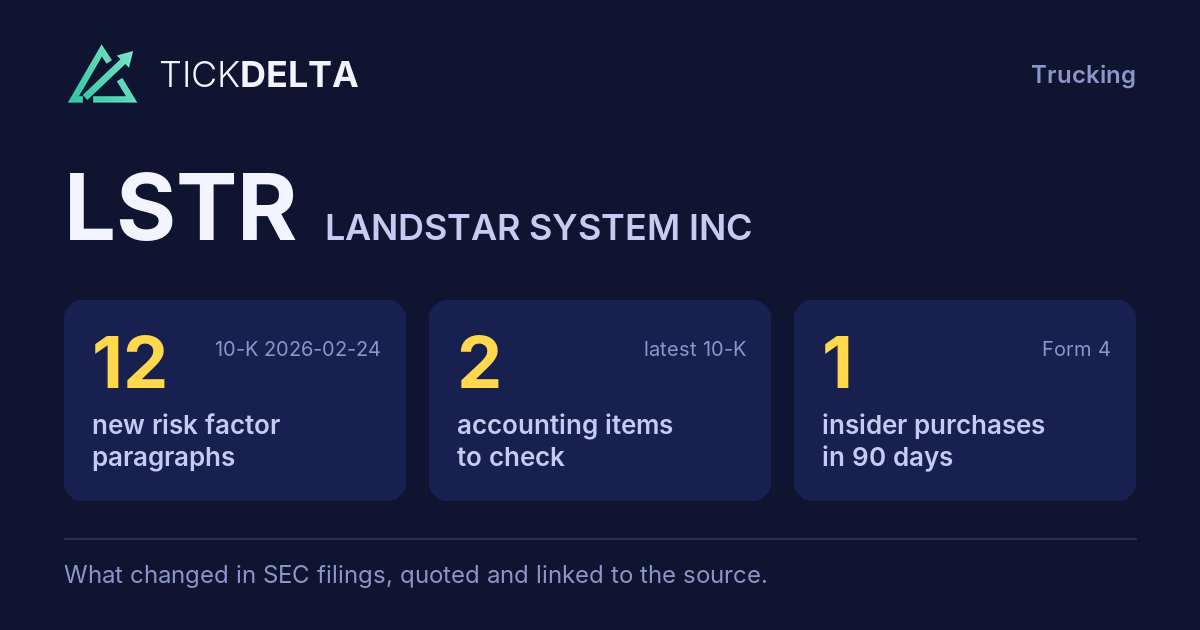
of the text changed · 7,961 words now · 12 new paragraphs, 2 gone
MD&A
17.3%
of the text changed · 11,264 words now · 9 new paragraphs, 3 gone
10-K 0001193125-26-064756 (Feb 24, 2026) vs 10-K 0001193125-25-033543 (Feb 24, 2025) Not compared: Legal Proceedings, Accounting Policies.
Every paragraph, and how much of it changed
One bar per paragraph, in the order of the 10-K. Height and colour show the share of its words not in the closest paragraph a year earlier; the tallest bars are new paragraphs.
Risk Factors
46 paragraphs · 12 new · 18 reworded · 2 gone · 10-K Feb 24, 2026 against Feb 24, 2025
New paragraph
Reworded (5% of its words or more)
Same or nearly
Paragraph 16 · 43% changed
Every version of it
Paragraph 36 · 42% changed
Every version of it
Paragraph 38 · 32% changed
Every version of it
In particular, the FMCSA may propose regulatory changes that affect the operation of commercial motor carriers across the United States. For example, effective May 20, 2025, the FMCSA established a new enforcement policy with respect to English language proficiency (“ELP”) requirements applicable to commercial motor vehicle drivers and the ability of such drivers to communicate effectively with law enforcement and understand highway traffic signs throughout the United States. In 2025, the FMCSA also proposed amendments to federal regulations applicable to the issuance by State Driver’s Licensing Agencies (“SDLAs”) of CDLs to foreign-domiciled individuals in order to significantly limit the authority of SDLAs to issue and renew CDLs with respect to individuals domiciled in a foreign jurisdiction and/or who do not maintain a lawful immigration status in the United States. It is difficult to predict in what form FMCSA regulations may be implemented, modified or enforced and what impact any such regulations may have on motor carrier operations or the aggregate number of trucks that provide hauling capacity to the Company. No assurances can be given with respect to what impact new or revised motor carrier oversight programs implemented by the FMCSA could have on the Company, its motor carrier operations or the aggregate number of trucks that provide hauling capacity to the Company.
Paragraph 1 · 30% changed
Every version of it
Increased severity or frequency of accidents and other claims or a material unfavorable development of existing claims. As noted above in Item 1, “Business — Factors Significant to the Company’s Operations — Self-Insured Claims,” potential liability associated with accidents in the trucking industry is severe and occurrences are unpredictable. Landstar retains liability through a self-insured retention for commercial trucking claims up to $5 million per occurrence. Effective May 1, 2023, the Company entered into a three year commercial auto liability insurance arrangement for losses incurred between $5 million and $10 million (the “2023 Initial Excess Policy”) with a Historically, these third party insurance company. For commercial trucking claims incurred arrangements were based on or after policy year periods beginning on May 1 and ending on the subsequent April 30. Beginning with the policy year period commencing May 1, 2023 through April 30, 2025, the Company and its third party insurance providers adjusted the applicable policy year period, beginning in 2026, to commence on June 1 and end on the 2023 Initial Excess Policy provides for an aggregate deductible of $18 million over the thirty-six-month term subsequent May 31. All applicable third party insurance arrangements with a policy period ending April 30, 2026. After payment of the deductible, the 2023 Initial Excess Policy provides 2026 have been amended to provide for a limit for a single loss of $5 million, with an aggregate limit of $15 million for the thirty-six-month term policy period ending April 30, 2026. May 31, 2026, as reflected below.
Paragraph 2 · 28% changed
Every version of it
Paragraph 6 · 25% changed
Every version of it
Moreover, the Company from year to year manages the level of its financial exposure to commercial trucking claims in excess of $10 million, including through the use of additional self-insurance, deductibles, aggregate loss limits, quota shares and other structured arrangements with third party insurance companies, based on the availability of coverage within certain excess insurance coverage layers and estimated cost differentials between proposed premiums from third party insurance companies and historical and actuarially projected losses experienced by the Company at various levels of excess insurance coverage. For example, with respect to a single hypothetical claim in the amount of $65 million incurred during the annual policy year ending April 30, 2025, May 31, 2026, the Company would have an aggregate financial exposure of approximately $30 $36 million. Furthermore, the Company’s third party insurance arrangements provide excess coverage up to an uppermost coverage layer, in excess of which the Company retains additional financial exposure. No assurances can be given that the availability of excess coverage for commercial trucking claims will not continue to deteriorate, that the pricing associated with such excess coverage, to the extent available, will not continue to increase, nor that insurance coverage from third party insurers for excess coverage of commercial trucking claims will even be available on commercially reasonable terms at certain levels. Moreover, the occurrence of a Nuclear Verdict, or the settlement of a catastrophic injury and/or fatality claim that could have otherwise resulted in a Nuclear Verdict, could have a material adverse effect on Landstar’s cost of insurance and claims and its results of operations.
Paragraph 8 · 24% changed
Every version of it
Paragraph 20 · 48% changed
Every version of it
10-K Feb 24, 2025Disruptions or failures in the Company’s computer systems; cyber and other information security incidents. As noted above in Item 1, “Business — Factors Significant to the Company’s Operations — Technology,” the Company’s information technology systems used in connection with its operations are located in Jacksonville, Florida and to a lesser extent in Rockford, Illinois. In addition, the Company utilizes several third party data centers throughout the United States. Landstar relies, in the regular course of its business, on the proper operation of its information technology systems to link its extensive network of customers, employees, agents and third party capacity providers, including its BCO Independent Contractors. Moreover, a majority of the Company’s employees work remotely or on a hybrid basis. Although the Company has redundant systems for its critical operations, any significant disruption or failure of its technology systems or those of third party data centers on which it relies could significantly disrupt the Company’s operations and impose significant costs on the Company. Moreover, it is critical that the data processed by or stored in the Company’s information technology systems or otherwise in the Company’s possession remain confidential, as it often includes confidential, proprietary and/or competitively sensitive information regarding our customers, employees, agents and third party capacity providers, key financial and operational results and statistics, and our strategic plans, including technology innovations, developments and enhancements. Cyber incidents that impact the security, availability, reliability, speed, accuracy or other proper functioning of these systems and data, including outages, computer viruses, break-ins and similar disruptions, could have a significant impact on our operations. Accordingly, information security and the continued development and enhancement of the controls and processes designed to protect our systems, computers, software, data and networks from attack, damage or unauthorized access remain a priority for us. Our information systems and those of our third party service providers have been, and will likely continue to be, targeted by or subject to viruses, malware or other malicious codes, unauthorized access, cyber-attacks, cyber frauds, ransomware or other unauthorized occurrences which jeopardize the confidentiality, integrity or availability of our information or information systems. Cybersecurity threats are rapidly evolving and those threats and the means for obtaining access to our systems are becoming increasingly sophisticated. Cybersecurity threats can originate from a wide variety of sources including terrorists, nation states, financially motivated actors, hacktivists, internal actors, or third parties, such as external service providers or other third parties who may use an external service provider as a conduit to access our systems, and the techniques used change frequently and often are not recognized until after they have been launched. The rapid evolution and increased adoption of artificial intelligence technologies may intensify our cybersecurity risks including the deployment of artificial intelligence technologies by threat actors. Although we believe that we have robust security procedures and other safeguards in place, as threats continue to evolve, we may be required to expend additional resources to continue to enhance our information security measures and/or to investigate and remediate any security vulnerabilities. At any given time, we face known and unknown cybersecurity risks and threats that are not fully mitigated, and we may discover vulnerabilities as we continuously work to enhance our cybersecurity risk management program. A significant incident, including system failure, security breach, disruption by malware or ransomware, or other damage, could interrupt or delay our operations, damage our reputation with customers, agents, third party capacity providers, employees, vendors, investors or other stakeholders, cause a loss of customers, agents and/or third party capacity providers, expose us to a risk of loss or litigation, and/or cause us to incur significant time and expense to remedy such an event, any of which could have a material adverse impact on our results of operations and financial condition.
10-K Feb 24, 2026
believe that we have robust security procedures and other safeguards in place, as threats continue to evolve, we may be required to expend additional resources to continue to enhance our information security measures and/or to investigate and remediate any security vulnerabilities. At any given time, we face known and unknown cybersecurity risks and threats that are not fully mitigated, and we may discover vulnerabilities as we continuously work to enhance our cybersecurity risk management program. A significant incident, including system failure, security breach, disruption by malware or ransomware, or other damage, could interrupt or delay our operations, damage our reputation with customers, agents, third party capacity providers, employees, vendors, investors or other stakeholders, cause a loss of customers, agents and/or third party capacity providers, expose us to a risk of loss or litigation, and/or cause us to incur significant time and expense to remedy such an event, any of which could have a material adverse impact on our results of operations and financial condition.
Paragraph 16 · 43% changed
Every version of it
10-K Feb 24, 2025A number of these larger agencies, including the largest of Landstar’s independent commission sales agents by revenue, maintain administrative operations in countries outside of North America where the risks may be different than in the United States or Canada due to geopolitical, legal or other risks associated with maintaining administrative operations in such foreign jurisdictions. There can be no assurance regarding the potential disruption and impact adverse geopolitical developments in these foreign jurisdictions could have on the ability of certain large independent commission sales agents to generate and maintain administrative operations in support of significant amounts of Landstar revenue. As disclosed in a Current Report on Form 8-K filed by the Company on February 28, 2022, the largest Landstar independent commission sales agency by revenue referenced above, while based in the United States, has significant administrative operations located in Ukraine. The administrative operations of this agency were significantly disrupted during the onset of the Russian invasion of Ukraine and continue to be affected by the ongoing conflict. The Company also has another of its largest independent commission sales agencies, as measured by revenue, that is based in the United States but conducts a portion of its administrative operations in western Ukraine. Russian efforts to destroy infrastructure throughout Ukraine has impacted the availability of electricity and other basic utilities at various times throughout the country. The priority for Landstar and both of these agencies is the safety and well-being of these agencies’ Ukrainian workforces and their families. No assurances can be provided regarding the conflict between Russia and Ukraine and the extent of potential future operational disruption the conflict may have on either of these Landstar agencies and the related impact of these disruptions on the Company.
10-K Feb 24, 2026
western Ukraine. Russian efforts to destroy infrastructure throughout Ukraine has impacted the availability of electricity and other basic utilities at various times throughout the country. The priority for Landstar and both of these agencies is the safety and well-being of these agencies’ Ukrainian workforces and their families. No assurances can be provided regarding the conflict between Russia and Ukraine and the extent of potential future operational disruption the conflict may have on either of these Landstar agencies and the related impact of these disruptions on the Company.
Paragraph 36 · 42% changed
Every version of it
10-K Feb 24, 2025Regulatory and legislative changes. As noted above in Item 1, “Business — Factors Significant to the Company’s Operations — Regulation,” certain of the Operating Subsidiaries are motor carriers and/or property brokers authorized to arrange for transportation services by motor carriers which are regulated by the Federal Motor Carrier Safety Administration (“FMCSA”), an agency of the U.S. Department of Transportation, and by various state agencies. Several of the Operating Subsidiaries maintain a federal hazardous materials safety permit and, as a result, have an increased risk of compliance review by the FMCSA. Certain of the Operating Subsidiaries are licensed as Ocean Transportation Intermediaries by the U.S. Federal Maritime Commission as non-vessel-operating common carriers and/or as ocean freight forwarders. The Company’s air transportation activities in the United States are subject to regulation by the U.S. Department of Transportation as an indirect air carrier. One of the Company’s subsidiaries is licensed by the U.S. Department of Homeland Security through the Bureau of U.S. Customs and Border Protection (“U.S. Customs”) as a customs broker. The Company is also subject to regulations and requirements relating to safety and security promulgated by, among others, the U.S. Department of Homeland Security through U.S. Customs and the Transportation Security Administration, the Canada Border Services Agency and various state and local agencies and port authorities.
10-K Feb 24, 2026
subsidiaries is licensed by the U.S. Department of Homeland Security through the Bureau of U.S. Customs and Border Protection (“U.S. Customs”) as a customs broker. The Company is also subject to regulations and requirements relating to safety and security promulgated by, among others, the U.S. Department of Homeland Security through U.S. Customs and the Transportation Security Administration, the Canada Border Services Agency and various state and local agencies and port authorities.
Paragraph 38 · 32% changed
Every version of it
10-K Feb 24, 2025
In particular, the FMCSA may propose regulatory changes that affect the operation of commercial motor carriers across the United States. It is difficult to predict in what form FMCSA regulations may be implemented, modified or enforced and what impact any such regulations may have on motor carrier operations or the aggregate number of trucks that provide hauling capacity to the Company. No assurances can be given with respect to what impact new or revised motor carrier oversight programs implemented by the FMCSA could have on the Company, its motor carrier operations or the aggregate number of trucks that provide hauling capacity to the Company.
10-K Feb 24, 2026
In particular, the FMCSA may propose regulatory changes that affect the operation of commercial motor carriers across the United States. For example, effective May 20, 2025, the FMCSA established a new enforcement policy with respect to English language proficiency (“ELP”) requirements applicable to commercial motor vehicle drivers and the ability of such drivers to communicate effectively with law enforcement and understand highway traffic signs throughout the United States. In 2025, the FMCSA also proposed amendments to federal regulations applicable to the issuance by State Driver’s Licensing Agencies (“SDLAs”) of CDLs to foreign-domiciled individuals in order to significantly limit the authority of SDLAs to issue and renew CDLs with respect to individuals domiciled in a foreign jurisdiction and/or who do not maintain a lawful immigration status in the United States. It is difficult to predict in what form FMCSA regulations may be implemented, modified or enforced and what impact any such regulations may have on motor carrier operations or the aggregate number of trucks that provide hauling capacity to the Company. No assurances can be given with respect to what impact new or revised motor carrier oversight programs implemented by the FMCSA could have on the Company, its motor carrier operations or the aggregate number of trucks that provide hauling capacity to the Company.
Paragraph 1 · 30% changed
Every version of it
10-K Feb 24, 2025
Increased severity or frequency of accidents and other claims or a material unfavorable development of existing claims. As noted above in Item 1, “Business — Factors Significant to the Company’s Operations — Self-Insured Claims,” potential liability associated with accidents in the trucking industry is severe and occurrences are unpredictable. Landstar retains liability through a self-insured retention for commercial trucking claims up to $5 million per occurrence. Effective May 1, 2023, the Company entered into a three year commercial auto liability insurance arrangement for losses incurred between $5 million and $10 million (the “2023 Initial Excess Policy”) with a third party insurance company. For commercial trucking claims incurred on or after May 1, 2023 through April 30, 2026, the 2023 Initial Excess Policy provides for an aggregate deductible of $18 million over the thirty-six-month term ending April 30, 2026. After payment of the deductible, the 2023 Initial Excess Policy provides for a limit for a single loss of $5 million, with an aggregate limit of $15 million for the thirty-six-month term ending April 30, 2026.
10-K Feb 24, 2026
Increased severity or frequency of accidents and other claims or a material unfavorable development of existing claims. As noted above in Item 1, “Business — Factors Significant to the Company’s Operations — Self-Insured Claims,” potential liability associated with accidents in the trucking industry is severe and occurrences are unpredictable. Landstar retains liability through a self-insured retention for commercial trucking claims up to $5 million per occurrence. Historically, these third party insurance arrangements were based on policy year periods beginning on May 1 and ending on the subsequent April 30. Beginning with the policy year period commencing May 1, 2025, the Company and its third party insurance providers adjusted the applicable policy year period, beginning in 2026, to commence on June 1 and end on the subsequent May 31. All applicable third party insurance arrangements with a policy period ending April 30, 2026 have been amended to provide for a policy period ending May 31, 2026, as reflected below.
Paragraph 2 · 28% changed
Every version of it
10-K Feb 24, 2025Increased severity or frequency of accidents and other claims or a material unfavorable development of existing claims. As noted above in Item 1, “Business — Factors Significant to the Company’s Operations — Self-Insured Claims,” potential liability associated with accidents in the trucking industry is severe and occurrences are unpredictable. Landstar retains liability through a self-insured retention for commercial trucking claims up to $5 million per occurrence. Effective May 1, 2023, the Company entered into a three year commercial auto liability insurance arrangement for losses incurred between $5 million and $10 million (the “2023 Initial Excess Policy”) with a third party insurance company. For commercial trucking claims incurred on or after May 1, 2023 through April 30, 2026, the 2023 Initial Excess Policy provides for an aggregate deductible of $18 million over the thirty-six-month term ending April 30, 2026. After payment of the deductible, the 2023 Initial Excess Policy provides for a limit for a single loss of $5 million, with an aggregate limit of $15 million for the thirty-six-month term ending April 30, 2026.
10-K Feb 24, 2026
Effective May 1, 2023, the Company entered into a three year commercial auto liability insurance arrangement for losses incurred between $5 million and $10 million (the “2023 Initial Excess Policy”) with a third party insurance company. For commercial trucking claims incurred on or after May 1, 2023 through May 31, 2026, the 2023 Initial Excess Policy provides for an aggregate deductible of $18 million over the thirty-seven-month term ending May 31, 2026. After payment of the deductible, the 2023 Initial Excess Policy provides for a limit for a single loss of $5 million, with an aggregate limit of $15 million for the thirty-seven-month term ending May 31, 2026.
Paragraph 6 · 25% changed
Every version of it
10-K Feb 24, 2025
Moreover, the Company from year to year manages the level of its financial exposure to commercial trucking claims in excess of $10 million, including through the use of additional self-insurance, deductibles, aggregate loss limits, quota shares and other arrangements with third party insurance companies, based on the availability of coverage within certain excess insurance coverage layers and estimated cost differentials between proposed premiums from third party insurance companies and historical and actuarially projected losses experienced by the Company at various levels of excess insurance coverage. For example, with respect to a single hypothetical claim in the amount of $65 million incurred during the annual policy year ending April 30, 2025, the Company would have an aggregate financial exposure of approximately $30 million. Furthermore, the Company’s third party insurance arrangements provide excess coverage up to an uppermost coverage layer, in excess of which the Company retains additional financial exposure. No assurances can be given that the availability of excess coverage for commercial trucking claims will not continue to deteriorate, that the pricing associated with such excess coverage, to the extent available, will not continue to increase, nor that insurance coverage from third party insurers for excess coverage of commercial trucking claims will even be available on commercially reasonable terms at certain levels. Moreover, the occurrence of a Nuclear Verdict, or the settlement of a catastrophic injury and/or fatality claim that could have otherwise resulted in a Nuclear Verdict, could have a material adverse effect on Landstar’s cost of insurance and claims and its results of operations.
10-K Feb 24, 2026
Moreover, the Company from year to year manages the level of its financial exposure to commercial trucking claims in excess of $10 million, including through the use of additional self-insurance, deductibles, aggregate loss limits, quota shares and other structured arrangements with third party insurance companies, based on the availability of coverage within certain excess insurance coverage layers and estimated cost differentials between proposed premiums from third party insurance companies and historical and actuarially projected losses experienced by the Company at various levels of excess insurance coverage. For example, with respect to a single hypothetical claim in the amount of $65 million incurred during the annual policy year ending May 31, 2026, the Company would have an aggregate financial exposure of approximately $36 million.
Paragraph 8 · 24% changed
Every version of it
10-K Feb 24, 2025Moreover, the Company from year to year manages the level of its financial exposure to commercial trucking claims in excess of $10 million, including through the use of additional self-insurance, deductibles, aggregate loss limits, quota shares and other arrangements with third party insurance companies, based on the availability of coverage within certain excess insurance coverage layers and estimated cost differentials between proposed premiums from third party insurance companies and historical and actuarially projected losses experienced by the Company at various levels of excess insurance coverage. For example, with respect to a single hypothetical claim in the amount of $65 million incurred during the annual policy year ending April 30, 2025, the Company would have an aggregate financial exposure of approximately $30 million. Furthermore, the Company’s third party insurance arrangements provide excess coverage up to an uppermost coverage layer, in excess of which the Company retains additional financial exposure. No assurances can be given that the availability of excess coverage for commercial trucking claims will not continue to deteriorate, that the pricing associated with such excess coverage, to the extent available, will not continue to increase, nor that insurance coverage from third party insurers for excess coverage of commercial trucking claims will even be available on commercially reasonable terms at certain levels. Moreover, the occurrence of a Nuclear Verdict, or the settlement of a catastrophic injury and/or fatality claim that could have otherwise resulted in a Nuclear Verdict, could have a material adverse effect on Landstar’s cost of insurance and claims and its results of operations.
10-K Feb 24, 2026
Furthermore, the Company’s third party insurance arrangements provide excess coverage up to an uppermost coverage layer, in excess of which the Company retains additional financial exposure. No assurances can be given that the availability of excess coverage for commercial trucking claims will not continue to deteriorate, that the pricing associated with such excess coverage, to the extent available, will not continue to increase, nor that insurance coverage from third party insurers for excess coverage of commercial trucking claims will even be available on commercially reasonable terms at certain levels. Moreover, the occurrence of a Nuclear Verdict, or the settlement of a catastrophic injury and/or fatality claim that could have otherwise resulted in a Nuclear Verdict, could have a material adverse effect on Landstar’s cost of insurance and claims and its results of operations.
MD&A
96 paragraphs · 9 new · 37 reworded · 3 gone · 10-K Feb 24, 2026 against Feb 24, 2025
New paragraph
Reworded (5% of its words or more)
Same or nearly
Paragraph 24 · 48% changed
Landstar retains liability through a self-insured retention for commercial trucking claims up to $5 million per occurrence. Effective May 1, 2023, the The Company entered into a three year commercial auto liability insurance arrangement for losses incurred between $5 million and $10 million (the “2023 Initial Excess Policy”) with a also maintains third party insurance company. For arrangements providing coverage for commercial trucking claims incurred liabilities in excess of $5 million. Historically, these third party insurance arrangements were based on or after policy year periods beginning on May 1 and ending on the subsequent April 30. Beginning with the policy year period commencing May 1, 2023 through 2025, the Company and its third party insurance providers adjusted the applicable policy year period, beginning in 2026, to commence on June 1 and end on the subsequent May 31. All applicable third party insurance arrangements with a policy period ending April 30, 2026, the 2023 Initial Excess Policy provides for an aggregate deductible of $18 million over the thirty-six-month term ending April 30, 2026. After payment of the deductible, the 2023 Initial Excess Policy provides have been amended to provide for a limit for a single loss of $5 million, with an aggregate limit of $15 million for the thirty-six-month term policy period ending April 30, 2026. May 31, 2026, as reflected below.
Paragraph 62 · 40% changed
Depreciation and amortization decreased $1,415,000 $10,350,000 in fiscal year 2024 2025 compared to fiscal year 2023. 2024. The decrease in depreciation and amortization expense was primarily due to decreased trailing equipment depreciation, partially offset by increased depreciation on new and updated digital tools deployed for use by the Company’s network of agents, capacity providers and employees. information technology software.
Paragraph 66 · 35% changed
Net income was $115,007,000, or $3.31 per basic and diluted share, in fiscal year 2025. Net income was $195,946,000, or $5.51 per basic and diluted share, in fiscal year 2024. Net income during fiscal year 2025 was $264,394,000, unfavorably impacted by $32,170,000, or $7.36 $0.71 per basic and diluted share, in fiscal year 2023. related to the impairment of intangible and other assets charges noted above.
Paragraph 90 · 34% changed
Historically, the Company has generated sufficient operating cash flow to meet its debt service requirements, fund continued growth, both organic and through acquisitions, complete or execute share purchases of its Common Stock under authorized share purchase programs, pay dividends and meet working capital needs. As an asset-light provider of integrated transportation management solutions, the Company’s annual capital requirements for operating property are generally for trailing equipment and information technology hardware and software. In addition, a significant portion of the trailing equipment used by the Company is provided by third party capacity providers, thereby reducing the Company’s capital requirements. During fiscal years 2024, 2023 and 2022, the Company acquired $62,194,000, $4,093,000 and $30,659,000, respectively, of trailing equipment by entering into finance leases. During fiscal years 2024, 2023 and 2022, the Company also purchased $30,998,000, $25,688,000 and $26,005,000, respectively, of operating property. Landstar anticipates acquiring either by purchase or lease financing approximately $16,000,000 in new trailing equipment, primarily to replace older trailing equipment in fiscal year 2025. Landstar anticipates spending approximately $14,000,000 on information technology hardware and software in fiscal year 2025, $12,000,000 of which relates to either building or buying software applications that enhance or add to the Company’s technology ecosystem. In addition, Landstar anticipates spending approximately $4,000,000 on buildings and improvements in fiscal year 2025.
Paragraph 28 · 32% changed
Within the Company’s third party insurance arrangements providing excess coverage for commercial trucking liabilities, structured arrangements with third party reinsurers within a specific loss layer may include provisions that require additional payments of premium in the event of unfavorable loss experience or a refund of premium in the event of favorable loss experience. With During the 2025 fiscal year, with respect to one such three year three-year commercial auto liability reinsurance arrangement relating to certain excess claims incurred between May 1, 2020 through April 30, 2023, it is anticipated that during the 2025 second fiscal quarter, the Company will receive a received $12,000,000 of cash payment payments from a third party reinsurance provider providers in the form of a “no claims bonus” due to favorable loss experience with respect to claims incurred during the applicable policy period. As further described in Note 11 in the “Notes to Consolidated Financial Statements” in this Annual Report on Form 10-K, in connection with the Judgment (as defined below) in the Cabral Matter, the Company has recorded the “no claims bonus” within current insurance claims in the consolidated balance sheet as of December 27, 2025. The Company intends to record vigorously appeal the receipt of this payment as a deferred gain on Cabral Matter, including the balance sheet until such time as all underlying claims with exposure under the applicable excess layer insurance arrangement are resolved and the gain Judgment; however, no assurances can be recognized. provided regarding whether the Company will ultimately be able to recognize a gain with respect to the “no claims bonus.” For more information about the Cabral Matter, see Item 7, “Management’s Discussion and Analysis of Financial Condition and Results of Operations – Legal Proceedings.”
Paragraph 59 · 28% changed
Other operating costs increased $4,590,000 $2,805,000 in fiscal year 2024 2025 compared to fiscal year 2023. 2024. The increase in other operating costs compared to the prior year was primarily due to an increased trailer equipment maintenance costs, partially offset by a decreased provision for contractor bad debt and decreased gains on sales of operating property. debt.
Paragraph 30 · 26% changed
Further, the Company retains liability of up to $2,000,000 for each general liability claim, $250,000 for each workers’ compensation claim and $250,000 for each cargo claim. In addition, under reinsurance arrangements by Signature of certain risks of the Company’s BCO Independent Contractors, the Company retains liability of up to $500,000, $1,000,000 or $2,000,000 with respect to certain occupational accident claims and up to $750,000 with respect to certain workers’ compensation claims. The Company’s exposure to liability associated with accidents incurred by Truck Brokerage Carriers, railroads and air and ocean cargo carriers who transport freight on behalf of the Company is reduced by various legal defenses and other factors including the extent to which such carriers maintain their own insurance coverage. A material increase in the frequency or severity of accidents, cargo claims or workers’ compensation claims or the material unfavorable development of existing claims could have a material adverse effect on Landstar’s cost of insurance and claims and its results of operations.
Paragraph 54 · 24% changed
The decrease increase in revenue per load on loads hauled via truck was primarily due to a softer freight demand environment experienced during fiscal year 2024 and the impact of lower diesel fuel costs on loads hauled via Truck Brokerage Carriers. Revenue per load on loads hauled via other truck transportation services decreased 10%, on loads hauled via van equipment decreased 4% and on less-than-truckload loadings decreased 3%, while increased revenue per load on loads hauled via unsided/platform equipment increased 3% as compared equipment, which was entirely attributable to fiscal year 2023. The increase in revenue per load on loads hauled via unsided/platform equipment of 3% was favorably impacted by an increase in the percentage of revenue contributed by heavy/specialized equipment, which typically has a higher revenue per load. load than unsided/platform loadings transported using standard flatbed and other less specialized pieces of platform equipment. Revenue per load on loads hauled via unsided/platform equipment increased 3%, while revenue per load on less-than-truckload loadings decreased 3%, on loads hauled via van equipment decreased 1% and on other truck transportation services decreased 1% as compared to fiscal year 2024.
Paragraph 24 · 48% changed
10-K Feb 24, 2025
Landstar retains liability through a self-insured retention for commercial trucking claims up to $5 million per occurrence. Effective May 1, 2023, the Company entered into a three year commercial auto liability insurance arrangement for losses incurred between $5 million and $10 million (the “2023 Initial Excess Policy”) with a third party insurance company. For commercial trucking claims incurred on or after May 1, 2023 through April 30, 2026, the 2023 Initial Excess Policy provides for an aggregate deductible of $18 million over the thirty-six-month term ending April 30, 2026. After payment of the deductible, the 2023 Initial Excess Policy provides for a limit for a single loss of $5 million, with an aggregate limit of $15 million for the thirty-six-month term ending April 30, 2026.
10-K Feb 24, 2026
Landstar retains liability through a self-insured retention for commercial trucking claims up to $5 million per occurrence. The Company also maintains third party insurance arrangements providing coverage for commercial trucking liabilities in excess of $5 million. Historically, these third party insurance arrangements were based on policy year periods beginning on May 1 and ending on the subsequent April 30. Beginning with the policy year period commencing May 1, 2025, the Company and its third party insurance providers adjusted the applicable policy year period, beginning in 2026, to commence on June 1 and end on the subsequent May 31. All applicable third party insurance arrangements with a policy period ending April 30, 2026, have been amended to provide for a policy period ending May 31, 2026, as reflected below.
Paragraph 62 · 40% changed
10-K Feb 24, 2025
Depreciation and amortization decreased $1,415,000 in fiscal year 2024 compared to fiscal year 2023. The decrease in depreciation and amortization expense was primarily due to decreased trailing equipment depreciation, partially offset by increased depreciation on new and updated digital tools deployed for use by the Company’s network of agents, capacity providers and employees.
10-K Feb 24, 2026
Depreciation and amortization decreased $10,350,000 in fiscal year 2025 compared to fiscal year 2024. The decrease in depreciation and amortization expense was primarily due to decreased depreciation on information technology software.
Paragraph 66 · 35% changed
10-K Feb 24, 2025
Net income was $195,946,000, or $5.51 per basic and diluted share, in fiscal year 2024. Net income was $264,394,000, or $7.36 per basic and diluted share, in fiscal year 2023.
10-K Feb 24, 2026
Net income was $115,007,000, or $3.31 per basic and diluted share, in fiscal year 2025. Net income was $195,946,000, or $5.51 per basic and diluted share, in fiscal year 2024. Net income during fiscal year 2025 was unfavorably impacted by $32,170,000, or $0.71 per basic and diluted share, related to the impairment of intangible and other assets charges noted above.
Paragraph 90 · 34% changed
10-K Feb 24, 2025
Historically, the Company has generated sufficient operating cash flow to meet its debt service requirements, fund continued growth, both organic and through acquisitions, complete or execute share purchases of its Common Stock under authorized share purchase programs, pay dividends and meet working capital needs. As an asset-light provider of integrated transportation management solutions, the Company’s annual capital requirements for operating property are generally for trailing equipment and information technology hardware and software. In addition, a significant portion of the trailing equipment used by the Company is provided by third party capacity providers, thereby reducing the Company’s capital requirements. During fiscal years 2024, 2023 and 2022, the Company acquired $62,194,000, $4,093,000 and $30,659,000, respectively, of trailing equipment by entering into finance leases. During fiscal years 2024, 2023 and 2022, the Company also purchased $30,998,000, $25,688,000 and $26,005,000, respectively, of operating property. Landstar anticipates acquiring either by purchase or lease financing approximately $16,000,000 in new trailing equipment, primarily to replace older trailing equipment in fiscal year 2025. Landstar anticipates spending approximately $14,000,000 on information technology hardware and software in fiscal year 2025, $12,000,000 of which relates to either building or buying software applications that enhance or add to the Company’s technology ecosystem. In addition, Landstar anticipates spending approximately $4,000,000 on buildings and improvements in fiscal year 2025.
10-K Feb 24, 2026
Historically, the Company has generated sufficient operating cash flow to meet its debt service requirements, fund continued growth, both organic and through acquisitions, complete or execute share purchases of its Common Stock under authorized share purchase programs, pay dividends and meet working capital needs. As an asset-light provider of integrated transportation management solutions, the Company’s annual capital requirements for operating property are generally for trailing equipment and information
Paragraph 28 · 32% changed
10-K Feb 24, 2025
Within the Company’s third party insurance arrangements providing excess coverage for commercial trucking liabilities, structured arrangements with third party reinsurers within a specific loss layer may include provisions that require additional payments of premium in the event of unfavorable loss experience or a refund of premium in the event of favorable loss experience. With respect to one such three year commercial auto liability reinsurance arrangement relating to certain excess claims incurred between May 1, 2020 through April 30, 2023, it is anticipated that during the 2025 second fiscal quarter, the Company will receive a $12,000,000 cash payment from a third party reinsurance provider in the form of a “no claims bonus” due to favorable loss experience with respect to claims incurred during the policy period. The Company intends to record the receipt of this payment as a deferred gain on the balance sheet until such time as all underlying claims with exposure under the applicable excess layer insurance arrangement are resolved and the gain can be recognized.
10-K Feb 24, 2026
Within the Company’s third party insurance arrangements providing excess coverage for commercial trucking liabilities, structured arrangements with third party reinsurers within a specific loss layer may include provisions that require additional payments of premium in the event of unfavorable loss experience or a refund of premium in the event of favorable loss experience. During the 2025 fiscal year, with respect to one such three-year commercial auto liability reinsurance arrangement relating to certain excess claims incurred between May 1, 2020 through April 30, 2023, the Company received $12,000,000 of cash payments from third party reinsurance providers in the form of a “no claims bonus” due to favorable loss experience with respect to claims incurred during the applicable policy period. As further described in Note 11 in the “Notes to Consolidated Financial Statements” in this Annual Report on Form 10-K, in connection with the Judgment (as defined below) in the Cabral Matter, the Company has recorded the “no claims bonus” within current insurance claims in the consolidated balance sheet as of December 27, 2025. The Company intends to vigorously appeal the Cabral Matter, including the Judgment; however, no assurances can be provided regarding whether the Company will ultimately be able to recognize a gain with respect to the “no claims bonus.” For more information about the Cabral Matter, see Item 7, “Management’s Discussion and Analysis of Financial Condition and Results of Operations – Legal Proceedings.”
Paragraph 59 · 28% changed
10-K Feb 24, 2025
Other operating costs increased $4,590,000 in fiscal year 2024 compared to fiscal year 2023. The increase in other operating costs compared to the prior year was primarily due to an increased provision for contractor bad debt and decreased gains on sales of operating property.
10-K Feb 24, 2026
Other operating costs increased $2,805,000 in fiscal year 2025 compared to fiscal year 2024. The increase in other operating costs compared to the prior year was primarily due to increased trailer equipment maintenance costs, partially offset by a decreased provision for contractor bad debt.
Paragraph 30 · 26% changed
10-K Feb 24, 2025
Further, the Company retains liability of up to $2,000,000 for each general liability claim, $250,000 for each workers’ compensation claim and $250,000 for each cargo claim. In addition, under reinsurance arrangements by Signature of certain risks of the Company’s BCO Independent Contractors, the Company retains liability of up to $500,000, $1,000,000 or $2,000,000 with respect to certain occupational accident claims and up to $750,000 with respect to certain workers’ compensation claims. The Company’s exposure to liability associated with accidents incurred by Truck Brokerage Carriers, railroads and air and ocean cargo carriers who transport
10-K Feb 24, 2026
Further, the Company retains liability of up to $2,000,000 for each general liability claim, $250,000 for each workers’ compensation claim and $250,000 for each cargo claim. In addition, under reinsurance arrangements by Signature of certain risks of the Company’s BCO Independent Contractors, the Company retains liability of up to $500,000, $1,000,000 or $2,000,000 with respect to certain occupational accident claims and up to $750,000 with respect to certain workers’ compensation claims. The Company’s exposure to liability associated with accidents incurred by Truck Brokerage Carriers, railroads and air and ocean cargo carriers who transport freight on behalf of the Company is reduced by various legal defenses and other factors including the extent to which such carriers maintain their own insurance coverage. A material increase in the frequency or severity of accidents, cargo claims or workers’ compensation claims or the material unfavorable development of existing claims could have a material adverse effect on Landstar’s cost of insurance and claims and its results of operations.
Paragraph 54 · 24% changed
10-K Feb 24, 2025
The decrease in revenue per load on loads hauled via truck was primarily due to a softer freight demand environment experienced during fiscal year 2024 and the impact of lower diesel fuel costs on loads hauled via Truck Brokerage Carriers. Revenue per load on loads hauled via other truck transportation services decreased 10%, on loads hauled via van equipment decreased 4% and on less-than-truckload loadings decreased 3%, while revenue per load on loads hauled via unsided/platform equipment increased 3% as compared to fiscal year 2023. The increase in revenue per load on loads hauled via unsided/platform equipment of 3% was favorably impacted by an increase in the percentage of revenue contributed by heavy/specialized equipment, which typically has a higher revenue per load.
10-K Feb 24, 2026
The increase in revenue per load on loads hauled via truck was primarily due to increased revenue per load on loads hauled via unsided/platform equipment, which was entirely attributable to an increase in the percentage of revenue contributed by heavy/specialized equipment, which typically has a higher revenue per load than unsided/platform loadings transported using standard flatbed and other less specialized pieces of platform equipment. Revenue per load on loads hauled via unsided/platform equipment increased 3%, while revenue per load on less-than-truckload loadings decreased 3%, on loads hauled via van equipment decreased 1% and on other truck transportation services decreased 1% as compared to fiscal year 2024.
A paragraph is matched with the one last year that shares the most of its words; under half in common makes it new. The paragraphs shown are the 8 reworded the most in each section.
The paragraph that changed most in each section
The redline
Marked against last year's 10-K: cut words struck through, new words highlighted.
MD&A235 words changed in this paragraph; it is 37% similar to last year's version.
Insurance and claims decreased $11,594,000 increased $45,507,000 in fiscal year 2023 2025 compared to fiscal year 2022. 2024. The decrease highly elevated increase in insurance and claims expense compared to the prior year was primarily due to decreased severity (i) an increase of current year trucking claims during fiscal year 2023, decreased $23,258,000 in net unfavorable development of prior years’ claims in fiscal year 2023 2025 compared to fiscal year 2024, as further described below; (ii) increased severity of current year trucking and cargo claims in fiscal year 2025 compared to fiscal year 2024, including $11.0 million related to two separate tragic vehicular accidents which occurred during the 2025 fourth fiscal quarter; and (iii) a decrease in BCO miles traveled $5.3 million increase in the 2023 fiscal year, partially offset by increased insurance premiums, primarily Company’s actuarily determined claim reserves relating to the anticipated loss exposure for commercial auto and excess liability coverage. claims above $1 million. During the 2023 2025 and 2022 2024 fiscal years, insurance and claims costs included $6,058,000 $32,082,000 and $11,331,000 $8,824,000 of net unfavorable adjustments to prior years’ claims estimates, respectively. Unfavorable development of prior years’ claims estimates of $32,082,000 during the 2025 fiscal year was primarily comprised of (i) approximately $10.7 million of unfavorable development on commercial trucking claims up to $1 million per occurrence for accident years 2024 and prior; (ii) approximately $10.6 million of unfavorable development on commercial trucking claims in excess of $1 million per occurrence for accident years 2024 and prior, including approximately $5.7 million related to the Cabral Matter; (iii) approximately $8.4 million of unfavorable development on cargo-related claims primarily attributable to fraud and theft in the supply chain; and (iv) approximately $2.4 million of net unfavorable development relating to reinsurance arrangements involving the Company’s captive insurance subsidiary, Signature Insurance Company, in connection with certain risks of the Company’s BCO Independent Contractors.
Source: Item 7, 10-K 0001193125-26-064756 vs Item 7, 10-K 0001193125-25-033543
Risk Factors171 words changed in this paragraph; it is 84% similar to last year's version.
Disruptions or failures in the Company’s computer systems; cyber and other information security incidents. As noted above in Item 1, “Business — Factors Significant to the Company’s Operations — Technology,” the Company’s information technology systems used in connection with its operations are located in Jacksonville, Florida and to a lesser extent in Rockford, Illinois. In addition, the Company utilizes several third party data centers throughout the United States. Landstar relies, in the regular course of its business, on the proper operation of its information technology systems to link its extensive network of customers, employees, agents and third party capacity providers, including its BCO Independent Contractors. Moreover, a majority of the Company’s employees work remotely or on a hybrid basis. Although the Company has redundant systems for its critical operations, any significant disruption or failure of its technology systems or those of third party data centers on which it relies could significantly disrupt the Company’s operations and impose significant costs on the Company. Moreover, it is critical that the data processed by or stored in the Company’s information technology systems or otherwise in the Company’s possession remain confidential, as it often includes confidential, proprietary and/or competitively sensitive information regarding our customers, employees, agents and third party capacity providers, key financial and operational results and statistics, and our strategic plans, including technology innovations, developments and enhancements. Cyber incidents that impact the security, availability, reliability, speed, accuracy or other proper functioning of these systems and data, including outages, computer viruses, break-ins and similar disruptions, could have a significant impact on our operations. Accordingly, information security and the continued development and enhancement of the controls and processes designed to protect our systems, computers, software, data and networks from attack, damage or unauthorized access access, including from AI enabled attacks, remain a priority for us. Our information systems and those of our third party service providers have been, and will likely continue to be, targeted by or subject to viruses, malware or other malicious codes, unauthorized access, cyber-attacks, cyber frauds, ransomware or other unauthorized occurrences which jeopardize the confidentiality, integrity or availability of our information or information systems. Cybersecurity threats are rapidly evolving and those threats and the means for obtaining access to our systems are becoming increasingly sophisticated. Cybersecurity threats can originate from a wide variety of sources including terrorists, nation states, financially motivated actors, hacktivists, internal actors, or third parties, such as external service providers or other third parties who may use an external service provider as a conduit to access our systems, and the techniques used change frequently and often are not recognized until after they have been launched. The rapid evolution and increased adoption of artificial intelligence technologies may intensify our cybersecurity risks including the deployment of artificial intelligence technologies by threat actors. Although we believe that we have robust security procedures and other safeguards in place, as threats continue to evolve, we may be required to expend additional resources to continue to enhance our information security measures and/or to investigate and remediate any security vulnerabilities. At any given time, we face known and unknown cybersecurity risks and threats that are not fully mitigated, and we may discover vulnerabilities as we continuously work to enhance our cybersecurity risk management program. A significant incident, including system failure, security breach, disruption by malware or ransomware, or other damage, could interrupt or delay our operations, damage our reputation with customers, agents, third party capacity providers, employees, vendors, investors or other stakeholders, cause a loss of customers, agents and/or third party capacity providers, expose us to a risk of loss or litigation, and/or cause us to incur significant time and expense to remedy such an event, any of which could have a material adverse impact on our results of operations and financial condition.
Source: Item 1A, 10-K 0001193125-26-064756 vs Item 1A, 10-K 0001193125-25-033543
Sentences and paragraphs added, removed or reworded
Every change, by type
Sentences and paragraphs of LSTR's Risk Factors and MD&A, 10-K Feb 24, 2026 against 10-K Feb 24, 2025. Each links to the text at sec.gov.
Quiet changes are sentences kept from last year with one to four words changed, at least one of them a hedge, a modal or a qualifier (may, could, will, not, significant, material…). A year or date rolling forward is not counted.
The full word list
adverse, adversely, all, although, anticipate, anticipates, any, approximately, believe, believes, can, cannot, certain, could, expect, expects, generally, however, if, intend, intends, largely, likely, many, material, materially, may, might, most, must, never, no, not, possible, primarily, probable, should, significant, significantly, some, substantial, substantially, unlikely, will, would
AddedRisk Factors
In addition to the significant increase in the cost to motor carriers relating to commercial auto liability claims throughout the United States, there has also been a very significant increase throughout the United States in the number of, and potential loss exposure associated with, claims asserted against freight brokers in connection with accidents involving motor carriers the freight broker has engaged and contracted with to haul a shipment. The claims asserted against freight brokers often involve claims of
Read it in 10-K Feb 24, 2026 at sec.gov
AddedRisk Factors
negligent selection of the motor carrier who was involved in the relevant accident. Within the transportation logistics industry, these matters are often referred to as “Broker Liability Claims.” For example, see the discussion of the Cabral Matter (as defined below) in Item 7, “Management’s Discussion and Analysis of Financial Condition and Results of Operations — Legal Proceedings.” There is currently significant legal uncertainty regarding Broker Liability Claims as state and federal courts across the United States are divided as to whether such claims are preempted by federal law under the FAAAA, or are subject to the “safety exception” under the FAAAA. The matter of Montgomery v. Caribe Transport II, LLC, in which the Company is not a party, is currently pending before the U.S. Supreme Court and may result in a ruling relating to federal preemption of Broker Liability Claims under the FAAAA. No assurances can be provided as to any such ruling by the U.S. Supreme Court, the timing thereof, or the impact any such ruling may have on pending or future Broker Liability Claims asserted against the Company, including the Cabral Matter.
Read it in 10-K Feb 24, 2026 at sec.gov
AddedRisk Factors
Within the Company’s third party insurance arrangements providing excess coverage for commercial trucking liabilities, structured arrangements with third party reinsurers within a specific loss layer may include provisions that require additional payments of premium in the event of unfavorable loss experience or a refund of premium in the event of favorable loss experience. During the 2025 fiscal year, with respect to one such three-year commercial auto liability reinsurance arrangement relating to certain excess claims incurred between May 1, 2020 through April 30, 2023, the Company received $12,000,000 of cash payments from third party reinsurance providers in the form of a “no claims bonus” due to favorable loss experience with respect to claims incurred during the applicable policy period. As further described in Note 11 in the “Notes to Consolidated Financial Statements” in this Annual Report on Form 10-K, in connection with the Judgment (as defined below) in the Cabral Matter, the Company has recorded the “no claims bonus” within current insurance claims in the consolidated balance sheet as of December 27, 2025. The Company intends to vigorously appeal the Cabral Matter, including the Judgment; however, no assurances can be provided regarding whether the Company will ultimately be able to recognize a gain with respect to the “no claims bonus.” For more information about the Cabral Matter, see Item 7, “Management’s Discussion and Analysis of Financial Condition and Results of Operations – Legal Proceedings.”
Read it in 10-K Feb 24, 2026 at sec.gov
AddedRisk Factors
As noted below in Item 1, “Legal, Tax, Regulatory and Compliance Risks — Regulatory and legislative changes,” several of the Operating Subsidiaries maintain a federal hazardous materials safety permit in connection with the Company’s transportation of hazardous substances. In the event the Company is involved in a spill or other accident involving hazardous substances, there is a release of hazardous materials while such hazardous materials are being transported by the Company, or Landstar is found to be in violation of or fail to comply with applicable environmental laws or regulations in connection with the transportation of hazardous materials, the Company could be subject to clean-up costs and liabilities, including substantial fines or penalties or civil and criminal liability, any of which could have a material adverse effect on the Company’s business and results of operations.
Read it in 10-K Feb 24, 2026 at sec.gov
AddedRisk Factors
In recent years, the amount and sophistication of fraud and cargo theft throughout the freight transportation and logistics supply chain has significantly increased. In particular, “strategic” cargo theft refers to instances when bad actors incorporate deceptive tactics to commit cargo theft. Such tactics may involve the use of fraud to deceive shippers, brokers, and/or carriers using a combination of methods including identity theft and impersonation, fictitious track-and-trace information, fictitious proof of delivery information and fraudulent carrier schemes. The Company has experienced, and may continue to experience, increases in the amount of cargo theft, including strategic cargo theft, resulting in increased exposure to liability from cargo claims. The Company has also experienced, and may continue to experience, incidences of other types of supply chain fraud, for example the fraud referenced in Note 19 in the “Notes to Consolidated Financial Statements” in this Annual Report on Form 10-K.
Read it in 10-K Feb 24, 2026 at sec.gov
AddedRisk Factors
A material increase in the frequency or severity of accidents, cargo claims, or workers’ compensation claims, claims in connection with the transportation of hazardous materials, or the material unfavorable development of existing claims could have a material adverse effect on Landstar’s business, cost of insurance and claims and its results of operations.
Read it in 10-K Feb 24, 2026 at sec.gov
AddedRisk Factors
Adoption of artificial intelligence (“AI”). The Company uses, and will continue to expand its use of, machine learning and AI technologies to deliver services and operate its business. If the Company fails to successfully integrate AI into its digital ecosystem and business processes, or if it fails to keep pace with rapidly evolving AI technological developments, including attracting and retaining talented AI developers and programmers and cybersecurity personnel, the Company may face a competitive disadvantage. At the same time, the use or offering of AI technologies may result in new or expanded risks and liabilities, including enhanced government or regulatory scrutiny, litigation, privacy and compliance issues, ethical or confidentiality concerns, reputational harm, and security risks. It is not possible to predict all of the risks related to the use of AI, and changes in laws, rules, directives, and regulations governing the use of AI may adversely affect the Company’s ability to develop and use AI or subject it to legal liability. The cost of complying with laws and regulations governing AI could be significant and could increase our operating expenses, which could adversely affect our business, financial condition, and results of operations. Further, market demand and acceptance of AI technologies, including by our independent commission sales agents and BCO Independent Contractors, are uncertain, and we may be unsuccessful in efforts to further incorporate AI into our ecosystem of digital tools that are designed to: (i) assist Landstar independent commission sales agents in efficiently sourcing capacity, pricing transportation services and managing and analyzing the performance of their independent businesses, (ii) assist customers in meeting their transportation needs, (iii) assist third party capacity providers in identifying desirable freight opportunities and operating their independent businesses, and (iv) improve operational and administrative efficiency throughout the Company.
Read it in 10-K Feb 24, 2026 at sec.gov
AddedRisk Factors
Acquisitions, Divestitures and Investments. The Company periodically considers acquisitions and equity investments that it believes are strategically important based on the potential that any such acquisition or investment candidate would further strengthen the Company’s strategic goals and service offerings. The Company makes no assurance that it will be able to successfully achieve its strategic goals as it relates to any such acquisition or investment. Further, the Company may have difficulties integrating acquired companies or efficiently managing divestitures. For potential acquisitions, success may depend upon efficiently integrating the acquired business into our existing systems and operations. If we complete a large acquisition or multiple acquisitions within a short period of time, we may experience heightened difficulties integrating the acquired companies. The Company would also be required to integrate these acquired businesses into our internal control environment, which may present challenges that are different than those presented by organic growth and that may be difficult to manage. If we are unable to successfully integrate and grow any acquired businesses and to realize contemplated revenue synergies and cost savings from such acquisitions, our business, prospects, results of operations, financial position, and cash flows could be materially and adversely affected.
Read it in 10-K Feb 24, 2026 at sec.gov
Show the other 42
AddedRisk Factors
During 2017, the Company established Landstar Metro, S.A.P.I. de C.V. (“Landstar Metro”), which acquired substantially all of the assets of the asset-light transportation logistics business of Fletes Avella, S.A. de C.V. Landstar Metro provides freight and logistics services within Mexico and in conjunction with Landstar’s U.S.-Mexico cross-border services. The Company’s initial investment in Landstar Metro was approximately $8.5 million. The carrying value of the Company’s investment in Landstar
Read it in 10-K Feb 24, 2026 at sec.gov
AddedRisk Factors
Metro, as of December 27, 2025, was approximately $6.5 million, reflecting additional investment and the results of operations of Landstar Metro since inception, less non-cash impairment charges. Landstar Metro is subject to certain risks arising from doing business in Mexico, including: changes in Mexico’s economic strength; changes in trade agreements, US-Mexico trade relations, or the imposition of tariffs on imports from Mexico and related retaliatory tariffs that may be imposed by the Mexican government; disruptions related to port of entry restrictions; difficulties in enforcing contractual obligations; foreign currency fluctuations; theft or vandalism of equipment; and social, political, and economic instability. As previously disclosed in a Current Report on Form 8-K, filed with the SEC on August 13, 2025, in connection with an annual strategic review of the Company’s operations, the Company determined that Landstar Metro has not been able to meet the Company’s strategic or operational goals and expectations, and, in connection therewith, the Company entered into an arrangement with a financial advisor to actively market Landstar Metro and consider strategic alternatives for this business, which may involve a sale or other disposition in whole or in part of Landstar Metro. No assurances can be provided regarding any potential sale or other disposition of Landstar Metro and whether any additional non-cash impairment charges or other additional charges and expenses will be incurred by the Company in connection with this sale process or upon any ultimate disposition of Landstar Metro.
Read it in 10-K Feb 24, 2026 at sec.gov
AddedRisk Factors
Moreover, Landstar hauls a significant number of shipments that have either been imported into the United States or are destined for export from the United States. There is significant uncertainty in the marketplace as to the potential actions of the U.S. government with respect to international trade policy, and the impact of tariffs may significantly adversely impact our customers, our industry, and our business. The U.S. government has made significant changes in U.S. trade policy, including the imposition on April 2, 2025, of a baseline tariff of 10% on product imports from almost all countries and individualized higher tariffs on certain other countries. While the announcement of the tariffs has been followed by announcements of limited exceptions and temporary pauses, certain foreign governments either have taken or are threatening to take retaliatory actions in response. The changes in U.S. trade policy and tariffs have caused uncertainty and volatility in financial markets. Further, there is potential for significant disruption with respect to trade between the United States and, respectively, Mexico and Canada, in connection with the anticipated review in 2026 of the United States-Mexico-Canada Agreement and related potential impacts on trade, tariffs and border duties and taxes throughout North America. Moreover, on February 20, 2026, the U.S. Supreme Court ruled that the U.S. government cannot use the International Emergency Economic Powers Act (“IEEPA”) to impose tariffs, overturning certain recent tariffs announced throughout 2025, including those on global imports from China, Canada and Mexico. This decision creates uncertainty about the immediate path forward for many supply chains, as billions of dollars in duties are now in question and the process for potential refunds remains unclear. Further, not all tariffs announced throughout 2025 will be impacted by this U.S. Supreme Court decision since many tariffs were imposed under other legal authorities that remain in effect and new tariffs may continue to be implemented through these other legal authorities. Tariffs or other trade restrictions may lead to continuing uncertainty and volatility in U.S. and global financial and economic conditions, declining consumer confidence, inflation or an economic slowdown. These tariffs or other trade restrictions, including corresponding actions taken by other countries in response to U.S. governmental actions or continuing uncertainty around the timing, scope, level, magnitude, duration and product range of tariffs, could have an adverse economic impact in the markets in which the Company operates, could cause reduced demand for the Company’s services and a reduction in the volume of shipments transported by the Company’s network, and could have a material adverse effect on Landstar’s results of operations.
Read it in 10-K Feb 24, 2026 at sec.gov
AddedRisk Factors
Supply Chain Fraud Matter. As disclosed in a Current Report on Form 8-K filed with the SEC on April 2, 2025 and the Company’s Quarterly Report on Form 10-Q for the 2025 first quarter, filed with the SEC on May 13, 2025, during the last week of the Company’s 2025 first fiscal quarter, the Company identified a supply chain fraud relating to the Company’s international freight forwarding operations (the “Supply Chain Fraud Matter”). The Supply Chain Fraud Matter did not involve the Company’s core North American truckload services. The Company’s financial results for the fiscal year ended December 27, 2025 included a $4.8 million pre-tax expense, or $0.10 per basic and diluted share, relating to this matter. This expense reflected the total anticipated aggregate adverse financial impact to Landstar relating to the fraud, net of certain actual and anticipated recoveries and before taking into account the cost of legal and other professional fees as well as additional potential recoveries in the future. No assurance can be provided with respect to the Company’s ability to collect anticipated recoveries relating to the Supply Chain Fraud Matter or the cost of legal and other professional fees that may be incurred by the Company in the future in connection with such collection efforts related to the Supply Chain Fraud Matter. The inability of the Company to recover additional amounts relating to the Supply Chain Fraud Matter could impose additional adverse financial impact and costs on the Company.
Read it in 10-K Feb 24, 2026 at sec.gov
RemovedRisk Factors
RemovedRisk Factors
RewordedRisk Factors
Of these larger agencies, one two such Landstar independent commission sales agency, itself with a very diversified customer base, agencies each generated over 10% of Landstar’s consolidated revenue, or in the aggregate approximately $470,000,000, $994,000,000, or 10%, 21%, of Landstar’s consolidated revenue and approximately 5% 16% of Landstar’s consolidated variable contribution in fiscal year 2024. 2025.
Read it in 10-K Feb 24, 2026 at sec.gov
RewordedRisk Factors
For commercial trucking claims incurred on or after May 1, 2023 through April 30, May 31, 2026, the 2023 Initial Excess Policy provides for an aggregate deductible of $18 million over the thirty-six-month thirty-seven-month term ending April 30, May 31, 2026.
Read it in 10-K Feb 24, 2026 at sec.gov
RewordedRisk Factors
Since the annual policy year ended April 30, 2020, as compared to the annual policy year ending April 30, 2025, May 31, 2026, the Company experienced an increase of approximately $22 million, or over approximately 400%, in the premiums charged by third party insurance companies to the Company for excess coverage for commercial trucking liabilities in excess of $10 million.
Read it in 10-K Feb 24, 2026 at sec.gov
RewordedRisk Factors
For example, with respect to a single hypothetical claim in the amount of $65 million incurred during the annual policy year ending April 30, 2025, May 31, 2026, the Company would have an aggregate financial exposure of approximately $30 $36 million.
Read it in 10-K Feb 24, 2026 at sec.gov
RewordedRisk Factors
Accordingly, information security and the continued development and enhancement of the controls and processes designed to protect our systems, computers, software, data and networks from attack, damage or unauthorized access access, including from AI enabled attacks, remain a priority for us.
Read it in 10-K Feb 24, 2026 at sec.gov
RewordedRisk Factors
U.S. trade relationships. relationships and potential or imposed tariffs.
Read it in 10-K Feb 24, 2026 at sec.gov
RewordedRisk Factors
In recent years, the use of technology and the implementation of technology-based innovations innovations, which may increasingly incorporate AI, have become increasingly important to compete within the transportation and logistics industry.
Read it in 10-K Feb 24, 2026 at sec.gov
RewordedRisk Factors
After payment of the deductible, the 2023 Initial Excess Policy provides for a limit for a single loss of $5 million, with an aggregate limit of $15 million for the thirty-six-month thirty-seven-month term ending April 30, May 31, 2026.
Read it in 10-K Feb 24, 2026 at sec.gov
RewordedRisk Factors
During fiscal year 2024, 485 2025, 457 agents generated revenue for Landstar of at least $1 million each, or in the aggregate approximately 94% 95% of Landstar’s consolidated revenue.
Read it in 10-K Feb 24, 2026 at sec.gov
RewordedRisk Factors
Included among these Million Dollar Agents, 81 77 agents generated at least $10,000,000 of Landstar revenue during the 2024 2025 fiscal year, or in the aggregate approximately 67% 68% of Landstar’s consolidated revenue.
Read it in 10-K Feb 24, 2026 at sec.gov
RewordedRisk Factors
One of the Company’s subsidiaries is licensed by the U.S.
Read it in 10-K Feb 24, 2026 at sec.gov
RewordedRisk Factors
Over the past decade, fifteen years, there has been a significant increase in the prevalence occurrence of trials in courts throughout the United States involving catastrophic injury and fatality claims against commercial motor carriers that have resulted in verdicts in excess of $10 million.
Read it in 10-K Feb 24, 2026 at sec.gov
AddedMD&A
As further described in Note 18 in the “Notes to Consolidated Financial Statements” in this Annual Report on Form 10-K, during the last week of the Company’s 2025 first fiscal quarter, the Company identified a supply chain fraud relating to the Company’s international freight forwarding operations (the “Supply Chain Fraud Matter”). Other operating costs during the fiscal year ended December 27, 2025 included a $4.8 million expense relating to this matter. In addition, legal and other professional fees included in selling, general and administrative costs were slightly elevated during the Company’s 2025 fiscal year in connection with this matter.
Read it in 10-K Feb 24, 2026 at sec.gov
AddedMD&A
During the 2025 fiscal year, the Company recorded certain non-cash, non-recurring impairment charges of $32,170,000 in the aggregate (the “Non-Cash Impairment Charges”). The Non-Cash Impairment Charges, net of tax benefit, unfavorably impacted EPS by $0.71 per basic and diluted share. The Non-Cash Impairment Charges consisted of:
Read it in 10-K Feb 24, 2026 at sec.gov
AddedMD&A
$18,208,000, or $0.40 per basic and diluted share, in impairment charges to goodwill and certain other assets related to the Company’s decision to actively market for sale Landstar Metro, S.A.P.I. de C.V., the Company’s wholly-owned Mexican operating subsidiary, principally engaged in intra-Mexico truck transportation services. For additional information, see Note 14 in the “Notes to Consolidated Financial Statements” in this Annual Report on Form 10-K.
Read it in 10-K Feb 24, 2026 at sec.gov
AddedMD&A
$8,963,000, or $0.20 per basic and diluted share, in impairment charges related to the decision to select one of the Company’s transportation management systems as its primary such system for truckload brokerage services and, in connection with that decision, wind-down an alternative transportation management system currently in use by Landstar Blue, LLC, one of the Company’s operating subsidiaries. For additional information, see Note 15 in the “Notes to Consolidated Financial Statements” in this Annual Report on Form 10-K.
Read it in 10-K Feb 24, 2026 at sec.gov
AddedMD&A
$4,999,000 or $0.11 per basic and diluted share, relating to the carrying value of a non-controlling equity investment made by the Company in 2022 in Cavnue, LLC, a privately held technology start-up company. For additional information, see Note 16 in the “Notes to Consolidated Financial Statements” in this Annual Report on Form 10-K.
Read it in 10-K Feb 24, 2026 at sec.gov
AddedMD&A
The Company incurs costs of revenue related to the transportation of freight and, to a much lesser extent, to reinsurance premiums received by Signature. Costs of revenue include variable costs of revenue and other costs of revenue. Variable costs of revenue include purchased transportation and commissions to agents, as these costs are entirely variable on a shipment-by-shipment basis. Other costs
Read it in 10-K Feb 24, 2026 at sec.gov
AddedMD&A
Insurance and claims increased $45,507,000 in fiscal year 2025 compared to fiscal year 2024. The highly elevated increase in insurance and claims expense compared to the prior year was primarily due to (i) an increase of $23,258,000 in net unfavorable development of prior years’ claims in fiscal year 2025 compared to fiscal year 2024, as further described below; (ii) increased severity of current year trucking and cargo claims in fiscal year 2025 compared to fiscal year 2024, including $11.0 million related to two separate tragic vehicular accidents which occurred during the 2025 fourth fiscal quarter; and (iii) a $5.3 million increase in the Company’s actuarily determined claim reserves relating to the anticipated loss exposure for claims above $1 million. During the 2025 and 2024 fiscal years, insurance and claims costs included $32,082,000 and $8,824,000 of net unfavorable adjustments to prior years’ claims estimates, respectively. Unfavorable development of prior years’ claims estimates of $32,082,000 during the 2025 fiscal year was primarily comprised of (i) approximately $10.7 million of unfavorable development on commercial trucking claims up to $1 million per occurrence for accident years 2024 and prior; (ii) approximately $10.6 million of unfavorable development on commercial trucking claims in excess of $1 million per occurrence for accident years 2024 and prior, including approximately $5.7 million related to the Cabral Matter; (iii) approximately $8.4 million of unfavorable development on cargo-related claims primarily attributable to fraud and theft in the supply chain; and (iv) approximately $2.4 million of net unfavorable development relating to reinsurance arrangements involving the Company’s captive insurance subsidiary, Signature Insurance Company, in connection with certain risks of the Company’s BCO Independent Contractors.
Read it in 10-K Feb 24, 2026 at sec.gov
AddedMD&A
Impairment of intangibles and other assets was $32,170,000 in fiscal year 2025. This was attributable to the impairment matters referenced above under “Expenses – Impairment of intangible and other assets.”
Read it in 10-K Feb 24, 2026 at sec.gov
AddedMD&A
As previously disclosed by the Company in its Quarterly Report on Form 10-Q for the 2025 second quarter filed with the SEC on July 29, 2025, the Current Report on Form 8-K filed with the SEC on August 13, 2025, the Quarterly Report on Form 10-Q for the 2025 third quarter filed with the SEC on October 28, 2025 and the Current Report on Form 8-K filed with the SEC on January 21, 2026, a trial verdict (the “Verdict”) was rendered on August 6, 2025 in state court in El Paso County, Texas, in the matter of Eduardo Cabral, et. al. v. Landstar Ranger, Inc., et. al. (the “Cabral Matter”). As previously disclosed, the Verdict included a determination by the jury that Landstar Ranger, Inc. (“Landstar Ranger”) acted as a broker and not as a motor carrier with respect to the transportation of the shipment involved in a tragic accident. The Verdict also determined total monetary damages of $22.8 million and that 15% of such damages, or $3.42 million, was attributable to Landstar Ranger with the remainder of the total monetary damages attributable to the hauling motor carrier and the hauling motor carrier’s employee truck driver. On January 13, 2026, the trial court entered a judgment (the “Judgment”) with respect to the Verdict that found Landstar Ranger financially responsible for 100%, rather than 15%, of the $22.8 million of monetary damages awarded to the plaintiffs, plus pre-judgment interest. As a result of the Judgment, the Company recorded a pre-tax charge of approximately $5.7 million during the 2025 fiscal fourth quarter to insurance and claim costs which is included in insurance claims in the Company’s consolidated balance sheet as of December 27, 2025. The Company intends to vigorously appeal the Cabral Matter, including the Judgment; however, no assurances can be provided as to the probability of success with respect to any potential appeals relating to the Cabral Matter, generally, or the Judgment, specifically, or the ultimate outcome of any such appeals. The total cost associated with this matter, which may include post-judgment interest, bonding-related costs and legal and other professional fees, will depend on many factors and the ultimate financial impact, as well as the timing of the ultimate resolution of this matter, are difficult to predict.
Read it in 10-K Feb 24, 2026 at sec.gov
RemovedMD&A
RemovedMD&A
RemovedMD&A
RewordedMD&A
U.S. trade relationships; relationships and potential or imposed tariffs; an increase in the frequency or severity of accidents or other claims; unfavorable development of existing accident claims; dependence on third party insurance companies; dependence on independent commission sales agents; dependence on third party capacity providers; the impact of the Russian conflict with Ukraine on the operations of certain independent commission sales agents, including the Company’s second largest such agent by revenue in the 2025 fiscal year; substantial industry competition; disruptions or failures in the Company’s computer systems; cyber and other information security incidents; dependence on key vendors; potential changes in taxes; status of independent contractors; regulatory and legislative changes; regulations focused on diesel emissions and other air quality matters; regulations requiring the purchase and use of zero-emission vehicles; intellectual property; acquisitions and investments; and other operational, financial or legal risks or uncertainties detailed in this and Landstar’s other SEC filings from time to time and described in Item 1A in this Form 10-K under the heading “Risk Factors.
Read it in 10-K Feb 24, 2026 at sec.gov
RewordedMD&A
The decrease in operating income as a percentage of gross profit variable contribution from fiscal year 2023 2024 to fiscal year 2024, as well as from fiscal year 2022 to fiscal year 2023, 2025 resulted from the decrease of operating income at a more rapid percentage rate than the decrease in gross profit, variable contribution, primarily due to the impact of increased insurance and claims costs, the impact of the impairment of certain intangible and other assets and the impact of the Company’s fixed cost infrastructure, principally certain components of selling, general and administrative costs, in comparison to a smaller gross profit variable contribution base.
Read it in 10-K Feb 24, 2026 at sec.gov
RewordedMD&A
The increase in selling, general and administrative costs compared to prior year was primarily attributable to increased information technology project consulting fees, increased stock-based compensation expense, increased wages, increased legal fees, an increased provision for incentive compensation and increased employee benefit costs, primarily attributable to increased medical and pharmacy costs under the self-insured portion of the Company’s medical plan, partially offset by the impact of Chief Executive Officer (“CEO”) transition costs and an increased provision for incentive compensation, partially offset by decreased project consulting fees. in fiscal year 2024.
Read it in 10-K Feb 24, 2026 at sec.gov
RewordedMD&A
The increase in revenue per load on loads hauled via truck was primarily due to increased revenue per load on loads hauled via unsided/platform equipment of 3% equipment, which was favorably impacted by entirely attributable to an increase in the percentage of revenue contributed by heavy/specialized equipment, which typically has a higher revenue per load. load than unsided/platform loadings transported using standard flatbed and other less specialized pieces of platform equipment.
Read it in 10-K Feb 24, 2026 at sec.gov
RewordedMD&A
Loads hauled via van equipment decreased 4% and less-than-truckload loadings decreased 1%, while loads hauled via other truck transportation services decreased 20%, less-than-truckload loadings decreased 13%, loads hauled via van equipment decreased 7% increased 13% and loads hauled via unsided/platform equipment decreased 6% increased 2% as compared to fiscal year 2023. 2024.
Read it in 10-K Feb 24, 2026 at sec.gov
RewordedMD&A
Shareholders’ equity was $972,439,000, $795,665,000, or 90% 91% of total capitalization (defined as long-term debt including current maturities plus equity), at December 28, 2024, 27, 2025, compared to $972,439,000, or 90% of total capitalization at December 28, 2024 and $983,923,000, or 93% of total capitalization at December 30, 2023 and $887,221,000, or 90% of total capitalization at December 31, 2022. 2023.
Read it in 10-K Feb 24, 2026 at sec.gov
RewordedMD&A
RewordedMD&A
The increase decrease in investment income was attributable to lower average rates of return on investments in fiscal year 2025, partially offset by a higher average investment balance held by the insurance segment during fiscal year 2024 and higher average rates of return on investments in fiscal year 2024. 2025.
Read it in 10-K Feb 24, 2026 at sec.gov
RewordedMD&A
The decrease in depreciation and amortization expense was primarily due to decreased trailing equipment depreciation, partially offset by increased depreciation on new and updated digital tools deployed for use by the Company’s network of agents, capacity providers and employees. information technology software.
Read it in 10-K Feb 24, 2026 at sec.gov
RewordedMD&A
Working capital and the ratio of current assets to current liabilities were $520,486,000 and 1.7 to 1, respectively, at December 27, 2025, compared with $646,713,000 and 2.0 to 1, respectively, at December 28, 2024, compared with and $677,517,000 and 2.0 to 1, respectively, at December 30, 2023, and $561,255,000 and 1.6 to 1, respectively, at December 31, 2022. 2023.
Read it in 10-K Feb 24, 2026 at sec.gov
RewordedMD&A
The Company’s exposure to liability associated with accidents incurred by Truck Brokerage Carriers, railroads and air and ocean cargo carriers who transport freight on behalf of the Company is reduced by various legal defenses and other factors including the extent to which such carriers maintain their own insurance coverage.
Read it in 10-K Feb 24, 2026 at sec.gov
RewordedMD&A
The decrease in operating income as a percentage of gross profit from fiscal year 2023 2024 to fiscal year 2024, as well as from fiscal year 2022 to fiscal year 2023, 2025 resulted from the decrease of operating income at a more rapid percentage rate than the decrease in gross profit, primarily due to the impact of the impairment of certain intangible and other assets and the impact of the Company’s fixed cost infrastructure, principally certain components of selling, general and administrative costs, in comparison to a smaller gross profit base.
Read it in 10-K Feb 24, 2026 at sec.gov
Sources
The two latest 10-Ks on EDGAR, section by section. Each change links to the text at sec.gov.
Also
New risk factors: paragraphs with nothing like them last year, quoted in full.
Work with it
Excel workbook · CSV. Google Sheet that stays up to date: paste =IMPORTDATA("https://tickdelta.com/company/LSTR/export.csv") into a cell.