Screener / SEC EDGAR /CIK 0000018926 /10-K filed Feb 20, 2026, compared with Feb 20, 2025 /Numbers from the XBRL of the 10-Ks
Nasdaq Communication · Telecom

Lumen Technologies, Inc. LUMN

Compare with peers Embed
New in the 10-K 72 paragraphs with nothing like them in the 10-K filed Feb 20, 2025 New in the 10-Q 34 paragraphs not in the 10-Q filed Aug 4, 2026 10-Q against the 10-K 24 risk factor paragraphs and sentences added or reworded

New risk paragraphs, branching off last year

Each branch is a paragraph in Risk Factors with nothing like it in the 10-K filed Feb 20, 2025. A box jumps to the paragraph as filed, below.

72 new

Paragraphs with nothing like them in last year's 10-K

Quoted exactly

72 paragraphs in Risk Factors of the 10-K filed Feb 20, 2026 with nothing like them in the 10-K filed Feb 20, 2025. Quoted exactly. Paragraphs that were only edited are under 10-K change.

Challenges with integrating, modernizing, and digitally transforming our systems could adversely affect our business and financial results.

To achieve our operational and strategic goals and projected cost savings, we must integrate and modernize legacy systems, retire aging or obsolete platforms, deploy master data management, and complete our digital transformation to deliver a global digital platform with automated offerings and digital self-service. These initiatives require efficient resource allocation, advanced project management, adoption of emerging technologies (including AI), access to subject-matter experts, and cross-functional collaboration.

We cannot assure you these efforts will be completed on time, be within budget, or achieve intended benefits. Failure to execute could disrupt service delivery, delay repairs, reduce anticipated efficiencies, destabilize our network, and hinder compliance with regulatory or contractual obligations. These outcomes could result in customer loss, inability to attract new customers, and failure to meet financial objectives, any of which could materially and adversely affect our business and results of operations.

Read in the 10-K

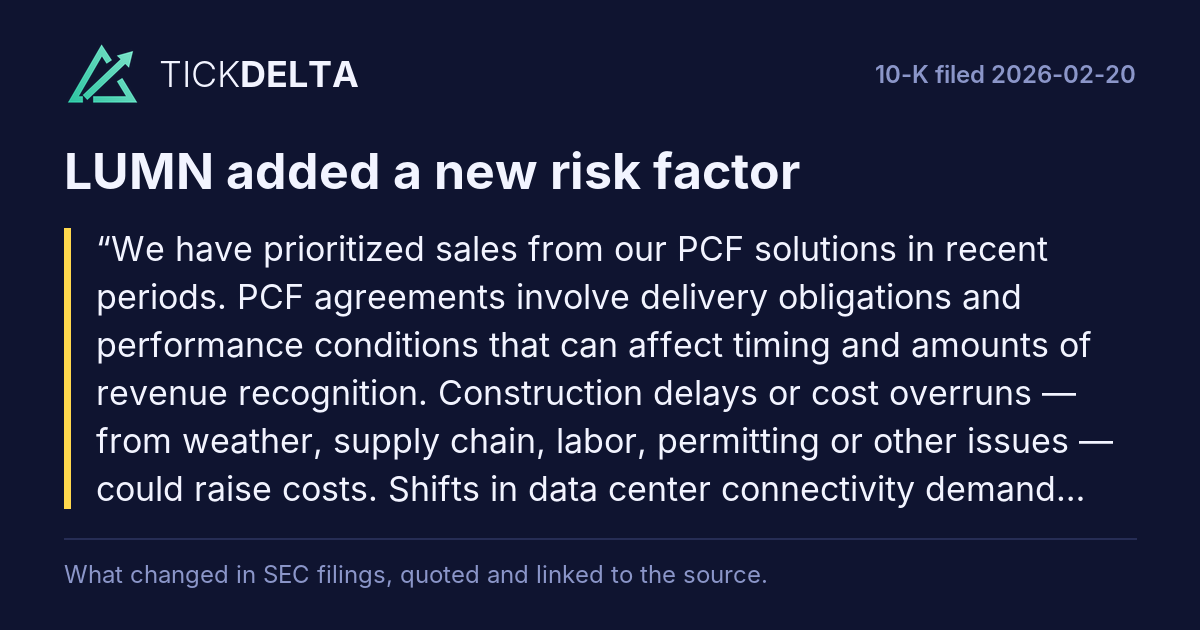
We have prioritized sales from our PCF solutions in recent periods. PCF agreements involve delivery obligations and performance conditions that can affect timing and amounts of revenue recognition. Construction delays or cost overruns — from weather, supply chain, labor, permitting or other issues — could raise costs. Shifts in data center connectivity demand could reduce or even eliminate future PCF profitability. If anticipated benefits do not materialize or costs increase, our financial results may be adversely impacted.

Read in the 10-K

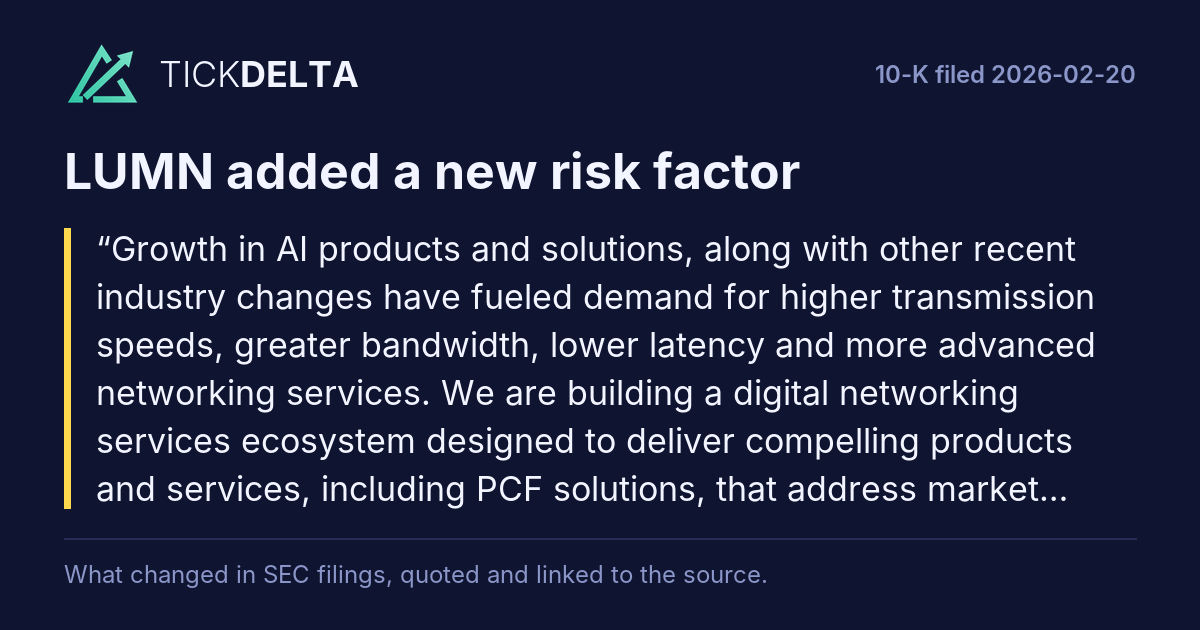
Growth in AI products and solutions, along with other recent industry changes have fueled demand for higher transmission speeds, greater bandwidth, lower latency and more advanced networking services. We are building a digital networking services ecosystem designed to deliver compelling products and services, including PCF solutions, that address market demand. Achieving this vision requires continuous system enhancements, seamless integration, and the ability to meet evolving customer needs amid rapid technological change and intense competition. If AI-related demand proves weaker, slower, or materially different from our assumptions in strategic plans or guidance, we risk misallocating resources and failing to meet growth objectives.

Read in the 10-K

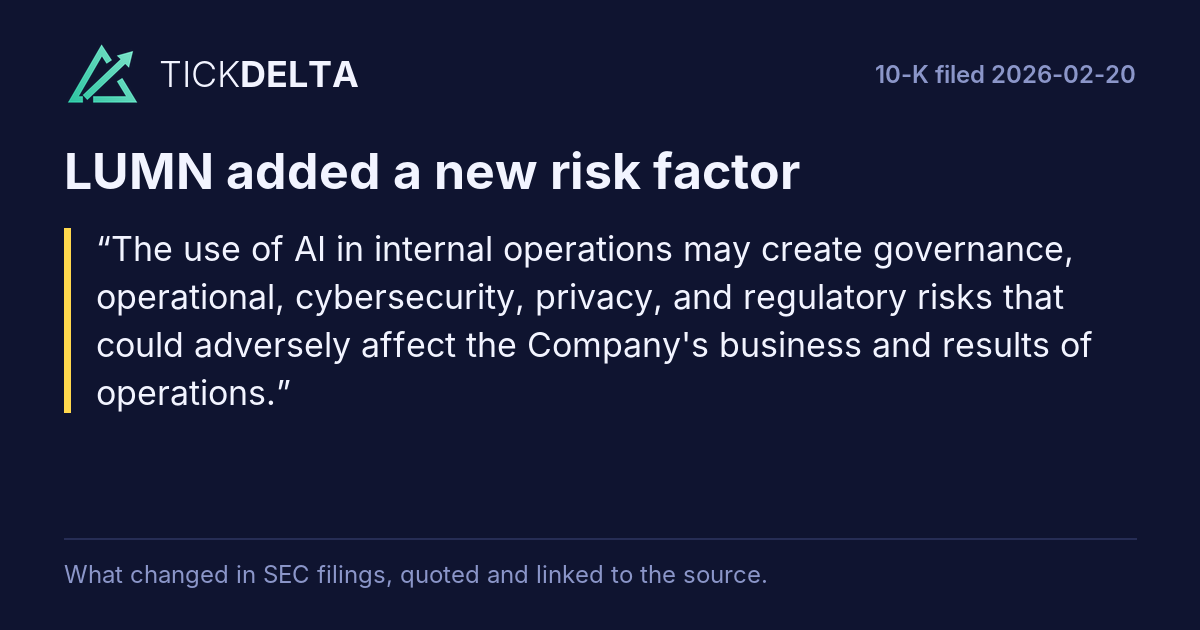
The use of AI in internal operations may create governance, operational, cybersecurity, privacy, and regulatory risks that could adversely affect the Company's business and results of operations.

Read in the 10-K

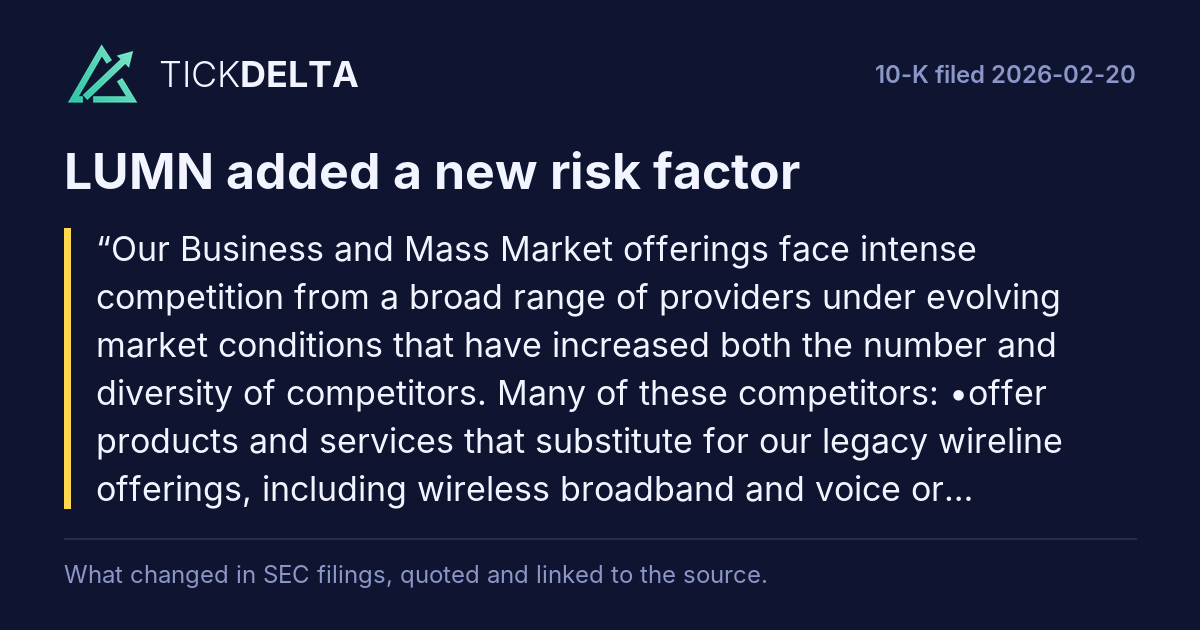
Our Business and Mass Market offerings face intense competition from a broad range of providers under evolving market conditions that have increased both the number and diversity of competitors. Many of these competitors:

•offer products and services that substitute for our legacy wireline offerings, including wireless broadband and voice or non-voice communication services;

•provide a more comprehensive portfolio of communications products and services;

•operate newer, more integrated, or more advanced systems that enable faster and more efficient service delivery;

•possess greater financial, technical, engineering, research, development, marketing, and customer relationship resources;

•benefit from stronger brand recognition and deeper, long-standing customer relationships; or

These advantages may allow competitors to compete more successfully for customers, strategic partners, and acquisition opportunities. In recent years, competitive pressures have commoditized pricing for certain products and reduced market prices for many others. We expect these pressures to continue, which could place further downward pressure on pricing and adversely impact our profitability.

Read in the 10-K
Show the other 22

The technology and communications industry is undergoing rapid technological change, increasing demand for digitally-integrated products and enabling an increasing variety of competitors to enter the market. These changes are reducing demand for certain services, enabling the development of competitive alternatives, allowing customers to bypass our networks, and compressing profit margins. Customers increasingly expect higher transmission speeds and advanced offerings, including traditional and generative AI services. Several competitors have committed substantial resources to developing these advanced services.

•develop and offer attractive products and services that meet evolving customer needs;

•maintain and expand our network to support significantly greater transmission capacity and speeds; and

Our ability to achieve these objectives may be constrained by limitations in our network, technology, capital resources, or personnel. Failure to successfully execute these initiatives could result in resource misallocation and an inability to retain existing customers or attract new ones, which may adversely affect our business, financial condition, and results of operations.

Talent constraints and evolving work models could significantly impede our ability to attract, develop and retain qualified personnel and may impair execution of our transformation and strategic initiatives.

As we continue transforming to primarily serve Business customers and deliver advanced products, we face intense competition for skilled leaders and employees and may be unable to attract and retain the technical, operational, sales, and managerial expertise needed to execute our strategy. Competitors with greater resources may offer compensation and benefits exceeding ours, and remote work arrangements have broadened the pool of employers competing for talent. The relatively low trading price of our common stock has reduced the perceived value of our equity-based compensation programs, further hindering our ability to recruit and retain critical talent. Moreover, our significant remote and hybrid workforce could impair collaboration, innovation, and productivity, and weaken the collegial relationships that support our corporate culture. These factors could materially and adversely affect our ability to execute our strategic plans and achieve our business objectives.

Declining revenues and financial uncertainty could adversely affect our business.

Read in the 10-K

These revenue declines or failure to hit our revenue growth goals, combined with elevated debt levels and a relatively low trading price for our common stock, may create uncertainty about our future prospects and ability to meet obligations. Concerns about our financial condition may adversely affect employee morale and customers, vendors, landlords, lenders, and other third parties may be reluctant to transact with us or impose unfavorable terms if they believe our future is uncertain. Our relatively low stock price may also restrict our ability to raise capital through equity offerings and reduce analyst coverage. Any of these factors could materially and adversely affect our business, financial condition, results of operations, and prospects.

Read in the 10-K

Our Lumen and other brand names, together with our corporate reputation, are critical assets that support our ability to attract and retain customers and employees. These assets are vulnerable to significant harm from events such as customer or competitor disputes, cyber-attacks, service outages, data breaches, internal control deficiencies, performance failures, compliance violations, employee misconduct, government investigations, or litigation. Similar incidents involving competitors could also generate negative publicity for the entire industry, indirectly impacting our business.

Our reputation may further be impaired by criticism from customers, vendors, employees, advocacy groups, regulators, investors, the media, social media influencers, or others regarding our services, operations, or public positions. For example, unfavorable trends in customer experience scores — such as Net Promoter Score (“NPS”) or Customer Health Score (“CHS”) — relative to competitors could adversely affect us. Additionally, the risk of reputational harm associated with unauthorized disclosure of confidential information or customer data may increase if employees misuse social networking platforms or emerging technologies, including generative AI tools. Negative or inaccurate information about Lumen, even if based on rumor or misunderstanding, could also cause reputational harm.

Read in the 10-K

As a critical infrastructure provider, our operations rely heavily on a broad range of hardware, software, networks and other products and services that are owned and managed by us or by third parties, including systems used to transmit and store large volumes of sensitive data (collectively, “IT systems”). We and our third-party partners and customers are frequent targets of increasingly sophisticated cyber-attacks, including distributed denial-of-service, ransomware, malware, viruses, credential harvesting, man-in-the-middle, software vulnerability exploitation, and social engineering. Our efforts to implement sound information security and business continuity programs cannot ensure the integrity of our systems and successful attacks could materially disrupt operations, compromise data, damage our reputation, trigger regulatory investigations or litigation, or result in significant costs. We have acquired and will continue to acquire companies that may have cybersecurity vulnerabilities or unsophisticated controls, which exposes us to significant risk.

We and certain of our third-party providers have previously experienced cyberattacks and security incidents. Future attacks could have a material adverse effect on our business, operations, or financial results.

As further described in Item 1C “Cybersecurity” of this annual report, cyber-attacks originate from multiple sources and manifest in diverse ways, potentially exposing personally identifiable information, customer data, or protected health information, subjecting us to stringent domestic and foreign data protection laws. These threats may also arise from failure or intrusions of unaffiliated third-party systems on which we materially rely to operate our business. Risks are heightened by factors such as:

•complexity of our global network infrastructure, including harder-to-secure legacy systems;

Consequences of a successful attack could include operational disruption, data loss or exposure, regulatory penalties, reputational harm, customer attrition, service credits or costly retention incentives, costly remediation, litigation, and loss of certifications. Any of these outcomes could require us to notify customers, regulatory agencies or the public of data incidents and have a material adverse impact on our business, operations, or financial results.

Our role in global internet traffic makes us a continuing target for advanced persistent threats, including nation-state actors and other sophisticated threat actors. Risks are amplified by AI-driven attacks, widely available evasion and anti-forensic tools that make it increasingly challenging to detect, respond to, and recover from cyber attacks. Escalating geopolitical tensions and rivalries increase the likelihood of state-sponsored cyber-attacks against us. No defenses can guarantee prevention. Consequently, we expect to experience cyber incidents in the future. While past incidents have not had a material adverse effect on our business strategy, results of operations, or financial condition, we cannot guarantee that material incidents will not occur in the future. We continue to take steps designed to limit our cyber risks, and although we maintain cyber insurance, coverage may be limited by deductibles, exclusions, and caps, and may not fully offset losses.

Moreover, as a contractor to the Department of Defense (“DoD”), we are contractually required to protect “controlled unclassified information” and comply with the DoD’s cybersecurity requirements, including the security controls specified in the National Institute of Standards and Technology Special Publication 800-171 (“NIST SP 800-171”). The DoD has also begun phased implementation of the Cybersecurity Maturity Model Certification (“CMMC”) into its contracts. CMMC incorporates the requirements of NIST SP 800-171 and will require all contractors to, depending on the level of security required, perform a self-assessment or receive specific third-party certifications. If we are unable to protect controlled unclassified information or to achieve or maintain the required CMMC level, we may be deemed ineligible to bid on or perform certain government contracts. Noncompliance could also result in contract termination, reduced revenue, reputational harm, and increased costs associated with remediation and reassessment, any of which could materially harm our business.

From time to time, we experience outages in our network, hosting, cloud, or IT platforms, or failures of our products and services — including basic and enhanced 911 emergency services — to perform as intended. These disruptions expose us to many of the same risks described above for cyber-attacks and may lead to lost revenue, issuance of customer credits or refunds, complete customer loss, regulatory fines, and reputational harm.

Read in the 10-K

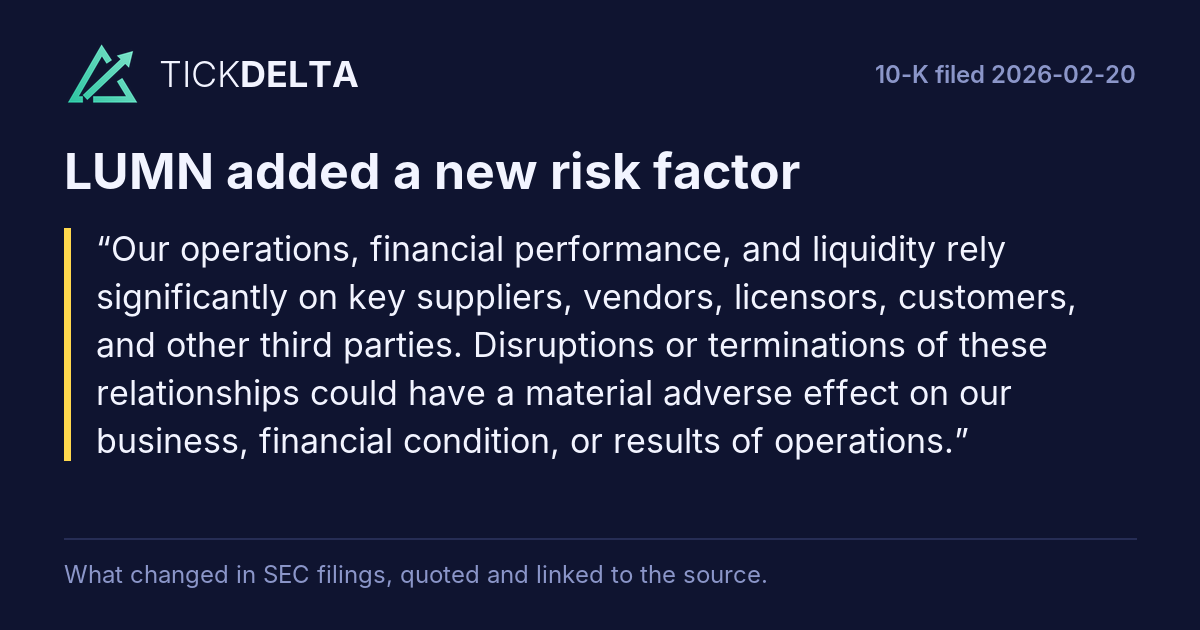
Our operations, financial performance, and liquidity rely significantly on key suppliers, vendors, licensors, customers, and other third parties. Disruptions or terminations of these relationships could have a material adverse effect on our business, financial condition, or results of operations.

Read in the 10-K

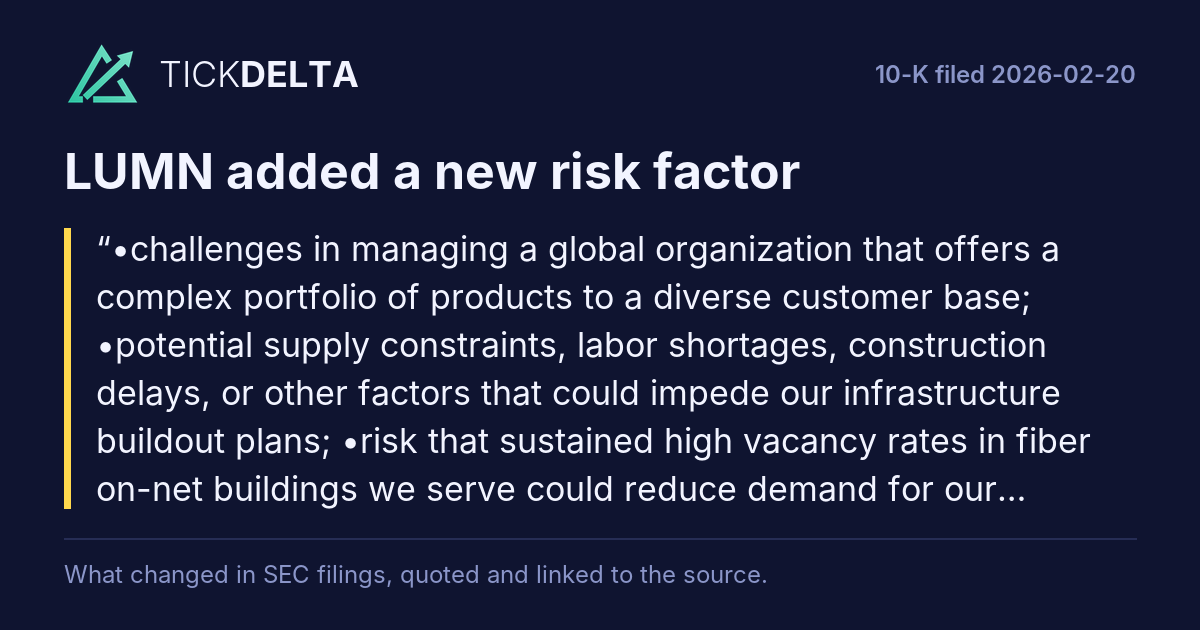
•challenges in managing a global organization that offers a complex portfolio of products to a diverse customer base;

•potential supply constraints, labor shortages, construction delays, or other factors that could impede our infrastructure buildout plans;

•risk that sustained high vacancy rates in fiber on-net buildings we serve could reduce demand for our services; and

•uncertainties and risks associated with acquiring or disposing of businesses or pursuing other strategic transactions.

Complex and evolving regulations could increase operational and compliance costs.

Read in the 10-K

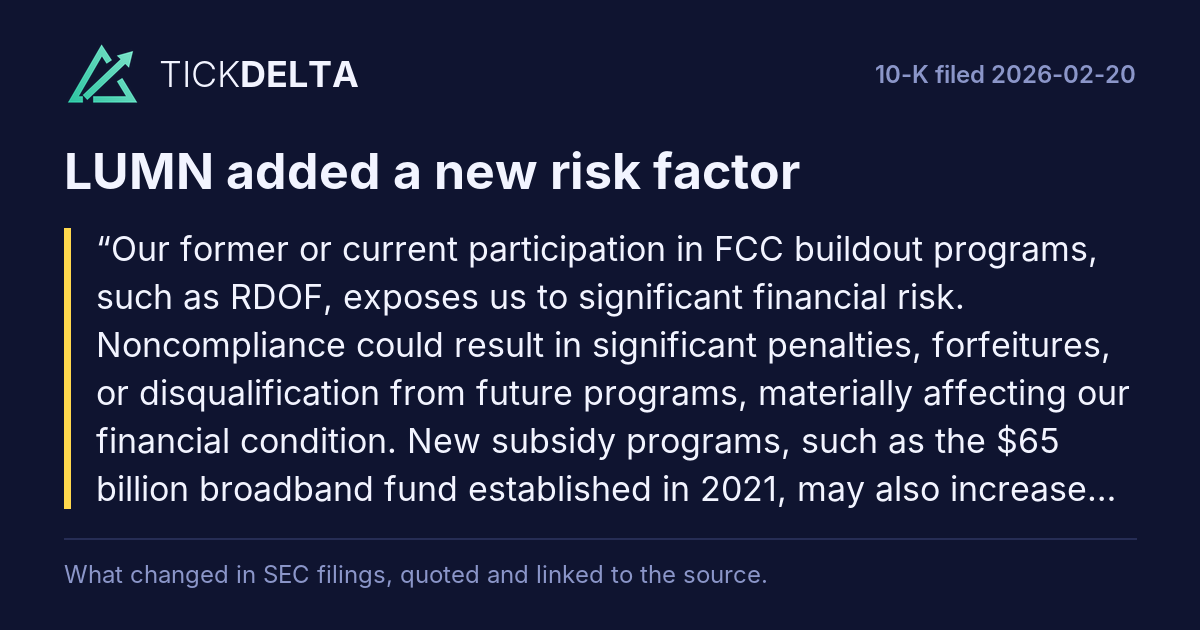
Our former or current participation in FCC buildout programs, such as RDOF, exposes us to significant financial risk. Noncompliance could result in significant penalties, forfeitures, or disqualification from future programs, materially affecting our financial condition. New subsidy programs, such as the $65 billion broadband fund established in 2021, may also increase competition in certain markets.

Read in the 10-K

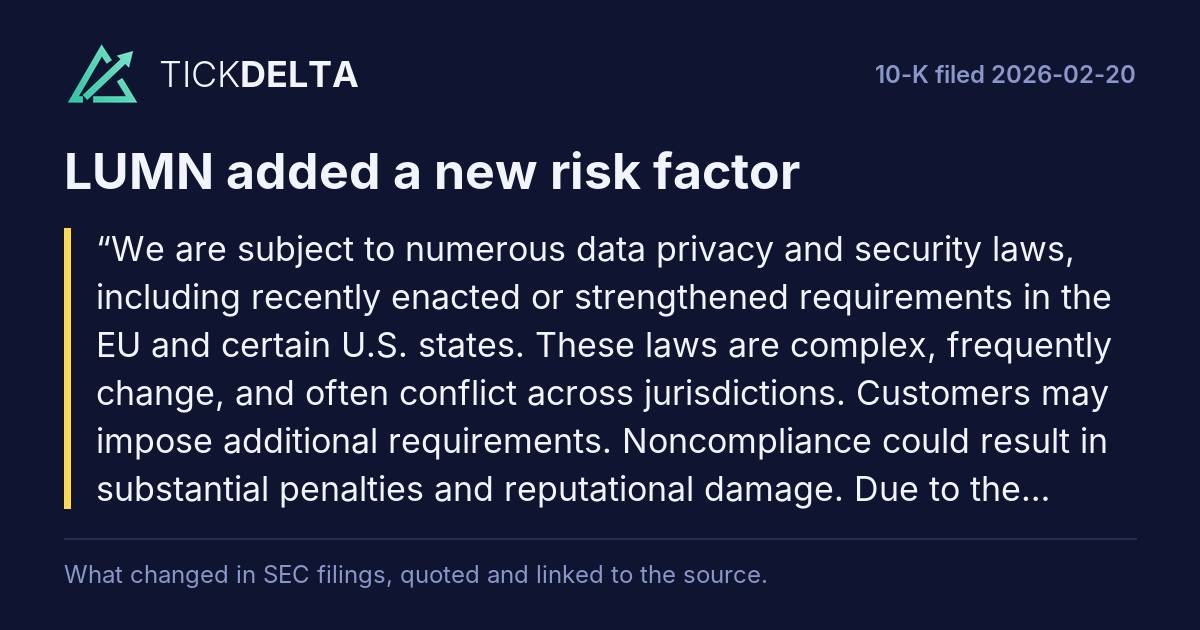
We are subject to numerous data privacy and security laws, including recently enacted or strengthened requirements in the EU and certain U.S. states. These laws are complex, frequently change, and often conflict across jurisdictions. Customers may impose additional requirements. Noncompliance could result in substantial penalties and reputational damage.

Due to the nature of our operations, we have been, and expect to continue to be impacted by regulatory developments related to climate change, including, for example, the direct regulation of greenhouse gas emissions or carbon policies that could result in a tax on such emissions. In addition, policy-driven changes in the prices of fuel or energy in geographies in which we operate could make it more expensive for us to purchase energy to power our networks and data centers.

Read in the 10-K

We may face legal and reputational risks related to third-party content on our network.

Read in the 10-K

Intellectual property claims could result in significant costs and operational disruptions.

Read in the 10-K

Any actual or perceived failure to comply with new or existing laws, regulations and other requirements relating to the privacy, security and processing of Personal Information could materially impact our business.

In connection with running our business, we receive, store, use and otherwise process information that relates to individuals or constitutes “personal information,” “personal data,” “personally identifiable information,” or similar terms under applicable data privacy laws (collectively, “Personal Information”). We are therefore subject to a variety of federal, state and foreign laws, regulations and other requirements relating to the privacy, security and processing of Personal Information.

The application and interpretation of such requirements are constantly evolving and are subject to change, creating a complex compliance environment. In some cases, these requirements may be either unclear in their interpretation and application or they may have inconsistent or conflicting requirements with each other. Further, there has been a substantial increase in legislative activity and regulatory focus on data privacy and security in the United States and elsewhere, including in relation to cybersecurity incidents. In addition, some such requirements place restrictions on our ability to process Personal Information across our business or across country borders.

It is possible that new laws, regulations and other requirements, or amendments to or changes in interpretations of existing laws, regulations and other requirements, may require us to incur significant costs, implement new processes, or change our processing of information and business operations, which could ultimately hinder our ability to grow our business by extracting value from our data assets. In addition, any failure or perceived failure by us to comply with laws, regulations and other requirements relating to the privacy, security and processing of information could result in legal claims or proceedings (including class actions), regulatory investigations or enforcement actions. We could incur significant costs in investigating and defending such claims and, if found liable, pay significant damages or fines or be required to make changes to our business. These proceedings and any subsequent adverse outcomes may subject us to significant negative publicity and an erosion of trust. If any of these events were to occur, our business, results of operations, and financial condition could be materially adversely affected.

Read in the 10-K

Allegations regarding lead-sheathed cables could result in regulatory or governmental actions, litigation, significant costs, and reputational harm.

Read in the 10-K

•increasing vulnerability to economic or industry downturns and interest rate fluctuations — particularly on variable-rate debt;

•negatively affecting perceptions of our company among customers, vendors, employees, creditors, and investors;

Read in the 10-K

These risks could be exacerbated by changes in economic conditions, additional borrowings, or credit rating downgrades. Subject to certain limitations, our existing debt agreements permit us and our subsidiaries to incur additional indebtedness.

Our ability to obtain future financing may be limited, and failure to refinance debt could adversely affect us.

Read in the 10-K

Restrictive covenants and potential defaults under our debt agreements could materially affect our operations and liquidity.

Read in the 10-K

We cannot assure you that we will be able to comply with these covenants. Failure to do so may result in an event of default, which could lead to the acceleration of substantial indebtedness, severely constrain our liquidity, and potentially force us to seek bankruptcy protection. Because certain instruments include cross-default and cross-acceleration provisions, a single default could trigger defaults across multiple agreements, significantly magnifying liquidity pressures.

Due to the complexity of our debt structure, covenants and operations, we have encountered, and may in the future encounter, disputes regarding our covenant compliance which, if not resolved in our favor, may cause a material adverse effect.

Each segment of our business is very capital intensive. We expect to fulfill obligations under certain PCF agreements, and maintain, upgrade, and expand our network infrastructure and product offerings. These capital needs are influenced by factors such as:

•ongoing investments to enhance our network to remain competitive and meet demand; and

Read in the 10-K

Our ability to meet our obligations depends on cash flows from our subsidiaries.

Read in the 10-K

Funding obligations for employee benefit plans could negatively impact profitability

Read in the 10-K

The cost to fund these pension and healthcare benefit plans for our active and retired employees has a significant impact on our profitability. Our costs of maintaining these plans, and the future funding requirements, are affected by several factors, including:

•changes in prevailing interest rates and discount rates or other factors used to calculate the funding status of our plans;

•increases in healthcare costs generally or claims submitted under our healthcare plans specifically;

•the impact of the continuing implementation and modification of current federal healthcare and pension funding laws and related regulations.

Read in the 10-K

•future intangible asset impairments could result in significant non-cash charges, reducing earnings and stockholders’ (deficit) equity and adversely affecting our financial condition;

•persistent or rising inflation could adversely affect our business, potentially leading to lower customer demand, reduced profit margins, increased interest costs, and challenges in retaining personnel if wage expectations are not met;

Read in the 10-K

•face disputes with purchasers regarding the scope or adequacy of transition services or the terms of our commercial agreements;

•incur greater costs or fewer benefits than anticipated under post-closing agreements, including tax or other expenses;

•experience increased vendor costs due to reduced economies of scale and other dis-synergies;

•encounter operational distractions as segregation and support of divested businesses divert resources from the operation, digitization, and transformation our retained business;

•face talent challenges, including difficulty retaining or attracting personnel; and

•experience operational challenges separating divested assets from retained assets.

Divestitures may not yield the expected benefits. We could incur greater tax or other costs, realize fewer benefits under the purchase agreement and related post-closing arrangements, or face operational challenges separating divested assets from retained assets. We may experience losses from stranded or underutilized assets, reduced future cash flows, and dis-synergies. We may not realize the expected proceeds, cash flows, or strategic benefits on the anticipated timeline or in the amounts projected. In addition, we remain subject to ongoing obligations and liabilities, including indemnification obligations, which could continue to divert resources and adversely affect our financial condition and results of operations.

Read in the 10-K

Changes in U.S. or foreign government policies may result in modifications to existing trade agreements, the imposition of new tariffs, or significant increases in existing tariffs on goods imported into the U.S., as well as retaliatory measures by foreign governments. The U.S. presidential administration has implemented or increased tariffs and signaled its intent to impose additional tariffs, but future actions by U.S. or foreign governments remain uncertain. A trade war or other governmental actions related to tariffs or trade agreements, as well as changes in social, political, regulatory, or economic conditions or laws governing foreign trade, manufacturing, development, and investment in countries where we operate, could negatively impact our business. In addition, any resulting negative sentiment toward the U.S. could further harm our operations, financial condition, or results of operations.
Read in the 10-K

Paragraphs in the 10-Q filed Nov 4, 2026 that were not in the one before

New in the latest 10-Q

34 paragraphs in the 10-Q filed Nov 4, 2026 with nothing like them in the 10-Q filed Aug 4, 2026 (at least half the words must differ; new numbers alone do not count). Quoted exactly, grouped by the item heading above them. This is text that changed, not a judgement of how serious it is.

10-Q

• risks associated with our use of AI in our service offerings and internal operations, including the risk that AI-enabled features do not perform as expected or produce inaccurate, biased, or harmful outputs, the

Read in the 10-Q

inadvertent disclosure of confidential, proprietary or customer data, and the introduction of security vulnerabilities through AI-generated software code;

Read in the 10-Q

• rapid and uncertain developments in AI technology, regulation, and market dynamics that may increase cybersecurity, legal, competitive and reputational risks and adversely affect our business;

Read in the 10-Q

Financial statements and notes

On October 6, 2026, our common stock, no par value per share (the “Common Stock”), as well as the 6.500 % Notes due 2051 and the 6.750 % Notes due 2052 (the “Notes”) issued by Qwest Corporation, a wholly-owned subsidiary of the Company and guaranteed by the Company, began trading on The Nasdaq Stock Market LLC ("Nasdaq") following our voluntary withdrawal from listing on the New York Stock Exchange at the close of trading on October 5, 2026.

Read in the 10-Q

The Common Stock continues to trade under the symbol “LUMN,” and the Notes continue to trade under the symbols “CTGG” and “CTHH.”

Read in the 10-Q
Show the other 29

We allocated the purchase price to tangible and identified intangible assets acquired and liabilities assumed based on their estimated fair values. These fair values were based on estimates and assumptions made by management at the time of acquisition. The allocation of the purchase price was completed as of September 30, 2026. The major classes of assets and liabilities to which we allocated the purchase price follow:

Read in the 10-Q

Goodwill includes the acquired workforce and was primarily attributable to strategic benefits and anticipated synergies that are expected to be achieved from the integration of Alkira. None of the goodwill is expected to be deductible for income tax purposes. The purchase price allocated to identified intangible assets acquired follows:

Read in the 10-Q

Intangible Asset Estimated Fair Value Amortization Period ─────────────────────────────────────────────────────────────────────────────────────────────────── (Dollars in millions) (Period in years) Developed technology $ 120 7 Customer relationships 92 14 Trade name 1 2.5 Total identified intangible assets $ 213

Read in the 10-Q

Developed technology consists of a cloud networking platform that enables enterprises to design, deploy and manage connectivity across public clouds, data centers, branch locations and other on-premise environments, remote users and external networks. We utilized the replacement cost method to estimate the fair value of the developed technology, considering factors such as historical cost, market participant profit mark-up, obsolescence and opportunity cost. The economic useful life was determined based on the technology cycle.

Read in the 10-Q

Customer relationships represent the fair value of future projected cash flows that will be derived from sales of products to existing customers of Alkira as of the transaction close. We estimated the fair value of customer relationships using the multi-period excess earnings method considering such factors as annual recurring revenue for existing customers, customer attrition, growth projections, margin attributable to existing customers, and contributory asset charges to reflect the use of other assets to sustain the customer relationships. The economic useful life was determined by evaluating factors such as the cash flows over the forecast period, term of contracts acquired, customer retention, and the economic lives of similar assets held by Lumen.

Read in the 10-Q

As a part of the transaction, Lumen acquired the Alkira trade name which Lumen expects to retain until the technology integration is complete. We utilized the relief-from-royalty method to estimate the fair value of the Alkira trade name. The estimated useful life represents the period of use until integration is complete.

Read in the 10-Q

As of September 30, 2026 and December 31, 2025, the gross carrying amount of goodwill and other intangible assets was $ 13.7 billion and $ 13.4 billion, respectively.

Read in the 10-Q

As a result of the acquisition of Alkira, Inc. described in Note 2 - Divestiture and Acquisition, the net carrying amount of goodwill, customer relationships and other intangible assets were $ 475 million as of September 30, 2026, which represents the excess of the purchase price over the fair value of the net tangible assets acquired.

Read in the 10-Q

We are required to assess our goodwill and other indefinite-lived intangible assets for impairment annually, or, under certain circumstances, more frequently, such as when events or changes in circumstances indicate there may be impairment. We are required to write down the value of goodwill only when our assessment determines the carrying value of equity of any of our reporting units exceeds its fair value. Our annual impairment assessment date for goodwill is October 31, at which date we assess our reporting units.

Read in the 10-Q

The Company assigned the goodwill to its Alkira reporting unit, which is expected to benefit from the acquisition.

Read in the 10-Q

The following table shows the rollforward of goodwill from December 31, 2025 to September 30, 2026.

Read in the 10-Q

In November 2023, the Company was named in a putative class action complaint in the U.S. District Court for the District of Oregon regarding claims that certain alleged legacy promotional offers on residential services were misleading to some customers. The court has dismissed certain of the claims and has yet to rule on a pending motion for class certification. In addition, several state attorneys general have also initiated investigations into certain of those promotional programs. The Company has not recorded a liability in connection with these matters because any potential loss is not currently probable and reasonably estimable. Additionally, the Company is unable to reasonably estimate the range of loss, if any, that may result from these matters.

Read in the 10-Q

On October 6, 2026, our common stock, no par value per share (the “Common Stock”), as well as the 6.500% Notes due 2051 and the 6.750% Notes due 2052 (the “Notes”) issued by Qwest Corporation, a wholly-owned subsidiary of the Company and guaranteed by the Company, began trading on The Nasdaq Stock Market LLC following our voluntary withdrawal from listing on the New York Stock Exchange at the close of trading on October 5, 2026.

Read in the 10-Q

The Common Stock continues to trade under the symbol “LUMN,” and the Notes continue to trade under the symbols “CTGG” and “CTHH.”

Read in the 10-Q

Communications Commission's Connect America Fund Phase II program, which lapsed on December 31, 2021.

Read in the 10-Q

• for the three month period, a decrease of $85 million, $23 million and $14 million in professional fees, property and other tax expenses, and marketing and advertising expenses, respectively; and an offsetting increase of $64 million and $16 million in employee-related expenses and hardware and software expenses, respectively; and

Read in the 10-Q

• for the nine month period, an increase of $195 million and $72 million in employee-related expenses and hardware and software expenses, respectively; and an offsetting decrease of $60 million, $31 million, $17 million and $15 million in professional fees, marketing and advertising expenses, external commissions, property and other tax expenses, respectively.

Read in the 10-Q

• an increase of $6 million for both periods due to intangibles acquired as part of the Alkira acquisition.

Read in the 10-Q

We are required to perform impairment tests related to our goodwill annually, which we perform as of October 31, or sooner if an indicator of impairment occurs. See Note 3 - Goodwill and Intangible Assets for further details.

Read in the 10-Q

• Repurchases of Debt Instruments - Second Quarter 2026: Lumen and Level 3 Financing, Inc. repurchased the following debt instruments:

Read in the 10-Q

• Repurchases of Debt Instruments - Third Quarter 2026: During the third quarter of 2026, we repurchased an immaterial amount of debt instruments on the open market related to the Qwest Corporation 6.500% Notes due 2056 and 6.750% Notes due 2057.

Read in the 10-Q

Risk Factors

Our use of AI in our service offerings and internally subjects us to additional risks.

Read in the 10-Q

We integrate AI into customer-facing offerings such as NaaS, Lumen Connect, programmable connectivity, managed security and digital self-service, and we are deploying AI internally to modernize systems, automate network operations, enhance customer care and improve productivity. Separately, our AI backbone initiative is focused on expanding our network capacity to position Lumen as the infrastructure platform that enables AI-driven networking and data movement. Certain of the AI functionality that is integrated into our service offerings and that we use internally is developed and supplied by third parties, and we have developed certain of our own AI functionalities on top of large language models and other AI tools supplied by third parties. If AI-enabled features we offer our customers do not perform as expected, produce biased, insufficient, or harmful outputs, cause service degradation, or fail to keep pace with our competitors’ AI-native capabilities, we could lose customers and market share, damage our reputation, lose pricing power or be subject to litigation, contractual disputes and adverse regulatory consequences, even if the AI technology we used in our service offering was supplied by a third party and we had no control over its development, defects, functionality, vulnerabilities, or limitations.

Read in the 10-Q

Our internal use of AI also exposes us to the risk of inadvertent disclosure of confidential, proprietary, or customer data, including through the use of AI models or tools that are not appropriately restricted to our environment, reliance on inaccurate or “hallucinated” outputs in business and operational decisions, intellectual property contamination, and violations of evolving employment, privacy, and consumer protection laws, each of which may not be identified or mitigated by our AI governance framework, particularly given the pace and complexity of AI development. Because the AI we use internally and in our service offerings is, in part, supplied by third parties, we are also subject to the risk that our AI service or infrastructure providers limit, withdraw, reprice, or change the terms of these offerings, suffer a service disruption or outage, or their tools contain defects, security vulnerabilities, or infringing content, or become subject to export controls or other restrictions, any of which may cause our ability to deliver AI-enabled services and deploy AI internally to be materially impaired. We also use AI tools, including tools provided by third parties, to develop or assist with developing our own software code, and we may not be able to anticipate or detect security vulnerabilities in such AI-generated software code, which could expose us to cybersecurity risks. For these reasons, our use of AI could materially harm our business, operations, financial condition or reputation.

Read in the 10-Q

Rapid and Uncertain Developments in AI Technology, Regulation, and Market Dynamics May Increase Cybersecurity, Legal, Competitive, and Reputational Risks and Adversely Affect Our Business.

Read in the 10-Q

AI is reshaping our external environment regardless of our own deployment: threat actors increasingly use AI to develop more sophisticated, scalable, and effective cyber‑attacks, social engineering, deepfakes, and fraud directed at our networks, employees, vendors, and customers, often times before patches become available or can be deployed; AI is subject to a rapidly evolving and fragmented patchwork of U.S. federal, state, and international laws and guidance, including the EU AI Act, which can impose significant penalties for breaches, and with which compliance is costly and uncertain across our jurisdictions and our customer segments; the EU Product Liability Directive also covers AI-enabled products and services, subjecting us to civil claims for AI-caused harms; a lack of comprehensive AI legislation in the U.S. subjects us to uncertainty as to whether and how existing state AI laws will apply; AI may enable competitors (including hyperscalers, satellite operators, and non‑traditional entrants) to bypass elements of the traditional network value chain, commoditize services on which we depend, or deliver AI‑native capabilities we cannot match; AI use by us or others may give rise to unsettled claims of copyright, patent, trademark or trade‑secret infringement, or invalidity; and despite certain providers agreeing to indemnify us against intellectual property ("IP") infringement claims, we may not be successful in recovering all or any of our losses, and the law is unsettled as to whether we can obtain, maintain, or enforce IP rights in our content, software code, or other outputs developed with AI; a slowdown or reversal in AI infrastructure investment or in AI-driven demand for network capacity and services could adversely affect our business and public, employee, investor, customer, and governmental scrutiny of AI (including ethics, bias, energy, and water consumption of AI data centers we serve, as well as labor impacts) could harm our reputation, stakeholder relationships, and talent pipeline. Because AI is simultaneously a strategic opportunity, a set of tools we deploy, a category of third‑party inputs we depend on, and an outside force reshaping our industry, these risks are interrelated and may compound one another, and the materialization of one or more could have a material adverse effect on our business, financial condition, results of operations, cash flows, reputation, and prospects.

Read in the 10-Q

Economic, political, and market conditions may adversely affect our business, financial condition, and results of operations.
Read in the 10-Q

Our business, financial condition, and operating results are affected by changes in general economic and political conditions, including interest rates, economic growth, recessions, or slowing growth, higher unemployment, changes or uncertainty in fiscal or monetary policy, tariffs and trade restrictions, fluctuations in global currencies, energy costs, rates of inflation (or concerns about deflation), supply chain disruptions, impacts of current geopolitical conflict or instability, such as the Ukraine-Russia, Israel-Hamas and Iran conflicts and any further escalations thereof, and other macroeconomic factors. Rising prices for goods, services, and labor due to inflation, including inflation resulting from higher tariffs, higher fuel costs, trade restrictions, and other economic disincentives to trade, could adversely impact our margins and growth. Weak economic and credit conditions may adversely affect our suppliers and other third-party partners, as well as our Business and government customers, some of which may file for bankruptcy, or may experience cash flow or liquidity problems, or may be unable to obtain or refinance credit such that they may no longer be able to operate. Any of these could adversely impact our business, financial condition and results of operations.
Read in the 10-Q

Item 6

(3) Exhibits 10.1 and 10.2 are management contracts or compensatory plans or arrangements.

Read in the 10-Q

The 10-Q's risk factors against the 10-K

Item 1A of the 10-Q filed Nov 4, 2026 against Item 1A of the 10-K filed Feb 20, 2026. A 10-Q repeats only the risks that changed, so a 10-K paragraph that is missing from it is not counted as removed. Added is a paragraph with nothing like it in the 10-K, Reworded a sentence that is in both with several words changed, Quiet changes a sentence in both where one to four words changed and one is a hedge or a modal (cut words struck through, new words highlighted). Text on the page, not a score; each links to the filing at sec.gov.

Added10-Q Nov 4, 2026 vs 10-K Feb 20, 2026
Our operations and financial results are subject to various risks and uncertainties, which could adversely affect our business, financial condition, results of operations, or prospects. We recommend that you carefully consider (i) the other information set forth elsewhere in this report and (ii) the risk factors discussed in Item 1A of Part I of our Annual Report on Form 10-K for the year ended December 31, 2025. As of September 30, 2026, there have been no material changes from the risk factors previously disclosed in response to Item 1A of Part I of our Annual Report on Form 10-K for the year ended December 31, 2025, except as set forth below.

Read it in the 10-Q at sec.gov

Added10-Q Nov 4, 2026 vs 10-K Feb 20, 2026
Risks relating to the exchange offers and the consent solicitations, as described in Note 5 - Long-Term Debt and Credit Facilities, are set forth in Lumen’s Registration Statement on Form S-4 (File No. 333-295091-01) and the related prospectus.

Read it in the 10-Q at sec.gov

Added10-Q Nov 4, 2026 vs 10-K Feb 20, 2026
We integrate AI into customer-facing offerings such as NaaS, Lumen Connect, programmable connectivity, managed security and digital self-service, and we are deploying AI internally to modernize systems, automate network operations, enhance customer care and improve productivity. Separately, our AI backbone initiative is focused on expanding our network capacity to position Lumen as the infrastructure platform that enables AI-driven networking and data movement. Certain of the AI functionality that is integrated into our service offerings and that we use internally is developed and supplied by third parties, and we have developed certain of our own AI functionalities on top of large language models and other AI tools supplied by third parties. If AI-enabled features we offer our customers do not perform as expected, produce biased, insufficient, or harmful outputs, cause service degradation, or fail to keep pace with our competitors’ AI-native capabilities, we could lose customers and market share, damage our reputation, lose pricing power or be subject to litigation, contractual disputes and adverse regulatory consequences, even if the AI technology we used in our service offering was supplied by a third party and we had no control over its development, defects, functionality, vulnerabilities, or limitations.

Read it in the 10-Q at sec.gov

Added10-Q Nov 4, 2026 vs 10-K Feb 20, 2026
Our internal use of AI also exposes us to the risk of inadvertent disclosure of confidential, proprietary, or customer data, including through the use of AI models or tools that are not appropriately restricted to our environment, reliance on inaccurate or “hallucinated” outputs in business and operational decisions, intellectual property contamination, and violations of evolving employment, privacy, and consumer protection laws, each of which may not be identified or mitigated by our AI governance framework, particularly given the pace and complexity of AI development. Because the AI we use internally and in our service offerings is, in part, supplied by third parties, we are also subject to the risk that our AI service or infrastructure providers limit, withdraw, reprice, or change the terms of these offerings, suffer a service disruption or outage, or their tools contain defects, security vulnerabilities, or infringing content, or become subject to export controls or other restrictions, any of which may cause our ability to deliver AI-enabled services and deploy AI internally to be materially impaired. We also use AI tools, including tools provided by third parties, to develop or assist with developing our own software code, and we may not be able to anticipate or detect security vulnerabilities in such AI-generated software code, which could expose us to cybersecurity risks. For these reasons, our use of AI could materially harm our business, operations, financial condition or reputation.

Read it in the 10-Q at sec.gov

Show the other 7
Added10-Q Nov 4, 2026 vs 10-K Feb 20, 2026
Rapid and Uncertain Developments in AI Technology, Regulation, and Market Dynamics May Increase Cybersecurity, Legal, Competitive, and Reputational Risks and Adversely Affect Our Business.

Read it in the 10-Q at sec.gov

Added10-Q Nov 4, 2026 vs 10-K Feb 20, 2026
AI is reshaping our external environment regardless of our own deployment: threat actors increasingly use AI to develop more sophisticated, scalable, and effective cyber‑attacks, social engineering, deepfakes, and fraud directed at our networks, employees, vendors, and customers, often times before patches become available or can be deployed; AI is subject to a rapidly evolving and fragmented patchwork of U.S. federal, state, and international laws and guidance, including the EU AI Act, which can impose significant penalties for breaches, and with which compliance is costly and uncertain across our jurisdictions and our customer segments; the EU Product Liability Directive also covers AI-enabled products and services, subjecting us to civil claims for AI-caused harms; a lack of comprehensive AI legislation in the U.S. subjects us to uncertainty as to whether and how existing state AI laws will apply; AI may enable competitors (including hyperscalers, satellite operators, and non‑traditional entrants) to bypass elements of the traditional network value chain, commoditize services on which we depend, or deliver AI‑native capabilities we cannot match; AI use by us or others may give rise to unsettled claims of copyright, patent, trademark or trade‑secret infringement, or invalidity; and despite certain providers agreeing to indemnify us against intellectual property ("IP") infringement claims, we may not be successful in recovering all or any of our losses, and the law is unsettled as to whether we can obtain, maintain, or enforce IP rights in our content, software code, or other outputs developed with AI; a slowdown or reversal in AI infrastructure investment or in AI-driven demand for network capacity and services could adversely affect our business and public, employee, investor, customer, and governmental scrutiny of AI (including ethics, bias, energy, and water consumption of AI data centers we serve, as well as labor impacts) could harm our reputation, stakeholder relationships, and talent pipeline. Because AI is simultaneously a strategic opportunity, a set of tools we deploy, a category of third‑party inputs we depend on, and an outside force reshaping our industry, these risks are interrelated and may compound one another, and the materialization of one or more could have a material adverse effect on our business, financial condition, results of operations, cash flows, reputation, and prospects.

Read it in the 10-Q at sec.gov

Added10-Q Nov 4, 2026 vs 10-K Feb 20, 2026
Economic, political, and market conditions may adversely affect our business, financial condition, and results of operations.
Read it in the 10-Q at sec.gov

Added10-Q Nov 4, 2026 vs 10-K Feb 20, 2026
Our business, financial condition, and operating results are affected by changes in general economic and political conditions, including interest rates, economic growth, recessions, or slowing growth, higher unemployment, changes or uncertainty in fiscal or monetary policy, tariffs and trade restrictions, fluctuations in global currencies, energy costs, rates of inflation (or concerns about deflation), supply chain disruptions, impacts of current geopolitical conflict or instability, such as the Ukraine-Russia, Israel-Hamas and Iran conflicts and any further escalations thereof, and other macroeconomic factors. Rising prices for goods, services, and labor due to inflation, including inflation resulting from higher tariffs, higher fuel costs, trade restrictions, and other economic disincentives to trade, could adversely impact our margins and growth. Weak economic and credit conditions may adversely affect our suppliers and other third-party partners, as well as our Business and government customers, some of which may file for bankruptcy, or may experience cash flow or liquidity problems, or may be unable to obtain or refinance credit such that they may no longer be able to operate. Any of these could adversely impact our business, financial condition and results of operations.
Read it in the 10-Q at sec.gov

Added10-Q Nov 4, 2026 vs 10-K Feb 20, 2026
We may be unable to successfully identify, complete, integrate and realize the benefits of acquisitions or manage the associated risks, all of which could have a material adverse effect on our business, financial condition and results of operations.
Read it in the 10-Q at sec.gov

Added10-Q Nov 4, 2026 vs 10-K Feb 20, 2026
We may opportunistically consider acquisitions or investments in order to, among other things, expand our products, services and technologies, and some of these acquisitions or investments may be material. There can be no assurance that we will successfully identify suitable candidates in the future for strategic transactions at acceptable prices or at all. Even if we do identify suitable candidates, we may not have sufficient capital resources or financing opportunities to finance potential acquisitions or be able to consummate any desired transactions. Financing acquisitions may require the incurrence of additional indebtedness, which may increase our interest expense and subject us to additional restrictive covenants, or the issuance of equity securities, which could be dilutive to our shareholders.

Read it in the 10-Q at sec.gov

Added10-Q Nov 4, 2026 vs 10-K Feb 20, 2026
Failure to complete potential acquisitions in which we have invested time and resources whether as a result of failure to meet or waive closing conditions, receive necessary regulatory approvals, obtain financing (where applicable) or otherwise, could have a material adverse effect on our business, financial condition and results of operations.
Read it in the 10-Q at sec.gov

The first 12 of 24 are shown (at most 12 of each type).

Phrases used for the first time

Two-word phrases in Risk Factors of the 10-K filed Feb 20, 2026 that are in none of the 1 earlier 10-Ks stored, back to Feb 20, 2025

personal information ×5climate change ×4acceptable terms ×3increase costs ×3requirements relating ×3privacy security ×3service delivery ×2customer loss ×2rapid technological ×2technological change ×2face intense ×2broad range ×2deliver advanced ×2legacy services ×2revenue declines ×2impose unfavorable ×2
Where each one is used
  • personal information: Any actual or perceived failure to comply with new or existing laws, regulations and other requirements relating to the privacy, security and processing of Personal Information could materially impact our business.
  • climate change: In addition, climate change may increase the frequency or severity of these events, heightening our exposure to operational disruptions and supply chain risks. Climate change could also require increased investment in network resilience and lead to additional regulatory requirements that may adversely affect our...
  • acceptable terms: Reliance on key suppliers and vendors: We rely on a limited number of suppliers and vendors for critical equipment and services, including fiber optic cable, software, optronics, transmission electronics, digital switches, routing equipment, customer premise equipment and components, and operational support to...
  • increase costs: As explained in greater detail elsewhere in this annual report, we are subject to numerous, often complex and occasionally conflicting laws and regulations at the international, federal, state, and local levels. We cannot assure that we will successfully obtain or maintain all authorization licenses necessary to...
  • requirements relating: Any actual or perceived failure to comply with new or existing laws, regulations and other requirements relating to the privacy, security and processing of Personal Information could materially impact our business.
  • privacy security: Any actual or perceived failure to comply with new or existing laws, regulations and other requirements relating to the privacy, security and processing of Personal Information could materially impact our business.
  • service delivery: We cannot assure you these efforts will be completed on time, be within budget, or achieve intended benefits. Failure to execute could disrupt service delivery, delay repairs, reduce anticipated efficiencies, destabilize our network, and hinder compliance with regulatory or contractual obligations. These outcomes...
  • customer loss: We cannot assure you these efforts will be completed on time, be within budget, or achieve intended benefits. Failure to execute could disrupt service delivery, delay repairs, reduce anticipated efficiencies, destabilize our network, and hinder compliance with regulatory or contractual obligations. These outcomes...

The 10-K at sec.gov

Used at least twice, small words left out. Counted, not picked: a phrase can be new because the company renamed something.

What was taken out

55 paragraphs of last year's Risk Factors with nothing like them now. The longest are quoted.

Across all companies
We believe the importance of our network to global internet data flows will continue to make it a target to a wide range of threat actors, including nation state actors and other advanced persistent threat actors. Moreover, the risk of incidents is likely to continue to increase due to several factors, including (i) the increasing use of machine learning, AI and other sophisticated techniques to initiate cyber and phishing attacks, (ii) the wider accessibility of cyber-attack tools that can circumvent security controls and evade detection, which can delay and limit our ability to...
In the 10-K filed Feb 20, 2025
Each of our Business and Mass Market offerings faces increasingly intense competition from a wide range of sources under evolving market conditions that have increased the number and variety of companies that compete with us. Some of our current and potential competitors: (i) offer products or services that are substitutes for our traditional wireline services, including wireless broadband, wireless voice and non-voice communication services, (ii) offer a more comprehensive range of communications products and services, (iii) operate systems that are newer, more integrated or more...
In the 10-K filed Feb 20, 2025
As further described in Item 1C of this annual report, cyber-attacks on our systems may stem from a variety of sources and take many forms. Cyber-attacks can put at risk personally identifiable information, customer data or protected health information, thereby implicating stringent domestic and foreign data protection laws. These threats may also arise from failure or intrusions of systems owned, operated or controlled by other unaffiliated third-party operators, upon whom we are materially reliant to operate our business. Various other factors could intensify these risks, including, (i)...
In the 10-K filed Feb 20, 2025
We believe our Lumen and other brand names and our reputation are important corporate assets that help us attract and retain customers and talented employees. However, our corporate reputation is susceptible to material damage by events such as disputes with customers or competitors, cyber-attacks, service outages, data breaches, internal control deficiencies, performance failures, compliance violations, employee misconduct, government investigations or legal proceedings. Similar events impacting one of our competitors could result in negative publicity for our entire industry that...
In the 10-K filed Feb 20, 2025

Sources

Item 1A of each 10-K and 10-Q on EDGAR, quoted exactly. Each paragraph links to the filing at sec.gov.

Also

10-K change: what was reworded or cut, section by section.

Work with it

Excel workbook · CSV. Google Sheet that stays up to date: paste =IMPORTDATA("https://tickdelta.com/company/LUMN/export.csv") into a cell.

Next:10-K change
Esc

Type a ticker such as AAPL, a name, an investor such as Buffett, or a topic such as tariffs. ↑ ↓ to move, Enter to open.