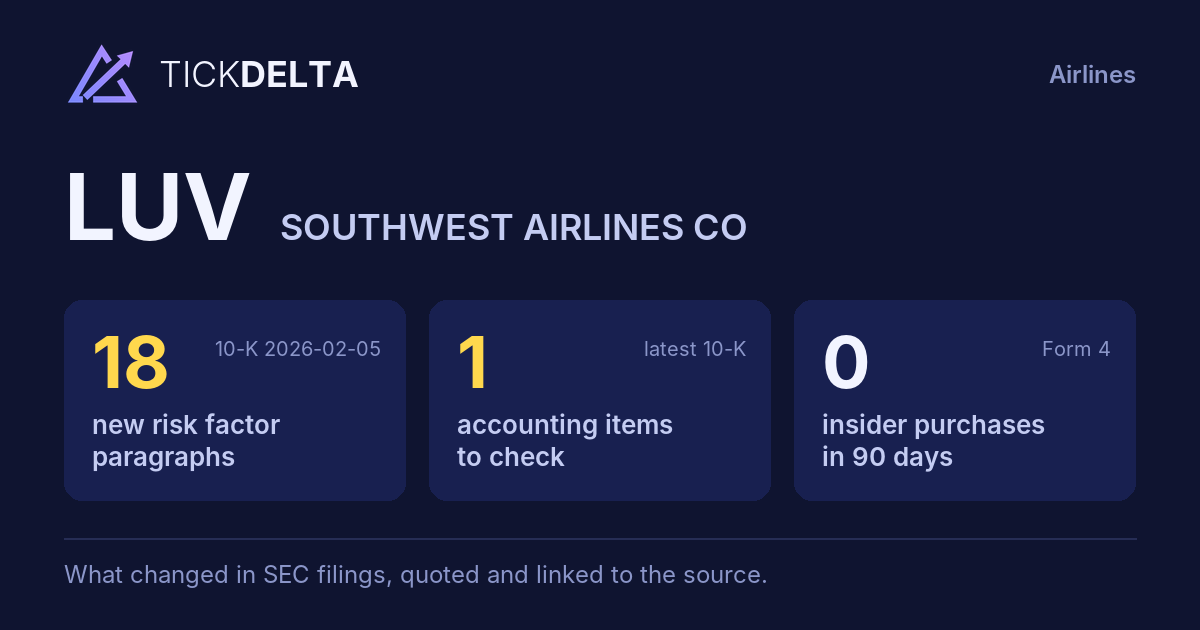
Sentences and paragraphs of LUV's Risk Factors and MD&A, 10-K 2026-02-05 against 10-K 2025-02-07.
Each links to the text at sec.gov.
Show the other 65
AddedRisk Factors
to optimally adjust capacity. The inability to recruit and retain skilled personnel or the unexpected loss of key skilled personnel could continue to adversely affect the Company’s operations.
Read it in 10-K 2026-02-05 at sec.gov ↗
AddedRisk Factors
•laws and regulations, which may change or which may be inconsistent across various jurisdictions; and
Read it in 10-K 2026-02-05 at sec.gov ↗
AddedRisk Factors
The Company is expanding its use of AI and machine-learning. Any failure in the Company’s AI implementation strategy, compliance with regulations, or failure to otherwise manage the risks related to AI technologies effectively could materially adversely affect its operations, reputation, and/or financial position.
Read it in 10-K 2026-02-05 at sec.gov ↗
AddedRisk Factors
•changes to environmental regulations, including mandates affecting the usage of SAF and enhanced emissions and climate reporting obligations;
Read it in 10-K 2026-02-05 at sec.gov ↗
RemovedRisk Factors
In addition, the Company has had to de-designate certain derivative instruments from their hedging relationships because the derivatives no longer qualify for hedge accounting under applicable accounting standards. The Company continues to be subject to the risk that its fuel derivatives will no longer qualify for hedge accounting under applicable accounting standards, or that the derivative instruments utilized will not effectively offset changes in the price of the jet fuel consumed, which can create additional earnings volatility. Adjustments in the Company's overall fuel hedging strategy, as well as the ability of the commodities used in fuel hedging to qualify for special hedge accounting, could continue to affect the Company's results of operations. In addition, there can be no assurance that the Company would be able to cost-effectively hedge against increases in fuel prices. Based on the current geopolitical and market dynamics, higher premium costs over time, and aggressive cost reductions underway, the Company does not intend to add new hedging positions to its current hedge book.
Read it in 10-K 2025-02-07 at sec.gov ↗
RemovedRisk Factors
has experienced significant inflationary cost pressure, particularly with respect to Salaries, wages, and benefits expense.
Read it in 10-K 2025-02-07 at sec.gov ↗
RemovedRisk Factors
products, or otherwise fulfill their commitments to the Company, could materially adversely affect the Company’s operations.
Read it in 10-K 2025-02-07 at sec.gov ↗
RemovedRisk Factors
adversely affect demand for the Company’s services, resulting in an adverse effect on its business, results of operations, and financial condition.
Read it in 10-K 2025-02-07 at sec.gov ↗
RemovedRisk Factors
limit or even curtail its growth, delay strategic initiatives, increase its compliance costs, harm its reputation, or reduce its competitive advantage.
Read it in 10-K 2025-02-07 at sec.gov ↗
RemovedRisk Factors
The Company is subject to changing federal, state, local, and international laws and regulations relating to the protection of the environment, including those relating to aircraft and ground-based emissions, discharges to water
Read it in 10-K 2025-02-07 at sec.gov ↗
RemovedRisk Factors
In addition to risks from potential changes to environmental regulation and policy, the transition to lower-carbon technologies could materially adversely affect the Company’s financial results. For example, lower-carbon technologies, such as SAF, are currently not available at scale or priced cost-competitively as compared to conventional jet fuel and may take a significant amount of time to develop and mature, and the cost to transition to them could be prohibitively expensive without appropriate government support, policies, and incentives in place (including tax credits). For additional disclosure related to the risks of SAF, see the Risk Factor entitled, “The Company is subject to risks related to its sustainability goals and disclosures, which may affect stakeholder sentiment and the Company’s reputation and brand.”
Read it in 10-K 2025-02-07 at sec.gov ↗
RemovedRisk Factors
Finally, the potential acute and chronic physical effects of climate change, such as increased frequency, duration, and severity of extreme weather events, longer-term changes in weather patterns, and other climate-related events,
Read it in 10-K 2025-02-07 at sec.gov ↗
RemovedRisk Factors
In addition to responding to legislative and regulatory requirements, the Company has voluntarily set near- and long-term environmental sustainability plans and goals. The achievement of these plans and goals is materially dependent on the performance of third parties and government action, and these goals could be adversely affected by changes in third-party expectations, methodologies, and priorities, which are rapidly changing. The Company expects its path toward achievement of these goals to depend on, among other things (i) increased use of SAF, which is not presently available at scale or at prices competitive to jet fuel; (ii) improved fuel efficiency from fleet modernization; (iii) operational initiatives; and (iv) technological innovation.
Read it in 10-K 2025-02-07 at sec.gov ↗
RemovedRisk Factors
The Company is attempting to diversify its sources of jet fuel or otherwise seek to limit its reliance on fossil-fuel based fuels, such as through increasing the volumes of SAF used in its operations. Supplies of SAF are limited and may not be developed in sufficient quantities to support the Company’s business or sustainability goals. The cost to transition to SAF could be prohibitively expensive without appropriate government support, policies, and incentives in place (including tax credits). Further, SAF incentives that are currently in place could expire or be repealed, and the Company may have binding SAF purchase commitments that extend beyond various incentives currently in place. Moreover, the new presidential administration may take action to revise, repeal, or otherwise modify existing SAF incentives, including tax credits and federal loans and grants. For example, on January 20, 2025, President Trump issued an Executive Order pausing certain funding disbursements under the Inflation Reduction Act of 2022; the impact of this Executive Order on the use of and investment in SAF, current and future SAF projects, and, ultimately, the Company's operations is uncertain at this time. Additionally, SAF purchase agreements may pertain to production from facilities that are planned but not yet operational, and which may utilize technology that has not been proven at commercial scale. There is no assurance that these facilities will produce SAF at commercial scale or that they will meet contracted production timelines and volumes. SAF has a limited distribution system and is subject to higher transportation risks than jet fuel. In the event SAF is not delivered on schedule or in sufficient volumes, there can be no assurance that the Company will be able to source a supply of SAF sufficient to meet its stated goals, or that it will be able to do so on favorable economic terms. It could become increasingly difficult to negotiate SAF purchase agreements with suppliers at commercially reasonable terms due to high demand and insufficient supply of SAF, particularly as more businesses publicly announce environmental sustainability goals or if SAF incentives expire, are repealed, or are otherwise negatively impacted by governmental action or inaction. Moreover, there is no guarantee that Customers, regulators, or other stakeholders will not object to any use of “book and claim” accounting methods (or similar constructs) for claims of GHG emission reductions in connection with the Company’s SAF purchase agreements, as such claims may be based on the separation of potential GHG emission reductions from the physical delivery of SAF. The Company cannot guarantee that it will be able to purchase SAF on a cost-effective basis, and in addition to the factors already discussed, the ability to leverage SAF as part of its sustainability efforts could also be adversely affected by any of the following: technology challenges in the production, development, transportation, storage, and distribution of SAF; compliance with and/or changes to government regulations; modifications to or failure of industry standards, accounting protocols, approaches to modeling life cycle GHG emissions, or other applicable requirements to allow the Company to realize benefits from SAF (including blend limitations); or changes in carbon costs or climate-related goals.
Read it in 10-K 2025-02-07 at sec.gov ↗
RemovedRisk Factors
Furthermore, to the extent that the Company may seek to achieve its voluntary climate goals and/or mandatory climate obligations through the use of carbon offsets, it may be exposed to additional costs associated with the procurement of offsets or limited supply in the carbon offsets market. In addition, to the extent the Company does utilize offsets, it may need to disclose information about such offsets through regulatory mandates and it will need to obtain these offsets from third parties. While the Company generally seeks to purchase only quality offsets verified by reputable third parties, it can make no guarantees that the underlying offset project will provide the full or any claimed GHG emission reduction benefits, nor can it guarantee that any such offsets will not be subject to criticism from Customers, regulators, or other stakeholders. As more businesses have publicly announced environmental sustainability goals, the cost of carbon offsets has also increased and may continue to increase significantly.
Read it in 10-K 2025-02-07 at sec.gov ↗
RemovedRisk Factors
The Company’s ability to achieve its environmental sustainability goals is subject to risks and uncertainties, many of which are outside of its control. These risks and uncertainties include, but are not limited to: the Company’s ability to successfully implement its business strategy, effectively respond to changes in market dynamics, and achieve the anticipated benefits and associated cost savings of such strategies and actions; the Company’s ability to implement its fleet modernization or planned fuel efficiency initiatives; availability and ability to utilize SAF at economical prices and with expected carbon intensity reductions; advancement in modernizing air traffic control systems; unforeseen production, design, operational, and technological difficulties; the outcome of research efforts and future technology developments, including the ability to scale projects and technologies on a commercially competitive basis; compliance with, and changes or additions to, global and regional regulations, taxes, charges, mandates, or requirements relating to GHG emissions, carbon costs, or climate-related goals; changes to emission accounting methodologies; adapting products to customer preferences and customer acceptance of sustainable supply chain solutions; the actions of competitors and competitive pressures; or other new developments related to the potential impacts of climate change. There is no assurance that the Company will be able to successfully execute its strategies and achieve its previously announced environmental and sustainability goals and plans.
Read it in 10-K 2025-02-07 at sec.gov ↗
RewordedRisk Factors
The Company’s Company has adopted certain provisions in its Bylaws designate specific courts as the exclusive forum for certain legal actions between the Company and its Shareholders, which that could increase costs to bring a claim, discourage claims, limit the ability of the Company’s Shareholders to bring a claim, or limit the ability of the Company’s Shareholders to bring a claim in a judicial forum viewed by the Shareholders as more favorable for disputes with the Company or the Company’s directors, officers, or other Employees.
Read it in 10-K 2026-02-05 at sec.gov ↗
RewordedRisk Factors
The In both 2024 and 2025, the Company has also announced plans for for, and is in the process of implementing, certain transformational initiatives, such as changing to an assigned seating model, offering premium seating with extra legroom, legroom seating, formalizing partnerships with international carriers to expand its network, offering Getaways by Southwest, introducing 24-hour operations, and reducing the turn times between flights. flights, and introducing bag fees for most fare products.
Read it in 10-K 2026-02-05 at sec.gov ↗
RewordedRisk Factors
Because If the Company uses a variety of different derivative instruments at different price points, were to resume its fuel hedging program in the Company is subject to the risk future, it cannot guarantee that the fuel derivatives it uses will not provide adequate protection against significant increases in fuel prices.
Read it in 10-K 2026-02-05 at sec.gov ↗
RewordedRisk Factors
The Company's business can be significantly impacted affected by the availability of jet fuel and high and/or volatile fuel, fuel prices, and volatility of fuel prices and the Company's operations are subject to disruption in the event of any delayed supply of fuel; therefore, the Company's strategic plans and future profitability are likely to be impacted affected by the Company's ability to effectively address fuel availability, price increases increases, and fuel price volatility and availability. volatility.
Read it in 10-K 2026-02-05 at sec.gov ↗
RewordedRisk Factors
If the MAX aircraft were to become unavailable for the Company's Company’s operations, or if the Company were not able to continue to experience prolonged delivery delays of MAX aircraft, procure future aircraft in a timely manner or on favorable commercial terms, the Company's Company’s business plans, strategies, and results of operations could be materially and adversely affected.
Read it in 10-K 2026-02-05 at sec.gov ↗
RewordedRisk Factors
As discussed further under "Management’s Discussion and Analysis of Financial Condition and Results of Operations," the Company's The Company’s unionized workforce makes up approximately 82 84 percent of its Employees and many have had pay scale increases as a result of contractual rate increases, which has put pressure on increased the Company's Company’s labor costs.
Read it in 10-K 2026-02-05 at sec.gov ↗
RewordedRisk Factors
In addition, while the Company cannot predict what requirements may be imposed in the future, future or the timing with respect to the same, federal, state, local, and international legislative and regulatory bodies in recent years have generally increased focus on climate change and reducing GHG, including CO2 emissions, by requiring disclosure of emissions and have generally continued climate-related risks, and may continue to do so.
Read it in 10-K 2026-02-05 at sec.gov ↗
RewordedRisk Factors
While the Company operates across a diverse geographic footprint, its operations at times have been adversely and materially impacted by severe weather, such as Hurricanes Harvey Winter Storm Fern in January 2026, Hurricane Milton in October 2024, and Irma in 2017, Winter Storm Elliott in December 2022, and Hurricane Milton in October 2024. 2022.
Read it in 10-K 2026-02-05 at sec.gov ↗
RewordedRisk Factors
Any failure, disruption, or delay in implementation of the Company’s IT Systems could limit or even curtail its growth, delay strategic initiatives, increase its compliance costs, harm its reputation, or reduce its competitive advantage.
Read it in 10-K 2026-02-05 at sec.gov ↗
RewordedRisk Factors
These relationships involve significant challenges and risks, including that cooperation agreements may be subject to ongoing review approval, review, and renewal requirements and requirements, may not generate the expected financial results. results, and may distract management from the Company’s operations or other strategic options.
Read it in 10-K 2026-02-05 at sec.gov ↗
RewordedRisk Factors
The forum selection provision selection, waiver of jury trial, and derivative proceedings threshold provisions may increase costs to bring a claim, discourage claims, limit a Shareholder’s ability to bring a claim, or limit a Shareholder’s ability to bring a claim in a judicial forum that such Shareholder finds favorable for disputes with the Company or the Company’s directors, officers, or other Employees, which may discourage such lawsuits against the Company or the Company’s directors, officers, and other Employees.
Read it in 10-K 2026-02-05 at sec.gov ↗
RewordedRisk Factors
Further, some businesses have continued to allow their employees to work remotely following the COVID-19 pandemic and/or have restricted restrict non-essential travel for their employees, which has kept impacted the demand for business air travel below pre-pandemic levels. travel.
Read it in 10-K 2026-02-05 at sec.gov ↗
Quiet changesRisk Factors
(iv) Customer and other stakeholder perceptions of statements made by the Company, its Employees and executives, agents, any industry trade associations, or other third parties; or (v) public pressure from certain investors or policy groups to change the Company's Company’s policies.
Read it in 10-K 2026-02-05 at sec.gov ↗
AddedMD&A
The Company experienced a year of meaningful transformation and execution as it implemented its transformational initiatives, which were planned and designed to attract new Customers and improve both the Company's operational and financial performance. During 2025, the Company:
Read it in 10-K 2026-02-05 at sec.gov ↗
AddedMD&A
•Changed its product offering, including the implementation of bag fees for most fare products, addition of a Basic fare product, and transition to new fare products, Choice, Choice Preferred, and Choice Extra;
Read it in 10-K 2026-02-05 at sec.gov ↗
AddedMD&A
•Updated its flight credit policy for tickets purchased on or after May 28, 2025;
Read it in 10-K 2026-02-05 at sec.gov ↗
AddedMD&A
•Began selling assigned and extra legroom seating for travel beginning January 27, 2026;
Read it in 10-K 2026-02-05 at sec.gov ↗
AddedMD&A
•Expanded distribution channels through new partnerships with online travel agencies, Expedia and Priceline;
Read it in 10-K 2026-02-05 at sec.gov ↗
AddedMD&A
•Better optimized its Rapid Rewards® program, including variable earn and burn rates;
Read it in 10-K 2026-02-05 at sec.gov ↗
AddedMD&A
•Amended its co-brand credit card agreement with JPMorgan Chase Bank, N.A. (“Chase”), including new benefits and improved economics;
Read it in 10-K 2026-02-05 at sec.gov ↗
AddedMD&A
•Announced free Wi-Fi sponsored by T-Mobile for all Rapid Rewards Members beginning October 24, 2025;
Read it in 10-K 2026-02-05 at sec.gov ↗
AddedMD&A
•Deployed new technology boosting operational reliability, a key enabler of the Company's #1 rank in The Wall Street Journal Best U.S. Airlines of 2025;
Read it in 10-K 2026-02-05 at sec.gov ↗
AddedMD&A
•Announced six strategic partnerships with Icelandair, EVA Air, China Airlines, Philippine Airlines, Condor, and Turkish Airlines.
Read it in 10-K 2026-02-05 at sec.gov ↗
AddedMD&A
In January 2026, the Company began operating assigned and extra legroom seating for travel beginning on January 27, 2026, which required retrofitting 780 aircraft. With assigned and extra legroom seating becoming operational, Southwest expects future earnings upside based on how booking behavior related to these initiatives unfolds. This includes upsell revenue from close-in bookings, which are more closely affiliated with business and price-flexible Customers, as well as growth in business and leisure Customer segments driven by the more attractive new product offering.
Read it in 10-K 2026-02-05 at sec.gov ↗
AddedMD&A
The Company has also announced its intention to commence new service at multiple locations in an effort to grow its network and provide more destinations for Customers. These locations include:
Read it in 10-K 2026-02-05 at sec.gov ↗
RemovedMD&A
calculation period completed in January 2025. See "Liquidity and Capital Resources" below for further information on the Company's 2024 share repurchases. The Company has $2.25 billion remaining under its September 2024 $2.5 billion share repurchase authorization. On December 5, 2024, the Company announced its intention to launch a $750 million accelerated share repurchase program in first quarter 2025. See Part II, Item 5 for further information on the Company's share repurchase authorizations.
Read it in 10-K 2025-02-07 at sec.gov ↗
RemovedMD&A
In late December 2022, the Company experienced a wide-scale operational disruption as extreme winter weather across a significant portion of the United States impacted its operational plan and flight schedules. This disruption and subsequent recovery efforts resulted in the cancellation of more than 16,700 flights during the period from December 21 through December 31, 2022. For first quarter 2023, these events also created a deceleration in bookings, largely isolated to January and February 2023, as well as additional expenses primarily in the form of reimbursing Customers for costs incurred as a result of the flight cancellations. The financial impact of this disruption on first quarter 2023 results was approximately $380 million on a pre-tax basis. Other than a fourth quarter 2023 charge associated with a DOT settlement of $107 million, there were no material impacts to operating
Read it in 10-K 2025-02-07 at sec.gov ↗
RemovedMD&A
The following tables provide selected financial guidance for first quarter 2025, as well as select full year 2025 guidance and 2027 targets, as applicable:
Read it in 10-K 2025-02-07 at sec.gov ↗
RemovedMD&A
1Q 2025 Estimation RASM (a), year-over-year Up 5% to 7% ASMs (b), year-over-year Down 2% to 3% Economic fuel costs per gallon (c) (d) $2.50 to $2.60 Fuel hedging premium expense per gallon $0.07 Fuel hedging cash settlement gains per gallon $— ASMs per gallon (fuel efficiency) 81 to 83 CASM-X (e), year-over-year (c) (f) Up 7% to 9% Scheduled debt repayments (millions) ~$5 Interest expense (millions) ~$45
Read it in 10-K 2025-02-07 at sec.gov ↗
RemovedMD&A
Operating margin, excluding special items (c) (g) 3% to 5% ≥ 10% Return on invested capital ("ROIC") after-tax (h) (i) 5% to 8% ≥ 15% ASMs (b), year-over-year Up 1% to 2% Up 1% to 2% 2025 Estimation 2027 Targets
Read it in 10-K 2025-02-07 at sec.gov ↗
RemovedMD&A
(b) Available seat miles ("ASMs" or "capacity"). The Company currently expects second quarter 2025 capacity to increase in the range of 1 percent to 2 percent, year-over-year.
Read it in 10-K 2025-02-07 at sec.gov ↗
RemovedMD&A
(d) Based on the Company's existing fuel derivative contracts and market prices as of January 21, 2025, first quarter 2025 economic fuel costs per gallon are estimated to be in the range of $2.50 to $2.60. Economic fuel cost projections do not reflect the potential impact of special items because the Company cannot reliably predict or estimate the hedge accounting impact associated with the volatility of the energy markets, or the impact to its financial statements in future periods. Accordingly, the Company believes a reconciliation of non-GAAP financial measures to the equivalent GAAP financial measures for projected results is not meaningful or available without unreasonable effort. See Note Regarding Use of Non-GAAP Financial Measures.
Read it in 10-K 2025-02-07 at sec.gov ↗
RemovedMD&A
(e) Operating expenses per available seat mile, excluding fuel and oil expense, special items, and profitsharing ("CASM-X").
Read it in 10-K 2025-02-07 at sec.gov ↗
RemovedMD&A
(g) Operating margin, excluding special items, is calculated as operating income, excluding special items, divided by operating revenues, excluding special items. Projections and targets do not reflect the potential impact of special items because the Company cannot reliably predict or estimate those items or expenses or their impact to its financial statements in future periods. Accordingly, the Company believes reconciliation of non-GAAP financial measures to the equivalent GAAP financial measures for these projected results is not meaningful or available without unreasonable effort.
Read it in 10-K 2025-02-07 at sec.gov ↗
RemovedMD&A
(h) See Note Regarding Use of Non-GAAP Financial Measures for additional information on ROIC. In addition, information regarding ROIC and economic results is included in the accompanying table Non-GAAP Return on Invested Capital (ROIC). Projections and targets do not reflect the potential impact of special items because the Company cannot reliably predict or estimate those items or expenses or their impact to its financial statements in future periods. Accordingly, the Company believes reconciliation of non-GAAP financial measures to the equivalent GAAP financial measures for these projected results is not meaningful or available without unreasonable effort.
Read it in 10-K 2025-02-07 at sec.gov ↗
RemovedMD&A
(i) The Company estimates its full year 2025 effective tax rate to be in the range of 22 percent to 24 percent.
Read it in 10-K 2025-02-07 at sec.gov ↗
RemovedMD&A
The Company expects first quarter 2025 RASM to increase in the range of 5 percent to 7 percent, year-over-year. The expected year-over-year improvement is driven primarily by a focus on capacity rationalization and the Company's continued focus on the execution of its tactical initiatives. The Company also anticipates continued strength in the demand environment.
Read it in 10-K 2025-02-07 at sec.gov ↗
RewordedMD&A
Average length of passenger haul (miles) 1,040 1,018 993 2.5% 2.2% Average aircraft stage length (miles) 780 763 730 4.5% 2.2% Trips flown 1,415,822 1,443,866 1,459,427 (1.1)% (1.9)% Seats flown (000s)(d) 228,193 230,187 231,409 (0.5)% (0.9)% Seats per trip(e) 161.2 159.4 158.6 0.5% 1.1% Average passenger fare(k) $ 190.41 $ 178.40 $ 172.18 3.6% 6.7% Passenger revenue yield per RPM (cents)(f)(k) 18.31 17.53 17.35 1.0% 4.4% Operating revenues per ASM (cents)(g)(k) 15.59 15.51 15.32 1.2% 0.5% Passenger revenue per ASM (cents)(h)(k) 14.18 14.09 13.88 1.5% 0.6% Operating expenses per ASM (cents)(i) 15.35 15.32 15.19 0.9% 0.2% Operating expenses per ASM, excluding fuel (cents) 12.44 12.05 11.54 4.4% 3.2% Operating expenses per ASM, excluding fuel and profitsharing profit sharing (cents) 12.38 11.99 11.47 4.5% 3.3% Fuel costs per gallon, including fuel tax $ 2.41 $ 2.64 $ 2.89 (8.7)% Fuel costs per gallon, including fuel tax, economic $ 2.41 $ 2.66 $ 2.89 (8.0)% (9.4)% Fuel consumed, in gallons (millions) 2,169 2,194 2,143 2.4% (1.1)% Active full-time equivalent Employees 72,790 72,450 74,806 (3.1)% 0.5% Aircraft at end of period(j) 803 817 (1.7)% 803 —%
Read it in 10-K 2026-02-05 at sec.gov ↗
RewordedMD&A
On a dollar and per ASM basis, approximately 50 percent of the increase was primarily attributable to an increase in airport rental expense and higher landing fees throughout the network driven by higher rates charged by airports, partially offset airports for leased space, 30 percent of the increase was primarily due to higher landing fees throughout the network, primarily driven by more increased usage of the heavier -8 aircraft and higher rates, and 20 percent of the increase was due to receiving fewer favorable settlements and credits from various airports received in 2024. 2025.
Read it in 10-K 2026-02-05 at sec.gov ↗
RewordedMD&A
The Company had a record full year 2024 revenue performance, performance in 2025, producing operating revenues of $27.5 $28.1 billion, due in part to continued demand strength and the benefits from strong domestic travel demand, as well as the execution of tactical actions related to initiatives announced by the Company transformational initiatives, which has resulted in 2024 designed to elevate the Customer Experience on its flights, improve strong financial performance, performance and drive driven incremental Shareholder value.
Read it in 10-K 2026-02-05 at sec.gov ↗
RewordedMD&A
The Company estimates its 2025 2026 net capital spending to be in the range of $2.5 $3.0 billion to $3.0 billion, which includes approximately $1.2 $3.5 billion in aircraft capital spending, based on the planning assumption its expectation of 38 66 -8 aircraft deliveries in 2025, and $1.6 billion in 2026, with the remainder representing non-aircraft capital spending, but does not include the impact of potential future partially offset by proceeds from planned fleet sales or sale-leaseback transactions. sales.
Read it in 10-K 2026-02-05 at sec.gov ↗
RewordedMD&A
Year ended December 31, Per ASM Percent (in cents, except for percentages) 2025 2024 2023 change change Salaries, wages, and benefits 7.21 6.91 6.55 0.36 5.5% 0.30 4.3% Fuel and oil 2.91 3.27 3.65 (0.38) (10.4) (0.36) (11.0) Maintenance materials and repairs 0.68 0.76 0.70 0.06 8.6 (0.08) (10.5) Landing fees and airport rentals 1.21 1.11 1.05 0.06 5.7 0.10 9.0 Depreciation and amortization 0.87 0.93 0.89 0.04 4.5 (0.06) (6.5) Other operating expenses 2.47 2.34 2.35 (0.01) (0.4) 0.13 5.6 Total 15.35 15.32 15.19 0.13 0.9% 0.03 0.2%
Read it in 10-K 2026-02-05 at sec.gov ↗
RewordedMD&A
As a result of applying hedge accounting in prior periods, the Company has amounts in Accumulated other comprehensive income ("AOCI") that will be recognized in earnings the Consolidated Statement of Comprehensive Income in future the periods when the underlying fuel derivative contracts settle. originally forecasted transactions occur, including deferred losses of $115 million in 2026 and $22 million in 2027 as of December 31, 2025 (net of tax).
Read it in 10-K 2026-02-05 at sec.gov ↗
RewordedMD&A
As of December 31, 2024, 2025, based on prevailing forward market interest rates, future interest payments associated with its fixed floating rate debt (excluding interest associated with finance leases) unsecured notes were $138 million in 2025, $128 $41 million in 2026, $71 $37 million in 2027, $13 $38 million in 2028, $13 $40 million in 2029, $41 million in 2030, and $7 $223 million thereafter.
Read it in 10-K 2026-02-05 at sec.gov ↗
RewordedMD&A
Capital expenditures expenditures, net were $2.1 $2.7 billion for 2024, 2025, compared with $3.5 $2.1 billion in the same prior year period, and decreased increased year-over-year largely due to decreases an increase in progress and delivery payments for aircraft received in 2024, as well as contractual progress payments made in 2024 associated with future scheduled aircraft deliveries.
Read it in 10-K 2026-02-05 at sec.gov ↗
RewordedMD&A
The During 2025, the Company returned $680 million continued to deliver value to its Shareholders by returning $2.9 billion to Shareholders through $430 $399 million in dividend payments and $250 million $2.6 billion through an accelerated share repurchase program programs entered into by the Company with a third party financial institution in fourth quarter 2024. institutions.
Read it in 10-K 2026-02-05 at sec.gov ↗
RewordedMD&A
The Company records revenue related to air transportation when the transportation travel is delivered and delivered, revenue related to marketing elements when the performance obligation obligations related to those services are satisfied, which is satisfied. generally the same period consideration is received from Chase, and revenue related to airline benefits when they are provided.
Read it in 10-K 2026-02-05 at sec.gov ↗
RewordedMD&A
The Company continues to have a large base of unencumbered aircraft and other related assets with a net book value of approximately $16 billion, including approximately $13 billion in aircraft value and approximately $3 billion in non-aircraft assets such as spare engines, ground equipment, and real estate. $17.0 billion.
Read it in 10-K 2026-02-05 at sec.gov ↗
RewordedMD&A
Subsequently, on On July 28, 2022, the Company modified its flight credit policy and announced that all $1.9 billion of unexpired flight credits outstanding as of that date, including these extended flight credits, will the majority of which were associated with travel disruptions during the COVID-19 pandemic, would no longer have an expiration date and thus will be able to be redeemed by Customers indefinitely.
Read it in 10-K 2026-02-05 at sec.gov ↗