Form 10-K for the Fiscal Year Ended December 31, 2020
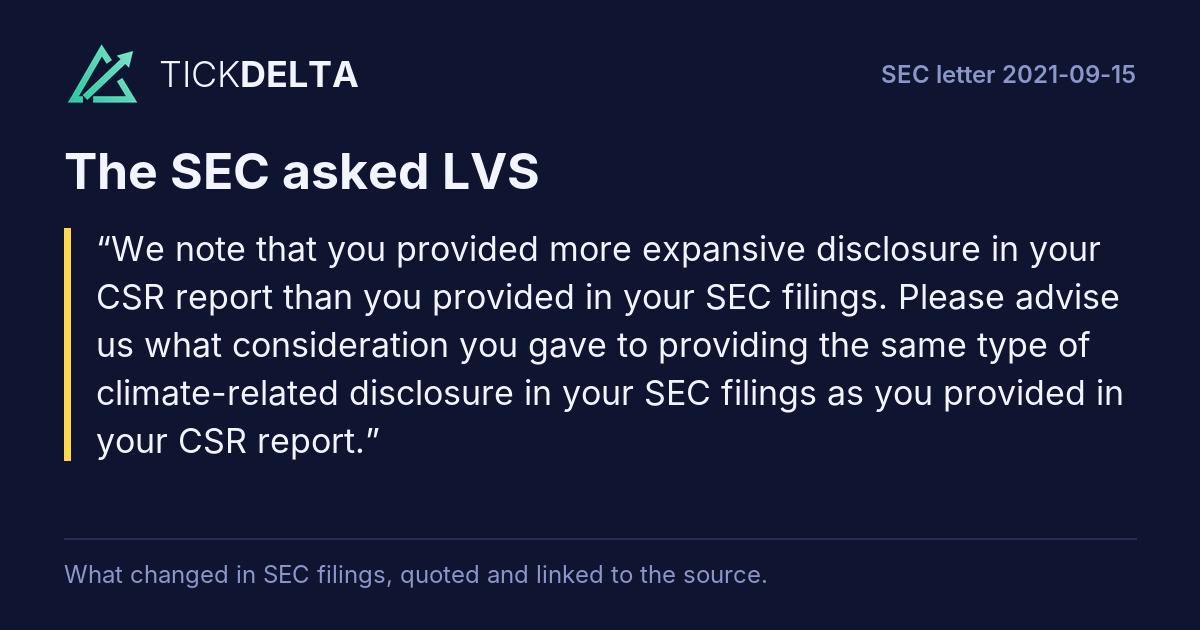
We note that you provided more expansive disclosure in your CSR report than you provided in your SEC filings. Please advise us what consideration you gave to providing the same type of climate-related disclosure in your SEC filings as you provided in your CSR report.
The Company respectfully acknowledges that its corporate social responsibility (“CSR”) report, “Environmental, Social and Governance Report 2020,” contained more expansive climate-related disclosures than what was disclosed in the Form 10-K for the year
3355 Las Vegas Blvd. South, Las Vegas, Nevada 89109
The Venetian Resort Las Vegas | Sands Expo | Sands Macao | The Venetian Macao | Four Seasons Macao
The Plaza Macao | The Londoner Macao | The Parisian Macao | Marina Bay Sands
Securities and Exchange Commission ended December 31, 2020.Read in the reply ↗Rest of the answer
The Company notes current SEC rules do not specifically mandate climate-related disclosure in the Form 10-K or other SEC filings, but such disclosure might be required if considered material to the Company. The Company also notes that certain information related to climate change is a focus area for some investors and as such, the Company voluntarily disclosed general information relating to our commitment to environmental sustainability, inclusive of climate change, in its Form 10-K filing. The Company intended such disclosure to be broadly informative and to alert investors of its focus on environmental sustainability and direct them to its more comprehensive CSR report should they be interested in additional information. The global CSR report, initiated by the Company in 2019, is meant to communicate to investors, suppliers, team members and other stakeholders the Company’s dedication to being a good corporate citizen and commitment to its people, its communities and the planet. The Company’s corporate responsibility platform represents our focus in a number of key areas that address the issues most important, while not material, to the Company’s team members, communities and other key stakeholders. As the Company does not believe the effects of climate change are material to the Company and its operations at this time, management respectfully submits the climate-related disclosure in the Company’s SEC filings to date is adequate and appropriate and its present intention is to continue this approach in future filings. Management will, however, continue to evaluate this emerging area, and, if warranted, will include additional disclosure in the future.
We note the disclosure in your Form 10-K, proxy statement and CSR report that you are seeking meaningful environmental improvement through green buildings, environmentally responsible operations, and green meetings and events. If material, please quantify capital expenditures and compliance costs for these climate-related initiatives.
The Company’s capital expenditures with regard to climate-related initiatives are primarily focused on energy and water efficiency projects, which include, among others, building system technology to monitor and help reduce consumption, and LED lighting and HVAC systems to conserve energy. Climate-related program costs related to these initiatives primarily consist of payroll from the sustainability departments at our properties and third-party consultant costs.Read in the reply ↗Rest of the answer
The Company has deemed capital expenditures and program costs related to climate-related initiatives incurred during the three years ended December 31, 2020, to be immaterial.
Comment 3.
If material, discuss the significant physical effects of climate change on your operations and results. This disclosure may include the following:
•severity of weather, such as floods, hurricanes, sea levels, extreme fires, and water availability and quality;
•quantification of material weather-related damages to your property or operations; and
•potential for indirect weather-related impacts that have affected or may affect your major customers or suppliers.
Response: The Company faces potential risks associated with the physical effects of climate change, which may include more frequent or severe storms, typhoons, flooding, rising sea levels and shortages of water, any of which could have a material adverse effect on our business, financial condition, results of operations and cash flows. To the extent climate change causes additional changes in weather patterns, the Company’s properties along the coast in Singapore and in Macao could be subject to an increase in the number and severity of typhoons and rising sea levels causing damage to these properties, while Las Vegas could be subject to extreme drought conditions leading to further water restrictions. Along with property damage, our property insurance premiums could increase as well as costs to operate our properties, including utility costs for water or energy. Additionally, these events and their aftermath could result in a temporary decline in visitation to our properties.
In recent years, our properties in Macao have sustained limited physical damage from three typhoons, as well as minimal interruption of business operations. In 2017, Typhoon Hato resulted in flooding, property damage and suspension of electricity and water, in which the electricity suspension impacted our Macao operations for approximately 47 hours. In 2018, Typhoon Mangkhut resulted in flooding, property damage and the suspension of gaming operations for 33 hours due to a Macao government mandate. In 2020, tropical storm Higos resulted in limited flooding and property damage. While these events caused property damage and resulted in temporary loss of business, the Company does not consider these events to be material as the financial impact was not material and the Company was able to recover the costs incurred to repair the physical property damage and lost revenues through its insurance coverage. To date, the Company has not experienced any severe weather events at its Las Vegas or Singapore properties.
The Company’s properties, similar to other businesses in the jurisdictions in which the Company operates, are exposed to potentially significant losses resulting from catastrophic events and severe weather conditions, which could be the result of climate change among a variety of other factors; however, the Company cannot predict the impact changing climate conditions will have on the Company’s business, financial condition, results of operations or cash flows. In this regard, in its Form 10-K for the year ended December 31, 2020, the Company included risk factors related to potential impacts of climate change such as “Natural or man-made disasters, an outbreak of highly infectious or contagious disease, political instability, civil unrest, terrorist activity or war could materially adversely affect the number of visitors to our facilities and disrupt our operations” and “We depend primarily on our properties in three markets for all of our cash flow,” where the Company describes the properties being at risk of “Acts of God,” such as typhoons and rainstorms, and other natural disasters and inclement weather, which the Company believes is inclusive of climate change. Additionally, the Company also includes the risk factor “Our insurance coverage may not be adequate to cover all possible losses that our properties could suffer and our insurance costs may increase in the future,” which addresses insurance coverage costs and potential limitations for climate-related events.
Comment 4. Disclose the material effects of transition risks related to climate change that may affect your business, financial condition, and results of operations, such as policy and regulatory changes that could impose operational and compliance burdens, market trends that may alter business opportunities, credit risks, or technological changes.
Response: Legislation and regulation regarding climate change could impose additional costs on the Company and its suppliers, including costs related to increased energy requirements, environmental monitoring, reporting and other compliance costs to comply with such regulations. Even without such regulation, investor and consumer attitudes or negative reaction towards the Company’s response, or lack thereof, to climate change could harm the Company’s reputation or access to capital. Given the regulatory or compliance obligations and uncertainty around the impact of climate change and how it should be addressed, the Company is unable to predict how future legislation and regulation will affect our business, financial condition, operations and cash flows. The Company assessed the current effects of climate change regulation on its business, credit risks, technological changes and market trends caused by climate change, and to date, deemed these immaterial. The Company will continue to monitor and evaluate the potential risks and impacts in this area and will consider expanding its disclosure of risks related to climate change in future Form 10-K filings as warranted.
Comment 5. If material, provide disclosure about your purchase or sale of carbon credits or offsets and any material effects on your business, financial condition, and results of operations.
Response: The Company has determined its purchase and sale of carbon credits or offsets to date are not material to the Company and do not have a material effect on its business, financial condition, results of operations and cash flows.
* * *
The Company believes the foregoing is fully responsive to the Comment Letter. Please let us know if you have any questions by contacting the undersigned at (702) 733-5503.
If material, discuss the significant physical effects of climate change on your operations and results. This disclosure may include the following: • severity of weather, such as floods, hurricanes, sea levels, extreme fires, and water availability and quality; • quantification of material weather-related damages to your property or operations; and • potential for indirect weather-related impacts that have affectedRest of the question
or may affect your major customers or suppliers.
No numbered answer found in the reply. Read the reply ↗
Disclose the material effects of transition risks related to climate change that may affect your business, financial condition, and results of operations, such as policy and regulatory changes that could impose operational and compliance burdens, market trends that may alter business opportunities, credit risks, or technological changes.
No numbered answer found in the reply. Read the reply ↗
If material, provide disclosure about your purchase or sale of carbon credits or offsets and any material effects on your business, financial condition, and results of operations.
No numbered answer found in the reply. Read the reply ↗
You state in response to prior comment 2 that your capital expenditures regarding climaterelated initiatives are primarily focused on energy and water efficiency projects and that your climate-related program costs related to these initiatives primarily consist of payroll and third-party consultant costs.Rest of the question
You further state that these capital expenditures and program costs were immaterial during the three years ended December 31, 2020. Please tell us more about physical changes you are making, such as the installation of building system technology to monitor and help reduce consumption, and whether you consider the related costs to be part of your capital expenditures for climate-related initiatives. Include information quantifying your capital expenditures and program costs and explain how you determined they were not material. In addition, tell us about any compliance costs you have incurred related to climate change.
The Company’s ECOTracker program aligns our energy efficiency, renewable energy and innovative technology initiatives with our greenhouse gas targets to ensure the Company stays on track to meet its goals. Upgrades to the Company’s building system technology, which is part of our ECOTracker program, include fixing or replacing sensors located throughout the properties and updating software to assist in monitoring and helping reduce energy consumption, provide trend analysis or alert management of potential equipment failure.Read in the reply ↗Rest of the answer
Other physical changes tracked in our ECOTracker program include, among others, chiller plant optimization, the installation of LED lighting, the replacement of old audio amplifiers with newer amplifiers that use less energy to operate and the replacement of old dishwashers with models that reduce water and energy usage. While the physical changes the Company makes regarding the above can be considered capital expenditures for climate-related initiatives, these are embedded in broader strategic spending aimed at improving operations while also being an environmentally responsible company. Capital expenditures and program costs related to climate-related initiatives were $40 million and $13 million, respectively, for the three-year period ended December 31, 2020. These capital expenditures represent approximately 1% of all capital expenditures incurred during the three-year period ended December 31, 2020, while program costs represent less than 0.1% of total consolidated operating expenses during the same three-year period. As such, these amounts were deemed immaterial for separate disclosure.
In addition to the internal program costs mentioned above, the Company’s listed subsidiary, Sands China Ltd., incurs climate change related compliance cost as it is required by the Hong Kong Stock Exchange to release an Environmental, Social and Governance (“ESG”) report within five months of the end of the financial year. The costs associated with this requirement primarily consist of the external costs to produce this report, which are deemed immaterial as the amount is less than $100,000 per year.
In your response to prior comment 3 you state that you experienced physical damage to your properties and temporary loss of business from several typhoons and that you do not consider these events to be material. Please provide more detail about and quantify the property damage and the loss of business you experienced and explain how you determined they were not material.Rest of the question
In addition, tell us how you considered how indirect weather-related impacts may affect your customers and suppliers.
As previously mentioned in our response to prior comment 3, for our operations in Macao, the Company has experienced limited physical damage as well as minimal interruption of business operations from three typhoons over the last five years. To date, the Company has not experienced any severe weather events at its Las Vegas or Singapore properties.
In August 2017, Typhoon Hato resulted in flooding, property damage and suspension of electricity and water, in which the electricity suspension impacted certain of our Macao operations for approximately 47 hours.Read in the reply ↗Rest of the answer
Additionally, on August 25, 2017, the Macao Tourism Bureau requested travel agencies to stop bringing in groups until August 30, 2017, resulting in additional loss of business during this period. Examples of property damage included damage to building facades, fit-out work, soft landscaping and other property and equipment, such as lighting and technology related equipment. Other costs included food spoilage, costs incurred to repair and replace assets and cleaning and clearing of debris costs. Incremental payroll and other related costs were incurred for team members who worked during a specific period.
In September 2018, Typhoon Mangkhut resulted in flooding, damage to soft landscaping and other property and equipment, repair and other operating costs, and the suspension of gaming operations for 33 hours due to a Macao government mandate. Additionally, the Company incurred overtime payments for team members who came to work during the typhoon.
In August 2020, tropical storm Higos resulted in limited flooding, damage to soft landscaping and other property and equipment, and repair and other operating costs.
A summary of the impact due to property damage and loss of business associated with the various typhoons described above after taking into account insurance proceeds and recoveries is shown below:
Typhoon Hato Typhoon Mangkhut Typhoon Higos
(in US$ millions)
Property Damage $ (12) $ (5) $ (3)
Payroll (5) (2) —
Other (4) (2) (1)
Total Costs Incurred (21) (9) (4)
Estimated Business Interruption (37) (11) —
Total Estimated Impact (58) (20) (4)
Insurance Recovery / Proceeds 42 20 6
Net Impact $ (16) $ — $ 2
% of Annual Net Income (Loss) (0.49) % — % (0.09) %
% of Consolidated Property and Equipment, Net at year-end (0.10) % — % 0.01 %
While these events caused limited property damage and resulted in temporary loss of business, the Company does not consider these events to be material as the impact was not material to our financial position and results of operations when compared to net income (loss) and consolidated property and equipment, net, and the Company was able to recover the majority of the costs incurred to repair the physical property damage and the lost revenues through its insurance coverage.
Indirect weather-related impacts may affect the number of visitors to our properties in various ways, such as blocked access due to flooding or air travel disruptions due to storms, temporary closure due to loss of power or water or as mandated by the government, restricted access due to property damage, altered tourist seasons or decreased attractiveness of our properties as a tourism and business destination. Our suppliers could be impacted by damage to their infrastructure and facilities, or disruptions in their operations, supply chain or distribution networks. Management considered these factors and determined the impacts to be temporary in nature and immaterial based on the historical impact of these typhoons, which caused limited disruption to our customers and suppliers.
You also state in your response to prior comment 3 that you are exposed to potentially significant losses resulting from catastrophic events and severe weather conditions, which could be the result of climate change among other factors.Rest of the question
However, the risk factors you cite in support of this statement appear to address natural disasters and weather conditions, not the risk of the significant physical effects of climate change. Given the statement in your response that you face potential risks associated with the physical effects of climate change--which may include more frequent or severe storms, typhoons, flooding, rising sea levels and shortages of water, any of which could have a material adverse effect on our business, financial condition, results of operations and cash flows--please tell us how you determined that additional risk factor disclosure specifically regarding climate change is not warranted at this time.
The Company respectfully acknowledges that it faces potential risks associated with the physical effects of climate change that could result in significant losses, as noted in its response to prior comment 3. At this time and based on our experience, the Company believes such risks, although potentially significant, are not material to warrant additional risk factor disclosure specifically regarding climate change.Read in the reply ↗Rest of the answer
In this regard, the Company notes that the SEC revised Item 105 of Regulation S-K last year, which applied to our Form 10-K for the year ended December 31, 2020, and was intended to streamline risk factor disclosures. In particular, the revised Item 105 requires disclosure of “material” risk factors (replacing the previous “most significant” standard) that are tailored to each company’s circumstances and particular risk profile. Management monitors and assesses on an ongoing basis climate change-related risks for potential material impacts on the Company’s operations, informed in part by utilizing publicly available tools provided by the World Resources Institute as well as our internal monitoring functions. Based on that assessment, management respectfully submits the risk factors in the Company’s SEC filings to date adequately address potential risks associated with the physical effects of climate change. Management will continue to evaluate these issues, and, if warranted, will include additional disclosure in the future.
In response to prior comment 4 you state that you assessed the current effects of climate change regulation on your business, credit risks, technological changes and market trends caused by climate change and deemed them immaterial.Rest of the question
Provide us with additional information supporting this assertion as your response appears to be conclusory without adequately detailing various transition risks related to climate change and the effect they may have on you. In addition, please tell us more about your assessment of transition risks in connection with future legislation or regulation related to climate change and explain how you considered providing disclosure regarding their potential effects.
The Company operates in three jurisdictions—Macao, Singapore and Las Vegas—and currently, the Company is not exposed to any climate change regulation in these jurisdictions.
The Company undertakes an environmental risk assessment process aligned with best practices from the COSO Enterprise Risk Management and Taskforce on Climate-related Financial Disclosure frameworks. This risk assessment is conducted at least once every three years and often more frequently, depending on emerging developments or changes in our business. Risk data is assessed on five-point scales for likelihood and impact.Read in the reply ↗Rest of the answer
All risks that meet certain criteria are integrated into the Company’s enterprise risk management process. Environmental-related risks identified by the Company, but that do not meet those criteria, are managed and monitored by the Sands ECO360 team.
As part of its environmental risk assessment, the Company evaluates transition risks—risks of not responding to climate change or progressing the way our businesses are run—such as those from policy and legal changes, new technologies, updated market requirements, emerging reputational considerations and limited upstream and downstream risks for each property. These risks, combined with potential negative public opinion, could result in reduced demand for our products and services, impact on our access to capital and additional costs to the Company and its suppliers, including costs related to increased energy requirements and environmental monitoring. Nevertheless, the Company believes the implementation of its current climate-related initiatives with a focus on environmental sustainability reduces transition risks to an immaterial level.
Beyond formal risk assessment, the Company also conducts ongoing environmental risk monitoring to track future climate-related regulation or legislation that may impact the Company in the jurisdictions in which it operates.
In Singapore, legislation and new rules under the Resource Sustainability Act 2019 (Part 5) will impose obligations relating to the collection and treatment of food waste. This regulation requires the provision of food waste segregation facilities in new and existing buildings and the subsequent treatment of this food waste. New buildings must be able to treat the food waste on site in the waste disposal facility while existing buildings can utilize this option or engage a licensed waste collector. Potential compliance costs associated with the application of these new rules to the Company’s existing buildings have been deemed immaterial using a worst case scenario based on the financial impact of Marina Bay Sands’ current waste disposal process; however, these provisions would need to be worked into the design of the Company’s second large-scale development in connection with a development agreement between Marina Bay Sands Pte. Ltd., a subsidiary of the Company, and the Singapore government. This new building would also be required to obtain a Green Mark certification (GMC) under the development agreement and, as new versions of the GMC’s are published, the compliance thresholds are expected to become more stringent, such as the Super Low Energy Programme (SLE), which encourages cost-effective and energy-efficient building designs that can achieve at least 60% energy savings over the 2005 building codes. At this time, the Company is unable to determine the impact this would have as the design of the building is still in progress; however, management will continue to monitor the cost of compliance.
In addition, the Company believes the risk factor included in its Form 10-K for the year ended December 31, 2020, under the heading “Because we own real property, we are subject to extensive environmental regulation.” adequately addresses the potential impact of transition risks to the Company.
The Company acknowledges that future legislation or regulation related to climate change could affect our operating costs, the demand for our products and services and supplier costs, which in turn could impact our margins. As part of the Company’s commitment to environmental sustainability, the Company is committed to identifying and addressing potential material impacts on the Company resulting from climate change. Management believes compliance with future legislation or regulation related to climate change would be incremental and immaterial to our already established environmental goals and initiatives. Should management determine the cost of compliance with future legislation or regulation related to climate change becomes or could become material to our operations in the future, we will appropriately update the Company’s disclosures in future filings.
Refer to prior comment 5. You state that the purchase and sale of carbon credits or offsets have not been material to you and have not had a material effect on your business, financial condition, results of operations and cash flows. Please provide us with additional detail to support this statement, including quantitative information.
During the three-year period ended December 31, 2020, carbon offsets totaled approximately $80,000, which the Company deemed immaterial.
* * *
The Company believes the foregoing is fully responsive to the Comment Letter. Please let us know if you have any questions by contacting the undersigned at (702) 733-5503. Read in the reply ↗
Also in this review: closing letter, 2022-01-19