Form 10-K
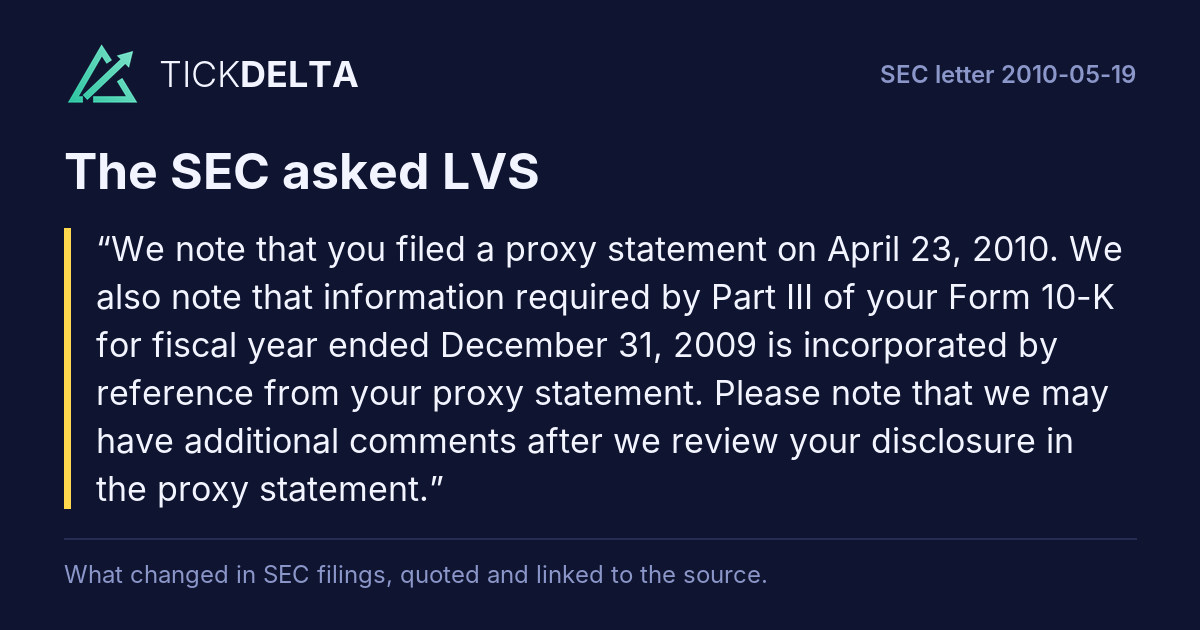
We note that you filed a proxy statement on April 23, 2010. We also note that information required by Part III of your Form 10-K for fiscal year ended December 31, 2009 is incorporated by reference from your proxy statement. Please note that we may have additional comments after we review your disclosure in the proxy statement.
to the Staff’s comment, the Company apologizes for the confusion related to its response to the original comment included in the letter from the Staff dated May 19, 2010. The Company’s intention is not to remove the risk factor currently included in the Form 10-K. Instead, the Company has added a second risk factor specifically related to the GGP bankruptcy, which is included in its Form 10-Q for the quarterly period ended June 30, 2010.Read in the reply ↗Rest of the answer
In future filings, if applicable, the Company will include the following two risk factors:
If the operating results of The Shoppes at The Palazzo continue to be less than we initially expected, if GGP (or any future owner of The Shoppes at The Palazzo or The Grand Canal Shoppes) breaches any of its material agreements with us, or if we are unable to maintain an acceptable working relationship with GGP (or any future owner), there could be a material adverse effect on our financial condition, results of operations or cash flows.
We have entered into agreements with GGP under which, among other things:
●
GGP remains obligated to make payments to us in connection with their purchase of The Shoppes at The Palazzo, which payments are based on projected and, ultimately, actual net operating income for The Shoppes at The Palazzo; and
GGP has agreed to operate The Grand Canal Shoppes and The Shoppes at The Palazzo subject to, and in accordance with, the cooperation agreement.
If the global economic downturn continues, the net operating income for The Shoppes at The Palazzo may continue to be significantly worse than expected at the time the complex was sold to GGP, and therefore the amounts GGP is obligated to pay us may also be significantly less than expected. (Some of the tenants at The Shoppes at The Palazzo whose sales have been less than initially expected have already asked for temporary reductions or abatements in base rent, to which we and GGP have agreed.)
Our agreements with GGP could be adversely affected in ways that could have a material adverse effect on our financial condition, results of operations or cash flows if we do not maintain an acceptable working relationship with GGP or its successors. For example:
the Company learned that one tenant filed a voluntary petition for relief under Chapter 7 of the U.S. Bankruptcy Code and another tenant has delayed its construction plans, creating a question as to whether the rent of the latter tenant will be included in the NOI; and the cooperation agreement that governs the relationships between The Shoppes at The Palazzo and The Palazzo and The Grand Canal Shoppes and The Venetian Las Vegas requires that the owners cooperate in various ways and take various joint actions, which will be more difficult to accomplish, especially in a cost-effective manner, if the parties do not have an acceptable working relationship.
There could be similar material adverse consequences to us if GGP breaches any of its agreements to us, such as its agreement under the cooperation agreement to operate The Grand Canal Shoppes consistent with the standards of first-class restaurant and retail complexes and the overall Venetian theme, and its various obligations as our landlord under the leases described above. Although our agreements with GGP provide us with various remedies in the event of any breaches by GGP and include various dispute resolution procedures and mechanisms, these remedies, procedures and mechanisms may be inadequate to prevent a material adverse effect on our financial condition, results of operations or cash flows if breaches by GGP occur or if we do not maintain an acceptable working relationship with GGP.
The bankruptcy filings of GGP and its subsidiary that owns The Shoppes at The Palazzo could have an adverse effect on the results of operations or cash flows of our Las Vegas Operating Properties.
In April 2009, GGP and its subsidiary that owns The Shoppes at The Palazzo filed the Chapter 11 Cases. Pursuant to the Amended Agreement for the sale of The Shoppes at The Palazzo, a calculation will be performed during the third quarter of 2010 (on the 30-month anniversary of the closing date) to determine whether additional amounts are owed to the Company. To date, the Company has received sale proceeds of $295.4 million. Should additional amounts be contractually owed to the Company, there can be no assurance that GGP will have the financial ability to make such a payment based on GGP’s current financial condition.
We note your disclosure on page 22 that “GGP and its subsidiary that own The Shoppes at The Palazzo filed voluntary petitions under Chapter 11 of the U.S. Bankruptcy Code.” We further note your statements on pages 22, 30 and 82 that there can be no assurance that GGP will be able to pay you future amounts owed.Rest of the question
Please add a risk factor to highlight GGP’s bankruptcy, the associated risks to your business operations and quantify any future amounts owed to you. Please provide this disclosure in future filings and tell us how you intend to comply.
to the Staff’s comment, the Company notes that in 2009, it did not achieve the predetermined EBITDAR-based performance target required for the payments of Mr. Adelson’s base bonus or annual supplemental bonus. As a result, Mr. Adelson did not receive a base bonus or annual supplemental bonus for his 2009 performance and this was reflected in the Summary Compensation Table under Non-Equity Incentive Plan Awards. The amounts of the base and annual supplemental bonuses are based on mathematical formulas and subject to the precondition that the Company achieve the specified EBITDAR-based targets.Read in the reply ↗Rest of the answer
As these targets were not met, the bonus amounts in the Summary Compensation Table are zero.
In the event that Mr. Adelson is entitled to receive a bonus for 2010 performance, the disclosure in the Company’s 2011 proxy statement will be simplified. Mr. Adelson’s employment agreement provides for increased base bonus and annual supplemental bonus opportunities as the Company achieves higher annualized six-month EBITDAR levels. Mr. Adelson’s bonus opportunities are no longer subject to increase because the Company has achieved the maximum annualized six-month EBITDAR levels specified in his contract and shown in the tables in the 2010 Proxy Statement. Accordingly, these tables will be removed from future filings. The disclosure in the 2011 Proxy Statement will specify Mr. Adelson’s target base bonus and annual supplemental bonus opportunities and will provide a more specific calculation to show the relationship between his bonus opportunities and the actual amounts, if any, included as performance-based compensation on the Summary Compensation Table.
In response to the Staff’s comment, in future filings, the Company will include additional disclosure that succinctly relates the amounts in the Summary Compensation Table to the target bonus amounts described in Compensation Discussion and Analysis for the Company’s other named executive officers to the extent applicable, similar to the following:
Mr. Leven. As noted in the 2010 Proxy Statement, under his employment agreement, Mr. Leven is eligible to receive an annual cash bonus, with a target bonus of 50% of his base salary, or $1,000,000. For the reasons set forth in the 2010 Proxy Statement, the Compensation Committee awarded Mr. Leven a bonus in respect of his 2009 performance at the level of 25% of the bonus opportunity specified in his contract, or $250,000. Mr. Leven’s actual bonus was pro-rated to $202,740, to reflect the commencement of his employment in March 2009. The Compensation Committee also awarded Mr. Leven a bonus of $67,745 to reimburse him for taxes related to his use of Mr. Adelson’s aircraft. These bonus amounts are shown in the Summary Compensation Table under “Bonus” and “All Other Compensation,” respectively.
Mr. Goldstein. Mr. Goldstein was eligible to receive base bonus payments for the first and second quarters of 2009. For the reasons discussed above in connection with Mr. Adelson’s base and annual bonus, the Summary Compensation Table shows that Mr. Goldstein did not receive performance-based bonus for the first and second quarters of 2009 because the amounts of these bonuses are based on mathematical formulas and subject to a precondition that was not met. In July 2009, Mr. Goldstein entered into a new employment agreement pursuant to which he is eligible to receive a discretionary cash bonus. For the reasons set forth in the 2010 Proxy Statement, the Compensation Committee awarded Mr. Goldstein a bonus in respect of his 2009 performance at the level of 25% of the annual bonus opportunity specified in his contract for 2010, or
$62,250, which is the amount shown in the Summary Compensation Table under “Bonus.”
Mr. Kay. As noted in the 2010 Proxy Statement, under his employment agreement, Mr. Kay is eligible to receive an annual cash bonus based on the achievement of annual performance objectives and in an amount not to exceed 100% of his base salary, which in 2009 was $916,667. For the reasons set forth in the 2010 Proxy Statement, the Compensation Committee awarded Mr. Kay a bonus in respect of his 2009 performance at the level of 25% of the bonus opportunity specified in his contract, or $230,000, which is the amount shown in the Summary Compensation Table under “Bonus.”
Mr. Jacobs. As noted in the 2010 Proxy Statement, under his August 2009 employment agreement, Mr. Jacobs is entitled to receive an annual bonus, with a bonus opportunity of 50% of his base salary, or $435,175, half of which is subject to the achievement of individual objectives to be mutually agreed and half of which is subject to the achievement by the Company’s Macau operations of annual EBITDAR-based performance objectives to be determined by the Compensation Committee. Following the listing of the shares of our subsidiary, Sands China Ltd., on the Stock Exchange of Hong Kong Limited, the Remuneration Committee of the Board of Directors of Sands China Ltd. became responsible for all decisions relating to Mr. Jacobs’s compensation. For the reasons set forth in the 2010 Proxy Statement, the Remuneration Committee of the Board of Directors of Sands China Ltd. awarded Mr. Jacobs a bonus of $433,333 in respect of his 2009 performance, which is the amount shown in the Summary Compensation Table under “Bonus.”
In response to the Staff’s comment, in future filings, the Company will include additional disclosure that succinctly relates the amounts in the Summary Compensation Table to the equity awards described in Compensation Discussion and Analysis for the Company’s named executive officers, similar to the following:
Mr. Adelson. Mr. Adelson’s annual equity incentive awards under his employment agreement are split into two equal components:
Nonqualified stock options. One half of the equity incentive award value is granted in the form of stock options early in the year to which the grant relates. The number of stock options is determined based on an estimate of the grant date Black-Scholes value of the award.
Performance-based restricted stock. One half of the equity incentive award value is granted as restricted stock early in the year following the year to which the grant relates, contingent upon attaining the targeted EBITDAR-based goals identified for the annual supplemental bonus in the prior year. The value of the restricted stock award may range from $0 (if the Company does not achieve 80% of the predetermined EBITDAR-based performance target) to 100% of the value of the restricted stock award opportunity (if the Company achieves 100% of the predetermined EBITDAR-based performance target). The number of shares of restricted stock, if earned, is determined based on the fair market value of our Common Stock on the NYSE on the grant date.
Under his employment agreement, Mr. Adelson is entitled to the following aggregate target grant values of his equity incentive awards as the Company achieves higher annualized six-month EBITDAR levels:
Annualized
EBITDAR
$600 million
$2,650,000
$700 million
$2,900,000
$800 million
$3,150,000
$900 million
$3,400,000
$1 billion
$3,650,000
Mr. Adelson’s target grant value for his restricted stock award for 2008 (granted in 2009) was $1,700,000 (one half of the total equity incentive award of $3,400,000) because the Company, prior to 2008, had achieved more than $900 million of annualized six-month EBITDAR. In 2008, the Company achieved 80.3% of the predetermined EBITDAR-based performance target relating to the award of restricted stock, and the value of Mr. Adelson’s restricted stock grant was pro-rated accordingly. As a result, Mr. Adelson was entitled to receive restricted stock with a value of $24,625, which is the amount shown in the Summary Compensation Table under “Stock Awards” and reflects the grant of 5,948 shares of restricted stock.
The value of Mr. Adelson’s 2009 stock option award opportunity was $1,825,000 (one half of the total equity incentive award of $3,650,000) because the Company, prior to 2009, had achieved more than $1 billion of annualized six-month EBITDAR. Accordingly, on February 6, 2009, Mr. Adelson received a grant of options to purchase654,121 shares of our Common Stock, based on the Black-Scholes value of the stock option award on the grant date. The grant date fair value of this award of $1,825,000 is shown in the Summary Compensation Table under “Option Awards.”
Mr. Goldstein. Under his 2004 employment agreement, Mr. Goldstein was entitled to annual equity incentive awards that are split into the same two equal components (nonqualified stock options and performance -based restricted stock) described above for Mr. Adelson, subject to the Company’s achievement of predetermined EBITDAR-based performance targets. Mr. Goldstein was entitled to the following target grant values of his equity incentive awards as the Company achieves higher annualized six-month EBITDAR levels:
$1,800,000
$2,000,000
$2,150,000
$2,300,000
$2,500,000
Mr. Goldstein’s target grant value for his restricted stock award for 2008 (granted in 2009) was $1,150,000 (one half of the total equity incentive award of $2,300,000) because the Company, prior to 2008, had achieved more than $900 million of annualized six-month EBITDAR. In 2008, the Company achieved 80.3% of the predetermined EBITDAR-based performance target relating to the award of restricted stock, and the value of Mr. Goldstein’s restricted stock grant was pro-rated accordingly. As a result, Mr. Goldstein was entitled to receive restricted stock with a value of $16,659, which is the amount shown in the Summary Compensation Table under “Stock Awards” and reflects the grant of 4,024 shares of restricted stock.
The value of Mr. Goldstein’s 2009 stock option award opportunity was $1,250,000 (one half of the total equity incentive award of $2,500,000) because the Company, prior to 2009, had achieved more than $1 billion of annualized six-month EBITDAR. Accordingly, on February 6, 2009, Mr. Goldstein received a grant of options to purchase 448,028 shares of our Common Stock, based on the Black-Scholes value of the stock option award on the grant date. In addition, Mr. Goldstein received a grant of 500,000 options to purchase shares of our Common Stock with a grant date fair market value of $2,320,000 at the time he entered into his new employment agreement on July 10, 2009. The total grant date fair value of Mr. Goldstein’s option grants of $3,570,000 is included in the Summary Compensation Table under “Option Awards.”
Messrs. Leven. Kay and Jacobs. As noted in the 2010 Proxy Statement, Messrs. Leven, Kay and Goldstein were granted options to purchase shares of our Common Stock in connection with their entry into employment and/or consulting agreements with the Company. In addition, Mr. Kay received a discretionary grant of options in June 2009 for the reasons set forth in the 2010 Proxy Statement. The grant date fair values of these awards are included in the Summary Compensation Table under “Option Awards.”
First report after the company's reply of 2010-08-06: 10-Q filed 2010-08-09 ↗, against the 10-Q filed 2010-05-10 ↗.
Tickdelta does not hold the text of both reports, so they are not compared here.
We note that, with respect to the lawsuit involving Richard Suen and Round Square Company, you state that you believe the “likelihood that the amount of the judgment will be affirmed is not probable.” Further, with respect to the lawsuit involving AAEC, you state that the case “is without merit.” Finally, with respect to the claims that may be brought by FEC, you state that these claims are “frivolous, baseless andRest of the question
without merit.” The statements that these claims are without merit or that the judgment will not be affirmed are legal conclusions that you are not qualified to make. Please confirm that you will omit this type of conclusory statement from future filings.
Please tell us the specific items of corporate and individual performance that are taken into account in determining compensation awards for each named executive officer. Please explain whether the officers met these goals and why the company determined to award bonuses in light of each officer’s achievement or failure to achieve a particular performance measure. Similar disclosure should be provided in future filings. Alternatively, tell us why you believe that disclosure of these targets is not required.Read in the reply ↗Rest of the answer
Refer to Item 402(b)(2)(v), (vi) and (vii) and Instruction 4 to Item 402(b).
The Company supplementally advises the Staff that the Performance Subcommittee did not establish individual performance goals for Messrs. Leven and Goldstein for 2009. The Performance Subcommittee approved the 2009 individual performance goals for Mr. Kay listed on Annex A to this letter and summarized in the 2010 Proxy Statement.
During its deliberations about bonuses, the Performance Subcommittee evaluated the 2009 performances of Messrs. Leven, Goldstein and Kay, generally, including their impact on the successful completion of the initial public offering of the Company’s subsidiary, Sands China Ltd. However, the Performance Committee also gave significant weight to the Company’s 2009 financial performance and condition, including the Company’s progress on its cost savings initiatives and the status of its development projects, several of which were suspended in November 2008. In addition, the Performance Subcommittee considered Mr. Kay’s achievement of all of his 2009 performance goals. The Performance Subcommittee concluded that it should give more consideration to the Company’s financial performance and condition than individual performance goals and thus decided to award bonuses to Messrs. Leven, Goldstein and Kay at the level of 25% of the bonus opportunity specified in their respective employment agreements.
The Company will provide similar disclosure in future filings.
* * * * * * * *
The Company acknowledges that:
the Company is responsible for the adequacy and accuracy of the disclosure in the filing;
Staff comments or changes to disclosure in response to Staff comments do not foreclose the Commission from taking any action with respect to the filing; and the Company may not assert Staff comments as a defense in any proceeding initiated by the Commission or any person under the federal securities laws of the United States.
If you need additional information relating to the matters discussed in this letter, please contact the undersigned at (702) 733-5544 or Gayle M. Hyman, Senior Vice President and General Counsel, at (702) 733-5322.
First report after the company's reply of 2010-08-06: 10-Q filed 2010-08-09 ↗, against the 10-Q filed 2010-05-10 ↗.
Tickdelta does not hold the text of both reports, so they are not compared here.
We note your disclosure on page 44 that, should economic conditions fail to improve, if you are unable to obtain sufficient funding or should you decide to abandon certain projects, all or a portion of your investment to date on your suspended projects could be lost and you may be subject to penalties under the termination clauses in your construction contracts or termination rights under your management contracts.Rest of the question
Please tell us what specific impact, if any, any of these events would have on your financial condition and results of operations, including quantifying the amount of your investment that could be lost and the penalties or termination rights under your contracts. Confirm that you will provide similar disclosure in future filings.
No numbered answer found in the reply. Read the reply ↗
First report after the company's reply of 2010-08-06: 10-Q filed 2010-08-09 ↗, against the 10-Q filed 2010-05-10 ↗.
Tickdelta does not hold the text of both reports, so they are not compared here.
In light of your suspension of certain development projects, please tell us how you determined it was not necessary to record an impairment charge for the assets related to the suspended projects.
No numbered answer found in the reply. Read the reply ↗
First report after the company's reply of 2010-08-06: 10-Q filed 2010-08-09 ↗, against the 10-Q filed 2010-05-10 ↗.
Tickdelta does not hold the text of both reports, so they are not compared here.
You state that your disclosure controls and procedures “are effective to provide reasonable assurance that the desired control objectives were achieved.” Please confirm to us and disclose in future filings, if true, that your Chief Executive Officer and your Chief Financial Officer concluded that your disclosure controls and procedures were effective “at the reasonable assurance level.” Please refer to Item 307 ofRest of the question
Regulation S-K.
No numbered answer found in the reply. Read the reply ↗
First report after the company's reply of 2010-08-06: 10-Q filed 2010-08-09 ↗, against the 10-Q filed 2010-05-10 ↗.
Tickdelta does not hold the text of both reports, so they are not compared here.
We note that you have incorporated by reference the forms of various agreements rather than executed agreements. For example, please see Exhibits 4.7, 4.8, and 4.9. Please tell us why you have not filed executed copies of these agreements to the extent such executed versions are material contracts required to be filed. Please see Item 601(a)(4) and Instruction 1 to Item 601 of Regulation S-K.Rest of the question
* * * * Please respond to our comments within 10 business days or tell us when you will provide us with a response. Please submit your response letter on EDGAR. Please understand that we may have additional comments after reviewing your response to our comments.
No numbered answer found in the reply. Read the reply ↗
We note your response to comment 2 of our letter dated May 19, 2010. In response to our comment, you have proposed replacing the risk factor “If the operating results of The Shoppes at The Palazzo continue to be less …” with a new risk factor specifically focused on the bankruptcy filings of GGP.Rest of the question
Please revise your disclosure in the proposed risk factor to specifically address the impact on your business operations, as applicable, if you do not maintain an acceptable working relationship with GGP or its successors similar to disclosure in your previous risk factor.
No reply letter found.
First report after the SEC's letter of 2010-07-13: 10-Q filed 2010-08-09 ↗, against the 10-Q filed 2010-05-10 ↗.
Tickdelta does not hold the text of both reports, so they are not compared here.
We note your disclosure beginning on page 19 regarding the short-term incentives as well as the disclosure beginning on page 22 regarding the long-term incentives. With respect to your incentive compensation, please revise your disclosure to more succinctly describe how the amounts reflected on the summary compensation table relate to the target amounts described in the compensation discussion and analysis.Rest of the question
For example only, please clarify how the tables of annualized EBITDAR on page 20 are used to calculate Mr. Adelson’s bonus as well as how the annualized EBITDAR tables are used to calculate long-term incentive compensation.
No reply letter found.
First report after the SEC's letter of 2010-07-13: 10-Q filed 2010-08-09 ↗, against the 10-Q filed 2010-05-10 ↗.
Tickdelta does not hold the text of both reports, so they are not compared here.
Please tell us the specific items of corporate and individual performance that are taken into account in determining compensation awards for each named executive officer. Please explain whether the officers met these goals and why the company determined to award bonuses in light of each officer’s achievement or failure to achieve a particular performance measure. Similar disclosure should be provided future filings.Rest of the question
Alternatively, tell us why you believe that disclosure of these targets is not required. Refer to Item 402(b)(2)(v), (vi) and (vii) and Instruction 4 to Item 402(b).
No reply letter found.
First report after the SEC's letter of 2010-07-13: 10-Q filed 2010-08-09 ↗, against the 10-Q filed 2010-05-10 ↗.
Tickdelta does not hold the text of both reports, so they are not compared here.
Also in this review: company letter, 2010-06-02, closing letter, 2010-09-14