tickdelta
Sign in

Tickdelta is free for now. Sign up and get Pro free

← Screener

LYVLive Nation Entertainment

Communication · Entertainment · NYSE
Compare with peers → Embed
SEC comment letters, last 20 years

12 reviews of LYV's filings by SEC staff

UPLOAD and CORRESP
ReviewsRead ↓
12
latest letter 2024-10-29
Questions asked
56
each answered in the company's own letter
No closing letter
2
reviews without a letter saying the staff completed it

When the SEC's staff reviews a filing, it writes to the company with numbered questions, and the company answers each one in a letter. SEC publishes the exchange once the review is over, at least 20 business days later. A question is not an accusation; most reviews end with the company adding detail to its next filing.

Form 10-K

2024-10-29 to 2024-11-14 · 2 questions · 1 letter from the SEC, 1 from the company
Review closed 2024-11-14
Results discussion (MD&A)Goodwill and impairmentCritical estimatesRevenueSegmentsLiquidity and cashLeases
Critical Accounting Policies and Estimates · Goodwill, page 45
SEC asked (1)
We note your disclosure that one of your reporting units was assessed under the quantitative analysis. Please provide information for investors to assess the probability of future goodwill impairment charges related to this reporting unit.
Rest of the question

If the reporting unit is at risk of failing, you should disclose: • the percentage by which fair value exceeded carrying value at the date of the most recent test; • a discussion of the degree of uncertainty associated with the assumptions; and • a description of potential events and/or changes in circumstances that could reasonably be expected to negatively affect the key assumptions. Please refer to Item 303(b)(3) of Regulation S-K.

LYV answered
We respectfully acknowledge the Staff’s comment and although we performed a quantitative impairment test for one reporting unit during the year-ended December 31, 2023, we do not believe the results of such test indicated a risk of impairment. As such, we did not believe there was a risk of the reporting unit failing and more detailed disclosures were not required under Item 303(b)(3) of Regulation S-K.
Rest of the answer

In future filings, in the event that the Company performs a quantitative annual goodwill impairment test and there is an indication or risk of impairment, the Company will provide the appropriate disclosures, as set out above and as required by Item 303(b)(3) of Regulation S-K, as well as add a more detailed description of the methods and key assumptions used and how the key assumptions were determined, and will disclose the percentage by which fair value exceeded carrying value at the applicable date.

Read in the reply ↗
Notes to Consolidated Financial Statements · Note 12 - Segments and Revenue Recognition, page 84
SEC asked (2)
In addition to revenues earned from services, we note you also earn revenue from products like merchandise and concessions and from the rental of your owned and operated venues. Please explain your consideration of Rule 5-03(b) of Regulation S-X requiring separate presentation of revenue and costs of revenue from services, products and rentals; ASC 606-10-50-4(a) requiring revenue to be disclosed separately from
Rest of the question

other sources of revenue (e.g. rental income under ASC 842); ASC606-10-50-5 and 606-10-55-89 through 55-91 requiring disclosure of disaggregated revenue recognized from contracts with customers into categories that depict how the nature, amount, timing, and uncertainty of revenue and cash flows are affected by economic factors; and ASC 280-10-50-40 requiring separate presentation of revenues from external customers for each product and service or each group of similar products and services.

LYV answered
We respectfully acknowledge the Staff’s comment. Rule 5-03(b) of Regulation S-X requires that tangible product and service revenue, along with other categories of revenue, be displayed separately in the income statement if they are greater than 10% of consolidated revenues. For the year ended December 31, 2023, the sales of tangible products related to our concessions and merchandise sales, represented less than 10% of consolidated revenue and the related costs represent less than 4% of direct operating expenses.
Rest of the answer

Further, other categories of revenue primarily related to the rental of our owned and operated venues represented less than 1% of consolidated revenues and expenses. Lastly, we believe the sale of any tangible products, whether merchandise or concessions, to be part of the service of providing live events within our Concerts segment, and as such, we do not believe separate presentation would be required if over 10%, as the revenues would not occur without the related services of providing live events. As such, we do believe that separate presentation of the different categories of revenue and expenses to be required under Rule 5-03(b) of Regulation S-X.

We provide disclosures consistent with ASC 280-10-50-40 and ASC 606-10-50-5 and 606-10-55-89 through 55-91 in Note 12 – Segments and Revenue Recognition of the 10-K (“Note 12”). These disclosures allow the readers of the financial statements sufficient information to understand the nature, timing, amount, and sources of our revenues from each group of similar products and services. As merchandise, concessions, and rental of our owned and operated venues directly relate to our Concerts segment operations and revenues, our response below is focused on those items within the Concerts segment.

The Concert segment’s revenue is generated from events and includes all products and services that support the production, promotion, and execution of a live event. These include promotion or production of live music events and festivals in our owned or operated venues and in rented third-party venues, artist management commissions, and the sale of merchandise for music artists at events. Without a corresponding live event, most of the revenue within the Concerts segment would not occur; as such, the segment’s revenue is substantially correlated as a group of services of providing live events. We believe that our disclosure of revenue by segment within Note 12 fulfills the requirements under ASC 280-10-50-40 and ASC 606-10-50-5 and 606-10-55-89 through 55-91, as the segment represents a group of similar products and services.

Pertaining to your question related to rental income under ASC 606-10-50-4(a), rental income within the Concerts segment is not material for separate disclosure or presentation within the financial statements, as it represents less than 1% of our consolidated revenue. As such, we do not believe disclosure and presentation under ASC 606-10-50-4(a) is required.

Read in the reply ↗
In its next report

First report after the company's reply of 2024-11-12: 10-K filed 2025-02-21 ↗, against the 10-K filed 2024-02-22 ↗.

Tickdelta does not hold the text of both reports, so they are not compared here.

Also in this review: closing letter, 2024-11-14

Form 10-K for the Fiscal Year Ended December 31, 2022

2023-12-14 to 2024-02-05 · 3 questions · 1 letter from the SEC, 2 from the company
Review closed 2024-02-05
Non-GAAP measuresResults discussion (MD&A)Legal and contingencies
Management's Discussion and Analysis of Financial Condition and Results of Operations · Executive Overview, page 30
SEC asked (1)
We note consolidated AOI is a non-GAAP measure. Refer to Question 104.04 of the Compliance and Disclosure Interpretations on Non-GAAP Financial Measures. Please provide disclosure pursuant to Item 10(e)(1)(i) of Regulation S-K. This comment also applies to your Form 10-Q for the Quarterly Period Ended September 30, 2023 and Exhibit 99.1 to Form 8-K filed November 2, 2023.
LYV answered
We respectfully acknowledge the Staff’s comment and agree that consolidated AOI is a non-GAAP measure. We will amend future filings and provide disclosure consistent with 10(e)(1)(i) of Regulation S-K by including a reconciliation of GAAP operating income (loss) to the non-GAAP measure, and a statement disclosing the reasons why management believes the presentation to be useful to investors within the Non-GAAP Measure section of Management Discussion & Analysis. Read in the reply ↗
In its next report

First report after the company's reply of 2024-01-31: 10-K filed 2024-02-22 ↗, against the 10-K filed 2023-02-23 ↗.

Tickdelta does not hold the text of both reports, so they are not compared here.

Consolidated Results of Operations, page 32
SEC asked (2)
You present consolidated results of operations in constant currency for the years ended December 31, 2022, and 2021. It appears that you are presenting a partial income statement of non-GAAP measures. Please tell us your consideration of Question 102.10(c) of the Compliance and Disclosure Interpretations on Non-GAAP Financial Measures and Item 10(e)(1)(i)(A) of Regulation S-K.
Rest of the question

This comment also applies to your Form 10-Q for the Quarterly Period Ended September 30, 2023.

LYV answered
We respectfully acknowledge the Staff’s comment and agree the presentation of constant currency is a Non-GAAP Financial Measure. We will amend future filings to remove the presentation of non-GAAP measures for most of the income statement and will only reflect the constant currency non-GAAP measure for the Revenue and Operating Income (Loss) financial statement figures in the “Consolidated Results of Operations” table within Management Discussion & Analysis.
Rest of the answer

We will continue to provide disclosures with 10(e)(1)(i) of Regulation S-K, including a reconciliation of GAAP revenue and operating income (loss) to the respective non-GAAP measure, and a statement disclosing the reasons why management believes the presentation to be useful to investors.

Read in the reply ↗
In its next report

First report after the company's reply of 2024-01-31: 10-K filed 2024-02-22 ↗, against the 10-K filed 2023-02-23 ↗.

Tickdelta does not hold the text of both reports, so they are not compared here.

Notes to Consolidated Financial Statements · Note 6 - Commitments and Contingent Liabilities, page 17
SEC asked (3)
Please tell us what consideration you gave to disclosing more detailed information on the Astroworld litigation pursuant to ASC 450-20-503 through 5 including disclosure of the damages sought. In addition, you state you do not currently possess sufficient information to determine a range of reasonably possible liability.
Rest of the question

Please explain to us what factors are causing your inability to estimate and when you expect those factors to be alleviated. Explain to us the procedures you undertake to attempt to develop a range of reasonably possible loss for disclosure.

LYV answered
Pursuant to ASC 450-20-50-3 through 450-20-50-5, the Company regularly evaluates the status of the legal proceedings in which it is involved to determine both whether accruals are appropriate under ASC 450-20-25-2 and whether an estimate of possible loss or range of loss can be appropriately made under ASC 450-20-50-4.

These evaluations include meetings by legal, accounting, operations, and senior management to review and monitor material legal contingency matters and litigation developments.
Rest of the answer

It also includes analysis by our general counsel and other members of the legal department, outside counsel, and other third party advisors before the filing of our periodic report to review and monitor such matters and developments. As part of these processes, we examine each potentially material contingent liability on a case-by-case basis, taking into account as appropriate the nature of the litigation, claims or assessments, the procedural status of the matter, any recent rulings or determinations by courts or other governmental authorities, advice of experts and counsel, and any settlement discussions or scheduling issues that may impact the analysis. The Company also updates its views whenever significant developments occur, during the reporting period, at the end of each reporting period, and subsequent to the reporting period but prior to issuance of the related financial statements, and reassesses its loss contingency disclosures to ensure that they reflect the current information known to the Company.

The cases each have unique facts, and while in nearly every matter the plaintiffs allege that they suffered injuries related to the 2021 Astroworld Festival, the total amount of damages being sought in each case is generally unspecified. The specific damages sought, when ultimately presented, are expected to cover requests for actual and exemplary damages and will vary depending on ongoing developments in fact and expert discovery as each matter proceeds to trial. In the Company’s experience, legal proceedings of this nature are inherently unpredictable, and various factors may significantly affect the outcome of, and potential loss from, the proceedings. Here, these factors include, among other things: (1) no case has yet been tried; (2) there is uncertainty as to the outcome of any first trial and the outcome of the other, different proceedings, including pending appeals; (3) the various proceedings are currently scheduled to be brought to trial over the course of several years, before varying trial judges; (4) there are significant factual issues to be resolved, as fact discovery remain open; (5) the likelihood of settlement of various cases; and (6) the juries deciding any case actually brought to trial will have the opportunity to apportion percentages of responsibility among the several defendants, as well as among any applicable responsible third parties. There have been 6 death and 29 non-death claims resolved by settlement to date. The impact of these claims was not material to our consolidated financial statements of operations for any period presented due to insurance coverage of the related claims. However, the unique nature of those cases and settlements do not permit reliable conclusions about either liability exposure or the possible cost of additional settlements.

In light of all of these factors, we are unable to make an estimate of possible loss or range of possible losses associated with these cases. The Company advises the Staff that it will continue to assess and revise its Astroworld-related disclosures, consistent with the above.

Read in the reply ↗
In its next report

First report after the company's reply of 2024-01-31: 10-K filed 2024-02-22 ↗, against the 10-K filed 2023-02-23 ↗.

Tickdelta does not hold the text of both reports, so they are not compared here.

Also in this review: company letter, 2024-01-19, closing letter, 2024-02-05

Form 10-K for the Year Ended December 31, 2021

2022-04-26 to 2022-06-08 · 4 questions · 1 letter from the SEC, 2 from the company
Review closed 2022-06-08
Results discussion (MD&A)Non-GAAP measuresSegmentsRevenue
Management's Discussion and Analysis of Financial Condition and Results of Operations · Non-GAAP Measures, page 36
SEC asked (1)
We note that you use AOI to evaluate the performance of your operating segments; however, it does not appear that this is the segment measure being presented in Footnote 16 of the financial statements. Please advise.
LYV answered
We respectfully acknowledge the Staff’s comment and confirm that AOI is the segment measure of profitability used to evaluate the performance of our operating segments. We will revise the disclosure of the measure of segment profit or loss to include AOI in future filings. Read in the reply ↗
In its next report

First report after the company's reply of 2022-05-24: 10-Q filed 2022-08-04 ↗, against the 10-Q filed 2021-11-04 ↗.

Tickdelta does not hold the text of both reports, so they are not compared here.

Consolidated Results of Operations, page 41
SEC asked (2)
Please precede the disclosure of non-GAAP measures with your operating results disclosure, which is presented on a GAAP basis, to avoid giving undue prominence to the non-GAAP measures. Refer to Question 102.10 of the Compliance and Disclosure Interpretations on Non-GAAP Financial Measures.
LYV answered
We respectfully acknowledge the Staff’s comment. In reference to our response to Comment 1, we do not believe segment AOI is a non-GAAP measure. In prospective filings, we will remove the non-GAAP reconciliation and AOI discussion as shown on page 36 in the Company’s Form 10-K for the year ended December 31, 2021. For the remaining non-GAAP measures, we will precede the disclosure of non-GAAP measures with our operating results disclosure. Read in the reply ↗
In its next report

First report after the company's reply of 2022-05-24: 10-Q filed 2022-08-04 ↗, against the 10-Q filed 2021-11-04 ↗.

Tickdelta does not hold the text of both reports, so they are not compared here.

Consolidated Results of Operations, page 41
SEC asked (3)
Please tell us your consideration of discussing results of operations of the business as a whole pursuant to Item 303(b) of Regulation S-K.
LYV answered
We respectfully acknowledge the Staff’s comment and will amend future filings to discuss the Company as a whole in accordance with Item 303(b) of Regulation S-K. Read in the reply ↗
In its next report

First report after the company's reply of 2022-05-24: 10-Q filed 2022-08-04 ↗, against the 10-Q filed 2021-11-04 ↗.

Tickdelta does not hold the text of both reports, so they are not compared here.

Item 8. Financial Statements and Supplementary Data · Note 13. Revenue Recognition , page 93
SEC asked (4)
We note your statement that “The timing of our third-party clients’ event cancellations and rescheduling of postponed events versus new events available for sale can result in refunds of service charges exceeding current quarter sales resulting in negative revenue for that period.” Please tell us if negative revenue resulted in any of the quarters in 2020, and if material, tell us your treatment of the amount, and
Rest of the question

your consideration of disclosing the related amount.

LYV answered
We respectfully acknowledge the Staff’s comment and note that we previously disclosed negative revenue of $87.0 million and $19.8 million for the second and third quarters of 2020, respectively, for our Ticketing segment. These amounts were disclosed in the revenue recognition note to our consolidated financial statements in each of the respective Quarterly Reports on Form 10-Q.
Rest of the answer

We additionally disclosed our policy for recognition of refunds for cancelled events and for rescheduled events when a refund was requested in Notes 2 and 12 of the Company’s Form 10-K for the year ended December 31, 2020 and in Notes 2 and 13 of the Company’s Form 10-K for the year ended December 31, 2021. In those disclosures we discuss that refunds are recognized as a reduction in revenue and funds have either been returned to the customer or are reflected in accrued expenses in the consolidated financial statements. We believe the disclosures provided as part of our 2020 Form 10-Q’s and included within our 2020 and 2021 Form 10-K’s, along with the disclosure of total revenue for each of the years ended December 31, 2021, 2020, and 2019, provided sufficient information for readers of our consolidated financial statements to understand the impact of the global COVID-19 pandemic on our Ticketing segment’s revenues.

Read in the reply ↗
In its next report

First report after the company's reply of 2022-05-24: 10-Q filed 2022-08-04 ↗, against the 10-Q filed 2021-11-04 ↗.

Tickdelta does not hold the text of both reports, so they are not compared here.

Also in this review: company letter, 2022-05-06, closing letter, 2022-06-08

Form 10-K

2019-06-11 to 2019-07-12 · 1 question · 1 letter from the SEC, 1 from the company
Review closed 2019-07-12
Leases
Notes to the Financial Statements · Note 3. Leases, page 11
SEC asked
We note that in your disclosure of the significant components of operating lease expense on page 12, you disclose a combined amount for variable and short-term lease costs. Please provide us with your basis for this presentation and tell us the consideration your gave to ASC 842-20-50-4.
LYV answered
The Company followed the disclosure requirements as described in ASC 842-20-50-4 but also took into consideration the guidance in ASC 842-20-50-2, which allows lessees to aggregate disclosures provided that useful information is not obscured by aggregating a large amount of insignificant detail or by aggregating items that have different characteristics. The Company elected to aggregate its variable and short-term lease costs since these items have similar characteristics and due to the immateriality of its short-term lease costs, which were less than 3% of its total net lease costs. Read in the reply ↗
In its next report

First report after the company's reply of 2019-06-20: 10-Q filed 2019-07-25 ↗, against the 10-Q filed 2019-05-02 ↗.

Tickdelta does not hold the text of both reports, so they are not compared here.

Also in this review: closing letter, 2019-07-12

Form 10-K for the Year Ended December 31, 2017

2018-08-28 to 2018-09-24 · 4 questions · 1 letter from the SEC, 1 from the company
Review closed 2018-09-24
RevenueSegmentsResults discussion (MD&A)
Item 7. Management;s Discussion and Analysis of Financial Condition and results of Operations · Segment Operating Results, page 32
SEC asked (1)
We note that direct operating expenses increased significantly and in a higher proportion as compared to the percentage increase in revenue for each of your segments and on a consolidated basis. Please revise your disclosures in future filings to separately discuss direct operating expenses and to quantify and discuss factors responsible for changes pursuant to Item 303 of Regulation S-K.
Rest of the question

As part of your revised disclosure for direct operating expenses and for your existing expense discussion, please quantify each material component when a change is attributed to more than one factor. For example, you state that certain increases were “primarily” attributed to one factor, or "partially offset" by another factors, or you cite several other factors responsible for the change. In your response, please provide us with an example of the disclosure to be included in future filings. Refer to SEC Release No. 33-8350.

LYV answered
The Company provides variance explanations for material changes in revenue and material events affecting operating income (loss) separately on a segment level. Material unusual or infrequent events and known trends or uncertainties specifically related to direct operating expenses are included in the segment discussions under the caption “operating results” when the increase or decrease in direct operating expenses is not directly correlated to the increase or decrease in revenue. Pursuant to Item 303 of Regulation S-K and SEC Release No.
Rest of the answer

33-8350, the Company is not required to provide a line-by-line analysis of each financial statement line item as it would be duplicative to the operating results discussion provided for each segment.

The following summary addresses each segment’s increase in direct operating expenses for the 2017 year as compared to the 2016 year:

•

The Concerts segment’s direct operating expenses increased 28%, which the Company considers reasonable in comparison to the 26% increase in revenue. Overall, revenue increased by $1.6 billion and direct operating expenses increased by $1.4 billion. The increase in direct operating expenses was directly related to the increase in revenue, as higher concerts revenue drove an increase in artist fees and other event-related expenses. There was not a material event or transaction that was unusual or infrequent in nature associated with the increase in direct operating expenses in the period.

The Company addressed the increase in direct operating expenses for the Sponsorship & Advertising segment with the statement in the operating results discussion that the operating income increase was driven by “new sponsorship programs, net of higher fulfillment costs.”

The Ticketing segment’s direct operating expenses increased 22%, which the Company considers reasonable in comparison to the 17% increase in revenue. Overall, revenue increased by $0.6 billion and direct operating expenses increased by $0.2 billion. The increase in direct operating expenses was directly related to the increase in revenue, as higher ticket volume and fees drove an increase in credit card fees and other direct costs. There was not a material event or transaction that was unusual or infrequent in nature associated with the increase in direct operating expenses in the period.

2 | P a g e

The Company quantifies material changes in revenue and operating results that do not arise from its ongoing business or for material events that are considered unusual or infrequent such as acquisitions, foreign currency exchange rate impacts, legal settlements and impairments, among other events. In an effort to provide a clear presentation of the Company’s revenue and operating results, as outlined in SEC Release No. 33-8350, the Company generally does not quantify each component impacting the ongoing business as it believes that the additional information makes the discussion difficult to follow and does not provide a more meaningful analysis of the Company’s or a segment’s operating results.

Read in the reply ↗
In its next report

First report after the company's reply of 2018-09-12: 10-Q filed 2018-11-01 ↗, against the 10-Q filed 2018-07-26 ↗.

Tickdelta does not hold the text of both reports, so they are not compared here.

Note 8-Revenue Recognition, page 15
SEC asked (2)
We note your disclosure that over 95% of the total Concerts revenue is recognized on the day of the event. Please identify the performance obligations in your contracts for Concerts revenue. Additionally, identify the performance obligation(s) that is(are) not recognized on the day of the event.
Rest of the question

In your response, please provide us with further details and support for timing of revenue recognition and the amounts recognized for the periods presented for the following revenue streams: artist management and/or commissions, event promotion, and venue sponsorship.

LYV answered
The performance obligations identified in the Company’s contracts for Concerts revenue include delivering the event for which the fan has purchased a ticket, selling concessions and merchandise at those events, providing a venue to a third-party for the event, creating and selling merchandise for music artists to retailers and directly to consumers via the internet and providing advisory services to artists or clients to secure agreements to maximize his or her earnings potential from concert tours, appearances, endorsements, recording and publishing.
Rest of the answer

The performance obligations noted above that are not recognized on the day of the event include creating and selling merchandise for music artists to retailers and directly to consumers via the internet and advisory services to artists or clients to secure agreements including endorsements, recording and publishing.

For event promotion revenue, the customer is the fan who purchases a ticket for the event, buys concessions and merchandise at the event and purchases a parking space for the event. The ticket revenue and all other ancillary revenue streams associated with an event are dependent upon the event occurring as scheduled. As a result, the Company’s performance obligation of producing or delivering an event to the fan is not complete until the event takes place. Similar to event promotion, revenue from the rental of the Company’s owned or operated venues is dependent upon completion of the Company’s performance obligation of making the venue available for use on the date of the customer’s event. Revenue recognized for the event promotion business for the three months ended June 30, 2018 and 2017 was $2.3 billion and $2.2 billion, respectively, and for the six months ended June 30, 2018 and 2017 was $3.3 billion and $3.0 billion, respectively.

The majority of the Company’s artist management agreements for advisory services have no term or enforceable rights that would entitle the artist manager to consideration in exchange for the advisory services provided until the client or artist generates earnings. As a result, revenue from an artist manager’s advisory services is typically recognized when the artist or client fulfills his or

3 | P a g e her underlying obligation, such as performing a concert, generating the earnings that the artist manager has a right to receive a commission for. Revenue recognized for the artist management business for the three months ended June 30, 2018 and 2017 was $0.1 billion and $0.1 billion, respectively, and for the six months ended June 30, 2018 and 2017 was $0.1 billion and $0.1 billion, respectively. The Company did not disaggregate this revenue as it was not considered significant in relation to total revenue for the Concerts segment.

Revenue from venue sponsorship is included in the Sponsorship & Advertising segment rather than the Concerts segment, although it was inadvertently mentioned as part of the Concerts revenue recognition discussion (this will be revised in future filings).

The remaining revenue not discussed above related to the Company’s retail merchandise business is not considered significant.

Read in the reply ↗
In its next report

First report after the company's reply of 2018-09-12: 10-Q filed 2018-11-01 ↗, against the 10-Q filed 2018-07-26 ↗.

Tickdelta does not hold the text of both reports, so they are not compared here.

Note 8-Revenue Recognition, page 15
SEC asked (3)
Your disclosure on page 15 indicates that you no longer present payments to certain third parties as an expense and now reflect these payments as a reduction of revenue. Please further explain to us the nature of this change from gross to net reporting.
Rest of the question

Additionally, revise your Ticketing revenue disclosure to clarify whether you recognize revenue on a gross or net basis for (1) tickets sold for third-party clients and secondary market sales and (2) tickets sold for the company's concert events. Please refer to ASC 606-10-15-12. Explanatory Note, page 1

LYV answered
The Ticketing segment is an agency business that sells tickets on behalf of its clients, which include arenas, stadiums, festival and concert promoters, professional sports franchises and leagues, college sports teams, performing arts venues, museums and theaters. The ticket fee revenue recognized by the Ticketing segment is generated solely from convenience and order processing fees.

Based on the three principal indicators included in ASC 606 to assess whether the Company is acting as principal (booked gross) or agent (booked net), the Company has concluded that the Ticketing segment,
Rest of the answer

whether selling tickets for third-party clients, the Company’s concert events, or secondary market sales is acting as an agent and therefore, has only recorded the revenue associated with convenience and order processing fees. The Ticketing segment does not recognize the face value of the tickets as revenue. This accounting treatment is not a change from legacy U.S. Generally Accepted Accounting Principles (“GAAP”) and has been reflected consistently over the years.

However, ASC 606 includes new discussion and further clarifications on how customers should be identified. Specifically, the guidance could require the identification of multiple customers in transactions depending upon facts and circumstances. This concept was not previously outlined in the legacy GAAP. In addition, although not clearly stated in ASC 606, the examples and implementation guidance provided by the Financial Accounting Standards Board showed that in transactions where there is a principal, an end customer and an agent facilitating transfer of goods, the principal in the transaction is considered to be a customer of the agent along with the end customer.

Based on that guidance, the Company concluded that its Ticketing segment has multiple customers which are the fan (end customer) who purchases a ticket and the Ticketing segment’s clients. This

4 | P a g e view is a change from the past view that the client is the supplier rather than a customer, which was based on the fact that the client does not directly generate revenue and only supplies the venue and ticket inventory to sell to the fan. Therefore, in accordance with ASC 606, the Company no longer presents certain payments to ticketing clients as an expense but now reflects these payments as a reduction of revenue.

The Company will add the following disclosure in future filings: The Ticketing segment is acting as an agent on behalf of its clients and records revenue arising from convenience and order processing fees, regardless of whether these fees are related to tickets sold in primary or secondary markets, and regardless of whether these fees are associated with the Company’s concert events or third-party clients’ events. The Ticketing segment does not record the face value of the tickets as revenue.

Read in the reply ↗
In its next report

First report after the company's reply of 2018-09-12: 10-Q filed 2018-11-01 ↗, against the 10-Q filed 2018-07-26 ↗.

Tickdelta does not hold the text of both reports, so they are not compared here.

Note 8-Revenue Recognition, page 15
SEC asked (4)
We note that you filed audited and interim financial statements and pro forma financial statements for your equity method investment in Rock City S.A. Please explain why you furnished this information, as it appears to be akin to the reporting requirements of Rule 305 of Regulation S-X versus Rule 3-09 of Regulation S-X.
Rest of the question

In your response, please provide us your analysis on how you determined you are not required to consolidate this investment pursuant to ASC Topic 810.

LYV answered
The Company furnished the financial information in accordance with Item 9.01 of Form 8-K, which refers registrants to Rule 3-05 of Regulation S-X to determine the periods for which the financial statements of the acquired business should be provided. The Company’s May 2018 acquisition of a 50% interest in Rock City S.A. was considered significant when applying the significant subsidiary calculation as outlined in Rule 1-02(w) of Regulation S-X.
Rest of the answer

Rule 3.05(a)(1)(i) states that financial statements are required when the consummation of a business combination accounted for as a purchase has occurred or is probable (for purposes of this rule, the term “purchase” encompasses the purchase of an interest in a business accounted for by the equity method). Section 2405.4 of Topic 2 of the SEC Financial Reporting Manual notes that the acquisition of an investment accounted for using the equity method represents the acquisition of a business for reporting purposes and is subject to Rule 3-05 rather than Rule 3-09 of Regulation S-X.

With regards to the analysis through which we concluded that we are not required to consolidate Rock City S.A., all operating decisions of the investment are determined by a majority vote of the equity holders, including hiring, firing, and setting the compensation of management responsible for both implementing the day-to-day operations of the entity as well as approving and amending the annual budget and business plan. Additionally, none of the Company’s call options are currently exercisable and consequently would not constitute a transfer of voting rights. The Company does not control the majority vote, and therefore does not have a controlling financial interest and is not required to consolidate under ASC Topic 810.

Read in the reply ↗
In its next report

First report after the company's reply of 2018-09-12: 10-Q filed 2018-11-01 ↗, against the 10-Q filed 2018-07-26 ↗.

Tickdelta does not hold the text of both reports, so they are not compared here.

Also in this review: closing letter, 2018-09-24

Form 10-K for the Year Ended December 31, 2016

2017-04-04 to 2017-05-15 · 4 questions · 2 letters from the SEC, 2 from the company
Review closed 2017-05-15
Non-GAAP measuresResults discussion (MD&A)Liquidity and cashSegments
Management’s Discussion and Analysis of Financial Condition and Results of Operations · Non-GAAP Measures, page 30
SEC asked (1)
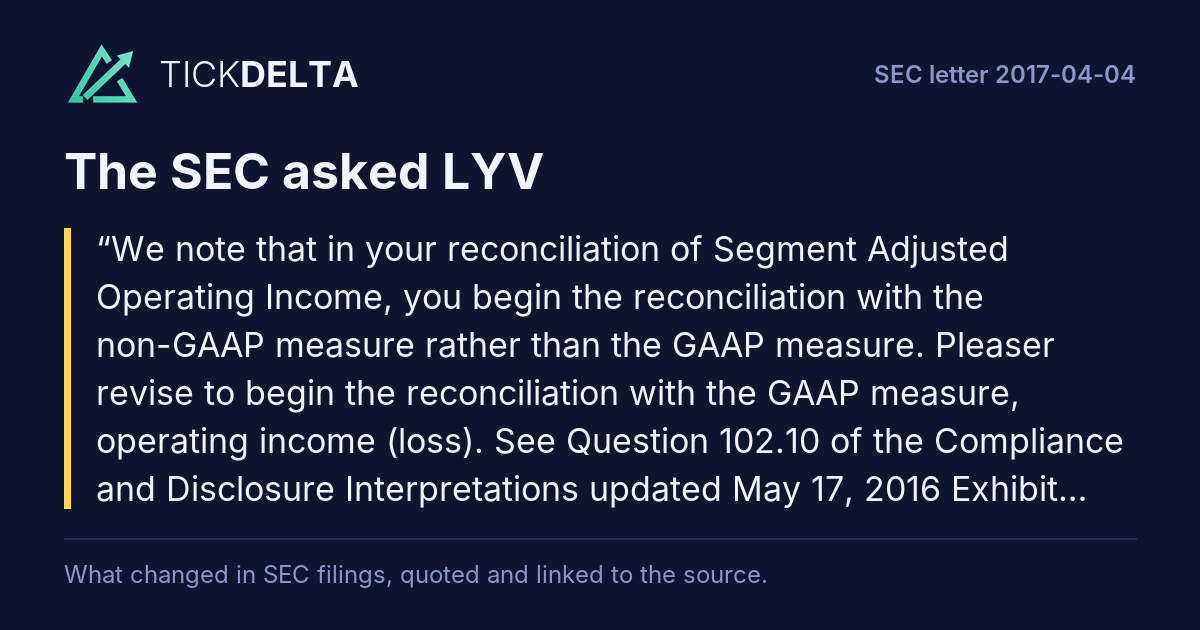
We note that in your reconciliation of Segment Adjusted Operating Income, you begin the reconciliation with the non-GAAP measure rather than the GAAP measure. Pleaser revise to begin the reconciliation with the GAAP measure, operating income (loss).
Rest of the question

See Question 102.10 of the Compliance and Disclosure Interpretations updated May 17, 2016 Exhibit 99.1 Reconciliation of Non-GAAP Measures to their Most Directly Comparable GAAP Measures (Unaudited), page 8

LYV answered
The Company will revise the presentation of this reconciliation in future filings accordingly. Read in the reply ↗
In its next report

First report after the company's reply of 2017-04-18: 10-Q filed 2017-05-04 ↗, against the 10-Q filed 2016-11-07 ↗.

Tickdelta does not hold the text of both reports, so they are not compared here.

Management’s Discussion and Analysis of Financial Condition and Results of Operations · Non-GAAP Measures, page 30
SEC asked (2)
We note from your disclosure on page 8 that you reconcile free cash flow to adjusted operating income (AOI). Given that non-GAAP measures should be reconciled to the most directly comparable GAAP measures, please revise to reconcile free cash flow to the most directly comparable GAAP measure.
Rest of the question

In this regard, we note from your definition of free cash flow and intended uses on page 9, that it appears you use this measure as a liquidity measure, indicating that the most comparable GAAP measure would be cash flow from operating activities. Also, since your definition of free cash flow differs from the typical definition of cash from operating activities as disclosed in the statement of cash flows less capital expenditures, we believe you should retitle this measure. In addition, your revised reconciliation should begin with the GAAP measure and reconcile to the non-GAAP measure. Please revise accordingly.

LYV answered
The Company agrees that given the stated intended uses of its free cash flow metric on page 9, this metric could be deemed to be a liquidity measure, and should therefore be reconciled to its most comparable GAAP liquidity measure. Accordingly, in future filings, the Company will adjust the definition and reconcile this metric to net cash provided by (used in) operating activities, which the Company believes will be the most directly comparable GAAP measure to the newly-defined measure.
Rest of the answer

Such reconciliation will begin with the GAAP measure.

Based on the Company’s research of the practices of other reporting companies, there does not appear to be a single, consistent definition used by companies that utilize free cash flow as a non-GAAP measure. There are many companies that define free cash flow as something other than cash from operating activities less capital expenditures1. Accordingly, the Company respectfully requests

________________________

1 The Staff have acknowledged this in the response to Question 102.07 of the Compliance and Disclosure Interpretations updated May 17, 2016: “However, companies should be aware that this measure [free cash flow] does not have a uniform definition and its title does not describe how it is calculated. Accordingly, a clear description of how this measure is calculated, as well as the necessary reconciliation, should accompany the measure where it is used.” that it be permitted to continue to title this measure (as newly-defined per the preceding paragraph) “free cash flow.” As noted above, whenever it uses free cash flow, the Company will provide a clear description of how it is calculated as well as the necessary reconciliation, thus foreclosing any potential confusion with similarly-titled metrics used by other companies.

Read in the reply ↗
In its next report

First report after the company's reply of 2017-04-18: 10-Q filed 2017-05-04 ↗, against the 10-Q filed 2016-11-07 ↗.

Tickdelta does not hold the text of both reports, so they are not compared here.

Management’s Discussion and Analysis of Financial Condition and Results of Operations · Non-GAAP Measures, page 30
SEC asked (3)
In accordance with Item 10(e)(1)(i)(A) of Regulation S-K, please consider revising to present your GAAP financial statements prior to your reconciliations of non-GAAP measures to avoid giving undue prominence to the non-GAAP data.
LYV answered
The Company acknowledges the Staff’s comment and the need to comply with the equal prominence mandates of Item 10(e)(1)(i)(A) of Regulation S-K (“Item 10(e)(1)(i)(A)”). However, the Company respectfully believes that its placement of reconciliations of non-GAAP measures within its earnings release, the inclusion of which is required by Item 10(e)(1)(i)(B) of Regulation S-K (“Item 10(e)(1)(i)(B)”), complies with both the letter and the spirit of Item 10(e)(1)(i)(A).

We arrive at this conclusion, at least partially, by careful consideration of the implications of the guidance provided by
Rest of the answer

Question 102.10 of the Compliance and Disclosure Interpretations updated May 17, 2016, which contains a non-exhaustive list of examples of disclosure of non-GAAP measures that the Staff would consider as more prominent. We do not believe that any of the examples are analogous to the placement of reconciliations of non-GAAP measures within our earnings release, nor do we think the concerns underlying those examples are present. In addition, as noted in the Company’s response to Comments 1 and 2 above, the Company will be revising the presentation of its reconciliations such that they will begin with the GAAP measure. The Company believes that this change has the added benefit of alleviating some of the Staff’s concerns regarding equal prominence.

The Company believes that, rather than causing an equal prominence issue under Item 10(e)(1)(i)(A), the Company’s placement of its reconciliations of non-GAAP measures serves the interests of its investors by making such reconciliations easily located and close to where the non-GAAP measures are actually “included” in the textual narrative (thus giving rise to the requirement to present the reconciliations), such that the differences between the GAAP and non-GAAP measures can be understood, as contemplated by Item 10(e)(1)(i)(B).

Read in the reply ↗
In its next report

First report after the company's reply of 2017-04-18: 10-Q filed 2017-05-04 ↗, against the 10-Q filed 2016-11-07 ↗.

Tickdelta does not hold the text of both reports, so they are not compared here.

SEC asked
We note your response to prior comment 2. However, since free cash flow is typically calculated as cash flow from operations adjusted by capital expenditures and your definition of free cash flow differs from the typical definition per Question 102.07 of the May 2016 C&DI on non-GAAP measures, we continue to believe you should retitle this measure to adjusted free cash flow or something similar.
Rest of the question

Please appropriately retitle the measure and advise.

LYV answered
The Company acknowledges the Staff’s comment and view that “free cash flow” as used by registrants should be reconciled back to cash provided by operating activities. As noted in our last response, the Company has redefined the definition of its free cash flow and will reconcile it back to cash provided by operating activities going forward. In addition, the Company agrees to retitle its metric as “free cash flow – adjusted” in future filings in order to distinguish it from other similar terms.
Rest of the answer

The Company understands that the Staff expects the non-GAAP measure titled “free cash flow” to only be used to represent ‘cash flow from operating activities adjusted by capital expenditures’ for registrants going forward.

Read in the reply ↗

Also in this review: closing letter, 2017-05-15

Form 10-K

2016-04-28 to 2016-05-26 · 2 questions · 1 letter from the SEC, 2 from the company
Review closed 2016-05-26
Acquisitions
Note 1. The Company and Summary of Significant Accounting Policies · Non-Cash and Stock-based Compensation, page 64
SEC asked (1)
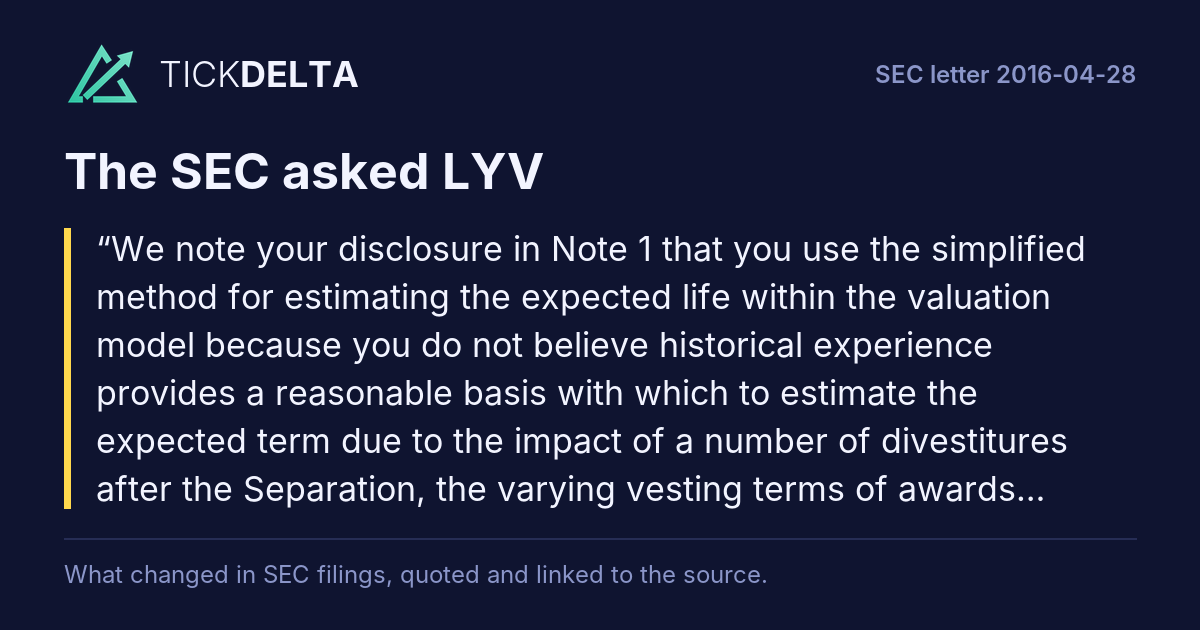
We note your disclosure in Note 1 that you use the simplified method for estimating the expected life within the valuation model because you do not believe historical experience provides a reasonable basis with which to estimate the expected term due to the impact of a number of divestitures after the Separation, the varying vesting terms of awards issued since the Separation and the impact from the type and amount
Rest of the question

of awards converted pursuant to the Company’s merger with Ticketmaster. In light of the fact that the Separation referred to was over ten years ago and the Ticketmaster acquisition was in 2010, please explain to us why you believe it is appropriate to continue using the simplified method in your valuation of stock options.

LYV answered
As noted on page 6 of the Proxy Statement, for a director to be independent, the board of directors must determine, among other things, that the director does not have any direct or indirect material relationship with the Company or any of the Company’s subsidiaries. The Company’s board of directors has established guidelines to assist it in determining director independence, which conform to, or are more exacting than, the independence requirements of the NYSE corporate governance standards.
Rest of the answer

For the Staff’s convenience, attached hereto as Annex A is a copy of the Company’s Director Independence Standards (the “Independence Standards”).

The board reviews information provided by a director candidate and information gathered by management in independent due diligence to make an independence determination upon a director’s initial appointment to the board, and annually thereafter (or more frequently as circumstances warrant). The Company believes that its director independence determinations have all been properly made, and that it has properly included in the Proxy Statement all transactions required to be reported by Item 404(a) of Regulation S-K. Set forth below is a more particular explanation of factors considered for each director and relationship identified by the Staff above, both as it relates to an independence determination and to required disclosures under Item 404(a) of Regulation S-K.

Ari Emanuel: Based on information both provided by Mr. Emanuel and gathered by management, Independence Standards 1, 2, 3, 4, 7 and 8 are met, as there are no facts that would call those standards into question. In examining Independence Standards 5 and 6, the Company did review the fact that the Company has no contractual relationship with WME, but noted that WME has a relationship as a talent agency with some of the artists that the Company enters into contracts with. Mr. Emanuel serves as co-CEO of WME, and also acts as personal agent to a number of high-level motion picture and television actors who do not contract with the Company. As a global concert and event promoter, the Company enters into contracts with a large number of artists for events where these artists perform, both in the musical and comedy genres. The Company contracts directly with the artist or the artist’s touring entity, not the artist’s agent or talent agency. The agent and talent agency are not a third-party beneficiary of these contracts between the artist and the Company. In some instances, the contract with the artist will specify that advances or payments in respect of future performances will be remitted to the artist’s talent agency and then these funds are generally remitted to the artist over time. The Company believes that the agency and/or the artist’s individual agent are paid a commission by the artist on their earnings, but the Company is not involved in those transactions. If an individual agent is part of a larger talent agency, such as WME, the Company believes that the agent and the agency will split the commission in some proportion (after netting out expenses), but again, the Company is not involved in those arrangements.

The Company does not believe that these arrangements, when made with a WME-represented artist, constitute a transaction between the Company and WME, and are rather a personal services contract with the individual artist, and thus outside the purview of both the “material relationship party” test in Independence Standards 5 and 6 and Item 404(a) of Regulation S-K. Nonetheless, the Company has routinely undertaken a deeper analysis of these relationships. In further review by the Company of its artist-relationships, the Company believes that none of the WME-represented musicians or comedians with whom the Company has contracted are personally represented by Mr. Emanuel, and thus Mr. Emanuel would not receive the agent’s portion, if applicable, of any commission paid by the artist.

For purposes of the Independence Standards and Item 404(a) of Regulation S-K, the Company sought to determine whether Mr. Emanuel could be deemed to have a “direct or indirect material interest” in the transactions between the Company and artists represented by other agents at WME, and in doing so reviewed available guidance, including that set forth in the Commission’s “Executive Compensation and Related Person Disclosure” release.1 Apart from his role as an agent to motion picture and television actors, Mr. Emanuel’s role at WME involves high-level company strategy and management. The Company does not believe that Mr. Emanuel had any direct involvement in the procurement, negotiation or execution of productions involving WME-represented artists. Furthermore, the Company does not believe that WME’s portion of the agency’s commission split with the actual agent are material to WME or Mr. Emanuel personally, based on communications the Company has had with WME. These transactions with the artist are part of the basic core business of the Company’s concerts and events operations, and the Company would be entering into them, with substantially the same terms, regardless of whether the artist had a relationship with WME or Mr. Emanuel were employed by WME. At the same time, the Company believes that it would have been able to procure the services of these artists independent of their affiliation with WME due to the Company’s vast experience as a promoter and professional reputation within the industry. Concerts and events with WME-represented

___________________________

1 See Release 33-8732A at pp. 149-150: “The materiality standard for disclosure embodied in Item 404(a) prior to these amendments is retained; a company must disclose based on whether the related person had or will have a direct or indirect material interest in the transaction. The materiality of any interest will continue to be determined on the basis of the significance of the information to investors in light of all the circumstances. As was the case before adoption of amended Item 404(a), the relationship of the related persons to the transaction, and with each other, the importance of the interest to the person having the interest and the amount involved in the transaction are among the factors to be considered in determining the materiality of the information to investors.” artists constitute only a portion of the promotions business done by the Company. Given this, the Company does not believe that information about these transactions is material to investors and does not believe Mr. Emanuel has a direct or indirect material interest in them. Accordingly, the Company believes Mr. Emanuel is an independent director, and there are no reportable transactions under Item 404(a) of Regulation S-K.

The Lollapalooza festival is majority-owned by a Company subsidiary. One of the minority partners in this festival is an entity that the Company believes is partially owned by a number of individuals who are agents or former agents at WME (which has led to some incorrect media reports that WME is itself a minority owner of Lollapalooza), but neither WME nor Mr. Emanuel in fact has an ownership interest in that entity.

Mark Carleton: Based on information both provided by Mr. Carleton and gathered by management, Independence Standards 1-8 are met, as there are no facts that would call those standards into question. Mr. Carleton is an employee of Liberty Media Corporation, which beneficially owns approximately 34.3% of the Company’s outstanding common stock and is party to several governance-related agreements with the Company. These Liberty Media Corporation relationships are included in the Proxy Statement, as required by Item 404(a) of Regulation S-K, under the heading “Certain Relationships and Transactions,” beginning on page 9. Based on information provided by Mr. Carleton and Liberty Media Corporation, Mr. Carleton is not an officer of Liberty Media Corporation within the meaning of Rule 16a-1(f) under the Securities Exchange Act of 1934, as amended, and meets the applicable standards as an independent director. Thus, the Company believes Mr. Carleton is an independent director, and there are no further reportable transactions under Item 404(a) of Regulation S-K.

Jeff Hinson: Based on information both provided by Mr. Hinson and gathered by management, Independence Standards 1, 2, 3, 4, 7 and 8 are met, as there are no facts that would call those standards into question. In examining Independence Standards 5 and 6, the Company did review the nature and dollar amount of transactions between YouPlus Media, where Mr. Hinson serves as President, and the Company’s House of Blues subsidiary. These ordinary-course, arms-length transactions consisted of marketing/promotional work performed by YouPlus Media for the Company’s House of Blues subsidiary and a small number of its local venues. In each of the years 2013, 2014 and 2015 the amount of payments made to YouPlus Media was well below both the “greater of $1 million, or 2% of such other company’s consolidated gross revenues” test for determining a “material relationship party” for purposes of Independence Standards 5 and 6 as well as the $120,000 threshold for reportable transactions under Item 404(a) of Regulation S-K. Thus, the Company believes Mr. Hinson is an independent director, and there are no reportable transactions under Item 404(a) of Regulation S-K.

Mark Shapiro: Based on information both provided by Mr. Shapiro and gathered by management, Independence Standards 1, 2, 3, 4, 7 and 8 are met, as there are no facts that would call those standards into question. In examining Independence Standards 5 and 6, the Company did review the nature and dollar amount of transactions between IMG, where Mr. Shapiro serves as Chief Content Officer of WME-IMG, and the Company. These transactions consisted of (i) ordinary-course ticket sales by the Company’s Ticketmaster subsidiary for a small number of events in Canada where IMG acted as promoter and Ticketmaster remitted to IMG the face value of tickets sold plus a share of fees charged, and (ii) advertising deposits for ticketing resale sponsorships both online and in venue, at two universities represented by IMG where the Company contracts with the universities, not IMG.

In each of the years 2013, 2014 and 2015 the amount of payments made to IMG under both types of transactions (payments made under type (ii) above would be remitted by IMG to its university clients after deducting any commissions retained by IMG, and thus arguably don’t even constitute “transactions” between the Company and IMG) was below the “greater of $1 million, or 2% of such other company’s consolidated gross revenues” test for determining a “material relationship party” for purposes of Independence Standards 5 and 6. For purposes of Item 404(a) of Regulation S-K, the Company sought to determine whether Mr. Shapiro could be deemed to have a “direct or indirect material interest” in these transactions, and in doing so reviewed available guidance, including that set forth in the Commission’s “Executive Compensation and Related Person Disclosure” release (see Footnote 1 above). Mr. Shapiro’s role at IMG involves high-level content, digital and production strategies. Mr. Shapiro had no involvement in the procurement, negotiation or execution of the transactions with the Company. Furthermore, these small, regional transactions are not material to Mr. Shapiro personally, either from the standpoint of measuring his success in his role as Chief Content Officer or from a compensation-related standpoint, based on communications the Company has had with WME/IMG. These ordinary-course, arms-length transactions are part of the basic core business of the Company’s Ticketmaster operations, and the Company would be entering into them on substantially similar terms regardless of whether Mr. Shapiro were employed by IMG. They constitute an extremely minute portion of the business done by Ticketmaster and the Company as a whole. Given these facts, the Company does not believe that information about these transactions is material to investors and does not believe Mr. Shapiro has a direct or indirect material interest in them. Accordingly, the Company believes Mr. Shapiro is an independent director, and that there are no reportable transactions under Item 404(a) of Regulation S-K.

Annex A

Director Independence Standards

A member of the Board will be deemed to be “independent” if the Board affirmatively determines that the director meets each of the following standards:

1. A director must not be, or have been within the last three years, an employee of the Company. In addition, a director’s immediate family member (“immediate family member” is defined to include a person’s spouse, parents, children, siblings, mother and father-in-law, sons and daughters-in-law and anyone (other than domestic employees) who shares such person’s home) must not be, or have been within the last three years, an executive officer of the Company.
Read in the reply ↗
In its next report

First report after the company's reply of 2016-05-09: 10-Q filed 2016-07-28 ↗, against the 10-Q filed 2015-10-29 ↗.

Tickdelta does not hold the text of both reports, so they are not compared here.

Note 2. Long-Lived Assets · Investments in Nonconsolidated Affiliates, page 71
SEC asked (2)
We note your disclosure on page 71 that among other investments, for the year ended December 31, 2015, your 60% investment in Vice Nation, LLC was significant on an individual basis. Please explain to us why you believe it is appropriate to account for this investment using the equity method of accounting, considering your 60% ownership in the entity.
LYV answered

No numbered answer found in the reply. Read the reply ↗

In its next report

First report after the company's reply of 2016-05-09: 10-Q filed 2016-07-28 ↗, against the 10-Q filed 2015-10-29 ↗.

Tickdelta does not hold the text of both reports, so they are not compared here.

Also in this review: company letter, 2016-05-12, closing letter, 2016-05-26

Schedule 14A

2016-04-25 to 2016-04-27 · 7 questions · 2 letters from the SEC, 0 from the company
No closing letter
SEC letter of 2016-04-25 ↗ no reply letter on EDGAR (the company may have answered in an amended filing)
Live Nation Should Not Maintain a Poison Pill…, page 1
SEC asked (1)
Please provide support for the assertions that:
LYV answered

No reply letter found.

 the majority of shareholder resolutions against pills in recent years have received majority support · Severance Pay for Quitting Over Ego or Personal Issues, page 3
SEC asked (2)
We note the statement that the rank-and-file employees of Live Nation would not consider asking for severance payments such as those described. Please provide support for this assertion.
LYV answered

No reply letter found.

 the majority of shareholder resolutions against pills in recent years have received majority support · Severance Pay for Quitting Over Ego or Personal Issues, page 3
SEC asked (3)
We note the statement that “These agreements send the wrong message to the Live Nation workforce.” Please characterize this statement as your belief.
LYV answered

No reply letter found.

Information on Participants, page 4
SEC asked (4)
Please revise the next-to-last sentence in the first paragraph of this section to address the say-on-pay proposal.
LYV answered

No reply letter found.

Form of Proxy
SEC asked (5)
Please clarify that the boxes represent votes “for all,” “against all” and “against all except,” or advise as to the meaning of these votes. Please also clarify that this proposal relates to the company nominees.
LYV answered

No reply letter found.

Form of Proxy
SEC asked (6)
Please revise your proxy statement to specifically direct security holders to the company’s proxy statement for information regarding the company nominees.
LYV answered

No reply letter found.

SEC letter of 2016-04-27 ↗ no reply letter on EDGAR (the company may have answered in an amended filing)
Independence, page 6
SEC asked
Please advise how it was determined that the following directors are independent under NYSE rules and that there are no relationships involving these directors, such as those noted below, that would require disclosure under Item 404(a) of Regulation S-K:  Mr. Ari Emanuel – Relationship between WME Entertainment and Lollapalooza; relationships between the company and WME Entertainment artists, etc.
LYV answered

No reply letter found.

Form 10-K for the Year Ended December 31, 2014

2015-04-07 to 2015-08-31 · 11 questions · 4 letters from the SEC, 4 from the company
Review closed 2015-08-31
Income taxesResults discussion (MD&A)SegmentsGoodwill and impairmentRevenueAcquisitionsKey metrics
Operations · Consolidated Results of Operations, page 30
SEC asked (1)
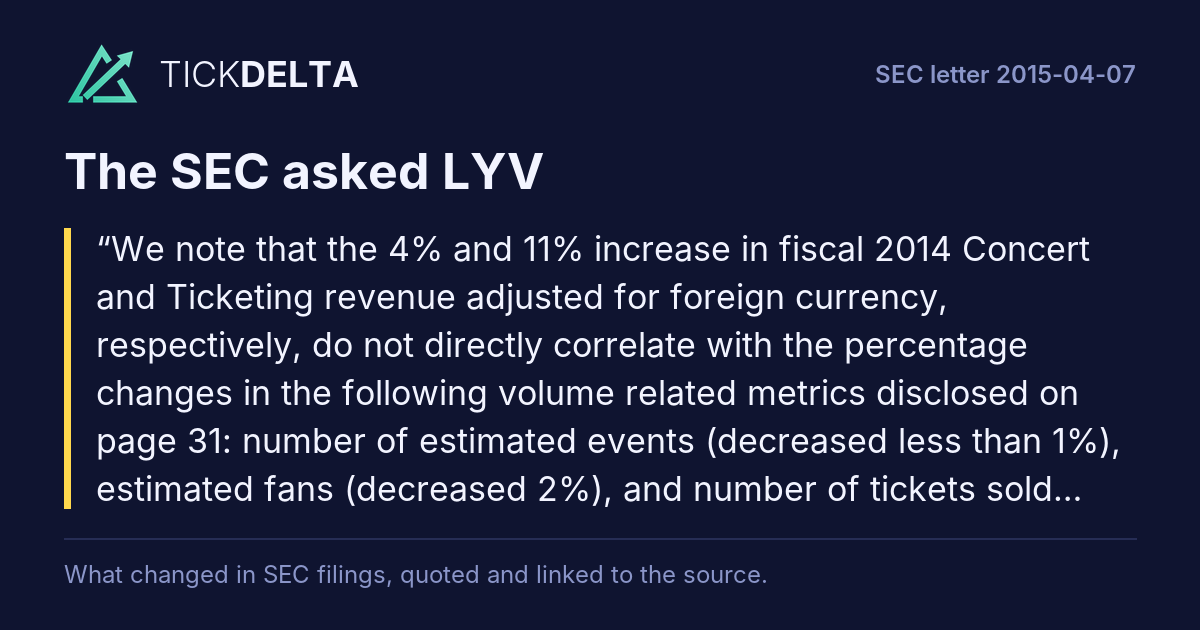
We note that the 4% and 11% increase in fiscal 2014 Concert and Ticketing revenue adjusted for foreign currency, respectively, do not directly correlate with the percentage changes in the following volume related metrics disclosed on page 31: number of estimated events (decreased less than 1%), estimated fans (decreased 2%), and number of tickets sold (increased 3%).
Rest of the question

You disclose on pages 28 and 29 that you analyze several other metrics used to judge the health of these segments. To the extent one or more of these metrics would demonstrate the increase in event pricing and/or fees earned from ticket sales, tell us your consideration to disclose such metrics in the table on page 31 and use them to explain material changes in revenue due to pricing in your results of operations discussion. Please refer to Section III of SEC Release 33-8350.

LYV answered
As noted on pages 28 and 29 of the 2014 Form 10-K, management primarily monitors the number of confirmed events, talent fees, average paid attendance and advance ticket sales to judge the health of our Concerts segment throughout the year and the gross transactional value of tickets sold, number of tickets sold, average convenience charges and order processing fees, number of clients renewed or added and average client royalty rate to judge the health of our Ticketing segment throughout the year.
Rest of the answer

These metrics are monitored and analyzed across various groupings of the business such as geographic region, divisional lines, venue type or sales channel and can be impacted by factors including the mix of venue types and specific artists on tour each year for our Concerts business and the timing of our clients selling tickets to their events, volume of fees on resale tickets sold, as well as the type of ticketed event for our Ticketing business. All of these factors can impact the overall relationship between the disclosed key metrics and the change in reported revenue. In determining which key metrics to disclose in the 2014 Form 10-K, management considered those metrics that most impact the Concerts and Ticketing businesses and have the most direct impact on overall fluctuations in revenue. Management also considered the potential competitive disadvantage that disclosure of one or more of these metrics could have on the Company. Management carefully considered how fluctuations in each of the metrics noted above directly or indirectly impact our results of operations to identify which of these metrics it considered a material or key operating metric to best meet the purpose of management’s discussion and analysis of financial condition and results of operations (“MD&A”) to provide readers of our financial statements with information that is necessary to understand our financial condition, changes in financial condition and results of operations.

For Concerts, management concluded that the key operating metrics to disclose were the number of events and fans based on geographic region and to further supplement the narrative discussion of Concerts’ results of operations with the specific type of venues that drive the variances year over year. While management considers average paid attendance a key operating metric, it was not included in the table on page 31 as it can be calculated using the number of events and fans already provided. During the year, management also monitors the number of confirmed events and advance ticket sales for events that will occur in future periods. These are forward-looking metrics that are primarily used by management to monitor the pacing and timing of events and number of fans against projections. As noted in our MD&A discussion for Concerts, one of the key reasons for the increase in revenue in 2014 was an increase in the number of stadium events in North America which was partially offset by a decline in the number of arena events in our international markets. While the decreases in the number of events and fans for our arena events were greater than the increases in the same metrics for our stadium events, the higher average ticket price that stadium shows command resulted in revenue increasing despite the overall declines in the number of events and fans. The Company believes that its readers generally understand that stadium shows command a higher ticket price and that they would therefore cause a corresponding increase in revenue.

For Ticketing, management has concluded that the key operating metric to disclose was the number of primary tickets sold on a consolidated basis and to further supplement the narrative discussion of Ticketing’s results of operations with the specific type of client events driving the volume and pricing variances year over year along with other factors, such as fees from secondary ticket sales. In previous year filings, the Company also reported the gross transaction value of primary tickets sold, but elected not to report that metric in the 2014 Form 10-K as it was believed to be potentially confusing to the readers of the financial statements since the gross transaction value is not reflected in the Company’s reported revenue. Management elected not to disclose metric information related to convenience charges and order processing fees or client royalty rates as management believes disclosure of this information could cause us competitive harm and that it does not significantly impact an investor’s understanding of the Company’s financial condition and results of operations. Management also elected not to report the net client renewal rate as this metric is forward-looking and does not have a direct correlation to increases or decreases in historical results of operations of the current period. In the narrative discussion of Ticketing results of operations on page 36, management did highlight that increases in fees for primary and secondary ticket sales were driving the increase in revenue along with the increases in primary ticket sales volume. The increased revenue for our secondary business, driven by our new TM+ resale product, was the primary reason the overall increase in our Ticketing segment’s revenue was larger than the increase in the number of primary tickets sold. Increases in revenue for fees from secondary ticket sales is impacted more by the gross transaction value of the tickets sold than a metric of number of secondary tickets sold since the tickets being resold are typically tickets in high demand allowing the individual ticket reseller to set a higher resale price. The improvements in our secondary ticketing business were also highlighted in our Executive Overview on page 28 where it mentions a 55% increase in gross transaction value of secondary tickets sold. As disclosed on page 31 of the 2014 Form 10-K, secondary tickets sold are not included in our operating metrics and therefore the Company believes that readers will understand that related increases in secondary volume will drive separate increases in revenue.

Management believes the current level of disclosure provides the readers of our financial statements with a foundation that supports an understanding of the businesses and the related impacts of material changes occurring during the periods discussed. Based on discussions with investors in the Company, management believes that disclosing more metrics would not lead to a better understanding of the business and that the metrics disclosed are the most useful for the readers of our financial statements.

Read in the reply ↗
In its next report

First report after the company's reply of 2015-04-21: 10-Q filed 2015-04-30 ↗, against the 10-Q filed 2014-10-30 ↗.

Tickdelta does not hold the text of both reports, so they are not compared here.

Operations · Consolidated Results of Operations, page 30
SEC asked (2)
We note from your disclosure in Note 9 that there is a significant reconciling item in the effective income tax reconciliation due to differences between foreign and United States statutory rates, which are primarily attributable to your Luxembourg holding company structure and tax rulings received from Luxembourg tax authorities.
Rest of the question

Please tell us the nature of the items included in the reconciling line item titled “differences between foreign and U.S. statutory rates.” Also, please provide us with the pre -tax income, statutory rate, and effective tax rate in Luxembourg for all periods presented. Additionally, please tell us nature of the factors that are driving the changes in this line item from year to year, including the nature of any significant tax rulings.

LYV answered
Live Nation has operating entities in many foreign jurisdictions in addition to its operations in the United States (“U.S.”). In each of the years presented, the Company incurred losses in the U.S. and earned profits in certain international jurisdictions. In order to arrive at the Company’s statutory tax expense, the statutory rate (or effective rate if different) of each jurisdiction is applied to the financial statement pre-tax income or loss of the legal entity (excluding permanent nondeductible differences) to determine the statutory tax expense or benefit.
Rest of the answer

The total statutory tax expense or benefit is then reconciled to the expense or benefit computed “as if” the worldwide pretax income were taxed at the U.S. statutory tax rate of 35% with the difference between these calculations reflected as the “differences between foreign and U.S. statutory rates”.

There are three main factors that can impact this “differences between foreign and U.S. statutory rates” reconciling item year over year: (i) changes in the foreign statutory rates (which are generally immaterial from year to year for the Company); (ii) the amount of foreign source income from international operations (the Company had less foreign income in 2014 than in prior periods resulting in a smaller difference between foreign and U.S. statutory rates in the rate reconciliation schedule as compared to the prior years); and (iii) the impact of income in Luxembourg and the effect of the Luxembourg effective tax rate calculated in accordance with tax rulings that the Company has received from Luxembourg.

The Company’s pre-tax income in Luxembourg was $32.6 million, $50.2 million and $59.0 million in the years ended December 31, 2014, 2013 and 2012, respectively. The statutory tax rate was 29% in 2014 and 2013 and 28% in 2012. The effective tax rate was 0.16%, 0.93% and 0.55% in 2014, 2013 and 2012, respectively. The Luxembourg territorial tax system does not impose tax on offshore income and the Company’s rulings from the Luxembourg tax authorities provide that certain portions of its income are treated as offshore and are not subject to Luxembourg statutory tax. The rulings also approved the deductibility of interest for certain debt instruments. In 2014, the difference between application of the effective tax rate and the statutory tax rate to Luxembourg pre-tax income is approximately $9 million.

The total “differences between foreign and U.S. statutory rates” was a negative $10.7 million in 2014 compared to a negative $21.2 million in 2013. This decrease of $10.5 million from 2013 was driven by a reduction in foreign source income (impact of $4.7 million) and a decrease in Luxembourg pre-tax income (impact of $5.8 million).

Read in the reply ↗
In its next report

First report after the company's reply of 2015-04-21: 10-Q filed 2015-04-30 ↗, against the 10-Q filed 2014-10-30 ↗.

Tickdelta does not hold the text of both reports, so they are not compared here.

Notes to the Financial Statements · Note 2. Long-Lived Assets, page 67
SEC asked (3)
We note from your disclosure on page 79 that you recorded goodwill impairment charges of $117 million in fiscal 2014 within the International Concert reporting unit. Please provide us with your analysis as to why no impairment was recorded for indefinite-live or definite-lived intangible assets within the Concert reporting segment pursuant to ASC 350-30-35.
Rest of the question

In your response, please identify the amount and type of indefinite and indefinite-lived intangible assets related to the International Concert report ing unit.

LYV answered
As of December 31, 2014, the Company’s International Concerts reporting unit had the following types of indefinite and definite-lived intangible assets:

($ millions)

Client/Vendor relationships

26.1

Trademark and naming rights

4.9

Venue management and leaseholds

13.8

Revenue-generating contracts

71.7

Indefinite-lived trademarks

3.5

As stated in the 2014 Form 10-K, the Company tests for possible impairment of definite-lived intangible assets whenever events or circumstances adversely change.
Rest of the answer

The Company is not required to test definite-lived intangibles for impairment if no indicators of impairment exist as they are continuing to amortize. Additionally, the Company tests for possible impairment of indefinite-lived intangible assets at least annually. These reviews are performed considering ASC 350 impairment indicators, other qualitative factors, historical results and undiscounted future cash flows that pertain to the specific individual intangible assets under review.

Conversely, the Company tests each reporting unit’s goodwill at least annually for impairment considering its combined and discounted cash flows as well as overall qualitative factors.

During 2014, the Company did record impairments of certain of its intangibles including a $1.8 million impairment of one of its International Concerts’ definite-lived intangibles related to a specific festival. Please note that the disclosure in the Company’s 2014 Form 10-K reports the primary contributors to its 2014 total intangible impairments of $11.1 million, of which this was the smallest contributor and thus not specifically discussed.

As part of the Company’s consideration of impairment indicators of its definite-lived intangibles within the International Concerts reporting unit, the Company did not experience any operating or undiscounted cash flow losses in 2014, nor did it expect either of these to occur in the future, and did not identify the existence of other impairment indicators for those definite-lived intangible assets when reviewed on a stand-alone basis. Additionally, the Company did not note unfavorable financial performance, or other unfavorable qualitative factors, associated with the International Concerts reporting unit’s indefinite-lived trademark asset. Finally, a comparison of the fair values of the International Concerts reporting unit’s intangibles, developed as part of the goodwill impairment calculation, to their book values did not identify any impairment indicators. Management also considered qualitatively that these conclusions are appropriate as much of the recent underperformance in this reporting unit’s financial results is due to the promotion of certain concerts or start-up festivals which were not acquired and, therefore, are not associated with recorded intangibles. Additionally, the impact of discounting the cash flows used in the goodwill test has a significant impact on those cash flows and the results of the related impairment tests.

Read in the reply ↗
In its next report

First report after the company's reply of 2015-04-21: 10-Q filed 2015-04-30 ↗, against the 10-Q filed 2014-10-30 ↗.

Tickdelta does not hold the text of both reports, so they are not compared here.

Note 9. Income Taxes, page 83
SEC asked (4)
We note your disclosure that during 2014 you recorded an income tax benefit of $12.9 million from the release of valuation allowances related to deferred tax liabilities associated with certain acquisitions. In light of the continuing losses incurred by the company, please explain to us why you believe that this release of the valuation allowance is appropriate in 2014.
LYV answered
The Company made certain acquisitions in the U.S. during 2014 and, as part of purchase accounting, the acquired entities recorded a step-up to the financial basis of the assets held at acquisition. However, no tax elections were made to obtain a corresponding increase to the tax basis of these assets.

Since the financial basis of the assets of the acquired companies was higher than the tax basis, the Company recorded a deferred tax liability for the difference, in accordance with ASC 740-30.

Because the Company does not have a history of earnings in the U.S., there is a full valuation
Rest of the answer

allowance against the net deferred tax assets. The recording of net deferred tax liabilities resulting from these 2014 acquisitions increased the future reversals of existing taxable temporary differences that the Company could look to in determining the amount of the valuation allowance required. As a result, the Company released a portion of its valuation allowance.

Read in the reply ↗
In its next report

First report after the company's reply of 2015-04-21: 10-Q filed 2015-04-30 ↗, against the 10-Q filed 2014-10-30 ↗.

Tickdelta does not hold the text of both reports, so they are not compared here.

Note 9. Income Taxes, page 83
SEC asked (5)
In your reconciliation of income tax on page 85, your reconciling item labeled “Other, net” represented a 35% increase to the income tax benefit at United States federal statutory rates for fiscal 2014. Please tell us the nature of amounts included in this line item for the fiscal years presented.
Rest of the question

To the extent any individual reconciling items within this caption are greater than five percent, please revise to disclose them pursuant to Rule 4-08(h)(2) of Regulation S-X.

LYV answered
The amount of “Other, net” in 2014 is a negative adjustment of $12.4 million. Rule 4-08(h)(2) of Regulation S-X requires the disclosure of reconciling items in the effective tax rate that are individually equal to or greater than 5% of the statutory tax expense (the amount computed by multiplying the income before tax by the applicable statutory federal income tax rate).
Rest of the answer

While most items were individually below the 5% threshold, there were two that were individually greater than 5% that were included in this line item.

The first was an adjustment for noncontrolling interests in consolidated entities of $3.5 million representing taxes that are the responsibility of the noncontrolling interest holders. The second item was an accumulation of tax return to provision benefits that totaled $7.2 million recognized in 2014 in conjunction with the filing of certain tax returns. The tax benefit for these items was aggregated so that the rate reconciliation presented the major items considered most relevant to an investor’s assessment of the Company’s effective tax rate. In future filings, the Company will disclose all items in excess of 5% of the statutory rate on a separate line in the reconciliation of income tax table.

Read in the reply ↗
In its next report

First report after the company's reply of 2015-04-21: 10-Q filed 2015-04-30 ↗, against the 10-Q filed 2014-10-30 ↗.

Tickdelta does not hold the text of both reports, so they are not compared here.

Operations · Consolidated Results of Operations, page 30
SEC asked (1)
We note from your response to our prior comment 1 that in determining which key metrics to disclose in the 2014 10-K, management considered those metrics that most impact the Concerts and Ticketing businesses and have the most direct impact on overall fluctuations in revenue.
Rest of the question

However, in light of the fact that it appears different venues have different impacts on revenue in the Concerts segment, we would expect to see metrics that reflect the differences in these venues (e.g. stadium events vs. arena events). Also, we note that that operating metrics relating to secondary ticket sales are not included in your Form 10-K. In light of the fact that it appears the increased revenue from your secondary ticket sales business had a significant effect on revenue in the Ticketing segment for 2014, please consider including metrics related to these sales (such as secondary ticket volume) in your MD&A discussion. Please revise accordingly.

LYV answered
The Company appreciates the Staff’s view regarding the potential to add Concerts segment venue metrics and Ticketing segment secondary metrics. However, the Company respectfully continues to believe that these metrics do not require disclosure because they do not meet both criteria of being (1) used by management and (2) material to investors.

As it relates to the Concerts segment, the number of events by venue type would generally fall into these categories: stadiums, arenas, amphitheaters, theaters and clubs, festivals and other.
Rest of the answer

The Company believes disclosure of these venue specific metrics would not be material to investors, and potentially could even be misleading, for the following reasons:

•

Providing the number of events by venue type would not provide information to the reader that is more useful to them then the narrative provided in MD&A already. As the Company does not present revenue based on venue type in accordance with Regulation S-X, the reader would not be able to determine if the changes in the number of individual venue type events is affecting similar changes in its revenue stream, and indeed may misinterpret such information by assuming precisely that correlation. The Company therefore continues to believe that it is more helpful to provide narrative on what the additional drivers are outside of the change in total fans and total events.

Changes in Concerts segment revenue do not necessarily follow any trend in venue-type event increases and decreases, therefore making it less corroborative, and less predictive, for the reader. This is, in part, because of the impacts to revenue from factors such as attendance, ticket prices and ancillary revenue streams (e.g., concessions and merchandise). In addition, revenue by venue type and revenue by specific show by venue type can vary greatly so that the increase or decrease in events by venue type do not necessarily drive consistent changes in revenue. Again, providing events by venue type could therefore present a distorted picture for the reader.

With this many categories of venue types, the Company believes the level of data provided would make it difficult for a reader to discern what is important to consider most relevant.

Management does believe, however, that venue type discussion can be useful to provide more detail when discussing revenue within the MD&A section of its filings, and proposes to continue to provide such narrative discussion as we have in the past.

As it relates to the Ticketing segment, the Company believes disclosure of secondary ticket sales would not be material to investors at this point for the following reasons:

The revenue generated from secondary ticket sales is less than 3% of total revenue and is, therefore, not a material source of the Company’s revenue. While not inconsequential to the Ticketing segment, it is currently still not a significant portion of the segment revenue.

The number of secondary tickets sold is less than 4% of total fee-bearing tickets sold.

Management discusses secondary ticket sales in the 2014 Form 10-K MD&A because the Company launched a new product in September of 2013 in order to drive secondary ticket sales and, as a result, this secondary revenue stream has increased as compared to 2013. Further, success in the secondary market is a key part of our growth strategy and complements our primary ticketing business, so felt it was a relevant part of the MD&A discussion. As this business grows in the future and becomes larger and more meaningful to total revenue, the Company will continue to evaluate the metrics disclosed in order to best inform the reader of the Company’s results and operations.

Read in the reply ↗
In its next report

First report after the company's reply of 2015-05-27: 10-Q filed 2015-08-10 ↗, against the 10-Q filed 2014-10-30 ↗.

Tickdelta does not hold the text of both reports, so they are not compared here.

Operations · Consolidated Results of Operations, page 30
SEC asked (2)
We note your response to our prior comment 2 and continue to have further questions regarding your income tax disclosure. Please provide us the following information:  Provide us your pre-tax income/loss, statutory tax rate, and tax expense/benefit by jurisdiction;  For each jurisdiction where the tax expense/benefit differs from the pre-tax income/loss multiplied by the statutory rate, please explain to us the
Rest of the question

nature of the differences;  Please explain to us how the $10,735 reconciling item titled “differences between foreign and United States statutory rates” was calculated or determined; and  Explain to us why your provision for income taxes includes foreign tax expense (rather than a tax benefit) considering you had a net foreign loss before taxes of $83.6 million.

LYV answered
The following table illustrates the Company’s pre-tax income, statutory tax rate, tax expense or tax benefit determined by applying the statutory tax rate and actual tax expense by jurisdiction for the year ended December 31, 2014.

Note: The Company has requested confidential treatment of portions of this response (indicated by [***]) in accordance with 17 C.F.R.
Rest of the answer

§ 200.83.

Table is in USD ($ in millions)

Country

Pre-tax Income/(Loss)

Statutory Tax Rate

Hypothetical Income Tax Expense/(Benefit) at Statutory Rate

Tax Expense/(Benefit) After Adjustment

Variance

Reasons (see below)

United States

[***]

35%

2,3,4,5,6

United Kingdom

21%

1,3,4,5

Luxembourg

29%

Netherlands

25%

2,3,4

France

34%

3,4,5

Canada

26%

2,3,4,5

Spain

30%

Germany

33%

4,5

Norway

27%

Finland

20%

Poland

19%

Hong Kong

17%

Belgium

Ireland

13%

Denmark

Turkey

New Zealand

28%

Australia

Italy

31%

Total

The table above includes the detail by jurisdiction for all countries with more than $1 million in pre-tax income/expense; all others net to zero

As illustrated in the table above, the actual tax expense/(benefit) in many jurisdictions differs from tax expense/(benefit) determined at the statutory rate. These differences are due to several items that vary by jurisdiction, but can be summarized as follows:

1. The Company had two items that were treated as tax rate adjustments in 2014 with a total benefit of approximately $25 million. These items were:

a.

In Luxembourg, the actual statutory rate that we are subject to is different than the published statutory rate due to tax rulings received;

b.

The Company impaired goodwill in 2014 within the International Concerts reporting unit for US GAAP purposes. This amount is not deductible for tax purposes.

2. There are amounts attributable to the exclusion or inclusion of certain financial statement items that are not taxable or deductible for tax and also amounts that must be included in income or expense for tax purposes but not for financial statement purposes. These amounts were approximately $3 million in 2014.

Read in the reply ↗
In its next report

First report after the company's reply of 2015-05-27: 10-Q filed 2015-08-10 ↗, against the 10-Q filed 2014-10-30 ↗.

Tickdelta does not hold the text of both reports, so they are not compared here.

Operations · Consolidated Results of Operations, page 30
SEC asked (1)
We note from your response to our prior comment 2 that the table illustrating the reconciling item titled “Differences between foreign and United States statutory rates” includes adjustments for goodwill impairment and Luxembourg ruling benefit, which result in an additional $25 million benefit.  Please explain to us how you calculated or determined this $25 million benefit.
Rest of the question

In this regard, please tell us the tax-effected amount associated with the non-deductible goodwill impairment of $117 million.  In light of the fact that your response indicates that the goodwill impairment is not deductible for tax purposes (implying additional tax expense), please explain to us why it appears from your response that this goodwill impairment plus the Luxembourg tax benefit, results in an increase to the tax benefit.  We note from Note 9 that the reconciliation of income tax computed at the US federal statutory rates to income tax expense includes a separate line item titled “Nondeductible items”, which is disclosed as primarily relating to the 2014 goodwill impairment that is not deductible for tax purposes. Please clarify for us whether the tax effects of this 2014 goodwill impairment is included in both the $55 million reconciling item titled “Nondeductible items” and the $10.7 million reconciling item titled “Differences between foreign and US statutory rates.” If the 2014 goodwill impairment is not included in the line “Nondeductible items,” please tell us the reasons for the significant increase in this line.

LYV answered
The table included in the Company’s prior response that the Staff refers to reconciles its reported foreign pre-tax loss at U.S. statutory rates to the loss at foreign statutory rates, adjusted for two items in order to reconcile to the reported amount on the rate reconciliation table in the 2014 Form 10-K. The two items are as follows:

The $10 million rate benefit in Luxembourg relates to certain tax rulings and enacted tax laws which reduced the Luxembourg tax expense, resulting in a net provision of less than $1 million during the year ended December 31, 2014.
Rest of the answer

The Company has included this benefit in calculating the “Differences between foreign and United States statutory rates”. These tax rulings are further discussed in the response to Comment 2 below.

The $15 million adjustment removes the impacts of the tax rate differences between the goodwill impairment of $117 million taxed at the U.S. statutory rate of 35% ($41 million) and the goodwill impairment taxed at the respective jurisdictional rates ($26 million). The adjustment was to add this back for purposes of the reconciliation as the entire $41 million was included in the "Nondeductible items."

The goodwill impairment is nondeductible; therefore, included in the “Nondeductible items” is a calculated tax expense of $41 million (representing the $117 million impairment at the 35% U. S. statutory rate). This is included in the reconciliation as a tax benefit is calculated on the 2014 goodwill impairment in the first line of the tax rate reconciliation in the footnote (“Income tax benefit at United States statutory rates”). The Company excluded the pre-tax impacts of the goodwill impairment in determining the “Differences between foreign and U.S. statutory rates.” No income tax benefit was recognized on the goodwill impairment recorded in 2014.

Read in the reply ↗
In its next report

First report after the company's reply of 2015-06-30: 10-Q filed 2015-08-10 ↗, against the 10-Q filed 2014-10-30 ↗.

Tickdelta does not hold the text of both reports, so they are not compared here.

Operations · Consolidated Results of Operations, page 30
SEC asked (2)
We note from your response to our prior comment 2 that part of the tax rate adjustments in 2014, which contributed to the tax benefit, was an actual statutory tax rate in Luxembourg that is different than the published statutory rate due to tax rulings received. Please tell us the nature of the tax rulings and any risks and uncertainties associated with those tax rulings, including expiration dates.
LYV answered
The Luxembourg companies have obtained rulings from the Luxembourg tax authorities during the period of November 2008 to July 2014 confirming the Company’s tax positions under the current tax rules in Luxembourg. These rulings related to income earned by certain of the entities and the deductibility of intercompany interest expense.
Rest of the answer

The rulings received provided certainty for the Company’s tax filing positions.

The existing rulings continue in effect indefinitely, absent a change in law or practice, since the tax implications secured are consistent with the tax positions currently accepted by the Luxembourg tax authorities. As the Company has complied with the parameters of the rulings, it does not consider the rulings to include any significant risk or uncertainties. The Company will continue to assess any statutory developments, and evaluate whether additional disclosure in management’s discussion and analysis related to changes or new potential risks is required in future filings.

Read in the reply ↗
In its next report

First report after the company's reply of 2015-06-30: 10-Q filed 2015-08-10 ↗, against the 10-Q filed 2014-10-30 ↗.

Tickdelta does not hold the text of both reports, so they are not compared here.

Operations · Consolidated Results of Operations, page 30
SEC asked (3)
We note from your response to our prior comment 2 that one reason for the variance between the hypothetical tax expense and the actual tax expense is the exclusion or inclusion of certain items (reason 2).  Please tell us how reason 2 differs from “Non-deductible items” in your income tax rate reconciliation. It appears that both reflect book financial statement expenses that are not deductible for tax purposes.
Rest of the question

 It appears that reason 2 corresponds to the line “Non-United States income inclusions and exclusions” in your income tax rate reconciliation in note 9. However, from your response, it appears that reason 2 applies to both U.S. and non-U.S. jurisdictions. Please confirm our understanding.

LYV answered
The amounts included in the line “Nondeductible items” are amounts that are disallowed by tax law. The items in “reason 2” include amounts that are not deductible by the Company due to other factors even though they are allowed by tax law. In 2014, this primarily included foreign withholding taxes that were not deducted because of insufficient income to offset these taxes in the relevant foreign jurisdictions. This deduction can be carried forward to a future period when the entity incurring the withholding tax has adequate income to absorb the deduction.
Rest of the answer

Another smaller item included in “reason 2” was dividends paid to foreign countries that were not taxable in the foreign jurisdiction.

“Reason 2” corresponds to the “Non-United States income inclusions and exclusions” in Note 9 of the 2014 Form 10-K, except for the immaterial ($0.6 million) U. S. items.

Read in the reply ↗
In its next report

First report after the company's reply of 2015-06-30: 10-Q filed 2015-08-10 ↗, against the 10-Q filed 2014-10-30 ↗.

Tickdelta does not hold the text of both reports, so they are not compared here.

Note 9. Income Taxes, page 83
SEC asked
We note your response to our prior comments and have no further questions related to how you calculated the reconciling items in your income tax rate reconciliation. However, please tell us your consideration of disclosing the following information to further clarify the difference between income tax computed at the United States federal statutory rate and income tax computed at the effective tax rate:  The
Rest of the question

concentration of pre-tax income in Luxembourg, as well as the foreign statutory rate and foreign effective tax rate in Luxembourg;  The nondeductible goodwill impairment charge was recorded in the United Kingdom, and;  The nature of “Non-United States income inclusions and exclusions” in periods where this adjustment is material.

LYV answered
Dated August 6, 2015

File No. 001-32601

Ms. Raminpour and Ms. Erlanger:

Set forth below is the response of Live Nation Entertainment, Inc. (“Live Nation” or the “Company”) to the comments of the staff of the Securities and Exchange Commission (the “Staff”) contained in your letter dated July 31, 2015 with respect to the Company’s Form 10-K for the year ended December 31, 2014 (the “2014 Form 10-K”).
Rest of the answer

For your convenience, the comments provided by the Staff have been included herein together with Live Nation’s responses.

The Company acknowledges the following:

●

Live Nation is responsible for the adequacy and accuracy of the disclosure in the 2014 Form 10-K;

Staff comments or changes to disclosure in response to Staff comments do not foreclose the Commission from taking any action with respect to the 2014 Form 10-K; and

Live Nation may not assert Staff comments as a defense in any proceeding initiated by the Commission or any person under the federal securities laws of the United States.

The Company hopes that this letter is helpful and responsive to your requests. If you have any questions or comments to these responses, please do not hesitate to contact me directly at (713) 693-2626.

Read in the reply ↗
In its next report

First report after the company's reply of 2015-08-10: 10-Q filed 2015-10-29 ↗, against the 10-Q filed 2014-10-30 ↗.

Tickdelta does not hold the text of both reports, so they are not compared here.

Also in this review: closing letter, 2015-08-31

Schedule TO-I

2014-06-20 to 2014-07-07 · 3 questions · 2 letters from the SEC, 1 from the company
No closing letter
Offer to Purchase
SEC asked (1)
Disclosure indicates that through at least July 29, 2014, holders may convert their Securities into cash consideration. Please advise how this is consistent with Exchange Act Rules 13e-4(f)(6) and 14e-5.
LYV answered
Based on discussions with the Staff, the Company intends to deliver a notice of redemption no sooner than July 30,

2014 (the 11th business day after the termination/expiration of the Offer to Purchase1) with a redemption date no sooner than 30 days thereafter. The Company will file an amendment to the Schedule

TO-I reflecting these revised plans.
Rest of the answer

Therefore, the Offer to Purchase, the purchases pursuant to the redemption, conversions of the Securities, if any, which will be permitted under

As described in the Schedule TO-I, the Offer to Purchase expires at 5:00 p.m., New York City time, on Tuesday, July 15, 2014.

the Indenture from the date of the notice of redemption until the close of business on the business day immediately preceding the redemption date, and the Company’s ability to settle such conversions in cash will be consistent with Rules 13e-4(f)(6) and 14e-5 under the Securities Exchange Act of 1934 (as amended, the “Exchange Act”).

Read in the reply ↗
Offer to Purchase
SEC asked (2)
Please advise why the right to convert the Securities is not a tender offer subject to Exchange Act Regulation 14E and Rule 13e-4. Please address in your response the fact that the Company may pay cash consideration for any converted Securities, the Securities appear to be convertible only during the period beginning on or after June 20, 2014 (the date that the Company issues a notice of redemption) and ending July
Rest of the question

29, 2014 and that the Company may choose to redeem the Notes on or after July 30, 2014.

LYV answered
The term “tender offer” is not defined in the

Exchange Act. However, based on conversations with the Staff and our understanding of its views and thus assuming that a redemption by the Company coupled with the concomitant right to convert (which we think must be viewed together, as it is the issuance of the redemption notice2 which even arguably presents some of the factors associated with a tender offer), we note that the courts and the Staff generally look to eight factors, first outlined in 1979 in Wellman v. Dickinson, to identify a tender offer. See Wellman v. Dickinson, 475 F. Supp.
Rest of the answer

783 (S.D.N.Y. 1979). The eight factors, as described in Hanson Trust PLC v. SCM Corp., are:

“1. active and widespread solicitation of public shareholders for the shares of an issuer;

2. solicitation made for a substantial percentage of the issuer’s stock;

Read in the reply ↗
SEC letter of 2014-07-07 ↗ no reply letter on EDGAR
SEC asked
We disagree with your analysis in response to prior comment 2. Absent a material change in facts, we continue to believe that the right to convert the Securities for cash may be a tender offer subject to Rule 13e-4 and Regulation 14E.
LYV answered

No reply letter found.

Form 10-K for the Year Ended December 31, 2013

2014-05-29 to 2014-06-23 · 8 questions · 1 letter from the SEC, 1 from the company
Review closed 2014-06-23
Results discussion (MD&A)SegmentsGoodwill and impairmentCritical estimates
Ticketing Results of Operations, page 48 · Year Ended 2013 Compared to Year Ended 2012, page 48
SEC asked (1)
We note your disclosure indicating that depreciation expense was higher in 2013 due to higher amortization of non-recoupable contract advances in the Ticketing segment. We also note from your disclosure in Note 1 that this amortization expense was $73.6 million in 2013 compared to $43.1 million in 2012.
Rest of the question

Please explain to us and in MD&A why you had such a significant increase in the amortization of non-recoupable contract advances during 2013.

LYV answered
Depreciation and amortization related to the Ticketing segment increased by $25.5 million in 2013 ($73.6 million versus $48.1 million) as a result of higher amortization from non-recoupable ticketing contract advances. The higher amortization from these advances resulted from an increase in the amount of large nonrecoupable advances paid.
Rest of the answer

2013 was a year impacted by the renewal of a number of more significant contracts that had expired as well as the continued addition of new contracts requiring advances as negotiated in the normal course of business, and which are amortized over the life of the contracts. The Company agrees that providing additional discussion in its filings for an increase in amortization of this amount could be useful to investors and will do so in future filings.

Read in the reply ↗
In its next report

First report after the company's reply of 2014-06-12: 10-Q filed 2014-07-31 ↗, against the 10-Q filed 2014-05-06 ↗.

Tickdelta does not hold the text of both reports, so they are not compared here.

Critical Accounting Policies and Estimates, page 60 · Goodwill, page 64
SEC asked (2)
We note that in a letter to the staff dated April 19, 2013, in response to our prior comment 3, you agreed to expand your discussion in Critical Accounting Policies and Estimates – Goodwill and Note 1 – The Company and Summary of Significant Accounting Policies – Goodwill to discuss the ranges of key inputs used and the related sensitivity analysis used in your impairment analysis of goodwill.
Rest of the question

However, it does not appear that your discussion in Critical Accounting Policies and Estimates has been revised to include this additional disclosure. Please revise your discussion in the Critical Accounting Policies section of MD&A to include the disclosures that you previously agreed to provide.

LYV answered
The Company did previously agree to provide this disclosure in the Critical Accounting Policies and Estimates section of its Management’s Discussion and Analysis. Subsequently, however, in an effort to reduce redundancy within its filings and pursuant to Section V of Securities Act Rel. No. 33-8350 which requires, if applicable, discussion that supplements, but does not duplicate, the discussion in the footnotes, the Company decided to not include the discussion in this section of its Management’s Discussion and Analysis.
Rest of the answer

However, the Company recognizes that it did agree to do so, and given the forward-looking perspective of this section of its filings and the potential usefulness of this disclosure toward that end, the Company will include it in future filings.

Read in the reply ↗
In its next report

First report after the company's reply of 2014-06-12: 10-Q filed 2014-07-31 ↗, against the 10-Q filed 2014-05-06 ↗.

Tickdelta does not hold the text of both reports, so they are not compared here.

Note 1. The Company and Summary of Significant Accounting Policies, page72 · Advertising Expense, page 76
SEC asked (3)
We note your disclosure that you record advertising expense in the year that it is incurred. Throughout the year, general advertising expenses are recognized as they are incurred but event-related advertising for concerts is recognized once the show occurs. However, all advertising costs incurred during the year and not previously recognized are expensed at the end of the year.
Rest of the question

Please explain to us how this policy is in compliance with the guidance outlined in ASC 720-35-25. It appears that your policy expenses the appropriate amount within the applicable fiscal year, however it may result in inappropriate amounts recorded for purposes of quarterly financial reporting. Please advise or revise accordingly.

LYV answered
We believe that ASC 720-35-15-3(b) indicates that the guidance in ASC 720-35 further refers entities to the guidance in ASC 270 Interim Reporting. ASC 270-10-45-9(d) stipulates that advertising costs may be deferred within a fiscal year if the benefits of an expenditure clearly extend beyond the interim period in which the expenditure is made. Live Nation’s event-related advertising for its concerts is one of the primary ways in which the Company communicates to the general public when tickets for a future event are going on sale, the date of the concert and how a ticket can be purchased.
Rest of the answer

The advertising campaign regarding the on-sale date and continued advertising of the upcoming event can, and often does, begin in a different quarter than the quarter in which the event takes place, as advanced advertising is critical to the success of a majority of events. Ticket sales occur from the on-sale date through the date of the event. While Live Nation does not believe it has sufficient evidence to link individual ticket sales to specific advertising campaigns, as there are other methods through which the general public also becomes aware of upcoming events, the Company does believe that the benefits of its advertising campaigns clearly extend beyond the interim period in which the expenditure is incurred, when the event date is subsequent to the current interim period. Live Nation only defers advertising costs within the interim periods of a fiscal year where the events are scheduled to occur in subsequent periods and properly expenses at year end any remaining expenditures incurred during the current fiscal year for events occurring in the next fiscal year. In addition, the majority of the Company’s advertising expense is recognized in the second and third quarters of the same year in which it is incurred due to the seasonal nature of events at outdoor amphitheaters and festivals, which occur primarily in May through September. Therefore, the Company believes its policy for advertising expense is in compliance with the guidance outlined in both ASC 720-35 and ASC 270.

Read in the reply ↗
In its next report

First report after the company's reply of 2014-06-12: 10-Q filed 2014-07-31 ↗, against the 10-Q filed 2014-05-06 ↗.

Tickdelta does not hold the text of both reports, so they are not compared here.

Note 2. Long-Lived Assets, page 77 · Definite-lived Intangible Assets, page 78
SEC asked (4)
We note that footnote (1) to your table on page 79 indicates that “other” includes netdowns of fully amortized or impaired assets, plus in 2013, a reclassification from indefinite-lived intangible assets due to a change in the asset’s estimated useful life. Please provide us with additional details as to the nature and amount of this reclassification transaction during 2013.
Rest of the question

As part of your response, please indicate the nature and specific timing of the events or circumstances that occurred during 2013 which resulted in the reclassification of this asset from an indefinite -lived asset to one with a defined useful life. Also, as we would expect that if there was a transfer from indefinite lived intangible assets to definite lived intangible assets, the gross carrying amount of such assets would increase rather than decrease. Please advise us of why this did not occur.

LYV answered
The reclassification from indefinite-lived intangible assets consisted of a trade name for an e-commerce business that had a gross carrying amount of $1.2 million. In the first quarter of 2013, management concluded that the useful life of the trade name was no longer indefinite due to plans that indicated that the trade name would be phased out.
Rest of the answer

However, the gross carrying amount of definite-lived intangible assets that were netted down because they were fully amortized or had been impaired exceeded the gross carrying amount of the reclassification, resulting in an overall reduction to the “other” line item for the gross carrying amount of definite-lived intangible assets during 2013.

Read in the reply ↗
In its next report

First report after the company's reply of 2014-06-12: 10-Q filed 2014-07-31 ↗, against the 10-Q filed 2014-05-06 ↗.

Tickdelta does not hold the text of both reports, so they are not compared here.

Goodwill, page 81
SEC asked (5)
We note your disclosure that a quantitative analysis was performed for two reporting units that account for approximately 19% of the Company’s goodwill and an assessment of the implied fair value of goodwill was performed for one reporting that accounts for approximately 15% of your goodwill due to a negative carrying value.
Rest of the question

Please tell us if any of your reporting units were at risk of failing Step 1 of the impairment analysis (as defined in ASC Topic 350). For any reporting units that are at risk of failing step one, please revise your disclosure in MD&A to provide the following  The percentage by which fair value exceeded carrying value as of the date of the most recent test;  The amount of goodwill allocated to the reporting unit;  A description of the methods and key assumptions used and how the key assumptions were determined;  A discussion of the degree of uncertainty associated with the key assumptions; and  A description of potential events and/or changes in circumstances that could reasonably be expected to negatively affect the key assumptions.

LYV answered
The Company did not believe that any of its reporting units were at risk of failing Step 1 as of the reporting date. This conclusion was reached based on consideration of the respective reporting units’ quantitative test results, as well as expectations of future performance, trends in carrying values, discount rates and market multiples and the results of sensitivity tests. However, the Company agrees that, given the same facts in future periods it should assert and disclose that no reporting units are at risk or make the disclosures you note above if any reporting unit is at risk. Read in the reply ↗
Investments in Nonconsolidated Affiliates, page 82
SEC asked (6)
We note your disclosure indicating that for the year ended December 31, 2013, your investments in Venta de Boletos por Computadora S.A de CV, a 33% owned entity, and Three Six Zero Grp Limited, a 50% owned artist management company, were individually significant.
Rest of the question

We also note from your disclosure on page 116 of your Form 10-K that under Rule 3-09 of Regulation S-X, you are required to file audited financial statements of Venta de Boletos por Computadora S.A. de CV, and you intend to file these financial statements in an amended Form 10-K on or before June 30, 2014. Please explain to us how you evaluated the significance of your investment in Three Six Zero Grp Limited under Rule 3-09 of Regulation S-X and explain why you do not intend to provide audited financial statements of this entity. If your investment in this entity is significant at or in excess of the 20% level indicated in Rule 3-09, please revise to include audited financial statements of Three Six Zero Grp Limited for the appropriate financial statement periods.

LYV answered
The Company performed its test under Rule 3-09 of Regulation S-X for Three Six Zero Grp Limited (“TSZ”) and concluded that the Company was not required to include separate financial statements for TSZ for 2013. The Company’s calculations and results related to TSZ are as follows:

1. Investment test – Live Nation’s investment in, and advances to, TSZ was divided by Live Nation’s total consolidated assets, which resulted in a significance level of less than 1%.

2.
Rest of the answer

Income test – Live Nation’s share of TSZ’s income before taxes was divided by the absolute value of Live Nation’s loss before income taxes and after amounts attributable to noncontrolling interests excluding Live Nation’s share of TSZ’s income before taxes, which resulted in a significance level of 19%. Please note that the Company has incurred a loss before income taxes and after amounts attributable to noncontrolling interests in each of the past five years; therefore the current year loss before income taxes and after amounts attributable to noncontrolling interests was used for this test as income averaging was not applicable.

As the results of both the investment test and the income test were below the 20% significance level, the Company concluded that it was not required to file audited financial statements for TSZ in 2013.

Read in the reply ↗
In its next report

First report after the company's reply of 2014-06-12: 10-Q filed 2014-07-31 ↗, against the 10-Q filed 2014-05-06 ↗.

Tickdelta does not hold the text of both reports, so they are not compared here.

Note 14. Quarterly Information, page 109
SEC asked (7)
We note your disclosure that in May 2013 you completed the sale of a theater in New York and recognized a gain of $21.9 million in the second quarter, $7 million in the third quarter, and a loss of $4 million in the fourth quarter of 2013.
Rest of the question

Please explain to us why you recorded these gains and losses associated with the sale of the theatre over three quarters, rather than recording the entire gain in the second quarter at the time of the sale. As part of your response and your revised disclosures, please explain in further detail the nature of the gains and losses that were recognized in the third and fourth quarters in connection with the sale of this theatre.

LYV answered
The Company recorded these impacts from the sale of the theater in New York due to three separate and distinct events related to the sale. In the second quarter of 2013, the Company recognized the initial impact from the sale comprised primarily of the purchase price received less the net assets sold.
Rest of the answer

Impacting that initial gain was a liability reflecting management’s best estimate of a union pension withdrawal liability payment related to this theater that was considered probable at the time of filing of the second quarter Form 10-Q, based on correspondence solicited by the Company and received from the applicable union prior to the sale. In October of 2013, the Company received final correspondence from the union concluding that the Company ultimately would have no withdrawal liability obligation to its pension fund. As such, the Company appropriately reversed the $7 million accrual for this obligation in the third quarter of 2013.

Also under the terms of the sale agreement, the Company had a contingent obligation to the purchaser if the production that was in the theater at the time of the sale subsequently closed before a specified period. At the time of the sale, there was no expectation or known event that would have indicated that the production would close early. The production had substantial attendance and ticket sales through the date of the theater’s sale, and had run for a number of years already. However, in the fourth quarter of 2013, upon the announcement of the closing of the show in the press based on information from the operators of the show, the Company recorded a $4 million liability which was the expected ultimate liability under the contingent obligation. The Company received the official notice letter regarding this contingent obligation from the purchaser in January of 2014. As the Company determined the value of the obligation to be zero at the time of the sale, but it subsequently became probable in the fourth quarter of 2013, the Company believes the timing of this accrual was appropriate.

Read in the reply ↗
In its next report

First report after the company's reply of 2014-06-12: 10-Q filed 2014-07-31 ↗, against the 10-Q filed 2014-05-06 ↗.

Tickdelta does not hold the text of both reports, so they are not compared here.

Note 14. Quarterly Information, page 109
SEC asked (8)
We note your disclosure that you recorded charges of $4.9 million. $4.1 million, and $1.5 million in the second, third and fourth quarters of 2013, respectively, for the acceleration of amortization related to changes in estimates of certain venue management and leasehold intangible assets in the Concert segment.
Rest of the question

Please explain to us the nature of these changes in estimates and tell us why they occurred over several quarters during 2013.

LYV answered
The majority of the accelerated amortization relates to changes in the estimated useful lives of two definite-lived intangible assets and one indefinite-lived intangible asset. The discussion that follows is in descending order of significance in relation to the total amount of accelerated amortization reported for the full year. The largest item relates to a change in the estimated useful life of a venue management and leasehold definite-lived intangible asset in the Company’s Concerts segment.
Rest of the answer

At the end of the first quarter of 2013, the Company executed a termination agreement which accelerated the expiration date of a lease agreement for a theater resulting in the lease expiring in the third quarter of 2013 and thereby reducing the remaining useful life from 18 months to five months. The Company disclosed the impacts that this change in estimate had on amortization in both the second and third quarters’ Forms 10-Q. The second item relates to a change in the estimated useful life of a technology definite-lived intangible asset in the Company’s Ticketing segment. During the second quarter of 2013, management finalized a plan to migrate one of its international markets with multiple ticketing platforms to a single ticketing platform. The migration plan was expected to be completed by the end of 2013 so the remaining useful life was reduced from 36 months to nine months. The final item relates to a change in the estimated useful life of an indefinite-lived trade name intangible asset in the Company’s Ticketing segment discussed in the response to comment #4 above. In the first quarter of 2013, management concluded that the useful life of the trade name was no longer indefinite due to plans to begin phasing out this trade name. Management established a useful life of one year based on its expectation of continued use of this trade name. These three items represent 93% of the total amount of accelerated amortization disclosed for the year.

Read in the reply ↗
In its next report

First report after the company's reply of 2014-06-12: 10-Q filed 2014-07-31 ↗, against the 10-Q filed 2014-05-06 ↗.

Tickdelta does not hold the text of both reports, so they are not compared here.

Also in this review: closing letter, 2014-06-23

Form 10-K for the year ended December 31, 2012

2013-04-08 to 2013-05-15 · 7 questions · 2 letters from the SEC, 2 from the company
Review closed 2013-05-15
Results discussion (MD&A)RevenueSegmentsGoodwill and impairmentCritical estimatesIncome taxes
Operations · Executive Overview, page 42
SEC asked (1)
We note that your Executive Overview section focuses strictly on your revenue generating activities, and similarly, the segment overview focuses on the health of your segments from a revenue generating standpoint, with no discussion of operating loss or net loss for the most recent period presented in your financial statements.
Rest of the question

Given the fact that despite the revenue increase in 2012, operating income and net income significantly decreased from the prior period, we believe these sections should be significantly enhanced to discuss the expense increases and their impact to your business currently and prospectively, in order for an investor to gain an understanding as to why your operating income and net earnings decreased from the prior period. Please revise and enhance MD&A accordingly.

LYV answered
Live

Nation provides the Executive Overview in order to give the reader a sense of key highlights for the year and/or where a segment’s focus is going forward. According to the SEC’s guidance regarding Management’s Discussion and

Analysis of Financial Condition and Results of Operations, or MD&A, companies are encouraged, but not required, to start their MD&A with a section that “provides an executive-level overview that provides context for the remainder of the discussion.” This guidance goes on to state that this “introduction or overview should include the most important matters on which
Rest of the answer

a company’s executives focus in evaluating financial condition and operating performance.”

Therefore, the Company does not believe it is the objective of this section to explain the overall financial results of the business and its segments for the year. As such, the Company’s Executive Overview includes key drivers of the business for the year regarding revenue, key metrics and acquisitions and does not attempt to duplicate the information provided in the more detailed discussion and analysis that follows.

The Segment Overview is provided to give the reader a high level overview of what business operations are reported in the segment, any cyclicality differences, significant differences in accounting of revenue and expenses between the businesses and the key performance indicators the Company looks at to evaluate these businesses. This section does not provide any discussion of current operating results.

The Company provides the overall operating results discussion and reasons for variances starting on page 46. In this section, the overall breakdown of the variances by segment is provided for any Consolidated Statements of Operations line item that is discussed in more detail in the results of operations discussion by segment so that the reader is clear on which segment is impacting these changes.

This section also provides the variance discussion and key impacts for any of these line items that are evaluated for the Company as a whole. Furthermore, in the discussion of results by segment, the Company provides details by line item through operating income (loss).

As you noted, in 2012 the Company’s revenue increased but its operating income (loss) and its net loss declined. The decline in both these line items was primarily the result of the increase in depreciation and amortization due to an impairment in the Company’s Artist Nation segment and the increase in income tax expense due to a 2011 tax benefit recognized from an acquisition and subsequent tax consolidation. The Company believes that its overall MD&A section adequately addressed these items through the following discussions:

Depreciation and amortization increase:

MD&A—Depreciation and amortization section – “During 2012, we recorded an impairment charge primarily related to client/vendor relationship intangible assets in the Artist Nation segment…”;

MD&A—Artist Nation Results of Operations section – “Artist Nation depreciation and amortization increased $65.3 million…primarily due to an impairment charge of $62.7 million related to certain client/vendor relationship intangibles in the management business based on current expectations of future cash flows on this business.”

Income tax increase:

MD&A—Income taxes section – “The net increase in 2012 tax expense as compared to 2011 is principally driven by the 2011 valuation allowance release of $39.5 million related to the 2011 federal tax consolidation of Front Line with the Company’s other domestic operations.”

Without the impairment of $62.7 million, and the fact that 2011 income taxes were a benefit due to an unusual item, the Company’s operating income and net loss would have improved over 2011. The

Company believes that the above disclosures adequately outline these variances for the readers of its 2012 Form 10-K within the MD&A section and therefore no additional disclosures need to be added. In addition, both of these items are more unique in nature and the Company did not believe further disclosure on prospective results was necessary.

Read in the reply ↗
In its next report

First report after the company's reply of 2013-04-19: 10-Q filed 2013-05-07 ↗.

No earlier 10-Q before the SEC's letter is in Tickdelta, so there is nothing to compare with.

Consolidated Results of Operations · Depreciation and amortization, page 46
SEC asked (2)
We note the disclosure on page 46 indicating that you recorded an impairment charge primarily related to client/vendor relationship intangible assets in the Artist Nation segment and revenue-generating contracts and client/vendor relationships in the Concerts segment during 2012.
Rest of the question

Please tell us and revise your discussion of changes in depreciation and amortization to quantify the amounts of the impairment charges recognized for the intangible assets of your Artist Nation and Concerts segments. Your discussion of your results of operations for the Concerts segment should be similarly revised.

LYV answered
For the year ended December 31, 2012, the Company recorded impairment charges in the Artist Nation segment of $62.7 million related to a client/vendor relationship intangible asset and in the

Concerts segment of $26.9 million related to revenue-generating contracts intangible assets and client/vendor relationship intangible assets.
Rest of the answer

The amounts were not included in the MD&A—Depreciation and amortization section in part to avoid duplication, and more specifically, for the following reasons:

the Artist Nation impairment amount approximates the segment overall increase;

the Artist Nation impairment amount is specifically stated in MD&A—Artist Nation Results of Operations;

the Concerts impairment is discussed in MD&A—Concerts Results of Operations as a driver of the total depreciation and amortization variance year over year, even though the amount is not provided due to the prior year impairments largely offsetting the current year impairments ; and

Note 2—Long-Lived Assets, and Note 6—Fair Value Measurements, both disclose that total impairments for the year ended

December 31, 2012 were $89.6 million and were all within the Artist Nation and Concerts segments; the reader can then subtract the previously disclosed impairment of $62.7 million within the Artist Nation segment and accurately arrive at the

Concerts’ impairment amount.

However, the Company agrees that including the specific Concerts segment impairment amount, and the related variances to the prior year, within the MD&A—Depreciation and amortization and/or the MD&A—Concerts Results of Operations sections would provide useful disclosure for the reader and respectfully proposes that the Company do so in future filings.

Read in the reply ↗
In its next report

First report after the company's reply of 2013-04-19: 10-Q filed 2013-05-07 ↗.

No earlier 10-Q before the SEC's letter is in Tickdelta, so there is nothing to compare with.

Critical Accounting Policies · Intangible Assets and Goodwill, page 63
SEC asked (3)
We note that your discussion of critical accounting policies as it relates to goodwill is generic, and does not provide any significant insight as to the assumptions used in this analysis such as market multiples, control premiums, future increases in operating expenses and margins or the discounts rates and other assumptions used.
Rest of the question

In light of the fact that approximately 34% of your recorded goodwill balance relates to your Concerts and Artist Nation segments which have experienced operating losses during all periods presented in your consolidated financial statements, please revise this section to focus on the sensitivity aspects of your critical accounting policies, that is, the likelihood that materially different results would be reported under different conditions or assumptions. More specifically, please provide a sensitivity analysis which describes how the use of different assumptions such as revenue and expense growth rates, discount rates, etc. would impact your goodwill impairment analysis for these segments. In addition, please include a discussion as to how your actual results of operations for the current period have compared to the estimates and assumptions used in your prior periods goodwill impairment analysis for these segments.

LYV answered
The

Concerts reportable segment comprises two reporting units (North American Concerts and International Concerts) and the Artist Nation reportable segment also comprises two reporting units (Artist Services and Artist Management).

It is important to note that while Concerts and Artist Nation have experienced operating losses in recent years, they are impacted by significant noncash charges such as depreciation, amortization and stock-based compensation. Excluding the impacts of depreciation and amortization alone would cause all years presented to yield operating income rather than losses.
Rest of the answer

As such, the Company uses cash inflows and outflows within its goodwill impairment test projections to arrive at an adjusted operating income amount that excludes these noncash items. All discount rates, market multiples and sensitivity tests discussed below were derived and/or computed with the assistance of external valuation consultants.

In performing its 2012 goodwill impairment review for these reporting units, the Company identified financial performance/projections, discount rates and market multiples as its more impactful inputs.

Artist

Services

The Company performed a step zero goodwill impairment test for this reporting unit. The previous step one test had resulted in a significant excess of fair value over carrying value. It was noted that the current period results for this reporting unit were below those projected in the previous step one test. However, the Company performed a sensitivity analysis around the projected margin percentages in the model and determined that an adjusted operating income margin growth rate approximating zero percent would be required before the reporting unit’s fair value would not exceed its carrying value. The Company also noted that the discount rate for this reporting unit had decreased since the previous step one test and performed related sensitivity analysis, determining that a rate well above the current rate would need to be experienced in order for the fair value to fall below its carrying value. Finally, the Company noted that this reporting unit’s market multiples had increased as of this year’s test date, but on average for 2012 were slightly lower than the previous step one.

Therefore, the Company performed a sensitivity test and determined that an adjusted operating income multiple approximating 1.5x would need to be experienced in order for the fair value to fall below its carrying value.

Considering these factors, as well as other reporting unit specific, industry and macroeconomic factors, the Company concluded that the reporting unit was not more likely than not impaired.

Artist Management

The Company performed a step one goodwill impairment test for this reporting unit. The results of the test indicated a 19% excess of fair value over carrying value. The Company noted that adjusted operating income results for 2012 were somewhat lower than projected in the previous step one test, although 2011 had been higher than previously projected. The Company also noted that the discount rate had declined slightly and market multiples had decreased as compared to the previous step one test. The Company performed sensitivity analyses related to discount rates, adjusted operating income margin growth rates and market multiples which demonstrated that meaningful change to these inputs would be required for the fair value to fall below the carrying value. While the reporting unit did record a $62.7 million definite-lived intangible asset impairment in the fourth quarter of 2012, based on the same cash flow projections as used in this step one goodwill test, this noncash impairment positively impacted the step one goodwill impairment test by lowering the reporting unit’s carrying value.

North American Concerts

The Company performed a step one goodwill impairment test for this reporting unit. As of the date of the prior year annual goodwill tests, this reporting unit had no goodwill recorded and had not since 2008. The test resulted in a 572% excess of fair value over carrying value. The Company noted that adjusted operating income for this reporting unit had been increasing in the last two years, that the discount rate was lower and the market multiples higher than in 2008. The Company performed sensitivity analyses related to discount rates, adjusted operating income margin growth rates and market multiples which demonstrated that meaningful change to these inputs would be required for the fair value to fall below the carrying value.

International Concerts

The Company performed a step two goodwill impairment test for this reporting unit, not because it failed a step one test, but due to its negative carrying value. The test resulted in a 34% excess fair value of goodwill over book value of goodwill. It was noted that current year adjusted operating income for this reporting unit was below those projected in the previous step one test, that the discount rate remained consistent and the market multiples increased substantially over the previous step one test. The Company performed sensitivity analyses related to discount rates, adjusted operating income margin growth rates and market multiples which demonstrated that meaningful change to these inputs would be required for the fair value to fall below the carrying value.

In summary, as discussed above, the Company performs sensitivity analyses in relation to its annual goodwill impairment testing through the identification of key inputs and impacts to the derived fair values resulting from changes in those inputs. The Company agrees that these facts are useful to investors and in future filings will expand the discussion in Critical Accounting Policies and Estimates—Goodwill and Note 1—The

Company and Summary of Significant Accounting Policies—Goodwill to discuss the ranges of key inputs used and the related sensitivity analyses.

Read in the reply ↗
In its next report

First report after the company's reply of 2013-04-19: 10-Q filed 2013-05-07 ↗.

No earlier 10-Q before the SEC's letter is in Tickdelta, so there is nothing to compare with.

Consolidated Statements of Operations, page 68 · Consolidated Statements of Changes in Stockholders’ Equity, page 70
SEC asked (4)
We note that the amount of net income attributable to non-controlling interests as reflected in your consolidated statements of operations for the various periods presented does not agree to the amounts reflected in your consolidated statements of changes in stockholders’ equity for any of the periods presented in your financial statements. Please reconcile and revise these amounts for consistency.
LYV answered
The amount of net income attributable to noncontrolling interests in the Company’s Consolidated Statements of Operations also includes net income (loss) attributable to redeemable noncontrolling interests which are reported outside of permanent equity. Both of these amounts are presented in the Company’s Consolidated Statements of Changes in Stockholders’ Equity.
Rest of the answer

A reconciliation of the amounts reflected in the Company’s Consolidated Statements of Changes in Stockholders’ Equity for net income (loss) attributable to noncontrolling interests to the amount reflected in its Consolidated Statements of Operations for the various periods presented is included below for your convenience.

Consolidated Statements of Changes in

Stockholders’ Equity

Consolidated

Statements of

Net loss attributable to redeemable noncontrolling interests

Net income attributable to

(in thousands)

Year ended December 31, 2012

$

(1,526

)

2,856

1,330

Year ended December 31, 2011

(5,122

17,735

12,613

Year ended December 31, 2010

(885

Read in the reply ↗
In its next report

First report after the company's reply of 2013-04-19: 10-Q filed 2013-05-07 ↗.

No earlier 10-Q before the SEC's letter is in Tickdelta, so there is nothing to compare with.

Note 14 – Quarterly Results of Operations, page 109
SEC asked (5)
Please revise Note 14 to disclose the nature and amount of any unusual or infrequent items such as impairment charges, stock-based compensation charges or other unusual items that materially impacted your quarterly results of operations for the various periods presented. Refer to the guidance outlined in Item 302(a)(3) of Regulation S-K.
LYV answered
The Company acknowledges the requirement of Item 302(a)(3) and agrees that additional disclosure in Note 14—Quarterly

Results of Operations (Unaudited) summarizing the unusual or infrequent items impacting the various periods presented would be beneficial to the readers of its financial statements. The Company believes the only material unusual or infrequent items that impacted its quarterly results of operations for the various periods presented were:

the impairment charges recorded in depreciation and amortization in the second and fourth quarters of 2012 and the third and fourth quarters
Rest of the answer

of 2011 which were discussed in Note 2—Long-Lived Assets and Note 6—Fair Value Measurements;

the stock-based compensation expense recorded in corporate expenses in the fourth quarter of 2012 in connection with Mr. Azoff’s resignation which was discussed in Note 11—Stock-Based Compensation;

the stock-based compensation expense recorded in selling, general and administrative expenses in the first quarter of 2011 in connection with the acquisition of the remaining equity interests of Front Line Management Group, Inc. which was discussed in Note 3—Acquisitions and Note 11—Stock-Based Compensation; and the federal income tax benefit recorded in the first quarter of 2011 which was discussed in Note 9—Income Taxes.

The Company believes these items were adequately disclosed in the above referenced notes in its 2012 Form

10-K but respectfully proposes to provide a summarized discussion of unusual or infrequent items that materially impact its quarterly results of operations in future filings.

Read in the reply ↗
In its next report

First report after the company's reply of 2013-04-19: 10-Q filed 2013-05-07 ↗.

No earlier 10-Q before the SEC's letter is in Tickdelta, so there is nothing to compare with.

Operations · Executive Overview, page 4
SEC asked (1)
We note your response to our prior comment 1 but do not believe that your response adequately addressed the concerns raised in our prior comment. Please note that we believe the Executive Overview section is intended to provide the key highlights of your results of operations to an investor.
Rest of the question

By discussing only the aspects of the business that showed improvement, this section does not give an investor a balanced discussion of your results of operations or the factors which resulted in changes in your results of operations. Although we do not expect you to repeat information already included in detail in Results of Operations or other MD&A sections, we believe you should mention any factors that negatively contributed to results of operations in order to provide a fair and balanced overview. Given the fact that despite the revenue increase in 2012, operating income and net income significantly decreased from the prior period, we believe this section should be enhanced to discuss the increases in depreciation and amortization and income taxes and their impact to your results of operations, in order for an investor to gain an understanding as to why your operating income and net earnings decreased from the prior period, without duplicating the details that are provided in other sections of MD&A. Please confirm that your will revise future filings accordingly.

LYV answered
The Company appreciates the clarity provided as to the SEC’s expectations regarding the Executive Overview section of Management’s Discussion and Analysis of Financial Condition and Results of Operations. In future filings, the Company will ensure that this section highlights not only the key drivers for the business, but also any factors that negatively contributed to its results of operations during the periods presented. Read in the reply ↗
In its next report

First report after the company's reply of 2013-05-08: 10-Q filed 2013-08-06 ↗.

No earlier 10-Q before the SEC's letter is in Tickdelta, so there is nothing to compare with.

Consolidated Statements of Operations, page 68 · Consolidated Statements of Changes in Stockholders’ Equity, page 70
SEC asked (2)
We note from your response to our prior comment number 4 that net income attributable to non-controlling interests in the Company’s Consolidated Statements of Operations also include net income (loss) attributable to redeemable non-controlling interests which are reported outside of permanent equity.
Rest of the question

Please revise the notes to your financial statements to include a reconciliation of the beginning and end of the period equity or net assets associated with the redeemable non-controlling interests. Refer to the guidance outlined in ASC 810-10-50-1A.

LYV answered
A separate reconciliation from the beginning to end of period equity or net assets associated with the redeemable noncontrolling interests was included in the Company’s Consolidated Statements of Changes in Stockholders’ Equity on pages 70-71 of the Company’s 2012 Form 10-K, as required by the referenced literature.
Rest of the answer

In future filings, the Company will revise the format of its Consolidated Statements of Changes in Stockholders’ Equity to reflect the reconciliation of equity or net assets associated with redeemable noncontrolling interests to the right of the total column so it is clear that the redeemable noncontrolling interest balances are reported outside of permanent equity and are not included in the total column of that statement.

Read in the reply ↗
In its next report

First report after the company's reply of 2013-05-08: 10-Q filed 2013-08-06 ↗.

No earlier 10-Q before the SEC's letter is in Tickdelta, so there is nothing to compare with.

Also in this review: closing letter, 2013-05-15

From the SEC's correspondence on EDGAR: staff letters (form UPLOAD) and company letters (form CORRESP), 48 letters filed since 2013-04-08. Questions and answers are matched by their numbers; topics come from words in each question. The reports are compared word for word (same form, before the first SEC letter against the first report after the company's reply). No AI.

Next in Owners and insiders Insider trades →