Form 10-K
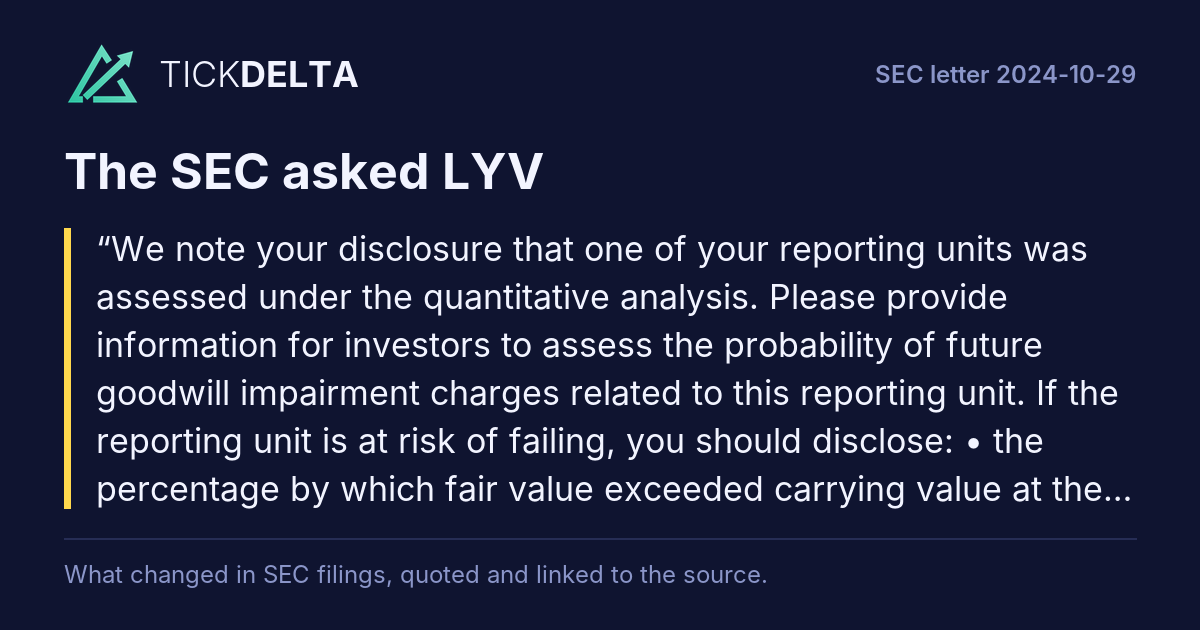
We note your disclosure that one of your reporting units was assessed under the quantitative analysis. Please provide information for investors to assess the probability of future goodwill impairment charges related to this reporting unit.Rest of the question
If the reporting unit is at risk of failing, you should disclose: • the percentage by which fair value exceeded carrying value at the date of the most recent test; • a discussion of the degree of uncertainty associated with the assumptions; and • a description of potential events and/or changes in circumstances that could reasonably be expected to negatively affect the key assumptions. Please refer to Item 303(b)(3) of Regulation S-K.
We respectfully acknowledge the Staff’s comment and although we performed a quantitative impairment test for one reporting unit during the year-ended December 31, 2023, we do not believe the results of such test indicated a risk of impairment. As such, we did not believe there was a risk of the reporting unit failing and more detailed disclosures were not required under Item 303(b)(3) of Regulation S-K.Read in the reply ↗Rest of the answer
In future filings, in the event that the Company performs a quantitative annual goodwill impairment test and there is an indication or risk of impairment, the Company will provide the appropriate disclosures, as set out above and as required by Item 303(b)(3) of Regulation S-K, as well as add a more detailed description of the methods and key assumptions used and how the key assumptions were determined, and will disclose the percentage by which fair value exceeded carrying value at the applicable date.
In addition to revenues earned from services, we note you also earn revenue from products like merchandise and concessions and from the rental of your owned and operated venues. Please explain your consideration of Rule 5-03(b) of Regulation S-X requiring separate presentation of revenue and costs of revenue from services, products and rentals; ASC 606-10-50-4(a) requiring revenue to be disclosed separately fromRest of the question
other sources of revenue (e.g. rental income under ASC 842); ASC606-10-50-5 and 606-10-55-89 through 55-91 requiring disclosure of disaggregated revenue recognized from contracts with customers into categories that depict how the nature, amount, timing, and uncertainty of revenue and cash flows are affected by economic factors; and ASC 280-10-50-40 requiring separate presentation of revenues from external customers for each product and service or each group of similar products and services.
We respectfully acknowledge the Staff’s comment. Rule 5-03(b) of Regulation S-X requires that tangible product and service revenue, along with other categories of revenue, be displayed separately in the income statement if they are greater than 10% of consolidated revenues. For the year ended December 31, 2023, the sales of tangible products related to our concessions and merchandise sales, represented less than 10% of consolidated revenue and the related costs represent less than 4% of direct operating expenses.Read in the reply ↗Rest of the answer
Further, other categories of revenue primarily related to the rental of our owned and operated venues represented less than 1% of consolidated revenues and expenses. Lastly, we believe the sale of any tangible products, whether merchandise or concessions, to be part of the service of providing live events within our Concerts segment, and as such, we do not believe separate presentation would be required if over 10%, as the revenues would not occur without the related services of providing live events. As such, we do believe that separate presentation of the different categories of revenue and expenses to be required under Rule 5-03(b) of Regulation S-X.
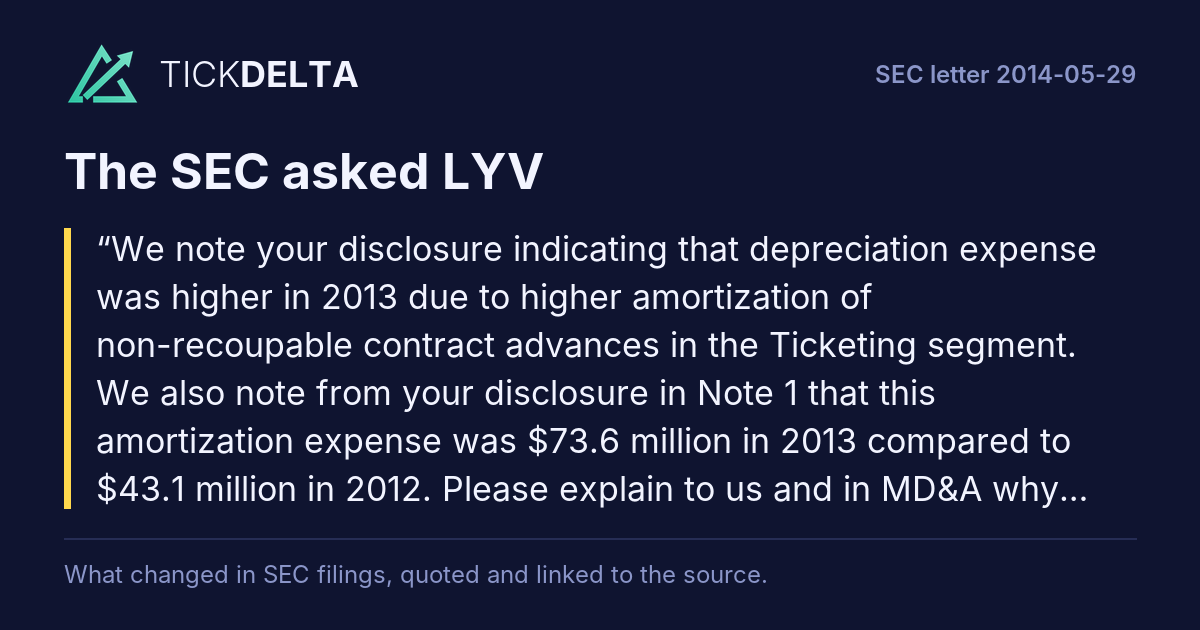
We provide disclosures consistent with ASC 280-10-50-40 and ASC 606-10-50-5 and 606-10-55-89 through 55-91 in Note 12 – Segments and Revenue Recognition of the 10-K (“Note 12”). These disclosures allow the readers of the financial statements sufficient information to understand the nature, timing, amount, and sources of our revenues from each group of similar products and services. As merchandise, concessions, and rental of our owned and operated venues directly relate to our Concerts segment operations and revenues, our response below is focused on those items within the Concerts segment.
The Concert segment’s revenue is generated from events and includes all products and services that support the production, promotion, and execution of a live event. These include promotion or production of live music events and festivals in our owned or operated venues and in rented third-party venues, artist management commissions, and the sale of merchandise for music artists at events. Without a corresponding live event, most of the revenue within the Concerts segment would not occur; as such, the segment’s revenue is substantially correlated as a group of services of providing live events. We believe that our disclosure of revenue by segment within Note 12 fulfills the requirements under ASC 280-10-50-40 and ASC 606-10-50-5 and 606-10-55-89 through 55-91, as the segment represents a group of similar products and services.
Pertaining to your question related to rental income under ASC 606-10-50-4(a), rental income within the Concerts segment is not material for separate disclosure or presentation within the financial statements, as it represents less than 1% of our consolidated revenue. As such, we do not believe disclosure and presentation under ASC 606-10-50-4(a) is required.
First report after the company's reply of 2024-11-12: 10-K filed 2025-02-21 ↗, against the 10-K filed 2024-02-22 ↗.
Tickdelta does not hold the text of both reports, so they are not compared here.
Also in this review: closing letter, 2024-11-14