Form 10-K
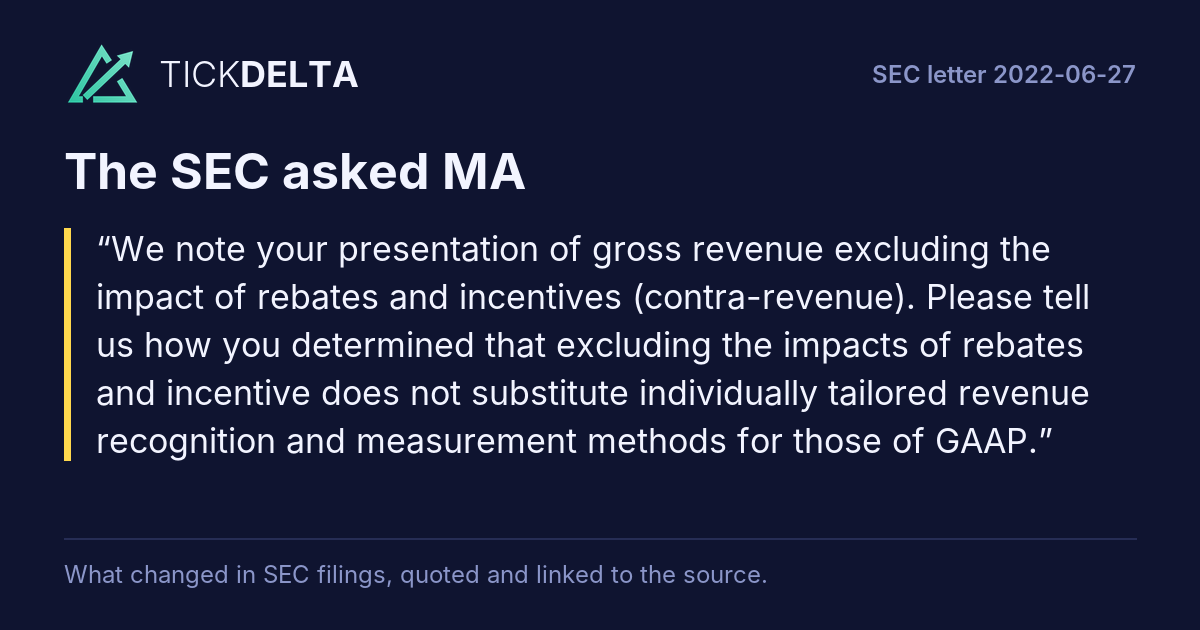
We note your presentation of gross revenue excluding the impact of rebates and incentives (contra-revenue). Please tell us how you determined that excluding the impacts of rebates and incentive does not substitute individually tailored revenue recognition and measurement methods for those of GAAP.
The intent of the Company’s disclosure of gross revenue on pages 51 and 77 of the 10-K is not to substitute an individually tailored revenue recognition and measurement method for those of GAAP. Instead, disclosure of gross revenue is provided only as a subtotal of the Company’s individual driver-based sources of revenue, which together with rebates and incentives (contra-revenue) represent the Company’s disaggregated revenue components for purposes of disclosure in accordance with ASC 606 (the “Standard”).Read in the reply ↗Rest of the answer
These revenue categories serve as the basis to explain the nature, amount, timing and uncertainty of the Company’s total GAAP revenue, which is Net revenue.
We note your presentation of gross revenue excluding the impact of rebates and incentives (contra-revenue). Please tell us how your presentation complies with ASC 606 and why the rebates and incentives have not been allocated to the individual sources of revenue.Rest of the question
We remind you that the company and its management are responsible for the accuracy and adequacy of their disclosures, notwithstanding any review, comments, action or absence of action by the staff.
to your letter, Mastercard acknowledges that the Company and its management are responsible for the accuracy and adequacy of its disclosures, notwithstanding any review, comments, action or absence of action by the Staff. Read in the reply ↗
First report after the company's reply of 2022-07-08: 10-Q filed 2022-07-28 ↗, against the 10-Q filed 2022-04-28 ↗.
Tickdelta does not hold the text of both reports, so they are not compared here.
We note your response to comment 1. We continue to consider your response and may have additional comments.
The Company respectfully awaits the Staff’s response to comment 1. Read in the reply ↗
We note your response to comment 2. Please explain what the gross revenue excluding the impact of rebates and incentive represents and how you determined the revenue by source amounts. Please also tell us how you determined it is appropriate to use the titles “gross revenue” and “other revenues” as they do not represent GAAP revenue in accordance with ASC 606 guidance.Rest of the question
In addition, please further explain why performing an allocation of rebates and incentives to the individual sources of revenue would require a high level of assumptions to estimate when the rebates and incentives can be tied to customer contracts and customer performance.
The Company respectfully acknowledges the Staff’s comments. In order to respond to the Staff’s comments, the Company has structured its response into four parts. First, the Company will address the Staff’s comments as to what gross revenue represents and why the Company has titled it “gross revenue”. Second, the Company will address the Staff’s comment as to the use of the title “other revenues”. Third, the Company will address the Staff’s comment as to how the revenue by source amounts are determined.Read in the reply ↗Rest of the answer
Lastly, the Company will address the Staff’s comment as to why an allocation of rebates and incentives would require a high level of assumptions.
Gross Revenue
The disclosure of “gross revenue” within the disaggregated net revenue table is provided only as a subtotal of the Company’s individual sources of revenue. The individual sources of revenue (domestic assessments, cross-border volume fees, transaction processing and other revenues), together with rebates and incentives (contra-revenue), represent the Company’s disaggregated revenue components for purposes of disclosure in accordance with ASC 606 (the “Standard”). These revenue categories serve as the basis to explain the nature, amount, timing and uncertainty of the Company’s total GAAP revenue, which is Net revenue. It is not intended that gross revenue represent a metric outside of GAAP revenue. During quarterly earnings calls, investor presentations and forums, investors frequently inquire as to the level and changes in rebates and incentives as a percentage of the Company’s total gross revenue. This continues to be a consideration as to why the Company presents the subtotal “gross revenue” within its disaggregated revenue disclosures.
Other Revenues
The Company’s use of the title “other revenues” is to aggregate individually insignificant revenues from various value-added products and services that are often sold with the Company’s payment network services and are recognized in accordance with the Standard in the period in which the related services are performed, or transactions occur. Other revenues, as disclosed within Note 3 of the Form 10-K, includes the following:
•Cyber and intelligence solutions fees are for products and services offered to prevent, detect and respond to fraud and to ensure the safety of transactions made primarily on Mastercard products.
•Data analytics and consulting fees are for insights, analytics, and test and learn capabilities as well as Mastercard’s advisory and managed services.
•Loyalty and rewards solutions fees are charged to issuers for benefits provided directly to consumers with Mastercard-branded cards, such as access to a global airline lounge network, global and local concierge services, individual insurance coverages, emergency card replacement, emergency cash advance services and a 24-hour cardholder service center. Loyalty and reward solution fees also include rewards campaigns and management services.
•Program management services provided to prepaid card issuers consist of foreign exchange margin, commissions, load fees and ATM withdrawal fees paid by cardholders on the sale and encashment of prepaid cards.
•Batch and real-time account-based payment services relating to ACH transactions and other ACH related services.
•Other payment-related products and services and platforms, including account and transaction enhancement services, open banking and digital identity solutions, rules compliance and publications.
The disclosure of “other revenues” is consistent with how the Company's management evaluates the performance of the business. The Company continually reviews its disclosures to ensure they accurately reflect the activity of the business and are consistent with management’s approach to analyzing the Company’s performance.
Sources of Revenue
As it relates to Mastercard’s payment network services, the Company has a single performance obligation to its customers: A promise to provide continuous access to the payment network and stand ready to provide transaction processing, and related services, over the contract term. A single transaction within the payment network can result in assessments, transaction processing fees and other fees which are classified in different revenue streams dependent upon the nature of the transaction and the revenues generated.
Paragraph 606-10-50-5 of the Standard requires disaggregation of revenue “into categories that depict how the nature, amount, timing, and uncertainty of revenue are affected by economic factors.” For purposes of internal review and to address the external disclosure objective, the Company has elected to disaggregate its components of revenue into categories, or sources of revenue, that match the economic drivers commonly used and recognized in the payments industry. For instance, domestic assessments revenue is assessed against domestic gross dollar volume (“GDV”) which measures dollar volume of activity on cards carrying the Company’s brands during the period. GDV represents purchase volume plus cash volume and includes the impact of balance transfers and convenience checks. Cross-border volume fees are assessed against cross-border volume which measures cross- border dollar volume initiated and switched through the Company’s network during the period for all Mastercard-branded programs. Finally, transaction processing revenue is measured against the number of transactions “switched” by Mastercard, which is defined as the number of transactions initiated and switched through the Company’s network during the period. Collectively, and including other revenues, these disaggregated components of revenue constitute the Company’s revenue streams and are typically representative of the Company’s cash inflows.
Allocation of Rebates and Incentives
The Company wants to provide further clarification to its response stating that performing an allocation of rebates and incentives to the individual sources of revenue would require a high level of assumptions to estimate. Rebates and incentives are tied to customer contracts. Within those contracts, there are fixed and variable-based rebates and incentives that do not directly correlate to the individual sources of revenue. Any allocation of rebates and incentives to the sources of revenue would be done with a high level of subjectivity as explained in more detail below, and while achievable, would disconnect the disaggregated revenue growth rates from the correlated key revenue metric drivers (GDV, cross-border volume, switched transactions) discussed above in the "Sources of Revenue" section. Further, management reviews rebates and incentives in totality, separately from its driver-based sources of revenue, when assessing the financial performance of the Company. In addition, during quarterly earnings calls, investor presentations and forums, investors frequently inquire as to the level and changes in rebates and incentives as a percentage of the Company’s total gross revenue.
The Company’s contracts with customers regularly provide for rebates and incentives which may include fixed payments directly related to entering into an agreement or variable-based rebates and incentives which may be tied to customer performance, such as volume thresholds, but may also be tied to card issuance, card conversions and merchant acceptance. Depending on factors such as economic factors, competitive pressure and length of a customer contract, the size and structure of the associated fixed and variable incentives could significantly vary customer-to-customer.
Fixed incentives typically represent payments to a customer directly related to entering into an agreement, which are generally capitalized and amortized over the life of the agreement on a straight-line basis as a reduction of revenue. Examples of fixed incentives include sign-on bonuses that obligate the customer to terms over the contract period and marketing support that can be provided to promote customer products over some or all years of the contract. Fixed incentives are neither tied nor correlated to an individual source of revenue. Variable rebates and incentives are typically tied to customer performance, such as volume thresholds, and are recorded as a reduction of revenue primarily when volumeand transaction-based revenues are recognized over the contractual term. Because a single transaction within Mastercard’s payment network may generate multiple sources of revenue (i.e., dollar volume assessments and transaction processing), the rebate or incentive provided as a result of that customer volume is not tied to a single source of revenue and can vary significantly based on the mix of assessments and transactions in any given period. Other types of variable incentives, such as card issuance and conversion bonuses, are based on number of cards or new customers. These incentives are neither tied nor correlated to an individual source of revenue. In totality, the timing and nature of rebates and incentives and their recognition do not directly correlate to an individual source of revenue. Therefore, any allocation of rebates and incentives among the multiple sources of revenue would be subjective.
Further, given that Mastercard’s payment network services represent a single performance obligation, the Company’s disaggregated revenue disclosure is meant to show the sources of revenue that accumulate to that single performance obligation and, without a sound basis to allocate discounts to the components, the Company discloses the sources on a gross basis and separately presents rebates and incentives as contra-revenue.
An allocation of rebates and incentives to the individual sources of revenue is also inconsistent with the way that management reviews the financial performance of the Company. Management reviews its driver-based sources of revenue, which align with the Company's corresponding key metrics, separate from rebates and incentives. For the reasons noted above, the Company does not believe an allocation of rebates and incentives to the individual sources of revenue is required under the Standard nor would it provide meaningful information to users of the financial statements.
First report after the company's reply of 2022-08-05: 10-Q filed 2022-10-27 ↗, against the 10-Q filed 2022-04-28 ↗.
Tickdelta does not hold the text of both reports, so they are not compared here.
We have reviewed your response to our prior comment 1 in your letter dated July 8, 2022 and your response to our prior comment 2 in your letter dated August 5, 2022. We do not believe your disclosure of “gross revenue” by source with total rebates and incentives shown as a separate line, complies with the requirements of ASC 606.Rest of the question
In this regard, we note that these categories are not revenue based on the recognition and measurement guidance in ASC Topic 606. Please revise your disclosure as appropriate.
The Company respectfully acknowledges the Staff’s comment. In accordance with ASC 606-10-55, paragraphs 90 and 91, we will update our disaggregated net revenue presentation to reflect the nature of our payment services and will continue to provide a disaggregation of net revenue by geographic region. This revised presentation reflects the recognition and measurement guidance in ASC 606.Read in the reply ↗Rest of the answer
The following revised net revenue presentation by category will be applied prospectively for all periods presented within our December 31, 2022 Form 10-K:
The Company’s disaggregated net revenue by category was as follows for the years ended December 31:
2022 2021 2020
(in millions)
Revenue by category:
Payment network $ — $ — $ —
Value-added services and solutions — — —
Net revenue $ — $ — $ —
Management's discussion and analysis of financial condition and results of operations
Additionally, in response to the comment in your initial letter dated June 27, 2022 on Item 7. Management’s discussion and analysis of financial condition and results of operations (“MD&A”), Financial Results, Revenue, page 51, we will remove the disaggregated net revenue table on pg. 51 and replace it with our revised disaggregated net revenue table as presented above, disaggregating net revenues between (i) payment network and (ii) value-added services and solutions.
Supplemental non-GAAP disclosures
To enable users of our financial statements to understand and evaluate financial performance related to our payment network revenue category, as compared to the most relevant key metrics and economic factors commonly evaluated in our industry, we will also include the following supplemental disclosure and table in the Non-GAAP Financial Information section of MD&A:
Supplemental Presentation of our Payment Network Revenue Category
We have provided a non-GAAP supplemental table to present the fees we charge on domestic and cross-border volumes, transactions processed and other network fees, as well as the corresponding rebates and incentives. The growth rates in fees charged for our domestic and cross-border volumes and transactions processed enable a comparison to the related key metrics and economic factors that drive payment network revenue growth such as gross dollar volume (“GDV”), cross-border volume and switched transactions (see pg. XX for a description of our key metrics). It also provides visibility of the total rebates and incentives provided to customers to generate these fees. We believe, for these reasons, the supplemental table provides a meaningful presentation of our results.
For the Years Ended December 31, 2022 2021
2022 2021 2020 Increase / (Decrease) Currency-neutral Increase / (Decrease) Increase / (Decrease) Currency-neutral Increase / (Decrease)
($ in millions)
Payment network $ —
$
—
—%
Domestic assessment fees $ — $ — $ — —% —% —% —%
Cross-border volume fees — — — —% —% —% —%
Transaction processing fees — — — —% —% —% —%
Other network fees — — — —% —% —% —%
Rebates and incentives — — — —% —% —% —%
Note: Table may not sum due to rounding.
The Company will update other sections of the December 31, 2022 Form 10-K to conform to these revised disclosures.
First report after the company's reply of 2022-12-28: 10-K filed 2023-02-14 ↗, against the 10-K filed 2022-02-11 ↗.
Tickdelta does not hold the text of both reports, so they are not compared here.
Also in this review: company letter, 2023-02-09, closing letter, 2023-02-10