Reworded10-Q Nov 6, 2026 vs 10-K Feb 27, 2026
The risks set out and uncertainties described below are not the only risks we face. ones facing us.
Each branch is a paragraph in Risk Factors with nothing like it in the 10-K filed Feb 28, 2025. A box jumps to the paragraph as filed, below.
10 paragraphs in Risk Factors of the 10-K filed Feb 27, 2026 with nothing like them in the 10-K filed Feb 28, 2025. Quoted exactly. Paragraphs that were only edited are under 10-K change.
•Changes to U.S. tariff, trade and economic policies may have a negative effect on our portfolio companies and, in turn, harm us.
•The market price of our securities may be volatile and fluctuate significantly.
Changes to U.S. tariff, trade and economic policies may have a negative effect on our portfolio companies and, in turn, harm us.
The U.S. has enacted, and subsequently rescinded and/or temporarily suspended, significant tariffs against certain countries, prompting reciprocal tariffs against the U.S. Additionally, the current U.S. presidential administration and the U.S. Congress have directed various federal agencies to further evaluate other key aspects of U.S. trade and economic policies, including changes to domestic fiscal policies aimed at reducing U.S. federal expenditures, and there has been ongoing discussion and commentary regarding further potential significant changes to such tariff, trade and economic policies. These developments, and the perception that further material changes may occur or continue to occur, have contributed to volatility in global financial markets and may have a material adverse effect on global economic conditions. This may significantly reduce global trade, affect the ability of businesses to procure new or extend existing government contracts and have other negative impacts on U.S. businesses. Any of these factors could depress economic activity and may restrict our portfolio companies’ access to suppliers or customers and have a material adverse effect on their business, financial condition and results of operations, which in turn would negatively impact us.
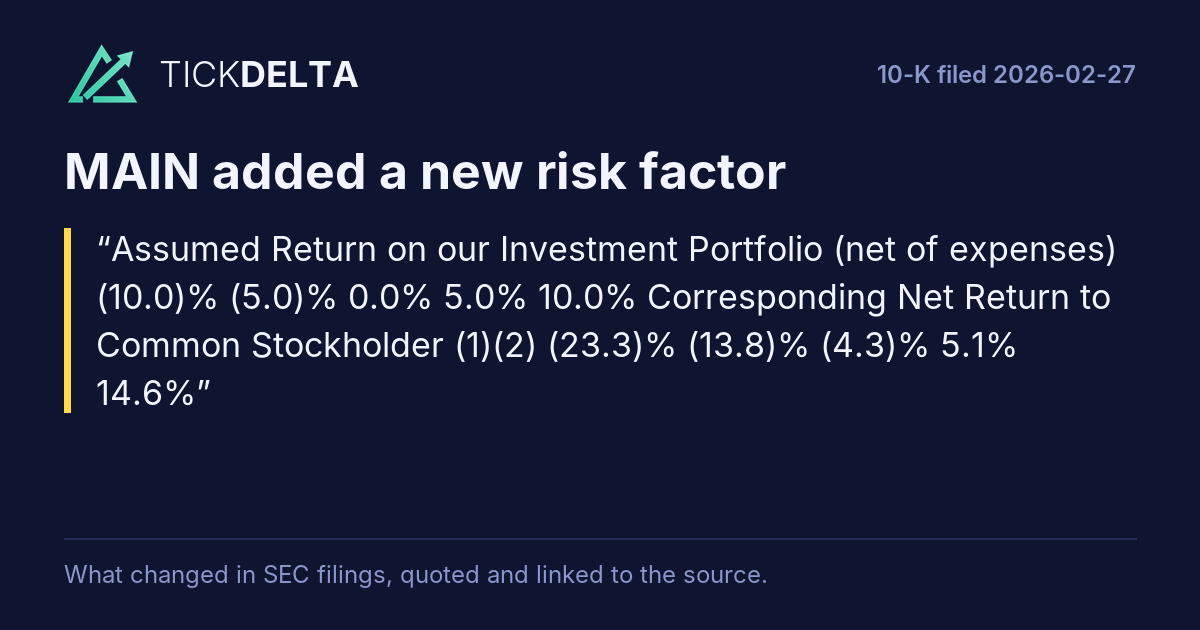
Assumed Return on our Investment Portfolio (net of expenses) (10.0)% (5.0)% 0.0% 5.0% 10.0% Corresponding Net Return to Common Stockholder (1)(2) (23.3)% (13.8)% (4.3)% 5.1% 14.6%
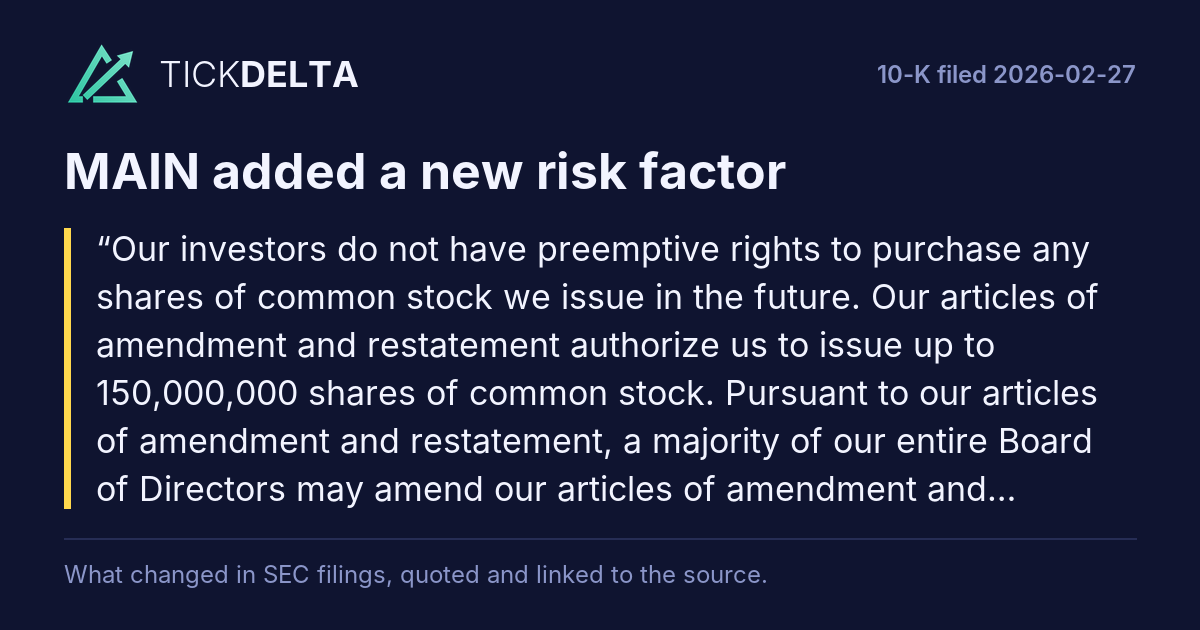
Our investors do not have preemptive rights to purchase any shares of common stock we issue in the future. Our articles of amendment and restatement authorize us to issue up to 150,000,000 shares of common stock. Pursuant to our articles of amendment and restatement, a majority of our entire Board of Directors may amend our articles of amendment and restatement from time to time to increase or decrease the aggregate number of authorized shares of stock or the number of authorized shares of stock of any class or series without stockholder approval. Our Board of Directors may elect to sell additional shares in future public offerings or issue equity interests in private offerings. To the extent we issue additional equity interests, our stockholders’ percentage ownership interest in us will be diluted. In addition, depending upon the terms and pricing of any additional offerings and the value of our investments, stockholders may also experience dilution in the book value and fair value of their shares of common stock.
Our credit ratings may not reflect all risks of an investment in our debt securities.
Our credit ratings are an assessment by third parties of our ability to pay our obligations. Consequently, real or anticipated changes in our credit ratings will generally affect the market value of our debt securities. Our credit ratings, however, may not reflect the potential impact of risks related to market conditions generally or other factors discussed above on the market value of or trading market for the publicly issued debt securities.
Sales of substantial amounts of our common stock in the public market may have an adverse effect on the market price of our common stock.
Sales of substantial amounts of our common stock, or the perception that such sales could occur, could adversely affect the prevailing market prices for our common stock. If these sales occur, it could impair our ability to raise additional capital through the sale of equity securities should we desire to do so. We cannot predict what effect, if any, future sales of securities, or the availability of securities for future sales, will have on the market price of our common stock prevailing from time to time.
New in the latest 10-Q
7 paragraphs in the 10-Q filed Nov 6, 2026 with nothing like them in the 10-Q filed Aug 7, 2026 (at least half the words must differ; new numbers alone do not count). Quoted exactly, grouped by the item heading above them. This is text that changed, not a judgement of how serious it is.
Shares Value Balances as of December 31, 2024 88,400,391 $ 884 $ 2,394,492 $ 402,462 $ 2,797,838 Public offering of common stock, net of offering costs 89,091 1 5,197 — 5,198 Share‑based compensation — — 4,842 — 4,842 Dividend reinvestment 156,749 2 9,085 — 9,087 Amortization of directors’ deferred compensation — — 108 — 108 Issuance of restricted stock, net of forfeited shares 13,366 — — — — Net increase in net assets resulting from operations — — — 116,082 116,082 Dividends to stockholders — — 190 (93,212) (93,022) Balances as of March 31, 2025 88,659,597 $ 887 $ 2,413,914 $ 425,332 $ 2,840,133 Public offering of common stock, net of offering costs 195,454 2 10,831 — 10,833 Share‑based compensation — — 5,416 — 5,416 Purchase of vested stock for employee payroll tax withholding (177,024) (2) (10,013) — (10,015) Dividend reinvestment 167,705 2 9,377 — 9,379 Amortization of directors’ deferred compensation — — 97 — 97 Issuance of restricted stock, net of forfeited shares 436,863 4 (4) — — Net increase in net assets resulting from operations — — — 122,534 122,534 Dividends to stockholders — — 199 (94,359) (94,160) Balances as of June 30, 2025 89,282,595 $ 893 $ 2,429,817 $ 453,507 $ 2,884,217 Public offering of common stock, net of offering costs 111,941 1 6,858 — 6,859 Share‑based compensation — — 5,433 — 5,433 Purchase of vested stock for employee payroll tax withholding (66) — (4) — (4) Dividend reinvestment 146,971 1 9,585 — 9,586 Amortization of directors’ deferred compensation — — 91 — 91 Issuance of restricted stock, net of forfeited shares (4,937) — — — — Net increase in net assets resulting from operations — — — 123,671 123,671 Dividends to stockholders — — 207 (95,485) (95,278) Balances as of September 30, 2025 89,536,504 $ 895 $ 2,451,987 $ 481,693 $ 2,934,575 Balances as of December 31, 2025 89,838,001 $ 898 $ 2,457,660 $ 535,335 $ 2,993,893 Public offering of common stock, net of offering costs 2,430,825 25 134,258 — 134,283 Share‑based compensation — — 5,105 — 5,105 Dividend reinvestment 173,523 2 9,959 — 9,961 Amortization of directors’ deferred compensation — — 90 — 90 Issuance of restricted stock, net of forfeited shares 19,924 — — — — Net increase in net assets resulting from operations — — — 48,981 48,981 Dividends to stockholders — — 213 (98,882) (98,669) Balances as of March 31, 2026 92,462,273 $ 925 $ 2,607,285 $ 485,434 $ 3,093,644 Public offering of common stock, net of offering costs 364,392 4 18,867 — 18,871 Share‑based compensation — — 5,807 — 5,807 Purchase of vested stock for employee payroll tax withholding (169,445) (2) (8,972) — (8,974) Dividend reinvestment 203,405 2 10,645 — 10,647 Amortization of directors’ deferred compensation — — 86 — 86 Issuance of restricted stock, net of forfeited shares 498,700 5 (5) — — Net increase in net assets resulting from operations — — — 147,577 147,577 Dividends to stockholders — — 222 (101,342) (101,120) Balances as of June 30, 2026 93,359,325 $ 934 $ 2,633,935 $ 531,669 $ 3,166,538 Public offering of common stock, net of offering costs 198,882 2 10,769 — 10,771 Share‑based compensation — — 5,880 — 5,880 Dividend reinvestment 176,899 1 9,872 — 9,873 Amortization of directors’ deferred compensation — — 82 — 82 Issuance of restricted stock, net of forfeited shares 9,086 — — — — Net increase in net assets resulting from operations — — — 117,083 117,083 Dividends to stockholders — — 231 (102,780) (102,549) Balances as of September 30, 2026 93,744,192 $ 937 $ 2,660,769 $ 545,972 $ 3,207,678
Read in the 10-Q
In September 2026, the FASB issued ASU 2026-03, Investment Companies with Equity Securities Subject to Contractual Sale Restrictions. The amendments in this update require investment companies to consider the effect of any contractual sale restrictions when measuring the fair value of an equity security. ASU 2026-03 is effective for years beginning after December 15, 2027 and interim reporting periods within those years. Early adoption is permitted. The Company is currently assessing the impact of the new guidance, but it does not expect ASU 2026-03 to have a material impact on the consolidated financial statements and the notes thereto.
Read in the 10-Q
(2) Excludes the dollar value of shares authorized for purchase under the MSIF Purchase Plan that expired without being utilized because the plan’s parameters were not met.
Read in the 10-Q
(3) The MSIF Purchase Plan was entered into in August 2026, and the broker was not authorized to begin purchases under the plan until September 2026. Accordingly, no purchases were made under the MSIF Purchase Plan during July or August 2026.
Read in the 10-Q
Net Gain/(Loss) # of Portfolio Companies Net Gain/(Loss) # of Portfolio Companies Net Gain/(Loss) # of Portfolio Companies Net Gain/(Loss) Net Gain/(Loss)
Read in the 10-Q
(c) The increase in share-based compensation expense was primarily attributable to incentive compensation awards issued in April 2026.
Read in the 10-Q
4.2 Form of 6.55% Notes due 2030 (contained in the Ninth Supplemental Indenture incorporated by reference as Exhibit 4.1 hereto).
Read in the 10-Q
Item 1A of the 10-Q filed Nov 6, 2026 against Item 1A of the 10-K filed Feb 27, 2026.
A 10-Q repeats only the risks that changed, so a 10-K paragraph that is missing from it is not counted as removed.
Added is a paragraph with nothing like it in the 10-K, Reworded a sentence that is in both with several words changed,
Quiet changes a sentence in both where one to four words changed and one is a hedge or a modal
(cut words struck through, new words highlighted).
Text on the page, not a score; each links to the filing at sec.gov.
What the 10-Q itself says about its risk factors:In addition to the other information set forth in this report, you should carefully consider the risk factors described in Item 1A. Risk Factors in our Annual Report on Form 10-K for the fiscal year ended December 31, 2025 that we filed with the SEC on February 27, 2026, which could materially affect our business, financial condition and/or operating results.
Read in the 10-Q
What the 10-Q itself says about its risk factors:There are no material changes to the risk factors as previously disclosed in our Annual Report on Form 10-K for the fiscal year ended December 31, 2025.
Read in the 10-Q
Two-word phrases in Risk Factors of the 10-K filed Feb 27, 2026 that are in none of the 1 earlier 10-Ks stored, back to Feb 28, 2025
Used at least twice, small words left out. Counted, not picked: a phrase can be new because the company renamed something.
Item 1A of each 10-K and 10-Q on EDGAR, quoted exactly. Each paragraph links to the filing at sec.gov.
10-K change: what was reworded or cut, section by section.
Excel workbook · CSV. Google Sheet that stays up to date: paste =IMPORTDATA("https://tickdelta.com/company/MAIN/export.csv") into a cell.