Screener / SEC EDGAR /CIK 0000871763 /Numbers from the XBRL of the 10-Ks
NYSE Industrials · Help Supply Services

ManpowerGroup Inc. MAN

Compare with peers Embed
SEC comment letters, last 20 years

2 reviews of MAN's filings by SEC staff

UPLOAD and CORRESP
Reviews 2 latest letter Dec 19, 2023
Questions asked 3 each answered in the company's own letter
No closing letter 0 reviews without a letter saying the staff completed it

When the SEC's staff reviews a filing, it writes to the company with numbered questions, and the company answers each one in a letter. SEC publishes the exchange once the review is over, at least 20 business days later. A question is not an accusation; most reviews end with the company adding detail to its next filing.

How the reviews went

Every review on EDGAR, from the first staff letter to the letter that closes it

  1. 1. Staff letters 2 UPLOAD
  2. 2. Questions in them 3 numbered comments
  3. 3. Company replies 1 CORRESP
  4. 4. Reviews closed 2 of 2 closing letter

Half the closed reviews took 21 days or less from the first letter to the closing letter.

Form 10-K

2023-12-19 to 2023-12-29 · 2 questions · 1 letter from the SEC, 0 from the company
Review closed 2023-12-29
RevenueSegmentsResults discussion (MD&A)Russia and UkraineNon-GAAP measuresLiquidity and cash
SEC letter of Dec 19, 2023 ↗ no reply letter on EDGAR
Consolidated Results - 2022 compared to 2021 · Segment Results, page 37
SEC asked (1)
Please revise to provide quantification of factors to which changes are attributed in absolute dollar amounts, to the extent providing such quantification would provide meaningful analysis of your year over year results.
Rest of the question

For example, your discussions of revenue and gross profit for your Americas segment discusses multiple factors without quantification that would allow users to understand the impact of each material factor. Also, certain discussions do not appear to discuss or quantify all material factors that impacted your year over year results. Specifically, when discussing you Northern Europe results, you attribute your OUP margin decrease to the loss on sale of your Russia business partially offset by the increase in gross profit margin. Your discussion focuses on the decreased OUP margin without quantified discussion on what caused your Northern Europe Operating Unit Profit ("Organic Constant Currency Variance") to decrease by 22.3%. Refer to Item 303 of Regulation S-K.

MAN answered

No reply letter found.

In its next report

First report after the SEC's letter of Dec 19, 2023: 10-K filed Feb 16, 2024 ↗, against the 10-K filed Feb 17, 2023 ↗.

Tickdelta does not hold the text of both reports, so they are not compared here.
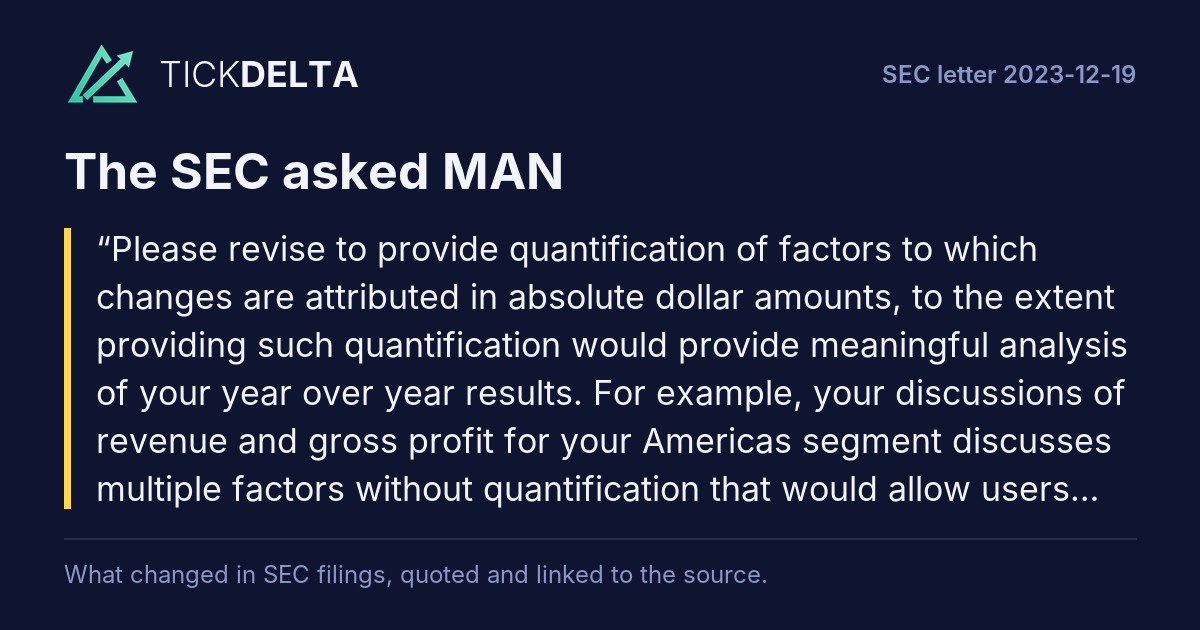
Exhibit 99.1, page 1
SEC asked (2)
You present a non-GAAP measure of Free Cash Flow in the initial bullet points of your earnings release. Please revise to include the disclosures required by Item 10(e)(1)(i) of Regulation S-K.
MAN answered

No reply letter found.

In its next report

First report after the SEC's letter of Dec 19, 2023: 10-K filed Feb 16, 2024 ↗, against the 10-K filed Feb 17, 2023 ↗.

Tickdelta does not hold the text of both reports, so they are not compared here.

Also in this review: closing letter, 2023-12-29

Form 10-K

2015-11-13 to 2015-12-04 · 1 question · 1 letter from the SEC, 1 from the company
Review closed 2015-12-04
Results discussion (MD&A)Executive pay
Compensation Discussion and Analysis · We Focus on Three Key Performance Metrics, page 22
SEC asked
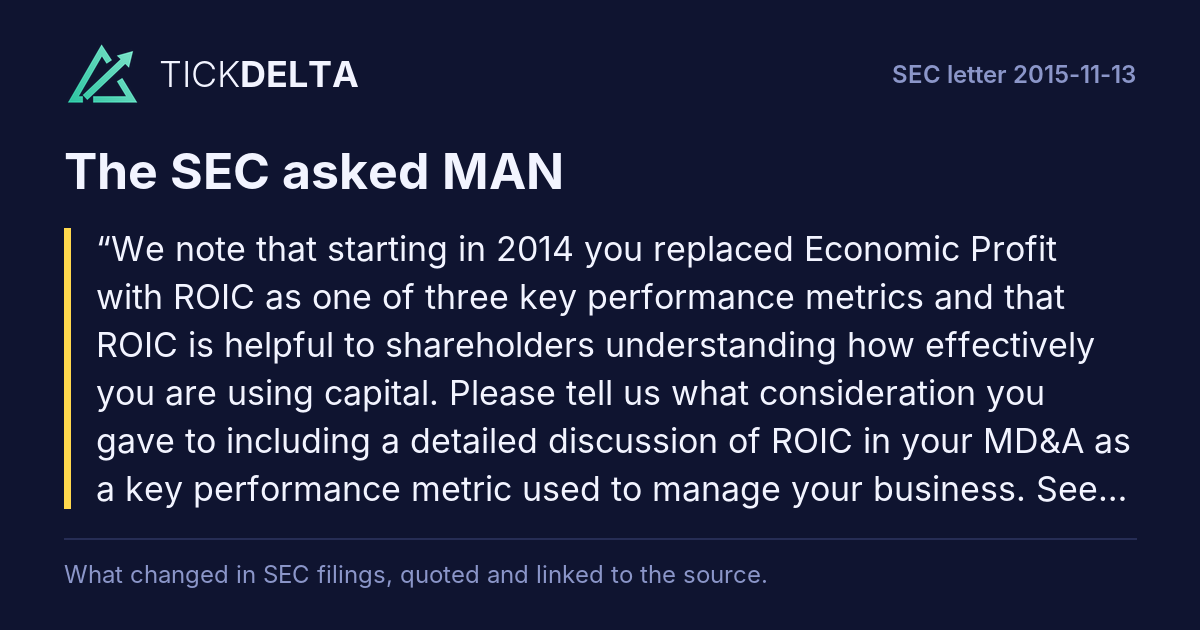
We note that starting in 2014 you replaced Economic Profit with ROIC as one of three key performance metrics and that ROIC is helpful to shareholders understanding how effectively you are using capital. Please tell us what consideration you gave to including a detailed discussion of ROIC in your MD&A as a key performance metric used to manage your business. See Section III.B.1. of SEC Release No. 33-8350.
MAN answered
We use the ROIC (“return on invested capital”) metric as a performance metric for the compensation of our Named Executive Officers, as discussed in the Compensation Discussion and Analysis section of our proxy statement. We believe the ROIC metric, which forms a part of the annual cash incentive for executives, incentivizes them to focus not only on profitability but also on effectively deploying capital and creating shareholder value.

However, we do not utilize ROIC as an operational metric, and it is not one of the financial measurements our leadership utilizes as part of its management of
Rest of the answer

the Company’s business. We think that managing the business with this metric wouldn’t give us the proper visibility into our operations, given the complexity and number of components in the ROIC calculation. Instead, we find it more effective to manage the business by separately monitoring, measuring and forecasting several of the components of the ROIC calculation, in particular Operating Profit, Provision for Income Taxes, Cash, Debt and Shareholders’ Equity. Similarly, when we speak to shareholders during our quarterly earnings calls, we discuss these individual components and do not specifically discuss ROIC.

We use Operating Profit and Operating Profit Margin (Operating Unit Profit and Operating Unit Profit Margin at a segment reporting level) to manage the earnings performance of our overall business and various business units. We also manage our Provision for Income Taxes on a consolidated basis as we monitor the overall net earnings of the Company. For Invested Capital, defined as Debt plus Shareholders’ Equity less Cash, we manage each of these separate components through our focus on cash provided by operating activities, capital expenditures, working capital levels and overall capital structure (including dividends and share repurchases).

We are mindful of the guidance in SEC Release No. 33-8350 that MD&A should give readers a view of the Company through the eyes of management by providing both a short and long-term analysis of the business. As such, we have included discussion in our MD&A of each of the above components used by our management to manage our operations. We believe these disclosures give shareholders appropriate visibility into changes in our operating performance and changes in our invested capital, consistent with how we manage the business. However, as management does not manage the Company’s operations using ROIC, we have not included a specific discussion of this metric in our MD&A.

Since we use ROIC as a performance metric and not as an operational metric, we will revise our proxy disclosure to reflect this. In future filings, we will change the disclosure in our proxy statement (see, for example, page 22 of our proxy statement filed March 14, 2015) from “…three financial and operating metrics” to “…three performance metrics” to avoid any potential confusion about how we use the ROIC metric.

In connection with the responses to your comments we acknowledge that:

• the Company is responsible for the adequacy and accuracy of the disclosure in the filing;

staff comments or changes to disclosure in response to staff comments do not foreclose the Commission from taking any action with respect to the filing; and the Company may not assert staff comments as a defense in any proceeding initiated by the Commission or any person under the federal securities laws of the United States.

Read in the reply
In its next report

First report after the company's reply of Nov 30, 2015: 10-K filed Feb 22, 2016 ↗, against the 10-K filed Feb 20, 2015 ↗.

Tickdelta does not hold the text of both reports, so they are not compared here.

Also in this review: closing letter, 2015-12-04

Letters without questions

Other letters

UPLOAD and CORRESP
1 other letter: notices that a filing will not be reviewed, requests to declare a registration effective, and the like
  • Dec 29, 2023 · MAN: letter to the SEC · ManpowerGroup Inc. · Form 10-K for Fiscal Year Ended December 31, 2022 Form 8-K...

From the SEC's correspondence on EDGAR: staff letters (form UPLOAD) and company letters (form CORRESP), 6 letters filed since 2015-11-13. Questions and answers are matched by their numbers; topics come from words in each question. The reports are compared word for word (same form, before the first SEC letter against the first report after the company's reply). No AI.

Sources

The SEC's correspondence on EDGAR: staff letters (form UPLOAD) and company letters (form CORRESP), matched question by question. No AI.

Also

Filings: the letters in the filing list.

Work with it

Excel workbook · CSV. Google Sheet that stays up to date: paste =IMPORTDATA("https://tickdelta.com/company/MAN/export.csv") into a cell.

Next in Owners and insiders:Insider trades
Esc

Type a ticker such as AAPL, a name, an investor such as Buffett, or a topic such as tariffs. ↑ ↓ to move, Enter to open.