Form 10-K for the Fiscal Year Ended December 31, 2022
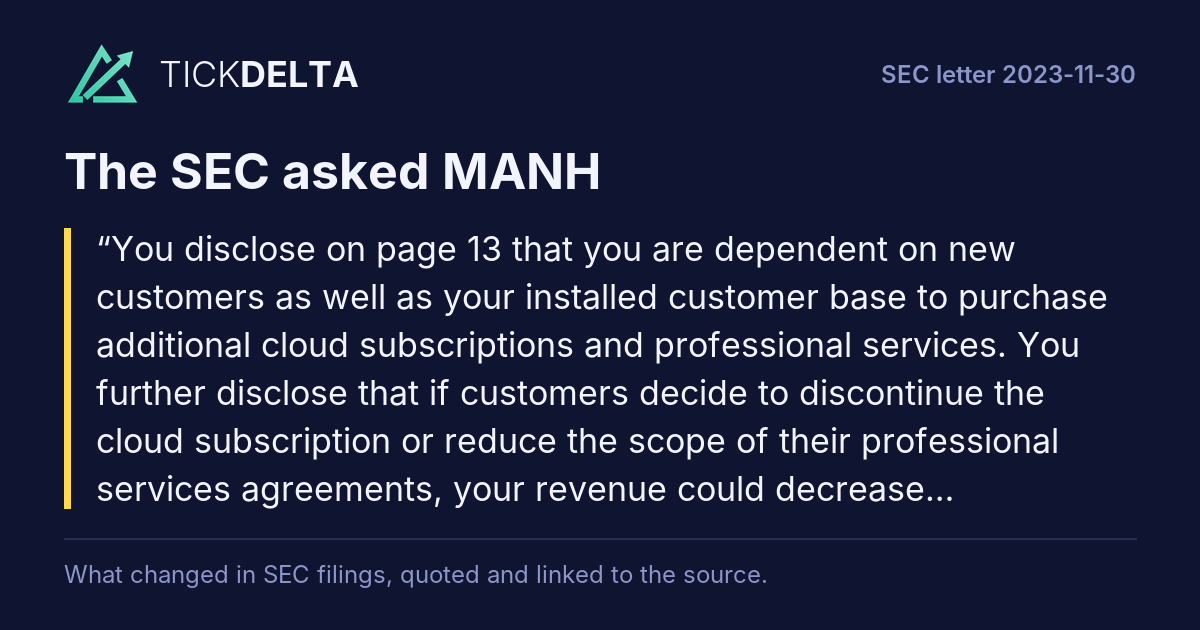
You disclose on page 13 that you are dependent on new customers as well as your installed customer base to purchase additional cloud subscriptions and professional services. You further disclose that if customers decide to discontinue the cloud subscription or reduce the scope of their professional services agreements, your revenue could decrease significantly.Rest of the question
Please tell us and revise to include a quantified discussion of the metrics or measures you use to monitor your ability to attract new customers, sell additional services to existing customers, and renew cloud subscription and maintenance contracts, such as number of customers, renewal rates, and expansion rates. Refer to SEC Release 33-10751.
The Company would like to call the Staff’s attention to the Cloud Subscriptions and Software License revenue paragraph on page 23 where the Company notes that cloud subscription revenue and remaining performance obligation (RPO) growth are the leading indicators of its business performance. In future filings, the Company intends to add a separate section in the MD&A, currently expected to be substantially as set forth below, to highlight these metrics more clearly.Read in the reply
Additionally, due to the Company’s recent transition to a Cloud-based model, only a small number of the Company’s cloudRest of the answer
subscriptions have come up for renewal to date. The Company expects renewals to increase in the coming years at which point the Company expects that it will begin to track and disclose retention rates as an additional key performance metric.
Key Performance Metrics
We regularly review metrics to evaluate our business, measure our performance, identify trends affecting our business, formulate financial projections and make strategic decisions. We believe cloud subscriptions revenue growth and RPO growth are the leading indicators of our business performance, primarily derived from cloud subscription fees that customers pay for our Unified Omnichannel Commerce and Digital Supply Chain solutions.
Cloud Subscriptions Revenue Growth
Our cloud revenue growth provides insight into our ability to maintain and grow our cloud customer base. Total cloud revenue increased from $122.2 million in 2021 to $176.5 million in 2022, representing a 44% year-over-year increase. Total cloud revenue increased from $79.8 million in 2020 to $122.2 million in 2021, representing a 53% year-over-year increase. Cloud revenue growth is being driven by strong demand for our cloud offerings.
Remaining performance obligations
Transaction price allocated to RPO represents contracted revenue that has not yet been recognized, which includes deferred revenue and non-cancelable amounts that we expect to invoice and recognize as revenue in future periods. Substantially all of our RPO represents cloud native subscriptions with a non-cancelable term greater than one year. Maintenance contracts typically are for one year and not included in RPO. RPO provides insight into our contracted backlog of future business. As of December 31, 2022, our RPO was approximately $1.05 billion, an increase of 50% over December 31, 2021.
Results of Operations
Revenue, page 28
You disclose that cloud subscription revenue increased on customers demand for your SaaS offerings and that your customers increasingly prefer cloud solutions, including existing customers that are migrating from on-premise to cloud offerings. Further, you disclose that service revenue was primarily driven by adoption and implementation of your cloud solutions. Please tell us and revise to disclose the amount or percentage of the increase in these revenue streams attributable to new versus existing customers and those migrating from on-premise to cloud offerings, in order to provide better context to your results. Refer to Section III.B of SEC Release 33-8350.
The Company would like to call the Staff’s attention to page 24 in the revenue discussion where it states that the percentage mix of new to existing customers for cloud subscriptions and software license sales taken together was approximately 40/60 in 2022. As mentioned above, only a small number of the Company’s cloud subscriptions have come up for renewal to date. The Company expects renewals to increase in the coming years at which point we expect we will begin to track and disclose retention rates.
As stated on page 24, our services revenue growth is contingent on cloud sales and customer upgrade cycles. The Company will disclose in future filings the percentage of professional services revenue that relates to cloud subscriptions. From 2020 to 2022, the percentage of professional services revenue that related to cloud subscriptions increased from approximately 25% in 2020 to over 50% in 2022 and continues to increase in 2023.
Notes to Consolidated Financial Statements
Note 1. Organization, Consolidation and Summary of Significant Accounting Policies
Remaining Performance Obligations, page 49
You disclose approximately $1,051.5 million of revenue is expected to be recognized from remaining performance obligations, approximately 40% over the next 24 months with the balance recognized thereafter. Please tell us and revise to better explain when the other 60% will be recognize as revenue, on a quantitative basis or by providing qualitative information. Refer to ASC 606-10-50-13.
In future filings, the Company will revise its disclosure to clarify that most of the remaining balance will be recognized in the following 36 months.
You disclose that cloud subscription revenue increased on customers demand for your SaaS offerings and that your customers increasingly prefer cloud solutions, including existing customers that are migrating from on-premise to cloud offerings. Further, you disclose that service revenue was primarily driven by adoption and implementation of your cloud solutions.Rest of the question
Please tell us and revise to disclose the amount or percentage of the increase in these revenue streams attributable to new versus existing customers and those migrating from on-premise to cloud offerings, in order to provide better context to your results. Refer to Section III.B of SEC Release 33-8350.
Please tell us and revise to disclose whether commissions are earned on cloud subscription renewals. If so, disclose whether they are commensurate with the commissions earned on the initial contract and how you account for such commissions. Refer to ASC 340-40-35-1 and 340-40-50.Read in the reply
Commissions are earned on cloud subscription renewals, but they are not commensurate with the commission earned on the initial contract. As such, renewal commissions are amortized over the contractual renewal period. The Company will revise its future filings to provide additional clarification.
You disclose approximately $1,051.5 million of revenue is expected to be recognized from remaining performance obligations, approximately 40% over the next 24 months with the balance recognized thereafter. Please tell us and revise to better explain when the other 60% will be recognize as revenue, on a quantitative basis or by providing qualitative information. Refer to ASC 606-10-50-13.
No numbered answer found in the reply. Read the reply ↗
First report after the company's reply of Dec 12, 2023: 10-K filed Feb 6, 2024 ↗, against the 10-K filed Feb 6, 2023 ↗.
Tickdelta does not hold the text of both reports, so they are not compared here.
Please tell us and revise to disclose whether commissions are earned on cloud subscription renewals. If so, disclose whether they are commensurate with the commissions earned on the initial contract and how you account for such commissions. Refer to ASC 340-40-35-1 and 340-40-50.
No numbered answer found in the reply. Read the reply ↗
First report after the company's reply of Dec 12, 2023: 10-K filed Feb 6, 2024 ↗, against the 10-K filed Feb 6, 2023 ↗.
Tickdelta does not hold the text of both reports, so they are not compared here.
We note your response to prior comment 2 and acknowledge the disclosure on page 24. While that disclosure indicates the mix of new to existing customers for cloud subscriptions and software license for sales in 2022, it is not clear what comprises the year over year growth in cloud subscription revenue.Rest of the question
Therefore, as previously requested, please tell us and revise to disclose the amount or percentage of the increase in cloud subscription revenue attributable to new versus existing customers including those that are migrating from on-premise offerings to cloud offerings, in order to provide better context to your results of operations discussion.
In drafting MD&A, the Company is mindful that the Staff’s 2003 MD&A Interpretative Release, 34-48960, instructs that one of the principal objectives of MD&A is “to provide a narrative explanation of a company's financial statements that enables investors to see the company through the eyes of management.”Read in the reply
Management focuses on the total value of non-cancelable cloud subscriptions and license fees signed during each period by new versus existing customers rather than revenue.Rest of the answer
Approximately 40% of the total value of non-cancelable cloud subscriptions signed during 2022 was with new customers and 60% was with existing customers. In future filings, the Company will clarify that its percentage mix disclosure is by contract value.
For 2020, 2021, and 2022, revenue recognized from first time cloud customers (defined as customers with no prior active cloud subscriptions) during the year in which their initial cloud subscription began was 13%, 11%, and 7% of total cloud revenue, respectively. The Company will include these percentages of new customer cloud revenue in future filings, but respectfully proposes not to disclose period-to-period growth amounts or percentages as the Company does not view them as material for the reasons set forth in this response.
Management focuses on contract value because our customers contract for multi-year subscriptions which typically increase in scope and price over the term, and thus revenue recognized during the year when the contract is signed tends to be small relative to the total contract value, as can be seen from the percentages in the preceding paragraph. This is because revenue recognized in the initial year excludes revenue beyond the first year of the contract and excludes revenue from additional solutions sold to the customer in future years. Finally, revenue recognized in the initial year could be skewed by the timing of the start date of the subscription during the year. For these reasons, the Company believes that the percentage of total value of non-cancelable cloud subscriptions signed during each period with new versus existing customers is more helpful to investors in assessing business performance.
You indicate in your response to prior comment 2 that you will disclose in future filings the percentage of professional services revenue that relates to cloud subscriptions, which was approximately 25% in 2020 and over 50% in 2022. Please tell us and revise to disclose the actual percentages for fiscal 2021 and 2022, and explain the types of professional services that comprise the remaining amounts.Rest of the question
Further, as previously requested, in order to better explain the year over year growth in service revenue, tell us and revise to disclose the amount or percentage of the increase attributable to new versus existing customers.
The percentage of professional services revenue that relates to cloud subscriptions in 2020, 2021, and 2022 was approximately 25%, 40% and 55%, respectively. The remainder of our professional services revenue relates to implementations, ongoing support, and upgrades of licensed software.Read in the reply
For 2020, 2021, and 2022, revenue from new customer cloud-based professional services (defined as customers with no prior active cloud subscriptions) recognized during the year in which their initial cloud subscription began was 7%, 14%, and 12%, respectively, of total professional services revenue.Rest of the answer
The Company will include these percentages of new customer cloud-based professional services revenue in future filings, but respectfully proposes not to disclose growth amounts or percentages as the Company does not view them as material for the reasons set forth below.
As with our cloud software subscriptions, customers often continue to purchase our professional services beyond their initial implementation to roll out additional locations, implement additional features and functionality, and implement additional products, as well as for general support. Revenue recognized from new customer cloud-based professional services excludes those services we provided after the year in which the initial cloud subscription began. Further, as with revenue attributable to new customer cloud-based subscription services, the revenue attributable to new customer cloud-based professional services could be skewed by the timing of the start date of the subscription during the year.
Also in this review: closing letter, 2024-01-02