tickdelta
Sign in

Tickdelta is free for now. Sign up and get Pro free

← Screener

MCDMcDonald's

Consumer discretionary · Restaurants · NYSE
Headquarters
Chicago, IL
Next results
around Feb 10, 2027
Compare with peers → Embed

When the SEC's staff reviews a filing, it writes to the company with numbered questions, and the company answers each one in a letter. SEC publishes the exchange once the review is over, at least 20 business days later. Below: what the staff asked MCD, and the company's answer to each question, quoted from the letters. A question is not an accusation; most reviews end with the company adding detail to its next filing.

Form 10-K

2026-04-13 to 2026-04-28 · 1 question · 1 letter from the SEC, 1 from the company
Review closed 2026-04-28
RevenueSegmentsResults discussion (MD&A)
Consolidated Operating Results · Revenues, page 14
SEC asked
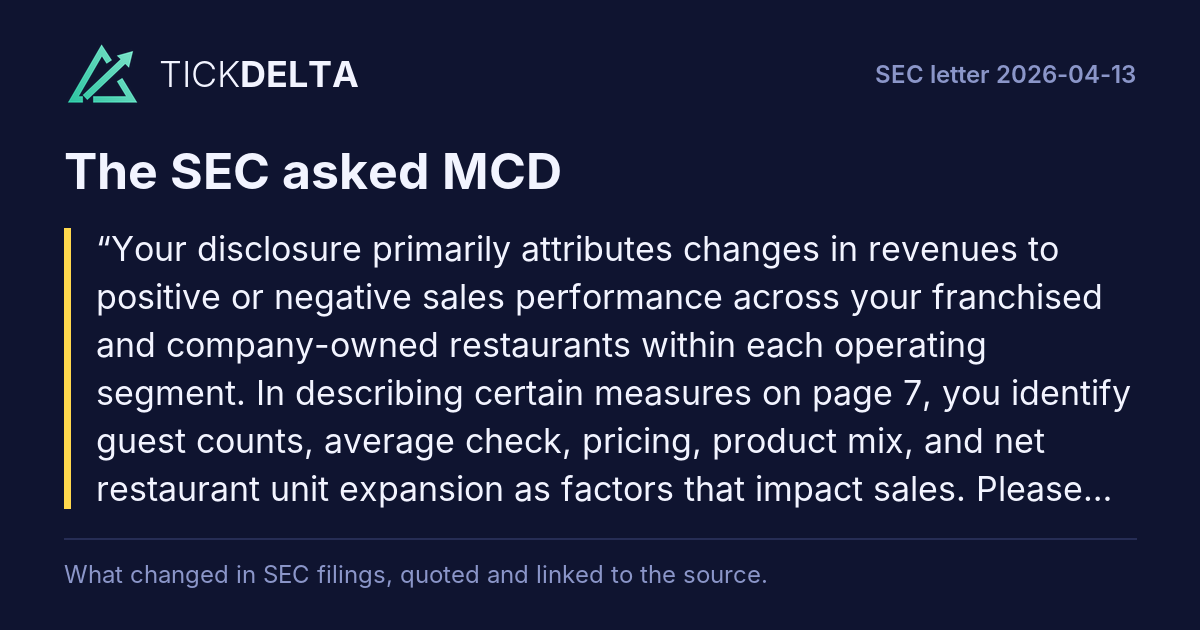
Your disclosure primarily attributes changes in revenues to positive or negative sales performance across your franchised and company-owned restaurants within each operating segment. In describing certain measures on page 7, you identify guest counts, average check, pricing, product mix, and net restaurant unit expansion as factors that impact sales.
Rest of the question

Please provide quantitative and qualitative disclosure of all factors that materially impacted your period over period revenues, including any offsetting amounts. Refer to Item 303(a), introductory paragraph of (b) and (b)(2) of Regulation S- K. Further, consider whether a tabular or reconciliation format would more clearly convey the quantitative impact of these factors.

MCD answered
The Company respectfully acknowledges the Staff’s comment. As context for our response, McDonald’s is predominantly a franchisor, with franchised restaurants representing approximately 95% of McDonald’s restaurants worldwide at December 31, 2025. The Company’s revenues are principally derived from rents and royalties paid by franchisees and licensees, which are contractually calculated as a percentage of sales.

Consistent with this business model, the Company’s Management’s Discussion and Analysis focuses on explaining changes in its reported revenues by reference to changes in systemwide
Rest of the answer

sales and comparable sales. Systemwide sales and comparable sales, as described on page 7 of the Company’s Annual Report on Form 10-K for fiscal year 2025, represent measures that management believes are meaningful in understanding changes in rents and royalties, as they reflect the underlying sales trends of franchised and company‑owned restaurants. The Company presents percentage changes of these measures in tabular form by operating segment (page 14) and provides accompanying qualitative and quantitative discussion throughout the section to explain material period‑over‑period changes in comparable sales and systemwide sales, including the relative impact of comparable sales growth and net restaurant unit expansion.

The components described by the Staff—such as guest counts, average check, pricing, and product mix—are underlying drivers of systemwide and comparable sales. Given the Company’s franchisor model, the availability of quantitative data supporting these individual drivers is limited, and management believes that presenting additional quantitative disaggregation of these underlying drivers would not meaningfully enhance an investor’s understanding of reported revenues beyond the information already provided through systemwide sales and comparable sales disclosures.

With respect to company‑owned restaurants, these restaurants represent less than five percent of the Company’s total systemwide restaurant base. As a result, no individual statistical driver (such as price, average check, product mix or guest counts) related solely to company‑owned restaurants would have a material impact on the Company’s consolidated revenues. In future filings, we will continue to monitor for and disclose matters that have had a material impact on period‑over‑period changes in company-owned and operated sales.

The Company also notes that, in prior periods when changes in underlying drivers, such as guest counts, materially affected sales, the Company has included enhanced qualitative discussion of those factors in its periodic filings. Based on the facts and circumstances for fiscal year 2025, the Company believes that its existing disclosures provide investors with material information necessary to understand matters that have had a material impact on period‑over‑period changes in revenues in accordance with Item 303 of Regulation S‑K.

Read in the reply ↗

Also in this review: closing letter, 2026-04-28

Form 10-K

2025-05-15 to 2025-06-05 · 1 question · 1 letter from the SEC, 1 from the company
Review closed 2025-06-05
Segments
Segment and Geographic Information, page 52
SEC asked
Please tell us how your disclosure complies with the requirement to disclose how the chief operating decision maker uses the reported measure of segment profit or loss in assessing segment performance and deciding how to allocate resources. See ASC 28010-50-29(f).
MCD answered
The Company respectfully acknowledges the Staff’s comment and in future quarterly and annual filings will expand its segment and geographic information footnote, as follows, to provide additional information about how the chief operating decision makers use the reported measure of segment profit or loss in assessing segment performance and deciding how to allocate resources:

The Company's chief operating decision makers (CODMs) are the President and CEO and the Executive Vice President and Global Chief Financial Officer ("CFO").
Rest of the answer

Segment performance is evaluated based on one measure of a segment's profit or loss, operating income, which is used to allocate resources in the annual planning process. Throughout the year, the CODMs consider forecast to actual operating income results and variances against plan to evaluate segment performance and priorities related to allocation of capital and resources supporting organizational objectives.

Read in the reply ↗
In its next report

First report after the company's reply of 2025-05-30: 10-Q filed 2025-08-06 ↗, against the 10-Q filed 2025-05-12 ↗.

Tickdelta does not hold the text of both reports, so they are not compared here.

Also in this review: closing letter, 2025-06-05

Form 10-K

2024-09-12 to 2024-10-07 · 1 question · 1 letter from the SEC, 1 from the company
Review closed 2024-10-07
Pensions
Notes to Consolidated Financial Statements · Employee Benefit Plans, page 57
SEC asked
The consolidated statement of comprehensive income discloses amounts in regard to defined benefit pension plans. Please explain to us why you have not provided applicable disclosure for these plans in accordance with ASC 715-20-50.
MCD answered
We respectfully acknowledge the Staff’s comment, and we advise the Staff that the referenced amounts disclosed in the Consolidated Statement of Comprehensive Income are related to the Company’s UK defined benefit pension plan (the “UK Plan”) which is not material to the financial statements. Accordingly, the Company has not provided the related disclosures set forth in ASC 715-20-50.
Rest of the answer

We have summarized the primary quantitative and qualitative factors that the Company’s management evaluated in arriving at this conclusion, as follows:

•The UK Plan is in an overfunded position with an ending net noncurrent asset balance of $0.1 million and $26.7 million recognized in the Consolidated Balance Sheet as of

December 31, 2023 and December 31, 2022, respectively. On a gross basis, the actuarially determined projected benefit obligation and fair value of plan assets as of December 31, 2023, were approximately $579.3 million each (~1% of total assets and total liabilities). For the comparative period ended December 31, 2022, the projected benefit obligation and fair value of plan assets were $525.6 million and $552.3 million, respectively (~1% of total assets and total liabilities).

•The pension benefit, recognized primarily in nonoperating income in the Consolidated Statement of Income, for the years ended December 31, 2023 and 2022 was $37.4 million (~0.4% of income before provision for income taxes) and $5.3 million (~0.1% of income before provision for income taxes), respectively. For the year ended December 31, 2021, the pension cost was $7.1 million (~0.1% of income before provision for income taxes).

•Employer contributions to the UK Plan were $20.8 million, $20.7 million, and $23.7 million for the years ended December 31, 2023, 2022, and 2021, respectively (less than 0.5% of cash provided by operations for all comparative periods presented).

•The 2024 projected pension benefit and employer contributions are moderately lower than the 2023 actual amounts, and therefore are projected to remain immaterial.

•The UK Plan has been frozen to new entrants since 2002 and includes a limited number of participants residing in one market.

Read in the reply ↗
In its next report

First report after the company's reply of 2024-09-25: 10-Q filed 2024-11-07 ↗, against the 10-Q filed 2024-08-08 ↗.

Tickdelta does not hold the text of both reports, so they are not compared here.

Also in this review: closing letter, 2024-10-07

Form 10-K for the Fiscal Year Ended December 31, 2021

2022-09-19 to 2022-11-23 · 2 questions · 1 letter from the SEC, 2 from the company
Review closed 2022-11-23
RevenueResults discussion (MD&A)Liquidity and cashRussia and UkraineNon-GAAP measures
Item 2. Management's Discussion and Analysis of Financial Condition and Results of Operations · Impact of the War in Ukraine, page 16
SEC asked (1)
We note company-operated restaurants in Russia appear to be more than 25% of total company-operated restaurants. Please explain to us and disclose as appropriate the expected impact on your cash flows, liquidity, financial position, and results of operations (in particular, revenues) due to your exit from Russia. Refer to Item 303 of Regulation S- K and Release Nos. 33-6835 and 33-8350 for guidance.
MCD answered
We respectfully acknowledge the Staff’s comment, and we advise the Staff that the Company's exit from Russia did not have a material impact on reported cash flows, liquidity, financial position and results of operations and will not have a material impact on those metrics in the future. As of December 31, 2021, Company-operated restaurants represented 7% of total restaurants, and restaurants in Russia (most of which were Company-operated) represented only 2% of total restaurants.
Rest of the answer

Additionally, as previously disclosed during the question-and-answer portion of the Company's second quarter 2022 earnings conference call, for the year ended December 31, 2021, Russia represented only 2% of Systemwide sales and 2% of Operating income. Systemwide sales and Operating income are key predictive indicators of our business performance and therefore included in the guidance provided by the Company in its Outlook. Although Russia represented 7% of Revenues as of December 31, 2021, it represented only 2% of Operating income due to the cost structure of Company-operated restaurants.

On February 24, 2022, the Company posted supplemental information to its website titled “Supplemental Information on McDonald’s Russia and Ukraine” disclosing the number of restaurants in Russia and Ukraine as of December 31, 2021, including ownership type, as well as the combined impact of Russia and Ukraine to Systemwide sales, Revenues and Operating income for 2021. As disclosed in the supplemental information, for the year ended December 31, 2021, Russia and Ukraine combined represented only 2% of Systemwide sales, 9% of Revenues and less than 3% of Operating income. As noted above, the Company also shared the impact of Russia in relation to Systemwide sales, Revenues, and Operating income during its second quarter 2022 earnings conference call.

In addition to the supplemental information posted on the Company's website, the Company also filed a Form 8-K on May 16, 2022 announcing the decision to exit the Russian market, where it reaffirmed its 2022 Outlook (previously included on page 25 of the Company's Form 10-Q for the quarter ended March 31, 2022), with the following minimal updates:

•The Company expects operating margin to be in the 40% range as a result of the charge for Russia. Excluding impairment and other strategic charges, the Company expects adjusted operating margin to be in the mid-40% range (operating margin is defined as operating income as a percent of total revenues).

•Excluding the closure of all restaurants in Russia, the Company expects:

◦net restaurant unit expansion will contribute about 1.5% to 2022 Systemwide sales growth in constant currencies.

◦over 1,300 net restaurant additions in 2022.

•The Company expects 2022 capital expenditures to be approximately $2.1 to $2.3 billion.

This updated 2022 Outlook was also included in the Company's Form 10-Q for the quarter ended June 30, 2022, where guidance related to free cash flows remained unchanged, along with additional guidance provided to assist in forecasting the Company’s future results for 2022.

Given that the exit from Russia was a one-time event and the size of the historical contributions from the market, the Company believes its disclosures satisfy the requirements of Item 303 of Regulation S-K and the Staff’s additional guidance in Release Nos. 33-6835 and 33-8350.

Read in the reply ↗
In its next report

First report after the company's reply of 2022-09-30: 10-Q filed 2022-11-07 ↗, against the 10-Q filed 2022-08-04 ↗.

Tickdelta does not hold the text of both reports, so they are not compared here.

Operating Income & Operating Margin, page 28
SEC asked (2)
Please provide for the periods presented here and as applicable in your Form 10-K filings and interim period earnings releases furnished in Form 8-K a reconciliation between "Non-GAAP operating income" and GAAP "operating income." Refer to Item 10(e)(1)(i)(B) of Regulation S-K.
MCD answered
We respectfully acknowledge the Staff’s comment, and we advise the Staff that the Company’s Form 10-K for the fiscal year ended December 31, 2021; Form 10-Q for the quarter ended March 31, 2022; and Form 10-Q for the quarter ended June 30, 2022, as well as the associated earnings materials filed on Form 8-K, contain all components that are necessary to reconcile Non-GAAP Operating income to Operating income (and, as a result, Non-GAAP Operating margin to Operating margin).
Rest of the answer

Further, in each filing, the descriptions of all such adjustments are presented in advance of the disclosure of the Non-GAAP financial measures.

Specifically, in the Company’s Form 10-Q for the quarter ended June 30, 2022, prior to disclosing Non-GAAP Operating income and Non-GAAP Operating margin on page 28, all of the gains and charges adjusted in such measures and used to calculate Non-GAAP Net income are included on page 22 under “Net Income and Earnings Per Share-Diluted Reconciliation,” as well as on page 27 under “Other Operating (Income) Expense, net.” By providing these amounts, users are able to reconcile Non-GAAP Operating income to Operating Income.

Further, the definition of Operating margin is included on page 28 of the same filing, which allows users to recalculate Non-GAAP Operating margin and Operating margin using the Non-GAAP Operating income and Operating income figures provided.

We believe that the information provided is sufficient for users to reconcile the Non-GAAP financial measures to their most directly comparable GAAP financial measures. However in order to provide greater clarity, beginning with the Company’s Form 10-Q for the quarter ending September 30, 2022, as well as the associated earnings materials, we undertake to revise the disclosure under the “Operating Income & Operating Margin” table to summarize the applicable reconciling items previously disclosed elsewhere, should we elect to disclose non-GAAP operating income in the future. By way of example, revisions to the existing disclosure on page 28 of the Company’s Form 10-Q for the quarter ended June 30, 2022 are set forth below (with changes emphasized in bold):

Operating Income: Operating income decreased $979.3 million, or 36% (30% in constant currencies), for the quarter and $948.0 million, or 19% (15% in constant currencies) for the six months. Results for the quarter and six months 2022 reflected $1.2 billion and $1.3 billion, respectively, of pre-tax charges related to the sale of the Company's business in Russia. Results for both periods of 2022 also reflected a gain of $271 million related to the Company's sale of its Dynamic Yield business. Results for the quarter and six months 2021 reflected $98 million and $233 million, respectively, of net gains, primarily related to the sale of McDonald's Japan stock. The items above are excluded from non-GAAP operating income.

Read in the reply ↗
In its next report

First report after the company's reply of 2022-09-30: 10-Q filed 2022-11-07 ↗, against the 10-Q filed 2022-08-04 ↗.

Tickdelta does not hold the text of both reports, so they are not compared here.

Also in this review: company letter, 2022-11-07, closing letter, 2022-11-23

Form 10-K

2021-06-02 to 2021-06-21 · 1 question · 1 letter from the SEC, 1 from the company
Review closed 2021-06-21
Results discussion (MD&A)
Management's Discussion and Analysis · Restaurant Margins, page 15
SEC asked
We note your presentation of Restaurant Margins. Please revise to provide a description of how franchised restaurant margins and company-operated margins are derived. Additionally, please explain the limitations on the usefulness of company-operated margins to emphasize that it excludes costs that are necessary to support the operations of your restaurants.
MCD answered
The Company acknowledges the Staff’s comment and will provide the following additional information about restaurant margins in future quarterly and annual filings:

Franchised restaurant margins are measured as revenues from franchised restaurants less franchised restaurant occupancy costs. Franchised revenues include rent and royalties based on a percent of sales, and initial fees.
Rest of the answer

Franchised restaurant occupancy costs include lease expense and depreciation, as the Company generally owns or secures a long-term lease on the land and building for the restaurant location.

Company-operated restaurant margins are measured as sales from Company-operated restaurants less costs for food & paper, payroll & employee benefits and occupancy & other operating expenses necessary to run an individual restaurant. Company-operated margins exclude costs that are not allocated to individual restaurants, primarily payroll & employee benefit costs of non-restaurant support staff, which are included in selling, general & administrative expenses.

Read in the reply ↗
In its next report

First report after the company's reply of 2021-06-15: 10-Q filed 2021-08-04 ↗, against the 10-Q filed 2021-05-05 ↗.

Tickdelta does not hold the text of both reports, so they are not compared here.

Also in this review: closing letter, 2021-06-21

Form 10-K for the Fiscal Year Ended December 31, 2019

2020-04-27 to 2020-07-08 · 5 questions · 2 letters from the SEC, 3 from the company
Review closed 2020-07-08
SegmentsLiquidity and cashInventoryControlsRevenue
Operating Income · Operating margin, page 15
SEC asked (1)
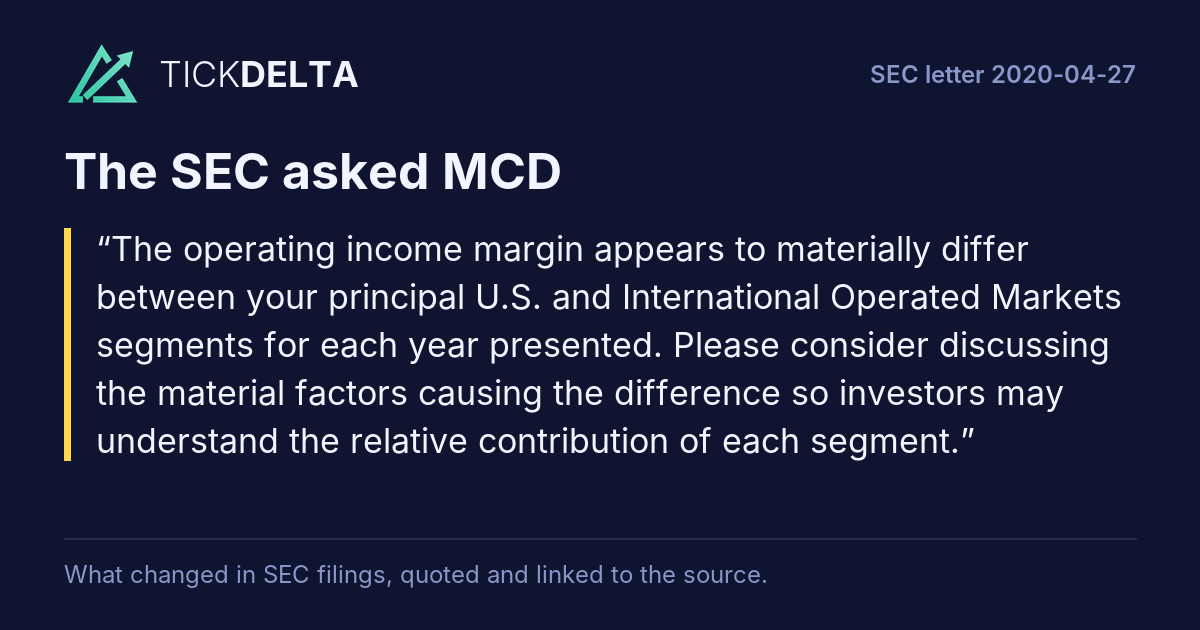
The operating income margin appears to materially differ between your principal U.S. and International Operated Markets segments for each year presented. Please consider discussing the material factors causing the difference so investors may understand the relative contribution of each segment.
MCD answered
The primary driver causing operating margin of the U.S. and International Operated Markets (“IOM”) segments to materially differ from one another for each year presented is due to each of the segment’s ownership structure, and primarily its percentage of franchised restaurants. The operating margin percent for a franchised restaurant is higher than that of a Company-owned restaurant due to the fact that franchised margin expenses (primarily comprised of lease expense and depreciation expense) are lower and relatively fixed, whereas Company-operated restaurant expenses are higher and have more
Rest of the answer

variable cost components that fluctuate with sales. As a perspective, prior to COVID-19, the Company generated franchised margin percents between 75% to 85%, while Company-operated margin percents were between 15% to 20%.

As of December 31, 2019, the U.S. segment was 95% franchised and the IOM segment was 84% franchised. These percentages are disclosed within the Segment and Geographic Information footnote on page 45 of the Form 10-K. Within the Management’s Discussion and Analysis of Financial Condition and Results of Operations (“MD&A”) section of the Form 10-K, the Company discloses Company-operated sales and Franchised revenues generated by each segment separately. The Company also discloses the components of operating income by segment throughout MD&A, which includes franchised margins, Company-operated margins, and selling, general and administrative expenses.

McDonald’s believes that the Form 10-K provides meaningful information for a reader to understand the drivers of operating margin by segment. The Company does not calculate or disclose operating margin by segment, as we do not set targets or provide guidance for this metric by segment. Further, the ownership structure, which is the primary driver of operating margin, is affected by refranchising transactions, and the timing of these transactions within various markets is generally hard to predict, therefore, the Company has provided a long-term outlook for operating margin on a consolidated basis only.

The Company’s management does not make key business decisions based on this particular metric by segment, and therefore we do not plan to provide operating margin by segment in future filings. However, we will provide additional information in the definition of consolidated operating margin to describe the differences in segment contributions. This additional information was provided on page 23 of our Quarterly Report on Form 10-Q for the quarter ended March 31, 2020, filed on May 7, 2020 and will also be included in future filings [changes to address the comment are emphasized in bold]:

•

Operating Margin: Operating margin is defined as operating income as a percent of total revenues. The contributions to operating margin differ by segment due to each segment's ownership structure, primarily due to the relative percentage of franchised versus Company-operated restaurants. Additionally, the number of temporary restaurant closures, which vary by segment, as a result of COVID-19, will also impact the contribution of each segment to the consolidated operating margin.

Operating margin was 35.9% and 41.7% for the quarters ended 2020 and 2019, respectively. The decrease in operating margin percent was driven by a decline in sales performance, higher other operating expenses and higher G&A spend.

Read in the reply ↗
In its next report

First report after the company's reply of 2020-05-11: 10-Q filed 2020-08-10 ↗, against the 10-Q filed 2019-11-04 ↗.

Tickdelta does not hold the text of both reports, so they are not compared here.

Contractual Obligations and Commitments , page 19
SEC asked (2)
It appears from your disclosure certain purchase commitments that are not recognized in the consolidated financial statements and are primarily related to construction, inventory, energy, marketing and other service related arrangements that occur in the normal course of business have been excluded from the table of contractual obligations.
Rest of the question

You further state such commitments are generally shorter term in nature, will be funded from operating cash flows, and are not significant to your overall financial position. Because the purpose of the table is to improve investors' ability to assess liquidity and capital resource needs, please explain to us the relative materiality of these commitments to your operating cash flows and what period of time is meant by "shorter term in nature."

MCD answered
As the purpose of the table is to improve investors’ ability to assess liquidity and capital resource needs, we have focused attention on our operating leases and debt obligations as they represent the most significant contractual obligations of the Company and are most relevant to an investor assessing our liquidity and potential capital resource needs.
Rest of the answer

The Company also provides a narrative, which specifically acknowledges certain liabilities recorded in its financial statements related to supplemental benefit plans and unrecognized tax benefits, that are discussed further within the Benefit Plan and Tax footnotes in our Form 10-K, respectively. In addition, in an effort to acknowledge certain other non-significant items not included in the table or recorded elsewhere in our financial statements, the Company discusses identified items and their potential source of funding.

On an annual basis, the Company employs a robust process in which we seek out potential purchase commitments or obligations from those individuals within the Company most likely to have knowledge of these types of commitments. These inquiries are designed to capture financial commitments of the Company that exceed $1 million USD. Although the inquiries are designed to capture significant items, many of the responses received are less than the designated $1 million threshold, and even when aggregated, the combined total is less than 5% of our 2019 operating cash flows. Furthermore, many of the identified commitments through this process are not subject to legally binding contracts or permit cancellation with no or minimal costs to the Company. The majority of the identified commitments are for ongoing business operations and range in periods anywhere from less than 12 months to 36 months.

Throughout the MD&A and Outlook sections of our Form 10-K, the Company discusses and provides guidance on key annual operating obligations that impact cash flows and liquidity, such as restaurant margin expenses (a subset of which is our lease obligations), selling, general & administrative expenses, capital expenditures and interest expense. The Company believes that focusing attention on the operating lease and debt obligations within the table, and then acknowledging the less significant items in the subsequent narrative and other areas of the filing, provides investors with a clear understanding of the Company’s liquidity and capital resource needs. In an effort to provide even more clarity to our investors, beginning with the Form 10-K for the fiscal year ending December 31, 2020, we will change our disclosure to address the comment to read as follows:

On a recurring basis, the Company contracts with vendors and suppliers in the normal course of business. These contracts may include items related to construction projects, inventory, energy, marketing, technology and other services. Generally, these items are shorter term in nature and have no minimum payment requirements. They are funded from operating cash flows and reflected in other areas of the Form 10-K (e.g., franchised margins, Company-operated margins and selling, general and administrative expenses that are reflected in the Consolidated Statement of Income and capital expenditures that are reflected on the Consolidated Statement of Cash Flows).

Read in the reply ↗
In its next report

First report after the company's reply of 2020-05-11: 10-Q filed 2020-08-10 ↗, against the 10-Q filed 2019-11-04 ↗.

Tickdelta does not hold the text of both reports, so they are not compared here.

Notes to Consolidated Financial Statements · Advertising Costs, page 41
SEC asked (3)
You disclose advertising costs of company operated restaurants and franchisees consist of contributions to advertising cooperatives. You further disclose the costs incurred by these advertising cooperatives are approved and managed jointly by vote of both company operated restaurants and franchisees.
Rest of the question

Please tell us in detail how these advertising cooperatives operate, the significant terms of these arrangements for both company operated restaurants and franchisees and your accounting for the cooperatives, particularly in regard to the costs incurred by and contributions to them. Additionally, explain to us the basis for your conclusion that consolidation of these cooperatives is not appropriate.

MCD answered
The Company and its franchisees are members of national and local advertising cooperatives in countries in which it does business around the world. The cooperatives are operated for the collective benefit of its members to secure and pay for advertising costs. Advertising cooperatives receive contributions from both franchisees and Company-operated restaurants based on a percentage of their respective sales.
Rest of the answer

The proportion of contributions from Company-operated restaurants is commensurate with the percentage of Company-operated sales in each country, and are reflected within Company-operated expenses, as sales are incurred. The contributions from Company-operated restaurants are disclosed annually in the Advertising Costs footnote in our Form 10-K. Globally, McDonald’s is 93% franchised and sales from Company-operated restaurants represented approximately 10% of total Systemwide sales for 2019. The cooperatives are not designed to make a profit. Their activities are strictly limited to promoting products offered for sale in restaurants using advertising support.

There are two advertising cooperative models across the McDonald’s System, with the majority operated as independent legal entities (variable interest entities as assessed under Accounting Standards Codification ("ASC") 810 "Consolidation") that make up over 80% of total annual Systemwide advertising spend. The remaining less than 20% are operated as consolidated pass through entities and are accounted for under ASC 606 “Revenue Recognition - Revenue from Contracts with Customers”, primarily as an agent.

The advertising cooperatives were created in order to have a formalized manner in which to conduct advertising for McDonald’s brand on behalf of the McDonald’s system. McDonald’s does not have any equity ownership interests in these cooperatives. The purpose of the cooperatives is to promote products and services offered for sale by the members of the cooperative through the purchase of national or local advertising (through all media channels) and marketing support. All franchise members and McDonald’s (for Company-owned restaurants) contribute a consistent percentage of sales to these entities, which generate market wide advertising for the McDonald’s System.

An operating committee is established for each country’s cooperative to represent the Company-owned restaurants and franchisees in cooperative decisions. The annual marketing plan in each country and any subsequent interim revisions are subject to a vote of the respective country’s cooperative operating committee, and includes all marketing campaigns and expenditures therein, along with approvals of annual restaurant contribution rates. Any increase in the approved annual cooperative budget must also be approved by a majority vote of the operating committee. The operating committee may, but need not, delegate to a governing committee and/or a governing committee chair (if either one exists in that country structure), at its discretion, the authority to modify or commit additional funds within the approved budget or make changes in the plan. However, these delegations are required to be temporary. A governing committee or a governing committee chair may not exceed budgeted expenditures without the approval of the operating committee. The composition of a governing committee, if one exists, must be structured such that McDonald’s does not represent the majority of committee members. McDonald’s is not permitted to chair a governing committee. The composition of an operating committee is based on franchisee and McDonald’s representation within each market that is in line with the relative percentage of franchised and Company-owned restaurants. This results in McDonald’s vote being significantly less than 50%, and McDonald’s therefore does not have the power to direct the activities and expenditures of a cooperative in any one country.

McDonald’s has concluded that in countries where the structure of the cooperative is through an independent legal entity, these advertising cooperatives are variable interest entities in accordance with ASC 810. However, McDonald’s is not the primary beneficiary of these entities as evaluated under ASC 810-10-25-38. McDonald’s does not have the power, through voting or similar rights, to direct the activities of the cooperatives that most significantly impact their economic performance, such as the establishment of the annual restaurant contribution rates and how those contributions are ultimately spent on advertising activities. The Company’s voting is largely consistent with the Company-operated restaurant percentage in each market. As such, the Company has significantly less than half of the voting power in each country, and therefore cannot make any controlling decisions, nor does McDonald’s have any participating rights (i.e., tiebreaker or veto rights). The power of the cooperative is equally distributed across all restaurants, as no one restaurant benefits more than any other.

McDonald’s has concluded that consolidation of these advertising cooperatives is not appropriate. Therefore, as mentioned above, we reflect advertising expenses for Company-operated restaurants at the time the obligation to the cooperative is due, which is as sales are incurred. As the advertising cooperatives generally operate on a zero based budget (i.e., all funds that are received are spent in a given year), any assets or liabilities that remain with the cooperative at the end of any year are immaterial, and therefore no disclosure of these assets or liabilities is necessary.

In addition, McDonald’s may contract for production costs for radio and television advertising outside of the cooperative structure and/or in addition to advertising services managed by the cooperatives, as needed. These production costs as well as marketing-related expenses are included in Selling, general & administrative expenses.

In order to provide an investor with greater clarity into our accounting for advertising cooperatives, beginning with the Form 10-K for the fiscal year ending December 31, 2020, that we will enhance our disclosure to read as follows [changes to address the comment are emphasized in bold]:

Advertising costs included in operating expenses of Company-operated restaurants primarily consist of contributions to advertising cooperatives and were (in millions): 2020-$xxx; 2019-$xxx; 2018-$xxx. In addition, significant advertising costs are incurred by conventional franchisees through contributions to advertising cooperatives in individual markets. In the markets that make up the vast majority of the Systemwide advertising spend, including the U.S., McDonald’s is not the primary beneficiary of these entities, and therefore has concluded that consolidation would not be appropriate, as the Company does not have the power through voting or similar rights to direct the activities of the cooperatives that most significantly impact their economic performance.

Production costs for radio and television advertising are expensed when the commercials are initially aired. These production costs, primarily in the U.S., as well as other marketing-related expenses are included in Selling, general & administrative expenses and were (in millions): 2020-$xxx; 2019-$xxx; 2018-$xxx.

Read in the reply ↗
In its next report

First report after the company's reply of 2020-05-11: 10-Q filed 2020-08-10 ↗, against the 10-Q filed 2019-11-04 ↗.

Tickdelta does not hold the text of both reports, so they are not compared here.

Controls and Procedures · Disclosure Controls, page 59
SEC asked (4)
Your conclusion regarding the effectiveness of disclosures controls and procedures specifically addressed only a portion of the definition of disclosure controls and procedures as defined in Exchange Act Rules 13a-15(e) and 15d-15(e).
Rest of the question

The portion of the definition not addressed is in regard to disclosure controls and procedures designed to ensure that information required to be disclosed in reports filed or submitted under the Act is accumulated and communicated to management as appropriate to allow timely decisions regarding required disclosure. Although there is no requirement to disclose the full definition, specific reference to only a portion of the definition gives the appearance of limiting management´s conclusion solely to the portion referred to. Please represent to us and revise future filings to state management´s conclusion in regard to the company's disclosure controls and procedures as fully defined in Exchange Act rules 13a-15(e) and 15d-15(e).

MCD answered
The Company represents that for the fiscal year ended December 31, 2019, management’s conclusion set forth in the Form 10-K with respect to disclosure controls and procedures was on the basis of the full definition of disclosure controls and procedures in Exchange Act Rules 13a-15(e) and 15d-15(e). The Company will revise its future filings to state management’s conclusion in regard to disclosure controls and procedures as fully defined in Exchange Act Rules 13a-15(e) and 15d-15(e).
Rest of the answer

In addition, the Company has included the following conclusion regarding the effectiveness of its disclosure controls and procedures on page 32 in our Quarterly Report on Form 10-Q for the quarter ended March 31, 2020, filed on May 7, 2020, which will also be included in future filings [changes to address the comment are emphasized in bold]:

An evaluation was conducted under the supervision and with the participation of the Company’s management, including the Chief Executive Officer (“CEO”) and Chief Financial Officer (“CFO”), of the effectiveness of the design and operation of the Company’s disclosure controls and procedures (as that term is defined in Rules 13a-15(e) and 15d-15(e) under the Securities Exchange Act of 1934 (the “Exchange Act”)) as of March 31, 2020. Based on that evaluation, the CEO and CFO concluded that the Company’s disclosure controls and procedures were effective as of such date to provide reasonable assurances that information required to be disclosed by the Company in the reports filed or submitted under the Exchange Act, is recorded, processed, summarized and reported within the time periods specified in Securities and Exchange Commission rules and forms, and is accumulated and communicated to the Company's management, including the CEO and CFO, as appropriate to allow timely decisions regarding required disclosure.

Read in the reply ↗
In its next report

First report after the company's reply of 2020-05-11: 10-Q filed 2020-08-10 ↗, against the 10-Q filed 2019-11-04 ↗.

Tickdelta does not hold the text of both reports, so they are not compared here.

Notes to Consolidated Financial Statements · Advertising Costs, page 41
SEC asked
We note your response to prior comment 3. You state advertising cooperatives that you consolidate are pass through entities that you primarily account for as an agent under ASC 606. Since you control these entities, please explain to us your basis for why you are an agent rather than the principal in these cooperative arrangements pursuant to ASC 606.
Rest of the question

In your response, tell us whether franchisees contribute to the advertising cooperatives you consolidate and who is responsible for billing and collecting contributions to these cooperatives. Also, please explain to us in further detail your accounting for and financial statement reporting of the receipts and disbursements associated with the advertising cooperatives you are involved with. In so doing, break out your response between those associated with cooperatives you consolidate versus those associated with cooperatives you do not consolidate.

MCD answered
Background: Cooperative Arrangements and Unconsolidated Legal Entity Cooperatives

As detailed in our previous response dated May 11, 2020, the Company and its franchisees are members of national and local advertising cooperatives in countries in which we do business around the world. There are two advertising cooperative models across the McDonald’s System, with the majority operated as separate unconsolidated legal entities (variable interest entities as assessed under Accounting Standards Codification (“ASC”) 810 “Consolidation”), and these make up over 80% of total annual Systemwide
Rest of the answer

advertising spend. The remaining less than 20% of total Systemwide advertising spend, which has historically been equivalent to less than 2% of annual consolidated revenues, is primarily facilitated through the Company’s consolidated operating entities and is accounted for under ASC 606 “Revenue Recognition - Revenue from Contracts with Customers”, primarily as an agent. The net amount accounted for as an agent has historically been less than 0.1% of annual consolidated revenues. These amounts are not material to our financial statements and, at the current time, we do not expect these figures to materially change in future periods.

An operating committee is established for each country’s cooperative to represent the Company-operated restaurants and franchisees in cooperative decisions. The annual marketing plans in each country, and any subsequent interim revisions to these plans, are subject to a vote of the respective country’s cooperative operating committee. This annual plan includes the marketing campaigns, and through the approval of the campaign, the approval of the advertising agency and associated expenditures. The cooperative is structured to break even and spend all monies collected. The cooperative operating committee also approves annual restaurant contribution rates and how any surplus or deficit at the end of a year will be used or managed. Any increase in the approved annual cooperative budget must also be approved by a majority vote of the operating committee. The operating committee may, but need not, delegate to a governing committee or a committee chair (if either one exists in that country structure), at its discretion, the authority to modify or commit additional funds within the approved budget or make changes in the plan. However, these delegations are required to be temporary. A governing committee or a committee chair may not exceed budgeted expenditures without the approval of the operating committee. The composition of a governing committee, if one exists, must be structured such that McDonald’s does not represent the majority of committee members. McDonald’s is not permitted to chair a governing committee. The composition of an operating committee is based on franchisee and McDonald’s representation within each country that is in line with the relative percentage of franchised and Company-operated restaurants. This results in McDonald’s vote being less than 50%, and McDonald’s therefore does not have the power to direct the activities and expenditures of a cooperative in any one country. Regardless of whether the cooperative is a separate unconsolidated legal entity or facilitated through the Company’s consolidated operating entities, the operating and governance structure are substantially consistent.

Cooperative Arrangements

For the less than 20% of annual Systemwide advertising spend that occurs through pass through cooperative arrangements, the Company has concluded that the contributions collected from franchisees are revenues from a customer, and therefore refers to ASC 606 for the applicable guidance concerning the accounting treatment and conclusions. The cooperatives that operate within our primary operating entities in a country are established for the purpose of facilitating advertising services for Company-operated and franchised restaurants. The facilitation of advertising services entails McDonald’s collecting contributions based on a percent of sales from Company-operated and franchised restaurants, as well as contracting with third party marketing and advertising agencies on behalf of, and as directed by the marketing plan voted on by the members of the cooperative. Members of the cooperative vote each year on the contribution rate and contributions are restricted to the use of paying for marketing and advertising services. Such services are pursuant to a marketing plan voted on by members of the cooperative annually, with McDonald’s merely serving to facilitate the billing and collection in accordance with the marketing plan.

In the Company’s evaluation of the accounting for the cooperatives (and operating spending) that are facilitated through a consolidated operating entity, the Company evaluated step two of the ASC 606 five step model by identifying the specified goods or services (the performance obligations) to be provided to the customer (our franchisees) in order to evaluate whether the goods or services are separate and apart from the franchise agreement. Under the Company’s franchise agreement, a franchisee is obligated to pay rent for the use of the real estate, a royalty for Brand support, and an initial franchise fee for the right to operate a McDonald’s restaurant. The franchise agreement establishes a commitment by the franchisee to advertise and promote the restaurant to the general public and to spend a specified percentage of the restaurant’s gross sales each year for this purpose. This commitment of the franchisee to spend a percentage of gross sales on advertising does not dictate the amount be spent through the cooperative. Further, the franchise agreement does not include an obligation by McDonald’s to provide marketing or advertising services. Therefore, the collection of the restaurant contributions and disbursements for advertising services (i.e., the facilitation of advertising services) is a separate performance obligation from those in the franchise agreement, and the Company is considered an agent in connection with ASC 606-10-55-36 as its obligation is to arrange for the marketing services as further discussed below.

The advertising services performed by a marketing or advertising agency are also not part of the franchise agreement. These are separate contracts with distinct services offered to the restaurants through the cooperative by third party agencies. Although McDonald’s may be the contracting party with the third party agencies, when the activities are conducted through one of our consolidated operating entities, the agency and campaign is subject to the approval by the cooperative members through the operating and governance model discussed above. The operating and governance model does not allow for McDonald’s to unilaterally approve or make changes to the annual marketing plan and its campaigns therein. McDonald’s, as part of the franchise agreement, has no obligation to make placement of any program in the national or local media (via print, radio, television, outdoor, point of sale, direct mail or the Internet), nor does it make any obligations to facilitate the process for a third party to provide the marketing or advertising activities. Marketing and advertising services are not dependent on, or interrelated with, the continuing rights and services offered through the franchise agreement. In these situations, the Company evaluates whether the nature of its facilitation is a performance obligation to provide the specified goods or services itself (that is, the Company is a principal) or to arrange for those goods or services to be provided by another party (that is, the Company is an agent) (ASC 606-10-55-36). McDonald’s has concluded that it is an agent in that it does not control the advertising or marketing services before they are transferred to the customer, our franchisees.

An entity that is a principal controls any one of the following prior to its transfer to a customer (ASC 606-10-55-37):

a.

A good or another asset from the other party that it then transfers to the customer.

b.

A right to a service to be performed by the other party, which gives the entity the ability to direct that party to provide the service to the customer on the entity’s behalf.

c.

A good or service from the other party that it then combines with other goods or services in providing the specified good or service to the customer.

Based on the operating and governance model of the cooperative described above, McDonald’s cannot direct the use of the assets (advertising contributions from restaurants) or the spending of the cooperative entity (payments for advertising services), nor can it prevent the franchisees from obtaining the benefits of the advertising services.

The company also considered the following indicators, which denote whether an entity controls the specified good or service before it is transferred to a customer (ASC 606-10-55-39), and has included how each may be applicable to McDonald’s:

The entity is primarily responsible for fulfilling the promise to provide the specified good or service.

•

McDonald’s is not primarily responsible for providing advertising or marketing activities to restaurants. A third party advertising or marketing agency selected to execute a marketing campaign is responsible for fulfilling the contract for these services. This third party agency is either approved or vetoed by the operating committee of the cooperative through the cooperative voting on the annual marketing plan and each marketing campaign. Notably, the operating and governance model of the cooperative does not allow for McDonald’s to unilaterally approve or make changes to the annual marketing plan and its campaigns therein.

The entity has inventory risk before the specified good or service has been transferred to a customer or after transfer of control to the customer.

Inventory risk does not apply in McDonald’s cooperative arrangements as the arrangement is to facilitate the delivery of advertising and marketing services, not a product or good that would be considered subject to inventory risk.

The entity has discretion in establishing the price for the specified good or service.

Through the voting structure of the cooperative described above, McDonald’s does not have the ability to control the annual contribution rate that restaurants pay to the cooperative each year. McDonald’s also does not have the discretion to set the price that the cooperative pays for the advertising services as that is dictated by the independent agencies providing the services.

Based on the above, the Company has concluded that McDonald’s acts as an agent for the advertising services managed through pass through advertising cooperative arrangements, rather than a principal. As such, we present both the cash receipts from franchised restaurants and cash disbursements to third party marketing and advertising agencies on a net basis within our consolidated financial statements for these pass through advertising cooperative arrangements. In 2019, the gross receipts collected by the cooperative from our franchisees represented less than 2% of total consolidated revenues, and the net amount at year-end was less than 0.1% of total consolidated revenues. The contributions to the pass through cooperative from our Company-operated restaurants are reflected as Company-operated restaurant expenditures as sales are incurred.

Unconsolidated Legal Entity Cooperatives

As detailed in our previous response, dated May 11, 2020, the advertising cooperative entities that are operated as separate legal entities are not consolidated and therefore, have no impact on our consolidated financial statements. The contributions to the unconsolidated cooperatives from franchisees is between the franchisee and the cooperative entity only, and accordingly these contributions are not reflected in McDonald's consolidated financial statements. McDonald’s does not collect or disburse any cash associated with franchisee contributions to these unconsolidated cooperatives and has no decision making authority other than through minority representation on the operating committee reflecting its Company-operated restaurants. The cash disbursements of the unconsolidated cooperatives are expenditures of the cooperatives and are therefore reflected in the financial statements of the cooperatives and not those of McDonald’s Corporation or its subsidiaries. Similar to the pass through arrangements, McDonald’s contributions for Company-operated restaurants to the unconsolidated cooperatives are reflected within Company-operated restaurant expenditures as sales are incurred.
Read in the reply ↗
In its next report

First report after the company's reply of 2020-06-29: 10-Q filed 2020-08-10 ↗, against the 10-Q filed 2019-11-04 ↗.

Tickdelta does not hold the text of both reports, so they are not compared here.

Also in this review: company letter, 2020-06-11, closing letter, 2020-07-08

From the SEC's correspondence on EDGAR: staff letters (form UPLOAD) and company letters (form CORRESP), 22 letters filed since 2020-04-28. Questions and answers are matched by their numbers; topics come from words in each question. The reports are compared word for word (same form, before the first SEC letter against the first report after the company's reply). No AI.

Work on MCD in a spreadsheet: Excel workbook (a sheet per section, ten years by column, charts, links to the filings) · CSV. For a Google Sheet that stays up to date, paste =IMPORTDATA("https://tickdelta.com/company/MCD/export.csv") into a cell.