Form 10-K for the Fiscal Year Ended December 31, 2021
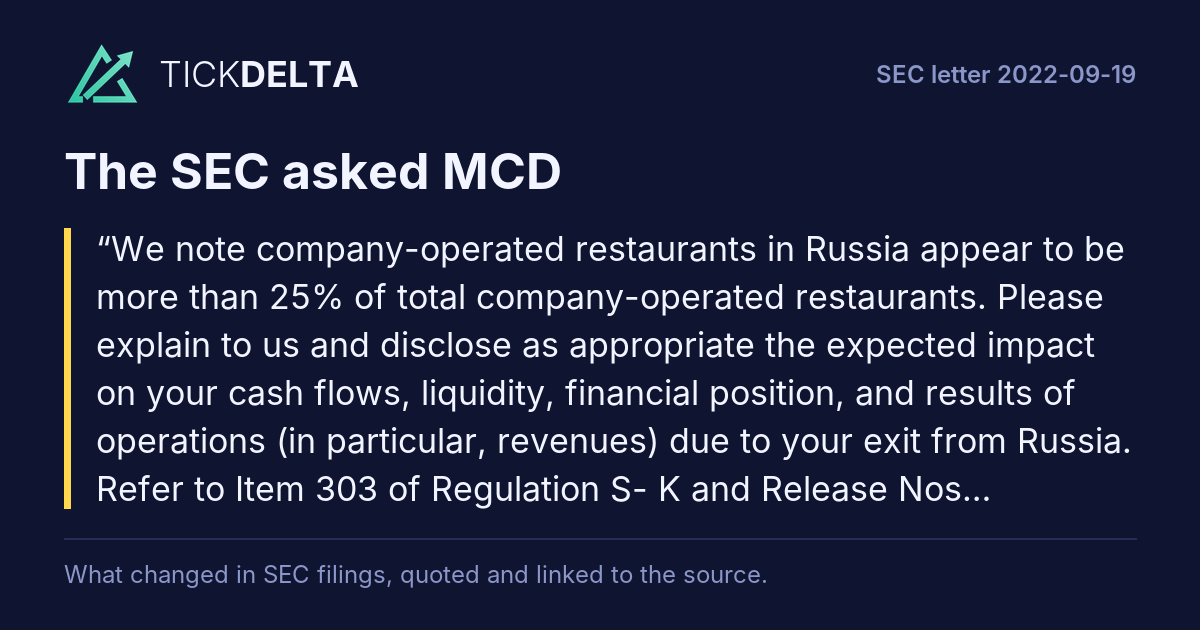
We note company-operated restaurants in Russia appear to be more than 25% of total company-operated restaurants. Please explain to us and disclose as appropriate the expected impact on your cash flows, liquidity, financial position, and results of operations (in particular, revenues) due to your exit from Russia. Refer to Item 303 of Regulation S- K and Release Nos. 33-6835 and 33-8350 for guidance.
We respectfully acknowledge the Staff’s comment, and we advise the Staff that the Company's exit from Russia did not have a material impact on reported cash flows, liquidity, financial position and results of operations and will not have a material impact on those metrics in the future. As of December 31, 2021, Company-operated restaurants represented 7% of total restaurants, and restaurants in Russia (most of which were Company-operated) represented only 2% of total restaurants.Read in the reply ↗Rest of the answer
Additionally, as previously disclosed during the question-and-answer portion of the Company's second quarter 2022 earnings conference call, for the year ended December 31, 2021, Russia represented only 2% of Systemwide sales and 2% of Operating income. Systemwide sales and Operating income are key predictive indicators of our business performance and therefore included in the guidance provided by the Company in its Outlook. Although Russia represented 7% of Revenues as of December 31, 2021, it represented only 2% of Operating income due to the cost structure of Company-operated restaurants.
On February 24, 2022, the Company posted supplemental information to its website titled “Supplemental Information on McDonald’s Russia and Ukraine” disclosing the number of restaurants in Russia and Ukraine as of December 31, 2021, including ownership type, as well as the combined impact of Russia and Ukraine to Systemwide sales, Revenues and Operating income for 2021. As disclosed in the supplemental information, for the year ended December 31, 2021, Russia and Ukraine combined represented only 2% of Systemwide sales, 9% of Revenues and less than 3% of Operating income. As noted above, the Company also shared the impact of Russia in relation to Systemwide sales, Revenues, and Operating income during its second quarter 2022 earnings conference call.
In addition to the supplemental information posted on the Company's website, the Company also filed a Form 8-K on May 16, 2022 announcing the decision to exit the Russian market, where it reaffirmed its 2022 Outlook (previously included on page 25 of the Company's Form 10-Q for the quarter ended March 31, 2022), with the following minimal updates:
•The Company expects operating margin to be in the 40% range as a result of the charge for Russia. Excluding impairment and other strategic charges, the Company expects adjusted operating margin to be in the mid-40% range (operating margin is defined as operating income as a percent of total revenues).
•Excluding the closure of all restaurants in Russia, the Company expects:
◦net restaurant unit expansion will contribute about 1.5% to 2022 Systemwide sales growth in constant currencies.
◦over 1,300 net restaurant additions in 2022.
•The Company expects 2022 capital expenditures to be approximately $2.1 to $2.3 billion.
This updated 2022 Outlook was also included in the Company's Form 10-Q for the quarter ended June 30, 2022, where guidance related to free cash flows remained unchanged, along with additional guidance provided to assist in forecasting the Company’s future results for 2022.
Given that the exit from Russia was a one-time event and the size of the historical contributions from the market, the Company believes its disclosures satisfy the requirements of Item 303 of Regulation S-K and the Staff’s additional guidance in Release Nos. 33-6835 and 33-8350.
First report after the company's reply of 2022-09-30: 10-Q filed 2022-11-07 ↗, against the 10-Q filed 2022-08-04 ↗.
Tickdelta does not hold the text of both reports, so they are not compared here.
Please provide for the periods presented here and as applicable in your Form 10-K filings and interim period earnings releases furnished in Form 8-K a reconciliation between "Non-GAAP operating income" and GAAP "operating income." Refer to Item 10(e)(1)(i)(B) of Regulation S-K.
We respectfully acknowledge the Staff’s comment, and we advise the Staff that the Company’s Form 10-K for the fiscal year ended December 31, 2021; Form 10-Q for the quarter ended March 31, 2022; and Form 10-Q for the quarter ended June 30, 2022, as well as the associated earnings materials filed on Form 8-K, contain all components that are necessary to reconcile Non-GAAP Operating income to Operating income (and, as a result, Non-GAAP Operating margin to Operating margin).Read in the reply ↗Rest of the answer
Further, in each filing, the descriptions of all such adjustments are presented in advance of the disclosure of the Non-GAAP financial measures.
Specifically, in the Company’s Form 10-Q for the quarter ended June 30, 2022, prior to disclosing Non-GAAP Operating income and Non-GAAP Operating margin on page 28, all of the gains and charges adjusted in such measures and used to calculate Non-GAAP Net income are included on page 22 under “Net Income and Earnings Per Share-Diluted Reconciliation,” as well as on page 27 under “Other Operating (Income) Expense, net.” By providing these amounts, users are able to reconcile Non-GAAP Operating income to Operating Income.
Further, the definition of Operating margin is included on page 28 of the same filing, which allows users to recalculate Non-GAAP Operating margin and Operating margin using the Non-GAAP Operating income and Operating income figures provided.
We believe that the information provided is sufficient for users to reconcile the Non-GAAP financial measures to their most directly comparable GAAP financial measures. However in order to provide greater clarity, beginning with the Company’s Form 10-Q for the quarter ending September 30, 2022, as well as the associated earnings materials, we undertake to revise the disclosure under the “Operating Income & Operating Margin” table to summarize the applicable reconciling items previously disclosed elsewhere, should we elect to disclose non-GAAP operating income in the future. By way of example, revisions to the existing disclosure on page 28 of the Company’s Form 10-Q for the quarter ended June 30, 2022 are set forth below (with changes emphasized in bold):
Operating Income: Operating income decreased $979.3 million, or 36% (30% in constant currencies), for the quarter and $948.0 million, or 19% (15% in constant currencies) for the six months. Results for the quarter and six months 2022 reflected $1.2 billion and $1.3 billion, respectively, of pre-tax charges related to the sale of the Company's business in Russia. Results for both periods of 2022 also reflected a gain of $271 million related to the Company's sale of its Dynamic Yield business. Results for the quarter and six months 2021 reflected $98 million and $233 million, respectively, of net gains, primarily related to the sale of McDonald's Japan stock. The items above are excluded from non-GAAP operating income.
First report after the company's reply of 2022-09-30: 10-Q filed 2022-11-07 ↗, against the 10-Q filed 2022-08-04 ↗.
Tickdelta does not hold the text of both reports, so they are not compared here.
Also in this review: company letter, 2022-11-07, closing letter, 2022-11-23