tickdelta
Sign in

Tickdelta is free for now. Sign up and get Pro free

← Screener

Technology · Semiconductors · Nasdaq

MCHPMicrochip Technology

Compare with peers → Embed
The 10-K against last year's

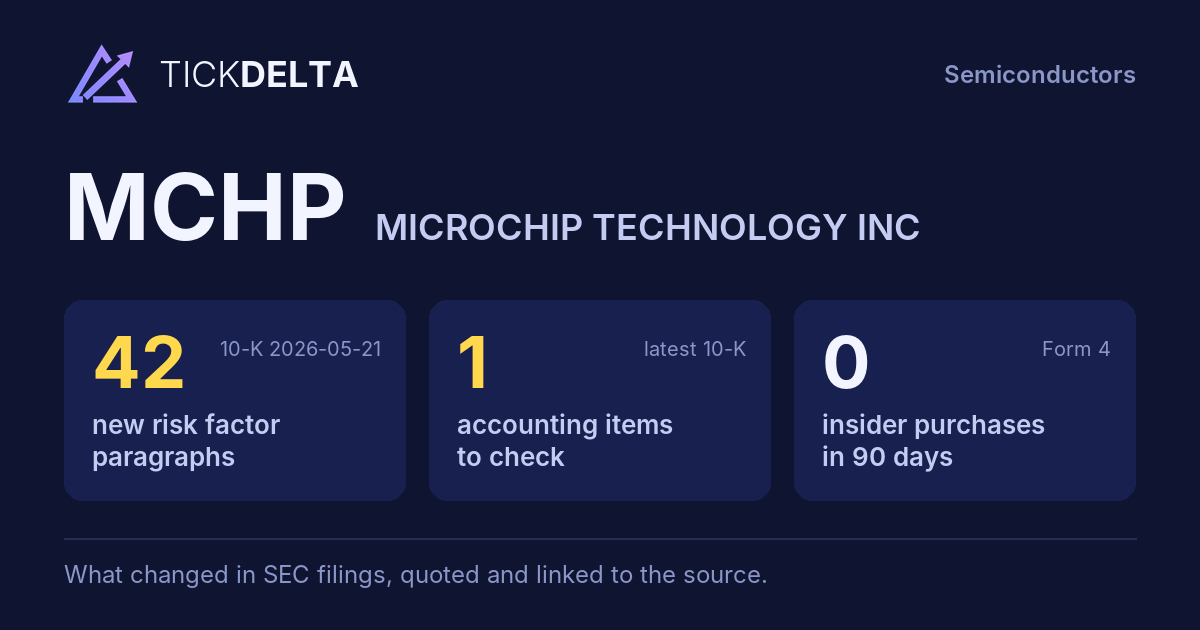
224 changes: 51 added, 30 removed, 135 reworded, 8 quiet changes

10-K May 21, 2026 vs May 23, 2025
Risk FactorsRedline ↓
26.6%
of the text changed · 23,054 words now
22.9%
of the text changed · 8,492 words now
Legal ProceedingsRedline ↓
25.1%
of the text changed · 655 words now
Accounting PoliciesRedline ↓
12.6%
of the text changed · 4,642 words now

10-K 0000827054-26-000016 (2026-05-21) vs 10-K 0000827054-25-000077 (2025-05-23)

The redline

The paragraph that changed most in each section

Marked against last year's 10-K: cut words struck through, new words highlighted and underlined.

Risk Factors 328 words changed in this paragraph; it is 52% similar to last year's version.
We rely on outside wafer foundries for a significant portion of our wafer fabrication needs. Specifically, during fiscal 2025 2026 and fiscal 2024, 2025, approximately 64% 65% and 64%, respectively, of our net sales came from products that were produced at outside wafer foundries. We also use several contractors for a portion of the assembly and testing of our products. Specifically, during fiscal 2025, 2026, approximately 33% of our assembly requirements and 31% of our test requirements were performed by third-party contractors compared to approximately 33% of our assembly requirements and 33% of our test requirements were performed by third-party contractors compared to approximately 41% during fiscal 2025. We have long-term commitment contracts with certain of our assembly requirements and 29% of our test requirements during fiscal 2024. Due third-party suppliers to the amount of inventory of our products help ensure that we are holding, receive capacity from them to manufacture wafers and assemble and test our products. We may decide to still purchase products or services under these contracts even though we currently may not need all of them in order to take advantage of contract credits. This could result in excess inventory and inventory reserve charges that may negatively affect our gross margin and results of operations. Additionally, if we have recently taken actions to decrease our a need for greater manufacturing, assembly or test capacity allocation from our wafer fabrication, assembly and test subcontractors. In the event that we need to increase capacity allocation from our wafer fabrication, assembly and test subcontractors in the future future, or greater capacity for certain types of products, there can be no assurance that we will be able to secure the necessary allocation of capacity from our wafer foundries and other contractors, contractors with the process technologies that we need, or that such capacity will be available on acceptable terms. As our manufacturing subcontractors move to more advanced process technologies over time, we may find that they do not invest in some of the trailing edge process technologies on which a large portion of our products are manufactured. If this occurs, it may limit the amounts of net sales that we can achieve or require us to make significant investments to be able to manufacture these products in As more companies focus on building leading edge products, our own facilities or at other foundries and assembly and testing contractors. We expect that our reliance on third party contractors may increase over time as our business grows, and any inability to secure necessary external capacity could adversely affect our operating results. Transitioning production of products to new manufacturers may result in delayed product launches, reduced yields, or decreased product performance. If we encounter issues with product quality, insufficient capacity from a third-party manufacturer, or if we discontinue using a particular manufacturer or contractor, we may face challenges in securing an alternative supply for specific products in a timely manner. This could lead to significant delays in product shipments, potentially having an adverse impact on our results of operations. If our reliance on third-party contractors increases over time, our inability to secure necessary external capacity could adversely affect our operating results.

Source: Item 1A, 10-K 0000827054-26-000016 vs Item 1A, 10-K 0000827054-25-000077

MD&A 271 words changed in this paragraph; it is 55% similar to last year's version.
Our level of capital expenditures varies from time to time as a result of actual and anticipated business conditions. Capital expenditures were $126.0 $91.1 million and $285.1 $126.0 million in fiscal 2025 2026 and fiscal 2024, 2025, respectively. Capital expenditures were primarily for the selective expansion of production capacity and the addition of research and development equipment. Consistent with the slowing macroeconomic environment in fiscal 2025, we have paused most of our factory expansion actions and reduced our planned capital investments through fiscal 2026. 2027. Our investments in equipment and facilities during the next 12 months are expected to be at or below $100 approximately $100.0 million. We believe that the capital expenditures anticipated to be incurred over the next 12 months will provide sufficient manufacturing capacity to support the growth of our production capabilities for our new products and technologies and to bring in-house more of the assembly and test operations that are currently outsourced. We expect to finance our capital expenditures through our existing cash balances and cash flows from operations. While select investments are still being made, in the fourth quarter of fiscal 2024, we paused most of our expansion activity. In the third quarter of fiscal 2025, we announced the closure of Fab 2 in Tempe, Arizona which was completed in May 2025. Despite pausing our expansion activity, we believe that our current inventory and production capacity are adequate to fulfill the projected requirements of our customers. In August 2022, the U.S. government enacted the CHIPS Act to provide billions of dollars of cash incentives and a new investment tax credit to increase domestic manufacturing capacity in our industry. In December 2023, we reached a Preliminary Memorandum of Terms with the U.S. Department of Commerce for $162 million in CHIPS Act grants for two of our U.S. wafer fabrication facilities; however, we have not concluded negotiations with the U.S. Department of Commerce and there can be no assurance that the grants will receive final approval. If we do receive a CHIPS Act grant, the restrictions and operational requirements that are imposed on CHIPS Act grant recipients could add complexity to our operations and increase our costs. We expect to receive the cash benefit associated with the investment tax credit for qualifying capital expenditures in future periods and may apply for other incentives provided by the legislation; however, there can be no assurance that we will receive any such other incentives, what the amount and timing of any incentive we receive will be, as to which other companies will receive incentives and whether the legislation will have a positive or negative impact on our competitive position.

Source: Item 7, 10-K 0000827054-26-000016 vs Item 7, 10-K 0000827054-25-000077

Accounting Policies 218 words changed in this paragraph; it is 31% similar to last year's version.
The Company is required to perform an impairment review of indefinite-lived intangible assets, including goodwill annually, and more frequently under certain circumstances. Indefinite-lived intangible assets are subjected to this annual impairment test during the fourth quarter of the Company's fiscal year. The Company engages primarily in the development, manufacture and sale of semiconductor products as well as technology licensing. As a result, the Company concluded there are two reporting units, semiconductor products and technology licensing. The Company's impairment evaluation consists of a qualitative impairment assessment in which management evaluates whether it is more likely than not that the indefinite-lived intangible assets are impaired. If it is determined that it is more likely than not, the Company performs a quantitative impairment test, which compares the fair value of the reporting unit or indefinite-lived intangible asset to its carrying value. If the Company determines through the impairment process that the indefinite-lived intangible asset has been impaired, the Company will record the impairment charge in its results of operation. Through March 31, 2025, the Company has never recorded a goodwill impairment charge. In the event that facts and circumstances indicate definite-lived intangible assets may be impaired, the Company evaluates the recoverability and estimated useful lives of such assets. If such indicators are present, recoverability is evaluated based on whether the sum of the estimated undiscounted cash flows attributable to the asset (group) in question is less than their carrying value. If less, the Company measures the fair value of the asset (group) and recognizes an impairment loss if the carrying amount of the assets exceeds their respective fair values.

Source: 10-K text, Note 1 – Significant Accounting Policies, 10-K 0000827054-26-000016 vs 10-K text, Note 1 – Significant Accounting Policies, 10-K 0000827054-25-000077

Legal Proceedings 167 words changed in this paragraph; it is 41% similar to last year's version.
In the ordinary course of the Company's business, it is exposed to various legal actions as a result of contracts, product liability, customer claims, pricing or royalty disputes with customers and licensees, governmental investigations and other matters. The Company is involved in a limited number of these legal actions, both as plaintiff and defendant, with respect to the foregoing types of matters. Consequently, the Company could incur uninsured liability in any of these legal actions. The Company also periodically receives notifications from various third parties alleging infringement of patents or other intellectual property rights, or from customers requesting reimbursement for various costs. With respect to pending legal actions to which the Company is a party and other claims, although the outcomes are generally not determinable, the Company believes that the ultimate resolution of these matters (other than certain tax matters in the U.S., Germany, and Malaysia as described in Note 12 below) will not have a material adverse effect on its financial position, cash flows or results of operations. Litigation, governmental investigations and disputes relating to the semiconductor industry are not uncommon, and the Company is, from time to time, subject to such litigation, governmental investigations and disputes. As a result, no assurances can be given with respect to the extent or outcome of any such litigation, governmental investigations or disputes in the future.

Source: Item 3, via Note 11 – Commitments and Contingencies, 10-K 0000827054-26-000016 vs Item 3, via Note 11 – Commitments and Contingencies, 10-K 0000827054-25-000077

Every change, by type

Sentences and paragraphs added, removed or reworded

Sentences and paragraphs of MCHP's Risk Factors and MD&A, 10-K 2026-05-21 against 10-K 2025-05-23. Each links to the text at sec.gov.

AddedRisk Factors
•impact of geopolitical instability in the Middle East on the availability of critical semiconductor materials, fuel costs, and our ability to meet customer demand;

Read it in 10-K 2026-05-21 at sec.gov ↗

AddedRisk Factors
•ability to introduce new products on a timely basis, including in response to market changes driven by AI and other factors, or by changing our product design and manufacturing to more advanced technology nodes;

Read it in 10-K 2026-05-21 at sec.gov ↗

AddedRisk Factors
•impact of evolving risks related to artificial intelligence, cybersecurity and data privacy across our products, operations, regulatory compliance, intellectual property, talent, and transactions;

Read it in 10-K 2026-05-21 at sec.gov ↗

AddedRisk Factors
Our manufacturing operations require a continuous supply of raw and processed materials, components, and production equipment that must meet stringent performance and quality standards. Although we generally maintain multiple sources for these items, only a limited number of suppliers may be capable of meeting our technical requirements. From time to time, we have experienced supply shortages, extended lead times, supplier announcements that certain orders could not be fulfilled, or the discontinuation of updates or parts for certain equipment. For example, in fiscal 2023 and fiscal 2022, we experienced cost increases from certain suppliers for materials used in our production processes; although conditions stabilized in fiscal 2024 and fiscal 2025, similar cost pressures may recur.

Read it in 10-K 2026-05-21 at sec.gov ↗

AddedRisk Factors
Any interruption in the supply of raw materials, components, or equipment - or reduced supplier support for key manufacturing tools - could adversely affect our ability to produce products in the required volumes or on expected timelines. Supply availability may be further limited as global semiconductor demand increases, suppliers shift production toward higher cost or more complex products, or as a result of supply chain disruptions, transit delays, or political instability. For example, as memory manufacturers transition to more advanced products, availability of the memory components we use may become constrained, have longer lead times, or become more expensive. Consolidation among suppliers may reduce supply alternatives or alter our commercial relationships. In addition, reduced labor availability or public health concerns may further impact the supply chain.

Read it in 10-K 2026-05-21 at sec.gov ↗

Show the other 13
AddedRisk Factors
Any of these factors could increase our manufacturing costs, impair our sourcing flexibility, delay our production schedules, and adversely affect our operating results. Additionally, our sales may be adversely impacted if tariffs or government trade actions restrict access to needed supplies.

Read it in 10-K 2026-05-21 at sec.gov ↗

AddedRisk Factors
Tariffs, trade restrictions, and evolving global trade policies pose risks to our supply chain, cost structure, and customer demand. Beginning in 2018 and continuing through 2026, the U.S. imposed additional tariffs on various imports, and several countries have imposed retaliatory tariffs on goods originating from the U.S. Although semiconductors currently remain exempt from certain U.S. tariffs under the ongoing Section 232 investigation, many inputs used in semiconductor manufacturing - including chemicals, metals, and equipment - remain subject to country specific tariffs or may become subject to new duties. The tariff landscape remains uncertain and may change with limited notice.

Read it in 10-K 2026-05-21 at sec.gov ↗

AddedRisk Factors
Tariffs and trade restrictions also affect our customers. If customers face reduced availability of labor, materials, or components, whether due to trade restrictions, supplier disruptions, escalating shipping constraints, or public health issues, they may reduce or suspend production of their own products, leading to decreased demand for our products. For example, in 2025, government actions involving Nexperia (including export control measures and interventions affecting its operations and cross-border shipments) resulted in restricted availability of certain mature-node semiconductors (such as discrete devices and standard logic) that are widely used by automotive and consumer electronics manufacturers. As a result, some of our customers may experience shortages of these components which may reduce their production volumes and, in turn, reduce demand for our products. Any such customer side disruptions may negatively affect our revenue and operating results.

Read it in 10-K 2026-05-21 at sec.gov ↗

AddedRisk Factors
On February 20, 2026, the U.S. Supreme Court ruled that certain tariffs collected pursuant to the International Emergency Economic Powers Act (IEEPA) were unconstitutional. On April 20, 2026, the U.S. Customs and Border Protection (CBP) began processing refunds through its Consolidated Administration and Processing of Entries (CAPE) portal. Although Microchip was the importer of record for products that were subject to tariffs imposed under IEEPA and should be entitled to a refund, the timing and the amount of any such recovery is not yet clear. As such, this could have a favorable impact on our financial position, operations, or cash flows, but we cannot predict the timing, likelihood, or amount of any refunds or other recoveries we may realize.

Read it in 10-K 2026-05-21 at sec.gov ↗

AddedMD&A
•The benefits and risks of the use of artificial intelligence by us, our partners and customers, or malicious third parties and its impact on our products, our labor and technological needs, and regulatory or intellectual property compliance;

Read it in 10-K 2026-05-21 at sec.gov ↗

AddedMD&A
•The impact on our business from the global minimum tax (GMT) and the Side-by-Side system introduced by the Organisation for Economic Co-operation and Development;

Read it in 10-K 2026-05-21 at sec.gov ↗

AddedMD&A
During fiscal 2025, our overall business was weak as we navigated through a large inventory correction due to our customers holding excess levels of inventory. In March 2025, we implemented a business recovery plan which included restructuring actions to reduce our costs, resize our manufacturing operations and reduce our headcount. In fiscal 2026, we saw an improvement in our business due to increased demand after our customers reduced excess inventory levels. Net sales in all our product lines and all our geographies increased in fiscal 2026 compared to fiscal 2025. Consistent with our recovery plan, we reduced inventory in fiscal 2026 compared to fiscal 2025 and we are now in a significant revenue growth mode and we expect our inventory to continue to decline as we appropriately manage our manufacturing and foundry resources. However, there continues to be uncertainty regarding overall macroeconomic conditions, including increased geopolitical tensions, risk of a recession, and the effects of potential trade policies, including tariffs.

Read it in 10-K 2026-05-21 at sec.gov ↗

AddedMD&A
Net sales of our mixed-signal microcontroller products increased approximately 4.7% in fiscal 2026 compared to fiscal 2025. The increase in net sales was primarily due to increased demand after customers reduced excess inventory levels as well as new customer design win activity entering production.

Read it in 10-K 2026-05-21 at sec.gov ↗

AddedMD&A
Net sales from our analog product line increased approximately 14.9% in fiscal 2026 compared to fiscal 2025. The increase in net sales was primarily due to increased demand due to a portion of our customer base having reduced excess inventory levels as well as new customer design win activity entering production.

Read it in 10-K 2026-05-21 at sec.gov ↗

AddedMD&A
is not met, no tax benefit of the uncertain tax position is recognized. If the threshold is met, we recognize the largest amount of the tax benefit that is more than 50% likely to be realized upon ultimate settlement.

Read it in 10-K 2026-05-21 at sec.gov ↗

AddedMD&A
The Organisation for Economic Co-operation and Development has introduced a global minimum corporate tax framework (GMT), with phased implementation starting January 1, 2024. While the U.S. has not adopted GMT, several countries where we operate have enacted related legislation, and others are expected to follow. In January 2026, the Organisation for Economic Co-operation and Development published a side-by-side system, which excludes U.S. multi-national entities from certain aspects of the GMT. We will continue to monitor developments around this guidance. The impact of the GMT for the fiscal year ended March 31, 2026 was not material to our financial results.

Read it in 10-K 2026-05-21 at sec.gov ↗

AddedMD&A
In July 2025, the U.S. government enacted the One Big Beautiful Bill Act (OBBBA), which includes permanent extensions of certain Tax Cuts and Jobs Act provisions and changes to the international tax framework. The effects of these changes have been recognized in the period ending March 31, 2026. The impact of OBBBA for the fiscal year ended March 31, 2026 was not material to our financial results. We will continue to evaluate the broader implications of OBBBA, including the effects of future regulatory guidance and interpretations.

Read it in 10-K 2026-05-21 at sec.gov ↗

AddedMD&A
With respect to shares of our Series A Preferred Stock, dividends are cumulative at an annual rate of 7.50% on the liquidation preference of $1,000.00 per share of Series A Preferred Stock. To date, our cumulative dividend payments on our Series A Preferred Stock have totaled approximately $108.5 million. A quarterly cash dividend of $18.750 per share of Series A Preferred Stock was declared on May 7, 2026 and will be paid on June 15, 2026 to the holders of Series A Preferred Stock of record as of June 1, 2026.

Read it in 10-K 2026-05-21 at sec.gov ↗
Next Related parties →