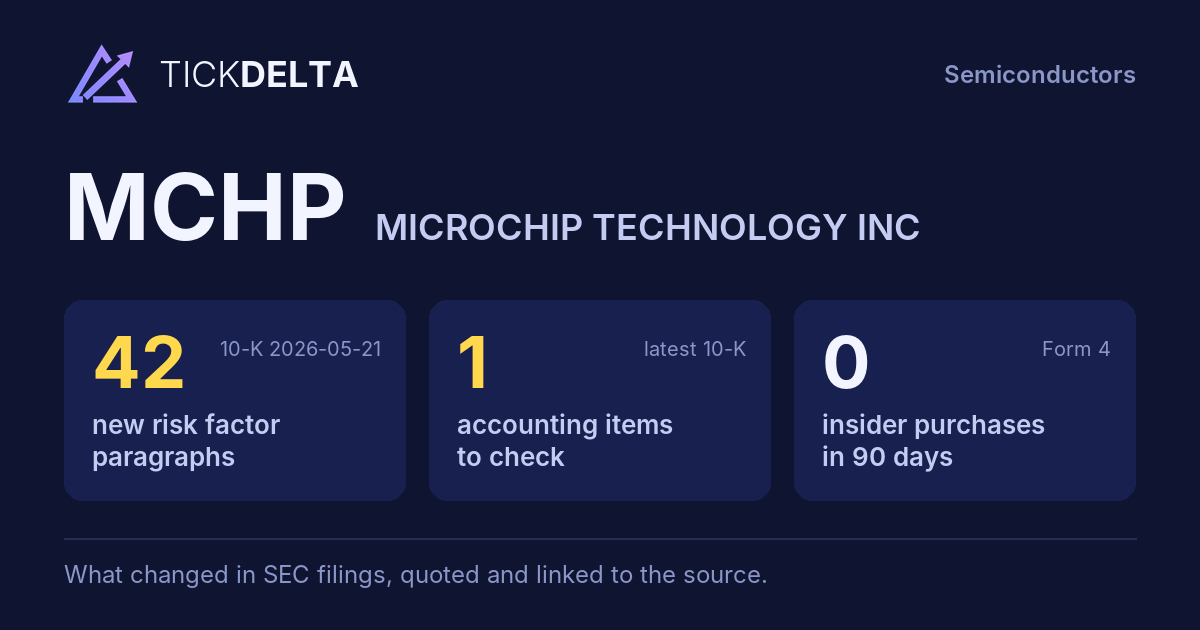
Sentences and paragraphs of MCHP's Risk Factors and MD&A, 10-K 2026-05-21 against 10-K 2025-05-23.
Each links to the text at sec.gov.
Show the other 69
AddedRisk Factors
Any of these factors could increase our manufacturing costs, impair our sourcing flexibility, delay our production schedules, and adversely affect our operating results. Additionally, our sales may be adversely impacted if tariffs or government trade actions restrict access to needed supplies.
Read it in 10-K 2026-05-21 at sec.gov ↗
AddedRisk Factors
Tariffs, trade restrictions, and evolving global trade policies pose risks to our supply chain, cost structure, and customer demand. Beginning in 2018 and continuing through 2026, the U.S. imposed additional tariffs on various imports, and several countries have imposed retaliatory tariffs on goods originating from the U.S. Although semiconductors currently remain exempt from certain U.S. tariffs under the ongoing Section 232 investigation, many inputs used in semiconductor manufacturing - including chemicals, metals, and equipment - remain subject to country specific tariffs or may become subject to new duties. The tariff landscape remains uncertain and may change with limited notice.
Read it in 10-K 2026-05-21 at sec.gov ↗
AddedRisk Factors
Tariffs and trade restrictions also affect our customers. If customers face reduced availability of labor, materials, or components, whether due to trade restrictions, supplier disruptions, escalating shipping constraints, or public health issues, they may reduce or suspend production of their own products, leading to decreased demand for our products. For example, in 2025, government actions involving Nexperia (including export control measures and interventions affecting its operations and cross-border shipments) resulted in restricted availability of certain mature-node semiconductors (such as discrete devices and standard logic) that are widely used by automotive and consumer electronics manufacturers. As a result, some of our customers may experience shortages of these components which may reduce their production volumes and, in turn, reduce demand for our products. Any such customer side disruptions may negatively affect our revenue and operating results.
Read it in 10-K 2026-05-21 at sec.gov ↗
AddedRisk Factors
On February 20, 2026, the U.S. Supreme Court ruled that certain tariffs collected pursuant to the International Emergency Economic Powers Act (IEEPA) were unconstitutional. On April 20, 2026, the U.S. Customs and Border Protection (CBP) began processing refunds through its Consolidated Administration and Processing of Entries (CAPE) portal. Although Microchip was the importer of record for products that were subject to tariffs imposed under IEEPA and should be entitled to a refund, the timing and the amount of any such recovery is not yet clear. As such, this could have a favorable impact on our financial position, operations, or cash flows, but we cannot predict the timing, likelihood, or amount of any refunds or other recoveries we may realize.
Read it in 10-K 2026-05-21 at sec.gov ↗
RemovedRisk Factors
•impact of price increases, increased tariffs, raw material availability or other factors affecting our suppliers;
Read it in 10-K 2025-05-23 at sec.gov ↗
RemovedRisk Factors
We may lose sales if suppliers of raw materials, components or equipment fail to meet our or our customers' needs, increase prices, are impacted by increases in tariffs, or such raw materials, components or equipment become restricted or unavailable.
Read it in 10-K 2025-05-23 at sec.gov ↗
RemovedRisk Factors
Our manufacturing operations require raw and processed materials and equipment that must meet exacting standards. We generally have multiple sources for these supplies, but there may be a limited number of suppliers capable of meeting our standards. We have experienced supply shortages from time to time in the past, and on occasion our suppliers have told us they need more time to fill our orders, that they cannot fill certain orders, that they will no longer support certain equipment with updates or parts, or that they are increasing prices. In particular, in fiscal 2023 and in fiscal 2022, we experienced increased prices at certain suppliers for certain materials required for production purposes. However, in fiscal 2024 and fiscal 2025, the pricing environment stabilized compared to the two prior fiscal years. An interruption of any materials or equipment sources, or the lack of supplier support for a particular piece of equipment, could harm our business. The supplies necessary for our business could become more difficult to obtain as worldwide use of semiconductors increases, or due to supply chain disruptions, transit disruptions, trade restrictions or political instability. Additionally, consolidation in our supply chain due to mergers and acquisitions may reduce the number of suppliers or change our relationships with them. Also, the reduced availability of necessary labor, the application of sanctions, trade restrictions or tariffs by the U.S. or other countries or the impact of public health concerns, may adversely impact the industry supply chain. The U.S. has imposed additional tariffs on imports, and certain countries have imposed retaliatory tariffs on imports that have the U.S. as their country of origin. For example, in March and April 2025, the U.S imposed tariffs on imports from China and other countries and foreign governments imposed tariffs on imports from the U.S. It is unclear what tariffs will apply to semiconductors during this time of change.
Read it in 10-K 2025-05-23 at sec.gov ↗
RemovedRisk Factors
Our customers may also be adversely affected by the tariffs and other issues described above. The labor, supplies and equipment necessary for their businesses could become more difficult to obtain for various reasons not limited to business interruptions of suppliers, reduced availability of labor, transit disruptions, consolidation in their supply chain, or sanctions, trade restrictions or tariffs or the impact of public health concerns that impair sourcing flexibility or increase costs. If our customers are not able to produce their products, then their need for our products will decrease. Such interruptions of our customers’ businesses could harm our business.
Read it in 10-K 2025-05-23 at sec.gov ↗
RemovedRisk Factors
We do not, nor have we historically, purchased significant amounts of equipment from Russia, Belarus, or Ukraine. However, the semiconductor industry, and purchasers of semiconductors, use raw materials that are sourced from these regions, such as neon, palladium, cesium, rubidium, and nickel. If we, or our direct or indirect customers, are unable to obtain the requisite raw materials or components needed to manufacture products, our ability to manufacture products, or demand for our products, may be adversely impacted. This could have a material adverse effect on our business, results of operations or financial condition. While there has been an adverse impact on the world’s palladium, neon, cesium, and rubidium supply chains, at this time, our supply chains have been able to meet our needs. While sales of our products into Russia, Belarus and Ukraine and to customers that sell into these countries, have been negatively impacted by the Russian invasion of Ukraine, at this time, we have not experienced a material impact on our business, results of operations or financial conditions. Further, because we do not support the actions of Russia against Ukraine, in March 2022 we stopped selling products to customers
Read it in 10-K 2025-05-23 at sec.gov ↗
RemovedRisk Factors
In August 2022, the U.S. government passed the CHIPS Act to provide billions of dollars of cash incentives and a new investment tax credit to increase domestic manufacturing capacity in our industry. We expect to receive the cash benefit associated with the investment tax credit for qualifying capital expenditures in future periods and applied for other incentives provided by the legislation; however, we have not concluded negotiations with the U.S. Department of Commerce and there can be no assurance that we will pursue or receive any such other incentives, what the amount and timing of any incentive we receive will be, as to which other companies will receive incentives and whether the legislation will have a positive or negative impact on our competitive position. If we conclude our CHIPS Act negotiations and receive a CHIPS Act grant, the restrictions and operational requirements that are imposed on CHIPS Act grant recipients could add complexity to our operations and increase our costs.
Read it in 10-K 2025-05-23 at sec.gov ↗
RemovedRisk Factors
Consistent with the slowing macroeconomic environment, and the growth in our inventory, we have paused our factory expansion actions at Fab 4 and Fab 5 and reduced our planned capital investments through fiscal 2026. We are unable to predict the duration or continued impact of the current or any future slowdown on our business.
Read it in 10-K 2025-05-23 at sec.gov ↗
RemovedRisk Factors
Additionally, operations at our customers and licensees may be disrupted for a number of reasons. In April and May 2020, we received a greater number of order cancellations and requests by our customers to reschedule deliveries to future dates. Some customers requested order cancellations within our firm order window and claimed applicability of force majeure clauses due to the impact of COVID-19. Likewise, if our licensees are unable to manufacture and ship products incorporating our technology, or if there is a decrease in product demand due to a business disruption, our royalty revenue may decline.
Read it in 10-K 2025-05-23 at sec.gov ↗
RemovedRisk Factors
contested the amount of royalty payments and related claims have resulted and could result in significant legal fees and require significant attention from our management. These issues may adversely impact the success of our licensing business and adversely affect our future operating results.
Read it in 10-K 2025-05-23 at sec.gov ↗
RemovedRisk Factors
certain limitations on our business, which would adversely affect our operating results and financial position.
Read it in 10-K 2025-05-23 at sec.gov ↗
RemovedRisk Factors
When we acquire a business, a substantial portion of the purchase price of the acquisition is allocated to goodwill and other identifiable intangible assets. The amount of the purchase price which is allocated to goodwill is determined by the excess of the purchase price over the net identifiable assets acquired. As of March 31, 2025, we had goodwill of $6.68
Read it in 10-K 2025-05-23 at sec.gov ↗
RemovedRisk Factors
We must attract and retain qualified personnel to be successful, and competition for qualified personnel and available labor may intensify for a variety of reasons, including the increase in work-from-home arrangements, the wage inflation in our industry, and the demand for employees with expertise in developing fields such as AI.
Read it in 10-K 2025-05-23 at sec.gov ↗
RewordedRisk Factors
If we enable or offer solutions that draw controversy due to their perceived or actual impact on society, societal impact, such as AI solutions that have with unintended consequences, infringe copyright or rights of publicity, or are controversial because of their impact on those that raise concerns related to human rights, privacy, employment or other social, economic social or political issues, or if we are unable to develop maintain effective internal policies and frameworks relating to mechanisms for the responsible development development, deployment, and use of technologies, including AI enabling products, we may experience brand or reputational harm, competitive harm or legal liability.
Read it in 10-K 2026-05-21 at sec.gov ↗
RewordedRisk Factors
In the event that Additionally, if we have a need to increase for greater manufacturing, assembly or test capacity allocation from our wafer fabrication, assembly and test subcontractors in the future future, or greater capacity for certain types of products, there can be no assurance that we will be able to secure the necessary allocation of capacity from our wafer foundries and other contractors, contractors with the process technologies that we need, or that such capacity will be available on acceptable terms.
Read it in 10-K 2026-05-21 at sec.gov ↗
RewordedRisk Factors
In the U.S., the EU, and China, there are various current and proposed regulatory frameworks relating to cybersecurity, AI development, and the use deployment of automation and AI in products products, services and services. operations, including the EU AI Act, China’s generative AI regulations, and various current or proposed U.S. federal and state AI and/or cybersecurity legislative or governance frameworks, executive orders, rules, regulations and laws.
Read it in 10-K 2026-05-21 at sec.gov ↗
RewordedRisk Factors
Use of AI tools may result in allegations or claims against us related to violation of privacy or third-party intellectual property rights, unauthorized access to or use of proprietary information, failure to comply with open-source software requirements, or government regulated data (e.g., controlled unclassified information, ITAR, export-controlled data), and failure to comply noncompliance with actual or asserted legal legal, contractual, or other obligations. obligations (including open source requirements).
Read it in 10-K 2026-05-21 at sec.gov ↗
RewordedRisk Factors
And, while While some of our products contain encryption or security algorithms to protect third-party content or user-generated data stored on our products, and we receive and process alerts regarding potential security vulnerabilities in our products through our public facing Product Security Incident Response Team, these products could still be hacked or the encryption schemes could be compromised, breached, or circumvented by motivated and sophisticated attackers. attackers, including attackers using powerful new AI-driven technologies.
Read it in 10-K 2026-05-21 at sec.gov ↗
RewordedRisk Factors
Use The use of AI tools may result in allegations or claims against us related relating to violation of third-party intellectual property third‑party IP rights, unauthorized access to or use or processing of proprietary proprietary, confidential or personal information, failure to comply with open-source open‑source software requirements, and failure to comply with actual or asserted other legal or other contractual obligations.
Read it in 10-K 2026-05-21 at sec.gov ↗
RewordedRisk Factors
Any In certain circumstances, failure to comply with these requirements and requirements, the terms of government contracts, or with other applicable regulations may result in fines and penalties, or loss of current or future business including our ability to continue as a supplier to U.S. governmental agencies and its contractors and may materially and adversely affect our operating results. for a period of time.
Read it in 10-K 2026-05-21 at sec.gov ↗
RewordedRisk Factors
AI tools may also produce inaccurate responses generate unreliable, inaccurate, inferential, unexplainable or biased outputs that could lead to errors in our decision-making, decision‑making, product development or other business activities, which could have a negative impact on our business, operating results and financial condition. activities.
Read it in 10-K 2026-05-21 at sec.gov ↗
RewordedRisk Factors
Certain of our software, as well as that the software of our customers, suppliers and customers may also be derived from “open source” software that is generally made available to the public by its authors. open source software.
Read it in 10-K 2026-05-21 at sec.gov ↗
RewordedRisk Factors
In the fourth quarter of fiscal 2025, we began a global That reduction of our work in force that may have negatively affected employee morale and could negatively affect employee morale, and diminish our attractiveness as an employer.
Read it in 10-K 2026-05-21 at sec.gov ↗
RewordedRisk Factors
Also, if we refinance such fixed rate notes with variable rate debt, changes Changes in interest rates will have a more significant impact on our interest expense in future periods. if we refinance our fixed rate debt with variable rate debt.
Read it in 10-K 2026-05-21 at sec.gov ↗
RewordedRisk Factors
In the fourth quarter of fiscal 2025, we began implemented a global reduction of our work force that could negatively affect employee morale, and diminish our attractiveness as an employer. force, which we completed in the first quarter of fiscal 2026.
Read it in 10-K 2026-05-21 at sec.gov ↗
Quiet changesRisk Factors
The Any increase in tariffs on semiconductors and raw materials that have the U.S. as their country of origin could lower demand for our products in China and other countries.
Read it in 10-K 2026-05-21 at sec.gov ↗
Quiet changesRisk Factors
We depend on orders that are received and shipped in the same quarter and have limited visibility to product shipments other than orders placed under our certain LTSAs.
Read it in 10-K 2026-05-21 at sec.gov ↗
Quiet changesRisk Factors
Further, if when we decide to divest assets or a business, it may be difficult to find or complete divestiture opportunities or alternative exit strategies, which may include site closures, timely or on acceptable terms.
Read it in 10-K 2026-05-21 at sec.gov ↗
Quiet changesRisk Factors
There were no material intangible asset impairment charges in fiscal 2025. 2026.
Read it in 10-K 2026-05-21 at sec.gov ↗
Quiet changesRisk Factors
While we exclude consequential damages in our standard terms and conditions, certain of our contracts may do not exclude such liabilities.
Read it in 10-K 2026-05-21 at sec.gov ↗
Quiet changesRisk Factors
Our inability to timely obtain a license, for any reason, including not limited to a delay in license processing due to a federal government shutdown, or changes in government policies of approval or denial of licenses, could cause a delay in scheduled shipments which could have a material adverse impact on our revenue within the quarter of a shutdown, and in following quarters depending on the extent that license processing is delayed.
Read it in 10-K 2026-05-21 at sec.gov ↗
Quiet changesRisk Factors
There can be no assurance that the final determination of any of these or any future examinations will not have an a material adverse effect on our effective tax rates, financial position and results of operations.
Read it in 10-K 2026-05-21 at sec.gov ↗
AddedMD&A
•The benefits and risks of the use of artificial intelligence by us, our partners and customers, or malicious third parties and its impact on our products, our labor and technological needs, and regulatory or intellectual property compliance;
Read it in 10-K 2026-05-21 at sec.gov ↗
AddedMD&A
•The impact on our business from the global minimum tax (GMT) and the Side-by-Side system introduced by the Organisation for Economic Co-operation and Development;
Read it in 10-K 2026-05-21 at sec.gov ↗
AddedMD&A
During fiscal 2025, our overall business was weak as we navigated through a large inventory correction due to our customers holding excess levels of inventory. In March 2025, we implemented a business recovery plan which included restructuring actions to reduce our costs, resize our manufacturing operations and reduce our headcount. In fiscal 2026, we saw an improvement in our business due to increased demand after our customers reduced excess inventory levels. Net sales in all our product lines and all our geographies increased in fiscal 2026 compared to fiscal 2025. Consistent with our recovery plan, we reduced inventory in fiscal 2026 compared to fiscal 2025 and we are now in a significant revenue growth mode and we expect our inventory to continue to decline as we appropriately manage our manufacturing and foundry resources. However, there continues to be uncertainty regarding overall macroeconomic conditions, including increased geopolitical tensions, risk of a recession, and the effects of potential trade policies, including tariffs.
Read it in 10-K 2026-05-21 at sec.gov ↗
AddedMD&A
Net sales of our mixed-signal microcontroller products increased approximately 4.7% in fiscal 2026 compared to fiscal 2025. The increase in net sales was primarily due to increased demand after customers reduced excess inventory levels as well as new customer design win activity entering production.
Read it in 10-K 2026-05-21 at sec.gov ↗
AddedMD&A
Net sales from our analog product line increased approximately 14.9% in fiscal 2026 compared to fiscal 2025. The increase in net sales was primarily due to increased demand due to a portion of our customer base having reduced excess inventory levels as well as new customer design win activity entering production.
Read it in 10-K 2026-05-21 at sec.gov ↗
AddedMD&A
is not met, no tax benefit of the uncertain tax position is recognized. If the threshold is met, we recognize the largest amount of the tax benefit that is more than 50% likely to be realized upon ultimate settlement.
Read it in 10-K 2026-05-21 at sec.gov ↗
AddedMD&A
The Organisation for Economic Co-operation and Development has introduced a global minimum corporate tax framework (GMT), with phased implementation starting January 1, 2024. While the U.S. has not adopted GMT, several countries where we operate have enacted related legislation, and others are expected to follow. In January 2026, the Organisation for Economic Co-operation and Development published a side-by-side system, which excludes U.S. multi-national entities from certain aspects of the GMT. We will continue to monitor developments around this guidance. The impact of the GMT for the fiscal year ended March 31, 2026 was not material to our financial results.
Read it in 10-K 2026-05-21 at sec.gov ↗
AddedMD&A
In July 2025, the U.S. government enacted the One Big Beautiful Bill Act (OBBBA), which includes permanent extensions of certain Tax Cuts and Jobs Act provisions and changes to the international tax framework. The effects of these changes have been recognized in the period ending March 31, 2026. The impact of OBBBA for the fiscal year ended March 31, 2026 was not material to our financial results. We will continue to evaluate the broader implications of OBBBA, including the effects of future regulatory guidance and interpretations.
Read it in 10-K 2026-05-21 at sec.gov ↗
AddedMD&A
With respect to shares of our Series A Preferred Stock, dividends are cumulative at an annual rate of 7.50% on the liquidation preference of $1,000.00 per share of Series A Preferred Stock. To date, our cumulative dividend payments on our Series A Preferred Stock have totaled approximately $108.5 million. A quarterly cash dividend of $18.750 per share of Series A Preferred Stock was declared on May 7, 2026 and will be paid on June 15, 2026 to the holders of Series A Preferred Stock of record as of June 1, 2026.
Read it in 10-K 2026-05-21 at sec.gov ↗
RemovedMD&A
•Our expectations regarding the amount, timing, and future applications for investment tax credits under the CHIPS Act;
Read it in 10-K 2025-05-23 at sec.gov ↗
RemovedMD&A
During fiscal 2024, many of our customers felt the adverse effects of slowing economic activity, increasing business uncertainty, persistent inflation and higher interest rates and we received requests to push out or cancel backlog resulting from customer actions to reduce inventory levels. Although we began to see evidence of improvements in our business in the March 2024 quarter which have continued in fiscal 2025, such as a decrease in customer requests to push out or cancel backlog while the number of expedites and shipment pull in requests grew, the overall macroeconomic environment remained weak throughout fiscal 2025 as we navigated through a large inventory correction. With our inventory levels being high and having ample capacity in place, on December 2, 2024, we announced our decision to close our Tempe, Arizona wafer fabrication facility that we refer to as Fab 2. Many of the process technologies that run in Fab 2 also run in our Oregon and Colorado factories, which both have ample clean room space for expansion. The closure of Fab 2 was completed in May 2025 and we expect that it will generate annual cash savings of approximately $90 million. Due to the high levels of inventory of the products which are manufactured in Fab 2, we do not expect to see income statement savings from the closure until the start of the June 2026 quarter based on a first-in first-out basis. We expect that the Fab 2 closure will begin to help us moderate our inventory levels. On March 3, 2025, we announced additional restructuring actions to reduce costs, resize manufacturing operations and to reduce headcount at our Fab 4 and Fab 5 facilities and our backend manufacturing facility in the Philippines which will result in approximately $25 million in annual savings from the temporarily reduced compensation costs. These actions resulted in a reduction of inventory in the March 2025 quarter. We also announced a 10% headcount reduction across our company to decrease our operating expenses, which reduction will be fully implemented by the June 2025 quarter. We expect this action to reduce our ongoing operating expenses by approximately $90 million to $100 million on an annualized basis. Consistent with the macroeconomic environment, most of our factory expansion activity remains paused, we have reduced our planned capital investments, and we remain focused on reducing our inventory levels and days of inventory through fiscal 2026.
Read it in 10-K 2025-05-23 at sec.gov ↗
RemovedMD&A
There continues to be uncertainty regarding overall macroeconomic conditions, including increased geopolitical tensions, risk of a recession, and the effects of potential trade policies, including tariffs. Long established global trade relationships are potentially changing in fundamental ways that make it difficult to predict how global supply chains and economic environments will be affected. For example, in March and April 2025, the U.S. imposed tariffs on imports from China and other countries and foreign governments imposed additional tariffs on imports from the U.S. It is unclear what tariffs will apply to semiconductors during this time of change.
Read it in 10-K 2025-05-23 at sec.gov ↗
RemovedMD&A
While we continue to evaluate the potential impacts of these proposed tariffs and our ability to mitigate their related impacts, these tariffs and any retaliatory tariffs imposed may adversely impact our revenue and cost of goods sold in the U.S. and internationally. The imposition of tariffs could impact our supply chain for rare earth and other materials and cause a decrease in the sales of products to customers located in China, other customers selling to Chinese end users, or other global customers, which could materially and adversely affect our business, financial condition and results of operations. The ultimate impact of any tariffs will depend on various factors, including whether semiconductors continue to be exempt from tariffs and any changes to the amount, scope and nature of the tariffs imposed by the U.S. or other countries. For additional information, see “Item 1A. Risk Factors”, including the risk factor titled “We may lose sales if suppliers of raw materials, components or equipment fail to meet our or our customers' needs, increase prices, are impacted by increases in tariffs, or such raw materials, components or equipment become restricted or unavailable."
Read it in 10-K 2025-05-23 at sec.gov ↗
RemovedMD&A
Net sales of our mixed-signal microcontroller products decreased approximately 47.3% in fiscal 2025 compared to fiscal 2024. The decrease in net sales was primarily due to adverse economic conditions, including slowing economic activity, increasing business uncertainty, competitive pressures, persistent inflation, high interest rates, and shorter product lead times, which factors resulted in many customers having higher levels of inventory and delaying or reducing orders.
Read it in 10-K 2025-05-23 at sec.gov ↗
RemovedMD&A
Net sales from our analog product line decreased approximately 42.6% in fiscal 2025 compared to fiscal 2024. The decrease in net sales was primarily due to adverse economic conditions, including slowing economic activity, increasing business uncertainty, persistent inflation, high interest rates, and shorter product lead times, which factors resulted in many customers having higher levels of inventory and delaying or reducing orders.
Read it in 10-K 2025-05-23 at sec.gov ↗
RemovedMD&A
Loss on settlement of debt in fiscal 2025 was $1.7 million compared to $12.2 million in fiscal 2024. In fiscal 2025, the loss primarily related to the amendment and restatement of our Revolving Credit Facility. In fiscal 2024, the loss related to the settlement of a portion of our outstanding Convertible Debt.
Read it in 10-K 2025-05-23 at sec.gov ↗
RemovedMD&A
We are subject to taxation in many jurisdictions in which we have operations. The effective tax rates that we pay in these jurisdictions vary widely, but they are generally lower than our combined U.S. federal and state effective tax rate. Our domestic blended statutory tax rate in each of fiscal 2025 and fiscal 2024 was approximately 22%. Our non-U.S. blended statutory tax rates in fiscal 2025 and fiscal 2024 were lower than this amount. The difference in rates applicable in foreign jurisdictions results from a number of factors, including lower statutory rates, tax holidays, financing arrangements and other factors. Our effective tax rate has been and will continue to be impacted by the geographical dispersion of our earnings and losses.
Read it in 10-K 2025-05-23 at sec.gov ↗
RemovedMD&A
Our foreign tax rate differential benefit primarily relates to our operations in Malta taxed at a 5.0% statutory tax rate and Ireland taxed at a 12.5% statutory tax rate. Additionally, our Thailand manufacturing operations are currently subject to numerous tax holidays granted to us based on our investment in property, plant, and equipment in Thailand. Our tax holiday periods in Thailand expire at various times in the future; however, we actively seek to obtain new tax holidays, otherwise we will be subject to tax at the statutory tax rate of 20.0%. We do not expect the future expiration of any of our tax holiday periods in Thailand to have a material impact on our effective tax rate.
Read it in 10-K 2025-05-23 at sec.gov ↗
RemovedMD&A
In January 2025, we received several assessments from the German Tax Authorities (GTA) regarding the German extraterritorial taxation of royalty payments between nonresidents (referred to as offshore receipts in respect of intangible property or ORIP) and intellectual property transfers by nonresidents (referred to as extraterritorial capital gains taxation or ETT). If the assessment is upheld, it could result in income taxes and penalties up to $92.0 million. The timing of adjudicating this matter is uncertain but could occur in the next 12 months.
Read it in 10-K 2025-05-23 at sec.gov ↗
RemovedMD&A
In August 2022, the U.S. government enacted the Inflation Reduction Act into law. The Inflation Reduction Act includes a new corporate alternative minimum tax (Corporate AMT) of 15.0% on the adjusted financial statement income (AFSI) of corporations with average AFSI exceeding $1.00 billion over a three-year period, as well as a 1% excise tax on the net fair market value of stock repurchases made after December 31, 2022. The Corporate AMT is effective beginning in fiscal 2024. The Inflation Reduction Act did not have a material impact on the year ending March 31, 2025 and the year ending March 31, 2024.
Read it in 10-K 2025-05-23 at sec.gov ↗
RemovedMD&A
As of March 31, 2025, 55 countries have enacted various aspects of the Organisation for Economic Co-operation and Development’s Base Erosion and Profit Shifting Project to ensure that multinational enterprises pay a GMT. In 38 of those countries, the GMT is effective for tax years beginning in our fiscal 2025. As of March 31, 2025, the impact of GMT on our fiscal 2025 results is not material.
Read it in 10-K 2025-05-23 at sec.gov ↗
RewordedMD&A
As of March 31, 2026 2025 As of March 31, 2024 Current assets, excluding intercompany $ 243.3 $ 671.8 $ 470.8 Intercompany receivables from Non-Guarantors 3,579.0 3,527.3 2,665.6 Goodwill and intangible assets 4,595.3 4,586.8 4,619.0 Non-current assets, excluding intercompany 1,127.6 1,213.6 915.7 Non-current intercompany receivables from Non-Guarantors 179.8 181.6 186.6 Total assets $ 9,725.0 $ 10,181.1 $ 8,857.7 Current liabilities, excluding intercompany $ 314.9 $ 618.1 Intercompany payables due to Non-Guarantors 6,095.1 5,867.6 Long-term debt 5,630.4 5,000.4 Non-current liabilities, excluding intercompany 959.6 1,037.7 Non-current intercompany payables due to Non-Guarantors 2,116.2 2,158.3 Total liabilities $ 15,116.2 $ 14,682.1
Read it in 10-K 2026-05-21 at sec.gov ↗
RewordedMD&A
As of March 31, 2026 2025 As of March 31, 2024 Current assets, excluding intercompany $ 671.8 $ 470.8 Intercompany receivables from Non-Guarantors 3,527.3 2,665.6 Goodwill and intangible assets 4,586.8 4,619.0 Non-current assets, excluding intercompany 1,213.6 915.7 Non-current intercompany receivables from Non-Guarantors 181.6 186.6 Total assets $ 10,181.1 $ 8,857.7 Current liabilities, excluding intercompany $ 240.9 $ 314.9 $ 618.1 Intercompany payables due to Non-Guarantors 6,583.8 6,095.1 5,867.6 Long-term debt 5,496.4 5,630.4 5,000.4 Non-current liabilities, excluding intercompany 919.6 959.6 1,037.7 Non-current intercompany payables due to Non-Guarantors 2,113.0 2,116.2 2,158.3 Total liabilities $ 15,353.7 $ 15,116.2 $ 14,682.1
Read it in 10-K 2026-05-21 at sec.gov ↗
RewordedMD&A
For the Fiscal Year Ended March 31, 2026 2025 For the Year Ended March 31, 2024 Revenue, excluding intercompany $ 1,431.0 $ 1,365.3 $ 2,242.7 Revenue from Non-Guarantors 250.3 400.2 560.4 Total revenue $ 1,681.3 $ 1,765.5 $ 2,803.1 Gross profit, excluding intercompany 1,070.8 971.0 1,973.4 Gross loss from Non-Guarantors (415.3) (378.9) (692.9) Total gross profit $ 655.5 $ 592.1 $ 1,280.5 Operating income, excluding intercompany 582.3 483.0 1,419.9 Operating loss from Non-Guarantors (415.3) (378.9) (692.9) Total operating income $ 167.0 $ 104.1 $ 727.0 Net income, excluding intercompany 348.9 210.8 1,198.6 Net loss from Non-Guarantors (429.2) (402.8) (733.4) Total net income (loss) loss $ (80.3) $ (192.0) $ 465.2
Read it in 10-K 2026-05-21 at sec.gov ↗
RewordedMD&A
In September 2023, we established a Commercial Paper program under which we may issue short-term unsecured promissory notes up Pursuant to a the Credit Agreement, the maximum principal amount outstanding at any time of $2.75 under the Commercial Paper program is $2.25 billion with a maturity of up to 397 days from the date of issue.
Read it in 10-K 2026-05-21 at sec.gov ↗
RewordedMD&A
Our effective tax rate in fiscal 2024 2026 includes a $69.8 $55.6 million tax benefit received from current year generated R&D credits, which reduced our effective tax rate by 3.0%; 20.3%; an $83.0 million tax benefit for the notional interest deduction, which reduced our effective tax rate by 30.4%; and a $62.9 $119.6 million tax expense for the effects of foreign operations, which increased our effective tax rate by 2.7%. 43.7%.
Read it in 10-K 2026-05-21 at sec.gov ↗
RewordedMD&A
In September 2023, we established a Commercial Paper program under which we may issue short-term unsecured promissory notes up to a maximum principal amount outstanding at any time of $2.75 billion with a maturity of up to 397 days from the date of issue. notes.
Read it in 10-K 2026-05-21 at sec.gov ↗
RewordedMD&A
Inventory holding patterns at our distributors have had a material adverse impact on our net sales in recent periods. fiscal 2025 and the first half of 2026, as our distributors held relatively high levels of inventory and purchased fewer products from us.
Read it in 10-K 2026-05-21 at sec.gov ↗
RewordedMD&A
Approximately 64% During fiscal 2026, approximately 65% of our net sales came from products that were produced at outside wafer foundries in each of foundries, compared to approximately 64% during fiscal 2025 and fiscal 2024. 2025.
Read it in 10-K 2026-05-21 at sec.gov ↗
RewordedMD&A
R&D expenses for fiscal 2025 2026 were $1.09 billion, or 23.0% of net sales, compared to $983.8 million, or 22.4% of net sales, compared to $1.10 billion, or 14.4% of net sales, for fiscal 2024. 2025.
Read it in 10-K 2026-05-21 at sec.gov ↗
RewordedMD&A
The primary reasons for the decrease increase in R&D expenses in fiscal 2025 2026 compared to fiscal 2024 was lower 2025 were higher employee compensation costs. costs, including higher share-based compensation partially offset by our restructuring efforts.
Read it in 10-K 2026-05-21 at sec.gov ↗
RewordedMD&A
Selling, general and administrative expenses for fiscal 2025 2026 were $674.3 million, or 14.3% of net sales, compared to $617.7 million, or 14.0% of net sales, compared to $734.2 million, or 9.6% of net sales, for fiscal 2024. 2025.
Read it in 10-K 2026-05-21 at sec.gov ↗
RewordedMD&A
The primary reason reasons for the decrease increase in selling, general and administrative expenses was lower were higher employee compensation costs. costs, including higher share-based compensation partially offset by our restructuring efforts.
Read it in 10-K 2026-05-21 at sec.gov ↗
Quiet changesMD&A
We plan to refinance certain of our existing notes as they mature and we may from time to time seek to refinance certain of our other outstanding debt or Convertible Debt through issuances of new notes or convertible debt, term loans, Commercial Paper, tender offers, exchange transactions or open market repurchases.
Read it in 10-K 2026-05-21 at sec.gov ↗