MCKMcKesson
- Employees
- 43,000
- Headquarters
- Irving, TX
- CEO
- Brian S. Tyler
- Next results
- around Feb 3, 2027
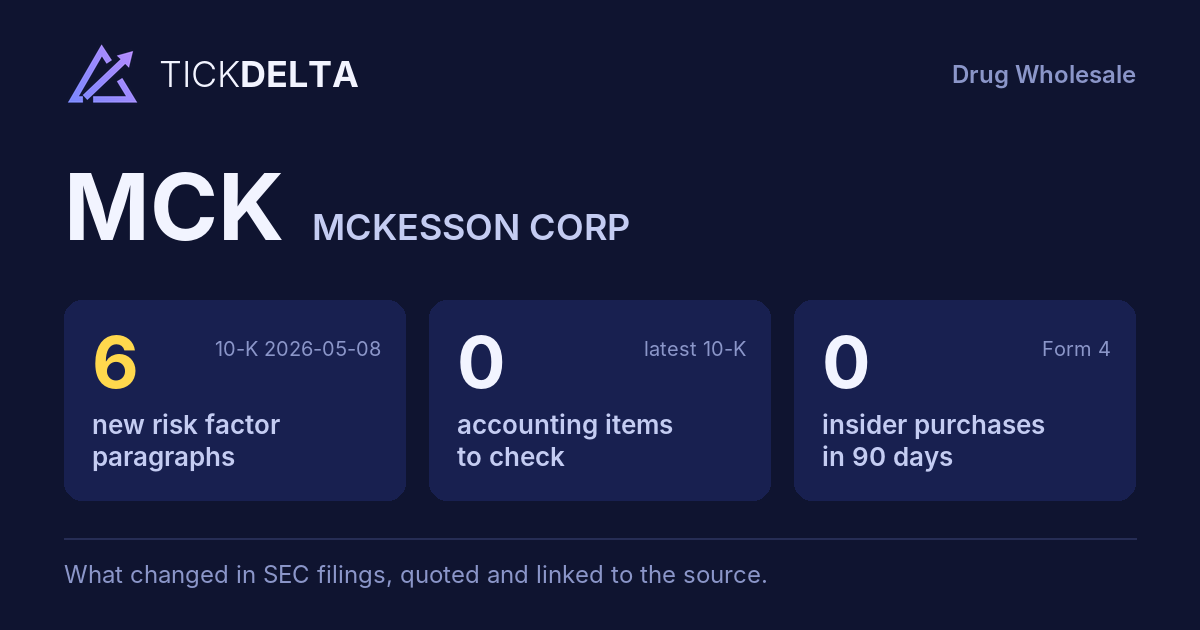
What the 10-K filed 2026-05-08 says about risks that are not on the face of the balance sheet, from the notes to the financial statements, Legal Proceedings and the MD&A (and, for big customers and key suppliers, Business and Risk Factors). Tickdelta picks sentences with specifics (amounts, accruals, covenant ratios) and quotes them as filed. New marks a sentence with nothing like it in the 10-K filed 2025-05-09.
Big customers
2 newCustomers the company names as a large share of revenue or receivables (it must name any worth 10% of revenue).
New “At March 31, 2026, sales to our largest customer represented approximately 24% of our total consolidated revenues and approximately 21% of our total trade receivables, and those of our ten largest customers combined accounted for approximately 73% of our consolidated revenues and approximately 43% of our trade receivables.”
Read it in the 10-K ↗
“Sales to our ten largest customers, including group purchasing organizations (“GPOs”), accounted for approximately 73% of total consolidated revenues in fiscal 2026 and comprised approximately 43% of total trade accounts receivable at March 31, 2026.”
Read it in the 10-K ↗
“Sales to our largest customer, CVS Health Corporation (“CVS”), accounted for approximately 24% of our total consolidated revenues in fiscal 2026 and comprised approximately 21% of total trade accounts receivable at March 31, 2026.”
Read it in the 10-K ↗
New “Sales to our next two largest customers accounted for 11% and 10% of total consolidated revenues in fiscal 2026.”
Read it in the 10-K ↗
Key suppliers
Parts or manufacturing that depend on one or a few suppliers.
No specific sentence about this in the 10-K.
Lawsuits and legal claims
1 newPending cases, settlements and what the company has set aside for them.
“Gross profit for the years ended March 31, 2026 and 2025 included gains of $23 million and $444 million, respectively, representing our share of antitrust legal settlements.”
Read it in the 10-K ↗
“cash receipts for our share of antitrust legal settlements of $23 million and $444 million for the years ended March 31, 2026 and 2025, respectively;”
Read it in the 10-K ↗
“At March 31, 2026, the Company had accrued liabilities of $5.7 billion related to the settlement of opioid-related litigation claims with U.S. governmental entities, including Native American tribes, and certain non-governmental plaintiffs as described in Financial Note 17, “Commitments and Contingent Liabilities,” to the consolidated financial statements included in this Annual Report.”
Read it in the 10-K ↗
New “On September 4, 2025, the trial court entered judgment against McKesson, awarding $37 million in compensatory damages and an additional $72 million in “monetary abatement” to fund programs related to drug abuse in Baltimore.”
Read it in the 10-K ↗
“cash receipts for the Company’s share of antitrust legal settlements were $23 million, $444 million, and $244 million for the years ended March 31, 2026, 2025, and 2024, respectively.”
Read it in the 10-K ↗
Guarantees and indemnities
Promises to pay someone else's debts or losses if they cannot.
“At March 31, 2026, our banks and insurance companies have issued $288 million of standby letters of credit and surety bonds.”
Read it in the 10-K ↗
“This amount excludes the customer loan guarantees discussed in Financial Note 16, “Financial Guarantees and Warranties.” The Company believes there is no material loss exposure on these assets or from these relationships.”
Read it in the 10-K ↗
“At March 31, 2026, the maximum amounts of inventory repurchase guarantees and customers’ debt guarantees were $451 million and $7 million, respectively, of which the Company has not accrued any amounts.”
Read it in the 10-K ↗
“Because the amounts of these indemnification obligations often are not explicitly stated, the overall maximum amount of these commitments cannot be reasonably estimated.”
Read it in the 10-K ↗
Debt covenants
3 newConditions in loan agreements that, if broken, can make debt due early.
New “At March 31, 2026, we remained adequately capitalized, including access to liquidity from our $4.0 billion revolving credit facility and $1.0 billion 364-day credit facility, and were in compliance with all debt covenants and believe we have the ability to continue to meet our debt covenants in the future.”
Read it in the 10-K ↗
“The 2022 Credit Facility contains various customary investment grade covenants, including a financial covenant which obligates the Company to maintain a maximum Total Debt to Consolidated EBITDA ratio, as defined in the 2022 Credit Facility.”
Read it in the 10-K ↗
“The 364-Day Credit Facility contains various customary investment grade covenants, including a financial covenant which obligates the Company to maintain a maximum Total Debt to Consolidated EBITDA ratio, as defined in the 364-Day Credit Facility.”
Read it in the 10-K ↗
New “The 2026 Credit Facility contains various customary investment grade covenants, including a financial covenant which obligates the Company to maintain a maximum Total Debt to Consolidated EBITDA ratio, each as defined in the 2026 Credit Facility, excluding any indebtedness of the Medical-Surgical Solutions segment and the portion of Consolidated EBITDA attributable to that segment.”
Read it in the 10-K ↗
New “The MMS Credit Agreement also includes financial maintenance covenants requiring MMS Borrower to maintain a maximum Total Net Leverage Ratio and a minimum Interest Coverage Ratio, in each case, tested on a quarterly basis, and customary events of default.”
Read it in the 10-K ↗
Commitments off the balance sheet
Contracts the company must pay for later: purchase obligations, take-or-pay deals.
No specific sentence about this in the 10-K.
Sentences are chosen by their words, not read by AI, so some can be off topic. Always check the filing. Open the 10-K ↗
Work on MCK in a spreadsheet:
Excel workbook (a sheet per section, ten years by column, charts, links to the filings) ·
CSV.
For a Google Sheet that stays up to date, paste =IMPORTDATA("https://tickdelta.com/company/MCK/export.csv") into a cell.