Paragraph 132 · 50% changed
Every version of it
Screener
/
SEC EDGAR
/CIK 0001441816
/10-K filed Mar 11, 2026, compared with Mar 21, 2025
/Numbers from the XBRL of the 10-Ks
Nasdaq
Technology · Software
MongoDB, Inc. MDB
The 10-K against last year's
119 changes: 33 added, 18 removed, 68 reworded
10-K Mar 11, 2026 vs Mar 21, 2025
Risk Factors
16.0%
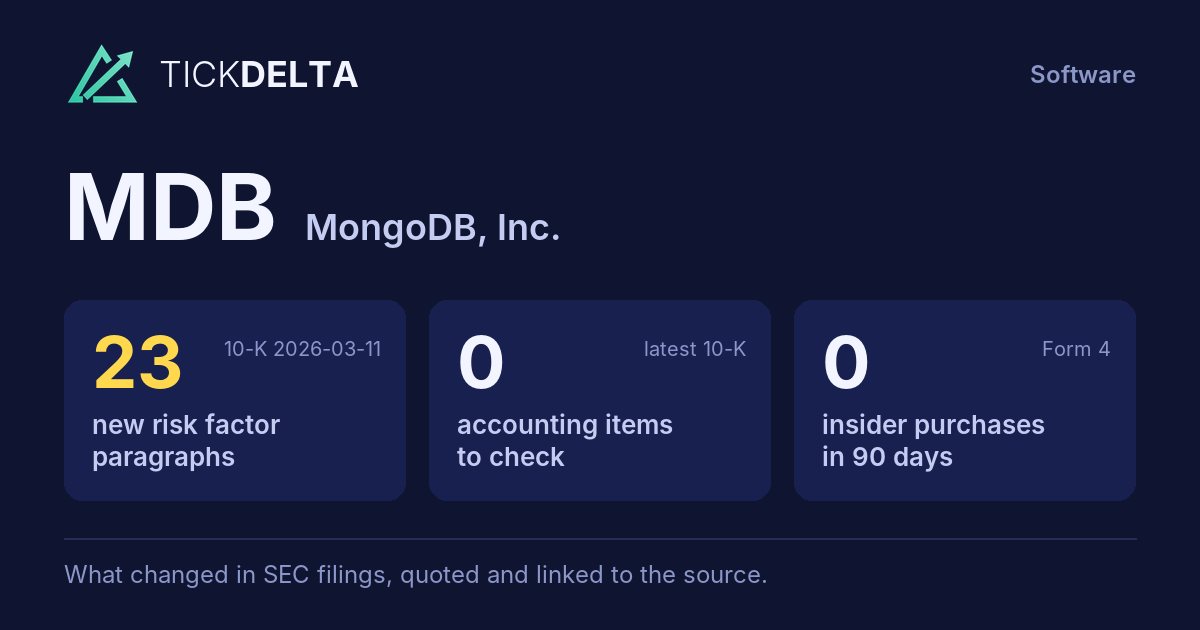
of the text changed · 29,399 words now · 23 new paragraphs, 13 gone
MD&A
23.7%
of the text changed · 6,350 words now · 10 new paragraphs, 5 gone
Legal Proceedings
26.2%
of the text changed · 933 words now
Accounting Policies
9.0%
of the text changed · 6,596 words now
10-K 0001628280-26-016799 (Mar 11, 2026) vs 10-K 0001441816-25-000057 (Mar 21, 2025)
Every paragraph, and how much of it changed
One bar per paragraph, in the order of the 10-K. Height and colour show the share of its words not in the closest paragraph a year earlier; the tallest bars are new paragraphs.
Risk Factors
325 paragraphs · 23 new · 83 reworded · 13 gone · 10-K Mar 11, 2026 against Mar 21, 2025
New paragraph
Reworded (5% of its words or more)
Same or nearly
Paragraph 264 · 50% changed
Every version of it
Social, ethical, security and regulatory issues relating to the use of new and evolving technologies such as AI, AI and ML, including generative AI, AI and AI models, in our offerings offerings, internal operations or partnerships, may result in reputational harm and liability, and may cause us to incur additional research and development costs to resolve such issues. The use of generative and agentic AI, relatively new and emerging technologies in the early stages of commercial use, exposes us to additional risks, such as damage to our reputation, competitive position, and business, legal and regulatory risks and additional costs. For example, generative AI has been known to produce false or “hallucinatory” inferences or output, and certain generative AI uses machine learning and predictive analytics, which can create inaccurate, incomplete, or misleading content, unintended biases, and other discriminatory or unexpected results, errors or inadequacies, any of which may not be easily detectable by us or any of our related service providers. As with many innovations, AI and ML presents risks and challenges that could affect its adoption, and therefore our business. No assurance can be provided that our use of AI will enhance our products or services or produce the intended results. For example, AI algorithms may be flawed, insufficient, of poor quality, reflect unwanted forms of bias, or contain other errors or inadequacies, any of which may not be easily detectable and AI, particularly generative AI, has been known to produce false or “hallucinatory” inferences or outputs. If we enable or offer solutions that draw controversy due to their perceived or actual impact Our offerings based on society or if the content, analyses or recommendations that AI-powered solutions assist in producing in our products and services are, or are perceived to be, deficient, inaccurate, biased, unethical or otherwise flawed, we may experience brand or reputational harm, competitive harm or legal liability. Potential government regulation related to AI use and ethics may also increase the burden and cost of research and development in this area, and failure to properly remediate AI usage or ethics issues may cause public confidence in AI to be undermined. AI and machine learning ML may change the way our industry identifies expose us to additional claims, demands and responds proceedings by private parties and regulatory authorities and subject us to cybersecurity threats, legal liability as well as brand and businesses that are slow to adopt or fail to adopt such new technologies may face a competitive disadvantage. Our competitors or other third parties may incorporate AI into their products more quickly or more successfully than us, which could impair our ability to compete effectively. The rapid evolution of AI will require the application of resources to develop, test and maintain any potential offerings or partnerships to help ensure that AI is implemented ethically in order to minimize unintended, harmful impact. reputational harm.
Paragraph 286 · 49% changed
Every version of it
In addition, if the market for technology stocks or the stock market in general experiences a loss of investor confidence, the trading price of our common stock could decline for reasons unrelated to our business, results of operations or financial condition. The trading price of our common stock might also decline in reaction to events that affect other companies in our industry even if these events do not directly affect us. In the past, following periods of volatility in the trading price of a company’s securities, securities class action litigation has often been brought against that company. If our stock price is volatile, we may become the target of securities litigation. Securities litigation could result in substantial costs and divert our management’s attention and resources from our business. This could have an adverse effect on our business, results of operations and financial condition.
Paragraph 151 · 48% changed
Every version of it
Paragraph 270 · 47% changed
Every version of it
Paragraph 196 · 46% changed
Every version of it
Paragraph 266 · 46% changed
Every version of it
In addition, the use of AI and ML may enhance intellectual property, cybersecurity, operational and technological risks. Examples of heightened cybersecurity threats emerging from the rise of generative AI include the use of deepfake technologies in phishing and social engineering attacks, and more sophisticated malware that can evade conventional detection tools. AI and ML also makes make it cheaper for attackers to create malware, phishing, code reviews, or other tools at a high volume. As the regulatory framework for AI and related ML may change the way our industry identifies and responds to cybersecurity threats, and businesses that are slow to adopt or fail to adopt such new technologies evolves, it is possible that new laws may face a competitive disadvantage. The use of AI also has resulted in, and regulations will be adopted, or that existing laws and regulations, including intellectual property, privacy, data protection and cybersecurity, consumer protection, competition and equal opportunity laws and regulations, may be interpreted in ways that would affect our business and the ways in which we or our partners use AI or related technologies, our financial condition and our results of operations, including as a future result of the cost to comply with such laws or regulations. For example, if we or our third-party AI providers do not have sufficient rights to use the data in, security breaches or other material security incidents that implicate the personal data of users of AI-powered applications. If we experience security breaches or content on which AI tools rely, or the output generated by incidents in connection with our use of such AI tools, we may incur and ML, it could adversely affect our reputation and expose us to legal liability through the violation of such laws, third-party intellectual property, privacy or other rights, or contracts to which we are a party. Moreover, use of generative AI in our code development process, while offering various potential benefits, could also pose certain ownership and security risks with respect to our codebase, given the current legal uncertainties relating to ownership of AI-generated works and the potential for security flaws in output code. If any of our employees, contractors, vendors or service providers use any third-party AI- regulatory risk.
Paragraph 267 · 46% changed
Every version of it
Paragraph 132 · 50% changed
Every version of it
10-K Mar 21, 2025Some foreign data privacy and security laws, including, without limitation, the GDPR, the U.K. GDPR, and the Swiss Federal Act on Data Protection may restrict the cross-border transfer of personal data, such as transfers of data to the United States from the E.E.A., Switzerland or U.K. These laws may require data exporters and data importers - as a condition of cross-border data transfers - to implement specific safeguards to protect the transferred personal data. Existing mechanisms that facilitate cross-border personal data transfers may change or be invalidated. For example, the GDPR generally restricts the transfer of personal data to countries outside of the E.E.A. that the European Commission does not consider to provide an adequate level of data privacy and security, such as the United States, unless the parties to the transfer have implemented specific safeguards to protect the transferred personal data, such as, most commonly, the “Standard Contractual Clauses” (“SCCs”) released by the European Commission. Use of the SCCs imposes additional compliance burdens, such as conducting transfer impact assessments to determine whether additional security measures are necessary to protect the at-issue personal data. Although the U.K. currently has an adequacy decision from the European Commission, such that SCCs are not required for the transfer of personal data from the E.E.A. to the U.K., that decision will sunset in June 2025 unless extended and it may be revoked in the future by the European Commission if the U.K. data protection regime is reformed in ways that deviate substantially from the GDPR. Adding further complexity for international data transfers, in March 2022, the U.K. adopted its own International Data Transfer Agreement for transfers of personal data out of the U.K. to so-called third countries, as well as an international data transfer addendum that can be used with the SCCs for the same purpose. Moreover, on July 10, 2023 the European Commission adopted an adequacy decision concluding that the United States ensures an adequate level of protection for personal data transferred from the E.U. to the U.S. under the EU-U.S. Data Privacy Framework.
10-K Mar 11, 2026
adopted its own International Data Transfer Agreement for transfers of personal data out of the U.K. to so-called third countries, as well as an international data transfer addendum that can be used with the SCCs for the same purpose. Moreover, on July 10, 2023 the European Commission adopted an adequacy decision concluding that the United States ensures an adequate level of protection for personal data transferred from the E.U. to the U.S. under the EU-U.S. Data Privacy Framework.
Paragraph 264 · 50% changed
Every version of it
10-K Mar 21, 2025
Social, ethical, security and regulatory issues relating to the use of new and evolving technologies such as AI, including generative AI, in our offerings or partnerships, may result in reputational harm and liability, and may cause us to incur additional research and development costs to resolve such issues. As with many innovations, AI presents risks and challenges that could affect its adoption, and therefore our business. No assurance can be provided that our use of AI will enhance our products or services or produce the intended results. For example, AI algorithms may be flawed, insufficient, of poor quality, reflect unwanted forms of bias, or contain other errors or inadequacies, any of which may not be easily detectable and AI, particularly generative AI, has been known to produce false or “hallucinatory” inferences or outputs. If we enable or offer solutions that draw controversy due to their perceived or actual impact on society or if the content, analyses or recommendations that AI-powered solutions assist in producing in our products and services are, or are perceived to be, deficient, inaccurate, biased, unethical or otherwise flawed, we may experience brand or reputational harm, competitive harm or legal liability. Potential government regulation related to AI use and ethics may also increase the burden and cost of research and development in this area, and failure to properly remediate AI usage or ethics issues may cause public confidence in AI to be undermined. AI and machine learning may change the way our industry identifies and responds to cybersecurity threats, and businesses that are slow to adopt or fail to adopt such new technologies may face a competitive disadvantage. Our competitors or other third parties may incorporate AI into their products more quickly or more successfully than us, which could impair our ability to compete effectively. The rapid evolution of AI will require the application of resources to develop, test and maintain any potential offerings or partnerships to help ensure that AI is implemented ethically in order to minimize unintended, harmful impact.
10-K Mar 11, 2026
Social, ethical, security and regulatory issues relating to the use of new and evolving technologies such as AI and ML, including generative AI and AI models, in our offerings, internal operations or partnerships, may result in reputational harm and liability, and may cause us to incur additional research and development costs to resolve such issues. The use of generative and agentic AI, relatively new and emerging technologies in the early stages of commercial use, exposes us to additional risks, such as damage to our reputation, competitive position, and business, legal and regulatory risks and additional costs. For example, generative AI has been known to produce false or “hallucinatory” inferences or output, and certain generative AI uses machine learning and predictive analytics, which can create inaccurate, incomplete, or misleading content, unintended biases, and other discriminatory or unexpected results, errors or inadequacies, any of which may not be easily detectable by us or any of our related service providers. As with many innovations, AI and ML presents risks and challenges that could affect its adoption, and therefore our business. Our offerings based on AI and ML may expose us to additional claims, demands and proceedings by private parties and regulatory authorities and subject us to legal liability as well as brand and reputational harm.
Paragraph 286 · 49% changed
Every version of it
10-K Mar 21, 2025
In addition, if the market for technology stocks or the stock market in general experiences a loss of investor confidence, the trading price of our common stock could decline for reasons unrelated to our business, results of operations or financial condition. The trading price of our common stock might also decline in reaction to events that affect other companies in our industry even if these events do not directly affect us. In the past, following periods of volatility in the trading price of a company’s securities, securities class action litigation has often been brought against that company. If our stock price is volatile, we may become the target of securities litigation. Securities litigation could result in substantial costs and divert our management’s attention and resources from our business. This could have an adverse effect on our business, results of operations and financial condition.
10-K Mar 11, 2026
In addition, if the market for technology stocks or the stock market in general experiences a loss of investor confidence, the trading price of our common stock could decline for reasons unrelated to our business, results of operations or
Paragraph 151 · 48% changed
Every version of it
10-K Mar 21, 2025We outsource substantially all of the infrastructure relating to MongoDB Atlas across AWS, Microsoft Azure and GCP to host our cloud offering. If the hosting of MongoDB Atlas is disrupted or interfered with for any reason, our business would be negatively impacted. Customers of MongoDB Atlas need to be able to access our platform at any time, without interruption or degradation of performance and we provide them with service level commitments with respect to uptime. Third-party cloud providers run their own platforms that we access and we are, therefore, vulnerable to their service interruptions. We may experience interruptions, delays and outages in service and availability from time to time as a result of problems with our third-party cloud providers’ infrastructure. Lack of availability of this infrastructure could be due to a number of potential causes including technical failures, natural disasters, fraud, cyberattacks, or security breaches or other security incidents that we cannot predict or prevent. Such interruptions, delays or outages could lead to the triggering of our service level agreements and the issuance of credits to our cloud offering customers, which may impact our business, results of operations and financial condition. In addition, if we or any of these third-party cloud providers, experience a security breach or other security incident, our software is unavailable or our customers are unable to use our software within a reasonable amount of time or at all, then our business, results of operations and financial condition could be adversely affected. In some instances, we may not be able to identify the cause or causes of these performance problems within a period of time acceptable to our customers. It is possible that our customers and potential customers would hold us accountable for any breach of security affecting a third-party cloud provider’s infrastructure and we may incur significant liability from those customers and from third parties with respect to any breach affecting these systems. We may not be able to recover a material portion of our liabilities to our customers and third parties from a third-party cloud provider. It may also become increasingly difficult to maintain and improve our performance, especially during peak usage times, as our software becomes more complex and the usage of our software increases. Any of the above circumstances or events may harm our business, results of operations and financial condition.
10-K Mar 11, 2026
affecting a third-party cloud provider’s infrastructure and we may incur significant liability from those customers and from third parties with respect to any breach affecting these systems. We may not be able to recover a material portion of our liabilities to our customers and third parties from a third-party cloud provider. It may also become increasingly difficult to maintain and improve our performance, especially during peak usage times, as our software becomes more complex and the usage of our software increases. Any of the above circumstances or events may harm our business, results of operations and financial condition.
Paragraph 270 · 47% changed
Every version of it
10-K Mar 21, 2025powered software in connection with our business or the services they provide to us, it may lead to the inadvertent disclosure of our confidential information, including inadvertent disclosure of our confidential information into publicly available third-party training sets, which may impact our ability to realize the benefit of, or adequately maintain, protect and enforce our intellectual property or confidential information, harming our competitive position and business. Our ability to mitigate risks associated with disclosure of our confidential information, including in connection with AI-powered software, will depend on our implementation, maintenance, monitoring and enforcement of appropriate technical and administrative safeguards, policies and procedures governing the use of AI in our business. Moreover, any content created by us using generative AI tools may not be subject to copyright protection which may adversely affect our intellectual property rights in, or ability to commercialize or use, any such content. In the United States, a number of civil lawsuits have been initiated related to the foregoing and other concerns, the outcome of any one of which may, amongst other things, require us to limit the ways in which we use AI in our business. For example, the output produced by generative AI tools may include information subject to certain rights of publicity or privacy laws or constitute an unauthorized derivative work of the copyrighted material used in training the underlying AI model, any of which could also create a risk of liability for us, or adversely affect our business or operations. In addition, the use of AI has resulted in, and may in the future result in, security breaches or other security incidents that implicate the personal data of users of AI-powered applications. If we experience security breaches or incidents in connection with our use of AI, it could adversely affect our reputation and expose us to legal liability or regulatory risk.
10-K Mar 11, 2026
may, amongst other things, require us to limit the ways in which we use AI in our business. For example, the output produced by generative AI tools may include information subject to certain rights of publicity or privacy laws or constitute an unauthorized derivative work of the copyrighted material used in training the underlying AI model, any of which could also create a risk of liability for us, or adversely affect our business or operations. Our business, financial condition and results of operations may be adversely affected if content, recommendations, solutions or features or their development or deployment (including the collection, use, or other processing of data used to train or create such AI and ML solutions or features) are found to have or alleged to have infringed upon or misappropriated third-party intellectual property rights or violate applicable laws, regulations, or other actual or asserted legal obligations to which we are or may become subject.
Paragraph 196 · 46% changed
Every version of it
10-K Mar 21, 2025As we continue to expand our international operations, we become more exposed to the effects of fluctuations in currency exchange rates. Often, contracts executed by our foreign operations are denominated in the currency of that country or region and a portion of our revenue is therefore subject to foreign currency risks. However, a strengthening of the U.S. dollar could increase the real cost of our subscription offerings and related services to our customers outside of the United States, adversely affecting our business, results of operations and financial condition. We incur expenses for employee compensation and other operating expenses at our non-U.S. locations in the local currency. Fluctuations in the exchange rates between the U.S. dollar and other currencies could result in the dollar equivalent of such expenses being higher. This could have a negative impact on our reported results of operations. To date, we have not engaged in any hedging strategies and any such strategies, such as forward contracts, options and foreign exchange swaps related to transaction exposures that we may implement in the future to mitigate this risk may not eliminate our exposure to foreign exchange fluctuations. Moreover, the use of hedging instruments may introduce additional risks if we are unable to structure effective hedges with such instruments.
10-K Mar 11, 2026
such strategies, such as forward contracts, options and foreign exchange swaps related to transaction exposures that we may implement in the future to mitigate this risk may not eliminate our exposure to foreign exchange fluctuations. Moreover, the use of hedging instruments may introduce additional risks if we are unable to structure effective hedges with such instruments.
Paragraph 266 · 46% changed
Every version of it
10-K Mar 21, 2025
In addition, the use of AI may enhance intellectual property, cybersecurity, operational and technological risks. Examples of heightened cybersecurity threats emerging from the rise of generative AI include the use of deepfake technologies in phishing and social engineering attacks, and more sophisticated malware that can evade conventional detection tools. AI also makes it cheaper for attackers to create malware, phishing, code reviews, or other tools at a high volume. As the regulatory framework for AI and related technologies evolves, it is possible that new laws and regulations will be adopted, or that existing laws and regulations, including intellectual property, privacy, data protection and cybersecurity, consumer protection, competition and equal opportunity laws and regulations, may be interpreted in ways that would affect our business and the ways in which we or our partners use AI or related technologies, our financial condition and our results of operations, including as a result of the cost to comply with such laws or regulations. For example, if we or our third-party AI providers do not have sufficient rights to use the data or other material or content on which AI tools rely, or the output generated by our use of such AI tools, we may incur liability through the violation of such laws, third-party intellectual property, privacy or other rights, or contracts to which we are a party. Moreover, use of generative AI in our code development process, while offering various potential benefits, could also pose certain ownership and security risks with respect to our codebase, given the current legal uncertainties relating to ownership of AI-generated works and the potential for security flaws in output code. If any of our employees, contractors, vendors or service providers use any third-party AI-
10-K Mar 11, 2026
In addition, the use of AI and ML may enhance intellectual property, cybersecurity, operational and technological risks. Examples of heightened cybersecurity threats emerging from the rise of generative AI include the use of deepfake technologies in phishing and social engineering attacks, and more sophisticated malware that can evade conventional detection tools. AI and ML also make it cheaper for attackers to create malware, phishing, code reviews, or other tools at a high volume. AI and ML may change the way our industry identifies and responds to cybersecurity threats, and businesses that are slow to adopt or fail to adopt such new technologies may face a competitive disadvantage. The use of AI also has resulted in, and may in the future result in, security breaches or other security incidents that implicate the personal data of users of AI-powered applications. If we experience security breaches or incidents in connection with our use of AI and ML, it could adversely affect our reputation and expose us to legal liability or regulatory risk.
Paragraph 267 · 46% changed
Every version of it
10-K Mar 21, 2025In addition, the use of AI may enhance intellectual property, cybersecurity, operational and technological risks. Examples of heightened cybersecurity threats emerging from the rise of generative AI include the use of deepfake technologies in phishing and social engineering attacks, and more sophisticated malware that can evade conventional detection tools. AI also makes it cheaper for attackers to create malware, phishing, code reviews, or other tools at a high volume. As the regulatory framework for AI and related technologies evolves, it is possible that new laws and regulations will be adopted, or that existing laws and regulations, including intellectual property, privacy, data protection and cybersecurity, consumer protection, competition and equal opportunity laws and regulations, may be interpreted in ways that would affect our business and the ways in which we or our partners use AI or related technologies, our financial condition and our results of operations, including as a result of the cost to comply with such laws or regulations. For example, if we or our third-party AI providers do not have sufficient rights to use the data or other material or content on which AI tools rely, or the output generated by our use of such AI tools, we may incur liability through the violation of such laws, third-party intellectual property, privacy or other rights, or contracts to which we are a party. Moreover, use of generative AI in our code development process, while offering various potential benefits, could also pose certain ownership and security risks with respect to our codebase, given the current legal uncertainties relating to ownership of AI-generated works and the potential for security flaws in output code. If any of our employees, contractors, vendors or service providers use any third-party AI-
10-K Mar 11, 2026
As the regulatory framework for AI, ML and related technologies evolves, it is possible that new laws and regulations will be adopted, or that existing laws and regulations, including intellectual property, privacy, data protection and cybersecurity, consumer protection, competition and equal opportunity laws and regulations, may be interpreted in ways that would affect our business and the ways in which we or our partners use AI, ML or related technologies, our financial condition and our results of operations, including as a result of the cost to comply with such laws or regulations.
MD&A
80 paragraphs · 10 new · 34 reworded · 5 gone · 10-K Mar 11, 2026 against Mar 21, 2025
New paragraph
Reworded (5% of its words or more)
Same or nearly
Paragraph 16 · 50% changed
Paragraph 55 · 44% changed
We have generated significant operating losses as reflected in our accumulated deficit of $1.9 billion as of January 31, 2026. We expect to continue to incur operating losses, may experience negative cash flows from operations in the future and may require additional capital resources to execute strategic initiatives to grow our business. Our future capital requirements and adequacy of available funds will depend on many factors, including our growth rate and any impact on it from global macroeconomic conditions, including rising interest rates, inflation, the timing and extent of spending to support development efforts, the expansion of sales and marketing and international operation activities, the timing and size of new subscription introductions and customer usage of our developer data platform, the continuing market acceptance of our subscriptions and services and the impact of the macroeconomic conditions on the global economy and our business, financial condition and results of operations. As the impact of macroeconomic conditions on the global economy and our operations continues to evolve, we will continue to assess our liquidity needs. In the future, we may enter into arrangements to acquire or invest in complementary businesses, services and technologies, including intellectual property rights. We may be required to seek additional equity or debt financing. In the event that additional financing is required from outside sources, we may not be able to raise it on terms acceptable to us or at all. If we are unable to raise additional capital when desired, our business, operating results and financial condition would be adversely affected.
Paragraph 47 · 40% changed
The increase in general and administrative expense was primarily driven by an a $22.2 million increase in headcount resulting in $15.4 million higher personnel costs and stock-based compensation, a $7.3 $9.3 million increase related in software expenses associated with ongoing initiatives to enhance systems and operational efficiency, which was partially offset by a $7.2 million release of reserves for value-added tax expense and a $2.8 million increase due related to higher consulting costs. our operations in certain non-US jurisdictions.
Paragraph 45 · 37% changed
The increase in sales and marketing expense was primarily driven by a $38.8 $41.1 million increase in commissions, a $27.5 million increase in personnel costs and stock-based compensation, costs, a $22.5 $19.8 million increase in spend on in-person events and digital marketing programs and a $20.5 $4.5 million in restructuring costs. The increase in commission expense. Our headcount sales and marketing was 2,542 as of January 31, 2025 compared partially offset by a $11.8 million decrease in travel-related expenses due to 2,338 as of January 31, 2024. reduced internal travel and sales events and a $11.5 million decrease in stock-based compensation.
Paragraph 46 · 36% changed
The increase in research and development expense was primarily driven by a $67.0 $110.5 million increase in personnel costs and costs, stock-based compensation as we grew our headcount by 8%. In addition, research and development expense increased by $10.6 allocated overhead, and a $8.8 million due to higher increase in third-party infrastructure expenses related to support ongoing product development costs of our MongoDB Atlas offering. and testing activities.
Paragraph 42 · 33% changed
Total revenue growth reflects increased demand for our platform and related services. Subscription revenue increased by $316.5 $442.1 million primarily due to an increase in consumption of $269.4 million from Atlas by our Direct Sales Customers, inclusive large existing customers as evidenced by our net ARR expansion rate of the impact from Direct Sales Customers who were self-serve customers 121% as of MongoDB Atlas in the prior-year period. January 31, 2026.
Paragraph 59 · 32% changed
Cash provided by operating activities during the year ended January 31, 2025 2026 was $150.2 $505.1 million, driven primarily by due to an increase in our cash collections reflecting the overall growth of our sales and expansion of our customer base. Accordingly, our accounts receivable increased by $69.2 million. In addition, our collected from customers resulting from an increase in sales. Our net loss of $129.1 million, $71.2 million includes non‑cash charges $550.5 million of $493.9 stock‑based compensation, $112.4 million for stock‑based compensation of deferred revenue, $27.8 million of accrued liabilities, and $11.8 $22.4 million for of depreciation and amortization. Our accrued liabilities increased by $25.3 million reflecting our increase in expenses and timing of payments. Partially offsetting these benefits to our operating cash flow were amortization increases in accounts receivable of premium and accretion of discount on short-term investments, net of $25.1 $106.4 million, an increase in deferred commissions of $69.1 million, an increase in prepaid expenses and other current assets of $24.8 million, an increase in other long-term assets of $30.7 $13.0 million, $9.8 million of deferred commissions, and $7.6 million of other net non-cash charges of $32.8 million. charges.
Paragraph 50 · 32% changed
The decrease increase in the provision for income taxes during for the year ended January 31, 2025 2026 was primarily due to an increase in foreign taxes as we continue our global expansion and the release of our U.K. the UK valuation allowance. allowance in the prior period.
Paragraph 16 · 50% changed
10-K Mar 21, 2025For further details of our contractual obligations and lease agreements, refer to our Notes to Consolidated Financial Statements, within Part II, Item 8, Financial Statements and Supplementary Data of this Form 10-K, specifically Note 6, Convertible Senior Notes, Note 7, Leases and Note 8, Commitments and Contingencies.
10-K Mar 11, 2026
The results of operations of this business combination have been included in our consolidated financial statements from the date of acquisition. See Note 5, Business Combinations, in our Notes to Consolidated Financial Statements included in Part II, Item 8 of this Form 10-K, for details regarding this business combination.
Paragraph 55 · 44% changed
10-K Mar 21, 2025
operating losses, may experience negative cash flows from operations in the future and may require additional capital resources to execute strategic initiatives to grow our business. Our future capital requirements and adequacy of available funds will depend on many factors, including our growth rate and any impact on it from global macroeconomic conditions, including rising interest rates, inflation, the timing and extent of spending to support development efforts, the expansion of sales and marketing and international operation activities, the timing and size of new subscription introductions and customer usage of our developer data platform, the continuing market acceptance of our subscriptions and services and the impact of the macroeconomic conditions on the global economy and our business, financial condition and results of operations. As the impact of macroeconomic conditions on the global economy and our operations continues to evolve, we will continue to assess our liquidity needs. In the future, we may enter into arrangements to acquire or invest in complementary businesses, services and technologies, including intellectual property rights. We may be required to seek additional equity or debt financing. In the event that additional financing is required from outside sources, we may not be able to raise it on terms acceptable to us or at all. If we are unable to raise additional capital when desired, our business, operating results and financial condition would be adversely affected.
10-K Mar 11, 2026
We have generated significant operating losses as reflected in our accumulated deficit of $1.9 billion as of January 31, 2026. We expect to continue to incur operating losses, may experience negative cash flows from operations in the future and may require additional capital resources to execute strategic initiatives to grow our business. Our future capital requirements and adequacy of available funds will depend on many factors, including our growth rate and any impact on it from global macroeconomic conditions, including rising interest rates, inflation, the timing and extent of spending to support development
Paragraph 47 · 40% changed
10-K Mar 21, 2025
The increase in general and administrative expense was primarily driven by an increase in headcount resulting in $15.4 million higher personnel costs and stock-based compensation, a $7.3 million increase related to value-added tax expense and a $2.8 million increase due to higher consulting costs.
10-K Mar 11, 2026
The increase in general and administrative expense was primarily driven by a $22.2 million increase in personnel costs and stock-based compensation, a $9.3 million increase in software expenses associated with ongoing initiatives to enhance systems and operational efficiency, which was partially offset by a $7.2 million release of reserves for value-added tax expense related to our operations in certain non-US jurisdictions.
Paragraph 45 · 37% changed
10-K Mar 21, 2025
The increase in sales and marketing expense was primarily driven by a $38.8 million increase in personnel costs and stock-based compensation, a $22.5 million increase in spend on in-person events and marketing programs and a $20.5 million increase in commission expense. Our headcount was 2,542 as of January 31, 2025 compared to 2,338 as of January 31, 2024.
10-K Mar 11, 2026
The increase in sales and marketing expense was primarily driven by a $41.1 million increase in commissions, a $27.5 million increase in personnel costs, a $19.8 million increase in spend on in-person events and digital marketing programs and $4.5 million in restructuring costs. The increase in sales and marketing was partially offset by a $11.8 million decrease in travel-related expenses due to reduced internal travel and sales events and a $11.5 million decrease in stock-based compensation.
Paragraph 46 · 36% changed
10-K Mar 21, 2025
The increase in research and development expense was primarily driven by a $67.0 million increase in personnel costs and stock-based compensation as we grew our headcount by 8%. In addition, research and development expense increased by $10.6 million due to higher third-party infrastructure expenses related to development costs of our MongoDB Atlas offering.
10-K Mar 11, 2026
The increase in research and development expense was primarily driven by a $110.5 million increase in personnel costs, stock-based compensation and allocated overhead, and a $8.8 million increase in third-party infrastructure expenses to support ongoing product development and testing activities.
Paragraph 42 · 33% changed
10-K Mar 21, 2025
Total revenue growth reflects increased demand for our platform and related services. Subscription revenue increased by $316.5 million primarily due to an increase of $269.4 million from our Direct Sales Customers, inclusive of the impact from Direct Sales Customers who were self-serve customers of MongoDB Atlas in the prior-year period.
10-K Mar 11, 2026
Total revenue growth reflects increased demand for our platform and related services. Subscription revenue increased by $442.1 million primarily due to an increase in consumption of Atlas by our large existing customers as evidenced by our net ARR expansion rate of 121% as of January 31, 2026.
Paragraph 59 · 32% changed
10-K Mar 21, 2025
Cash provided by operating activities during the year ended January 31, 2025 was $150.2 million, driven primarily by an increase in our cash collections reflecting the overall growth of our sales and expansion of our customer base. Accordingly, our accounts receivable increased by $69.2 million. In addition, our net loss of $129.1 million, includes non‑cash charges of $493.9 million for stock‑based compensation and $11.8 million for depreciation and amortization. Our accrued liabilities increased by $25.3 million reflecting our increase in expenses and timing of payments. Partially offsetting these benefits to our operating cash flow were amortization of premium and accretion of discount on short-term investments, net of $25.1 million, an increase in deferred commissions of $69.1 million, an increase in prepaid expenses and other current assets of $24.8 million, an increase in other long-term assets of $30.7 million and other net non-cash charges of $32.8 million.
10-K Mar 11, 2026
Cash provided by operating activities during the year ended January 31, 2026 was $505.1 million, driven primarily due to an increase in cash collected from customers resulting from an increase in sales. Our net loss of $71.2 million includes $550.5 million of stock‑based compensation, $112.4 million of deferred revenue, $27.8 million of accrued liabilities, and $22.4 million of depreciation and amortization. Partially offsetting these benefits to our operating cash flow were increases in accounts receivable of $106.4 million, other long-term assets of $13.0 million, $9.8 million of deferred commissions, and $7.6 million of other net non-cash charges.
Paragraph 50 · 32% changed
10-K Mar 21, 2025
The decrease in the provision for income taxes during the year ended January 31, 2025 was primarily due to the release of our U.K. valuation allowance.
10-K Mar 11, 2026
The increase in the provision for income taxes for the year ended January 31, 2026 was primarily due to an increase in foreign taxes as we continue our global expansion and the release of the UK valuation allowance in the prior period.
A paragraph is matched with the one last year that shares the most of its words; under half in common makes it new. The paragraphs shown are the 8 reworded the most in each section.
The paragraph that changed most in each section
The redline
Marked against last year's 10-K: cut words struck through, new words highlighted.
Risk Factors332 words changed in this paragraph; it is 39% similar to last year's version.
Source: Item 1A, 10-K 0001628280-26-016799 vs Item 1A, 10-K 0001441816-25-000057
Accounting Policies253 words changed in this paragraph; it is 36% similar to last year's version.
The Company uses its best estimates and assumptions applies a screen test to assign evaluate if substantially all of the fair value of the gross assets acquired is concentrated in a single identifiable asset or group of similar identifiable assets to determine whether a transaction is accounted for as an asset acquisition or business combination. When the Company acquires a business, the purchase consideration is allocated to the tangible assets acquired, liabilities assumed, and intangible assets acquired and liabilities assumed as of the acquisition date. based on their estimated respective fair values. The excess of the fair value of purchase consideration over the fair values of the tangible and intangible these identifiable assets acquired and liabilities assumed is recorded as goodwill. Estimates used in valuing certain intangible assets include, but are not limited to, time and resources required to recreate the assets acquired. These estimates are based on information obtained from the management of the acquired companies, the Company’s assessment of the information, and historical experience. The Company’s estimates of fair value are based upon assumptions believed to be reasonable, but which are inherently uncertain and subject to refinement. unpredictable and, as a result, actual results may differ from estimates. During the measurement period, which may be up to one year from the acquisition date, the Company may record adjustments to the preliminary fair value of these tangible and intangible the assets acquired and liabilities assumed, with the corresponding offset to goodwill. In addition, uncertain tax positions and tax-related valuation allowances are initially established in connection with a business combination as of the acquisition date. Upon the conclusion of assumed. After the measurement period or final determination of the fair value of assets acquired or liabilities assumed, whichever comes first, period, any subsequent adjustments are recorded to reflected in the Company’s consolidated statements of operations. Acquisition-related expenses are recognized separately from the business combination operations and comprehensive income (loss). Acquisition costs are expensed as incurred.
Source: Item 8, Note 2 – Summary of Significant Accounting Policies, 10-K 0001628280-26-016799 vs Item 8, Note 2 – Summary of Significant Accounting Policies, 10-K 0001441816-25-000057
MD&A187 words changed in this paragraph; it is 42% similar to last year's version.
We have generated significant operating losses as reflected in our accumulated deficit of $1.9 billion as of January 31, 2026. We expect to continue to incur operating losses, may experience negative cash flows from operations in the future and may require additional capital resources to execute strategic initiatives to grow our business. Our future capital requirements and adequacy of available funds will depend on many factors, including our growth rate and any impact on it from global macroeconomic conditions, including rising interest rates, inflation, the timing and extent of spending to support development efforts, the expansion of sales and marketing and international operation activities, the timing and size of new subscription introductions and customer usage of our developer data platform, the continuing market acceptance of our subscriptions and services and the impact of the macroeconomic conditions on the global economy and our business, financial condition and results of operations. As the impact of macroeconomic conditions on the global economy and our operations continues to evolve, we will continue to assess our liquidity needs. In the future, we may enter into arrangements to acquire or invest in complementary businesses, services and technologies, including intellectual property rights. We may be required to seek additional equity or debt financing. In the event that additional financing is required from outside sources, we may not be able to raise it on terms acceptable to us or at all. If we are unable to raise additional capital when desired, our business, operating results and financial condition would be adversely affected.
Source: Item 7, 10-K 0001628280-26-016799 vs Item 7, 10-K 0001441816-25-000057
Legal Proceedings129 words changed in this paragraph; it is 70% similar to last year's version.
On October 7, 2024, a purported shareholder derivative lawsuit was filed in the U.S. District Court for the Southern District of New York, Case. No. 1:24-cv-07594, against the Company, as a nominal defendant, and former CEO Dev Ittycheria, former COO and CFO Michael Gordon, and several of the Company’s current and former directors. The case is captioned Roy v. Ittycheria et al. The lawsuit alleges that the individual defendants breached their fiduciary duties and committed other alleged misconduct in connection with the statements at issue in the Securities Action and by causing the Company to issue allegedly false and misleading statements to investors. Another similar case was subsequently filed in the same district and has been consolidated with the Roy action with the caption In re MongoDB, Inc. Shareholder Litigation (the “Derivative “S.D.N.Y. Derivative Litigation”). On September 12, 2025 another purported derivative action was filed in the Court of Chancery of the State of Delaware, Case No. 2025-1030, against the Company, as a nominal defendant, and former CEO Dev Ittycheria, former COO and CFO Michael Gordon, and several of the Company’s current and former directors. The case is captioned Sansone v. Ittycheria, et al. The lawsuit, like the S.D.N.Y. Derivative Action, alleges that the individual defendants breached their fiduciary duties and committed other alleged misconduct in connection with the statements at issue in the Securities Action and by causing the Company to issue allegedly false and misleading statements to investors. The S.D.N.Y. Derivative Litigation is and the Delaware Derivative Action are both at an early stage stages and has have both been stayed, pending the outcome of the Court's Court’s decision on the defendants’ anticipated motion to dismiss the Securities Action.
Source: Item 3, via Note 9 – Commitments and Contingencies, 10-K 0001628280-26-016799 vs Item 3, via Note 8 – Commitments and Contingencies, 10-K 0001441816-25-000057
Sentences and paragraphs added, removed or reworded
Every change, by type
Sentences and paragraphs of MDB's Risk Factors and MD&A, 10-K Mar 11, 2026 against 10-K Mar 21, 2025. Each links to the text at sec.gov.
Quiet changes are sentences kept from last year with one to four words changed, at least one of them a hedge, a modal or a qualifier (may, could, will, not, significant, material…). A year or date rolling forward is not counted.
The full word list
adverse, adversely, all, although, anticipate, anticipates, any, approximately, believe, believes, can, cannot, certain, could, expect, expects, generally, however, if, intend, intends, largely, likely, many, material, materially, may, might, most, must, never, no, not, possible, primarily, probable, should, significant, significantly, some, substantial, substantially, unlikely, will, would
AddedRisk Factors
and maintain profitability in future periods. As a result, we expect to continue to generate losses. We cannot assure you that we will achieve profitability in the future or that, if we do become profitable, we will be able to sustain profitability.
Read it in 10-K Mar 11, 2026 at sec.gov
AddedRisk Factors
To encourage developer usage, familiarity and adoption of our platform, we offer Community Server as a “freemium” offering. Community Server is a free-to-download version of our database that does not include all of the features of our
Read it in 10-K Mar 11, 2026 at sec.gov
AddedRisk Factors
We make our Community Server offering available under either the SSPL (for versions released on or after October 16, 2018) or the AGPL (for versions released prior to October 16, 2018). Community Server is a free-to-download version of
Read it in 10-K Mar 11, 2026 at sec.gov
AddedRisk Factors
•timing, amount, and cost of our investments to expand the capacity of our public cloud providers;
Read it in 10-K Mar 11, 2026 at sec.gov
AddedRisk Factors
•the amount and timing of legal expenses, including settlements, judgments, fines, legal fees, and other charges associated with litigation, governmental investigations or inquiries, regulatory investigations or inquiries, or other legal proceedings;
Read it in 10-K Mar 11, 2026 at sec.gov
AddedRisk Factors
•the amount and timing of costs associated with hiring, training, and integrating new employees and retaining and motivating existing employees;
Read it in 10-K Mar 11, 2026 at sec.gov
AddedRisk Factors
•changes in regulatory or legal environments, including the interpretation or enforcement of regulatory or legal requirements, that may cause us to incur, among other things, expenses associated with compliance;
Read it in 10-K Mar 11, 2026 at sec.gov
AddedRisk Factors
and remediate vulnerabilities, if any, in our information technology systems and networks (including our products), our efforts may not be successful. As new technology, particularly AI, makes it easier to detect and understand vulnerabilities in our code, it may become easier for third parties to exploit such vulnerabilities before we can remediate them, which may require us to dedicate greater time and resources to vulnerability detection and remediation than in the past. Further, we may experience delays in developing and deploying remedial measures designed to address any such identified vulnerabilities.
Read it in 10-K Mar 11, 2026 at sec.gov
Show the other 55
AddedRisk Factors
Furthermore, from time to time, U.S. presidential administrations have issued, and may in the future issue, Executive Orders related to cybersecurity practices that may affect our business.For example, while the Biden administration’s Executive Order 14208 (2021) established a framework for federal cybersecurity, the current administration has shifted toward a more decentralized, risk-based approach. In June 2025, the Trump administration issued Executive Order 14306,
Read it in 10-K Mar 11, 2026 at sec.gov
AddedRisk Factors
which amended prior orders and increased private-sector flexibility. The transition to this decentralized model may lead to inconsistent or fragmented cybersecurity requirements across various federal agencies, complicating our compliance efforts,
Read it in 10-K Mar 11, 2026 at sec.gov
AddedRisk Factors
On July 4, 2025, the One Big Beautiful Bill ("OBBBA") was signed into law. The OBBBA includes a broad range of U.S. tax reform measures, including, among other provisions, the immediate expensing of U.S. research and development expenditures. In accordance with ASC 740, we have recognized the effects of the new tax law in the period of enactment. As we maintain a full valuation allowance on its U.S. deferred tax assets, the legislation does not have a material impact on its consolidated financial statements.
Read it in 10-K Mar 11, 2026 at sec.gov
AddedRisk Factors
Moreover, any content created by us using generative AI tools may not be subject to copyright protection which may adversely affect our intellectual property rights in, or ability to commercialize or use, any such content. In the United States, a number of civil lawsuits have been initiated related to the foregoing and other concerns, the outcome of any one of which
Read it in 10-K Mar 11, 2026 at sec.gov
RemovedRisk Factors
RemovedRisk Factors
RemovedRisk Factors
RemovedRisk Factors
RemovedRisk Factors
RemovedRisk Factors
RemovedRisk Factors
RemovedRisk Factors
RemovedRisk Factors
RemovedRisk Factors
RemovedRisk Factors
RemovedRisk Factors
RewordedRisk Factors
The principal competitive factors in our market include: mindshare with software developers and information technology (“IT”) executives; product capabilities, including flexibility, scalability, performance, security and reliability; flexible deployment options, including fully managed as a service or self-managed in the cloud, on-premises or in a hybrid environment and ease of deployment; breadth of use cases supported; ease of integration with existing IT infrastructure; robustness of professional services and customer support; price and total cost of ownership; adherence to industry standards and certifications, including cybersecurity standards and certifications; size of customer base and level of user adoption; strength of sales and marketing efforts; and brand awareness and reputation. on-
Read it in 10-K Mar 11, 2026 at sec.gov
RewordedRisk Factors
RewordedRisk Factors
For example, fluctuations in our quarterly operating results and the price of our common stock may be particularly pronounced in the current economic environment due to the ongoing geopolitical instability resulting from the conflict in Iran, the unrest in Mexico, the conflicts between Russia and Ukraine and Ukraine, Israel and Hamas, severely diminished liquidity Hamas and credit availability, recent events in Venezuela, continued restrictive monetary policy in certain markets in which we operate, declines in consumer confidence, declines in economic growth, increases in unemployment rates, instability in the banking sector, increases in persistent inflation rates, higher interest rates and uncertainty about economic stability.
Read it in 10-K Mar 11, 2026 at sec.gov
RewordedRisk Factors
We and our third-party intermediaries may have direct or indirect interactions with officials and employees of government agencies or state-owned or affiliated entities and other third parties where we may be held liable for the corrupt or other illegal activities of these third-party business partners and intermediaries, our employees, representatives, contractors, resellers and agents, even if we do not explicitly authorize such activities.
Read it in 10-K Mar 11, 2026 at sec.gov
RewordedRisk Factors
Even in the absence of tariffs or other trade barriers, the related uncertainty and the market's fears relating to international trade might may lead to continuing volatility in U.S. and global financial and economic conditions and commodity markets, declining consumer confidence, significant inflation and diminished expectations for the economy, and may ultimately result in lower demand for our offerings, which could adversely affect our business, financial condition and results of operations.
Read it in 10-K Mar 11, 2026 at sec.gov
RewordedRisk Factors
However, EU Member States have flexibility in identifying the types of entities considered “essential. “essential,” and many EU Member States have not yet fully transposed NIS2 into national law, creating ongoing uncertainty around how NIS2 will impact our business.
Read it in 10-K Mar 11, 2026 at sec.gov
RewordedRisk Factors
It is possible that our customers and potential customers would hold us accountable for any breach of security affecting a third-party cloud provider’s infrastructure and we may incur significant liability from those customers and from third parties with respect to any breach affecting these systems.
Read it in 10-K Mar 11, 2026 at sec.gov
RewordedRisk Factors
The ongoing military geopolitical instability resulting from the conflict in Iran, the unrest in Mexico, the conflict between Israel and Hamas, Hamas and recent events in Venezuela, and any resulting conflicts in the region, respective regions, may have similar negative impacts.
Read it in 10-K Mar 11, 2026 at sec.gov
RewordedRisk Factors
During times of war and other major conflicts, we and the third parties upon whom we rely may be vulnerable to a heightened risk of these attacks, including retaliatory cyberattacks, that could materially disrupt our systems and networks, operations and supply chain.
Read it in 10-K Mar 11, 2026 at sec.gov
RewordedRisk Factors
We have developed and are continuing to refine our disclosure controls and other procedures that are designed to ensure that information required to be disclosed by us in the reports that we will file with the SEC is recorded, processed, summarized and reported within the time periods specified in SEC rules and forms and that information required to be disclosed in reports under the Exchange Act is accumulated and communicated to our principal executive and financial officers.
Read it in 10-K Mar 11, 2026 at sec.gov
RewordedRisk Factors
Additionally, cybersecurity risks may be heightened as a result of the ongoing global conflicts such as the military conflict between Russia and Ukraine and the related sanctions imposed by the United States and other countries or the ongoing military geopolitical instability resulting from the conflict in Iran, the unrest in Mexico, the conflict between Israel and Hamas. Hamas and recent events in Venezuela.
Read it in 10-K Mar 11, 2026 at sec.gov
RewordedRisk Factors
Our data processing activities subject us to numerous data privacy and security obligations, such as various laws, regulations, rules, guidance, industry standards, external and internal privacy and security policies, contracts, and other obligations that govern the processing of personal data by us and on our behalf.
Read it in 10-K Mar 11, 2026 at sec.gov
AddedMD&A
In February 2025, the Company’s Board of Directors authorized a program to repurchase up to $200.0 million of the Company’s common stock. In June 2025, the Company’s Board of Directors authorized an additional $800.0 million in repurchases under the Share Repurchase Program, bringing the aggregate authorized repurchase amount to $1.0 billion. During the year ended January 31, 2026, the Company repurchased 1,576,109 shares of common stock for $400.3 million. The average price per share for the year ended January 31, 2026 was $306.87. All repurchases were made in open market transactions and recorded in treasury stock. As of January 31, 2026, our total remaining authorization under our stock repurchase plan is $599.7 million.
Read it in 10-K Mar 11, 2026 at sec.gov
AddedMD&A
The timing and amount of any repurchases will be determined by management based on an evaluation of market conditions and other factors. The program does not obligate us to acquire any particular amount of common stock, and the repurchase program may be suspended or discontinued at any time at our discretion.
Read it in 10-K Mar 11, 2026 at sec.gov
AddedMD&A
On February 17, 2025, we acquired all of the outstanding shares of Voyage AI Innovations, Inc. (“Voyage AI”), an AI-powered software company that specializes in embedding and reranking models. The acquisition date fair value of the purchase consideration was $160.9 million, which was comprised of 484,169 shares of our common stock valued at $141.4 million as of the acquisition date and $19.5 million in cash. In addition, we also issued to certain of Voyage AI’s employees a total of 213,023 shares of restricted stock awards and 35,152 shares of restricted stock units in exchange for a portion of their Voyage AI stock. These shares are subject to vesting agreements contingent upon each of these employees’ continued employment with us or our affiliates, pursuant to which the shares will vest over the weighted-average requisite service period of 2.7 years. The $62.2 million fair value of these restricted stock awards and $10.3 million fair value of these restricted stock units are accounted for as post-combination stock-based compensation expense over the weighted-average requisite service period.
Read it in 10-K Mar 11, 2026 at sec.gov
AddedMD&A
we have introduced an application programming interface (API) within Atlas that natively provides access to Voyage AI’s embedding and reranking models. These capabilities, when combined with the core functionality of Atlas, enable organizations to build, deploy and scale AI-powered applications with higher accuracy, lower latency and reduced architectural complexity.
Read it in 10-K Mar 11, 2026 at sec.gov
AddedMD&A
On July 4, 2025, the One Big Beautiful Bill ("OBBBA") was signed into law. The OBBBA includes a broad range of U.S. tax reform measures, including, among other provisions, the immediate expensing of U.S. research and development expenditures. In accordance with ASC 740, we have recognized the effects of the new tax law in the period of enactment. As we maintain a full valuation allowance on its U.S. deferred tax assets, the legislation does not have a material impact on its consolidated financial statements.
Read it in 10-K Mar 11, 2026 at sec.gov
AddedMD&A
Years Ended January 31, Change (in thousands) 2026 2025 $ % Provision for (benefit from) income taxes $ 15,460 $ (2,527) $ 17,987 (712)%
Read it in 10-K Mar 11, 2026 at sec.gov
AddedMD&A
In June 2025, our Board of Directors authorized an additional $800.0 million in repurchases under the Share Repurchase Program, bringing the aggregate authorized repurchase amount to $1.0 billion. During the year ended January 31, 2026, we repurchased 1,576,109 shares of common stock for $400.3 million. The average price per share for the year ended January 31, 2026 was $306.87. Refer to Note 11, Equity, in our Notes to Consolidated Financial Statements included in Part II, Item 8, and “Purchases of Equity Securities by the Issuer” included in Part II, Item 5 of this Form 10-K for further details.
Read it in 10-K Mar 11, 2026 at sec.gov
AddedMD&A
In October 2025, we began funding withholding taxes in certain jurisdictions due on the vesting of employee RSUs by net share settlement, rather than our previous approach of selling shares of our common stock to cover taxes upon vesting of such awards. The amount of withholding taxes paid related to net share settlement of employee RSUs was $98.6 million for the year ended January 31, 2026.
Read it in 10-K Mar 11, 2026 at sec.gov
AddedMD&A
•our purchase obligations under non-cancelable agreements for cloud infrastructure capacity commitments and subscription and marketing services. During the year ended January 31, 2026, the Company entered into a renewal agreement with a cloud infrastructure provider that includes a non-cancelable commitment of $300 million to be paid over a period from October 2025 through October 2028;
Read it in 10-K Mar 11, 2026 at sec.gov
AddedMD&A
We apply a screen test to evaluate if substantially all of the fair value of the gross assets acquired is concentrated in a single identifiable asset or group of similar identifiable assets to determine whether a transaction is accounted for as an asset acquisition or business combination. When we acquire a business, the purchase consideration is allocated to the tangible assets acquired, liabilities assumed, and intangible assets acquired based on their estimated respective fair values. The excess of the fair value of purchase consideration over the fair values of these identifiable assets and liabilities is recorded as goodwill. Estimates used in valuing certain intangible assets include, but are not limited to, time and resources required to recreate the assets acquired. These estimates are based on information obtained from the management of the acquired companies, our assessment of the information, and historical experience. Our estimates of fair value are based upon assumptions believed to be reasonable, but which are inherently uncertain and unpredictable and, as a result, actual results may differ from estimates. During the measurement period, we may record adjustments to the preliminary fair value of the assets acquired and liabilities assumed. After the measurement period, any subsequent adjustments are reflected in the consolidated statements of operations and comprehensive income (loss). Acquisition costs are expensed as incurred.
Read it in 10-K Mar 11, 2026 at sec.gov
RemovedMD&A
RemovedMD&A
RemovedMD&A
RemovedMD&A
RemovedMD&A
RewordedMD&A
Cash provided by used in financing activities during the year ended January 31, 2024 2026 was $38.2 $462.4 million, due to $36.9 repurchases of common stock of $400.3 million, $98.6 million due to taxes paid related to net share settlement of equity awards, and principal payments of finance leases of $7.5 million, offset by proceeds from the issuance of common stock under the Employee Stock Purchase Plan of $40.8 million and $6.8 million proceeds from the exercises of stock options, partly offset by $5.5 million options of principal repayments of finance leases. $3.2 million.
Read it in 10-K Mar 11, 2026 at sec.gov
RewordedMD&A
Our future capital requirements and adequacy of available funds will depend on many factors, including our growth rate and any impact on it from global macroeconomic conditions, including rising interest rates, inflation, the timing and extent of spending to support development efforts, the expansion of sales and marketing and international operation activities, the timing and size of new subscription introductions and customer usage of our developer data platform, the continuing market acceptance of our subscriptions and services and the impact of the macroeconomic conditions on the global economy and our business, financial condition and results of operations.
Read it in 10-K Mar 11, 2026 at sec.gov
RewordedMD&A
Cash used in provided by investing activities during the year ended January 31, 2025 2026 was $657.4 $538.8 million, due to purchases proceeds from maturities and sales of marketable securities, net of maturities and sales, purchases, of $616.6 $555.0 million, partially offset by cash used for investments in non-marketable securities of $11.3 $9.2 million, purchases of property and equipment of $5.0 million and purchases payments related to the Voyage AI acquisition of property, equipment and other assets of $29.6 $2.0 million.
Read it in 10-K Mar 11, 2026 at sec.gov
RewordedMD&A
RewordedMD&A
Cash provided by financing activities during the year ended January 31, 2024 2025 was $38.2 $202.1 million, due to $36.9 million proceeds from the settlement of capped calls and other of $170.2 million, proceeds from the issuance of common stock under the Employee Stock Purchase Plan and $6.8 million exercises of stock options, options of $38.0 million, partly offset by $5.5 million of principal repayments payments of finance leases. leases of $6.2 million.
Read it in 10-K Mar 11, 2026 at sec.gov
RewordedMD&A
The increase in research and development expense was primarily driven by a $67.0 $110.5 million increase in personnel costs and costs, stock-based compensation as we grew our headcount by 8%. and allocated overhead, and a $8.8 million increase in third-party infrastructure expenses to support ongoing product development and testing activities.
Read it in 10-K Mar 11, 2026 at sec.gov
RewordedMD&A
Cash provided by operating activities during the year ended January 31, 2025 2026 was $150.2 $505.1 million, driven primarily by due to an increase in our cash collections reflecting the overall growth of our sales and expansion of our customer base. collected from customers resulting from an increase in sales.
Read it in 10-K Mar 11, 2026 at sec.gov
RewordedMD&A
RewordedMD&A
The increase in subscription cost of revenue was primarily due to a $71.6 $93.6 million increase in third‑party cloud infrastructure costs, including costs associated with the growth of MongoDB Atlas. Atlas, an increase of $17.1 million in personnel costs and stock-based compensation, and a $13.7 million increase in amortization costs primarily related to acquired intangible assets.
Read it in 10-K Mar 11, 2026 at sec.gov
RewordedMD&A
The decrease increase in the provision for income taxes during for the year ended January 31, 2025 2026 was primarily due to an increase in foreign taxes as we continue our global expansion and the release of our U.K. the UK valuation allowance. allowance in the prior period.
Read it in 10-K Mar 11, 2026 at sec.gov
RewordedMD&A
Our subscription gross margin declined to 77% 76% due to an increase of third-party cloud infrastructure costs which was primarily driven by the growth of MongoDB in subscription revenue from Atlas revenue as a percent percentage of our total revenue.
Read it in 10-K Mar 11, 2026 at sec.gov
RewordedMD&A
The increase in sales and marketing expense was primarily driven by a $38.8 $41.1 million increase in commissions, a $27.5 million increase in personnel costs and stock-based compensation, costs, a $22.5 $19.8 million increase in spend on in-person events and digital marketing programs and a $20.5 $4.5 million increase in commission expense. restructuring costs.
Read it in 10-K Mar 11, 2026 at sec.gov
Sources
The two latest 10-Ks on EDGAR, section by section. Each change links to the text at sec.gov.
Also
New risk factors: paragraphs with nothing like them last year, quoted in full.
Work with it
Excel workbook · CSV. Google Sheet that stays up to date: paste =IMPORTDATA("https://tickdelta.com/company/MDB/export.csv") into a cell.