tickdelta
Sign in

Tickdelta is free for now. Sign up and get Pro free

← Screener

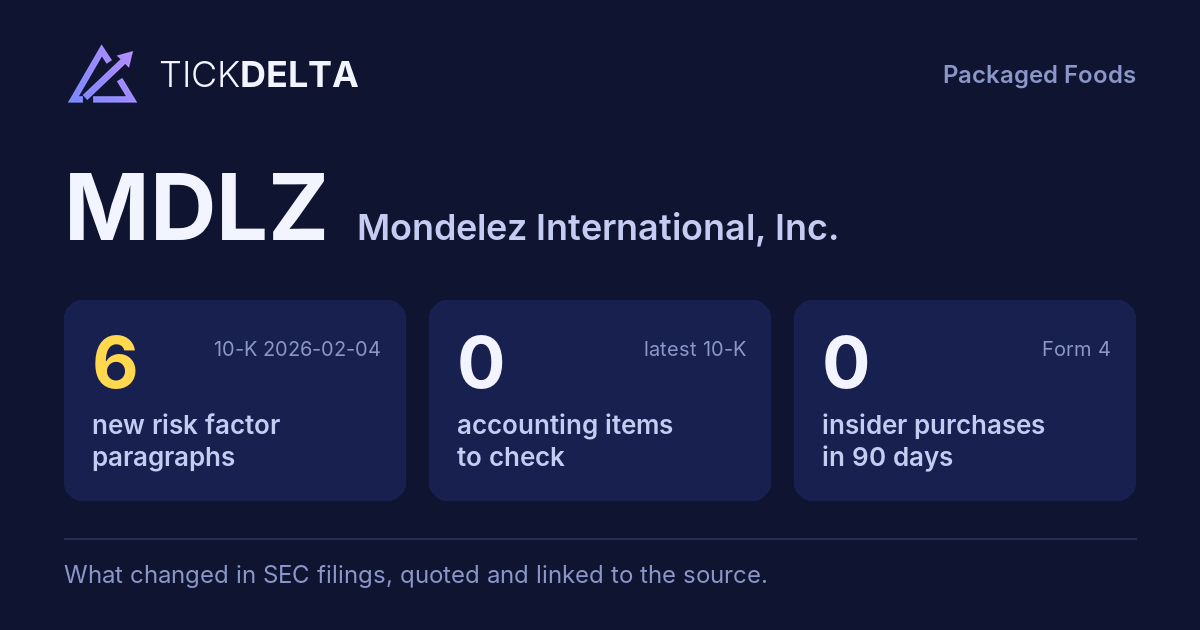
MDLZMondelez International

Consumer staples · Packaged Foods · Nasdaq

Mondelēz International’s purpose is to empower people to snack right. 10-K, Item 1

Employees
91,000
Headquarters
Chicago, IL
CEO
de Put Dirk Van
Next results
around Feb 2, 2027
Compare with peers → Embed

When the SEC's staff reviews a filing, it writes to the company with numbered questions, and the company answers each one in a letter. SEC publishes the exchange once the review is over, at least 20 business days later. Below: what the staff asked MDLZ, and the company's answer to each question, quoted from the letters. A question is not an accusation; most reviews end with the company adding detail to its next filing.

Schedule 14A

2022-09-02 to 2022-10-20 · 3 questions · 1 letter from the SEC, 0 from the company
Review closed 2022-10-20
Controls
SEC letter of 2022-09-02 ↗ no reply letter on EDGAR (the company may have answered in an amended filing)
Definitive Proxy Statement on Schedule 14A filed April 6, 2022 · General
SEC asked (1)
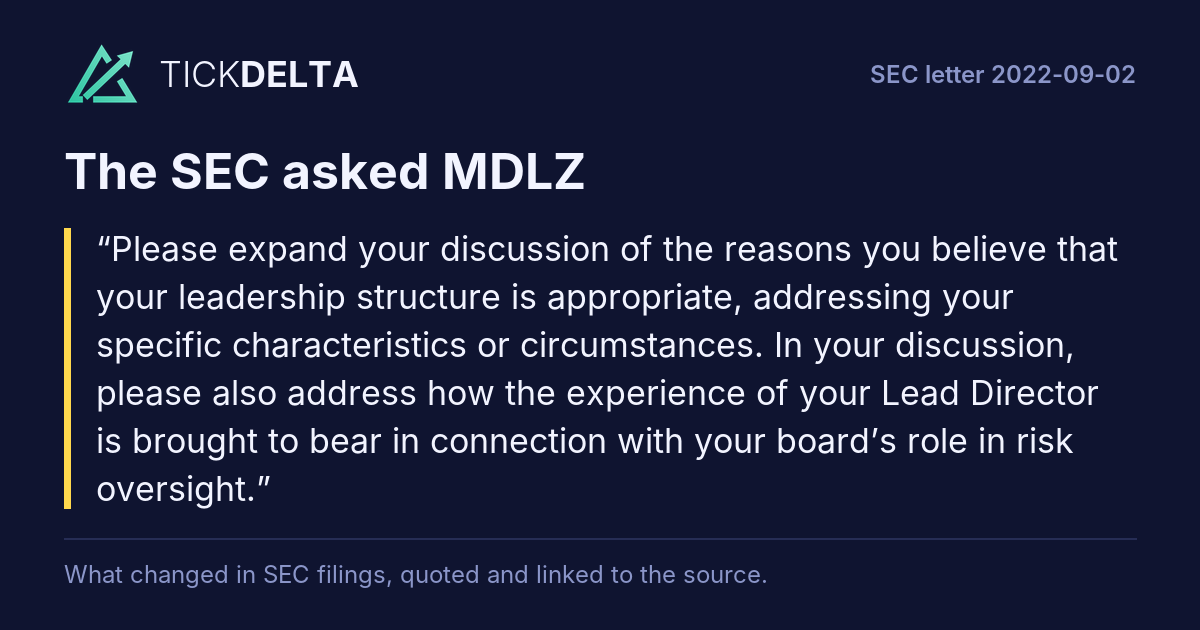
Please expand your discussion of the reasons you believe that your leadership structure is appropriate, addressing your specific characteristics or circumstances. In your discussion, please also address how the experience of your Lead Director is brought to bear in connection with your board’s role in risk oversight.
MDLZ answered

No reply letter found.

Definitive Proxy Statement on Schedule 14A filed April 6, 2022 · General
SEC asked (2)
Please expand upon the role that your Lead Director plays in the leadership of the board. For example, please enhance your disclosure to address whether or not your Lead Director may: • represent the board in communications with stakeholders other than "major shareholders," as well as any threshold to qualify as such; or • require board consideration of, and/or override your CEO on, any risk matters.
MDLZ answered

No reply letter found.

Definitive Proxy Statement on Schedule 14A filed April 6, 2022 · General
SEC asked (3)
Please expand upon how your board administers its risk oversight function. For example, please disclose: • the timeframe over which you evaluate risks (e.g., short-term, intermediate-term, or long-term) and how you apply different oversight standards based upon the immediacy of the risk assessed; • whether you consult with outside advisors and experts to anticipate future threats and trends, and how often you
Rest of the question

re-assess your risk environment; • how the board interacts with management to address existing risks and identify significant emerging risks; • to whom your Chief Compliance Officer reports; and • how your risk oversight process aligns with your disclosure controls and procedures.

MDLZ answered

No reply letter found.
Also in this review: closing letter, 2022-10-20
Form 10-K

2019-03-13 to 2019-04-23 · 2 questions · 1 letter from the SEC, 1 from the company
Review closed 2019-04-23
Results discussion (MD&A)Goodwill and impairmentCritical estimatesLiquidity and cashLegal and contingencies
Management's Discussion and Analysis of Financial Condition and Results of Operations · Critical Accounting Estimates, page 48
SEC asked (1)
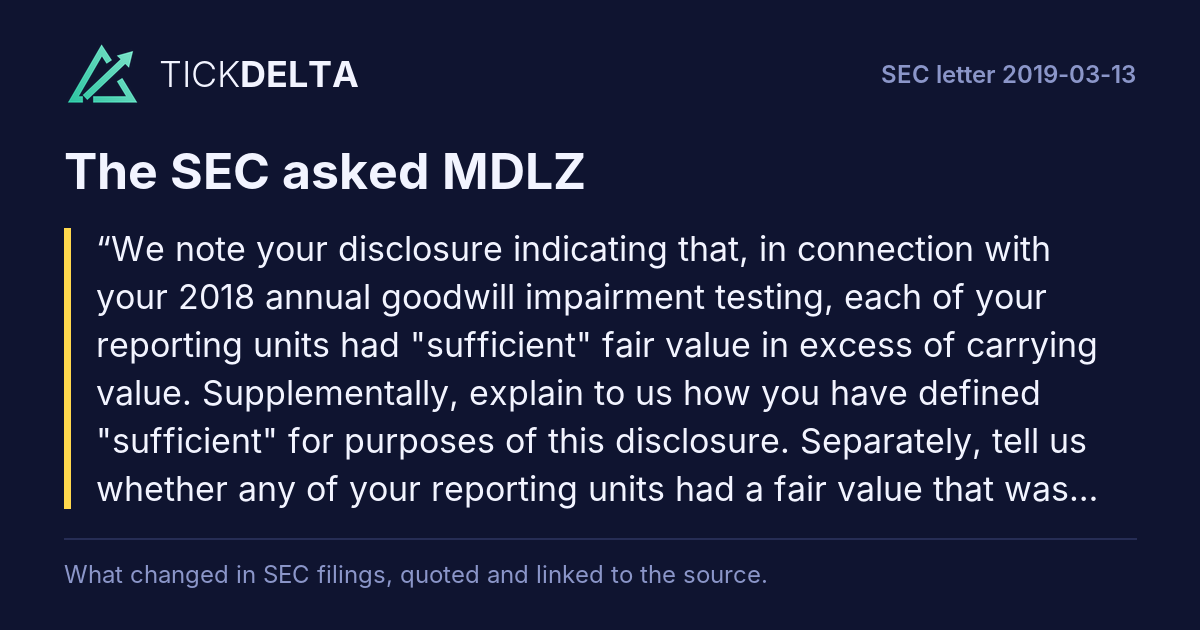
We note your disclosure indicating that, in connection with your 2018 annual goodwill impairment testing, each of your reporting units had "sufficient" fair value in excess of carrying value. Supplementally, explain to us how you have defined "sufficient" for purposes of this disclosure.
Rest of the question

Separately, tell us whether any of your reporting units had a fair value that was not substantially in excess of carrying value and which were therefore at risk of goodwill impairment under FASB ASC Topic 350. To the extent that reporting units are at risk of goodwill impairment, explain to us how you considered providing the following disclosures: • The percentage by which fair value exceeded carrying value as of the date of the most recent test; • The amount of goodwill allocated to the reporting unit; • A description of the methods and key assumptions used and how the key assumptions were determined; • A discussion of the degree of uncertainty associated with the key assumptions. The discussion regarding uncertainty should provide specifics to the extent possible (e.g., the valuation model assumes recovery from a business downturn within a defined period of time); and • A description of potential events and/or changes in circumstances that could reasonably be expected to negatively affect the key assumptions.

MDLZ answered
We respectfully acknowledge the Staff’s comment and note that based on our annual impairment testing, each of our reporting units has fair value significantly in excess of carrying value. If we were to determine that a reporting unit did not have sufficient fair value in excess of carrying value, we would provide the additional disclosures noted in your comment. In making this determination, we would use a threshold of 10% excess of fair value over carrying value, which is consistent with the threshold we use for our intangible asset disclosures.
Rest of the answer

As no reporting units were at risk of a goodwill impairment, we did not expand our Form 10-K disclosures to include all the disclosures referenced above. In Note 1, Summary of Significant Accounting Policies, and in Critical Accounting Estimates in the Form 10-K, we further describe our goodwill testing and valuation methods, key assumptions and related uncertainties, and potential events and changes that could negatively affect our key assumptions and test results.

Read in the reply ↗
In its next report

First report after the company's reply of 2019-03-21: 10-Q filed 2019-05-01 ↗, against the 10-Q filed 2018-10-30 ↗.

Tickdelta does not hold the text of both reports, so they are not compared here.

Financial Statements and Supplementary Data · Note 13 - Commitments and Contingencies, page 109
SEC asked (2)
You indicate in the last paragraph under the caption Legal Proceedings that you believe the ultimate outcome of the various legal proceedings to which you are a party, individually and in the aggregate, will not materially harm your financial position, results of operations or cash flows.
Rest of the question

If it is at least reasonably possible that a loss exceeding amounts already recognized may have been incurred and the amount of that additional loss would be material, either disclose the estimated additional loss, or range of loss, that is reasonably possible, or state that such an estimate cannot be made. Refer to FASB ASC paragraph 450-20-50-4 and Question 2 to SAB Topic 5:Y.

MDLZ answered
We note the Staff’s comment with respect to the last paragraph under the caption Legal Proceedings in Note 13 to the financial statements. We advise the Staff that based on current circumstances, we are unable to estimate the amount of loss or amount of any range of loss with respect to the disclosed matters due to the procedural status and early stage in the proceedings of these matters.

Following the guidance in ASC 450-20-50-3 and 450-20-50-4, we regularly evaluate the status of the legal proceedings in which we are involved to determine whether accruals are appropriate under ASC
Rest of the answer

450-20-25-2 and whether estimates of possible loss or range of loss can be made under ASC 450-20-50-4. As part of this evaluation, we analyze each potentially material contingent liability, taking into account, as appropriate, the nature of the litigation, claim or assessment, the procedural status of the matter, any recent rulings or determinations by courts or other governmental authorities, advice of experts and counsel, and any settlement discussions and other developments that may impact the analysis. We evaluate new developments and information regularly and re-evaluate our loss contingency disclosures in accordance with the guidance of ASC 450 to reflect current information.

In future filings, unless circumstances have changed, we will supplement the last paragraph of our Legal Proceedings disclosure as follows:

We are a party to various legal proceedings incidental to our business, including those noted above in this section. We record provisions in the consolidated financial statements for pending litigation when we determine that an unfavorable outcome is probable and the amount of the loss can be reasonably estimated.

For matters that are reasonably possible to result in an unfavorable outcome, management is unable to estimate the possible loss or range of loss or such amounts have been determined to be immaterial. At present we believe that the ultimate outcome of these proceedings, individually and in the aggregate, will not materially harm our financial position, results of operations or cash flows. However, legal proceedings and government investigations are subject to inherent uncertainties, and unfavorable rulings or other events could occur. Unfavorable resolutions could involve substantial monetary damages. In addition, in matters for which conduct remedies are sought, unfavorable resolutions could include an injunction or other order prohibiting us from selling one or more products at all or in particular ways, precluding particular business practices or requiring other remedies. An unfavorable outcome might result in a material adverse impact on our business, results of operations or financial position.

Read in the reply ↗
In its next report

First report after the company's reply of 2019-03-21: 10-Q filed 2019-05-01 ↗, against the 10-Q filed 2018-10-30 ↗.

Tickdelta does not hold the text of both reports, so they are not compared here.

Also in this review: closing letter, 2019-04-23

Form 10-K for the Fiscal Year Ended December 12, 2016

2017-05-05 to 2017-05-26 · 2 questions · 1 letter from the SEC, 1 from the company
Review closed 2017-05-26
Russia and UkraineRevenue
General
SEC asked (1)
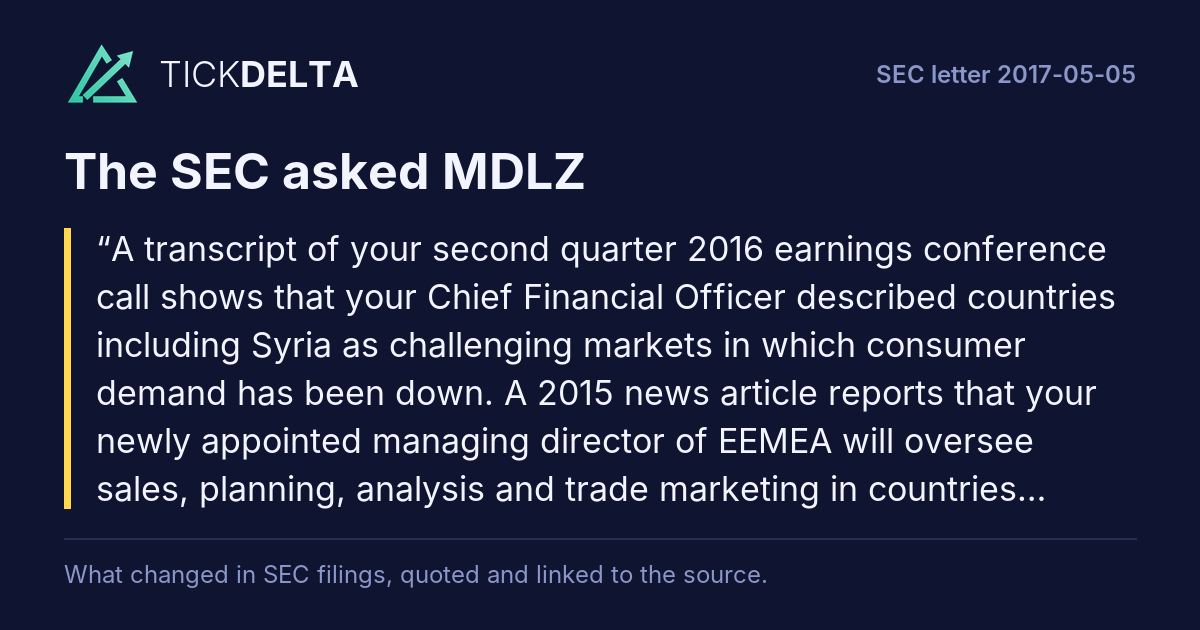
A transcript of your second quarter 2016 earnings conference call shows that your Chief Financial Officer described countries including Syria as challenging markets in which consumer demand has been down. A 2015 news article reports that your newly appointed managing director of EEMEA will oversee sales, planning, analysis and trade marketing in countries including Sudan.
Rest of the question

Syria and Sudan are designated by the State Department as state sponsors of terrorism, and are subject to U.S. economic sanctions and export controls. Your Form 10-K does not provide disclosure about those countries. Please describe to us the nature and extent of your past, current, and anticipated contacts with Syria and Sudan, whether through subsidiaries, affiliates, distributors, resellers or other direct or indirect arrangements. You should describe any products or services you have provided to Syria and Sudan, directly or indirectly, and any agreements, commercial arrangements, or other contacts with the governments of those countries or entities they control.

MDLZ answered
We have very limited activities related to either Syria or North and South Sudan (which we refer to together as Sudan). We have no offices, operations, employees or assets in either country and no agreements or arrangements that involve the governments of Syria or Sudan or entities they control.

Cecilia Blye

Page

U.S. law permits sales of food and beverage products into Syria and Sudan provided theses sales comply with applicable requirements, and we believe that our activities related to Syria and Sudan comply with these requirements.
Rest of the answer

We work with distributors in Syria and Sudan that sell our snack and/or beverage products in those countries and we obtain some intellectual property-related legal advisory services from firms in Syria and Sudan. These arrangements are conducted in accordance with applicable legal requirements, including general or specific licenses from the Office of Foreign

Assets Control (“OFAC”) of the U.S. Department of the Treasury. Our agreements with these entities also contain provisions that require these business partners to comply fully with all applicable laws. Details of these arrangements are as follows.

Syria

One of our subsidiaries entered into a distributorship agreement with International Megabrands LLC (“Megabrands”), a company incorporated in Syria. Megabrands distributes a variety of our gum products in Syria. Our OFAC license to sell non-U.S. origin gum to Syria expired in November 2016, and we ceased such sales upon expiration. However, we are currently seeking to renew it.

Sudan

We have subsidiaries that have entered into distributorship agreements with the following companies:

•

Unibrands Co Ltd (“Unibrands”), a company incorporated in Sudan. Unibrands distributes a variety of our candy products to retail and wholesale markets in Sudan. We also intend to sell gum in Sudan in the future.

Trans Africa for Investment & Distribution Co. Ltd (“Trans Africa”), a company incorporated in Sudan. Trans Africa has distributed a variety of our biscuits, chocolate and beverages products in Sudan.

We are currently renegotiating this agreement.

Transmed West Africa (“Transmed”), a company incorporated in Lebanon. Transmed distributes a variety of our biscuits, chocolate and beverages products in Sudan.

Read in the reply ↗
General
SEC asked (2)
Please discuss the materiality of the contacts with Syria and Sudan you describe in response to the comment above, and whether those contacts constitute a material investment risk for your security holders. You should address materiality in quantitative terms, including the approximate dollar amounts of any associated revenues, assets, and liabilities for the last three fiscal years and the subsequent interim
Rest of the question

period. Also, address materiality in terms of qualitative factors that a reasonable investor would deem important in making an investment decision, including the potential impact of corporate activities upon a company’s reputation and share value. Various state and municipal governments, universities, and other investors have proposed or adopted divestment or similar initiatives regarding investment in companies that do business with U.S.- designated state sponsors of terrorism. You should address the potential impact of the investor sentiment evidenced by such actions directed toward companies that have operations associated with Syria and Sudan.

MDLZ answered
We believe that our limited contacts with and revenue derived from Syria and Sudan are not material to investors, taking into account both quantitative and qualitative factors as described below.

Quantitatively, net revenues related to our activities in Syria and Sudan for the periods requested were as follows (USD in millions):

Total Company

Period

$

% of

Total

2014

$34,244

100%

$0.00

0.000%

$1.90

0.006%

2015

$29,636

$1.50

0.005%

$1.20

0.004%

2016

$25,923

$0.70

0.003%

$0.60

0.002%

Q1 2017

$6,414

$0.10

We currently have only a $0.031 million outstanding receivable
Rest of the answer

that relates to Sudan. We do not have any assets in either Syria or Sudan.

Qualitatively, our operations in Syria and Sudan are not material to our overall business. We think a reasonable investor distinguishes between the sale of biscuits, chocolate, gum, candy and beverage products into these countries and the sale of goods or services that might contribute to activities that have resulted in these countries being sanctioned under U.S. laws. We regularly engage in discussions with our shareholders on a variety of issues to understand their views on our business. We have not received any inquiries or heard any concerns from our investors relating to activities in Syria or Sudan, nor do we have any information that would suggest that investors have deemed having such information important in making an investment decision with respect to our securities. Thus we do not think our activities in these countries are having or would have a negative effect on our operating results, reputation or share value.

Because we have very limited activities and minimal net revenues, assets and liabilities related to these countries and because of the nature of the products that we do sell, we do not believe that information related to our activities in those countries is material or will become material in the foreseeable future. As such, we have not disclosed information about these activities in our filings with the Commission. We will continue to monitor developments and investor interest in this area as well as review and monitor our global activities in order to comply with relevant U.S. law.

Read in the reply ↗

Also in this review: closing letter, 2017-05-26

Form 8-K

2016-09-27 to 2017-01-30 · 3 questions · 2 letters from the SEC, 2 from the company
Review closed 2017-01-30
Non-GAAP measuresRevenue
Form 8-K Filed July 27, 2016 · Exhibit 99.1
SEC asked (1)
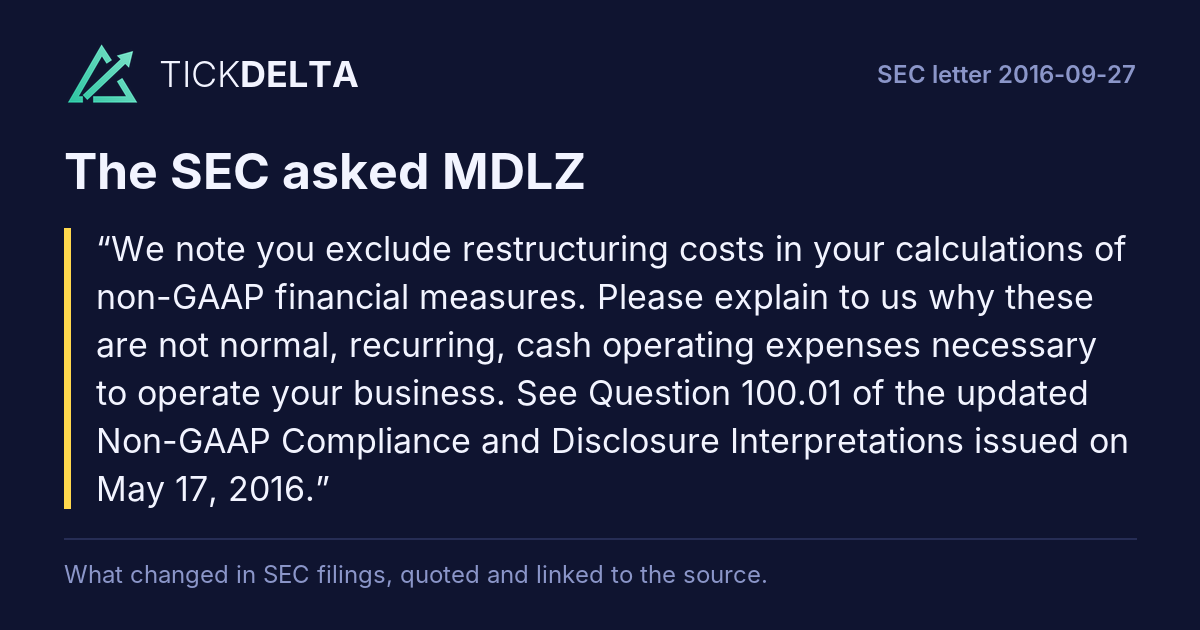
We note you exclude restructuring costs in your calculations of non-GAAP financial measures. Please explain to us why these are not normal, recurring, cash operating expenses necessary to operate your business. See Question 100.01 of the updated Non-GAAP Compliance and Disclosure Interpretations issued on May 17, 2016.
MDLZ answered
We exclude the costs of our 2014-2018 Restructuring Program as the program is not normal or recurring. The $3.5 billion program is comprised of approximately $2.5 billion in cash costs and $1.0 billion in non-cash costs and up to $2.2 billion in capital expenditures. The main objective of the program is to reduce our operating cost structure in both our supply chain and overhead costs through:

• the transformation of our portfolio of legacy manufacturing facilities into a modernized multi-product manufacturing supply chain infrastructure, which will entail streamlining and/or divesting over
Rest of the answer

65% of our plants across the globe and installing approximately 30 new, advanced production lines;

moving from country-based operations to regional operating businesses; and the implementation of shared services across our global operations to drive transactional efficiencies.

As indicated by the filing of our Current Report on Form 8-K dated May 7, 2014, this program was approved by the Board of Directors and commits the Company to this plan. The Restructuring Program is a global-scale initiative that we do not expect to recur once we have made the resulting changes to our business.

Brad Skinner

We monitor the Restructuring Program to ensure compliance with the objectives of the program. Any restructuring activity not aligned with the program goals is expensed and not subject to adjustment in our presentation of non-GAAP earnings measures. In keeping with the updated Non-GAAP Compliance and Disclosure Interpretations, we present GAAP financial measures prominently and supplement that information with certain non-GAAP financial measures that management uses in making decisions regarding the business and that provide useful information to investors and the finance community, which allows them to compare our performance across periods and against our peers. We benchmarked our non-GAAP measures against the measures presented by the U.S. companies in our performance peer group, as referenced in our filings with the Commission, and our treatment of costs associated with the 2014-2018 Restructuring Program is consistent with these peers, as they also exclude major restructuring programs from their non-GAAP financial measures.

In order to clarify how we adjust our non-GAAP financial measures to reflect the costs of the Restructuring Program, in future earnings releases and filings, we intend to include a footnote to our “Definitions of the Company’s Non-GAAP Financial Measures” section stating as follows, with conforming changes throughout as appropriate:

Non-GAAP adjustments related to the 2014-2018 Restructuring Program reflect costs incurred that relate to the objectives of the company’s program to transform its supply chain network and organizational structure. Costs that do not meet the program objectives are not reflected in the non-GAAP adjustments.

Read in the reply ↗
Form 8-K Filed July 27, 2016 · Exhibit 99.1
SEC asked (2)
We note that you adjust your non-GAAP measure “Adjusted EPS” for your proportionate share of unusual or infrequent items recorded by your equity investees. Please explain to us why this treatment of equity method investment earnings is not an individually tailored measurement method substituted for the one in GAAP.
Rest of the question

See Question 100.04 of the updated Non-GAAP Compliance and Disclosure Interpretations issued on May 17, 2016.

MDLZ answered
We record and report “equity method investment net earnings” as prescribed by U.S. GAAP and without adjustment in our financial statements. In our presentation of “Adjusted EPS”, we seek to reflect the results of our equity method investees in a manner consistent with how we present non-GAAP results for the Company as a whole by recognizing our share of unusual or infrequent items recorded by our equity method investees.
Rest of the answer

These one-time costs also include the integration costs for:

The transactions completed on July 2, 2015 in which we combined our wholly owned coffee businesses with those of D.E Master Blenders 1753 B.V. to create a new company, Jacobs Douwe Egberts (“JDE”) in which we currently hold a 26.4% equity interest and;

The transaction completed on March 7, 2016 in which we exchanged a portion of our equity in JDE for a 24.2% equity interest in Keurig Green Mountain Inc.

We review the non-GAAP adjustments with our investees each quarter to evaluate whether the adjustments are appropriate and consistent with industry practices. We adjust for the non-GAAP items of the investees in order to provide investors with a comparable view of our performance across periods. Prior to entering into these investments, we benchmarked equity method investee non-GAAP reporting against that of similarly situated companies with material equity method investments. Our review confirmed that others reflected their share of the equity method investee non-GAAP adjustments in their non-GAAP presentation.

In order to clarify the purpose and effect of these adjustments, in future earnings releases and filings, we intend to revise our description of “Adjusted EPS” in relevant part as follows, with conforming changes throughout as appropriate:

“Adjusted EPS” is defined as diluted EPS attributable to Mondelēz International from continuing operations excluding…

Similarly, within Adjusted EPSIn addition, the company’s has adjusted its equity method investment net earnings for exclude its proportionate share of its investees’ unusual or infrequent items, such as acquisition and divestiture-related costs and restructuring program costs, recorded by the company’s JDE and Keurig Green Mountain Inc. (“Keurig”) equity method investees. The company believes that Adjusted EPS provides improved comparability of underlying operating results…

Read in the reply ↗
Form 8-K Filed July 27, 2016 · Exhibit 99.1
SEC asked
We note your response to prior comment two that includes your proposed disclosure related to your non-GAAP measure that excludes the proportionate share of your equity method investees’ unusual or infrequent items in order to provide improved comparability of underlying operating results.
Rest of the question

Please revise your disclosure to include a discussion of the limitations associated with the use of this non-GAAP measure as compared to the use of the most directly comparable GAAP measure. For example, your disclosure should explain that you do not control, nor do you have any legal claim, to the revenues and expenses related to your equity method investees and that excluding these expenses may imply that you have control over the operations and resulting revenue and expenses.

MDLZ answered
We revised the disclosure in our earnings release for the quarter ended September 30, 2016 as we committed to do in our response to prior comment two. To address the limitations associated with the use of this non-GAAP measure as compared to the use of the most directly comparable GAAP measure, in future earnings releases and filings, we intend to include the additional footnote shown below:

Brad Skinner

Page

“Adjusted EPS” is defined as diluted EPS attributable to Mondelēz

International from continuing operations excluding … Similarly, within Adjusted EPS, the company’s equity method
Rest of the answer

investment net earnings exclude its proportionate share of its investees’ unusual or infrequent items (1), such as acquisition and divestiture-related costs and restructuring program costs...

(1)

We have excluded our proportionate share of our equity method investees’ unusual or infrequent items in order to provide investors with a comparable view of our performance across periods. Although we have shareholder rights and board representation commensurate with our ownership interests in our equity method investees and review the underlying operating results and unusual or infrequent items with them each reporting period, we do not have direct control over their operations or resulting revenue and expenses. Our use of equity method investment net earnings on an adjusted basis is not intended to imply that we have any such control. Our GAAP “diluted EPS attributable to Mondelēz

International from continuing operations” includes all of the investees’ unusual and infrequent items.

Read in the reply ↗

Also in this review: closing letter, 2017-01-30

Form 10-K for the Fiscal Year ended December 31, 2014

2015-04-06 to 2015-05-01 · 1 question · 1 letter from the SEC, 1 from the company
Review closed 2015-05-01
RevenueResults discussion (MD&A)
Management’s Discussion and Analysis of Financial Condition and Results of Operations, page
SEC asked
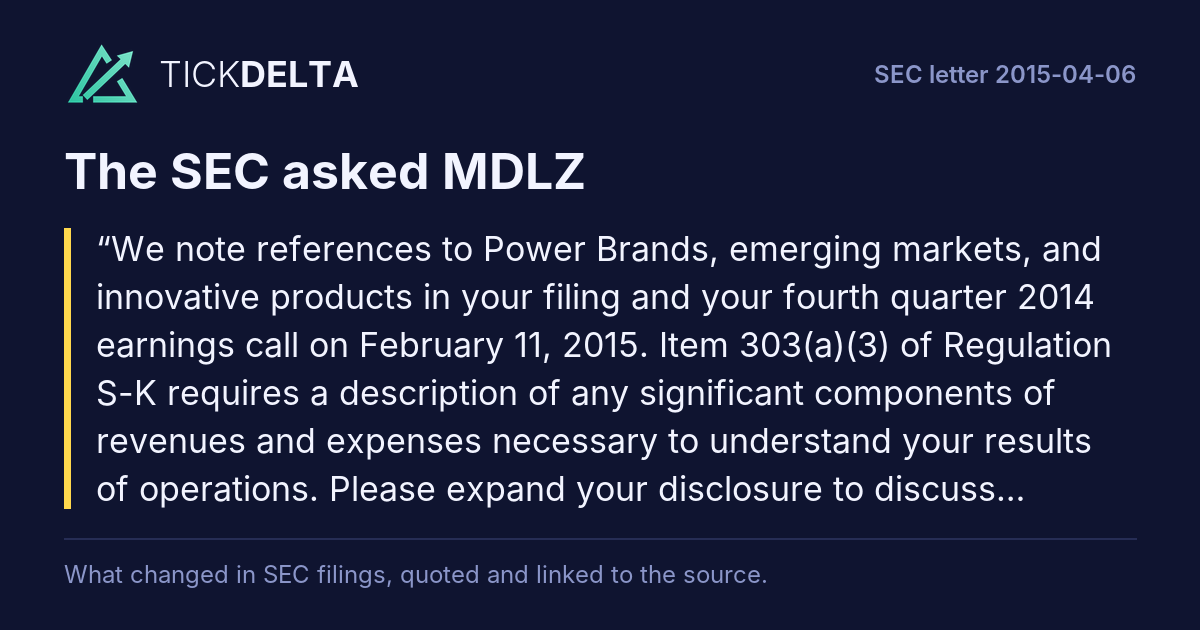
We note references to Power Brands, emerging markets, and innovative products in your filing and your fourth quarter 2014 earnings call on February 11, 2015. Item 303(a)(3) of Regulation S-K requires a description of any significant components of revenues and expenses necessary to understand your results of operations.
Rest of the question

Please expand your disclosure to discuss revenues and expenses related to these components, or explain to us why you do not believe additional disclosure pursuant to Regulation S-K is necessary.

MDLZ answered
We acknowledge the staff’s comments and will disclose revenue attributable to Power Brands and emerging markets in our MD&A discussion in future filings beginning with our Q1 2015 Form 10-Q. Management cites revenues attributable to Power Brands and emerging markets as part of its overall evaluation of revenues only.
Rest of the answer

We do not separately track all expenses for our Power Brands and emerging markets and therefore, we have not in the past provided and do not plan to provide on a going-forward basis this information.

With respect to innovative products, we disclose our strategies and how we develop new products and adapt successful products from one market to others. Offering innovative

Karl Hiller products is an important objective in running and growing our business, and we have provided disclosures to investors about our initiatives and examples of some of our recent innovative products.

However, unlike revenues attributable to Power Brands and emerging markets, we do not aggregate revenue information on innovative products within our systems. Furthermore, as with Power Brands and emerging markets, we do not track expense information on innovative products. As such, periodically, we work with our offices around the world to collect and derive, to the extent possible, supplemental information about our innovative products and may disclose limited information from time to time, but this information is not otherwise regularly made available to or used by management. We believe the information we currently provide in our periodic filings on our innovative product strategies is appropriate and meaningful to our investors.

As requested by the staff, we hereby acknowledge that

• the Company is responsible for the adequacy and accuracy of the disclosure in the filing;

staff comments or changes to disclosure in response to staff comments do not foreclose the Commission from taking any action with respect to the filing; and the Company may not assert staff comments as a defense in any proceeding initiated by the Commission or any person under the federal securities laws of the United States.

Read in the reply ↗
In its next report

First report after the company's reply of 2015-04-16: 10-Q filed 2015-04-30 ↗, against the 10-Q filed 2014-11-06 ↗.

Tickdelta does not hold the text of both reports, so they are not compared here.

Also in this review: closing letter, 2015-05-01

Form 8-K

2014-08-26 to 2014-09-09 · 1 question · 1 letter from the SEC, 1 from the company
Review closed 2014-09-09
RevenueNon-GAAP measures
Form 8-K dated August 6, 2014 · Exhibit 99.1
SEC asked
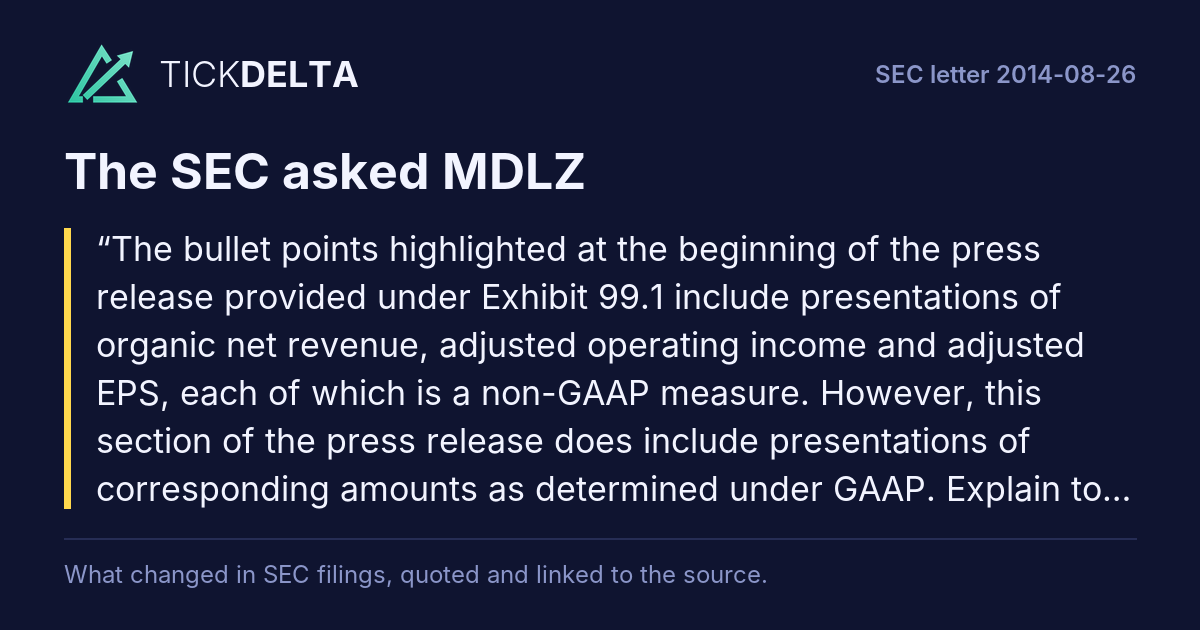
The bullet points highlighted at the beginning of the press release provided under Exhibit 99.1 include presentations of organic net revenue, adjusted operating income and adjusted EPS, each of which is a non-GAAP measure. However, this section of the press release does include presentations of corresponding amounts as determined under GAAP.
Rest of the question

Explain to us why you believe this complies with Item 10(e)(1)(i)(A) of Regulation S-K, which requires a presentation, with equal or greater prominence, of the most directly comparable financial measure or measures calculated and presented in accordance with GAAP.

MDLZ answered
We acknowledge the staff’s comment regarding the presentation of non-GAAP financial measures in the Form

8-K. For the reasons explained below, we believe that our earnings release satisfies the applicable requirements. However, in light of the staff’s comments, in future filings we will include in the bullet points at the beginning of the press release the corresponding amounts as determined under GAAP.

Each use of non-GAAP financial information in the bullets at the beginning of the press release is clearly noted and appears together on the same page of the press release as the comparable
Rest of the answer

GAAP numbers. We also present the GAAP numbers in the chart on page 2 of the press release in a form that permits the reader to easily compare the GAAP and non-GAAP numbers. The footnotes to the non-GAAP numbers in the bullet points direct the reader to the definitions of the non-GAAP terms and the reconciliations of the non-GAAP numbers to the comparable GAAP numbers. In addition, each non-GAAP term in the bullet points contains either the word “organic” or “adjusted” to indicate to the reader that it represents a non-GAAP number.

Page

Overall, we believe that this presentation provides information about our financial results in the form that our investors expect and find most useful, while fulfilling the requirement to present GAAP numbers with equal prominence.

As requested by the staff, we hereby acknowledge that

• the Company is responsible for the adequacy and accuracy of the disclosure in the filing;

staff comments or changes to disclosure in response to staff comments do not foreclose the Commission from taking any action with respect to the filing; and the Company may not assert staff comments as a defense in any proceeding initiated by the Commission or any person under the federal securities laws of the United States.

Read in the reply ↗

Also in this review: closing letter, 2014-09-09

1 other letter: notices that a filing will not be reviewed, requests to declare a registration effective, and the like
  • 2022-09-15 · MDLZ: letter · Mondelez International, Inc. · Definitive Proxy Statement on Schedule 14A · Filed...

From the SEC's correspondence on EDGAR: staff letters (form UPLOAD) and company letters (form CORRESP), 20 letters filed since 2014-08-27. Questions and answers are matched by their numbers; topics come from words in each question. The reports are compared word for word (same form, before the first SEC letter against the first report after the company's reply). No AI.

Work on MDLZ in a spreadsheet: Excel workbook (a sheet per section, ten years by column, charts, links to the filings) · CSV. For a Google Sheet that stays up to date, paste =IMPORTDATA("https://tickdelta.com/company/MDLZ/export.csv") into a cell.