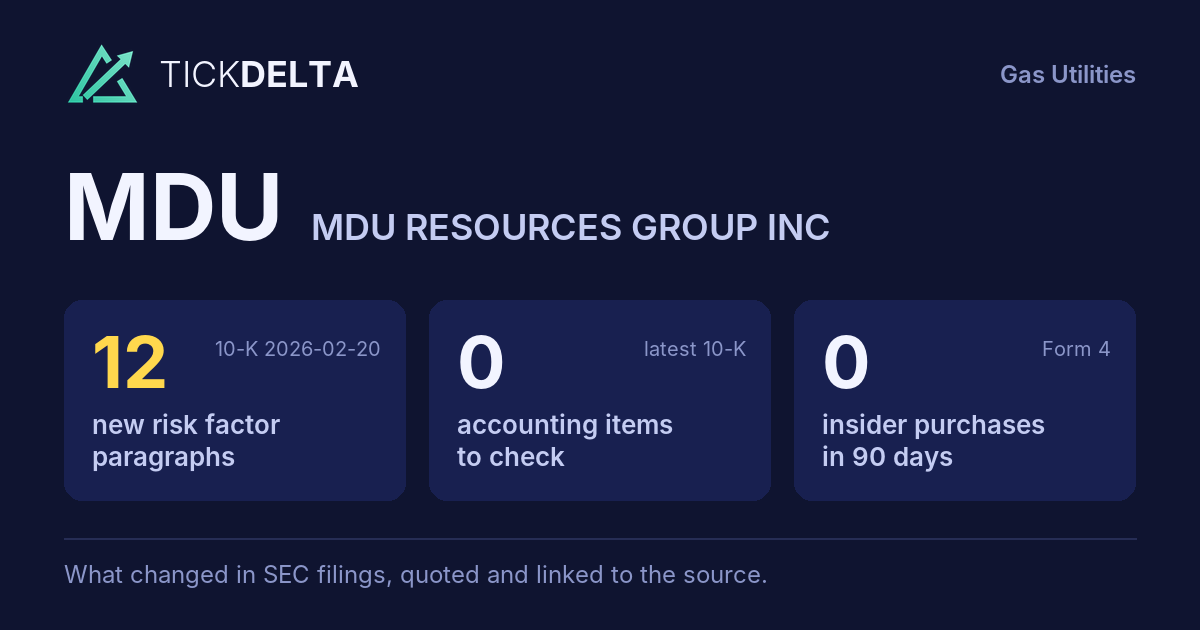
Screener / SEC EDGAR /CIK 0000067716 /10-K filed Feb 20, 2026, compared with Feb 20, 2025 /Numbers from the XBRL of the 10-Ks
NYSE Utilities · Gas Utilities

MDU Resources Group Inc MDU

Compare with peers Embed
The 10-K against last year's

207 changes: 42 added, 83 removed, 82 reworded

10-K Feb 20, 2026 vs Feb 20, 2025

10-K 0000067716-26-000014 (Feb 20, 2026) vs 10-K 0000067716-25-000016 (Feb 20, 2025)

Every paragraph, and how much of it changed

One bar per paragraph, in the order of the 10-K. Height and colour show the share of its words not in the closest paragraph a year earlier; the tallest bars are new paragraphs.

Risk Factors

105 paragraphs · 12 new · 34 reworded · 0 gone · 10-K Feb 20, 2026 against Feb 20, 2025
New paragraph Reworded (5% of its words or more) Same or nearly
Paragraph 55 · 48% changed Every version of it
The Company's operations could be negatively adversely impacted by import tariffs and/or other government mandates. severe weather and changing weather patterns.
Paragraph 67 · 44% changed Every version of it
The Company has faced and may continue to face stakeholder scrutiny related to ESG matters. Certain stakeholders of the Company, such as investors, customers, employees employees, and lenders, have increased their scrutiny of the impacts and social cost associated with ESG matters, including climate change. Concern that GHG emissions contribute to global climate change has led to international, federal, state and local legislative and regulatory proposals to reduce or mitigate the effects of GHG emissions. The Company certain stakeholders may experience significant future costs associated with compliance of such legislative actions. The Company’s primary GHG emission is carbon dioxide from fossil fuels combustion at Montana-Dakota's electric generating facilities, particularly its jointly owned coal-fired facilities. hold divergent opinions on these issues.
Paragraph 68 · 41% changed Every version of it
The Company has faced Certain states and customers are seeking cleaner energy sources and may continue demand alternatives to traditional energy sources. If state or customer sentiment shifts more rapidly than expected, the Company may face stakeholder scrutiny related reduced demand for its existing services or be pressured to ESG matters. Certain stakeholders of offer new low-carbon solutions. Decarbonization policies on building electrification initiatives could slow or reduce future customer additions in the Company, such as investors, customers, employees and lenders, have increased their scrutiny of Company's service territories. Jurisdictions pursuing aggressive GHG reduction strategies may adopt building codes or incentive structures that discourage new natural gas hookups, potentially impacting the impacts and social cost associated with ESG matters, including climate change. Company's long-term growth assumptions. Concern that GHG emissions contribute to global climate change has led to international, federal, state and local legislative and regulatory proposals to reduce or mitigate the effects of GHG emissions. The Company may experience significant future costs associated with compliance of such legislative actions. The Company’s primary GHG emission is carbon dioxide from fossil fuels combustion at Montana-Dakota's electric generating facilities, particularly its jointly owned coal-fired facilities.
Paragraph 40 · 36% changed Every version of it
Changes to federal, state and local tax laws have the ability to benefit or adversely affect the Company's earnings and customer costs. Significant changes to corporate tax rates could result in the impairment of deferred tax assets that are established based on existing law at the time of deferral. The U.S. administration has introduced uncertainty regarding the continuation of the IRA electric business owns and a potential shift in federal operates renewable energy policies regarding clean energy projects. Changes in regulations that impact the value of various tax credits, including generating facilities. These facilities generate production tax credits could change used to reduce the economics Company's federal income tax liability. The amount of resources production tax credits earned depends on the date the qualifying generating facilities are placed in service and the resource selection various operating and economic factors, including facility generation, transmission constraints, and wind production. These factors could impact current and/or future projects for the electric generation business and the development level of other renewable energy projects, such as RNG. Such actions could adversely affect the Company's ability to secure production tax credits and other incentives that support the development of renewable energy projects. credits. Regulation incorporates changes in tax law into the rate-setting process, which could create timing delays before the impact of changes are realized.
Paragraph 71 · 31% changed Every version of it
The Company is subject to government regulations that may have a negative impact on its business and its results of operations and cash flows. Statutory Statutory, legal, and regulatory requirements also may limit another party's ability to acquire the Company or impose conditions on an acquisition of or by the Company.
Paragraph 4 · 27% changed Every version of it
In the normal course of business, the Company often places assets in service and establishes historical test periods before rate cases that seek to adjust customer rates and the Company's allowed rate of return to recover those investments can be filed for. The rate case review policy varies by jurisdiction in which the Company operates and is as long as eleven months in certain states. Because of this process, the Company could have assets placed in service without the benefit of rate relief, commonly referred to as regulatory lag. In certain jurisdictions, regulatory authorities have approved various infrastructure and annual rate adjustment mechanisms to effectively reduce regulatory lag inherent in the rate making process. Regulatory lag could significantly increase if the regulatory authorities modify or terminate these rate mechanisms. There can be no assurance that applicable regulatory commissions will determine that the Company's costs have been prudent, which could result in the disallowance of costs in setting rates for customers. Also, the regulatory process of approving rates for these businesses may not allow for timely and full recovery of the costs of providing services or a return on the Company's invested capital. Changes in regulatory requirements or operating conditions may require early retirement of certain assets. While regulation typically provides rate recovery for these retirements, there is no assurance regulators will allow full recovery of all remaining costs, which could leave stranded asset costs. Rising fuel costs could increase the risk that the utility businesses will not be able to fully recover those fuel costs from customers.
Paragraph 2 · 27% changed Every version of it
The Company is subject to government regulations that may have a negative impact on its business and its results of operations and cash flows. Statutory and regulatory requirements also may limit another party's ability to acquire the Company or impose conditions on an acquisition of or by the Company.
Paragraph 28 · 23% changed Every version of it
In 2024, 2023 2025, 2024 and 2022, 2023, the Company experienced elevated commodity and supply chain costs at varying degrees over the 3-year timeframe, including the costs of labor, raw materials, energy-related products and other inputs used in for constructing the production and distribution of facilities the Company uses to provide its products and services.

MD&A

162 paragraphs · 30 new · 76 reworded · 83 gone · 10-K Feb 20, 2026 against Feb 20, 2025
New paragraph Reworded (5% of its words or more) Same or nearly
Paragraph 98 · 50% changed
In 2024, the EPA published several final rules related to GHG emissions from regulations continue to evolve due to congressional actions and agency reconsideration. Methane Waste Emissions Charge regulations finalized in 2024 were eliminated by a resolution of disapproval passed by Congress and signed by the oil and natural gas industry. These rules update, strengthen and expand standards to reduce GHG emissions and other air pollutants from new and existing oil and gas facilities, revise the GHG reporting rules to improve the monitoring, measurement, calculation and reporting of GHG data, and incorporate President in March 2025. The OBBBA postponed the Waste Emissions Charge provisions from in the IRA. Clean Air Act to 2034. The EPA has issued several actions since the EPA Administrator's announcement regarding 31 historic actions to advance the President's "Power the Great American Comeback", which include extending deadlines for certain oil and gas new source performance standards and a proposal to reconsider the Greenhouse Gas Reporting Program. The Company continues to comply with rules as they remain in effect, and to monitor and assess these rulemakings rulemaking changes and the potential impacts they may have on its business processes, current and future projects, results of operations and disclosures.
Paragraph 142 · 48% changed
Critical accounting estimates are defined as estimates that require management to make assumptions about matters that are uncertain at the time the estimate was made and changes in the estimates could have a material impact on the Company's financial position or results of operations. The Company's critical accounting estimates are subject to judgments and uncertainties that affect the application of its significant accounting policies discussed in Item 8 - Note 2. As additional information becomes available, or actual amounts are determinable, the recorded estimates are revised. Consequently, the Company's financial position or results of operations may be materially different when reported under different conditions or when using different assumptions in the application of the following critical accounting estimates.
Paragraph 117 · 47% changed
At December 31, 2024, 2025, the pension plans' accumulated projected benefit obligations exceeded these plans' assets by approximately $24.7 $18.5 million. Pretax pension expense reflected in the Consolidated Statements of Income for the year ended December 31, 2024 was $835,000. Pretax pension income reflected in the Consolidated Statements of Income for the years ended December 31, 2023 and 2022, was $580,000 and $2.3 million, respectively. The Company's pension expense is currently projected to be approximately $3.4 million in 2025. Funding for the pension plans is actuarially determined. The Company expects to contribute the minimum funding requirement of $1.7 million in 2025. For the year ended December 31, 2024, the Company contributed the minimum funding requirement of $2.9 million. There were no minimum required contributions for the years ended December 31, 2023, or 2022 due to an additional contribution of $20.0 million in 2019, which created prefunding credits that were used in future periods. For more information on the Company's pension plans, see Item 8 - Note 18.
Paragraph 67 · 46% changed
On •In July 30, 2024, the ODEQ released the published its proposed rules to create a new Climate Protection Program Rule. On November 21, 2024, the Program. The Oregon Environmental Quality Commission adopted the new Climate Protection Program Rule. Like the prior rule, natural gas companies are required to significantly reduce GHG emissions 50 percent below the baseline by 2035 and 90 percent below the baseline by 2050. Each year, ODEQ will distribute compliance instruments to the Company at no cost and will decline annually rules in step with the reduction from baseline. The first compliance period is three years, from 2025 to 2027, with compliance demonstrations required by December 9 of the year following the end of a compliance period. Compliance periods are two years in length thereafter. November 2024. The Company intends to meet its obligations first through surrendering no cost no-cost emissions allowances and will fill remaining compliance obligations by investing in additional customer conservation and energy efficiency programs, purchasing community climate investment credits, and purchasing low carbon fuels acquiring environmental attributes from low-carbon fuel projects such as RNG. Cascade is evaluating Compliance costs for these regulations are being recovered through customer bill impacts from rates. Due to the new rule. timing of regulatory recovery, future compliance obligation purchases could impact the Company's operating cash flow.
Paragraph 71 · 46% changed
•On •In March 6, 2024, the SEC issued Final Rule 33-11275 - The Enhancement and Standardization of Climate-Related Disclosures for Investors. This rule requires registrants to provide standardized disclosures in Form 10-K related to climate-related risks, Scope 1 and 2 GHG emissions, as well as to include in a footnote to the consolidated financial statements the financial impact of severe weather events and other natural conditions. The rule requires implementation in phases between 2025 and 2033. In April 2024, the SEC announced that it would voluntarily stay its final climate disclosure rules pending judicial review. The Company is evaluating In March 2025, the rule. SEC withdrew its defense of the rules. In July 2025, the SEC asked the Eighth Circuit to issue a ruling on the abandoned climate regulations. In September 2025, the Eighth Circuit stated it was pausing its consideration of legal challenges against this rule, pending further action by the SEC.
Paragraph 94 · 42% changed
•Income tax expense in continuing operations increased $5.1 $2.4 million, largely due to higher the absence of a benefit from an adjustment related to the Company's effective state income before income taxes, partially offset by a decrease in the state effective tax rate largely due to growth in North Dakota. change.
Paragraph 69 · 42% changed
•The Washington SBCC on November 28, in 2023 and December 12, 2023, adopted residential and commercial building code amendments that will significantly limit the use of natural gas for space and water heating in new and retrofitted commercial and multifamily buildings and proposed the review of similar restrictions in the future for residential buildings. These amendments came after previous, similar state building code amendments were stayed by the SBCC after legal challenge by Cascade, along with two other local natural gas distribution companies in Washington and a coalition of homeowners, builders, and suppliers. Cascade did not believe such revisions addressed the issues which existed in the initial amendments. On In May 15, 2024, the Company filed a joint complaint seeking declaratory and injunctive relief under federal law against the Washington SBCC's adoption of the amended Washington State Energy Code. This complaint was dismissed by the federal district court. Petitioners have appealed this decision to the United States Court of Appeals for the Ninth Circuit. The Company's opening brief was filed in July 2025. Oral argument before a three-judge panel of the Ninth Circuit was held on February 10, 2026.
Paragraph 124 · 42% changed
Planned utility investments in the Company's estimated capital expenditures for 2025 2026 through 2027 2028 include construction of electric transmission lines system upgrades, substation improvements and substations, as well as natural gas delivery infrastructure, to serve a customer base that is expected to continue growing at 1 percent to 2 percent annually over the next five years, generation projects, construction of JETx, system replacements, expansion and modernization projects to meet demand from a growing customer base, including new service extensions and capacity expansion to accommodate economic and population growth across the Company's eight-state territory. The pipeline business will continue to evaluate customer-driven projects, including expansion projects, to serve power generation projects, and replace and modernize existing electric and natural gas utility infrastructure to ensure continued safe and reliable service to customers. At industrial demand in the region. In addition, the pipeline business, the Company will focus on system growth to expand natural gas transmission capacity. maintenance and expanding capacity where market conditions support additional investment. A number of projects are included in the planned investments. investments as the Company continues to invest in safe, reliable and environmentally-responsible energy delivery infrastructure across its regulated businesses. For more information on the Company's growth projects, see Business Segment Financial and Operating Data.

A paragraph is matched with the one last year that shares the most of its words; under half in common makes it new. The paragraphs shown are the 8 reworded the most in each section.

The paragraph that changed most in each section

The redline

Marked against last year's 10-K: cut words struck through, new words highlighted.

MD&A261 words changed in this paragraph; it is 50% similar to last year's version.
In late summer and fall the second half of 2023, electric fuel and purchased power prices increased across Montana-Dakota's integrated system. system and remained elevated through January 2024. This was caused by transmission congestion in northwest North Dakota due to delays in additional SPP transmission line build-out, as well as additional load growth in the Bakken region. Electric fuel and purchased power prices remained elevated through January 2024. To assist in the recovery of the higher electric fuel and purchased power costs, Montana-Dakota filed waiver requests with the NDPSC and SDPUC, which were approved deferring the increased costs to the annual fuel clause adjustment. In Montana, the waiver request is filed monthly and was unopposed by the MTPSC. Montana-Dakota filed a complaint with FERC related to this issue on January 23, 2024. MISO also filed its own complaint with FERC against SPP on March 8, 2024. On September 10, 2024, FERC issued an order denying both Montana-Dakota and MISO's complaint regarding the issue. On October 10, 2024, Montana-Dakota and MISO filed with FERC for rehearing on FERC's decision to deny these complaints. Both rehearing requests were denied by operation of law on November 11, 2024. On January 2, 2025, Montana-Dakota filed a petition for review of the FERC decision with the United States Court of Appeals for the Eighth Circuit. MISO filed a petition for review of the FERC decision on January 8, 2025. On December 26, 2024, Montana-Dakota filed a request with the NDPSC for authorization to defer external legal expenses related to this congestion litigation and record those deferred expenses into a regulatory asset. Effective April 1, 2024, as approved by the NDPSC, Montana-Dakota started recovery in North Dakota of these increased costs over a period of two years rather than one year, which will lessen the impact to customers and allow more time for Montana-Dakota's FERC complaint to mature and have greater certainty of the outcome. year. In South Dakota and Montana, Montana-Dakota started recovery of recovered these costs over a one-year period effective July 1, 2024. In July 2025, the NDPSC approved Montana-Dakota's request to defer external legal expenses related to this congestion litigation and record those deferred expenses into a regulatory asset. Montana-Dakota and MISO each filed a petition for review of the FERC decision with the Eighth Circuit with a decision expected in the first half of 2026.

Source: Item 7, 10-K 0000067716-26-000014 vs Item 7, 10-K 0000067716-25-000016

Legal Proceedings251 words changed in this paragraph; it is 31% similar to last year's version.
Demand has been A claim was made of against Montana-Dakota to participate in investigation and remediation of environmental for contamination at a manufactured gas plant site in Missoula, Montana. The site operated as a former manufactured gas plant from approximately 1907 to 1938 when it was converted to a butane-air plant that operated until 1956. Montana-Dakota or its predecessors owned or controlled the site for a period of the time it operated as a manufactured gas plant and Montana-Dakota operated the butane-air plant from 1940 to 1951, at which time it sold the plant. There are no documented wastes or by-products resulting from the mixing or distribution of butane-air gas. Preliminary assessment of a portion of the site provided a recommended remedial alternative for that portion of approximately $560,000. However, the recommended remediation would not address any potential contamination to adjacent parcels that may be impacted from historic operations of the manufactured gas plant. An environmental assessment, which was started in 2020 and is still underway, is estimated to cost approximately $2.0 million. Montana-Dakota and another party agreed to voluntarily investigate and remediate the site and that Montana-Dakota will pay two-thirds of the costs for further investigation and remediation of the site. Montana-Dakota has accrued costs of $645,000 for the remediation An environmental assessment was started in 2020 and investigation costs and has incurred costs of $1.2 million as of December 31, 2024. Montana-Dakota received notice from a prior insurance carrier that it will participate in payment of defense costs incurred in relation to the claim. On December 9, 2021, Montana Dakota filed an application with is still underway. In July 2022, the MTPSC approved Montana-Dakota's application for deferred accounting treatment for of costs associated with the investigation and remediation of the site. The MTPSC approved the application for deferred accounting treatment as requested on July 26, 2022.

Source: Item 3, via Note 17 – Commitments and Contingencies, 10-K 0000067716-26-000014 vs Item 3, via Note 21 – Commitments and Contingencies, 10-K 0000067716-25-000016

Risk Factors134 words changed in this paragraph; it is 56% similar to last year's version.
Changes to federal, state and local tax laws have the ability to benefit or adversely affect the Company's earnings and customer costs. Significant changes to corporate tax rates could result in the impairment of deferred tax assets that are established based on existing law at the time of deferral. The U.S. administration has introduced uncertainty regarding the continuation of the IRA electric business owns and a potential shift in federal operates renewable energy policies regarding clean energy projects. Changes in regulations that impact the value of various tax credits, including generating facilities. These facilities generate production tax credits could change used to reduce the economics Company's federal income tax liability. The amount of resources production tax credits earned depends on the date the qualifying generating facilities are placed in service and the resource selection various operating and economic factors, including facility generation, transmission constraints, and wind production. These factors could impact current and/or future projects for the electric generation business and the development level of other renewable energy projects, such as RNG. Such actions could adversely affect the Company's ability to secure production tax credits and other incentives that support the development of renewable energy projects. credits. Regulation incorporates changes in tax law into the rate-setting process, which could create timing delays before the impact of changes are realized.

Source: Item 1A, 10-K 0000067716-26-000014 vs Item 1A, 10-K 0000067716-25-000016

Accounting Policies132 words changed in this paragraph; it is 48% similar to last year's version.
Basic earnings per share is computed by dividing net income by the weighted average number of shares of common stock outstanding during the year. Diluted earnings per share is computed by dividing net income by the total of the weighted average number of shares of common stock outstanding during the year, plus the effect of nonvested performance share awards PSAs and restricted stock units. Common stock outstanding includes issued RSUs, as well as potentially issuable shares less shares held in treasury. As a result of pursuant to FSAs using the 2023 Knife River separation, the Company retained legal ownership of 538,921 shares of the Company's common stock that were historically owned by a subsidiary of Knife River and recorded in Treasury stock at cost. Following the separation, the 538,921 treasury shares were retired. The 538,921 shares of treasury stock did not have an impact on weighted-average shares outstanding, as they were not outstanding prior to being retired. Net income was the same for both the basic and diluted earnings per share calculations. A reconciliation of the weighted average common shares outstanding used in the basic and diluted earnings per share calculations follows: method.

Source: Item 8, Note 2 – Significant Accounting Policies, 10-K 0000067716-26-000014 vs Item 8, Note 2 – Significant Accounting Policies, 10-K 0000067716-25-000016

Sentences and paragraphs added, removed or reworded

Every change, by type

Sentences and paragraphs of MDU's Risk Factors and MD&A, 10-K Feb 20, 2026 against 10-K Feb 20, 2025. Each links to the text at sec.gov.

Quiet changes are sentences kept from last year with one to four words changed, at least one of them a hedge, a modal or a qualifier (may, could, will, not, significant, material…). A year or date rolling forward is not counted.

The full word list

adverse, adversely, all, although, anticipate, anticipates, any, approximately, believe, believes, can, cannot, certain, could, expect, expects, generally, however, if, intend, intends, largely, likely, many, material, materially, may, might, most, must, never, no, not, possible, primarily, probable, should, significant, significantly, some, substantial, substantially, unlikely, will, would

AddedRisk Factors
The utility operates under franchise agreements granted by municipalities, which allow the Company to access public rights-of-way and provide utility services within city boundaries. These agreements typically require renewal every set number of years and risks include items such as potential non-renewal and renegotiation which could result in less favorable terms, additional fees or new operational obligations. Failure to obtain or renew franchise agreements on acceptable terms could materially affect the Company's ability to serve its customers in those jurisdictions.
Read it in 10-K Feb 20, 2026 at sec.gov
AddedRisk Factors
The ability to serve significant new commercial or industrial customers, including data centers and significant pipeline projects, may require certain regulatory approvals, and the activities and related costs could be significant. The inability or delays in obtaining regulatory approvals or securing necessary infrastructure to support such projects, due to supply chain risk, operational risk, or other factors, may impact the Company's ability, or the cost, to provide energy to new customers. The contract rates may not fully recover the costs, the contracts may increase counterparty credit risk, and the costs to provide service may be higher than expected. The addition of high volume customers or multiple customers serving the same industry, such as data center load, may increase the concentration of sales and increase revenue and earnings volatility.
Read it in 10-K Feb 20, 2026 at sec.gov
AddedRisk Factors
Additionally, demand for electricity associated with data center expansion could lead to an increase in demand for electric power in the MISO and in the Company's service territory, which could lead to an increase in generation capacity and grid infrastructure needed and could impact prices for customer energy purchased on the MISO market. Alternatively, this rapid expansion of data centers and resulting increase in demand for electric power may not develop as planned.
Read it in 10-K Feb 20, 2026 at sec.gov
AddedRisk Factors
Liabilities from wildfires could have a negative impact on the Company's operations or financial performance, and the Company's protocols may not prevent such liability. The Company invests resources on initiatives designed to mitigate wildfire risks; however, the potential for a wildfire event exists even when effective mitigation procedures are followed. Despite the Company's wildfire mitigation initiatives, a wildfire could be ignited, spread and cause damages, which would subject the Company to significant liability. Other potential risks associated with wildfires include the inability to secure sufficient insurance coverage, uninsured losses or losses in excess of current insurance coverage, increased costs of insurance, damage to the Company's reputation, regulatory recovery risk, litigation risk, the potential for a credit downgrade or the inability to access capital markets on reasonable terms.
Read it in 10-K Feb 20, 2026 at sec.gov
AddedRisk Factors
The United States government has implemented changes, and may do so again, to trade policy and introduced tariffs on a range of products from certain countries, in addition to applying baseline tariffs on imports from most countries. These actions have created uncertainty in global markets and have increased and may continue to increase the cost of raw materials, commodities, supplies and equipment purchased by the Company. Additionally, the tariff and trade policy changes could cause supply chain disruptions and delays in sourcing materials and equipment which could delay large capital projects and negatively impact the Company's financial condition and results of operations. If the Company's regulators do not determine the increased costs are prudent, or otherwise disallow certain costs, it could impact the Company's ability to recover the cost increases through rates or on a timely basis, which could adversely affect the Company's financial condition and results of operations.
Read it in 10-K Feb 20, 2026 at sec.gov
Show the other 52
AddedRisk Factors
The Company is subject to potentially adverse publicity as a result of the reliability of the Company’s services and how quickly the Company responds to certain outages. Adverse publicity could have a negative impact on the Company’s reputation as well as the way that state legislatures, utility commissions and other regulatory authorities view the Company and/or lead to less favorable legislative and regulatory outcomes or increased regulatory oversight. The imposition of any of the foregoing on the Company as a result of its actual or alleged failure to comply with reliability and security requirements could have a negative effect on the Company’s results of operations and financial condition.
Read it in 10-K Feb 20, 2026 at sec.gov
AddedRisk Factors
The Company’s amended and restated certificate of incorporation, bylaws, and Delaware law each contain provisions that may discourage or delay an acquisition of the Company, which could decrease the trading price of the Company’s common stock.
Read it in 10-K Feb 20, 2026 at sec.gov
AddedRisk Factors
The Company’s amended and restated certificate of incorporation, bylaws, and Delaware law each contain provisions that are intended to deter coercive takeover practices and inadequate takeover bids by making such practices or bids more expensive to the acquirers and to encourage prospective acquirers to negotiate with the Company’s board of directors rather than attempt a hostile takeover of the Company. These provisions include rules regarding how stockholders may present proposals or nominate directors for election at stockholder meetings and the right of the Company’s board of directors to issue preferred stock without stockholder approval. In addition, Section 203 of the Delaware General Corporation Law may discourage, delay, or prevent a change in control of the Company. Any delay or prevention of a change of control or change in management that stockholders might otherwise consider to be favorable could cause the market price of the Company’s common stock to decline.
Read it in 10-K Feb 20, 2026 at sec.gov
AddedRisk Factors
In addition, the Company enters into equity FSAs from time to time under which the Company may, at its election and subject to customary conditions, settle all or a portion of the agreements by physical delivery of shares of its common stock in exchange for cash proceeds, net share settlement, or cash settlement. Equity FSA's can expose the Company to risks associated with fluctuations in the market price of its common stock and certain forward-price adjustment factors, which may reduce the net proceeds the Company ultimately receives or increase its settlement obligation. These agreements also expose the Company to counterparty and timing risks and there can be no assurance that settling the agreements will ultimately prove to be beneficial to the Company's stockholders.
Read it in 10-K Feb 20, 2026 at sec.gov
RewordedRisk Factors
Consequently, the timing, magnitude, and sources of capital required may exceed cash flows from operations and, as such, the Company relies on financing sources and capital markets as sources of liquidity for capital requirements not satisfied by cash flows from operations. and may require non-traditional financing sources, such as partnerships.
Read it in 10-K Feb 20, 2026 at sec.gov
RewordedRisk Factors
In 2024, 2023 2025, 2024 and 2022, 2023, the Company experienced elevated commodity and supply chain costs at varying degrees over the 3-year timeframe, including the costs of labor, raw materials, energy-related products and other inputs used in for constructing the production and distribution of facilities the Company uses to provide its products and services.
Read it in 10-K Feb 20, 2026 at sec.gov
RewordedRisk Factors
The construction, startup and operation of natural gas pipelines and electric power generation and transmission facilities involve many risks, which may include delays; breakdown or failure of equipment; inability to obtain or remain in compliance with required governmental permits and approvals; inability to obtain or renew easements; public opposition; inability to complete financing; inability to negotiate acceptable equipment acquisition, construction, fuel supply, off-take, transmission, transportation or other material agreements; contractor performance failures; changes in markets and market prices for power; cost increases and overruns; the risk of performance below expected levels of output or efficiency; and the inability to obtain full cost recovery in regulated rates. rates; and the inability to recover preliminary costs incurred prior to receiving regulatory approval.
Read it in 10-K Feb 20, 2026 at sec.gov
RewordedRisk Factors
Certain stakeholders of the Company, such as investors, customers, employees employees, and lenders, have increased their scrutiny of the impacts and social cost associated with ESG matters, including climate change. change and certain stakeholders may hold divergent opinions on these issues.
Read it in 10-K Feb 20, 2026 at sec.gov
RewordedRisk Factors
The Company's operations are exposed to fluctuations in prices for labor, petroleum products, raw materials and services. services, pipeline transportation charges, and costs of credits for carbon allowance programs.
Read it in 10-K Feb 20, 2026 at sec.gov
RewordedRisk Factors
Events affecting the Company's Company's, including its subsidiaries', financial results may impact its cash flows and credit metrics, potentially resulting in a change in the Company's or its subsidiaries' credit ratings.
Read it in 10-K Feb 20, 2026 at sec.gov
RewordedRisk Factors
The Company's businesses are subject to comprehensive regulation by federal, state and local regulatory agencies with respect to, among other things, allowed rates of return and recovery of investments and costs; financing; rate structures; customer service; health care coverage and costs; taxes; franchises; recovery of fuel, purchased power and purchased natural gas costs; carbon compliance obligations costs; and construction and siting of generation generation, distribution and transmission facilities.
Read it in 10-K Feb 20, 2026 at sec.gov
RewordedRisk Factors
The Company is subject to cybersecurity and privacy laws, regulations and security directives of many government agencies, including TSA, FERC FERC, NERC, and NERC. state regulatory bodies.
Read it in 10-K Feb 20, 2026 at sec.gov
AddedMD&A
The Company generates, transmits and distributes electricity and provides natural gas distribution, transportation and storage services. Through a strategy focusing on its "CORE," the Company strives to deliver superior value and achieve industry-leading performance as a pure-play regulated energy delivery company, while pursuing organic growth opportunities. The Company's "CORE" strategy prioritizes customers and communities, operational excellence, returns focused initiatives and an employee driven culture.
Read it in 10-K Feb 20, 2026 at sec.gov
AddedMD&A
One Big Beautiful Bill Act On July 4, 2025, the reconciliation bill was enacted into law, extending key provisions of the 2017 Tax Cuts and Jobs Act while scaling back clean energy tax incentives of the IRA. Changes in tax laws may affect recorded deferred tax assets and deferred tax liabilities or the Company's effective tax rates in the future. The Company has evaluated new legislation, and it does not expect a material impact to the consolidated financial statements or ongoing tax rate as a result of this legislation.
Read it in 10-K Feb 20, 2026 at sec.gov
AddedMD&A
Results of Operations The Company's discussion and analysis for the year ended December 31, 2025 compared to 2024 is included herein. For discussion and analysis for the year ended December 31, 2024 compared to 2023 refer to Part II, Item 7. "Management's Discussion and Analysis of Financial Condition and Results of Operations" in the Company's report on Form 10-K for the year ended December 31, 2024, filed with the SEC on February 20, 2025.
Read it in 10-K Feb 20, 2026 at sec.gov
AddedMD&A
•Earnings at the electric business were impacted by higher operation and maintenance expense, primarily increased payroll-related costs, contract services related to Coyote Station planned outage-related costs, software expense, which include certain costs associated with services provided under the Transition Services Agreement with Everus that are recovered in other income, and insurance expense. Partially offsetting the increased operation and maintenance expense were higher retail sales revenue and retail sales volumes, partially driven by a data center near Ellendale, North Dakota.
Read it in 10-K Feb 20, 2026 at sec.gov
AddedMD&A
◦Also reflected are higher costs associated with services provided to Everus as part of the transition services agreement, offset in other income, as described below. The transition services are expected to be complete as of March 2026.
Read it in 10-K Feb 20, 2026 at sec.gov
AddedMD&A
•Other income decreased $800,000, primarily due to lower interest income related to a data center project and lower regulatory deferral balances, partially offset by higher transition services agreement income, as described above.
Read it in 10-K Feb 20, 2026 at sec.gov
AddedMD&A
◦Also reflected are higher costs associated with services provided to Everus as part of the transition services agreement, offset in other income, as described below. The transition services are expected to be complete as of March 2026.
Read it in 10-K Feb 20, 2026 at sec.gov
AddedMD&A
•Depreciation and amortization increased $3.0 million, of which $6.6 million resulted from increased property, plant and equipment balances related to growth and replacement projects placed in service, partially offset by lower depreciation rates implemented from rate cases in Montana, North Dakota, Wyoming, Washington and Oregon of $2.9 million, and lower regulatory amortizations.
Read it in 10-K Feb 20, 2026 at sec.gov
RemovedMD&A
The Company provides essential services, delivering reliable energy that powers lives. Through its infrastructure investments and operations the Company drives economic growth, supports communities, and energizes businesses that keep America moving.
Read it in 10-K Feb 20, 2025 at sec.gov
RemovedMD&A
Based on the Company becoming a pure-play regulated energy delivery business, the Company's board of directors established a long-term dividend payout ratio target of 60 percent to 70 percent of regulated energy delivery earnings. The Company has an 87-year history of uninterrupted dividend payments to stockholders and remains committed to paying a competitive dividend.
Read it in 10-K Feb 20, 2025 at sec.gov
RemovedMD&A
•The electric business experienced higher retail sales revenue due to rate relief in North Dakota, South Dakota and Montana. Lower volumes from the majority of customers, primarily due to cooler weather in the second quarter, and higher operation and maintenance expense, primarily contract services costs, partially offset the increases.
Read it in 10-K Feb 20, 2025 at sec.gov
RemovedMD&A
•The electric business experienced higher retail sales due to rate relief in North Dakota and Montana, an electric service agreement to provide power to a data center near Ellendale, North Dakota, and higher transmission interconnect upgrades. Electric earnings were partially offset by lower residential volumes, primarily due to cooler weather in the third quarter of the year.
Read it in 10-K Feb 20, 2025 at sec.gov
RemovedMD&A
•Natural gas distribution experienced higher retail sales revenue due to rate relief in Idaho and Washington, higher basic service charges, and recovery of short-term debt interest expense in Idaho related to increased gas costs. These increases were largely offset by higher operation and maintenance expense, primarily higher payroll-related costs. The natural gas distribution business also experienced a 6.6 percent decrease in retail sales volumes to all customer classes, largely due to warmer weather, which was partially offset by weather normalization and decoupling mechanisms.
Read it in 10-K Feb 20, 2025 at sec.gov
RemovedMD&A
•The pipeline's earnings increase was driven by higher transportation volumes, primarily from increased contracted volume commitments from the North Bakken Expansion project and a full year of benefit from this project; as well as organic growth projects placed in service in November 2023 and August 2022. In addition, revenues increased from new transportation and storage rates effective August 1, 2023 and higher storage-related activity. The pipeline also benefited from higher allowance for funds used during construction on organic growth projects, lower property taxes and higher non-regulated project margin. The increase was offset in part by higher operation and maintenance expense primarily attributable to payroll-related costs and contract services. The pipeline business also incurred higher interest expense as a result of higher interest rates and higher debt balances.
Read it in 10-K Feb 20, 2025 at sec.gov
RemovedMD&A
•Other experienced a realized gain of $186.6 million related to the tax-free exchange of its retained interest in Knife River and higher interest income. Partially offsetting these items were higher interest expense, primarily related to debt issued in connection with the Knife River separation. Other also benefited from improved claims experience at the captive insurer in 2023 compared to 2022.
Read it in 10-K Feb 20, 2025 at sec.gov
RemovedMD&A
•The Company's earnings from continuing operations were further impacted by $18.6 million in higher returns on the Company's nonqualified benefit plan investments, as discussed in Note 9, partially offset by higher costs incurred in connection with other strategic initiatives of $6.1 million, after tax.
Read it in 10-K Feb 20, 2025 at sec.gov
RemovedMD&A
The Company’s CODM, the chief executive officer of MDU Resources Group, Inc., regularly reviews discrete financial information of each reportable segment and uses net income to assess performance of each reportable segment. The CODM uses this information to assess performance and make decisions about resources to be allocated to each reportable segment, including capital and personnel. The information provided to the CODM is prepared at the reportable segment level in quarterly financial packages and on a more summarized basis monthly. Budget and forecast information is also provided to the CODM at the reportable segment level.
Read it in 10-K Feb 20, 2025 at sec.gov
RemovedMD&A
In December 2022 and January 2023, natural gas prices significantly increased across the Pacific Northwest from multiple price-pressuring events including wide-spread below-normal temperatures and higher natural gas consumption; reduced natural gas flows due to pipeline constraints, including maintenance in West Texas; and historically low regional natural gas storage levels. Natural gas prices stabilized by March 2023. The higher natural gas prices in December 2022 and January 2023 impacted both Intermountain and Cascade, both of which borrowed short-term debt of $125.0 million and $150.0 million, respectively, in January 2023 to finance the increased natural gas costs. To assist in the recovery of higher natural gas costs, Intermountain filed an out-of-cycle purchased gas adjustment with the IPUC that was effective February 1, 2023, and collected interest costs associated with short-term borrowing. Effective November 1, 2023, as approved by the WUTC, Cascade started recovery in Washington of these increased gas costs over a period of two years rather than the normal one year period. In January 2024, Cascade and Intermountain made the final repayment on short-term debt of $50.0 million and $45.0 million, respectively. For a discussion of the Company's most recent cases by jurisdiction, see Item 8 - Note 20.
Read it in 10-K Feb 20, 2025 at sec.gov
RewordedMD&A
The Company is segments are focused on cultivating organic growth while managing operating costs and monitoring opportunities for these segments to retain, grow and expand their customer base through extensions of existing operations, including building and upgrading electric generation, transmission and distribution, and natural gas systems, and through selected acquisitions of companies and properties with similar operating and growth objectives at prices that will provide stable cash flows and an opportunity to earn a competitive return on investment. systems.
Read it in 10-K Feb 20, 2026 at sec.gov
RewordedMD&A
Partially offsetting the decrease in net income was lower operation and maintenance expense, largely a result of corporate overhead costs classified as continuing operations allocated to the construction materials services business in 2023, 2024, which are not included were allocated to the Company's remaining segments in Other in 2024, and lower strategic initiative costs which did not meet the criteria for discontinued operations. 2025.
Read it in 10-K Feb 20, 2026 at sec.gov
RewordedMD&A
It is anticipated that all of the funds required for capital expenditures for the years 2025 2026 through 2027 2028 will be funded by various sources, including equity issuance, debt financing and internally generated funds; credit facilities and commercial paper of the Company and its subsidiaries, as described later; and issuance of debt and equity securities if necessary. funds.
Read it in 10-K Feb 20, 2026 at sec.gov
RewordedMD&A
On In March 4, 2023, the Company began to provide power for Applied Digital's data center near Ellendale, North Dakota under an interim electric service agreement approved by the NDPSC, and on June 6, 2023, the NDPSC unanimously approved the Company's electric service agreement request. Dakota.
Read it in 10-K Feb 20, 2026 at sec.gov
RewordedMD&A
Other includes activity for Everus for ten months in 2024 compared to the full year in 2023 and Knife River activity for five months in 2023 compared 2023, as well as corporate overhead costs paid by Everus and Knife River for those respective periods which were allocated to the full year Company's remaining segments in 2022. 2025.
Read it in 10-K Feb 20, 2026 at sec.gov
RewordedMD&A
The Both segments strive to be top performing utilities and provide safe, reliable, competitively priced and environmentally responsible energy service services to customers while focusing on growth and expansion opportunities within and beyond its existing territories. customers.
Read it in 10-K Feb 20, 2026 at sec.gov
RewordedMD&A
Effective April 1, 2024, as approved by the NDPSC, Montana-Dakota started recovery in North Dakota of these increased costs over a period of two years rather than one year, which will lessen the impact to customers and allow more time for Montana-Dakota's FERC complaint to mature and have greater certainty of the outcome. year.
Read it in 10-K Feb 20, 2026 at sec.gov
RewordedMD&A
On January 2, 2025, Montana-Dakota and MISO each filed a petition for review of the FERC decision with the United States Court Eighth Circuit with a decision expected in the first half of Appeals for the Eighth Circuit. 2026.
Read it in 10-K Feb 20, 2026 at sec.gov
RewordedMD&A
The risk adjusted cost of capital was 5.8 percent, 5.9 percent, percent and 6.7 percent for 2025, 2024, and 6.4 percent for 2024, 2023 and 2022, respectively for its natural gas distribution reporting unit. 2023, respectively.
Read it in 10-K Feb 20, 2026 at sec.gov
RewordedMD&A
The business also incurred higher depreciation and amortization expense due to growth projects placed in service service, as discussed earlier, which was partially offset by fully depreciated assets. previously discussed, and higher property taxes in Montana.
Read it in 10-K Feb 20, 2026 at sec.gov
RewordedMD&A
The Company completed the separations of Knife River on May 31, 2023, River, its former construction materials and contracting segment, on May 31, 2023 and of Everus on October 31, 2024, Everus, its former construction services segment, on October 31, 2024, into new independent publicly-traded companies.
Read it in 10-K Feb 20, 2026 at sec.gov
RewordedMD&A
Years ended December 31, 2025 2024 2023 2022 (In millions) Net cash provided by (used in) Operating activities $ 473.4 $ 502.3 $ 332.6 $ 510.0 Investing activities (780.9) (552.7) (540.7) (638.9) Financing activities 268.8 40.3 204.6 155.2 (Decrease) increase Decrease in cash, cash equivalents and restricted cash (38.7) (10.1) (3.5) 26.3 Cash, cash equivalents and restricted cash -- beginning of year 66.9 77.0 80.5 54.2 Cash, cash equivalents and restricted cash -- end of year $ 28.2 $ 66.9 $ 77.0 $ 80.5
Read it in 10-K Feb 20, 2026 at sec.gov

Sources

The two latest 10-Ks on EDGAR, section by section. Each change links to the text at sec.gov.

Also

New risk factors: paragraphs with nothing like them last year, quoted in full.

Work with it

Excel workbook · CSV. Google Sheet that stays up to date: paste =IMPORTDATA("https://tickdelta.com/company/MDU/export.csv") into a cell.

Next:Related parties
Esc

Type a ticker such as AAPL, a name, an investor such as Buffett, or a topic such as tariffs. ↑ ↓ to move, Enter to open.