Magnite, Inc. MGNI
New risk paragraphs, branching off last year
Each branch is a paragraph in Risk Factors with nothing like it in the 10-K filed Feb 26, 2025. A box jumps to the paragraph as filed, below.
Paragraphs with nothing like them in last year's 10-K
23 paragraphs in Risk Factors of the 10-K filed Feb 25, 2026 with nothing like them in the 10-K filed Feb 26, 2025. Quoted exactly. Paragraphs that were only edited are under 10-K change.
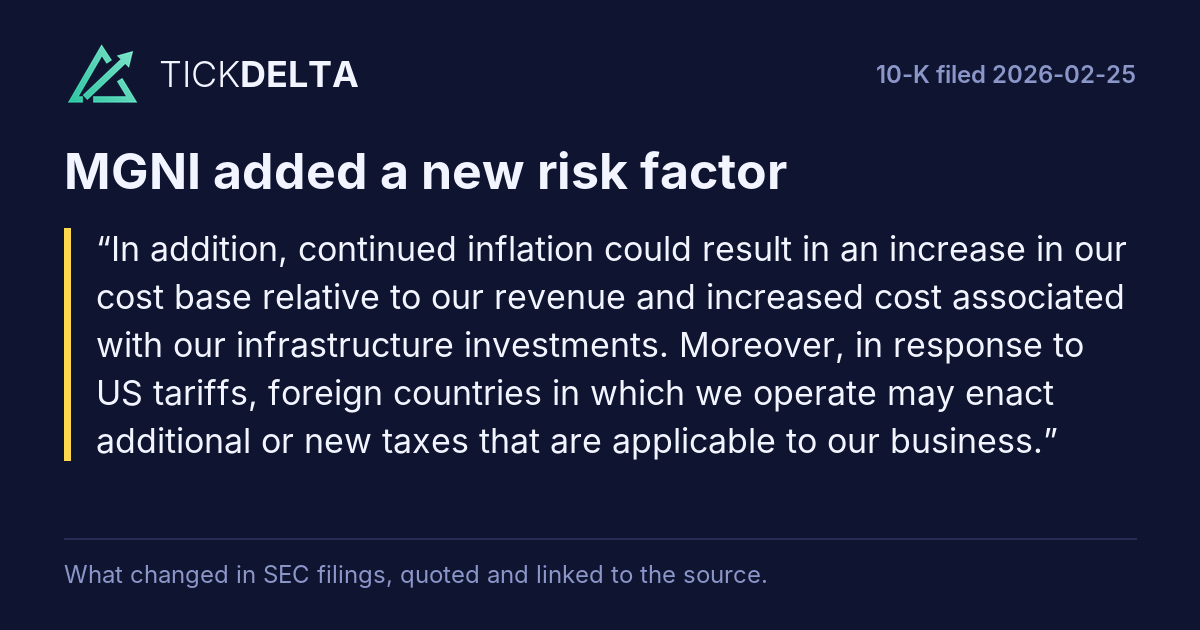
In addition, continued inflation could result in an increase in our cost base relative to our revenue and increased cost associated with our infrastructure investments. Moreover, in response to US tariffs, foreign countries in which we operate may enact additional or new taxes that are applicable to our business.
The digital advertising market, and our business, may be negatively impacted by advancements in AI.
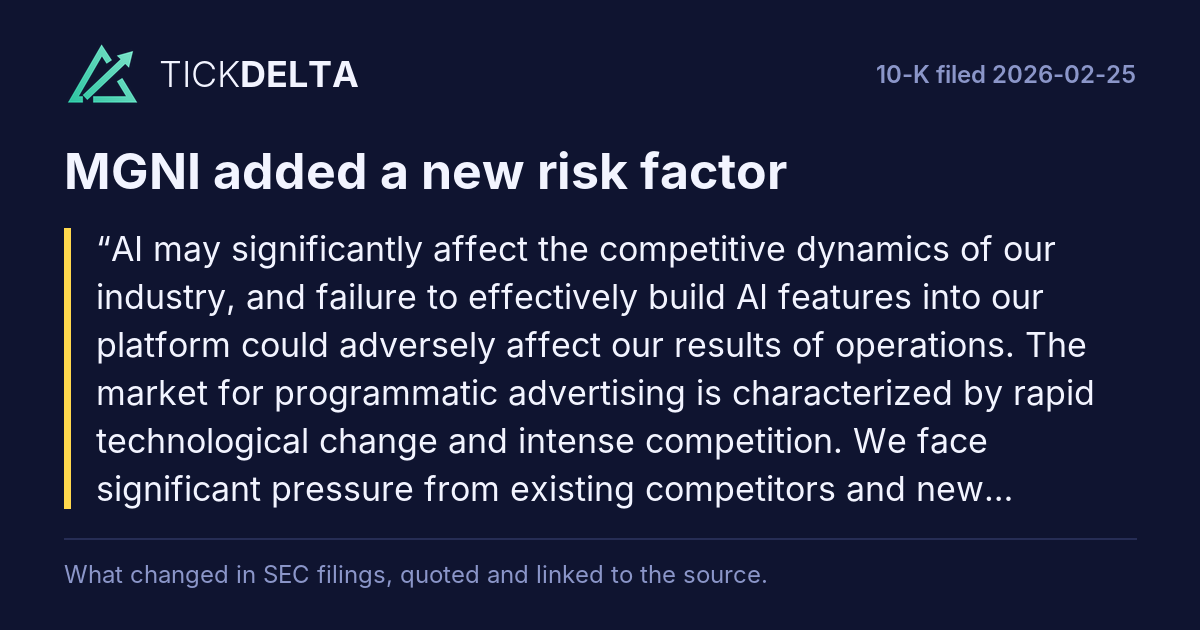
AI may significantly affect the competitive dynamics of our industry, and failure to effectively build AI features into our platform could adversely affect our results of operations.
The market for programmatic advertising is characterized by rapid technological change and intense competition. We face significant pressure from existing competitors and new market entrants who are increasingly leveraging AI to enhance their platforms. If our competitors or other third parties, including those with greater financial and technical resources, incorporate AI into their offerings more quickly or effectively than we do, our platform may become less attractive to buyers and sellers of digital advertising. Any failure on our part to successfully develop and deploy AI solutions into our platform could result in a loss of market share.
Moreover, emerging AI–driven programmatic advertising protocols and transaction frameworks may not be interoperable with, or may reduce reliance on, existing industry standards and infrastructure, which could disrupt established buying and selling workflows. If we are unable to adapt our technology or influence the adoption of such protocols, it could adversely affect demand for our platform and our market share. If we fail to anticipate and adequately respond to these AI-driven structural shifts, our competitive position and ability to maintain a leading independent marketplace may be compromised.
We may be ineffective in using AI to realize internal efficiencies, which could result in higher operating costs and decreased margins.
We currently incorporate AI solutions into our product offerings and internal workflows, and we expect the use of AI to become increasingly central to our operations over time. However, our ability to realize the anticipated benefits of these
technologies is subject to significant risks and uncertainties. We may fail to effectively leverage internal AI solutions to automate manual processes, optimize our infrastructure or enhance the productivity of our team.
If we are unable to realize the cost savings or operational improvements we anticipate from AI, our margins may be negatively impacted. Furthermore, the implementation of AI-driven internal tools requires significant investment in talent and infrastructure; if these investments do not yield a corresponding increase in productivity or a reduction in legacy costs, our financial condition and results of operations could be adversely affected. Additionally, any over-reliance on AI for critical business functions without adequate human oversight could lead to operational errors, data inaccuracies, or inefficiencies that could harm our reputation and competitive position.
The regulatory landscape governing AI is still developing, and our use of third party AI tools may result in increased legal and regulatory scrutiny, litigation, and reputational harm.
The regulatory landscape governing AI is highly uncertain and rapidly evolving. We face potential risks from new or enhanced governmental oversight and evolving legal standards regarding the use of AI.
The integration of third-party AI models with our products and services relies on certain safeguards implemented by the third-party developers of the underlying AI models. If the content, analyses, or recommendations that AI applications assist in producing are or are alleged to be inaccurate, deficient, or biased, our business and reputation may be adversely affected.
Additionally, AI applications generally state they do not use personal data or other classes of protected data, but we may not know the source of data used by an AI application and may inadvertently incorporate personal information, or data derived from personal data, in the course of using an AI application. Any such inclusion could lead to violations of global privacy laws, such as the GDPR or CCPA, and result in significant fines or legal action.
The use of AI also presents unique cybersecurity and intellectual property risks. Our use of AI tools could lead to cybersecurity incidents or the unauthorized public disclosure of our intellectual property. Moreover, malicious actors may increasingly use AI to develop more sophisticated and automated cyberattacks against our infrastructure.
If we are unable to minimize unintended harmful impacts of AI or fail to adapt to new AI-specific regulations, our competitive position and financial condition may be materially and adversely affected.
Our technology must scale to process the increased ad requests on our platform. For each ad request that we process we incur infrastructure costs regardless of whether that ad request is ultimately monetized through our platform. The number of ad requests that we process has grown significantly in order to support additional ad spend on our platform, in particular with respect to CTV sellers who operate at large scale and experience spikes in viewership.
•the ability of buyers to integrate demand directly with sellers without the use of our platform;
Show the other 5
Moreover, we have from time-to-time become subject to putative class actions or other litigation, including claims based on developing or unsettled interpretations of privacy, data use, or consumer protection laws, which regardless of their ultimate merit may require significant resources to address, divert management attention, and result in reputational harm or adverse outcomes.
reversals of such regulations or inconsistency between regulatory requirements in different jurisdictions, may further increase the complexity and cost of compliance.
Our litigation with Google LLC presents potential risks that could adversely affect our business, results of operations and financial condition.
On September 16, 2025, we filed a lawsuit in the U.S. District Court for the Eastern District of Virginia against Google LLC ("Google") seeking financial damages and other remedies (the "Google Action") in light of the U.S. District Court’s ruling that Google had engaged in unlawful anticompetitive practices with respect to certain ad tech markets. Google is a significant participant in the digital advertising ecosystem and both a major partner and competitor to Magnite and a significant portion of our revenue is generated through our relationship with Google. The Google Action is in its early stages, and the outcome and timing of the Google Action is uncertain and difficult to predict. The Google Action presents several risks to our business, including the potential for retaliatory actions by Google. Any such actions could disrupt our ability to serve our customers and partners, reduce our revenue, and harm our relationships with publishers and advertisers. The Google Action may be costly, protracted, and divert management's attention and resources from our business operations. Any damages awarded may not be commensurate with our expectations, and we may not receive any monetary damages at all. The existence of the Google Action and any potential retaliatory measures could also negatively affect our reputation and our ability to compete, potentially causing our business, financial condition, and results of operations to be materially and adversely affected.
It is important to sellers that the advertising placed on their media not conflict with existing seller arrangements and be of high quality, consistent with applicable seller standards and compliant with applicable legal and regulatory requirements. It is
As of December 31, 2025, we have released our U.S. federal valuation allowances, the majority of our state valuation allowances, and certain foreign valuation allowances on deferred tax assets based on sustained profitability and cumulative three-year pre-tax income. As a result, significant deferred tax assets are reflected on our balance sheet. The realization of these deferred tax assets depends on our ability to generate sufficient taxable income in the relevant jurisdictions during the periods in which the temporary differences reverse and tax attributes remain available. If our actual results differ materially from our projections, if we experience a significant decline in profitability, or if tax laws or interpretations change, we may determine that it is no longer more likely than not that some portion or all of our deferred tax assets will be realized. In such event, we would be required to establish or increase a valuation allowance through income tax expense, which could materially increase our effective tax rate and adversely affect our financial condition and results of operations.
Paragraphs in the 10-Q filed Nov 4, 2026 that were not in the one before
New in the latest 10-Q
4 paragraphs in the 10-Q filed Nov 4, 2026 with nothing like them in the 10-Q filed Aug 5, 2026 (at least half the words must differ; new numbers alone do not count). Quoted exactly, grouped by the item heading above them. This is text that changed, not a judgement of how serious it is.
Financial statements and notes
Adjustments to reconcile net income to net cash provided by operating activities:
Read in the 10-Q
Repayment of the Term Loan B Facility from refinancing and repricing activities — (92,622)
Read in the 10-Q
Proceeds from issuance of common stock under employee stock purchase plan 2,387 2,111
Read in the 10-Q
Other information
Officer Name Officer Title Date Plan Adopted/Terminated Duration of Plan Shares to be Purchased or Sold Intended to Satisfy Rule 10b5-1(c)? ─────────────────────────────────────────────────────────────────────────────────────────────────────────────────────────────────────────────────────────────────────────────────────────────────────────────────────────────────────────── David Day Former Chief Financial Officer Adopted August 17, 2026 November 16, 2026 - March 3, 2027 Sell up to 75,601, subject to certain conditions Yes Sean Buckley President, Revenue & Market Strategy Adopted September 11, 2026 December 11, 2026 - December 9, 2027 Sell up to 357,727*, subject to certain conditions Yes Michael Barrett Chief Executive Officer and Director Adopted September 15, 2026 December 15, 2026 - March 15, 2028 Sell up to 600,000, subject to certain conditions Yes Aaron Saltz Chief Legal Officer Terminated September 15, 2026 September 10, 2026 - June 11, 2027 Sell up to 100,000, subject to certain conditions Yes
Read in the 10-Q
The 10-Q's risk factors against the 10-K
Item 1A of the 10-Q filed Nov 4, 2026 against Item 1A of the 10-K filed Feb 25, 2026.
A 10-Q repeats only the risks that changed, so a 10-K paragraph that is missing from it is not counted as removed.
Added is a paragraph with nothing like it in the 10-K, Reworded a sentence that is in both with several words changed,
Quiet changes a sentence in both where one to four words changed and one is a hedge or a modal
(cut words struck through, new words highlighted).
Text on the page, not a score; each links to the filing at sec.gov.
Phrases used for the first time
Two-word phrases in Risk Factors of the 10-K filed Feb 25, 2026 that are in none of the 1 earlier 10-Ks stored, back to Feb 26, 2025
Where each one is used
- google action: On September 16, 2025, we filed a lawsuit in the U.S. District Court for the Eastern District of Virginia against Google LLC ("Google") seeking financial damages and other remedies (the "Google Action") in light of the U.S. District Court’s ruling that Google had engaged in unlawful anticompetitive practices with...
- february repurchase: On February 23, 2026, our Board of Directors approved a repurchase program (the "February 2026 Repurchase Plan"), under which we are authorized to repurchase common stock with an aggregate market value of up to $200.0 million, through February 29, 2028. The February 2026 Repurchase Plan allows us to repurchase our...
- sustainability matters: Our business is subject to evolving corporate governance and public disclosure regulations and expectations, including with respect to sustainability matters that could expose us to numerous risks.
- valuation allowances: As of December 31, 2025, we have released our U.S. federal valuation allowances, the majority of our state valuation allowances, and certain foreign valuation allowances on deferred tax assets based on sustained profitability and cumulative three-year pre-tax income. As a result, significant deferred tax assets are...
- regulatory landscape: The regulatory landscape governing AI is still developing, and our use of third party AI tools may result in increased legal and regulatory scrutiny, litigation, and reputational harm.
- landscape governing: The regulatory landscape governing AI is still developing, and our use of third party AI tools may result in increased legal and regulatory scrutiny, litigation, and reputational harm.
- reputational harm: The regulatory landscape governing AI is still developing, and our use of third party AI tools may result in increased legal and regulatory scrutiny, litigation, and reputational harm.
- potential risks: The regulatory landscape governing AI is highly uncertain and rapidly evolving. We face potential risks from new or enhanced governmental oversight and evolving legal standards regarding the use of AI.
Used at least twice, small words left out. Counted, not picked: a phrase can be new because the company renamed something.
What was taken out
11 paragraphs of last year's Risk Factors with nothing like them now. The longest are quoted.
Sources
Item 1A of each 10-K and 10-Q on EDGAR, quoted exactly. Each paragraph links to the filing at sec.gov.
Also
10-K change: what was reworded or cut, section by section.
Work with it
Excel workbook · CSV. Google Sheet that stays up to date: paste =IMPORTDATA("https://tickdelta.com/company/MGNI/export.csv") into a cell.