Mohawk Industries Inc MHK
New risk paragraphs, branching off last year
Each branch is a paragraph in Risk Factors with nothing like it in the 10-K filed Feb 20, 2025. A box jumps to the paragraph as filed, below.
Paragraphs with nothing like them in last year's 10-K
10 paragraphs in Risk Factors of the 10-K filed Feb 24, 2026 with nothing like them in the 10-K filed Feb 20, 2025. Quoted exactly. Paragraphs that were only edited are under 10-K change.
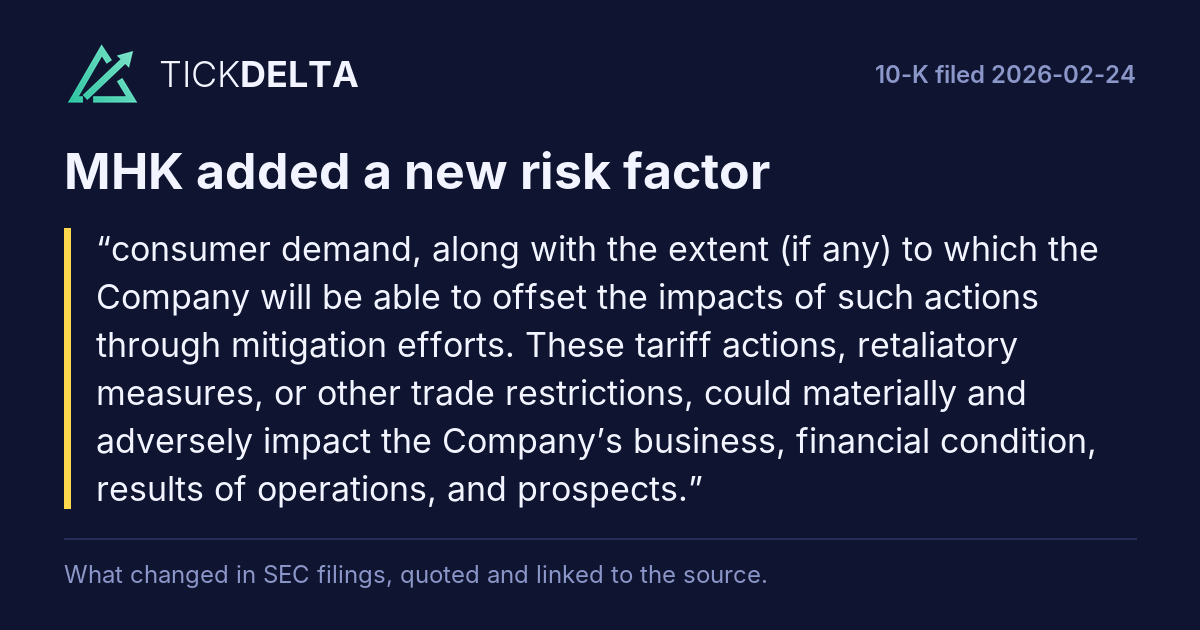
consumer demand, along with the extent (if any) to which the Company will be able to offset the impacts of such actions through mitigation efforts. These tariff actions, retaliatory measures, or other trade restrictions, could materially and adversely impact the Company’s business, financial condition, results of operations, and prospects.
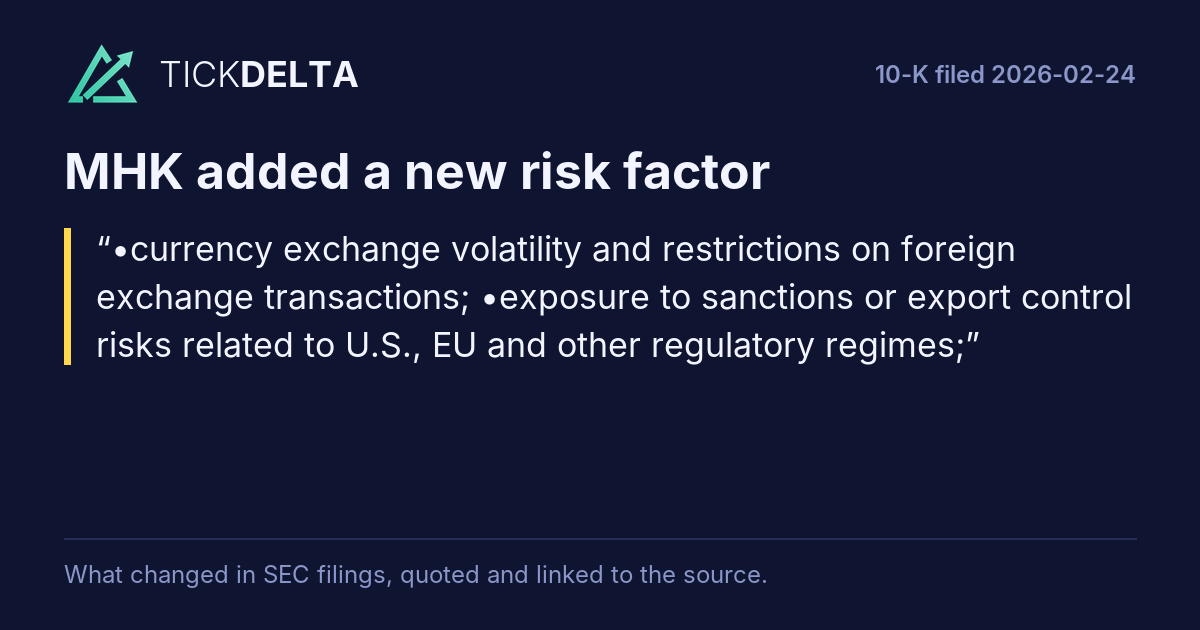
•currency exchange volatility and restrictions on foreign exchange transactions;
•exposure to sanctions or export control risks related to U.S., EU and other regulatory regimes;
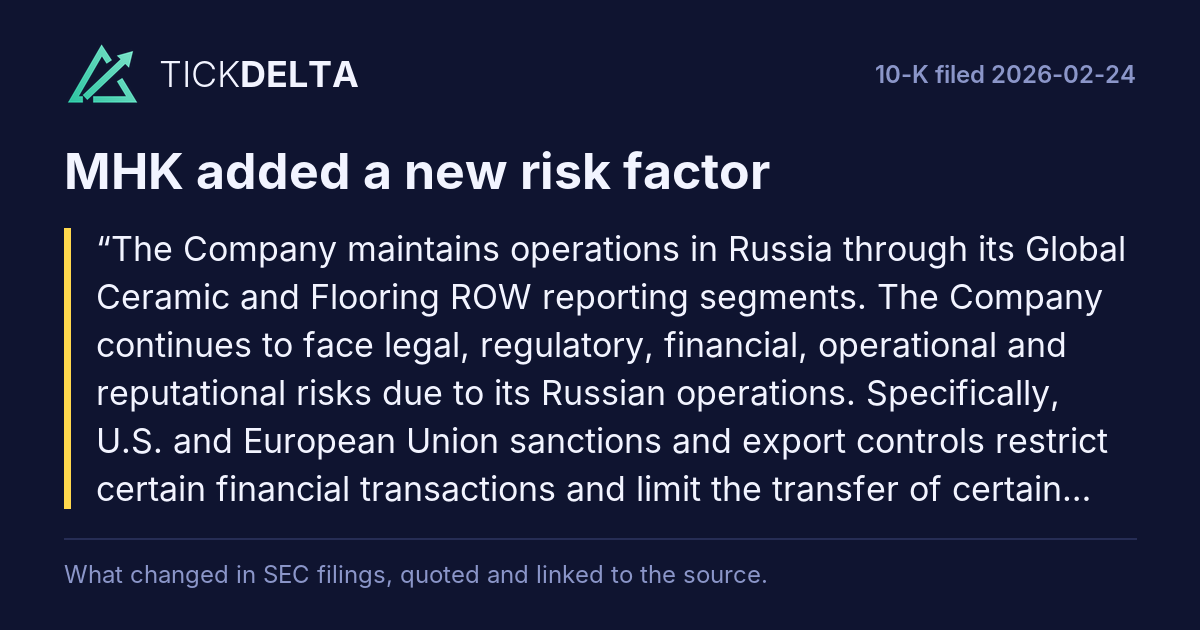
The Company maintains operations in Russia through its Global Ceramic and Flooring ROW reporting segments. The Company continues to face legal, regulatory, financial, operational and reputational risks due to its Russian operations. Specifically, U.S. and European Union sanctions and export controls restrict certain financial transactions and limit the transfer of certain technology, equipment and goods classified as “dual use.” Such export controls create complexity in the Company’s supply chain and the sourcing of certain materials and equipment required to continue operations, and violations of such sanctions and export controls could result in severe penalties, fines and reputational harm. In addition, certain Russian laws, such as those related to economic sanctions and data privacy, may conflict with U.S. and European Union regulations. Failure to comply with these varying laws could lead to penalties, fines and reputational harm, and increased compliance and diligence costs resulting from these risks could materially adversely affect the Company’s business. As of December 31, 2025, the Company’s Russian operations accounted for 5% of the Company’s net sales and approximately 7% of the Company’s total assets. Additionally, the Company’s Russian operations are subject to capital controls and currency volatility, both of which have impacted, and may continue to impact, profitability and ability to repatriate cash. Further, sanctions and related banking restrictions have limited, and may continue to limit, the Company’s ability to process payments or repatriate profits from Russia. As of December 31, 2025, 30% of the Company’s cash and cash equivalents are held in Russia, and generated interest income of approximately $30 million in 2025. In addition, the Company continues to face operational risks specific to Russia. As a result of the ongoing military actions between Russia and Ukraine, the Company has experienced and may continue to experience supply chain disruption and price increases of raw materials and spare parts needed in the Company’s Russian operations. The Company’s Russian operations are also subject to potential asset seizure, nationalization, expropriation or forced divestiture under Russian government policies. The Company continues to monitor the potential impacts on its business and the ancillary impacts that the conflict may have on its other global operations. While the extent of the conflict’s impact on the Company cannot be predicted, any of the foregoing factors could materially and adversely impact the Company’s business, financial condition, results of operations, and prospects.
The Company faces risks in identifying suitable acquisition candidates or partners for strategic investments.
Furthermore, the Company is also subject to extended producer responsibility (“EPR”) regulations in jurisdictions such as California and New York. These laws impose significant obligations on producers and manufacturers involved in packaging or product distribution, including product take-back, recycling, and detailed reporting requirements. Compliance may increase operational complexity and result in higher administrative costs. For example, EPR regulations may require registration with producer responsibility organizations, payment of eco-modulated fees based on recyclability, and adherence to labeling and recordkeeping standards, with requirements varying across jurisdictions. Failure to comply with these evolving mandates may expose the Company to penalties, enforcement actions, and reputational harm.
Show the other 3
The Company utilizes information systems within its own infrastructure as well as those provided by third-party service providers to manage its operations. Any failure, interruption, or deficiency in these systems could materially and adversely affect the Company’s business.
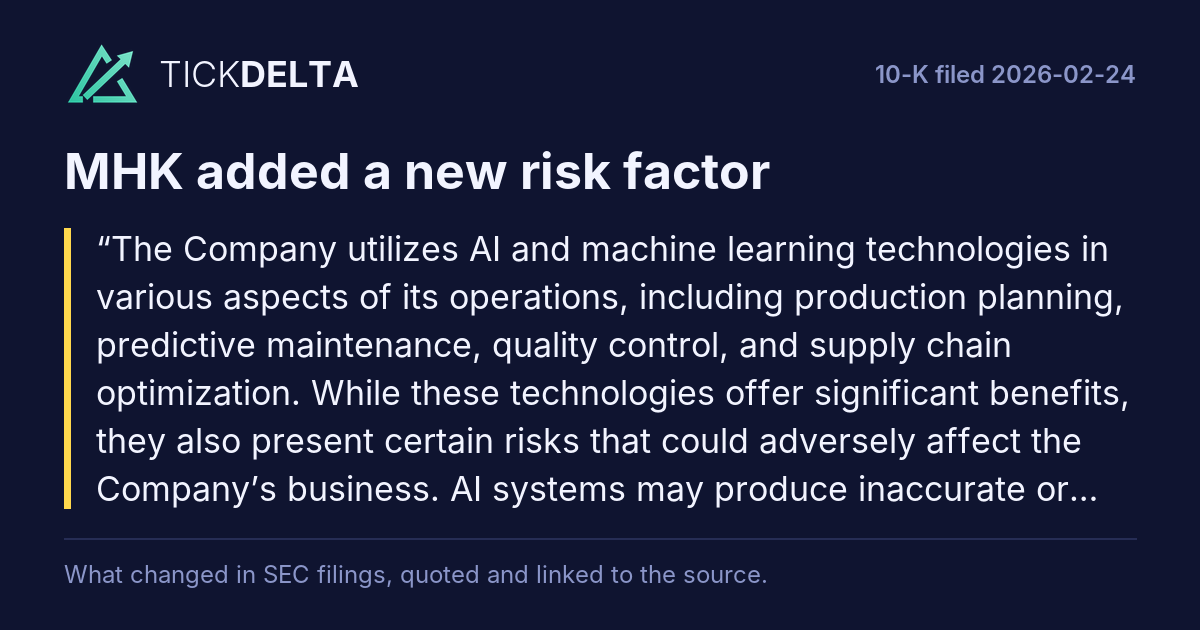
The Company utilizes AI and machine learning technologies in various aspects of its operations, including production planning, predictive maintenance, quality control, and supply chain optimization. While these technologies offer significant benefits, they also present certain risks that could adversely affect the Company’s business. AI systems may produce inaccurate or biased outputs, fail to integrate effectively with existing processes, or experience technical malfunctions. Such issues could disrupt manufacturing operations, reduce efficiency, or lead to product quality concerns. Additionally, the Company’s reliance on AI-driven automation may increase vulnerability to cybersecurity threats, data breaches, or unauthorized access to proprietary information.
In addition, regulatory frameworks governing AI use are evolving rapidly. Future laws or regulations may impose restrictions, increase compliance costs, or limit certain applications of AI in manufacturing. Failure to comply with these requirements could result in penalties, reputational harm, or operational delays. The Company’s ability to manage these risks effectively may impair the Company’s ability to achieve anticipated benefits from AI technologies.
Adverse macroeconomic conditions could impact the Company’s access to credit and increase its borrowing costs.
Paragraphs in the 10-Q filed Oct 30, 2026 that were not in the one before
New in the latest 10-Q
9 paragraphs in the 10-Q filed Oct 30, 2026 with nothing like them in the 10-Q filed Jul 31, 2026 (at least half the words must differ; new numbers alone do not count). Quoted exactly, grouped by the item heading above them. This is text that changed, not a judgement of how serious it is.
Financial statements and notes
(1) The Retained Earnings balance as of June 28, 2025 has been revised. See Note 1, "General - Revision of Previously Issued Financial Statements"
Read in the 10-Q
On October 26, 2026, the Company's Board of Directors approved the 2026 Share Repurchase Program. For further information, see the discussion set forth in Part II, Item 2.
Read in the 10-Q
Since the invalidation of the IEEPA tariffs, the U.S. presidential administration has imposed additional tariffs affecting the Company, including temporary tariffs under Section 122 of the Trade Act of 1974 (“Section 122 tariffs”), which expired on July 24, 2026 and longer-term tariffs under Section 301 of the Trade Act of 1974 (“Section 301 tariffs”). The U.S. administration could take action to implement additional tariffs in the future. The administration’s actions under the Section 122 tariffs and Section 301 tariffs have been, and continue to be, subject to legal challenges.
Read in the 10-Q
Notwithstanding the foregoing, uncertainty remains regarding the amount and timing of remaining IEEPA tariff refunds and the ongoing impact of the Section 122 and Section 301 tariffs, and any anticipated refunds may be delayed, reduced, or denied. The Company intends to seek recovery of its remaining IEEPA tariff refunds, including amounts subject to CAPE Phase 3 processing. In addition, certain aspects of the CIT’s orders concerning IEEPA tariff refunds remain subject to appeal by the U.S. government and other related proceedings, which could affect the availability, amount or timing of the Company’s remaining refunds.
Read in the 10-Q
In addition, in response to U.S. tariffs, Canada has imposed reciprocal tariffs on certain U.S.-origin goods imported into Canada, which have adversely affected the Company’s business in Canada. Separately, effective August 15, 2026, the U.S. administration implemented safeguard tariffs on certain quartz surface products. While the Company manufactures a significant portion of its quartz surface products in the United States, certain quartz surface products imported by the Company are subject to these tariffs. The Company will continue to monitor developments in U.S. tariff policy, including responsive tariff measures imposed by U.S. trading partners, and assess the potential impacts on its results of operations, cash flows and financial condition.
Read in the 10-Q
Show the other 4
Quarter Ended October 3, 2026, as compared with Quarter Ended September 27, 2025
Read in the 10-Q
Nine Months Ended October 3, 2026, as compared with Nine Months Ended September 27, 2025
Read in the 10-Q
The Company did not have any off-balance sheet arrangements as of October 3, 2026.
Read in the 10-Q
Item 6
10.1 Form of Restricted Stock Unit Award Agreement under the Mohawk Industries, Inc. 2026 Incentive Plan.
Read in the 10-Q
The 10-Q's risk factors against the 10-K
Item 1A of the 10-Q filed Oct 30, 2026 against Item 1A of the 10-K filed Feb 24, 2026.
A 10-Q repeats only the risks that changed, so a 10-K paragraph that is missing from it is not counted as removed.
Added is a paragraph with nothing like it in the 10-K, Reworded a sentence that is in both with several words changed,
Quiet changes a sentence in both where one to four words changed and one is a hedge or a modal
(cut words struck through, new words highlighted).
Text on the page, not a score; each links to the filing at sec.gov.
What the 10-Q itself says about its risk factors:There have been no material changes in the Company’s risk factors from those disclosed in Part I, Item 1A to the Company’s Annual Report on Form 10-K for the year ended December 31, 2025. The risk factors disclosed in these reports, in addition to the other information set forth in this report, could materially affect the Company’s business, financial condition or results.
Read in the 10-Q
1 paragraph in the 10-Q's Item 1A, and none of them adds, rewords or quietly edits a paragraph of the 10-K's.
Phrases used for the first time
Two-word phrases in Risk Factors of the 10-K filed Feb 24, 2026 that are in none of the 1 earlier 10-Ks stored, back to Feb 20, 2025
Where each one is used
- third-party service: The Company utilizes information systems within its own infrastructure as well as those provided by third-party service providers to manage its operations. Any failure, interruption, or deficiency in these systems could materially and adversely affect the Company’s business.
- service provider: The Company utilizes information systems within its own infrastructure as well as those provided by third-party service providers to manage its operations. Any failure, interruption, or deficiency in these systems could materially and adversely affect the Company’s business.
- service providers: The Company utilizes information systems within its own infrastructure as well as those provided by third-party service providers to manage its operations. Any failure, interruption, or deficiency in these systems could materially and adversely affect the Company’s business.
- anticipated benefits: Current U.S. tariff policies have impacted certain of the Company’s sourcing and supply chain processes occurring outside the U.S. as well as certain vendors, suppliers, and customers located outside the U.S. Tariffs have increased, and may continue to increase, the Company’s cost of goods sold on imported...
- export controls: The Company maintains operations in Russia through its Global Ceramic and Flooring ROW reporting segments. The Company continues to face legal, regulatory, financial, operational and reputational risks due to its Russian operations. Specifically, U.S. and European Union sanctions and export controls restrict...
- mohawk’s sustainability: In addition, investor advocacy groups, certain institutional investors, investment funds, lenders, market participants, stockholders, customers, and other stakeholders have focused increasingly on sustainability practices of companies. These parties have placed increased importance on the implications of the social...
- trade restrictions: Current U.S. tariff policies have impacted certain of the Company’s sourcing and supply chain processes occurring outside the U.S. as well as certain vendors, suppliers, and customers located outside the U.S. Tariffs have increased, and may continue to increase, the Company’s cost of goods sold on imported...
- faces risks: The Company faces risks and uncertainties associated with doing business in emerging markets.
Used at least twice, small words left out. Counted, not picked: a phrase can be new because the company renamed something.
What was taken out
6 paragraphs of last year's Risk Factors with nothing like them now. The longest are quoted.
Sources
Item 1A of each 10-K and 10-Q on EDGAR, quoted exactly. Each paragraph links to the filing at sec.gov.
Also
10-K change: what was reworded or cut, section by section.
Work with it
Excel workbook · CSV. Google Sheet that stays up to date: paste =IMPORTDATA("https://tickdelta.com/company/MHK/export.csv") into a cell.