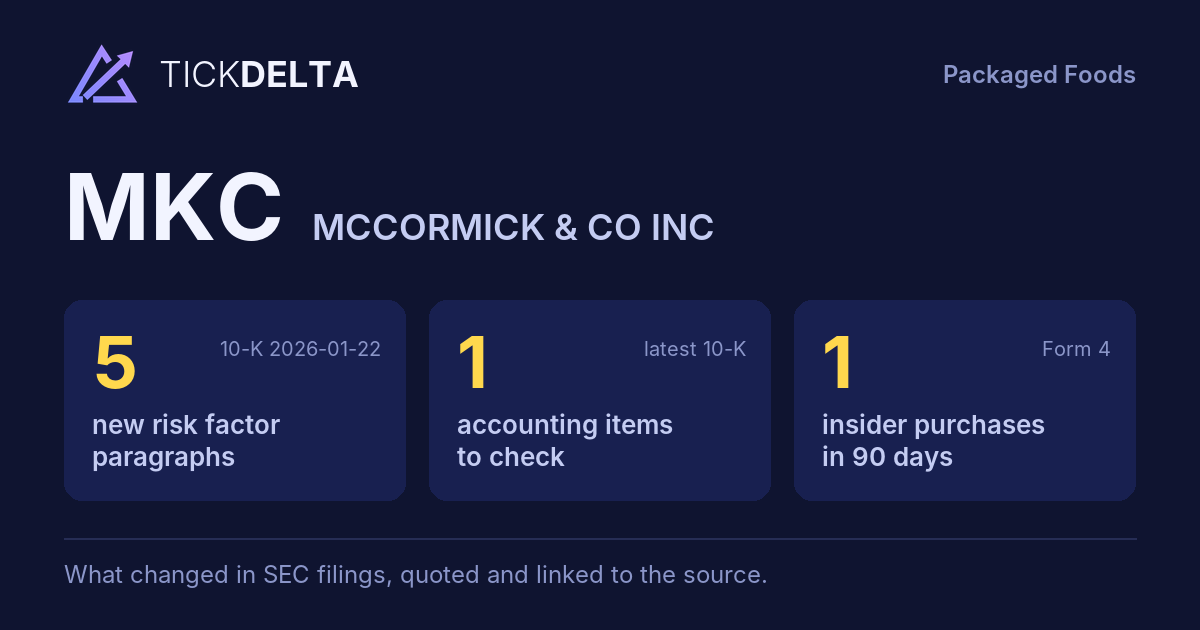
10-K 0000063754-26-000037 (2026-01-22) vs 10-K 0000063754-25-000005 (2025-01-23)
| Section | Compared text | Words now | Changed |
|---|
| Risk Factors | Item 1A | 9,777 |
16.3% |
| MD&A | Item 7 | 11,145 |
24.2% |
| Legal Proceedings | Item 3, via Note 14 – COMMITMENTS AND CONTINGENCIES | 110 |
not compared |
| Accounting Policies | Item 8, Note 1 – SUMMARY OF SIGNIFICANT ACCOUNTING POLICIES | 4,388 |
7.7% |
The redline: what was cut and what was added
In each section, the paragraph that changed most, marked against last year's 10-K:
cut words struck through, new words highlighted and underlined.
MD&A 256 words changed in this paragraph; it is 38% similar to last year's version.
Operating income was $1,070.8 million in 2025, compared to $1,060.3 million in 2024 and $963.0 million in 2023. We recognized $9.5 million and $61.2 million 2024, reflecting an increase of special charges in 2024 and 2023, respectively, related to organization and streamlining actions. In 2024, operating income was positively impacted by the higher level of sales and an improvement in our 1.0%. Our gross profit margin decreased by 60 basis points primarily driven by increased commodity costs including the impact of tariffs, unfavorable product mix, and increased conversion costs including costs to support capacity for future growth, partially offset by pricing actions and CCI-led cost savings. Selling, general, and administrative (SG&A) expense as a percentage of sales of 90 decreased by 70 basis points as compared to the prior year. The gross profit margin improvement was points, primarily driven by the effects of favorable pricing actions, favorable product lower performance-based employee compensation expense, lower distribution expense, and customer mix, less scrapped inventory, and CCI-led cost savings led by our CCI and Global Operating Effectiveness (GOE) programs which were including SG&A streamlining initiatives, partially offset by higher conversion costs, all as compared to the prior year. A higher level of SG&A expenses resulted in a 40 basis point increase in SG&A as a percentage of sales with approximately half of that basis point increase attributable to an increase in advertising and promotion spend. In addition, the higher level of SG&A expenses was driven by increased selling and brand marketing costs and a higher level of research and development expenses that were partially offset by, lower performance-based employee and stock based compensation expense and cost savings led by our CCI and GOE programs, all as compared to the prior year. expense. Excluding special charges, adjusted operating income was $1,094.0 million in 2025, reflecting an increase of 2.3% compared to $1,069.8 million in 2024, representing a 4.5% increase compared to $1,024.2 million in 2023. 2024. In constant currency, adjusted operating income increased 4.6%. 2.8%. For further details and a reconciliation of non-GAAP to reported amounts, see the subsequent discussion under the heading "Non-GAAP Financial Measures".
Source: Item 7, 10-K 0000063754-26-000037 vs Item 7, 10-K 0000063754-25-000005
Risk Factors 236 words changed in this paragraph; it is 32% similar to last year's version.
In the U.S., for example, the CCPA imposes requirements on companies that do business in California and collect personal information from certain individuals, including notice, consent and service provider requirements. The CCPA also provides for civil penalties for companies that fail to comply with these requirements, as well as a private right of action for data breaches. Further, the California Privacy Rights Act (CPRA) went into full effect on January 1, 2023 (with a ‘look-back’ to January 1, 2022). The CPRA builds on the CCPA and among other things, requires the establishment of a dedicated agency to regulate privacy issues. In 2021, Virginia, Colorado, Connecticut and Utah adopted laws which have now taken effect introducing new privacy obligations, which have required us to develop additional compliance mechanisms and processes. Many other states are considering similar legislation. A broad range of legislative measures also have been introduced at the federal level. There also is a wide range of enforcement agencies at both the state and federal levels that can review companies for privacy and data security concerns based on general consumer protection laws. The Federal Trade Commission and state Attorneys General all are aggressive in reviewing privacy and data security protections for consumers. Accordingly, failure to comply with federal and state laws (both those currently in effect and future legislation) regarding privacy and security of personal information could expose us to fines and penalties under such laws. There also is the threat of consumer class actions related to these laws and the overall protection of personal data. Even if we are not determined to have violated these laws, government investigations into these issues typically require the expenditure of significant resources and generate negative publicity, which could harm our reputation and our business.
Source: Item 1A, 10-K 0000063754-26-000037 vs Item 1A, 10-K 0000063754-25-000005
Accounting Policies 111 words changed in this paragraph; it is 70% similar to last year's version.
In September 2022, the FASB issued ASU No. 2022-04: Liabilities - Supplier Finance Programs (Topic 450-50): Disclosure of Supplier Finance Program Obligations that requires entities that use supplier finance programs in connection with the purchase of goods and services to disclose the key terms of the programs and information about obligations outstanding at the end of the reporting period, including a roll forward roll-forward of those obligations. The guidance does not affect the recognition, measurement measurement, or financial statement presentation of supplier finance program obligations. The new standard's We met the requirements to disclose the key terms of the programs and information about obligations outstanding are effective November 30, 2023. The requirement to include a roll-forward of the obligations is effective for all interim and our annual periods of our fiscal year period ending November 30, 2024. 2025. We include disclosure regarding the key terms of the our program and information about obligations outstanding at the end a roll forward of the reporting period obligation outstanding in Note 1. The standard’s requirement to disclose a roll forward of obligations outstanding will be effective for our fiscal year ending November 30, 2025. We have not adopted the disclosure requirements regarding the roll forward adoption of the obligation. The partial adoption of this new standard did not have a material impact on our consolidated financial statements. We do not expect the adoption of the future disclosure requirements will have a material impact on our consolidated financial statements.
Source: Item 8, Note 1 – SUMMARY OF SIGNIFICANT ACCOUNTING POLICIES, 10-K 0000063754-26-000037 vs Item 8, Note 1 – SUMMARY OF SIGNIFICANT ACCOUNTING POLICIES, 10-K 0000063754-25-000005
Every change, by type
Sentences and paragraphs of MKC's Risk Factors and MD&A, 10-K 2026-01-22 against 10-K 2025-01-23.
Each links to the text at sec.gov.
Quiet changes are sentences kept from last year with one to four words changed, at least one of them a hedge, a modal or a qualifier
(may, could, will, not, significant, material…). A year or date rolling forward is not counted.
The full word list
adverse, adversely, all, although, anticipate, anticipates, any, approximately, believe, believes, can, cannot, certain, could, expect, expects, generally, however, if, intend, intends, largely, likely, many, material, materially, may, might, most, must, never, no, not, possible, primarily, probable, should, significant, significantly, some, substantial, substantially, unlikely, will, would
AddedRisk Factors
Changes in global trade policies, including tariffs, have caused inflationary pressures and higher costs on certain raw materials and imports. These actions have impacted our business through increased costs and uncertainty. If maintained, the tariffs, as well as related measures that have been taken and which could be taken by other countries in the future could pose a risk to our business and results of operations. The extent and duration of the tariffs and the resulting impact on general economic conditions and on our business are uncertain and depend on various factors, such as legal challenges to the applicability of these tariffs, negotiations between affected countries, the responses of other countries or regions, exemptions, exclusions or other relief that may be granted, availability and cost of alternative sources of supply, and demand for our products in affected markets.
Read it in 10-K 2026-01-22 at sec.gov ↗
AddedRisk Factors
Changes in the political conditions in markets in which we manufacture, sell or distribute our products, as well as changing geopolitical conditions, including conflicts, may be difficult to predict and may adversely affect our business and financial results. Results of elections, referendums, sanctions or other political processes and pressures in certain markets in which our products are manufactured, sold or distributed have created and could continue to create uncertainty regarding how existing governmental policies, laws and regulations may change, including with respect to sanctions, taxes, tariffs, import and export controls and the general movement of goods, materials, services, capital, data and people between countries.
Read it in 10-K 2026-01-22 at sec.gov ↗
AddedRisk Factors
property (and the intellectual property of customers to which we have been given access), the value of our products and brands could be reduced and there could be an adverse impact on our business, financial condition and results of operations.
Read it in 10-K 2026-01-22 at sec.gov ↗
AddedRisk Factors
be perceived to be unsuccessful, which could adversely affect our business in the U.S., the European Union and in other countries.
Read it in 10-K 2026-01-22 at sec.gov ↗
AddedRisk Factors
There also is the threat of consumer class actions related to these laws and the overall protection of personal data. Even if we are not determined to have violated these laws, government investigations into these issues typically require the expenditure of significant resources and generate negative publicity, which could harm our reputation and our business.
Read it in 10-K 2026-01-22 at sec.gov ↗
RemovedRisk Factors
material to our business or financial results. Negative publicity about these concerns, whether or not valid, may discourage customers and consumers from buying our products or cause disruptions in production or distribution of our products and adversely affect our business, financial condition or results of operations.
Read it in 10-K 2025-01-23 at sec.gov ↗
RemovedRisk Factors
financial condition or operating results may be adversely affected. Furthermore, we may not be able to fully offset any cost increases through our productivity or efficiency initiatives.
Read it in 10-K 2025-01-23 at sec.gov ↗
RemovedRisk Factors
perceived to have failed or been delayed in achieving, or improperly report our progress toward achieving these goals and commitments, it could negatively affect consumer or customer preference for our products or investor confidence in our stock, as well as expose us to enforcement actions and litigation.
Read it in 10-K 2025-01-23 at sec.gov ↗
RemovedRisk Factors
Furthermore, our information technology systems, and the systems of our customers, vendors, suppliers, and other third-party service providers, are subject to cyber-attacks or other security incidents including computer viruses or other malicious codes, phishing attacks, unauthorized access attempts, cyber extortion, business email compromise, deepfake or social engineering schemes, denial of service attacks, hacking, ransomware, or other cyberattacks attempting to exploit vulnerabilities. Cybercriminals have increasingly demonstrated advanced capabilities, such as use of zero-day vulnerabilities, and rapid integration of new technology such as generative artificial intelligence. Continued geographical turmoil, including the ongoing conflicts between Russia and Ukraine, the war in the Middle East, and rising tensions between China and Taiwan, has heightened the risk of cyberattack. Such incidents could result in unauthorized access to information including customer, consumer or other company
Read it in 10-K 2025-01-23 at sec.gov ↗
RemovedRisk Factors
Food products are extensively regulated in most of the countries in which we sell our products. We are subject to numerous laws and regulations relating to the growing, sourcing, manufacturing, storage, labeling, marketing,
Read it in 10-K 2025-01-23 at sec.gov ↗
RemovedRisk Factors
In the U.S., for example, the CCPA imposes requirements on companies that do business in California and collect personal information from certain individuals, including notice, consent and service provider requirements. The CCPA also provides for civil penalties for companies that fail to comply with these requirements, as well as a private right of action for data breaches. Further, the California Privacy Rights Act (CPRA) went into full effect on January 1, 2023 (with a ‘look-back’ to January 1, 2022). The CPRA builds on the CCPA and among other things, requires the establishment of a dedicated agency to regulate privacy issues. In 2021, Virginia, Colorado, Connecticut and Utah adopted laws which have now taken effect introducing new privacy obligations, which have required us to develop additional compliance mechanisms and processes. Many other states are considering similar legislation. A broad range of legislative measures also have been introduced at the federal level. There also is a wide range of enforcement agencies at both the state and federal levels that can review companies for privacy and data security concerns based on general consumer protection laws. The Federal Trade Commission and state Attorneys General all are aggressive in reviewing privacy and data security protections for consumers. Accordingly, failure to comply with federal and state laws (both those currently in effect and future legislation) regarding privacy and security of personal information could expose us to fines and penalties under such laws. There also is the threat of consumer class actions related to these laws and the overall protection of personal data. Even if we are not determined to have violated these laws, government investigations into these issues typically require the expenditure of significant resources and generate negative publicity, which could harm our reputation and our business.
Read it in 10-K 2025-01-23 at sec.gov ↗
RemovedRisk Factors
Similarly, outside of the U.S., there are various laws and regulations governing the collection, use, disclosure, transfer, or other processing of personal data. For instance, the GDPR, which applies to the processing of personal data of individuals in the European Union, is wide-ranging in scope and imposes numerous requirements on companies that process personal data, including strict rules on the transfer of personal data to countries outside the European Union, including the U.S. Beyond GDPR, there are privacy and data security laws in a growing number of countries around the world (including in the United Kingdom as a result of Brexit). While many loosely follow GDPR as a model, other laws contain different or conflicting provisions. These laws may impact our ability to conduct our business activities and the costs associated with these activities.
Read it in 10-K 2025-01-23 at sec.gov ↗
RewordedRisk Factors
Our business and results of operations have in the past been, and may continue to be, adversely affected by changes in global economic conditions including inflation, changes in prevailing interest rates, bank failures, the impact of any potential U.S. federal government shutdown, changes in governmental rules and approaches to taxation, challenges in global supply chains including new or increased tariffs or trade restrictions, fluctuations in foreign currency interest rates, availability of capital markets, consumer spending rates, energy availability and costs, the negative impacts caused by pandemics and other local and global public health issues and the effect of governmental initiatives to manage economic conditions.
Read it in 10-K 2026-01-22 at sec.gov ↗
RewordedRisk Factors
Failure to attract, hire, develop, motivate and retain highly qualified and diverse the best executive and employee talent, especially in light of changing worker expectations and talent marketplace variability regarding flexible and hybrid work models, to meet our goals relating to fostering a diverse and inclusive culture or to adequately address potential increased scrutiny of our diversity, equity and inclusion initiatives for all employees could impact our ability to achieve our business objectives and adversely affect our future success.
Read it in 10-K 2026-01-22 at sec.gov ↗
RewordedRisk Factors
To the extent that price increases or packaging size decreases these actions are not sufficient to offset these increased increase costs adequately or in a timely manner, and/or if they result in significant decreases in sales volume, our business, financial condition, or operating results may be adversely affected.
Read it in 10-K 2026-01-22 at sec.gov ↗
RewordedRisk Factors
Political, socio-economic, cultural, and geopolitical (including instability and international conflicts such as the ongoing conflicts between Russia and Ukraine, the war in the Middle East, and rising tensions between China and Taiwan) conditions, as well as disruptions caused by terrorist activities or otherwise, could also create additional risks for regulatory compliance.
Read it in 10-K 2026-01-22 at sec.gov ↗
RewordedRisk Factors
If we do not allocate and effectively manage the resources necessary to build and sustain the proper information technology infrastructure, or if we fail to achieve the expected benefits from this initiative, it may impact our ability to process transactions accurately and efficiently and remain in step with the changing needs of our business, which could result in the loss of customers and revenue.
Read it in 10-K 2026-01-22 at sec.gov ↗
RewordedRisk Factors
During recent years, we We have experienced significantly elevated inflation of commodity and supply chain costs, including the costs of raw materials, packaging materials, labor, energy, fuel, transportation and other inputs necessary for the production and distribution of our products, and we expect inflation to continue in 2025 2026 at a similar level to that experienced in 2024 but at a more modest rate than experienced since 2022. 2025.
Read it in 10-K 2026-01-22 at sec.gov ↗
RewordedRisk Factors
Our attempts to offset these cost pressures, such as pressures through supply chain management initiatives and increases in the selling prices of some of our products, products may not be successful. successful or may result in reductions in sales volume.
Read it in 10-K 2026-01-22 at sec.gov ↗
RewordedRisk Factors
In addition, many of these materials and costs are subject to price fluctuations from a number of factors, including, but not limited to, market conditions, demand for raw materials, weather, growing and harvesting conditions, climate change, energy costs, currency fluctuations, supplier capacities, governmental actions, import and export requirements requirements, global trade policies (including tariffs), tariffs and retaliatory measures), armed hostilities (including the ongoing conflicts between Russia and Ukraine and Israel and Hamas) geopolitical conflicts) and other factors beyond our control.
Read it in 10-K 2026-01-22 at sec.gov ↗
RewordedRisk Factors
Increased compliance costs and expenses due to the impacts of climate change and additional legal or regulatory requirements regarding climate change that are designed to reduce or mitigate the effects of carbon dioxide and other greenhouse gas emissions on the environment may cause disruptions in, or an increase in the costs associated with, the running of our manufacturing facilities and our business, as well as increase distribution and supply chain costs.
Read it in 10-K 2026-01-22 at sec.gov ↗
RewordedRisk Factors
Our efforts to comply with these privacy and data protection laws may not be successful, or may be perceived to be unsuccessful, which could adversely affect our business in the U.S., the European Union and in other countries.
Read it in 10-K 2026-01-22 at sec.gov ↗
RewordedRisk Factors
These acquisitions, such as the additional 25% incremental ownership acquired in McCormick de Mexico on January 2, 2026, joint ventures and divestitures may present financial, managerial and operational challenges, including diversion of management attention from existing businesses, difficulty with integrating or separating personnel and financial and other systems, increased expenses and raw material costs, assumption of unknown liabilities and indemnities, and potential disputes with the buyers or sellers.
Read it in 10-K 2026-01-22 at sec.gov ↗
RewordedRisk Factors
To the extent that price increases or packaging size decreases are not sufficient to offset these increased costs adequately or in a timely manner, and/or if they result in significant decreases in sales volume, our business, financial condition or operating results may be adversely affected.
Read it in 10-K 2026-01-22 at sec.gov ↗
AddedMD&A
On January 2, 2026 we acquired an additional 25% ownership interest in McCormick de Mexico for a purchase price of $750 million, which increased our ownership to a 75% controlling interest. We believe the acquisition creates opportunities for further growth in the Mexican market and provides a strategic platform for further expansion in Latin America. McCormick de Mexico is a prominent food company in Mexico, with a broad portfolio, including mayonnaise, spices, marmalades, mustard, hot sauce, and tea, sold under McCormick brands.
Read it in 10-K 2026-01-22 at sec.gov ↗
AddedMD&A
Our fiscal 2026 outlook continues to reflect prioritized investments in key categories to sustain our volume trends and drive long-term profitable growth while appreciating the uncertainty of the consumer and macro environment, including global trade policies. Our CCI program is continuing to fuel growth investments while also driving operating margin expansion. Our fiscal 2026 outlook also reflects meaningful contributions from the acquisition of a controlling interest in McCormick de Mexico, which closed on January 2, 2026. Amounts are rounded with percentages calculated from the underlying amounts.
Read it in 10-K 2026-01-22 at sec.gov ↗
AddedMD&A
Our outlook for 2026 adjusted operating income and adjusted earnings per share are non-GAAP financial measures that exclude or otherwise adjust for items impacting comparability of financial results. We are unable to reconcile projected adjusted operating income to projected reported operating income because we cannot reasonably predict the amount of special charges, including transaction and integration expenses, during this time period. We expect 2026 transaction and integration expenses to include a step-up in inventory to fair value related to the recent acquisition of an additional 25% ownership interest in McCormick de Mexico. This step-up will be recognized in cost of goods sold as the related inventory is sold.
Read it in 10-K 2026-01-22 at sec.gov ↗
AddedMD&A
We are unable to reconcile projected adjusted earnings per share to projected reported earnings per share due to the same factors affecting reported operating income, and because we cannot reasonably predict the amount of the anticipated non-cash gain from remeasuring the previously held equity interest in McCormick de Mexico to fair value.
Read it in 10-K 2026-01-22 at sec.gov ↗
AddedMD&A
Other income, net, decreased by $9.0 million compared to the prior year primarily due to a lower level of interest income driven by lower interest rates and lower non-service cost income associated with our pension and postretirement benefit plans.
Read it in 10-K 2026-01-22 at sec.gov ↗
AddedMD&A
On July 4, 2025, legislation known as the One Big Beautiful Bill Act (OBBBA) was signed into law. The OBBBA makes changes to the United States corporate income tax system, including, among other provisions, the immediate expensing of research and development expenditures, and 100 percent bonus depreciation on qualified property. While we expect certain provisions of the OBBBA to change the timing of cash tax payments related to the current fiscal year and future year periods, we do not expect the legislation to have a material impact on our consolidated financial statements.
Read it in 10-K 2026-01-22 at sec.gov ↗
AddedMD&A
We are unable to reconcile projected adjusted earnings per share to projected reported earnings per share because our 2026 adjusted earnings per share is a non-GAAP measure that excludes certain elements that will be included in fiscal 2026 GAAP results that cannot be reasonably predicted. Given the recent acquisition date of an additional 25% ownership in McCormick de Mexico on January 2, 2026, we cannot reasonably predict the amount of special charges, including transaction and integration expenses, or the expected non-cash gain associated with remeasuring our previously held equity interest in McCormick de Mexico to fair value.
Read it in 10-K 2026-01-22 at sec.gov ↗
AddedMD&A
On January 2, 2026, we acquired an additional 25% ownership interest in McCormick de Mexico from Grupo Herdez, for $750 million which increased our ownership interest to a 75% controlling interest. The purchase of the additional 25% ownership interest was funded through a combination of cash on hand and commercial paper.
Read it in 10-K 2026-01-22 at sec.gov ↗
RemovedMD&A
•Pricing actions contributed 0.5% to the increase in net sales, driven by the favorable impact of pricing actions in our flavor solutions segment.
Read it in 10-K 2025-01-23 at sec.gov ↗
RemovedMD&A
•Excluding the impact of divestitures and fluctuations in currency rates, we grew sales, on an organic basis, by 0.8% over the prior year.
Read it in 10-K 2025-01-23 at sec.gov ↗
RemovedMD&A
We expect our 2025 gross profit margin to improve by 50 to 100 basis points from the 38.5% gross profit margin reported in 2024. This projected increase is primarily driven by (i) positive effects from product mix changes, (ii) anticipated cost savings from our Comprehensive Continuous Improvement (CCI) program, and (iii) a low single-digit percentage impact of inflation in 2025 compared to 2024.
Read it in 10-K 2025-01-23 at sec.gov ↗
RemovedMD&A
We also expect that our income from unconsolidated operations, including the performance of our largest joint venture, McCormick de Mexico, will decline by a mid-teen percentage rate from the 2024 level, reflecting the strengthening of the U.S. dollar against the Mexican peso.
Read it in 10-K 2025-01-23 at sec.gov ↗
RemovedMD&A
Operating income increased by $97.3 million, or 10.1%, from $963.0 million in 2023 to $1,060.3 million in 2024. Special charges decreased by $51.7 million in 2024, as compared to 2023, positively impacting operating income. Operating income as a percentage of net sales increased by 130 basis points in 2024, to 15.8% in 2024 from 14.5% in 2023 as a result of the factors previously described. Excluding the effect of special charges, adjusted operating income was $1,069.8 million in 2024 as compared to $1,024.2 million in 2023, an increase of $45.6 million or 4.5% from the 2023 level. Adjusted operating income as a percentage of net sales increased by 50 basis points in 2024, to 15.9% in 2024 from 15.4% in 2023.
Read it in 10-K 2025-01-23 at sec.gov ↗
RemovedMD&A
Numerous countries have enacted the Organization of Economic Corporation and Development’s framework on a global 15% minimum tax, referred to as Pillar 2, which are generally effective for our fiscal year ending November 30, 2025. We do not expect a material increase to our effective tax rate associated with the adoption of these model rules in the countries in which we operate.
Read it in 10-K 2025-01-23 at sec.gov ↗
RemovedMD&A
•Transaction and integration expenses associated with acquisitions – We exclude certain costs associated with our acquisitions, including our acquisition of FONA in December 2020, and the subsequent integration into the Company. Such costs, which we refer to as “Transaction and integration expenses,” include transaction costs associated with the acquisition, as well as integration costs following the acquisition, including the impact of the acquisition date fair value adjustment for inventories, together with the impact of discrete tax items, if any, directly related to the acquisition.
Read it in 10-K 2025-01-23 at sec.gov ↗
RemovedMD&A
•Gain on sale of Kitchen Basics – We exclude the gain realized upon our sale of the Kitchen Basics business in August 2022. As more fully described in Note 16 of the notes to the accompanying financial statements, the pre-tax gain associated with the sale was $49.6 million and is included in Other income, net in our consolidated income statement for the year ended November 30, 2022.
Read it in 10-K 2025-01-23 at sec.gov ↗
RemovedMD&A
A reconciliation of these non-GAAP financial measures to GAAP financial results is provided below:2024 2023 2022 Operating income $ 1,060.3 $ 963.0 $ 863.6 Impact of transaction and integration expenses(1) — — 2.2 Impact of special charges(2) 9.5 61.2 51.6 Adjusted operating income $ 1,069.8 $ 1,024.2 $ 917.4 % increase (decrease) versus prior year 4.5 % 11.6 % (16.7) % Operating income margin(3) 15.8 % 14.5 % 13.6 % Impact of transaction and integration expenses and special charges(3) 0.1 % 0.9 % 0.8 % Adjusted operating income margin(3) 15.9 % 15.4 % 14.4 % Income tax expense $ 184.0 $ 174.5 $ 168.6 Impact of transaction and integration expenses(1) — — 0.6 Impact of special charges(2) 2.4 14.5 13.3 Impact of sale of Kitchen Basics — — (11.6) Adjusted income tax expense $ 186.4 $ 189.0 $ 170.9 Income tax rate(4) 20.5 % 21.8 % 20.7 % Impact of transaction and integration expenses, special charges, and sale of Kitchen Basics(4) — % 0.2 % 0.2 % Adjusted income tax rate(4) 20.5 % 22.0 % 20.9 % Net income $ 788.5 $ 680.6 $ 682.0 Impact of transaction and integration expenses(1) — — 1.6 Impact of special charges(2) 7.1 46.7 38.3 Impact of after-tax gain on sale of Kitchen Basics — — (38.0) Adjusted net income $ 795.6 $ 727.3 $ 683.9 % increase (decrease) versus prior year 9.4 % 6.3 % (17.0) % Earnings per share—diluted $ 2.92 $ 2.52 $ 2.52 Impact of transaction and integration expenses(1) — — 0.01 Impact of special charges(2) 0.03 0.18 0.14 Impact of after-tax gain on sale of Kitchen Basics — — (0.14) Adjusted earnings per share—diluted $ 2.95 $ 2.70 $ 2.53
Read it in 10-K 2025-01-23 at sec.gov ↗
RemovedMD&A
(1) Transaction and integration expenses include integration expenses associated with our acquisition of FONA.
Read it in 10-K 2025-01-23 at sec.gov ↗
RemovedMD&A
(2) Special charges are more fully described in Note 2 of notes to our accompanying consolidated financial statements. Special charges for the year ended November 30, 2022 include a $10.0 million non-cash intangible asset impairment charge associated with our exit of our business operations in Russia. We exited our Kohinoor rice product line in India in the fourth quarter of fiscal 2021. Special charges for the year ended November 30, 2022 include a $13.6 million gain associated with the sale of the Kohinoor brand name.
Read it in 10-K 2025-01-23 at sec.gov ↗
RemovedMD&A
information is presented in U.S. dollar equivalents. Variable interest rates are based on the weighted-average rates of the portfolio at the end of the year presented.
Read it in 10-K 2025-01-23 at sec.gov ↗
RewordedMD&A
The $31.7 $27.6 million of net discrete tax benefits for 2024 2025 principally included (i) $19.4 $10.1 million of tax benefits associated with the recognition of a deferred tax asset related to an international legal entity reorganization, (ii) $12.3 million of tax benefit from the reversal of certain reserves for unrecognized tax benefits and related interest interest, including $5.9 million associated with both the effective settlement from the conclusion of a tax examination and the expiration of statutes of limitations, (iii) $6.0 (ii) $7.9 million of tax benefits resulting from state tax matters, and related deferred taxes, (iii) a $5.0 million tax benefit resulting from the revaluation of deferred taxes associated with enacted legislation, (iv) $1.8 $3.6 million of tax benefit benefits resulting from an adjustment to a prior year tax accrual accrual, and related deferred taxes taxes, based on the final returns return filed, and (v) $6.2 $1.1 million of excess tax expense benefits associated with the adjustment of valuation allowances due to changes in judgment about the realizability of deferred tax assets, and (vi) $1.8 million of tax expense related to certain unremitted prior year earnings. stock compensation.
Read it in 10-K 2026-01-22 at sec.gov ↗
RewordedMD&A
FOREIGN CURRENCY EXCHANGE CONTRACTS AT NOVEMBER November 30, 2024Currency 2025Currency sold Currency received Notional Average Fair value contractual value exchange rate British pound sterling U.S. dollar $ 245.3 1.27 258.5 1.34 $ (0.7) 2.3 Canadian dollar U.S. dollar 65.9 1.26 1.9 53.2 1.36 1.1 Euro U.S. dollar 27.6 1.10 0.8 41.2 1.18 0.5 Polish zloty U.S. dollar 2.8 3.98 0.1 8.4 3.69 (0.1) U.S. dollar Australian dollar 89.9 81.5 0.65 0.3 1.1 Swiss franc U.S. dollar 75.0 1.14 (0.9) 82.3 0.79 (0.3) U.S. dollar Singapore dollar 17.9 1.35 0.1 British pound sterling 45.0 1.31 0.4 U.S. dollar Euro 86.5 1.05 0.4 U.S. dollar Canadian dollar 21.4 1.41 0.1 Australian dollar Euro 21.6 1.66 (0.3) 129.9 1.15 0.5 U.S. dollar Chinese renminbi 268.4 7.00 (8.2) 289.4 7.04 0.6 Polish zloty Euro 5.5 11.4 4.34 — Canadian dollar British pound sterling 27.8 1.76 (0.1) (0.2) British pound sterling Euro 45.2 0.85 (0.8) U.S. dollar Mexican peso 8.5 20.66 (0.1) 5.8 0.88 —
Read it in 10-K 2026-01-22 at sec.gov ↗
RewordedMD&A
Projections for the Year Ending November 30, 2025 2026 Percentage change in net sales 0% 13% to 2% 17% Impact of unfavorable favorable foreign currency exchange 1% Percentage change in net sales in constant currency 12% to 16% Impact of acquisition 11% to 13% Percentage change in organic net sales 1% to 3% Percentage change in adjusted operating income 3% 16% to 5% 20% Impact of unfavorable favorable foreign currency exchange 1% Percentage change in adjusted operating income in constant currency 4% 15% to 6% 19% Percentage change in adjusted earnings per share - diluted 3% 2% to 5% Impact of unfavorable favorable foreign currency exchange 2% 1% Percentage change in adjusted earnings per share - diluted 5% 1% to 7% 4%
Read it in 10-K 2026-01-22 at sec.gov ↗
RewordedMD&A
This anticipated increase in adjusted operating income reflects recovery of adjusted gross margin, accretion from the expected rise acquisition of the controlling interest in our gross profit margin McCormick de Mexico and SG&A cost savings from our CCI program, although these will be partially offset by increased commodity costs and an increase in SG&A expense, including performance-based employee compensation expenses and investments aimed at driving volume growth, particularly in brand marketing.
Read it in 10-K 2026-01-22 at sec.gov ↗
RewordedMD&A
Income from unconsolidated operations, which is presented net of the elimination of earnings attributable to non-controlling interests, increased $17.8 decreased $2.0 million in 2024 2025, driven by the results of our largest joint venture, McCormick de Mexico, where unfavorable impacts from the prior year. foreign exchange rates were partially offset by improved operating results.
Read it in 10-K 2026-01-22 at sec.gov ↗
RewordedMD&A
In 2025, 2026, we expect net sales to grow between 0% 13% and 2% 17% compared to our 2024 net sales, 2025, including an 11% to 13% increase as a result of the acquisition of a controlling interest in McCormick de Mexico and a 1% unfavorable favorable impact from foreign currency rates, or to grow from 1% to 3% on an organic basis.
Read it in 10-K 2026-01-22 at sec.gov ↗
RewordedMD&A
This includes We use short-term debt, primarily in the form of commercial paper, principally to finance ongoing operations, including our requirements for working capital, which encompasses accounts capital (accounts receivable, prepaid expenses, expenses and other current assets, and inventories, less accounts payable, accrued payroll, and other accrued liabilities. liabilities).
Read it in 10-K 2026-01-22 at sec.gov ↗
RewordedMD&A
Excluding these special charges, In 2026, we expect an increase in adjusted operating income in 2025 of 16% to increase by 3% 20% compared to 5%, which includes 2025, including a 1% unfavorable favorable impact from foreign currency rates, or to increase by 4% 15% to 6% 19% on a constant currency basis.
Read it in 10-K 2026-01-22 at sec.gov ↗
RewordedMD&A
Details with respect to the composition of special charges charges, including transaction and gain on sale of Kitchen Basics for the years and in the amounts integration expenses, set forth below are included in Notes Note 2 and 16 of the notes to our accompanying consolidated financial statements.
Read it in 10-K 2026-01-22 at sec.gov ↗
RewordedMD&A
(3) Operating income (1) Gross margin, impact of transaction and integration expenses and special charges, and adjusted operating income gross profit margin are calculated as operating income, gross profit, impact of transaction and integration expenses and special charges, and adjusted operating income gross profit as a percentage of net sales for each period presented.
Read it in 10-K 2026-01-22 at sec.gov ↗
RewordedMD&A
Our committed revolving credit facilities include a five-year $1.5 $2.0 billion revolving credit facility, which will expire in June 2026 and a 364-day $500 million revolving credit facility, which was entered into in August 2024 and will expire in August 2025. May 2030.
Read it in 10-K 2026-01-22 at sec.gov ↗
RewordedMD&A
Pricing actions 0.3 % — % 6.5 % Volume and product mix 2.1 % 0.8 % (3.9) % Divestiture — % (0.5) % Foreign exchange 0.2 % 0.3 % (0.8) % Segment operating income $ 734.9 $ 740.3 $ 735.5 Segment operating income margin 18.6 % 19.2 % 19.3 %
Read it in 10-K 2026-01-22 at sec.gov ↗
Quiet changesMD&A
We manage our worldwide cash requirements by considering available funds among the many our subsidiaries through which we conduct our business and the cost effectiveness with which those funds can be accessed.
Read it in 10-K 2026-01-22 at sec.gov ↗