Paragraphs with nothing like them in last year's 10-K
Quoted exactly
4 paragraphs in Risk Factors of the 10-K filed Feb 26, 2026
with nothing like them in the 10-K filed Feb 24, 2025. Quoted exactly.
Paragraphs that were only edited are under 10-K change.
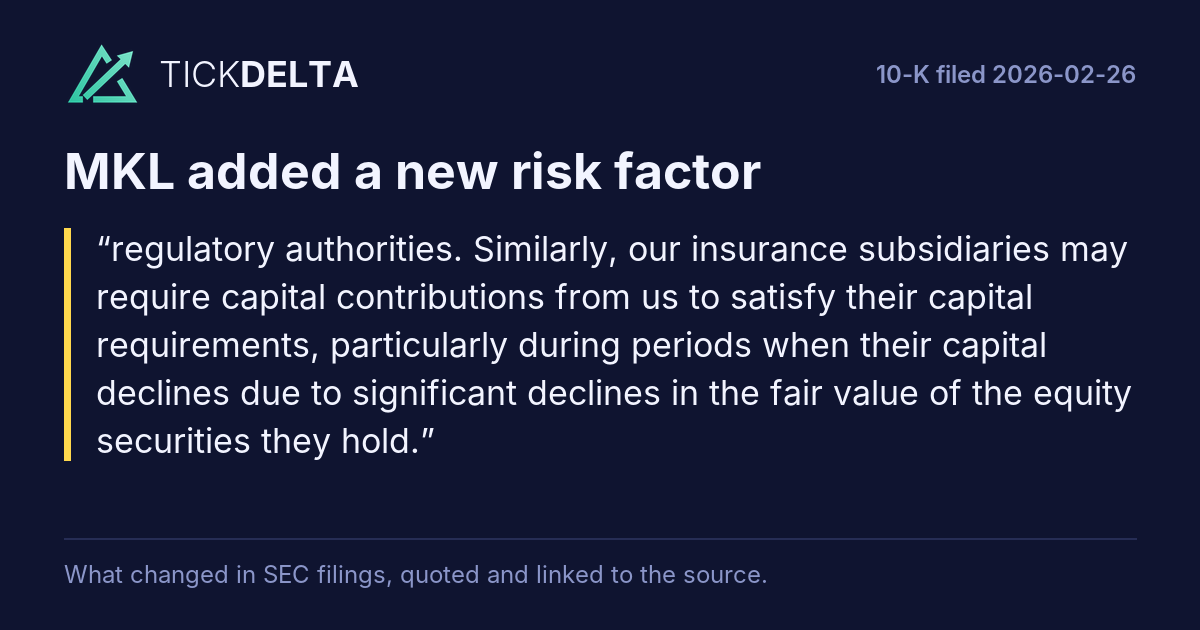
regulatory authorities. Similarly, our insurance subsidiaries may require capital contributions from us to satisfy their capital requirements, particularly during periods when their capital declines due to significant declines in the fair value of the equity securities they hold.
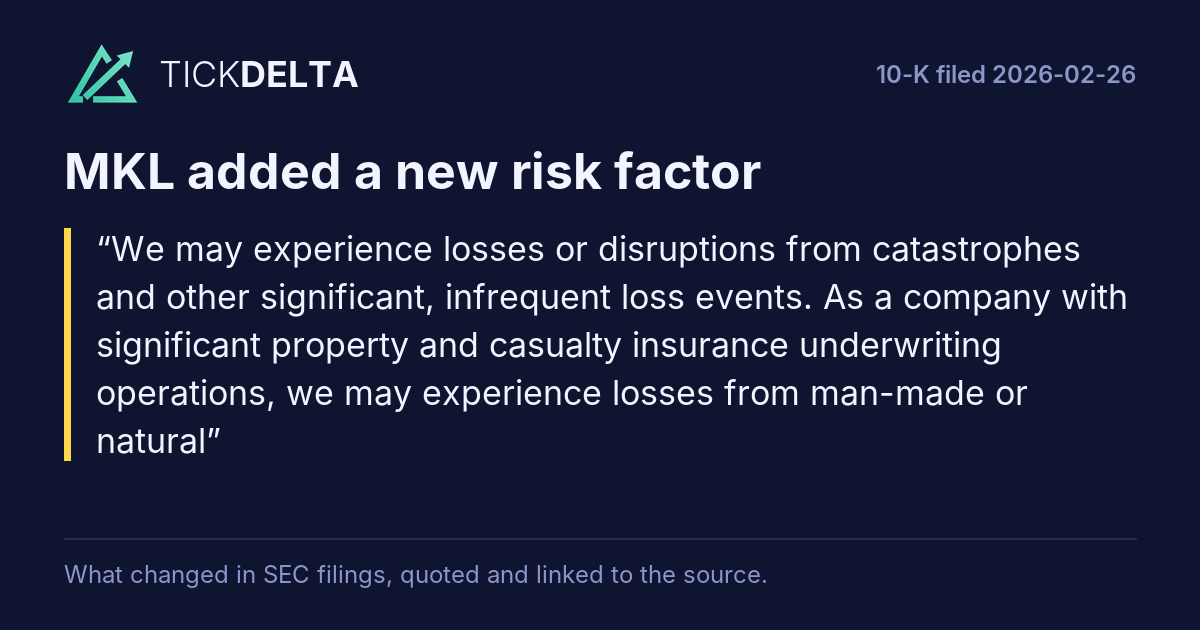
We may experience losses or disruptions from catastrophes and other significant, infrequent loss events. As a company with significant property and casualty insurance underwriting operations, we may experience losses from man-made or natural
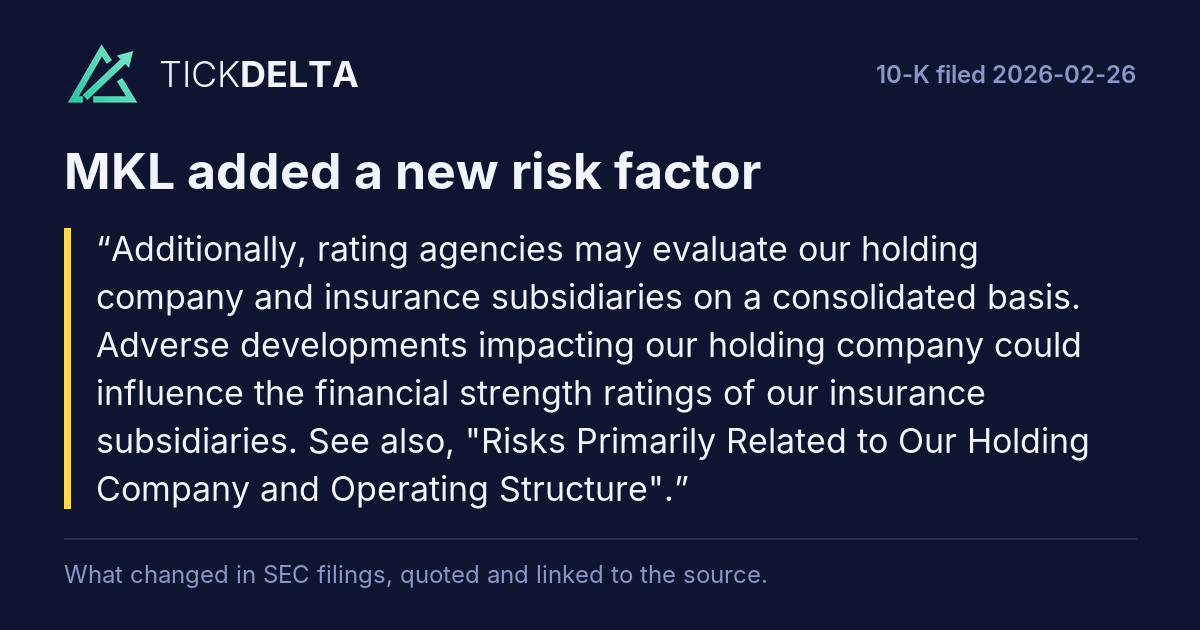
Additionally, rating agencies may evaluate our holding company and insurance subsidiaries on a consolidated basis. Adverse developments impacting our holding company could influence the financial strength ratings of our insurance subsidiaries. See also, "Risks Primarily Related to Our Holding Company and Operating Structure".
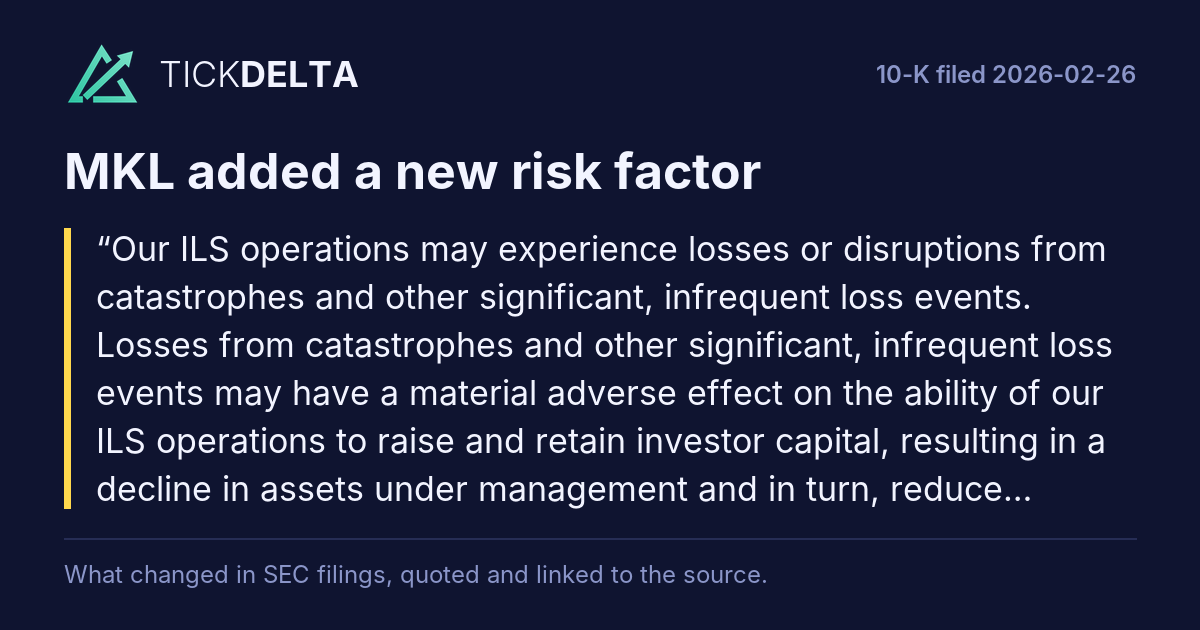
Our ILS operations may experience losses or disruptions from catastrophes and other significant, infrequent loss events. Losses from catastrophes and other significant, infrequent loss events may have a material adverse effect on the ability of our ILS operations to raise and retain investor capital, resulting in a decline in assets under management and in turn, reduce potential management fee generating opportunities. We use various modeling techniques and data analytics to analyze and estimate exposures, loss trends, and other risks associated with our ILS businesses. The usefulness of our models depends on the extent to which our actual experience is consistent with assumptions we use in our models and ultimate model outputs, which may from time-to-time contain inaccuracies. See also, "We may experience losses or disruptions from catastrophes and certain other, significant infrequent loss events."
Paragraphs in the 10-Q filed Oct 28, 2026 that were not in the one before
New in the latest 10-Q
14 paragraphs in the 10-Q filed Oct 28, 2026 with nothing like
them in the 10-Q filed Jul 29, 2026 (at least half the words must differ; new numbers alone do not count).
Quoted exactly, grouped by the item heading above them. This is text that changed, not a judgement of how serious it is.
Financial statements and notes
In July 2025, the Company commuted a portfolio of ceded reinsurance contracts with certain Nephila Reinsurers consisting of property catastrophe and brokerage property exposures for policy years 2023 and prior. Gross and ceded reserves for losses and loss adjustment expenses on the commuted contracts totaled $ 312.2 million and resulted in cash payments of $ 292.6 million.
Read in the 10-Qopen_in_new
On October 27, 2026, Markel Insurance entered into an adverse development cover reinsurance agreement with Cavello Bay Reinsurance Limited, a wholly-owned subsidiary of Enstar Group Limited (Enstar), covering a portfolio that includes the run-off Global Reinsurance business and certain exited lines within its insurance operations. The transaction is subject to regulatory approvals and other customary conditions and is expected to close in the fourth quarter of 2026.
Read in the 10-Qopen_in_new
The reinsurance agreement is effective as of April 1, 2026 and includes subject reserves of $ 4.8 billion. Markel Insurance will retain the first $ 2.6 billion of reserves and retrocede the next $ 2.3 billion to Enstar in exchange for a corresponding transfer of assets. The agreement also provides adverse loss development coverage of $ 1.2 billion above the $ 4.8 billion of subject reserves in exchange for payment of a risk premium of $ 120 million.
Read in the 10-Qopen_in_new
Subject reserves include 2025 and prior underwriting years of business written within the Global Reinsurance division and the exited risk-managed professional liability, architects and engineers, and certain other run-off product lines within the U.S. Wholesale and Specialty and Programs and Solutions divisions. Markel Insurance will maintain claims control for the covered reserves subject to certain administrative rights of Enstar.
Read in the 10-Qopen_in_new
On October 27, 2026, Markel Insurance entered into an adverse development cover reinsurance agreement with Cavello Bay Reinsurance Limited, a wholly-owned subsidiary of Enstar Group Limited (Enstar), covering a portfolio that includes the run-off Global Reinsurance business and certain exited lines within its insurance operations. The transaction is subject to regulatory approvals and other customary conditions and is expected to close in the fourth quarter of 2026.
Read in the 10-Qopen_in_new
Show the other 9
The reinsurance agreement is effective as of April 1, 2026 and includes subject reserves of $4.8 billion. Markel Insurance will retain the first $2.6 billion of reserves and retrocede the next $2.3 billion to Enstar in exchange for a corresponding transfer of assets. The agreement also provides adverse loss development coverage of $1.2 billion above the $4.8 billion of subject reserves in exchange for payment of a risk premium of $120 million. The adverse development cover provided through the transaction reduces the level of prudency management requires in its best estimate of ultimate losses; therefore, management expects the net impacts of the transaction to have an immaterial impact on underwriting results in the fourth quarter.
Read in the 10-Qopen_in_new
Subject reserves include 2025 and prior underwriting years of business written within the Global Reinsurance division and the exited risk-managed professional liability, architects and engineers, and certain other run-off product lines within the U.S. Wholesale and Specialty and Programs and Solutions divisions. Markel Insurance will maintain claims control for the covered reserves subject to certain administrative rights of Enstar.
Read in the 10-Qopen_in_new
The significant increase in premium volume within our international marine and energy product line was primarily attributable to breach premiums for our marine war coverages impacted by the Middle East conflict and the Russia-Ukraine conflict, as well as additional growth from new business. For the quarter and nine months ended September 30, 2026, we recognized $164.1 million and $199.1 million, respectively, in additional gross written premiums for these coverages compared to $19.5 million and $59.0 million for the quarter and nine months ended September 30, 2025, respectively.
Read in the 10-Qopen_in_new
Quarter Ended September 30, 2026 Nine Months Ended September 30, 2026 ──────────────────────────────────────────────────────────────────────────────────────────────────────────────── Industrial segment: Revenue growth 12.5% 7.2% Impact of inorganic activity (2.1)% (2.2)% Organic revenue growth 10.4% 5.0% Financial segment: Revenue growth 12.7% 0.4% Impact of inorganic activity —% 8.2% Organic revenue growth 12.7% 8.6% Consumer and Other segment: Revenue growth 1.7% 1.8% Impact of inorganic activity —% (1.6)% Organic revenue growth 1.7% 0.2%
Read in the 10-Qopen_in_new
• the adverse development cover reinsurance transaction may not close when expected or at all, including as a result of delays in obtaining required regulatory approval or satisfying other closing conditions, and the financial and accounting effects of the transaction, including its impact on underwriting results, may differ from management’s current estimates;
Read in the 10-Qopen_in_new
Other information
During the Company's quarterly period ended September 30, 2026, no director or officer (as defined in Exchange Act Rule 16a-1(f)) of the Company adopted or terminated a "Rule 10b5-1 trading arrangement" or "non-Rule 10b5-1 trading arrangement" as defined in Regulation S-K Item 408.
Read in the 10-Qopen_in_new
Item 6
The registrant hereby agrees to furnish to the Securities and Exchange Commission, upon request, a copy of all other instruments defining the rights of holders of long-term debt of the registrant and its subsidiaries.
Read in the 10-Qopen_in_new
31.1 Certification of Principal Executive Officer Pursuant to Rule 13a-14(a)/15d-14(a)*
Read in the 10-Qopen_in_new
31.2 Certification of Principal Financial Officer Pursuant to Rule 13a-14(a)/15d-14(a)*
Read in the 10-Qopen_in_new
The 10-Q's risk factors against the 10-K
Item 1A of the 10-Q filed Oct 28, 2026 against Item 1A of the 10-K filed Feb 26, 2026.
A 10-Q repeats only the risks that changed, so a 10-K paragraph that is missing from it is not counted as removed.
Added is a paragraph with nothing like it in the 10-K, Reworded a sentence that is in both with several words changed,
Quiet changes a sentence in both where one to four words changed and one is a hedge or a modal
(cut words struck through, new words highlighted).
Text on the page, not a score; each links to the filing at sec.gov.
What the 10-Q itself says about its risk factors:The disclosure below supplements risk factors previously disclosed in our 2025 Annual Report on Form 10-K. These risks and uncertainties, along with those previously disclosed, could materially adversely affect our businesses, results of operations, or financial condition.
Read in the 10-Qopen_in_new
Added10-Q Oct 28, 2026 vs 10-K Feb 26, 2026
Our adoption and use of artificial intelligence (AI), which is an evolving and rapidly developing technology, and the use of AI by third parties, may expose us to additional risks. We use, and expect to increasingly use, artificial intelligence, machine-learning, predictive analytics, and automated decision-making tools, including generative artificial intelligence, across many parts of our business, including underwriting, pricing, claims handling, fraud detection, and customer engagement. These technologies may not perform as intended and may produce inaccurate, incomplete, biased, or otherwise flawed outputs or analytics, or may be misinterpreted or misused by our employees, which could result in mispricing of risks, under-reserving or over-reserving of claims, assumption of unintended risks, operational disruption, inconsistent or unintended outcomes, or other adverse effects on our business and financial condition. We may also be exposed to additional operational, technological, security, reputational, legal, and regulatory risks related to its use, or third-party use, of artificial intelligence. These risks may arise from the misuse or inadvertent disclosure of personal data or sensitive or confidential information; unforeseen exposures or coverage issues under the policies we write; AI-related ethical considerations including the potential for algorithmic bias or unfair discrimination; failures or limitations in oversight, governance, or controls relating to AI systems; or potential intellectual property, contractual, or other legal issues associated with AI use. In addition, artificial intelligence may be used by threat actors to identify vulnerabilities, facilitate fraud, including insurance claims fraud, or to conduct more sophisticated cyberattacks, which could result in unauthorized access to or disclosure of data, litigation, regulatory action, or reputational harm.
Read it in the 10-Q at sec.govopen_in_new
Added10-Q Oct 28, 2026 vs 10-K Feb 26, 2026
Artificial intelligence also presents competitive and strategic risks. Competitors, technology companies, or other market participants may adopt artificial intelligence more quickly or effectively than we do, may be able to reverse-engineer or replicate our AI capabilities, or may have access to data or capabilities that we do not. The rapid pace of AI development may also require us to make significant and ongoing investments in technology, talent, and infrastructure to remain competitive. Questions regarding ownership of AI-generated content or inventions could create legal uncertainties. If we are unable to appropriately develop, deploy, or govern these technologies, attract and retain personnel with the necessary AI expertise, protect our AI-generated content or inventions, or if we adopt these technologies without sufficient controls, we may fail to achieve expected benefits, incur increased costs, or be placed at a competitive disadvantage, any of which could have a material adverse effect on our business, results of operations, or financial condition.
Read it in the 10-Q at sec.govopen_in_new
Added10-Q Oct 28, 2026 vs 10-K Feb 26, 2026
Any of these risks or other unanticipated AI-related risks could materially adversely affect our businesses, financial condition, or results of operations. See also, "Third-party providers may perform poorly, breach their obligations to us, or expose us to enhanced risks," "Our efforts to develop new products, expand in targeted markets, or improve business processes and workflows may not be successful and may increase or create new risks" and "Information technology systems that we use could fail or suffer a security breach or cyberattack, which could have a material adverse effect on us or result in the loss of regulated or sensitive information" in our 2025 Annual Report on Form 10-K in Item 1A Risk Factors.
Read it in the 10-Q at sec.govopen_in_new
Reworded10-Q Oct 28, 2026 vs 10-K Feb 26, 2026
These export controls and sanctions, or our failure to comply with them, could result in restrictions on our ability to do business in one or more of the jurisdictions in which we conduct business or have the other adverse effects previously discussed in our 2025 Annual Report on Form 10-K in Item 1A Risk Factors under "We are subject to laws and regulations relating to economic and trade sanctions and bribery and corruption, the violation of which could have a material adverse effect on us."
Read it in the 10-Q at sec.govopen_in_newThe 10-K sentenceopen_in_new
Reworded10-Q Oct 28, 2026 vs 10-K Feb 26, 2026
In addition, an ongoing conflict may have the effect of triggering or intensifying many of the risks described under this in our 2025 Annual Report on Form 10-K in Item 1A Risk Factors.
Read it in the 10-Q at sec.govopen_in_newThe 10-K sentenceopen_in_new
Show the other 2
Reworded10-Q Oct 28, 2026 vs 10-K Feb 26, 2026
The impact of geopolitical tensions related to these conflicts, including increased trade barriers or restrictions on global trade, is unknown and could result in, among other things, heightened cybersecurity threats, supply disruptions, disruptions to our operations, protracted or increased inflation, increased energy costs, lower consumer demand, fluctuations in interest and foreign exchange rates, and increased volatility in financial markets, any of which could adversely affect our businesses, results of operations operations, and financial condition.
Read it in the 10-Q at sec.govopen_in_newThe 10-K sentenceopen_in_new
Quiet changes10-Q Oct 28, 2026 vs 10-K Feb 26, 2026
Within our underwriting operations, we may have insurance contracts with exposure to losses attributed or corollary to a conflict, such as losses related to our coverage of ships, cargo, trade credit credit, and inventory.
Read it in the 10-Q at sec.govopen_in_newThe 10-K sentenceopen_in_new
Sources
Item 1A of each 10-K and 10-Q on EDGAR, quoted exactly. Each paragraph links to the filing at sec.gov.
Also
10-K change: what was reworded or cut, section by section.
Work with it
Excel workbook · CSV. Google Sheet that stays up to date: paste =IMPORTDATA("https://tickdelta.com/company/MKL/export.csv") into a cell.