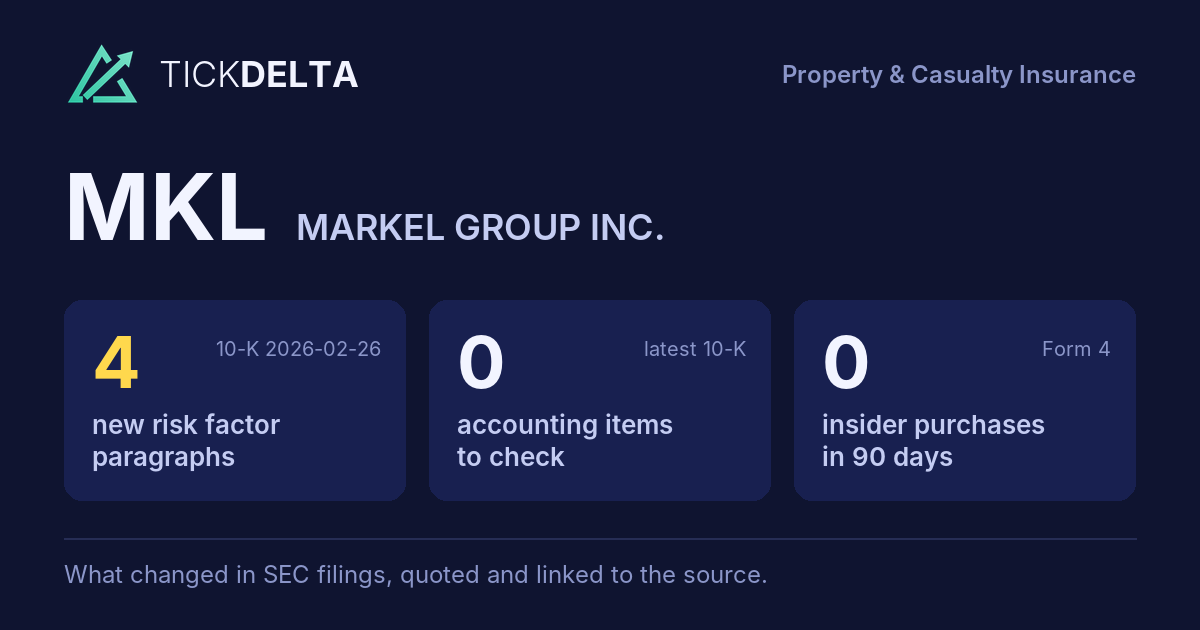
Screener / SEC EDGAR /CIK 0001096343 /10-K filed Feb 26, 2026, compared with Feb 24, 2025 /Numbers from the XBRL of the 10-Ks
NYSE Financials · Property & Casualty Insurance

Markel Group Inc. MKL

Compare with peers Embed
The 10-K against last year's

282 changes: 82 added, 65 removed, 131 reworded, 4 quiet changes

10-K Feb 26, 2026 vs Feb 24, 2025

10-K 0001096343-26-000020 (Feb 26, 2026) vs 10-K 0001096343-25-000027 (Feb 24, 2025) Not compared: Legal Proceedings.

Every paragraph, and how much of it changed

One bar per paragraph, in the order of the 10-K. Height and colour show the share of its words not in the closest paragraph a year earlier; the tallest bars are new paragraphs.

Risk Factors

100 paragraphs · 4 new · 66 reworded · 3 gone · 10-K Feb 26, 2026 against Feb 24, 2025
New paragraph Reworded (5% of its words or more) Same or nearly
Paragraph 29 · 46% changed Every version of it
We expect mortality, morbidity, longevity, and lapse experience to fluctuate somewhat from period to period, but believe they should remain reasonably predictable over a period of many years. Mortality, longevity, morbidity morbidity, or lapse experience that is less favorable than the mortality, longevity, morbidity morbidity, or lapse rates that we used in establishing the reserves for a reinsurance agreement will negatively affect our net income because the reserves we originally set for the risks we assumed may not be sufficient to cover the future claims and expense payments. Furthermore, even if the total benefits paid over the life of the contract do not exceed the expected amount, unexpected increases in the incidence of deaths or illness can result in changes to our assumptions in a given reporting period, adversely affecting our net income in any particular reporting period. If there are adverse changes to any of the above factors, a charge to earnings may be recorded, which may have a material adverse effect on our results of operations and financial condition.
Paragraph 15 · 45% changed Every version of it
Our insurance companies and senior debt are is rated by various rating agencies, and a downgrade or potential downgrade in one or more of these ratings could have a material adverse effect on us. Financial strength ratings are an important factor in establishing the competitive position of insurance and reinsurance companies. Our senior debt ratings also affect the availability and cost of capital. Certain of our insurance and reinsurance company subsidiaries and our senior debt securities are rated by various rating agencies. Our financial strength senior debt ratings affect the availability and cost of capital. Our debt ratings are subject to periodic review, and are subject to revision or withdrawal at any time. The financial strength ratings of our insurance subsidiaries are significantly influenced by their statutory surplus amounts and leverage and capital adequacy ratios and other financial metrics. Rating agencies may implement changes to their ratings methodologies or internal models that have the effect of increasing or decreasing the amount of capital our insurance subsidiaries must hold or restrict how the company may deploy its capital in order to maintain its current ratings. For example, for certain of our insurance subsidiaries, rating agencies may take into account in their calculations the collateral provided to us by reinsurers. A change in this practice could adversely impact our ratings. We cannot be sure that we will be able to retain our current, or any future, ratings. If our ratings are reduced from their current levels by one or more rating agencies, our competitive position in our target markets within the insurance industry could suffer and it would be more difficult for us to market our products. A ratings downgrade could result in a substantial loss of business as policyholders and ceding company clients move to other companies with higher claims-paying and financial strength ratings. In addition, a downgrade could trigger contract provisions that allow cedents to terminate their reinsurance contracts on terms disadvantageous to us or require us to collateralize our obligations through trusts or letters of credit. A ratings downgrade could also have a material adverse effect on our liquidity, including the availability of our letter of credit facilities, and limit our access to capital markets, and increase our cost of borrowing or issuing debt and require us to post collateral. debt.
Paragraph 47 · 43% changed Every version of it
Regulators may challenge our use of fronting arrangements in jurisdictions in which our capacity providers are not licensed. Our fronting businesses program services operations enter into fronting arrangements with general agents and domestic and foreign insurers capacity providers that want to access specific U.S. and foreign property and casualty insurance business in jurisdictions in which the capacity providers are not licensed or are not authorized to write particular lines of insurance. Some insurance regulators may object to these fronting arrangements. In certain jurisdictions, an insurance regulator has the authority to prohibit an authorized insurer from acting as an issuing carrier for an unauthorized insurer. In addition, insurance regulators in jurisdictions in which there is no such statutory or regulatory prohibition, could deem the assuming insurer to be transacting insurance business without a license and the issuing carrier to be aiding and abetting the unauthorized sale of insurance.
Paragraph 41 · 38% changed Every version of it
We invest a significant portion of the capital required to be held at our shareholders' equity insurance companies in equity securities, which may result in securities. Our insurance companies hold a significant variability in our investment results and net income and may have a material adverse effect on shareholders' equity. Additionally, our equity investment portfolio is concentrated, and declines amount of their required capital in the value form of these significant investments could have a material adverse effect on our financial results and on our ability to carry out our business plans. Equity securities were 70% and 64% of our shareholders' equity at December 31, 2024 and 2023, respectively. securities. Equity securities have historically produced higher returns than fixed maturity securities over long periods of time; however, investing in equity securities may result in significant variability in investment returns the fair value of the equity investments held by our insurance companies from one period to the next. next, including as as result of broader economic conditions. In volatile financial markets, we our insurance companies could experience significant declines in the fair value of our their equity investment portfolio, investments, which would result in a material decrease in net income and shareholders' equity. Our equity portfolio is concentrated in particular issuers and industries and, as a result, a decline in the fair value of these concentrated investments also could result in a material decrease in net income and shareholders' equity. the capital they hold to satisfy regulatory requirements. A material decrease in shareholders' equity the value of the capital held by our insurance companies may have a material adverse effect on our ability to carry out our business plans. plans and may require us to contribute additional capital to our insurance companies, either of which could have a material adverse effect on our results of operations or financial condition. See also, "We may require additional capital in the future, which may not be available or may only be available on unfavorable terms."
Paragraph 74 · 37% changed Every version of it
Our businesses, results of operations operations, and financial condition could be adversely affected by ongoing regional or military conflicts and related disruptions in the global economy. The global economy has been, and may in the future be, negatively impacted by regional or military conflicts, for example, the on-going conflicts between Russia and Ukraine and in Israel and surrounding areas. We may have operations in areas affected by a conflict, and some of our businesses may be adversely affected by a conflict and its effects. Within our underwriting operations, we may have insurance contracts with exposure to losses attributed to a conflict. Our other operations also may have direct exposure to customers and vendors in an affected area. Certain of our businesses may experience shortages in materials and increased costs for transportation, energy, and raw materials due in part to the negative impact of a conflict on the global economy.
Paragraph 42 · 33% changed Every version of it
Our insurance companies and senior debt are rated by various rating agencies, and a downgrade or potential downgrade in one or more of these ratings could have a material adverse effect on us. Financial strength ratings are an important factor in establishing the competitive position of insurance and reinsurance companies. Our senior debt ratings also affect the availability and cost of capital. Certain of our insurance and reinsurance company subsidiaries and our senior debt securities are rated by various rating agencies. Our financial strength and debt ratings are subject to periodic review, review and are subject to revision or withdrawal at any time. The financial strength ratings of our insurance subsidiaries are significantly influenced by their statutory surplus amounts and leverage and amounts, capital adequacy ratios ratios, and other financial metrics. Rating agencies may implement changes to their ratings methodologies or internal models that have the effect of increasing or decreasing the amount of capital our insurance subsidiaries must hold or restrict restricting how the company may deploy its capital in order to maintain its our current ratings. For example, for certain of our insurance subsidiaries, rating agencies may take into account in their calculations the collateral provided to us by reinsurers. A change in this practice could adversely impact our ratings. We cannot be sure that we will be able to retain our current, or any future, ratings. If our ratings are reduced from their current levels by one or more rating agencies, our competitive position in our target markets within the insurance industry could suffer and it would be more difficult for us to market our products. A ratings downgrade could result in a substantial loss of business as policyholders and ceding company clients move to other companies with higher claims-paying and financial strength ratings. In addition, a downgrade could trigger contract provisions that allow cedents to terminate their reinsurance contracts on terms disadvantageous to us or require us to collateralize our obligations through trusts or letters of credit. A ratings downgrade could also have a material adverse effect on our liquidity, including the availability of our letter of credit facilities, and limit our access to capital markets, increase our cost of borrowing or issuing debt and require us to post collateral.
Paragraph 81 · 32% changed Every version of it
Further, we routinely transmit, receive and store personal, confidential and proprietary information by email and other digital means. Although we attempt to protect this personal, confidential and proprietary information, we may be unable to do so in all cases, especially with business partners and other third parties who may not have or use appropriate controls to protect personal, confidential confidential, and proprietary information.
Paragraph 43 · 32% changed Every version of it
Our insurance companies and senior debt are rated by various rating agencies, and a downgrade or potential downgrade in one or more of these ratings could have a material adverse effect on us. Financial strength ratings are an important factor in establishing the competitive position of insurance and reinsurance companies. Our senior debt ratings also affect the availability and cost of capital. Certain of our insurance and reinsurance company subsidiaries and our senior debt securities are rated by various rating agencies. Our financial strength and debt ratings are subject to periodic review, and are subject to revision or withdrawal at any time. The financial strength ratings of our insurance subsidiaries are significantly influenced by their statutory surplus amounts and leverage and capital adequacy ratios and other financial metrics. Rating agencies may implement changes to their ratings methodologies or internal models that have the effect of increasing or decreasing the amount of capital our insurance subsidiaries must hold or restrict how the company may deploy its capital in order to maintain its current ratings. For example, for certain of our insurance subsidiaries, rating agencies may take into account in their calculations the collateral provided to us by reinsurers. A change in this practice could adversely impact our ratings. We cannot be sure that we will be able to retain our current, or any future, ratings. If our ratings are reduced from their current levels by one or more rating agencies, our competitive position in our target markets within the insurance industry could suffer and it would be more difficult for us to market our products. A ratings downgrade could result in a substantial loss of business as policyholders and ceding company clients move to other companies with higher claims-paying and financial strength ratings. In addition, upon a ratings downgrade could trigger contract provisions that allow cedents to terminate their or decline in an insurance company's capital in excess of specified amounts, certain of our reinsurance contracts on terms disadvantageous permit the cedent to us or require us to collateralize our obligations through trusts post collateral, recapture business, terminate the contract, or letters to otherwise exercise remedies that could adversely affect us. While we maintain capital levels at or in excess of credit. regulatory requirements, the exercise of these contractual rights could, under certain circumstances, limit an insurance company's ability to pay dividends or make distributions to us. In addition, these contractual requirements could be triggered during periods of financial stress or adverse market conditions, when access to capital may be more limited. A ratings downgrade could also have a material adverse effect on our liquidity, including the availability of our letter of credit facilities, and limit our access to capital markets, increase our cost of borrowing or issuing debt and require us to post collateral.

MD&A

242 paragraphs · 78 new · 135 reworded · 62 gone · 10-K Feb 26, 2026 against Feb 24, 2025
New paragraph Reworded (5% of its words or more) Same or nearly
Paragraph 69 · 50% changed
The In 2025, the 14% increase in gross premium volume and 12% increase in earned premiums within the Reinsurance segment's current accident year loss ratio in 2024 compared to 2023 was primarily due to higher attritional loss ratios, which we increased in response to recent loss development trends within International division were driven by increases on our professional liability and general liability product lines and to include an increase in the level of caution on these product lines. The increase also includes the impact of unfavorable premium adjustments International division's combined ratio in 2025 increased six points primarily due to less favorable development on prior accident years in 2024 compared to favorable premium adjustments on prior accident years in 2023, as well as large losses on our credit and surety product line in 2024. loss reserves.
Paragraph 144 · 50% changed
The following table presents the components of reconciles operating income to adjusted operating income on both a consolidated and comprehensive income to shareholders. per share basis.
Paragraph 170 · 50% changed
Each actuarial method has its own set of assumptions and its own strengths and limitations, with no one method being better than the others in all situations. Our actuaries select the reserving methods that they believe will produce the most reliable estimates for the class of business being evaluated. Greater judgment may be required when we introduce new product lines or when there have been changes in claims handling practices, as the statistical data available may be insufficient. In these instances, we may rely upon assumptions applied to similar lines of business, rely more heavily on industry experience, take into account changes in underwriting guidelines and risk selection or review the impact of changes in claims reserving practices with claims personnel. Greater judgment also may be required for product lines that experience a low frequency of high severity claims, particularly when we are reliant on third-party case reserve estimates and claims handling practices. In these instances, we may perform detailed claims reviews, analyzing the characteristics of each individual claim, with input from both actuarial and claims personnel to assess the adequacy of the case and IBNR reserves on the underlying product line. While we use our best judgment in establishing our estimate for loss reserves, applying different assumptions and variables could lead to significantly different loss reserve estimates.
Paragraph 66 · 49% changed
In 2023, 2024, the 6% decreases in gross premium volume and earned premiums within the U.S. Wholesale and Specialty division were primarily due to targeted underwriting actions, resulting in decreased writings within our brokerage contractors, brokerage excess and umbrella, and risk-managed excess casualty general liability products. The U.S. Wholesale and Specialty division's combined ratio included $57.1 million of adverse in 2024 decreased four points, primarily due to minimal development on prior accident years year loss reserves, which reserves in 2024 compared to adverse development in 2023, partially offset by a higher current accident year loss ratio. Adverse development in 2023 was driven by $95.5 $331.9 million, or nine points, 11 points on the U.S. Wholesale and Specialty combined ratio, of adverse development on our across the division's general liability product lines and $55.7 million, or five points, of adverse development on our public entity product line, as well as additional exposures recognized on prior accident years related to net favorable premium adjustments on our general liability product lines. These increases in prior accident year reserves in 2023 were partially offset by favorable development across several product lines, including our property and workers' compensation product lines, as well as reduced exposures recognized on prior accident years related to net unfavorable premium adjustments on our professional liability product lines.
Paragraph 190 · 49% changed
Intangible assets with definite lives are reviewed for impairment when events or circumstances indicate that their carrying value may not be recoverable. Goodwill and indefinite-lived intangible assets are tested for impairment annually, or when events or circumstances indicate that their carrying value may not be recoverable. A significant amount of judgment is required in performing impairment tests, including the optional assessment of qualitative factors for the annual impairment test, which is used to determine whether it is more likely than not that the fair value of a reporting unit is less than its carrying amount. This assessment serves as a basis for determining whether it is necessary to perform a quantitative impairment test. We completed our annual tests for impairment as of October 1, 2024 2025 based upon results of operations through September 30, 2024. 2025. We elected to perform a quantitative assessment for certain one of our reporting units and a qualitative assessment for all of our other reporting units.
Paragraph 156 · 48% changed
Our consolidated balance sheets included estimated unpaid losses The following table summarizes case reserves and loss adjustment expenses of $26.6 billion and reinsurance recoverables on unpaid losses of $11.1 billion at December 31, 2024 compared to $23.5 billion and $8.8 billion, respectively, at December 31, 2023. Included in these balances were unpaid losses and loss adjustment expenses and reinsurance recoverables on unpaid losses attributable to business that was fronted through our program services and ILS operations totaling $6.5 billion and $5.2 billion as of December 31, 2024 and 2023, respectively. Additionally, consolidated unpaid losses and loss adjustment expenses as of December 31, 2024 and December 31, 2023 included $25.0 million and $185.0 million, respectively, of fully collateralized reserves attributable to Markel CATCo Re, which we consolidate following the Markel CATCo buy-out. See note 17 of the notes to consolidated financial statements for further details regarding the consolidation of Markel CATCo Re. IBNR reserves. Our consolidated balance sheets do not include reserves for losses and loss adjustment expenses attributed to unconsolidated subsidiaries or affiliates that we manage through our Nephila insurance-linked securities operations.
Paragraph 54 · 48% changed
The Insurance segment's 2024 combined ratio included $451.0 million of favorable development on prior accident years loss reserves compared to $104.7 million in 2023. The increase in favorable development was primarily attributable to modest favorable development on our U.S. general liability product lines in 2024 compared to significant adverse development in 2023. In 2024, favorable development was primarily attributable to most significant within our international professional liability product lines, as well as our property, general liability, property, marine and energy, programs programs, and credit and surety insurance product lines. Favorable development in 2023 2024 was primarily attributable to our property, marine and energy, international professional liability, personal lines and workers' compensation product lines, partially offset by net of $176.9 million, or two points, of adverse development on our U.S. general liability risk-managed directors and professional liability officers product lines. See note 11 of the notes to consolidated financial statements included under Item 8 for more information on the Insurance segment's prior year loss reserve development. lines that are now in run-off.
Paragraph 60 · 48% changed
The Insurance segment's 2024 combined ratio included $451.0 million of favorable development on prior accident years loss reserves compared to $104.7 million in 2023. The increase in favorable development was primarily attributable to modest favorable development on our U.S. general liability product lines in 2024 compared to significant adverse development in 2023. In 2024, favorable development was primarily attributable to most significant within our international professional liability product lines, as well as our property, general liability, property, marine and energy, programs programs, and credit and surety insurance product lines. Favorable development in 2023 2024 was primarily attributable to our property, marine and energy, international professional liability, personal lines and workers' compensation product lines, partially offset by net of $176.9 million, or two points, of adverse development on our U.S. general liability risk-managed directors and professional liability officers product lines. See note 11 of the notes to consolidated financial statements included under Item 8 for more information on the Insurance segment's prior year loss reserve development. lines that are now in run-off.

A paragraph is matched with the one last year that shares the most of its words; under half in common makes it new. The paragraphs shown are the 8 reworded the most in each section.

The paragraph that changed most in each section

The redline

Marked against last year's 10-K: cut words struck through, new words highlighted.

Risk Factors273 words changed in this paragraph; it is 44% similar to last year's version.
Our insurance companies and senior debt are is rated by various rating agencies, and a downgrade or potential downgrade in one or more of these ratings could have a material adverse effect on us. Financial strength ratings are an important factor in establishing the competitive position of insurance and reinsurance companies. Our senior debt ratings also affect the availability and cost of capital. Certain of our insurance and reinsurance company subsidiaries and our senior debt securities are rated by various rating agencies. Our financial strength senior debt ratings affect the availability and cost of capital. Our debt ratings are subject to periodic review, and are subject to revision or withdrawal at any time. The financial strength ratings of our insurance subsidiaries are significantly influenced by their statutory surplus amounts and leverage and capital adequacy ratios and other financial metrics. Rating agencies may implement changes to their ratings methodologies or internal models that have the effect of increasing or decreasing the amount of capital our insurance subsidiaries must hold or restrict how the company may deploy its capital in order to maintain its current ratings. For example, for certain of our insurance subsidiaries, rating agencies may take into account in their calculations the collateral provided to us by reinsurers. A change in this practice could adversely impact our ratings. We cannot be sure that we will be able to retain our current, or any future, ratings. If our ratings are reduced from their current levels by one or more rating agencies, our competitive position in our target markets within the insurance industry could suffer and it would be more difficult for us to market our products. A ratings downgrade could result in a substantial loss of business as policyholders and ceding company clients move to other companies with higher claims-paying and financial strength ratings. In addition, a downgrade could trigger contract provisions that allow cedents to terminate their reinsurance contracts on terms disadvantageous to us or require us to collateralize our obligations through trusts or letters of credit. A ratings downgrade could also have a material adverse effect on our liquidity, including the availability of our letter of credit facilities, and limit our access to capital markets, and increase our cost of borrowing or issuing debt and require us to post collateral. debt.

Source: Item 1A, 10-K 0001096343-26-000020 vs Item 1A, 10-K 0001096343-25-000027

Accounting Policies244 words changed in this paragraph; it is 40% similar to last year's version.
q) Life and Annuity Benefits. The Company has a run-off block of life and annuity reinsurance contracts that subject the Company to mortality, longevity longevity, and morbidity risks. The contracts consist primarily of Euro and U.S. Dollar denominated life-contingent payout annuities and traditional and universal life contracts. The primary component of the Company's liabilities for life and annuity benefits is the present value of the liability for future policyholder benefits. Life and annuity benefit reserves are calculated for aggregated cohorts of contracts, which are determined based on the attributes of the underlying contracts, and are discounted using standard actuarial techniques and cash flow models. Since the development of the life and annuity benefit reserves is based upon cash flow projection models, the Company makes estimates and assumptions based on cedent experience and industry mortality tables. The cash flow assumptions used to determine the liability for future policyholder benefit reserves benefits are reviewed, and updated as necessary, at least annually. The discount rate assumptions are updated at each reporting date. Interest accretion for the reserves is calculated using the discount rate locked-in at contract inception. Policy benefit reserves are remeasured each period using current discount rates, based on yields for upper-medium grade fixed maturity securities, with the impact of changes in the discount rate included in other comprehensive income, net of taxes. All other results attributable to the run-off of life and annuity reinsurance contracts are included in services and other revenues and services and other expenses in the consolidated statements of income and comprehensive income. Investment income earned on the investments that support the policy benefit reserves are included in net investment income. Because of the uncertainty in the assumptions used to estimate reserves for life and annuity benefit obligations and the long-term nature of these reinsurance contracts, the ultimate liability may be greater or less than the estimated liability. See note 13 for further details regarding life and annuity benefits. inception, which was 2.3%.

Source: Item 8, Note 1 – Summary of Significant Accounting Policies, 10-K 0001096343-26-000020 vs Item 8, Note 1 – Summary of Significant Accounting Policies, 10-K 0001096343-25-000027

MD&A176 words changed in this paragraph; it is 32% similar to last year's version.
CONDENSED STATEMENTS OF INCOME Years ended December 31, 2025 2024 (dollars in thousands) 2024 2023 OPERATING REVENUES Products revenues ASSETS Investments, at estimated fair value: Fixed maturity securities, available-for-sale $ 2,635,659 17,184,810 $ 2,545,053 Services 15,384,895 Equity securities 10,859,200 9,713,411 Short-term investments, available-for-sale 757,540 840,248 Total Investments 28,801,550 25,938,554 Cash and cash equivalents 2,139,223 2,222,738 Restricted cash and cash equivalents 387,597 345,995 Receivables 1,854,029 1,791,175 Loans receivable from other revenues 2,477,419 2,434,715 Net investment income 7,018 5,313 Markel Group subsidiaries 728,000 788,000 Reinsurance recoverables 6,005,698 5,653,290 Deferred policy acquisition costs 908,499 874,762 Prepaid reinsurance premiums 1,416,783 1,291,847 Goodwill 1,025,407 993,777 Intangible assets 219,122 249,115 Other assets 828,693 454,571 Total Operating Revenues 5,120,096 4,985,081 OPERATING EXPENSES Products Assets $ 44,314,601 $ 40,603,824 LIABILITIES AND EQUITY Unpaid losses and loss adjustment expenses 2,272,219 2,220,676 Services $ 22,446,018 $ 20,801,334 Unearned premiums 5,545,832 5,362,364 Life and other expenses 2,327,795 2,244,527 Amortization of acquired intangible assets 81,317 82,370 annuity benefits 581,635 583,273 Payables to insurance and reinsurance companies 526,114 555,100 Other liabilities 2,291,893 1,785,473 Total Operating Expenses 4,681,331 4,547,573 Operating Income 438,765 437,508 Interest expense (1) (45,809) (47,227) Net foreign exchange gains (losses) 2,845 (6,295) Income Before Income Taxes 395,801 383,986 Income tax expense (87,927) (85,295) Net Income 307,874 298,691 Net income attributable to noncontrolling Liabilities 31,391,492 29,087,544 Shareholders' equity 12,923,551 11,516,724 Noncontrolling interests (42,168) (33,585) Net Income to Shareholders (442) (444) Total Equity 12,923,109 11,516,280 Total Liabilities and Equity $ 265,706 44,314,601 $ 265,106 40,603,824

Source: Item 7, 10-K 0001096343-26-000020 vs Item 7, 10-K 0001096343-25-000027

Sentences and paragraphs added, removed or reworded

Every change, by type

Sentences and paragraphs of MKL's Risk Factors and MD&A, 10-K Feb 26, 2026 against 10-K Feb 24, 2025. Each links to the text at sec.gov.

Quiet changes are sentences kept from last year with one to four words changed, at least one of them a hedge, a modal or a qualifier (may, could, will, not, significant, material…). A year or date rolling forward is not counted.

The full word list

adverse, adversely, all, although, anticipate, anticipates, any, approximately, believe, believes, can, cannot, certain, could, expect, expects, generally, however, if, intend, intends, largely, likely, many, material, materially, may, might, most, must, never, no, not, possible, primarily, probable, should, significant, significantly, some, substantial, substantially, unlikely, will, would

AddedRisk Factors
regulatory authorities. Similarly, our insurance subsidiaries may require capital contributions from us to satisfy their capital requirements, particularly during periods when their capital declines due to significant declines in the fair value of the equity securities they hold.
Read it in 10-K Feb 26, 2026 at sec.gov
AddedRisk Factors
We may experience losses or disruptions from catastrophes and other significant, infrequent loss events. As a company with significant property and casualty insurance underwriting operations, we may experience losses from man-made or natural
Read it in 10-K Feb 26, 2026 at sec.gov
AddedRisk Factors
Additionally, rating agencies may evaluate our holding company and insurance subsidiaries on a consolidated basis. Adverse developments impacting our holding company could influence the financial strength ratings of our insurance subsidiaries. See also, "Risks Primarily Related to Our Holding Company and Operating Structure".
Read it in 10-K Feb 26, 2026 at sec.gov
AddedRisk Factors
Our ILS operations may experience losses or disruptions from catastrophes and other significant, infrequent loss events. Losses from catastrophes and other significant, infrequent loss events may have a material adverse effect on the ability of our ILS operations to raise and retain investor capital, resulting in a decline in assets under management and in turn, reduce potential management fee generating opportunities. We use various modeling techniques and data analytics to analyze and estimate exposures, loss trends, and other risks associated with our ILS businesses. The usefulness of our models depends on the extent to which our actual experience is consistent with assumptions we use in our models and ultimate model outputs, which may from time-to-time contain inaccuracies. See also, "We may experience losses or disruptions from catastrophes and certain other, significant infrequent loss events."
Read it in 10-K Feb 26, 2026 at sec.gov
RemovedRisk Factors
unwillingness or inability to pay, or due to our inability to access sufficient collateral to cover our liabilities, could have a material adverse effect on our results of operations and financial condition.
Read it in 10-K Feb 24, 2025 at sec.gov
RemovedRisk Factors
or increased tariffs on certain foreign imports. These tariffs, or additional duties, tariffs and other trade barriers imposed by the U.S., and retaliatory countermeasures by other countries, may adversely affect the price and availability of goods for our businesses and the demand for our products. Our efforts to mitigate these impacts may not be successful and, even when they are successful, there may be a time lag before the impacts of these efforts are reflected in our results.
Read it in 10-K Feb 24, 2025 at sec.gov
RemovedRisk Factors
Our business could be disrupted as a result of a threatened proxy contest or other actions of activist shareholders. Publicly traded companies have increasingly become subject to campaigns by investors advocating corporate actions such as operational and financial restructuring, increased borrowing, special dividends, share repurchases or sales of assets or the entire company. For example, at a public investor conference on December 10, 2024, as well as in a subsequent letter to our Chief Executive Officer, JANA Partners made statements calling for us to, among other things, publicly announce a Board-led review to evaluate a potential simplification of Markel Group.
Read it in 10-K Feb 24, 2025 at sec.gov
RewordedRisk Factors
Despite our mitigation efforts, which include duration and currency targets for asset portfolios, compliance monitoring of these targets and means to reasonably and effectively match matching target asset duration and currency to the duration and currency of the related loss reserves, changes in interest rates and U.S. and international fiscal, monetary and trade policies as well as broader economic conditions these factors could have a material adverse effect on our investment results and, consequently, our results of operations and financial condition.
Read it in 10-K Feb 26, 2026 at sec.gov
Show the other 51
RewordedRisk Factors
To the extent that cash flows generated by our operations businesses and investments are insufficient to fund future operating requirements, or the capital position of our insurance subsidiaries is adversely impacted by a decline in the fair value of our investment portfolio, losses from catastrophe events or otherwise, we may need to raise additional funds through financings financing or curtail our growth.
Read it in 10-K Feb 26, 2026 at sec.gov
RewordedRisk Factors
Mortality, longevity, morbidity morbidity, or lapse experience that is less favorable than the mortality, longevity, morbidity morbidity, or lapse rates that we used in establishing the reserves for a reinsurance agreement will negatively affect our net income because the reserves we originally set for the risks we assumed may not be sufficient to cover the future claims and expense payments.
Read it in 10-K Feb 26, 2026 at sec.gov
RewordedRisk Factors
The failure of a reinsurer to meet its obligations to us, whether due to insolvency, dispute dispute, or other unwillingness or inability to pay, or due to our inability to access sufficient collateral to cover our liabilities, could have a material adverse effect on our results of operations and financial condition.
Read it in 10-K Feb 26, 2026 at sec.gov
RewordedRisk Factors
These export controls and sanctions, or our failure to comply with them, could result in restrictions on our ability to do business in one or more of the jurisdictions in which we conduct business or have the other adverse effects previously discussed above under this Item 1A. "We are subject to laws and regulations relating to economic and trade sanctions and bribery and corruption, the violation of which could have a material adverse effect on us."
Read it in 10-K Feb 26, 2026 at sec.gov
RewordedRisk Factors
The modeled outputs and related analyses from both proprietary models and third-party models models, including statistical, artificial intelligence, and machine-learning models, are subject to various assumptions, uncertainties, model design errors, complexities errors (e.g., bias and inadequate validation or documentation), complexities, and the inherent limitations of any statistical analysis, including those arising from the use of historical internal and industry data and assumptions. assumptions, which could result in mispricing, misreserving, or capital misallocation.
Read it in 10-K Feb 26, 2026 at sec.gov
RewordedRisk Factors
In addition, an ongoing conflict may have the effect of triggering or intensifying many of the risks described under this Item 1A Risk Factors under Risks Primarily Related to Our Insurance Operations, Risks Primarily Related to Our Investments and Access to Capital, and Risks Related to All of Our Operations. Factors.
Read it in 10-K Feb 26, 2026 at sec.gov
RewordedRisk Factors
Although we attempt to protect this personal, confidential confidential, and proprietary information, we may be unable to do so in all cases, especially with business partners and other third parties who may not have or use appropriate controls to protect personal, confidential and proprietary information.
Read it in 10-K Feb 26, 2026 at sec.gov
RewordedRisk Factors
In volatile financial markets, we our insurance companies could experience significant declines in the fair value of our their equity investment portfolio, investments, which would result in a material decrease in net income and shareholders' equity. the value of the capital they hold to satisfy regulatory requirements.
Read it in 10-K Feb 26, 2026 at sec.gov
RewordedRisk Factors
Our fronting businesses program services operations enter into fronting arrangements with general agents and domestic and foreign insurers capacity providers that want to access specific U.S. and foreign property and casualty insurance business in jurisdictions in which the capacity providers are not licensed or are not authorized to write particular lines of insurance.
Read it in 10-K Feb 26, 2026 at sec.gov
RewordedRisk Factors
Equity securities have historically produced higher returns than fixed maturity securities over long periods of time; however, investing in equity securities may result in significant variability in investment returns the fair value of the equity investments held by our insurance companies from one period to the next. next, including as as result of broader economic conditions.
Read it in 10-K Feb 26, 2026 at sec.gov
RewordedRisk Factors
Equity securities have historically produced higher returns than fixed maturity securities over long periods of time; however, investing in equity securities may result in significant variability in investment returns from one period to the next.
Read it in 10-K Feb 26, 2026 at sec.gov
AddedMD&A
In 2025, we made notable changes to our financial reporting, including the re-segmentation of our businesses, the expansion of both consolidated and segment financial metrics, and the addition of detail regarding our business strategy, among others. See note 2 of the notes to consolidated financial statements for additional details on the changes to our reportable segments.
Read it in 10-K Feb 26, 2026 at sec.gov
AddedMD&A
Markel Group is a dynamic system that strives to relentlessly compound shareholder capital at attractive rates across decades. We are responsible for capital allocation across our businesses and use a variety of metrics for each part of the Markel Group system, among other factors, to help inform these activities. Our capital allocation decisions are made with a long-term perspective that considers an array of qualitative and quantitative factors in the context of our capital allocation framework. See Item 1 Business "Relentlessly Compounding Shareholder Capital" for details of our capital allocation options and investment principles.
Read it in 10-K Feb 26, 2026 at sec.gov
AddedMD&A
We believe that our capital performance metrics are best viewed over longer periods of time. To better align with this long-term perspective, we use five-year time periods to assess capital performance.
Read it in 10-K Feb 26, 2026 at sec.gov
AddedMD&A
The five-year compound annual growth rate (CAGR) of intrinsic value per share is one of the ways by which we monitor the success of our capital allocation decisions and overall returns from the consolidated Markel Group system.
Read it in 10-K Feb 26, 2026 at sec.gov
AddedMD&A
As a diverse holding company, we use growth in intrinsic value per share as a measure to help us evaluate the value created by our businesses over five-year periods of time. While intrinsic value does not represent a precise valuation of our business, we believe growth in intrinsic value per share, considered among an array of other qualitative and quantitative factors, offers a useful tool to investors and management in understanding long-term value creation trends. A straightforward methodology can be used to measure intrinsic value per share growth using data from our financial statements.
Read it in 10-K Feb 26, 2026 at sec.gov
AddedMD&A
First, we take an adjusted earnings metric and apply a consistent multiple to arrive at an earnings valuation. We exclude certain non-cash items from our adjusted earnings metric, such as amortization, as well as income attributed to our public equity portfolio and income from our cash and short-term investments, which are valued separately in our calculation. Using a three-year average of earnings in our calculation helps mitigate the impact of cyclicality and non-recurring items in the earnings valuation.
Read it in 10-K Feb 26, 2026 at sec.gov
AddedMD&A
We consider a range of multiples in our earnings valuation calculation that reflects the diversity of our sources of cash flows, with 12x as the midpoint. Regardless of the multiple used, we believe using a consistent multiple for each year in the calculation is important when assessing the five-year compound annual growth rate in intrinsic value per share.
Read it in 10-K Feb 26, 2026 at sec.gov
AddedMD&A
Second, we add certain items from our balance sheet that are not included in the earnings valuation. The balance sheet component of the valuation consists of adding cash, short-term investments, and equity securities, then subtracting debt, preferred stock, and noncontrolling interests.
Read it in 10-K Feb 26, 2026 at sec.gov
AddedMD&A
Our simplified intrinsic value per share growth calculation may differ from calculations that others may perform, and our stock price growth may vary significantly from our intrinsic value growth calculation. We believe that the key with any calculation is applying a consistent methodology to measure the compound annual growth in intrinsic value per share over five-year periods, which is aligned with our long-term aim of relentlessly compounding shareholder capital.
Read it in 10-K Feb 26, 2026 at sec.gov
RemovedMD&A
Years Ended December 31, (dollars in thousands) 2024 2023 Operating income: Insurance segment $421,885 $162,176 Reinsurance segment (5,363) (19,265) Other insurance operations 184,480 205,234 Insurance operations 601,002 348,145 Investing segment 2,772,950 2,241,419 Markel Ventures segment 520,082 519,878 Amortization of acquired intangible assets (181,472) (180,614) Operating income 3,712,562 2,928,828 Interest expense (204,300) (185,077) Net foreign exchange gains (losses) 129,438 (90,045) Income tax expense (790,294) (552,616) Net income attributable to noncontrolling interests (100,384) (105,030) Net income to shareholders 2,747,022 1,996,060 Preferred stock dividends (36,000) (36,000) Net income to common shareholders 2,711,022 1,960,060 Other comprehensive income (loss) to shareholders (138,872) 289,284 Comprehensive income to shareholders $2,608,150 $2,285,344
Read it in 10-K Feb 24, 2025 at sec.gov
RemovedMD&A
The increase in comprehensive income to shareholders in 2024 compared to 2023 was primarily due to pre-tax net investment gains of $1.8 billion on our equity securities in 2024 compared to $1.6 billion in 2023.
Read it in 10-K Feb 24, 2025 at sec.gov
RemovedMD&A
The components of comprehensive income to shareholders are discussed in further detail under "Insurance Results," "Investing Results," "Markel Ventures Results," "Other" and "Other Comprehensive Income (Loss) to Shareholders."
Read it in 10-K Feb 24, 2025 at sec.gov
RemovedMD&A
Our Insurance operations include our underwriting, program services and insurance-linked securities (ILS) operations. We have a suite of capabilities through which we can access capital to support our customers' risks, which includes our own capital through our underwriting operations and third-party capital through our program services and ILS operations. Our underwriting operations, which are primarily comprised of our Insurance and Reinsurance segments, produce revenues primarily by underwriting insurance contracts and earning premiums in the specialty insurance market. Our program services and ILS operations produce revenues primarily through fees earned for fronting services and investment management services. Our insurance operations also include the underwriting results of run-off lines of business that were discontinued prior to, or in conjunction with, insurance acquisitions, and the results of our run-off life and annuity reinsurance business.
Read it in 10-K Feb 24, 2025 at sec.gov
RemovedMD&A
The following table presents summary data for our consolidated underwriting operations, which are comprised predominantly of our Insurance and Reinsurance segments. Our consolidated underwriting results also include results from discontinued lines of business and the retained portion of our fronting operations.
Read it in 10-K Feb 24, 2025 at sec.gov
RemovedMD&A
The increase in gross premium volume in our underwriting operations in 2024 was driven by growth within both of our underwriting segments. Our gross premium volume growth moderated in 2024 as a result of corrective underwriting actions taken and our focus on pursuing business that we feel is adequately priced. We remain cautious in our selection of risks and are allowing business to lapse where we believe rates are inadequate.
Read it in 10-K Feb 24, 2025 at sec.gov
RemovedMD&A
Within our professional liability product lines, we saw modest rate decreases driven by the continued rate decreases within our risk-managed professional liability product lines. Within these lines, we are contracting our new premium writings and reducing limits deployed and are also allowing business to lapse when we believe rates are inadequate. In other professional liability product lines, particularly within our international portfolio and our U.S. commercial products, we are generally seeing small rate decreases; however, we believe these pockets of the portfolio are adequately priced overall, and we are continuing to pursue growth opportunities.
Read it in 10-K Feb 24, 2025 at sec.gov
RemovedMD&A
In 2024, underwriting results included $70.6 million of net losses and loss adjustment expenses attributed to Hurricane Helene and Hurricane Milton (2024 Catastrophes). The net losses and loss adjustment expenses from the 2024 Catastrophes were net of ceded losses of $60.4 million. In 2023, underwriting results included $40.1 million of net losses and loss adjustment expenses attributed to Hawaiian wildfires and Hurricane Idalia (2023 Catastrophes). The net losses and loss adjustment expenses from the 2023 Catastrophes were net of ceded losses of $9.3 million. The net losses and loss adjustment expenses attributed to the 2024 Catastrophes as of December 31, 2024 represent our best estimate based upon information currently available. Our estimate for these losses is based on industry loss estimates and output from industry, broker and proprietary models, as well as policy level reviews and analysis of ceded reinsurance contracts. This estimate is based on various assumptions about coverage and liability and is therefore subject to change. While we believe our net reserves for the 2024 Catastrophes as of December 31, 2024 are adequate, we continue to closely monitor reported claims and may adjust our estimate of net losses as new information becomes available.
Read it in 10-K Feb 24, 2025 at sec.gov
RemovedMD&A
In January 2025, there was a series of wildfires in southern California. Based on information currently available, we estimate our range of underwriting losses, including the impact of reinstatement premiums, from these events to be between $90 million and $130 million, before income taxes. This estimated range of losses was derived based on a review of in-force contracts and an analysis of ceded reinsurance contracts, as well as preliminary industry loss estimates. Due to the inherent uncertainty associated with the nature of these wildfire events and limited claims activity, our underwriting loss estimates are subject to a wide range of variability. We will refine our estimate of net losses, which will be recorded in the first quarter of 2025, as more details about these events and actual level of claims emerge.
Read it in 10-K Feb 24, 2025 at sec.gov
RemovedMD&A
(2) Current accident year losses and loss adjustment expenses for the year ended December 31, 2023 included $65.0 million of credit losses in connection with a fraudulent letter of credit that was provided by an affiliate of Vesttoo Ltd. as collateral for reinsurance purchased on one of the policies that resulted in a claim.
Read it in 10-K Feb 24, 2025 at sec.gov
RemovedMD&A
Adverse development on our public entity product line in 2023 was due to increased frequency of large claims over several quarters on a segment of business that we discontinued writing in 2020. In 2024, we observed similar unfavorable claims trends across the remaining public entity contracts in the more recent accident years. In response to these adverse trends and the product's ultimate inability to meet our profitability targets, we discontinued writing the public entity product line in the fourth quarter of 2024.
Read it in 10-K Feb 24, 2025 at sec.gov
RewordedMD&A
Favorable The increase in favorable development in 2023 was primarily attributable to more favorable development on our property, marine and energy, international professional liability, personal energy product lines and workers' compensation product lines, in 2025 compared to 2024, partially offset by adverse less favorable development on our U.S. professional liability and general liability and professional liability product lines. lines in 2025 compared to 2024.
Read it in 10-K Feb 26, 2026 at sec.gov
RewordedMD&A
The increase in underwriting gross premium volume in our Markel Insurance segment in 2024 2025 was driven by new business significant growth and more favorable rates within our personal lines and international professional liability product lines, as well as growth within our programs, marine and energy energy, and credit and surety product lines, partially offset by lower premium volume within select lines of our U.S. general liability and professional liability product lines.
Read it in 10-K Feb 26, 2026 at sec.gov
RewordedMD&A
Excluding these losses, losses attributed to natural catastrophes, the improvement modest increase in the current accident year loss ratio in 2024 compared to 2023 was primarily attributable to lower attritional loss ratios within our international product lines, largely offset by higher attritional loss ratios across our U.S. product lines, driven largely by our professional liability and general liability product lines, largely offset by lower attritional loss ratios within our international product lines.
Read it in 10-K Feb 26, 2026 at sec.gov
RewordedMD&A
We are being Despite multiple years of rate increases, we continue to be cautious in selecting which risks to pursue and how much limit to deploy within certain subclasses of our U.S. general liability portfolio as we rebalance our general liability portfolio and focus on growth in areas of the portfolio that we project will meet our profitability requirements. portfolio.
Read it in 10-K Feb 26, 2026 at sec.gov
RewordedMD&A
Favorable development in 2024 included significant In 2025 and 2024, we had net favorable development across many most of our major product lines, partially offset by adverse development on however, certain long-tail lines within our U.S. professional liability product lines. lines experienced adverse development in both years.
Read it in 10-K Feb 26, 2026 at sec.gov
RewordedMD&A
The increase in interest expense for the year ended 2024 in 2025 was primarily attributable to the issuance of our 6.0% $600 million 6% unsecured senior notes in May 2024. 2024, partially offset by a decrease in interest expense on revolving lines of credit at certain of our operating businesses.
Read it in 10-K Feb 26, 2026 at sec.gov
RewordedMD&A
The following table summarizes our reserves for net unpaid losses and loss adjustment expenses and the actuarially established low and high and low ends of a range of reasonable net reserve estimates at December 31, 2024 2025 for our two underwriting segments. operations was $13.6 billion and $17.8 billion, respectively.
Read it in 10-K Feb 26, 2026 at sec.gov
RewordedMD&A
Excluding losses attributed to natural catastrophes, the improvement decrease in our consolidated the Markel Insurance segment combined ratio in 2024 compared to 2023 was primarily attributable to more favorable development on prior accident years loss reserves in 2024 compared to 2023 within our Insurance segment. reserves, partially offset by a higher expense ratio.
Read it in 10-K Feb 26, 2026 at sec.gov
RewordedMD&A
(1) Interest expense Adjusted operating income for the years ended December 31, 2024 2025, 2024, and 2023 included intercompany interest expense of $27.7 million $2.9 million, $58.1 million, and $26.5 $71.5 million, respectively, which was eliminated in consolidation. from Markel CATCo Re Ltd.
Read it in 10-K Feb 26, 2026 at sec.gov
RewordedMD&A
Years Year Ended December 31, (dollars in thousands) 2025 2024 2023 Change in net unrealized losses on available-for-sale investments, net of taxes $ 490,350 $ (130,295) $ 306,903 Change in discount rate for life and annuity benefits, net of taxes 252 (22,343) Other, net of taxes (8,711) 4,778 17,237 (8,459) (17,565) Other comprehensive income (income) loss attributable to noncontrolling interests 35 (118) (54) Other comprehensive income (loss) to shareholders $ 507,622 $ (138,872) $ 289,284
Read it in 10-K Feb 26, 2026 at sec.gov
RewordedMD&A
Our underwriting results in 2024 included $488.3 million, $455.3 million, and $38.6 million of net favorable development on prior years loss reserves compared to $38.6 million in 2023. 2025, 2024, and 2023, respectively, which represented 3.1%, 3.1%, and 0.3%, respectively, of beginning of year net reserves.
Read it in 10-K Feb 26, 2026 at sec.gov
RewordedMD&A
Additionally, we achieved high single digit However, the rate increases within many of our general liability for these product lines with U.S. exposures, and these rate increases are have generally been in line with, or better than, our assumptions on for loss cost trends.
Read it in 10-K Feb 26, 2026 at sec.gov
Quiet changesMD&A
Based on the potential for volatility in the financial markets, we understand that the level of gains or losses may vary significantly from one period to the next, and therefore believe that our investment performance is best analyzed over longer periods of time.
Read it in 10-K Feb 26, 2026 at sec.gov

Sources

The two latest 10-Ks on EDGAR, section by section. Each change links to the text at sec.gov.

Also

New risk factors: paragraphs with nothing like them last year, quoted in full.

Work with it

Excel workbook · CSV. Google Sheet that stays up to date: paste =IMPORTDATA("https://tickdelta.com/company/MKL/export.csv") into a cell.

Next:Related parties
Esc

Type a ticker such as AAPL, a name, an investor such as Buffett, or a topic such as tariffs. ↑ ↓ to move, Enter to open.