Paragraph 13 · 45% changed
Every version of it
Screener
/
SEC EDGAR
/CIK 0000089439
/10-K filed Feb 25, 2026, compared with Feb 26, 2025
/Numbers from the XBRL of the 10-Ks
NYSE
Materials · Metals
Mueller Industries Inc MLI
The 10-K against last year's
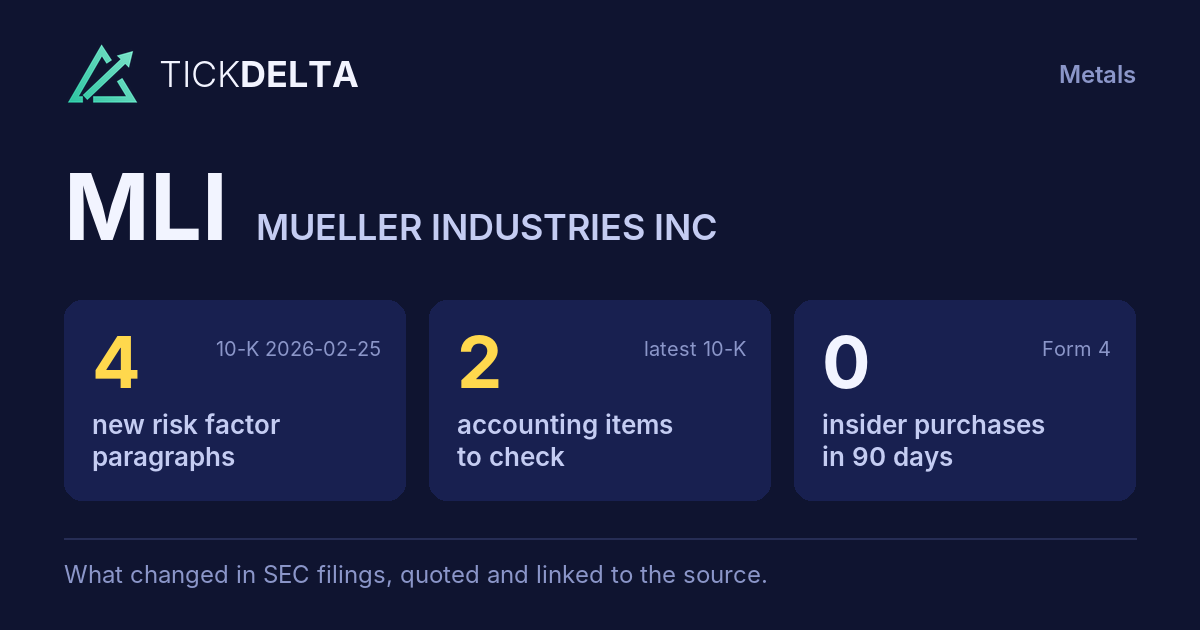
5 changes: 4 added, 1 reworded
10-K Feb 25, 2026 vs Feb 26, 2025
Risk Factors
20.7%
of the text changed · 2,572 words now · 4 new paragraphs, 0 gone
Legal Proceedings
16.4%
of the text changed · 3,080 words now
Accounting Policies
9.2%
of the text changed · 4,846 words now
10-K 0000089439-26-000008 (Feb 25, 2026) vs 10-K 0000089439-25-000010 (Feb 26, 2025) Not compared: MD&A.
Every paragraph, and how much of it changed
One bar per paragraph, in the order of the 10-K. Height and colour show the share of its words not in the closest paragraph a year earlier; the tallest bars are new paragraphs.
Risk Factors
30 paragraphs · 4 new · 6 reworded · 0 gone · 10-K Feb 25, 2026 against Feb 26, 2025
New paragraph
Reworded (5% of its words or more)
Same or nearly
Paragraph 22 · 44% changed
Every version of it
Paragraph 5 · 36% changed
Every version of it
Paragraph 15 · 26% changed
Every version of it
We conduct our business through subsidiaries in several different countries and export our products to many countries. Fluctuations in currency exchange rates could have a significant impact on the competitiveness of our products as well as the reported results of our operations, which are presented in U.S. dollars. A portion of our products are manufactured in or acquired from suppliers located in lower cost regions. Cross border transactions, both with external parties and intercompany relationships, result in increased exposure to foreign exchange fluctuations. While the U.S. dollar has weakened in recent months, any future strengthening of the U.S. dollar could expose our U.S. based businesses to competitive threats from lower cost producers in other countries such as China. Lastly, our sales are translated into U.S. dollars for reporting purposes. The strengthening of the U.S. dollar could result in unfavorable translation effects when the results of foreign operations are translated into U.S. dollars. Accordingly, significant changes in exchange rates, particularly the British pound sterling, Mexican peso, Canadian dollar, and the South Korean won, could have an adverse impact on our results of operations or financial position.
Paragraph 21 · 16% changed
Every version of it
The nature of our operations exposes us to the risk of liabilities and claims with respect to environmental, health, and safety matters. While we have established accruals intended to cover the cost of environmental remediation at contaminated sites, the actual cost is difficult to determine and may exceed our estimated reserves. Further, changes to, or more rigorous enforcement or stringent interpretation of environmental or health and safety laws could require significant incremental costs to maintain compliance. Recent and pending climate change regulation and initiatives on the state, regional, federal, and international levels may require certain of our facilities to reduce GHG emissions. While not reasonably estimable at this time, this could require capital expenditures for environmental control facilities and/or the purchase of GHG emissions credits in the coming years. In addition, with respect to environmental matters, future claims may be asserted against us for, among other things, past acts or omissions at locations operated by predecessor entities, or alleging damage or injury or seeking other relief in connection with environmental matters associated with our operations. Future liabilities, claims, and compliance costs may have a material adverse effect on us because of potential adverse outcomes, defense costs, diversion of our resources, availability of insurance coverage, and other factors. The overall impact of these requirements on our operations could increase our costs and diminish our ability to compete with products that are produced in countries without such rigorous standards; the long run impact could negatively impact our results and have a material adverse effect on our business.
Paragraph 12 · 13% changed
Every version of it
Since we operate in a variety of geographic areas, our businesses are subject to the economic conditions in each such area. General economic downturns or localized downturns in the regions where we have operations could have a material adverse effect on our business, financial condition, and results of operations. Additionally, the impact of economic conditions on the operations or liquidity of any party with which we conduct our business, including our suppliers and customers, may adversely impact our business.
Paragraph 13 · 45% changed
Every version of it
10-K Feb 26, 2025Since we operate in a variety of geographic areas, our businesses are subject to the economic conditions in each such area. General economic downturns or localized downturns in the regions where we have operations could have a material adverse effect on our business, financial condition, and results of operations. Additionally, the impact of economic conditions on the operations or liquidity of any party with which we conduct our business, including our suppliers and customers, may adversely impact our business.
10-K Feb 25, 2026
operations or liquidity of any party with which we conduct our business, including our suppliers and customers, may adversely impact our business.
Paragraph 22 · 44% changed
Every version of it
10-K Feb 26, 2025The nature of our operations exposes us to the risk of liabilities and claims with respect to environmental, health, and safety matters. While we have established accruals intended to cover the cost of environmental remediation at contaminated sites, the actual cost is difficult to determine and may exceed our estimated reserves. Further, changes to, or more rigorous enforcement or stringent interpretation of environmental or health and safety laws could require significant incremental costs to maintain compliance. Recent and pending climate change regulation and initiatives on the state, regional, federal, and international levels may require certain of our facilities to reduce GHG emissions. While not reasonably estimable at this time, this could require capital expenditures for environmental control facilities and/or the purchase of GHG emissions credits in the coming years. In addition, with respect to environmental matters, future claims may be asserted against us for, among other things, past acts or omissions at locations operated by predecessor entities, or alleging damage or injury or seeking other relief in connection with environmental matters associated with our operations. Future liabilities, claims, and compliance costs may have a material adverse effect on us because of potential adverse outcomes, defense costs, diversion of our resources, availability of insurance coverage, and other factors. The overall impact of these requirements on our operations could increase our costs and diminish our ability to compete with products that are produced in countries without such rigorous standards; the long run impact could negatively impact our results and have a material adverse effect on our business.
10-K Feb 25, 2026
connection with environmental matters associated with our operations. Future liabilities, claims, and compliance costs may have a material adverse effect on us because of potential adverse outcomes, defense costs, diversion of our resources, availability of insurance coverage, and other factors. The overall impact of these requirements on our operations could increase our costs and diminish our ability to compete with products that are produced in countries without such rigorous standards; the long run impact could negatively impact our results and have a material adverse effect on our business.
Paragraph 5 · 36% changed
Every version of it
10-K Feb 26, 2025Both the costs of raw materials used in our manufactured products (copper, brass, zinc, and aluminum) and energy costs (electricity, natural gas and fuel) have been volatile during the last several years, which has resulted in changes in production and distribution costs. For example, recent and pending climate change regulation and initiatives on the state, regional, federal, and international levels that have focused on reducing greenhouse gas (GHG) emissions from the energy and utility sectors may affect energy availability and costs in the near future. Tariffs impact the total cost of our products and the components and raw materials that go into manufacturing them. The new, substantial tariff increases on imports in the United States from Canada and Mexico (in addition to China) announced on February 1, 2025, should they be implemented and sustained for an extended period of time, could adversely impact the gross margin the Company earns on its products. While we typically attempt to pass costs through to our customers or to modify or adapt our activities to mitigate the impact of increases, we may not be able to do so successfully. The Company is prepared to proactively work with its supply chain to mitigate the cost impact and pass increases in costs to its customers, to the extent possible, when they occur, but failure to fully pass increases to our customers or to modify or adapt our activities to mitigate the impact could have a material adverse impact on our operating margins. Additionally, if we are for any reason unable to obtain raw materials or energy, our ability to manufacture our products would be impacted, which could have a material adverse impact on our operating margins.
10-K Feb 25, 2026
While we typically attempt to pass costs through to our customers or to modify or adapt our activities to mitigate the impact of increases, we may not be able to do so successfully. The Company is prepared to proactively work with its supply chain to mitigate the cost impact and pass increases in costs to its customers, to the extent possible, when they occur, but failure to fully pass increases to our customers or to modify or adapt our activities to mitigate the impact could have a material adverse impact on our operating margins. Additionally, if we are for any reason unable to obtain raw materials or energy, our ability to manufacture our products would be impacted, which could have a material adverse impact on our operating margins.
Paragraph 15 · 26% changed
Every version of it
10-K Feb 26, 2025
could expose our U.S. based businesses to competitive threats from lower cost producers in other countries such as China. Lastly, our sales are translated into U.S. dollars for reporting purposes. The strengthening of the U.S. dollar could result in unfavorable translation effects when the results of foreign operations are translated into U.S. dollars. Accordingly, significant changes in exchange rates, particularly the British pound sterling, Mexican peso, Canadian dollar, and the South Korean won, could have an adverse impact on our results of operations or financial position.
10-K Feb 25, 2026
We conduct our business through subsidiaries in several different countries and export our products to many countries. Fluctuations in currency exchange rates could have a significant impact on the competitiveness of our products as well as the reported results of our operations, which are presented in U.S. dollars. A portion of our products are manufactured in or acquired from suppliers located in lower cost regions. Cross border transactions, both with external parties and intercompany relationships, result in increased exposure to foreign exchange fluctuations. While the U.S. dollar has weakened in recent months, any future strengthening of the U.S. dollar could expose our U.S. based businesses to competitive threats from lower cost producers in other countries such as China. Lastly, our sales are translated into U.S. dollars for reporting purposes. The strengthening of the U.S. dollar could result in unfavorable translation effects when the results of foreign operations are translated into U.S. dollars. Accordingly, significant changes in exchange rates, particularly the British pound sterling, Mexican peso, Canadian dollar, and the South Korean won, could have an adverse impact on our results of operations or financial position.
Paragraph 21 · 16% changed
Every version of it
10-K Feb 26, 2025
The nature of our operations exposes us to the risk of liabilities and claims with respect to environmental, health, and safety matters. While we have established accruals intended to cover the cost of environmental remediation at contaminated sites, the actual cost is difficult to determine and may exceed our estimated reserves. Further, changes to, or more rigorous enforcement or stringent interpretation of environmental or health and safety laws could require significant incremental costs to maintain compliance. Recent and pending climate change regulation and initiatives on the state, regional, federal, and international levels may require certain of our facilities to reduce GHG emissions. While not reasonably estimable at this time, this could require capital expenditures for environmental control facilities and/or the purchase of GHG emissions credits in the coming years. In addition, with respect to environmental matters, future claims may be asserted against us for, among other things, past acts or omissions at locations operated by predecessor entities, or alleging damage or injury or seeking other relief in connection with environmental matters associated with our operations. Future liabilities, claims, and compliance costs may have a material adverse effect on us because of potential adverse outcomes, defense costs, diversion of our resources, availability of insurance coverage, and other factors. The overall impact of these requirements on our operations could increase our costs and diminish our ability to compete with products that are produced in countries without such rigorous standards; the long run impact could negatively impact our results and have a material adverse effect on our business.
10-K Feb 25, 2026
The nature of our operations exposes us to the risk of liabilities and claims with respect to environmental, health, and safety matters. While we have established accruals intended to cover the cost of environmental remediation at contaminated sites, the actual cost is difficult to determine and may exceed our estimated reserves. Further, changes to, or more rigorous enforcement or stringent interpretation of environmental or health and safety laws could require significant incremental costs to maintain compliance. Recent and pending climate change regulation and initiatives on the state, regional, federal, and international levels may require certain of our facilities to reduce GHG emissions. While not reasonably estimable at this time, this could require capital expenditures for environmental control facilities and/or the purchase of GHG emissions credits in the coming years. In addition, with respect to environmental matters, future claims may be asserted against us for, among other things, past acts or omissions at locations operated by predecessor entities, or alleging damage or injury or seeking other relief in
Paragraph 12 · 13% changed
Every version of it
10-K Feb 26, 2025
Since we operate in a variety of geographic areas, our businesses are subject to the economic conditions in each such area. General economic downturns or localized downturns in the regions where we have operations could have a material adverse effect on our business, financial condition, and results of operations. Additionally, the impact of economic conditions on the operations or liquidity of any party with which we conduct our business, including our suppliers and customers, may adversely impact our business.
10-K Feb 25, 2026
Since we operate in a variety of geographic areas, our businesses are subject to the economic conditions in each such area. General economic downturns or localized downturns in the regions where we have operations could have a material adverse effect on our business, financial condition, and results of operations. Additionally, the impact of economic conditions on the
MD&A
2 paragraphs · 0 new · 0 reworded · 0 gone · 10-K Feb 25, 2026 against Feb 26, 2025
New paragraph
Reworded (5% of its words or more)
Same or nearly
A paragraph is matched with the one last year that shares the most of its words; under half in common makes it new. The paragraphs shown are the 6 reworded the most in each section.
The paragraph that changed most in each section
The redline
Marked against last year's 10-K: cut words struck through, new words highlighted.
Accounting Policies165 words changed in this paragraph; it is 31% similar to last year's version.
In June 2022, December 2025, the FASB issued ASU 2022-03, Fair Value Measurement (Topic 820): Fair Value Measurement of Equity Securities Subject to Contractual Sale Restrictions. 2025-12, Codification Improvements. The new guidance was issued addresses suggestions received from stakeholders regarding the Accounting Standards Codification (ASC) and makes other incremental improvements to clarify existing guidance measuring U.S. GAAP. The update represents changes to the fair value ASC that clarify, correct errors in, or make other improvements to a variety of an equity security subject topics that are intended to contractual restrictions that prohibit the sale of an equity security make it easier to understand and introduce new disclosure requirements for applicable equity securities. apply. The ASU was is effective for fiscal years beginning after December 15, 2023 for public entities. The guidance requires prospective adoption, 2026 and early interim periods within those fiscal years. Entities are required to apply the amendments to ASC 260 retrospectively. All other amendments may be applied prospectively or retrospectively. Early adoption was is permitted. The Company adopted is evaluating the ASU during the first quarter impact of 2023. The adoption of the ASU did not have a material impact this guidance on the Company’s its Consolidated Financial Statements. Statements and related disclosures.
Source: 10-K text, Note 1 – Summary of Significant Accounting Policies, 10-K 0000089439-26-000008 vs 10-K text, Note 1 – Summary of Significant Accounting Policies, 10-K 0000089439-25-000010
Legal Proceedings155 words changed in this paragraph; it is 70% similar to last year's version.
On December 24, 2008, the Department of Commerce (DOC) initiated an antidumping administrative review of the antidumping duty order covering circular welded non-alloy steel pipe and tube from Mexico for the November 1, 2007 through October 31, 2008 period of review. The DOC selected Mueller Comercial as a respondent in the review. On April 19, 2010, the DOC published the final results of the review and assigned Mueller Comercial an antidumping duty rate of 48.33 percent. On May 25, 2010, the Company appealed the final results to the U.S. Court of International Trade (CIT). On December 16, 2011, the CIT issued a decision remanding the Department’s final results. While the matter was still pending, the Company and the United States reached an agreement to settle the appeal. Subject to the conditions of the agreement, the Company anticipated that certain of its subsidiaries would incur antidumping duties on subject imports made during the period of review and, as such, established a reserve for this matter. After the lapse of the statutory period of time during which U.S. Customs and Border Protection (CBP) was required, but failed, to liquidate the entries at the settled rate, the Company released the reserve. Between October 30, 2015 and November 27, 2015, CBP sent a series of invoices to Southland Pipe Nipples Co., Inc. (Southland), requesting payment of approximately $ 3.0 million in duties and interest in connection with 795 import entries made during the November 1, 2007 through October 31, 2008 period. On January 26, 2016 and January 27, 2016, Southland filed protests with CBP in connection with these invoices, noting that CBP’s asserted claims were not made in accordance with applicable law, including statutory provisions governing deemed liquidation. The Company believes in the merits of the legal objections raised in Southland’s protests, and CBP’s response to Southland’s protests is currently pending. Given the procedural posture and issues raised by this legal dispute, the Company cannot estimate the amount of potential duty liability, if any, that may result from CBP’s asserted claims.
Source: Item 3, via Note 15 – Commitments and Contingencies, 10-K 0000089439-26-000008 vs Item 3, via Note 15 – Commitments and Contingencies, 10-K 0000089439-25-000010
Risk Factors152 words changed in this paragraph; it is 63% similar to last year's version.
Source: Item 1A, 10-K 0000089439-26-000008 vs Item 1A, 10-K 0000089439-25-000010
Sentences and paragraphs added, removed or reworded
Every change, by type
Sentences and paragraphs of MLI's Risk Factors and MD&A, 10-K Feb 25, 2026 against 10-K Feb 26, 2025. Each links to the text at sec.gov.
Quiet changes are sentences kept from last year with one to four words changed, at least one of them a hedge, a modal or a qualifier (may, could, will, not, significant, material…). A year or date rolling forward is not counted.
The full word list
adverse, adversely, all, although, anticipate, anticipates, any, approximately, believe, believes, can, cannot, certain, could, expect, expects, generally, however, if, intend, intends, largely, likely, many, material, materially, may, might, most, must, never, no, not, possible, primarily, probable, should, significant, significantly, some, substantial, substantially, unlikely, will, would
AddedRisk Factors
Both the costs of raw materials used in our manufactured products (copper, brass, zinc, and aluminum) and energy costs (electricity, natural gas and fuel) have been volatile during the last several years, which has resulted in changes in production and distribution costs. Fluctuations in commodities prices are caused by varied and complex factors beyond our control, including global supply and demand impacted by industry production and inventory levels; global economic and political conditions; national and international regulatory, trade and/or tax policies, including tariffs and other controls or restrictions on
Read it in 10-K Feb 25, 2026 at sec.gov
AddedRisk Factors
imports and exports; current inflation rates and expectations regarding future inflation rates; and the strength of the U.S. dollar compared to foreign currencies. For example, tariffs may impact the total cost of our products and the components and raw materials that go into manufacturing them and could adversely impact the gross margin the Company earns on its products. Fuel and utility costs also have been, and will continue to be, affected by factors outside our control, such as supply and demand for fuel and utility services in both local and regional markets, including increased demand resulting from data center development.
Read it in 10-K Feb 25, 2026 at sec.gov
AddedRisk Factors
Enhanced U.S. tariffs, import/export restrictions or other trade barriers may have a negative effect on global economic conditions, financial markets and our business.
Read it in 10-K Feb 25, 2026 at sec.gov
AddedRisk Factors
There is currently significant uncertainty about the future relationship between the U.S. and various other countries with respect to trade policies, treaties, tariffs and taxes. Current or future tariffs imposed by the U.S. may negatively impact our customers’ businesses, thereby causing an indirect negative impact on our sales. For example, during 2025, the U.S. presidential administration threatened or imposed tariffs on imports from various countries, including China, Mexico, and Canada. In response, some of these countries threatened or announced tariffs on imports from the U.S. Further, on February 20, 2026, the United States Supreme Court issued a ruling striking down certain tariffs previously imposed under the International Emergency Economic Powers Act (IEEPA). Following the Supreme Court's decision, the U.S. presidential administration announced its intention to invoke other laws to collect tariffs and announced new tariffs on imports from all countries, in addition to any existing non-IEEPA tariffs. There remains substantial uncertainty regarding the duration of existing and newly announced tariffs, potential changes or pauses to such tariffs, tariff levels, and whether further additional tariffs or other retaliatory actions may be imposed, modified, or suspended, and the impacts of such actions on our business. The extent to which these threats will be enacted and the duration for which enacted tariffs will be in place remain uncertain and could lead to economic decline, which could negatively impact demand for our products and adversely affect our results of operations.
Read it in 10-K Feb 25, 2026 at sec.gov
RewordedRisk Factors
In addition, with respect to environmental matters, future claims may be asserted against us for, among other things, past acts or omissions at locations operated by predecessor entities, or alleging damage or injury or seeking other relief in connection with environmental matters associated with our operations.
Read it in 10-K Feb 25, 2026 at sec.gov
Sources
The two latest 10-Ks on EDGAR, section by section. Each change links to the text at sec.gov.
Also
New risk factors: paragraphs with nothing like them last year, quoted in full.
Work with it
Excel workbook · CSV. Google Sheet that stays up to date: paste =IMPORTDATA("https://tickdelta.com/company/MLI/export.csv") into a cell.