Form 10-K for the Fiscal Year Ended December 31, 2022
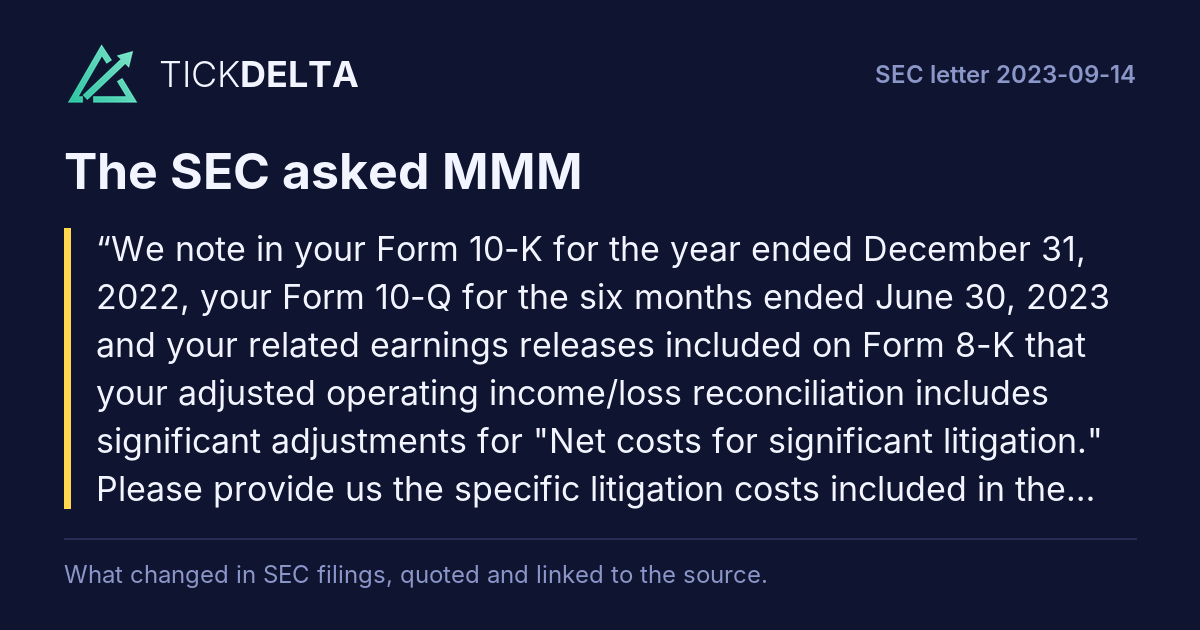
We note in your Form 10-K for the year ended December 31, 2022, your Form 10-Q for the six months ended June 30, 2023 and your related earnings releases included on Form 8-K that your adjusted operating income/loss reconciliation includes significant adjustments for "Net costs for significant litigation." Please provide us the specific litigation costs included in the non-GAAP measures each period, including theRest of the question
amounts related to settlements, accruals and legal fees and provide additional disclosure of these amounts in future filings. In addition, explain to us and disclose in future filings how each component of the elimination is consistent with the guidance in Question 100.01 of the SEC's Compliance and Disclosure Interpretations for Non-GAAP measures.
3M has provided the requested information to the Commission on a confidential basis under separate cover. As discussed further below, 3M believes it has complied with applicable law, regulation, and guidance from the
Commission, including Regulation G, Item 10(e) of Regulation S-K, and Compliance and Disclosure Interpretations on Non-GAAP Financial Measures (“C&DIs”) Questions 100.01 and 102.03, with respect to the way 3M discloses “net costs for significant litigation.” 3M further believes its presentation does not cause its disclosures to be misleading.Read in the reply ↗Rest of the answer
These costs, which currently relate exclusively to the Company’s respirator mask/asbestos, PFAS-related, and Combat Arms Earplugs dockets, are not normal operating expenses related to 3M’s ongoing operations, revenue generating activities, business strategy, industry, and regulatory environment. 3M management considers amounts adjusting for special items (of which this is a part), in addition to segment operating performance, in evaluating and managing ongoing operations, and believes that the measures are useful to investors in understanding underlying business performance when read in conjunction with GAAP results. In addition, 3M provides extensive disclosure regarding each of these matters in the Commitments and Contingencies note to its financial statements and believes information related to these charges is already included to the extent material. 3M will reference in future filings that it does not consider these costs to be normal, operating expenses. However, 3M does not believe additional quantification of the components is required and, further, believes such disclosure would have the potential to provide a competitive advantage to plaintiffs as 3M works to resolve the litigation in the best interest of shareholders.
As disclosed in the Company’s filings, the “net costs for significant litigation” are limited to costs relating to litigation and claims in three specific areas: respirator mask/asbestos, PFAS-related, and Combat Arms Earplugs (“CAE”). Costs of other legal matters are currently determined by 3M to be normal, recurring expenses necessary to operate the Company’s business and are not excluded when calculating 3M’s non-GAAP measures. Under 3M’s internal policy, in addition to periodic discussion with the Audit Committee, the three specific areas included in “net costs for significant litigation” involve net costs that are distinctive, volatile, and substantial in value. Additionally, these matters are specifically discussed within the Company’s Commitments and Contingencies note. Further, 3M concluded that expenses relating to these three areas of litigation do not constitute normal, recurring operating expenses otherwise necessary to operate the Company’s business. This conclusion was reached after considering the following, among other factors:
•The CAE and respirator mask/asbestos matters relate to products sold many years ago.
◦The CAE claims relate to products discontinued in 2015.
◦The respiratory mask/asbestos claims relate primarily to alleged usage of a particular product version dating back ten or more years and since discontinued.
•The PFAS matters include certain compounds that 3M announced in 2000 it was phasing out. The Company ceased manufacturing and using the vast majority of these compounds within approximately two years of this announcement and ceased all manufacturing and the last significant use of this chemistry by the end of 2008. Further, 3M announced in December 2022 it is exiting all PFAS manufacturing by the end of 2025.
•The three matters entail a potential significant magnitude of costs in terms of litigation support and/or potential liability. These notably were exponentially larger than past activity and/or could significantly impact reported results. For example, in a Form 8-K dated August 29, 2023, 3M disclosed a $6.0 billion settlement agreement intended to resolve all CAE litigation and claims, resulting in a Q3 pre-tax charge of approximately $4.2 billion. Note that aggregated sales of applicable CAE earplugs, through discontinuance in 2015, totaled less than $35 million. A further example of significant cost magnitude includes, as disclosed in 3M’s Q2 2023 Form 10-Q, the proposed settlement agreement the Company entered into that intends to resolve PFAS claims by a class of public water systems in the U.S. that provide drinking water to a vast majority of Americans. This resulted in a Q2 pre-tax charge of $10.3 billion.
•The three matters involve complex underlying circumstances that contribute to an extended litigation period and significant and varied legal fees over that timeframe. None of these constitute normal course business activity.
As a result of the above, 3M does not consider the components of net costs of significant litigation (specifically associated with these three matters) to be normal operating expenses related to the Company’s ongoing operations, revenue generating activities, business strategy, industry, and regulatory environment as described in C&DI Question 100.01. In addition, 3M considered C&DI Question 102.03, which states that although certain items may not be able to be described as non-recurring, infrequent or unusual, it still may be appropriate to adjust for certain items a registrant deems appropriate per Regulation G and the other requirements of Item 10(e) of Regulation S-K. 3M also believes, and correspondingly discloses, that providing certain amounts adjusting for special items (of which this is a part) is useful when read in conjunction with the corresponding GAAP amounts. Specifically, 3M management considers these measures, in addition to segment operating performance, in evaluating and managing ongoing operations. Further, 3M has disclosed that it believes such measures are useful to investors in understanding underlying business performance and provide additional transparency to the special items themselves. Splitting the “net costs of significant litigation” out of results provides investors additional useful information about the Company’s actual results of operations when read in conjunction with the Company's GAAP measures. Fully disclosing the costs of these unusual litigation items and including a note accompanying the non-GAAP disclosures ensures transparency. The adjustment helps investors better understand and evaluate period-over-period changes, both in underlying ongoing operations and the extent of “net costs of significant litigation.” In addition, the Company’s Commitments and Contingencies note includes extensive discussion of the underlying circumstances and developments associated with the three matters (respirator mask/asbestos, PFAS-related, and Combat Arms Earplugs) included in “net cost of significant litigation.”
The Company acknowledges the Staff’s comment regarding specific amounts associated with 3M’s “net costs of significant litigation.” The table below breaks out the components, consisting of changes in accrued liabilities; additional external legal fees; and insurance recoveries. Note that settlements are reflected in changes in accrued liabilities, as the value of the settlement, over or under any pre-existing accruals, is reflected in the changes taken in the period in which the settlement occurs.
(Millions) Years ended December 31, Six months ended June 30,
2022 2021 2020 2023 2022
Changes in accrued liabilities [***] [***] [***] [***] [***]
Additional external legal fees [***] [***] [***] [***] [***]
Insurance recoveries [***] [***] [***] [***] [***]
Total $ 2,291 $ 463 $ 353 $ 10,492 $ 1,966
In future filings, 3M will disclose that it does not consider the elements of the net costs associated with these matters to be normal, operating expenses related to the Company’s ongoing operations, revenue generating activities, business strategy, industry, and regulatory environment. However, the Company respectfully does not believe additional quantification of the components of the associated costs set forth in the table above is necessary or required in its future filings. 3M believes information related to these charges is already included in applicable disclosures to the extent material. For the Staff’s reference, these include:
•Clear indication of the three specific matters that encompass “net costs for significant litigation,” description of the nature of the types of costs included, and reference to which business segments (or Corporate and Unallocated) are impacted. See “Certain amounts adjusted for special items – (non-GAAP measures)” lead-in and description of the “net costs for significant litigation” special item on page of 22 of the 2022 Form 10-K. Further, this discussion references Note 16 (Commitments and Contingencies) where additional information is provided.
•Extensive discussion of the underlying circumstances and developments associated with the matters included in “net costs for significant litigation” in 3M’s Commitments and Contingencies note. In addition, 3M regularly makes specific granular disclosure of applicable factors or settlements that impact changes in related accruals and continues to provide the accrued liability balances associated with each of these three matters. For example:
◦Amount of increase in respirator mask/asbestos accruals along with period-end balance of accrued liability (page 30 of 2023 Q2 Form 10-Q and page 97 of 2022 Form 10-K).
◦Amount of increase in PFAS-related accruals along with period-end balance of accrued liability (page 47 of 2023 Q2 Form 10-Q and page 111 of 2022 Form 10-K). Disclosures earlier in the note also include descriptions of particular agreements/settlements and, to extent material for disclosure, specific associated amounts—representative Zwijndrecht and Alabama examples, pages 101 and 104 of 2022 10-K; public water systems (PWS) proposed settlement example, page 40 of 2023 Q2 Form 10-Q.
◦Amount of charge related to CAE and period-end balance of accrued liability as applicable (pages 47-50 of 2023 Q2 Form 10-Q and page 112 of 2022 Form 10-K).
•Inclusion of appropriate references in 3M’s Management Discussion and Analysis providing further full context for these costs to the extent material.
In addition, 3M believes that disclosing the amount of legal fees incurred in connection with these matters has the potential to impair 3M’s ability to resolve efficiently these matters, which could be detrimental to the Company’s shareholders. These matters each involve a number of individual cases that, at any given time, may be in active litigation, active settlement discussions or in the process of implementing settlement agreements. Specific quantification of legal fees in connection with such ongoing matters is information that litigants typically would not exchange or disclose during ongoing litigation and could be disadvantageous to the Company’s position in these matters, which, in turn, could be disadvantageous to the Company’s shareholders as well.
Further, as indicated above, the Company believes it has complied with the guidance of C&DI Questions 100.01 and 102.03 and, as a result, has not caused associated non-GAAP measures to be misleading in the absence of additional component quantification requested by the Staff. 3M is also not aware of other guidance in terms of the C&DIs, Regulation G, or provisions of Item 10(e) of Regulation S-K requiring this additional component disclosure. 3M will, of course, continue to provide similar narrative discussion of the relevant significant components of non-GAAP charges, including “net costs for significant litigation.”
First report after the company's reply of 2023-09-27: 10-Q filed 2023-10-24 ↗, against the 10-Q filed 2023-07-25 ↗.
Tickdelta does not hold the text of both reports, so they are not compared here.
Also in this review: closing letter, 2023-10-16