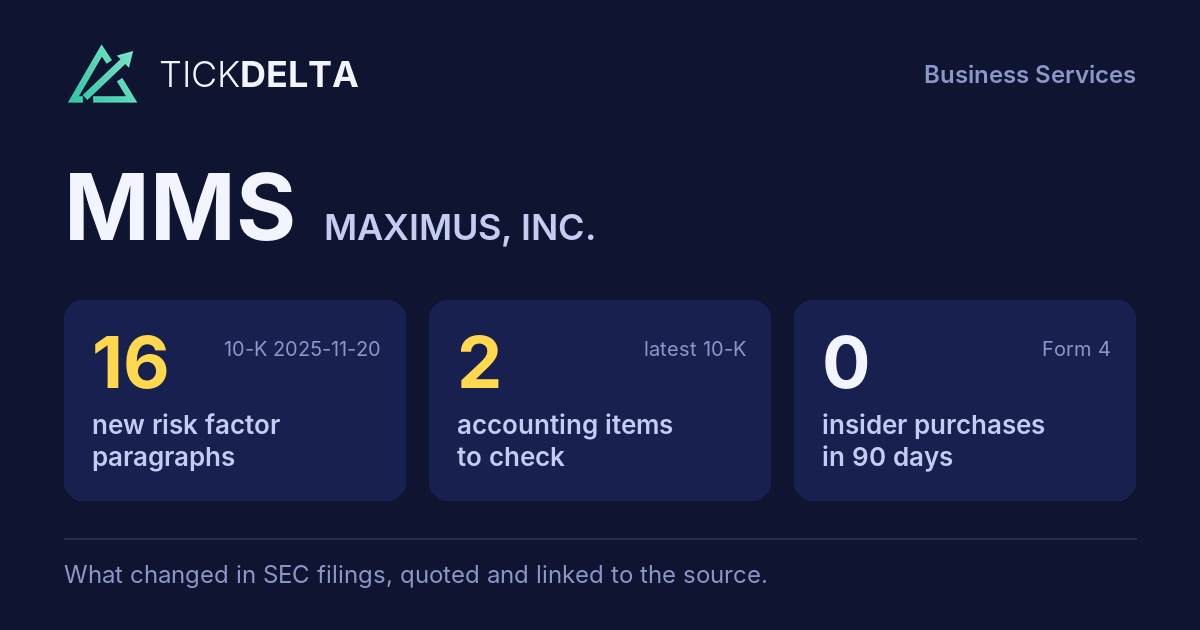
Paragraph 18 · 48% changed
Every version of it
Screener
/
SEC EDGAR
/CIK 0001032220
/10-K filed Nov 20, 2025, compared with Nov 21, 2024
/Numbers from the XBRL of the 10-Ks
NYSE
Industrials · Business Services
Maximus, Inc. MMS
The 10-K against last year's
136 changes: 40 added, 26 removed, 66 reworded, 4 quiet changes
10-K Nov 20, 2025 vs Nov 21, 2024
Risk Factors
16.9%
of the text changed · 8,517 words now · 16 new paragraphs, 4 gone
MD&A
25.1%
of the text changed · 5,279 words now · 24 new paragraphs, 22 gone
Legal Proceedings
27.8%
of the text changed · 1,092 words now
Accounting Policies
8.7%
of the text changed · 3,588 words now
10-K 0001032220-25-000053 (Nov 20, 2025) vs 10-K 0001032220-24-000094 (Nov 21, 2024)
Every paragraph, and how much of it changed
One bar per paragraph, in the order of the 10-K. Height and colour show the share of its words not in the closest paragraph a year earlier; the tallest bars are new paragraphs.
Risk Factors
132 paragraphs · 16 new · 48 reworded · 4 gone · 10-K Nov 20, 2025 against Nov 21, 2024
New paragraph
Reworded (5% of its words or more)
Same or nearly
Paragraph 36 · 48% changed
Every version of it
Paragraph 26 · 47% changed
Every version of it
Paragraph 16 · 38% changed
Every version of it
Changes in state or federal government initiatives or in the level of government spending due to budgetary or deficit considerations may have a significant impact on our future financial performance. For example, regulatory steps taken in response In recent quarters, the U.S. federal government has placed a significant focus on efficiency, including with respect to the COVID-19 pandemic in the United States affected the level contracting with private companies. These efforts may have a number of work effects on many of our contracts. business.
Paragraph 9 · 35% changed
Every version of it
Substantially all of our customers are government agencies. To market our services to secure work with government customers, we are often required to respond to competitive government RFPs, which may result in and we will only be issued a contract awards on award when we win such a competitive basis. competition. To do so effectively, we must accurately estimate our cost structure for providing the required services, the time required to establish operations, and likely terms of attempt to submit a proposal that is more advantageous for the proposals submitted by competitors. client than our competitors' proposals. We must also assemble and submit a large volume of information within an that must comply with the RFP's rigid requirements and relatively short timetable. Our ability to successfully respond successfully to RFPs will could greatly impact our business. There is no assurance that we will continue to obtain be awarded contracts in response to government RFPs, and our proposals when we are awarded such contracts, they may not result in profitable contracts. In addition, competitors be profitable. The competitive bidding process has substantial costs, including labor costs and management's time to prepare bids and proposals for contracts that may protest contracts not be awarded to us through the RFP process us, may be split among competitors, or that may cause the award to be delayed, overturned, or require the customer to reinitiate the RFP process. awarded but for which we do not receive a meaningful volume of task orders.
Paragraph 38 · 33% changed
Every version of it
We are continuously making investments in our business, enhancing resources for company-wide, business line or specific contract initiatives, including technology investments. These expenses include leasing and outfitting office space, purchasing office equipment, developing internal-use software, and hiring personnel. We may also make broad investments in resources, such as technology or personnel, to address new or adjacent markets. These investments may not be recovered if we are unsuccessful in our entrance into these markets.
Paragraph 35 · 31% changed
Every version of it
Paragraph 51 · 27% changed
Every version of it
We are a trusted provider to government and other clients of critical health and human services that rely heavily upon technology systems, software, and networks to receive, input, maintain, and communicate participant and client data. The risk of a security breach, system disruption, ransom-ware attack, or similar cyber-attack or intrusion, including by computer hackers, cyber terrorists, or foreign governments, is persistent, substantial, and increases as the volume, intensity, and sophistication of attempted attacks, intrusions and threats from around the world increase daily. If our systems or networks are compromised, we could be adversely affected by losing confidential or protected information of program participants and clients or by facing a demand for ransom to prevent disclosure of or to restore access to such information. The loss, theft, or improper disclosure of that information could subject us to sanctions under the relevant laws, breach of contract claims, contract termination, class action, or individual lawsuits from affected parties, negative press articles, reputational damage, and a loss of confidence from our government clients, all of which could adversely affect our existing business, future opportunities, and financial condition. Additionally, if our internal networks were compromised, we could suffer the loss of proprietary, trade secret, or confidential technical and financial data. That could make us less competitive in the marketplace and adversely affect our existing business, future opportunities, and financial condition.
Paragraph 18 · 48% changed
Every version of it
10-K Nov 21, 2024Similarly, increased or changed spending on defense, security, or anti-terrorism threats may impact the level of demand or funding for the health and human services programs that we operate. Many state programs in the United States, such as Medicaid, are federally mandated and fully or partially funded by the U.S. Federal Government. Changes to those programs, such as program eligibility, benefits, or the level of federal funding, including a government shutdown, could reduce the level of demand for our services, which could materially adversely impact our future financial performance.
10-K Nov 20, 2025
•Changes in priorities may also affect the level of demand or funding for our state programs in the United States, which are typically mandated and fully or partially funded by the U.S. federal government.
Paragraph 36 · 48% changed
Every version of it
10-K Nov 21, 2024We may encounter start-up challenges, new compliance requirements, unforeseen costs, and other risks as we enter new markets, including managing our ramp-up, recruiting and retaining appropriately experienced and qualified employees, managing customer expectations, and appropriately budgeting and pricing new work. If we are unable to manage the risks of operating in these new markets, our reputation and profitability could be adversely affected.
10-K Nov 20, 2025
There are inherent risks in our expansion goals. Even if our efforts are successful, growth initiatives may divert management's focus from our core business, and we may be unable to realize the levels of profitability we anticipated. If we are unable to manage the risks of operating in these new markets, our reputation and profitability could be adversely affected.
Paragraph 26 · 47% changed
Every version of it
10-K Nov 21, 2024Many of our government contracts contain base periods of one or more years, as well as option periods covering more than half of the contract's potential duration. Government agencies do not have to exercise these option periods, and they may elect not to exercise them for budgetary, performance, or any other reason. Our contracts also typically contain provisions permitting a government customer to terminate the contract on short notice, with or without cause. Termination without cause provisions generally allow the government to terminate a contract at any time and enable us to recover only our costs incurred or committed and settlement expenses and profit, if any, on the work completed prior to termination. We may or may not be able to recover all the costs incurred during the start-up phase of a terminated contract. The unexpected termination of significant contracts could result in significant revenue shortfalls. If revenue shortfalls occur and are not offset by corresponding reductions in expenses, our business could be adversely affected. We cannot anticipate if, when, or to what extent a customer might terminate their contracts with us.
10-K Nov 20, 2025
The unexpected termination of significant contracts could result in significant declines in revenues. If revenue declines occur and are not offset by corresponding reductions in expenses, our business could be adversely affected. We cannot anticipate if, when, or to what extent a customer might terminate their contracts with us.
Paragraph 16 · 38% changed
Every version of it
10-K Nov 21, 2024
Changes in state or federal government initiatives or in the level of government spending due to budgetary or deficit considerations may have a significant impact on our future financial performance. For example, regulatory steps taken in response to the COVID-19 pandemic in the United States affected the level of work on many of our contracts.
10-K Nov 20, 2025
Changes in state or federal government initiatives or in the level of government spending due to budgetary or deficit considerations may have a significant impact on our future financial performance. In recent quarters, the U.S. federal government has placed a significant focus on efficiency, including with respect to contracting with private companies. These efforts may have a number of effects on our business.
Paragraph 9 · 35% changed
Every version of it
10-K Nov 21, 2024
Substantially all of our customers are government agencies. To market our services to government customers, we are often required to respond to government RFPs, which may result in contract awards on a competitive basis. To do so effectively, we must accurately estimate our cost structure for providing the required services, the time required to establish operations, and likely terms of the proposals submitted by competitors. We must also assemble and submit a large volume of information within an RFP's rigid timetable. Our ability to respond successfully to RFPs will greatly impact our business. There is no assurance that we will continue to obtain contracts in response to government RFPs, and our proposals may not result in profitable contracts. In addition, competitors may protest contracts awarded to us through the RFP process that may cause the award to be delayed, overturned, or require the customer to reinitiate the RFP process.
10-K Nov 20, 2025
Substantially all of our customers are government agencies. To secure work with government customers, we are often required to respond to competitive government RFPs, and we will only be issued a contract award when we win such a competition. To do so effectively, we must accurately estimate our cost structure for providing the required services, the time required to establish operations, and attempt to submit a proposal that is more advantageous for the client than our competitors' proposals. We must also assemble and submit a large volume of information that must comply with the RFP's rigid requirements and relatively short timetable. Our ability to successfully respond to RFPs could greatly impact our business. There is no assurance that we will continue to be awarded contracts in response to government RFPs, and when we are awarded such contracts, they may not be profitable. The competitive bidding process has substantial costs, including labor costs and management's time to prepare bids and proposals for contracts that may not be awarded to us, may be split among competitors, or that may be awarded but for which we do not receive a meaningful volume of task orders.
Paragraph 38 · 33% changed
Every version of it
10-K Nov 21, 2024
We may also make broad investments in resources, such as technology or personnel, to address new or adjacent markets. These investments may not be recovered if we are unsuccessful in our entrance into these markets.
10-K Nov 20, 2025
We are continuously making investments in our business, enhancing resources for company-wide, business line or specific contract initiatives, including technology investments. These expenses include leasing and outfitting office space, purchasing office equipment, developing internal-use software, and hiring personnel. We may also make broad investments in resources, such as technology or personnel, to address new or adjacent markets. These investments may not be recovered if we are unsuccessful in our entrance into these markets.
Paragraph 35 · 31% changed
Every version of it
10-K Nov 21, 2024We may encounter start-up challenges, new compliance requirements, unforeseen costs, and other risks as we enter new markets, including managing our ramp-up, recruiting and retaining appropriately experienced and qualified employees, managing customer expectations, and appropriately budgeting and pricing new work. If we are unable to manage the risks of operating in these new markets, our reputation and profitability could be adversely affected.
10-K Nov 20, 2025
Our strategic plan seeks to expand our existing business and identify new organic growth opportunities. In seeking these opportunities, we may encounter start-up challenges, new compliance requirements, unforeseen costs, and other risks as we enter new markets, including identifying appropriate opportunities, differentiating ourselves from competitors, managing our ramp-up, recruiting and retaining appropriately experienced and qualified employees, managing customer expectations, and appropriately budgeting and pricing new work.
Paragraph 51 · 27% changed
Every version of it
10-K Nov 21, 2024
and clients or by facing a demand for ransom to prevent disclosure of or to restore access to such information. The loss, theft, or improper disclosure of that information could subject us to sanctions under the relevant laws, breach of contract claims, contract termination, class action, or individual lawsuits from affected parties, negative press articles, reputational damage, and a loss of confidence from our government clients, all of which could adversely affect our existing business, future opportunities, and financial condition. Additionally, if our internal networks were compromised, we could suffer the loss of proprietary, trade secret, or confidential technical and financial data. That could make us less competitive in the marketplace and adversely affect our existing business, future opportunities, and financial condition.
10-K Nov 20, 2025
We are a trusted provider to government and other clients of critical health and human services that rely heavily upon technology systems, software, and networks to receive, input, maintain, and communicate participant and client data. The risk of a security breach, system disruption, ransom-ware attack, or similar cyber-attack or intrusion, including by computer hackers, cyber terrorists, or foreign governments, is persistent, substantial, and increases as the volume, intensity, and sophistication of attempted attacks, intrusions and threats from around the world increase daily. If our systems or networks are compromised, we could be adversely affected by losing confidential or protected information of program participants and clients or by facing a demand for ransom to prevent disclosure of or to restore access to such information. The loss, theft, or improper disclosure of that information could subject us to sanctions under the relevant laws, breach of contract claims, contract termination, class action, or individual lawsuits from affected parties, negative press articles, reputational damage, and a loss of confidence from our government clients, all of which could adversely affect our existing business, future opportunities, and financial condition. Additionally, if our internal networks were compromised, we could suffer the loss of proprietary, trade secret, or confidential technical and financial data. That could make us less competitive in the marketplace and adversely affect our existing business, future opportunities, and financial condition.
MD&A
90 paragraphs · 24 new · 28 reworded · 22 gone · 10-K Nov 20, 2025 against Nov 21, 2024
New paragraph
Reworded (5% of its words or more)
Same or nearly
Paragraph 31 · 50% changed
Paragraph 51 · 48% changed
Paragraph 26 · 44% changed
Our U.S. Services Segment provides a variety of BPS, services, such as program operations, clinical services, employment services, services and technology solutions and related consulting professional services work for U.S. state and local government programs. These services support a variety of programs, including the programs under ACA, Medicaid, the Medicaid and Children's Health Insurance Program (CHIP), the Affordable Care Act (ACA) marketplaces, Temporary Assistance to Needy Families (TANF), and child support programs. In fiscal years 2020 through 2023, many programs in this segment were operating with depressed margins resulting from the pause in Medicaid redeterminations. The depressed margins resulted from reduced operating leverage in the segment as costs could not scale down at the same rate to meet lower demand due to the requirements to fulfill other obligations on these contracts. Fiscal year 2024 reflected a full period of volumes. The middle two quarters of the fiscal year experienced slightly elevated volumes from excess temporary work. This work was concluded by the last fiscal quarter with the segment’s margin appropriately aligned.
Paragraph 17 · 32% changed
Our effective income tax rate for the year fiscal years ended September 30, 2024 2025 and 2023, 2024, was 24.5% 28.3% and 23.1%, 24.5%, respectively. Our fiscal year 2025 tax rate was negatively affected by the disposal of our businesses in fiscal year 2023 received the benefit of higher tax credits. For fiscal year 2025, we expect the effective tax rate to be between 24.5% Australia and 25.5%. Korea.
Paragraph 45 · 30% changed
Net cash provided by operating activities increased decreased by $200.9 $85.9 million in fiscal year 2024 2025 compared to fiscal year 2023. Almost all of this increase was a result of our increased profitability. 2024.
Paragraph 78 · 29% changed
•During an acquisition, we are required to estimate the fair value of all acquired tangible and intangible assets, as well as liabilities assumed, in order to allocate the purchase price. For many assets acquired and liabilities assumed, the calculation of fair value requires little judgment as balances may be readily convertible to cash receipts or cash payments, or there may be an active market against which to measure value. For the valuation of intangible assets, significant judgment is necessary in identifying and valuing such assets. This valuation will also involve identifying the useful economic life of this asset. Our estimates of these fair values and useful economic lives are based upon assumptions we believe to be reasonable and, where appropriate, include assistance from third-party appraisal firms. The accounting for our acquisitions included determining the fair value of intangible assets representing customer relationships, the VES provider network, technology, and an assembled workforce. In making our determination of the fair value of these assets, we utilized estimates, the most significant of which were forecasts related to future revenues and profit margins. These assumptions relate to the future performance of the acquired business, are forward-looking, and could be affected by future economic and market conditions. The asset values and asset lives determined at acquisition may change based on circumstances such as contract terminations or changes in strategy. When this occurs, we may need to accelerate our amortization charges. These assets are also subject to impairment if events indicate that the carrying value of the assets may not be recoverable. For example, our intangible asset balance includes customer relationship assets which, if the customer relationship ends, would require evaluation of the remaining asset life and asset value.
Paragraph 32 · 24% changed
Our Outside the U.S. Segment provides BPS business process services and technology other solutions for international governments. These services include health and disability assessments, program administration for employment services, wellbeing solutions and other job seeker-related services, digitally-enabled customer services, and advanced technologies for modernization. We support programs and deliver services in the United Kingdom, including the newly awarded Functional Assessment Services (FAS) contract, which replaced the Health Assessment Advisory Service (HAAS) contract, contract and the Restart employment program; and Australia, including Workforce Australia, and other employment support and job seeker program. We also provide services in a number of other countries. Canada and the Middle East.
Paragraph 62 · 20% changed
The Credit Agreement contains a number of covenants with which we are expected to comply. covenants. Failure to meet these requirements would result in a need to renegotiate the agreement agreement, seek a waiver, or a requirement require us to repay our outstanding debt in full. There are two financial covenants, both defined in the Credit Agreement. Agreement:
Paragraph 31 · 50% changed
10-K Nov 21, 2024Our effective income tax rate for the year ended September 30, 2024 and 2023, was 24.5% and 23.1%, respectively. Our tax rate in fiscal year 2023 received the benefit of higher tax credits. For fiscal year 2025, we expect the effective tax rate to be between 24.5% and 25.5%.
10-K Nov 20, 2025
We anticipate operating margins for the U.S. Services Segment in fiscal year 2026 to range between 10% and 11%.
Paragraph 51 · 48% changed
10-K Nov 21, 2024In addition, we invested $18 million in acquiring one of our established vendors.
10-K Nov 20, 2025
•Fiscal year 2024 included an investment of $18.0 million to acquire one of our established vendors.
Paragraph 26 · 44% changed
10-K Nov 21, 2024
Our U.S. Services Segment provides a variety of BPS, such as program operations, clinical services, employment services, and technology solutions and related consulting work for U.S. state and local government programs. These services support a variety of programs, including the programs under ACA, Medicaid, the Children's Health Insurance Program (CHIP), Temporary Assistance to Needy Families (TANF), and child support programs. In fiscal years 2020 through 2023, many programs in this segment were operating with depressed margins resulting from the pause in Medicaid redeterminations. The depressed margins resulted from reduced operating leverage in the segment as costs could not scale down at the same rate to meet lower demand due to the requirements to fulfill other obligations on these contracts. Fiscal year 2024 reflected a full period of volumes. The middle two quarters of the fiscal year experienced slightly elevated volumes from excess temporary work. This work was concluded by the last fiscal quarter with the segment’s margin appropriately aligned.
10-K Nov 20, 2025
Our U.S. Services Segment provides a variety of services, such as program operations, clinical services, employment services and technology solutions and related professional services work for U.S. state and local government programs. These services support a variety of programs, including the programs under Medicaid and Children's Health Insurance Program (CHIP), the Affordable Care Act (ACA) marketplaces, Temporary Assistance to Needy Families (TANF), and child support programs.
Paragraph 17 · 32% changed
10-K Nov 21, 2024
Our effective income tax rate for the year ended September 30, 2024 and 2023, was 24.5% and 23.1%, respectively. Our tax rate in fiscal year 2023 received the benefit of higher tax credits. For fiscal year 2025, we expect the effective tax rate to be between 24.5% and 25.5%.
10-K Nov 20, 2025
Our effective income tax rate for the fiscal years ended September 30, 2025 and 2024, was 28.3% and 24.5%, respectively. Our fiscal year 2025 tax rate was negatively affected by the disposal of our businesses in Australia and Korea.
Paragraph 45 · 30% changed
10-K Nov 21, 2024
Net cash provided by operating activities increased by $200.9 million in fiscal year 2024 compared to fiscal year 2023. Almost all of this increase was a result of our increased profitability.
10-K Nov 20, 2025
Net cash provided by operating activities decreased by $85.9 million in fiscal year 2025 compared to fiscal year 2024.
Paragraph 78 · 29% changed
10-K Nov 21, 2024
•During an acquisition, we are required to estimate the fair value of all acquired tangible and intangible assets, as well as liabilities assumed, in order to allocate the purchase price. For many assets acquired and liabilities assumed, the calculation of fair value requires little judgment as balances may be readily convertible to cash receipts or cash payments, or there may be an active market against which to measure value. For the valuation of intangible assets, significant judgment is necessary in identifying and valuing such assets. This valuation will also involve identifying the useful economic life of this asset. Our estimates of these fair values and useful economic lives are based upon assumptions we believe to be reasonable and, where appropriate, include assistance from third-party appraisal firms. The accounting for our acquisitions included determining the fair value of intangible assets representing customer relationships, the VES provider network, technology, and an assembled workforce. In making our determination of the fair value of these assets, we utilized estimates, the most significant of which were forecasts related to future revenues and profit margins. These assumptions relate to the future performance of the acquired business, are forward-looking, and could be affected by future economic and market conditions. The asset values and asset lives determined at acquisition may change based on circumstances such as contract terminations or changes in strategy. When this occurs, we may need to accelerate our amortization charges. These assets are also subject to impairment if events indicate that the carrying value of the assets may not be recoverable. For example, our intangible asset balance includes customer relationship assets which, if the customer relationship ends, would require evaluation of the remaining asset life and asset value.
10-K Nov 20, 2025
•During an acquisition, we are required to estimate the fair value of all acquired tangible and intangible assets, as well as liabilities assumed, in order to allocate the purchase price. For many assets acquired and liabilities assumed, the calculation of fair value requires little judgment as balances may be readily convertible to cash receipts or cash payments, or there may be an active market against which to measure value. For the valuation of intangible assets, significant judgment is necessary in identifying and valuing such assets. This valuation will also involve identifying the useful economic life of this asset. Our estimates of these fair values and useful economic lives are based upon assumptions we believe to be reasonable and, where appropriate, include assistance from third-party appraisal firms.
Paragraph 32 · 24% changed
10-K Nov 21, 2024
Our Outside the U.S. Segment provides BPS and technology solutions for international governments. These services include health and disability assessments, program administration for employment services, wellbeing solutions and other job seeker-related services, digitally-enabled customer services, and advanced technologies for modernization. We support programs and deliver services in the United Kingdom, including the newly awarded Functional Assessment Services (FAS) contract, which replaced the Health Assessment Advisory Service (HAAS) contract, and the Restart employment program; and Australia, including Workforce Australia, and other employment support and job seeker services in a number of other countries.
10-K Nov 20, 2025
Our Outside the U.S. Segment provides business process services and other solutions for international governments. These services include health and disability assessments, program administration for employment services, wellbeing solutions and other job seeker-related services, digitally-enabled customer services, and advanced technologies for modernization. We support programs and deliver services in the United Kingdom, including the Functional Assessment Services (FAS) contract and the Restart employment program. We also provide services in Canada and the Middle East.
Paragraph 62 · 20% changed
10-K Nov 21, 2024
The Credit Agreement contains a number of covenants with which we are expected to comply. Failure to meet these requirements would result in a need to renegotiate the agreement or a requirement to repay our outstanding debt in full. There are two financial covenants, both defined in the Credit Agreement.
10-K Nov 20, 2025
The Credit Agreement contains a number of covenants. Failure to meet these requirements would result in a need to renegotiate the agreement, seek a waiver, or require us to repay our outstanding debt in full. There are two financial covenants, both defined in the Credit Agreement:
A paragraph is matched with the one last year that shares the most of its words; under half in common makes it new. The paragraphs shown are the 8 reworded the most in each section.
The paragraph that changed most in each section
The redline
Marked against last year's 10-K: cut words struck through, new words highlighted.
MD&A157 words changed in this paragraph; it is 62% similar to last year's version.
•During an acquisition, we are required to estimate the fair value of all acquired tangible and intangible assets, as well as liabilities assumed, in order to allocate the purchase price. For many assets acquired and liabilities assumed, the calculation of fair value requires little judgment as balances may be readily convertible to cash receipts or cash payments, or there may be an active market against which to measure value. For the valuation of intangible assets, significant judgment is necessary in identifying and valuing such assets. This valuation will also involve identifying the useful economic life of this asset. Our estimates of these fair values and useful economic lives are based upon assumptions we believe to be reasonable and, where appropriate, include assistance from third-party appraisal firms. The accounting for our acquisitions included determining the fair value of intangible assets representing customer relationships, the VES provider network, technology, and an assembled workforce. In making our determination of the fair value of these assets, we utilized estimates, the most significant of which were forecasts related to future revenues and profit margins. These assumptions relate to the future performance of the acquired business, are forward-looking, and could be affected by future economic and market conditions. The asset values and asset lives determined at acquisition may change based on circumstances such as contract terminations or changes in strategy. When this occurs, we may need to accelerate our amortization charges. These assets are also subject to impairment if events indicate that the carrying value of the assets may not be recoverable. For example, our intangible asset balance includes customer relationship assets which, if the customer relationship ends, would require evaluation of the remaining asset life and asset value.
Source: Item 7, 10-K 0001032220-25-000053 vs Item 7, 10-K 0001032220-24-000094
Risk Factors153 words changed in this paragraph; it is 55% similar to last year's version.
Substantially all of our customers are government agencies. To market our services to secure work with government customers, we are often required to respond to competitive government RFPs, which may result in and we will only be issued a contract awards on award when we win such a competitive basis. competition. To do so effectively, we must accurately estimate our cost structure for providing the required services, the time required to establish operations, and likely terms of attempt to submit a proposal that is more advantageous for the proposals submitted by competitors. client than our competitors' proposals. We must also assemble and submit a large volume of information within an that must comply with the RFP's rigid requirements and relatively short timetable. Our ability to successfully respond successfully to RFPs will could greatly impact our business. There is no assurance that we will continue to obtain be awarded contracts in response to government RFPs, and our proposals when we are awarded such contracts, they may not result in profitable contracts. In addition, competitors be profitable. The competitive bidding process has substantial costs, including labor costs and management's time to prepare bids and proposals for contracts that may protest contracts not be awarded to us through the RFP process us, may be split among competitors, or that may cause the award to be delayed, overturned, or require the customer to reinitiate the RFP process. awarded but for which we do not receive a meaningful volume of task orders.
Source: Item 1A, 10-K 0001032220-25-000053 vs Item 1A, 10-K 0001032220-24-000094
Legal Proceedings126 words changed in this paragraph; it is 50% similar to last year's version.
In October 2024, Maximus Federal Services, Inc. (a wholly-owned subsidiary of Maximus, Inc.) filed suit in the U.S. Court of Federal Claims, challenging the inclusion of a “labor harmony agreement” and related requirements in a solicitation issued by the Centers for Medicare and Medicaid Services (CMS) to reprocure the Contact Center Operations (CCO) 1-800-MEDICARE contract. In November 2024, CMS cancelled the early reprocurement. The labor harmony agreement requirements mandate that Court then granted Maximus Federal Services. Inc.'s request to voluntarily dismiss the apparent successful offeror lawsuit without prejudice. We will continue work on this contract, which was awarded to us in 2022, and contractor throughout performance enter into a labor harmony agreement with any union that demonstrates an intent to represent the workforce or risk ineligibility for contract award or default of the contract, among other remedies available to the government. The lawsuit alleges that the challenged requirements are unlawful, unduly restrictive of competition, and arbitrary and capricious. This lawsuit followed the Government Accountability Office’s ruling in September 2024 that partially sustained the Company’s pre-award protest, requiring CMS to revise the solicitation to remove an ambiguity. includes annual option periods through 2031.
Source: Item 3, via Note 15 – COMMITMENTS AND CONTINGENCIES, 10-K 0001032220-25-000053 vs Item 3, via Note 15 – COMMITMENTS AND CONTINGENCIES, 10-K 0001032220-24-000094
Accounting Policies60 words changed in this paragraph; it is 68% similar to last year's version.
In November 2023, the Financial Accounting Standards Board (FASB) issued Accounting Standards Update (ASU) No. 2023-07 2023-07, Segment Reporting (Topic 280). This ASU aims to improve disclosures over our segments, including disclosure of significant expense categories within segments, which are regularly provided to our Chief Executive Officer, as well as disclosing how segment measures of profit are used by our Chief Executive Officer. The amendments in this ASU are effective for us starting in fiscal year 2025 for annual periods and in fiscal year 2026 for interim periods, and are required to be applied retrospectively. We are assessing the effect of have adopted this standard but do not anticipate that it will have a material effect on our historical or future financial statements. in September 2025.
Source: Item 8, Note 2 – SIGNIFICANT ACCOUNTING POLICIES, 10-K 0001032220-25-000053 vs Item 8, Note 2 – SIGNIFICANT ACCOUNTING POLICIES, 10-K 0001032220-24-000094
Sentences and paragraphs added, removed or reworded
Every change, by type
Sentences and paragraphs of MMS's Risk Factors and MD&A, 10-K Nov 20, 2025 against 10-K Nov 21, 2024. Each links to the text at sec.gov.
Quiet changes are sentences kept from last year with one to four words changed, at least one of them a hedge, a modal or a qualifier (may, could, will, not, significant, material…). A year or date rolling forward is not counted.
The full word list
adverse, adversely, all, although, anticipate, anticipates, any, approximately, believe, believes, can, cannot, certain, could, expect, expects, generally, however, if, intend, intends, largely, likely, many, material, materially, may, might, most, must, never, no, not, possible, primarily, probable, should, significant, significantly, some, substantial, substantially, unlikely, will, would
AddedRisk Factors
In addition, competitors may protest contracts awarded to us through the RFP process that may cause the award to be delayed, cancelled, or require the customer to reinitiate the RFP process. Any loss or delay of start-up and funding of work under protested contract awards may adversely affect our revenues and profitability. In addition, certain of our multiple-award contracts require that we make post-award efforts to obtain task orders under the contract. Because of these factors, we may not be able to obtain task orders or recognize revenue under these multiple-award contracts.
Read it in 10-K Nov 20, 2025 at sec.gov
AddedRisk Factors
•Changes in priorities may result in procurement changes, delays or cancellations, as well as changes or cancellations of existing contracts.
Read it in 10-K Nov 20, 2025 at sec.gov
AddedRisk Factors
•Changes to procurement rules may result in additional competition, scrutiny and costs of compliance.
Read it in 10-K Nov 20, 2025 at sec.gov
AddedRisk Factors
•Changes in federal regulations may require us to change our existing business practices, may be disruptive to our business, may create a level of uncertainty within our workforce and may conflict with local laws and regulations.
Read it in 10-K Nov 20, 2025 at sec.gov
AddedRisk Factors
•The U.S. Government may seek to lower barriers to entry to allow greater involvement by the private sector. While this may provide additional opportunities for us, it may also expose us to greater levels of competition.
Read it in 10-K Nov 20, 2025 at sec.gov
AddedRisk Factors
These efficiency efforts are occurring in a highly volatile regulatory environment, which may limit our ability to make long-term planning decisions as these efforts may be curtailed or redirected with a change in administration or change in administration priorities. In addition, disputes over the efficiency efforts may result in legislative delays, including government shutdowns, which could result in additional costs and uncertainty. Furthermore, another prolonged government shutdown could adversely impact our operations, revenue, and cash flow, as the government may issue stop work orders on our contracts and delay payment on work already performed.
Read it in 10-K Nov 20, 2025 at sec.gov
AddedRisk Factors
In addition, in the past, we have experienced performance issues under certain contracts. Some of our contracts involve the development and implementation of complex systems and products to achieve formidable customer goals in a competitive procurement environment. As a result, we sometimes experience technological, scheduling or other performance difficulties, which have in the past and may in the future result in delays, cost overruns and failures in our performance under these contracts. If a government customer terminates a contract for default, we could be exposed to liability, including for excess costs incurred by the customer in procuring undelivered services and products from another source.
Read it in 10-K Nov 20, 2025 at sec.gov
AddedRisk Factors
Investments we make in the business may not be recovered on a timely basis, or at all.
Read it in 10-K Nov 20, 2025 at sec.gov
Show the other 60
AddedRisk Factors
When making these investments we assume that we will be able to recover these costs through future revenues or anticipated cost savings. If these future revenues or cost savings do not materialize, or fall short of the amounts anticipated, or if our investments exceed our anticipated budgets, we may not be able to realize these anticipated benefits. If our anticipated benefits are delayed, this may result in greater cash outflows and cause us to increase our borrowings. In addition, payments due to us from government agencies may be delayed due to administrative delays, billing cycles, or as a result of failures by the government to approve governmental budgets in a timely manner. To the extent that we have deferred the cost of these upfront investments as balance sheet assets, an anticipated failure to realize the benefits of these costs may result in impairment charges.
Read it in 10-K Nov 20, 2025 at sec.gov
AddedRisk Factors
We may not be successful in our AI initiatives, which could adversely affect our business, reputation, and/or financial results.
Read it in 10-K Nov 20, 2025 at sec.gov
AddedRisk Factors
AI presents new risks and challenges that may affect our business. We have made, and expect to continue to make, investments to integrate AI and machine learning technology into our products and solutions, as well as to use AI to enhance our own business operations. Given the nature of AI technology, we face significant competition from other companies and an evolving regulatory landscape. Our AI efforts may not be successful and our competitors may incorporate AI into their products more successfully than us, which could impair our ability to compete effectively and adversely affect our financial results. Our competitors may be larger, more diversified, better funded, and have access to more advanced technology, including AI. These competitive advantages may enable our competition to innovate better and more quickly and to compete more effectively on quality and price, causing us to lose business and profitability. Burgeoning interest in AI may increase our competition and disrupt our business model. AI may lower barriers to entry in our industry and we may be unable to effectively compete with the products or services offered by new competitors. AI-related changes to the products and services we offer may affect our customers’ expectations, requirements, or tastes in ways we cannot adequately anticipate or adapt to, causing our business to lose sales, customers, or the ability to operate profitably and sustainably.
Read it in 10-K Nov 20, 2025 at sec.gov
AddedRisk Factors
Our employees or subcontractors may engage in misconduct or other improper activities, which could harm our business.
Read it in 10-K Nov 20, 2025 at sec.gov
RemovedRisk Factors
RemovedRisk Factors
RemovedRisk Factors
RemovedRisk Factors
RewordedRisk Factors
RewordedRisk Factors
If the carrying value of our assets, including goodwill, exceeds their fair value, we may be required to take write-offs, write-downs, restructuring, impairment, or other charges that impair our goodwill, which could negatively affect business, assets, liabilities, prospects, outlook, result in a significant effect on our financial condition, results and results of operations. condition.
Read it in 10-K Nov 20, 2025 at sec.gov
RewordedRisk Factors
To do so effectively, we must accurately estimate our cost structure for providing the required services, the time required to establish operations, and likely terms of attempt to submit a proposal that is more advantageous for the proposals submitted by competitors. client than our competitors' proposals.
Read it in 10-K Nov 20, 2025 at sec.gov
RewordedRisk Factors
There is no assurance that we will continue to obtain be awarded contracts in response to government RFPs, and our proposals when we are awarded such contracts, they may not result in profitable contracts. be profitable.
Read it in 10-K Nov 20, 2025 at sec.gov
RewordedRisk Factors
RewordedRisk Factors
Government entities have in the past terminated and may, may in the future, future conclude their contracts with us earlier than we expect, or they could terminate their contracts with us earlier than we expect, which may result in revenue shortfalls and unrecovered costs.
Read it in 10-K Nov 20, 2025 at sec.gov
RewordedRisk Factors
The potential for adverse media coverage may have a negative effect on the willingness of government agencies to outsource or cause them to seek contract terms that could impact us adversely. adversely, which has happened in the past and could happen again in the future.
Read it in 10-K Nov 20, 2025 at sec.gov
RewordedRisk Factors
RewordedRisk Factors
RewordedRisk Factors
RewordedRisk Factors
Outside the United States, we currently operate outsourced programs with unionized employees in the U.K., U.K. and in the past we have operated programs with unionized employees in Canada.
Read it in 10-K Nov 20, 2025 at sec.gov
RewordedRisk Factors
Quiet changesRisk Factors
Our ability to successfully respond successfully to RFPs will could greatly impact our business.
Read it in 10-K Nov 20, 2025 at sec.gov
Quiet changesRisk Factors
We may or may not be able to recover all the costs incurred during the start-up phase of a terminated contract.
Read it in 10-K Nov 20, 2025 at sec.gov
Quiet changesRisk Factors
Subcontractor or teaming partner performance deficiencies could can result in a customer terminating our contract for default.
Read it in 10-K Nov 20, 2025 at sec.gov
AddedMD&A
•Our business has grown organically, mostly from the expansion of our U.S. Federal Services Segment.
Read it in 10-K Nov 20, 2025 at sec.gov
AddedMD&A
•During the first quarter of fiscal year 2025, we sold our businesses in Australia and Korea. This sale resulted in a loss and increased our full-year tax rate. However, this sale, and similar sales made in fiscal year 2024, have streamlined our international businesses and resulted in improved results in our Outside the U.S. Segment.
Read it in 10-K Nov 20, 2025 at sec.gov
AddedMD&A
•Our operating cash flows remain strong and our overall leverage is relatively low, allowing us to make significant purchases of our own common stock.
Read it in 10-K Nov 20, 2025 at sec.gov
AddedMD&A
Our SG&A expenses for fiscal year 2025 include a charge of $39.5 million related to the sale of certain of our businesses in our Outside the U.S. Segment. These charges included accumulated foreign currency losses incurred over two decades of operations, as well as indemnifications provided to the buyer. Absent this charge, SG&A was broadly consistent with fiscal year 2024.
Read it in 10-K Nov 20, 2025 at sec.gov
AddedMD&A
Our interest expense is principally driven by our debt facility in the United States. During fiscal year 2025, delays in payments from customers resulted in additional borrowings under our revolving credit facility, resulting in higher borrowings than in the prior year. This additional cost was partially offset by lower interest rates.
Read it in 10-K Nov 20, 2025 at sec.gov
AddedMD&A
For fiscal year 2026, we expect the effective tax rate to be between 25.0% and 26.0%. On July 4, 2025, the One Big Beautiful Bill Act (OBBBA) was signed in the United States. We do not believe the OBBBA will have a significant effect on our fiscal year 2026 tax rate but we anticipate that it could have a favorable cash flow impact in fiscal year 2026.
Read it in 10-K Nov 20, 2025 at sec.gov
AddedMD&A
Our U.S. Federal Services Segment delivers solutions that help various U.S. federal government agencies better execute on their mission, including program operations and management, clinical services, and advanced technology solutions.
Read it in 10-K Nov 20, 2025 at sec.gov
AddedMD&A
Our revenue growth was driven by our clinical programs, including medical assessments, as well as from support provided to the Federal Emergency Management Agency (FEMA). We have long-standing arrangements with FEMA to provide short-term assistance for natural disasters, the extent and timing of which are difficult to predict.
Read it in 10-K Nov 20, 2025 at sec.gov
AddedMD&A
Our medical assessment revenue benefitted from increased volumes, including those driven by the Honoring our Pact Act, which had necessitated a contract rebid to expand the scale of these arrangements, as well as volume increases from underlying assessment demands. Improvements in performance also reduced our share of penalties incurred, benefitting our profit margin.
Read it in 10-K Nov 20, 2025 at sec.gov
AddedMD&A
Our margins received a benefit from the implementation of technology initiatives, which increased the productivity of our operations.
Read it in 10-K Nov 20, 2025 at sec.gov
AddedMD&A
We anticipate operating margins for the U.S. Federal Services Segment in fiscal year 2026 to range between 15.5% and 16%.
Read it in 10-K Nov 20, 2025 at sec.gov
AddedMD&A
Our fiscal year 2024 results received the benefit of higher volumes as Medicaid redetermination activities continued, resulting in benefits to our revenue and profit margins. As anticipated, our results have returned to a steady state with the conclusion of this additional work.
Read it in 10-K Nov 20, 2025 at sec.gov
RemovedMD&A
RemovedMD&A
RemovedMD&A
RemovedMD&A
RemovedMD&A
RemovedMD&A
RemovedMD&A
RemovedMD&A
RemovedMD&A
RemovedMD&A
RemovedMD&A
RemovedMD&A
RewordedMD&A
In addition, Adjusted EBITDA EBITDA, as calculated by us, is also a useful measure of performance that focuses on the cash generating capacity of the business as it excludes the non-cash expenses of depreciation, depreciation and amortization of property, equipment, and capitalized software, amortization of intangible assets, and divestiture-related charges, and makes for easier comparisons between the operating performance of companies with different capital structures by excluding interest expense and therefore, the impacts of financing costs. charges.
Read it in 10-K Nov 20, 2025 at sec.gov
RewordedMD&A
Consolidated Results of Operations For the Year Ended September 30, 2025 2024 2023 (dollars in thousands, except per share data) Revenue $ 5,431,276 $ 5,306,197 $ 4,904,728 Cost of revenue 4,097,833 4,054,545 3,876,120 Gross profit 1,333,443 1,251,652 1,028,608 Gross profit percentage 24.6 % 23.6 % 21.0 % Selling, general, and administrative expenses 713,107 671,583 639,223 Selling, general, and administrative expenses as a percentage of revenue 13.1 % 12.7 % 13.0 % Amortization of intangible assets 92,047 91,570 94,591 Operating income 528,289 488,499 294,794 Operating margin 9.7 % 9.2 % 6.0 % Interest expense 84,080 82,440 84,138 Other (income)/expense, net (640) (450) 363 Income before income taxes 444,849 406,509 210,293 Provision for income taxes 125,815 99,595 48,501 Effective tax rate 28.3 % 24.5 % 23.1 % Net income $ 319,034 $ 306,914 $ 161,792 Earnings per share:
Read it in 10-K Nov 20, 2025 at sec.gov
RewordedMD&A
RewordedMD&A
We support programs and deliver services in the United Kingdom, including the newly awarded Functional Assessment Services (FAS) contract, which replaced the Health Assessment Advisory Service (HAAS) contract, contract and the Restart employment program; and Australia, including Workforce Australia, and other employment support and job seeker services in a number of other countries. program.
Read it in 10-K Nov 20, 2025 at sec.gov
RewordedMD&A
RewordedMD&A
Interest expense 84,080 82,440 84,138 Other expense, (income)/expense, net (640) (450) 363 Provision for income taxes 125,815 99,595 48,501 Amortization of intangibles 92,047 91,570 94,591 Stock compensation expense 41,182 35,349 29,522 Acquisition-related expenses 427 3,218 575 Loss on sale of businesses 39,549 1,018 883 Depreciation and amortization of property, equipment, and capitalized software 41,669 33,957 54,725 Pro forma and other adjustments permitted by our Credit Agreement 50,832 72,172 69,892 Consolidated EBITDA (as defined by our Credit Agreement) $ 793,995 $ 725,783 $ 544,982
Read it in 10-K Nov 20, 2025 at sec.gov
RewordedMD&A
Our effective interest rate was 5.37% at September 30, 2025, compared to 5.52% at September 30, 2024, compared to 5.97% at September 30, 2023, and 4.69% at September 30, 2022. 2024.
Read it in 10-K Nov 20, 2025 at sec.gov
RewordedMD&A
As a result, Consolidated EBITDA as defined by the Credit Agreement is calculated in a different manner from the Adjusted EBITDA we utilize to assess business performance and may not be comparable to EBITDA or related or similarly-titled similarly titled measures presented by other companies.
Read it in 10-K Nov 20, 2025 at sec.gov
RewordedMD&A
Our revenue and cost of revenue for the year ended September 30, 2024, increased 13.9% 2025, decreased 7.7% and 12.2%, respectively, compared to fiscal year 2023. 5.5%, respectively.
Read it in 10-K Nov 20, 2025 at sec.gov
RewordedMD&A
Net cash provided by operating activities $ 429,372 $ 515,258 $ 314,340 Net cash used in investing activities (60,261) (129,104) (80,963) Net cash used in financing activities (343,877) (275,646) (250,798) Effect of foreign exchange rates on cash and cash equivalents and restricted cash (538) 3,164 2,717 Net change in cash and cash equivalents and restricted cash $ 24,696 $ 113,672 $ (14,704)
Read it in 10-K Nov 20, 2025 at sec.gov
RewordedMD&A
Depreciation and amortization of property, equipment, and capitalized software 41,669 33,957 54,725 Adjusted EBITDA (Non-GAAP) $ 701,554 $ 615,044 $ 447,861 Adjusted EBITDA margin (Non-GAAP) 12.9 % 11.6 % 9.1 % Net income $ 319,034 $ 306,914 $ 161,792 Add back:
Read it in 10-K Nov 20, 2025 at sec.gov
RewordedMD&A
Our revenue and cost of revenue for the fiscal year ended September 30, 2024, 2025, increased 13.9% 12.1% and 12.2%, 9.0%, respectively, compared to the fiscal year 2023. ended September 30, 2024.
Read it in 10-K Nov 20, 2025 at sec.gov
Quiet changesMD&A
We have mitigated our risk by fixing interest rates on $650 million approximately half of our debt and our near-term capital allocation plan continues to prioritize reducing our debt using our free cash flow.
Read it in 10-K Nov 20, 2025 at sec.gov
Sources
The two latest 10-Ks on EDGAR, section by section. Each change links to the text at sec.gov.
Also
New risk factors: paragraphs with nothing like them last year, quoted in full.
Work with it
Excel workbook · CSV. Google Sheet that stays up to date: paste =IMPORTDATA("https://tickdelta.com/company/MMS/export.csv") into a cell.