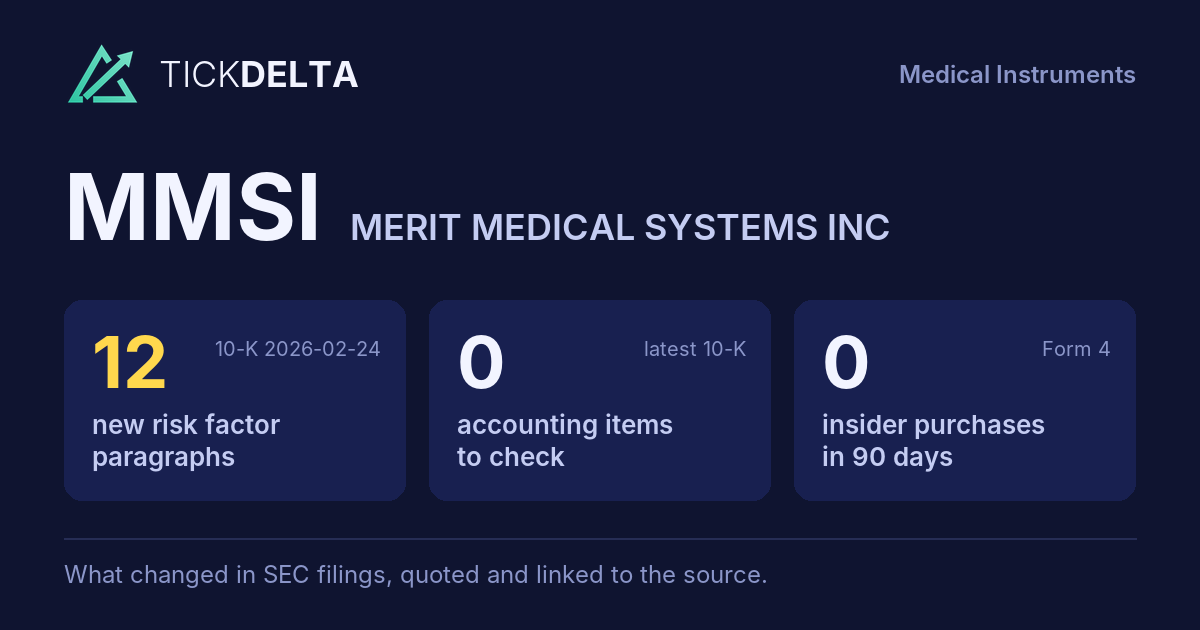
Paragraph 11 · 47% changed
Every version of it
Screener
/
SEC EDGAR
/CIK 0000856982
/10-K filed Feb 24, 2026, compared with Feb 25, 2025
/Numbers from the XBRL of the 10-Ks
Nasdaq
Health care · Medical Instruments
Merit Medical Systems Inc MMSI
The 10-K against last year's
129 changes: 14 added, 10 removed, 100 reworded, 5 quiet changes
10-K Feb 24, 2026 vs Feb 25, 2025
Risk Factors
17.2%
of the text changed · 11,290 words now · 12 new paragraphs, 6 gone
MD&A
20.0%
of the text changed · 3,944 words now · 2 new paragraphs, 4 gone
Legal Proceedings
9.3%
of the text changed · 572 words now
Accounting Policies
17.4%
of the text changed · 3,705 words now
10-K 0000856982-26-000008 (Feb 24, 2026) vs 10-K 0000856982-25-000011 (Feb 25, 2025)
Every paragraph, and how much of it changed
One bar per paragraph, in the order of the 10-K. Height and colour show the share of its words not in the closest paragraph a year earlier; the tallest bars are new paragraphs.
Risk Factors
137 paragraphs · 12 new · 65 reworded · 6 gone · 10-K Feb 24, 2026 against Feb 25, 2025
New paragraph
Reworded (5% of its words or more)
Same or nearly
Paragraph 57 · 46% changed
Every version of it
Effective succession planning is critical to our long-term success. Failure to ensure the transfer of knowledge and smooth transitions involving executives and other key employees could hinder our strategic planning and execution. Changes in our management team may be disruptive to our business, and any failure to successfully integrate key new hires or promote employees could adversely affect our operations. We have announced that a committee of our independent directors is overseeing a succession plan in preparation for the retirement of Fred P. Lampropoulos, our Chairman of the Board, Chief Executive Officer and President, which we currently anticipate will occur around December 31, 2025. Despite the efforts of that committee and our senior management team to implement an effective succession plan that will position Merit for future growth and development, there can be no assurance that we will not experience disruption in our management team, departure of key management or other employees, loss of focus on our strategic business objectives or other adverse consequences resulting from the anticipated transition. We do not maintain key man life insurance on Mr. Lampropoulos. The loss of Mr. Lampropoulos, or of certain other key management personnel, could have a materially adverse effect on our business, operations and financial condition.
Paragraph 4 · 45% changed
Every version of it
The availability and price cost of these the raw materials, parts, products components and services required to operate our business are affected by a variety of factors beyond our control, including existing and potential tariffs, tariffs and related counter-measures, changes in supply and demand, general economic conditions, labor and transportation costs, climate change (including existing and prospective laws and regulations), change, competition, import duties, currency exchange rates rates, regulatory changes and political uncertainty around the world. During 2024, In particular, we experienced significantly elevated commodity and supply chain costs, including the purchase large quantities of resins, which are oil-based components used to manufacture certain products. Any significant increase in resin costs of labor, raw materials, energy, packaging materials and other inputs necessary for the production and distribution of our products. Those elevated costs may continue in 2025, which could adversely affect impact future operating results. In addition to increased resin costs, increases in oil prices could also increase our business, operations or financial condition. packaging and transportation costs.
Paragraph 20 · 44% changed
Every version of it
Paragraph 5 · 34% changed
Every version of it
The availability overall costs of raw materials, transportation, construction, services and price energy necessary for the production and distribution of these materials, parts, our products continue to increase and services are affected by a variety of factors beyond our control, including existing and potential tariffs, changes in supply and demand, general economic conditions, labor and transportation costs, climate change (including existing and prospective laws and regulations), competition, import duties, currency exchange rates and political uncertainty around the world. be volatile. During 2024, 2025, we experienced significantly elevated commodity and supply chain costs, including the costs of labor, raw materials, energy, packaging materials and other inputs necessary for the production and distribution of our products. Those elevated costs may continue in 2025, 2026, which could adversely affect our business, operations or financial condition.
Paragraph 52 · 31% changed
Every version of it
To ensure adequate supply, we must forecast our inventory needs and place orders with our suppliers based on estimates of future demand for particular products. Our ability to accurately forecast demand for our products could be negatively affected by many factors, including product introductions by our competitors, an increase or decrease in customer demand for our products or for products of our competitors, unanticipated changes in general market conditions or regulatory matters and weakening of economic conditions, or decreased consumer confidence. Inventory levels in excess of customer demand may result in inventory write-downs or write-offs, which would impact our results of operation. Conversely, if we underestimate customer demand, our manufacturing facilities may not be able to deliver products to meet our order requirements, which could damage our reputation and customer relationships.
Paragraph 34 · 27% changed
Every version of it
Our integration of acquired businesses requires considerable efforts, which may include corporate restructuring and the coordination of information technologies, research and development, sales and marketing, operations, regulatory, supply chain, manufacturing, quality systems and finance. These efforts result in additional expenses and require significant management time. Some of the factors that could affect the success of our acquisitions include the effectiveness of our due diligence process, our ability to execute our business plan for the acquired operations, the strength of the acquired technology, results of clinical trials, regulatory approvals and reimbursement levels of the acquired products and related procedures, the performance of critical transition services, our ability to adequately fund acquired research and development projects and retain key employees and our ability to achieve synergies with the acquired businesses. Foreign acquisitions involve unique risks, including those related to integration of operations across different geographies, cultures and languages, currency risks and risks associated with the economic, political, legal and regulatory environment in specific countries. In addition, we have and may in the future acquire less than full ownership interests in other businesses, which involve unique challenges for effective collaboration. Further, other parties that hold remaining ownership interests in such businesses may have economic or business goals that are inconsistent with our goals or the goals of such businesses. Our failure to manage these challenges successfully and coordinate the growth of such effectively integrate acquired businesses or other investments could have an adverse impact on our business and our future growth. In addition, we cannot be certain that the businesses we acquire or invest in will become profitable or remain so, and if our acquisitions or investments are not successful, we may record related asset impairment charges in the future or experience other negative consequences on our operating results.
Paragraph 54 · 24% changed
Every version of it
Our reliance on third-party distributors in many countries could negatively impact the commercialization of our products in those countries. products.
Paragraph 11 · 47% changed
Every version of it
10-K Feb 25, 2025portion of our raw materials, component parts and finished products are sourced or manufactured in Mexico and China and could be subject to these tariffs, thereby increasing our manufacturing costs. We are currently evaluating the potential impact of the imposition of potential tariffs on our business and financial condition. The ultimate impact of any announced or future tariffs will depend on various factors, including whether such tariffs are ultimately implemented, the timing of implementation and the amount, scope and nature of such tariffs and potential exclusions from the application of those tariffs. Additionally, potential tariffs or other U.S. trade policy measures could trigger retaliatory actions by other countries, including by countries that are significant markets for our products, resulting in a “trade war.” A trade war could cause increased manufacturing costs, including with respect to our products manufactured in Mexico, foreign governments imposing tariffs on products that we export outside of the U.S., or limitations on our ability to sell our products domestically or abroad, any of which would negatively affect our business, operations and financial condition.
10-K Feb 24, 2026
Additionally, potential tariffs or other U.S. trade policy measures could trigger retaliatory actions by other countries, including by countries that are significant markets for our products, such as China. The escalation of trade tensions could impact us in a variety of ways, including (i) increases in manufacturing costs, (ii) disruptions or delays to our global supply chain, (iii) limitations on our ability to sell our products, and (iv) reductions in sales volumes and gross margins for our products, any of which could negatively affect our business, operations and financial condition.
Paragraph 57 · 46% changed
Every version of it
10-K Feb 25, 2025
Effective succession planning is critical to our long-term success. Failure to ensure the transfer of knowledge and smooth transitions involving executives and other key employees could hinder our strategic planning and execution. Changes in our management team may be disruptive to our business, and any failure to successfully integrate key new hires or promote employees could adversely affect our operations. We have announced that a committee of our independent directors is overseeing a succession plan in preparation for the retirement of Fred P. Lampropoulos, our Chairman of the Board, Chief Executive Officer and President, which we currently anticipate will occur around December 31, 2025. Despite the efforts of that committee and our senior management team to implement an effective succession plan that will position Merit for future growth and development, there can be no assurance that we will not experience disruption in our management team, departure of key management or other employees, loss of focus on our strategic business objectives or other adverse consequences resulting from the anticipated transition. We do not maintain key man life insurance on Mr. Lampropoulos. The loss of Mr. Lampropoulos, or of certain other key management personnel, could have a materially adverse effect on our business, operations and financial condition.
10-K Feb 24, 2026
Effective succession planning is critical to our long-term success. Failure to ensure the transfer of knowledge and smooth transitions involving executives and other key employees could hinder our strategic planning and execution. Changes in our management team may be disruptive to our business, and any failure to successfully integrate key new hires or promote employees could adversely affect our operations.
Paragraph 4 · 45% changed
Every version of it
10-K Feb 25, 2025
The availability and price of these materials, parts, products and services are affected by a variety of factors beyond our control, including existing and potential tariffs, changes in supply and demand, general economic conditions, labor and transportation costs, climate change (including existing and prospective laws and regulations), competition, import duties, currency exchange rates and political uncertainty around the world. During 2024, we experienced significantly elevated commodity and supply chain costs, including the costs of labor, raw materials, energy, packaging materials and other inputs necessary for the production and distribution of our products. Those elevated costs may continue in 2025, which could adversely affect our business, operations or financial condition.
10-K Feb 24, 2026
The cost of the raw materials, components and services required to operate our business are affected by a variety of factors beyond our control, including existing and potential tariffs and related counter-measures, changes in supply and demand, general economic conditions, labor and transportation costs, climate change, competition, import duties, currency exchange rates, regulatory changes and political uncertainty around the world. In particular, we purchase large quantities of resins, which are oil-based components used to manufacture certain products. Any significant increase in resin costs could adversely impact future operating results. In addition to increased resin costs, increases in oil prices could also increase our packaging and transportation costs.
Paragraph 20 · 44% changed
Every version of it
10-K Feb 25, 2025Our products are designed and manufactured in facilities around the world, either by us or third parties. Damage or interruption to our facilities or systems, or those of our suppliers, because of extreme weather conditions, natural disaster, power loss, communications failure, geopolitical disruption, labor strikes, riots, cyber-attack, public health crises, unauthorized entry or other events could significantly disrupt our operations, the operations of suppliers or critical infrastructure. These events may delay or prevent product manufacturing and shipment during the time required to repair, rebuild or replace the damaged facilities or systems. Climate change may increase both the frequency and severity of natural disasters and, consequently, risks to our operations and growth. In the event of any such delay or interruption of our operations, facilities or systems, or those of our suppliers, we may experience a loss of market share and harm to our reputation, which could adversely affect our business, operations or financial condition.
10-K Feb 24, 2026
Damage or interruption to our facilities or systems, or those of our suppliers, because of extreme weather conditions, natural disaster, power loss, communications failure, geopolitical disruption, labor strikes, civil unrest, cyber-attack, public health crises, unauthorized entry or other events could significantly disrupt our operations, the operations of suppliers or
Paragraph 5 · 34% changed
Every version of it
10-K Feb 25, 2025
The availability and price of these materials, parts, products and services are affected by a variety of factors beyond our control, including existing and potential tariffs, changes in supply and demand, general economic conditions, labor and transportation costs, climate change (including existing and prospective laws and regulations), competition, import duties, currency exchange rates and political uncertainty around the world. During 2024, we experienced significantly elevated commodity and supply chain costs, including the costs of labor, raw materials, energy, packaging materials and other inputs necessary for the production and distribution of our products. Those elevated costs may continue in 2025, which could adversely affect our business, operations or financial condition.
10-K Feb 24, 2026
The overall costs of raw materials, transportation, construction, services and energy necessary for the production and distribution of our products continue to increase and be volatile. During 2025, we experienced significantly elevated commodity and supply chain costs, including the costs of labor, raw materials, energy, packaging materials and other inputs necessary for the production and distribution of our products. Those elevated costs may continue in 2026, which could adversely affect our business, operations or financial condition.
Paragraph 52 · 31% changed
Every version of it
10-K Feb 25, 2025
To ensure adequate supply, we must forecast our inventory needs and place orders with our suppliers based on estimates of future demand for particular products. Our ability to accurately forecast demand for our products could be negatively affected by many factors, including product introductions by our competitors, an increase or decrease in customer demand for our products or for products of our competitors, unanticipated changes in general market conditions or regulatory matters and weakening of economic conditions, or decreased consumer confidence. Inventory levels in excess of customer demand may result in inventory write-downs or write-offs, which would impact our results of operation. Conversely, if we underestimate customer demand, our manufacturing facilities may not be able to deliver products to meet our order requirements, which could damage our reputation and customer relationships.
10-K Feb 24, 2026
To ensure adequate supply, we must forecast our inventory needs and place orders with our suppliers based on estimates of future demand for particular products. Our ability to accurately forecast demand for our products could be negatively affected by many factors, including product introductions by our competitors, an increase or decrease in customer demand
Paragraph 34 · 27% changed
Every version of it
10-K Feb 25, 2025
development projects and retain key employees and our ability to achieve synergies with the acquired businesses. Foreign acquisitions involve unique risks, including those related to integration of operations across different geographies, cultures and languages, currency risks and risks associated with the economic, political, legal and regulatory environment in specific countries. In addition, we have and may in the future acquire less than full ownership interests in other businesses, which involve unique challenges for effective collaboration. Further, other parties that hold remaining ownership interests in such businesses may have economic or business goals that are inconsistent with our goals or the goals of such businesses. Our failure to manage these challenges successfully and coordinate the growth of such businesses or other investments could have an adverse impact on our business and our future growth. In addition, we cannot be certain that the businesses we acquire or invest in will become profitable or remain so, and if our acquisitions or investments are not successful, we may record related asset impairment charges in the future or experience other negative consequences on our operating results.
10-K Feb 24, 2026
Our integration of acquired businesses requires considerable efforts, which may include corporate restructuring and the coordination of information technologies, research and development, sales and marketing, operations, regulatory, supply chain, manufacturing, quality systems and finance. These efforts result in additional expenses and require significant management time. Some of the factors that could affect the success of our acquisitions include the effectiveness of our due diligence process, our ability to execute our business plan for the acquired operations, the strength of the acquired technology, results of clinical trials, regulatory approvals and reimbursement levels of the acquired products and related procedures, the performance of critical transition services, our ability to adequately fund acquired research and development projects and retain key employees and our ability to achieve synergies with the acquired businesses. Foreign acquisitions involve unique risks, including those related to integration of operations across different geographies, cultures and languages, currency risks and risks associated with the economic, political, legal and regulatory environment in specific countries. In addition, we have and may in the future acquire less than full ownership interests in other businesses, which involve unique challenges for effective collaboration. Our failure to effectively integrate acquired businesses could have an adverse impact on our business and our future growth. In addition, we cannot be certain that the businesses we acquire or invest in will become profitable or remain so, and if our acquisitions or investments are not successful, we may record related asset impairment charges in the future or experience other negative consequences on our operating results.
Paragraph 54 · 24% changed
Every version of it
10-K Feb 25, 2025
Our reliance on third-party distributors in many countries could negatively impact the commercialization of our products in those countries.
10-K Feb 24, 2026
Our reliance on third-party distributors could negatively impact the commercialization of our products.
MD&A
52 paragraphs · 2 new · 31 reworded · 4 gone · 10-K Feb 24, 2026 against Feb 25, 2025
New paragraph
Reworded (5% of its words or more)
Same or nearly
Paragraph 40 · 46% changed
Paragraph 52 · 39% changed
Paragraph 38 · 38% changed
Paragraph 39 · 36% changed
Cash paid for income taxes was $45.0 $31.4 million and $31.5 $45.0 million for the years ended December 31, 2024 2025 and 2023, 2024, respectively, primarily due as the result of increased taxes payable and an increased portion of our total tax expense relating to increases in income before tax. deferred tax expense.
Paragraph 25 · 36% changed
Selling, General and Administrative Expenses. Our selling, general and administrative (“SG&A”) expenses as a percentage of sales were 29.5%, 30.0%, 29.5% and 29.7% and 29.8% for the years ended December 31, 2024, 2023 2025, 2024 and 2022, 2023, respectively. SG&A expenses increased $26.1 $55.5 million, or 7.0%, 13.9%, for the year ended December 31, 2024 2025 compared to 2023. 2024. The increase in SG&A expenses for the year ended December 31, 2024 2025 compared to the year ended December 31, 2023 2024 was primarily related due to increased labor-related costs associated with an increase in headcount and higher labor-related costs including (i) variable compensation linked to company performance, associated with performance-based bonus programs, commissions associated with sales growth, as well as an increase of stock-based compensation in expense associated with new both performance and non-performance based equity grants awards; and variability (ii) headcount additions to support investment in our stock price, the business and an growth from acquisitions, including those in connection with the Cook Transaction and the Biolife Merger. In addition, higher marketing, advertising, and travel expenditures contributed to the year‑over‑year increase in travel related costs associated with our sales and marketing activities, partially offset by a decrease in consulting costs primarily associated with our Foundations for Growth Program which ended in 2023. 2025.
Paragraph 41 · 32% changed
Cash used for inventories was $2.3 $21.6 million and $32.1 $2.3 million for the years ended December 31, 2024 2025 and 2023, respectively due primarily 2024, respectively. The increase in inventories during 2025 was principally associated with our strategy to efforts proactively invest in our inventory balances to normalize inventory levels following prior year investments encourage high customer service levels, as well as to build bridge inventory for production line transfers and increases in safety stock due to vendor supply delays.
Paragraph 30 · 32% changed
Endoscopy Operating Income. Our endoscopy operating income for the year ended December 31, 2024 2025 was $5.5 $18.6 million, compared to operating income of $9.5 $5.5 million for the year ended December 31, 2023. 2024. This decrease increase in endoscopy operating income relative to 2023 2024 was primarily due to higher SG&A expense associated with the acquisition increased sales and integration of operations acquired from EGS and higher R&D expenses, partially offset by higher sales. gross profit.
Paragraph 15 · 27% changed
Paragraph 40 · 46% changed
10-K Feb 25, 2025Net income was $120.4 million and $94.4 million for the years ended December 31, 2024 and 2023, respectively.
10-K Feb 24, 2026
Stock-based compensation expense was $43.5 million and $28.5 million for the years ended December 31, 2025 and 2024, respectively. The increase in stock-based compensation expense during 2025 is primarily associated with the increase in the Company’s stock price and grants of restricted stock units.
Paragraph 52 · 39% changed
10-K Feb 25, 2025During the year ended December 31, 2022, we identified indicators of impairment associated with certain acquired intangible assets within the asset groups based on our qualitative assessment. During the year ended December 31, 2022, we recorded total impairment charges associated with intangible assets in our cardiovascular segment of $1.7 million. We did not have any goodwill or intangible asset impairments for the years ended December 31, 2024 and 2023. These expenses are reflected within impairment charges in our consolidated statements of income. The primary factors driving impairment of certain intangible assets were planned closure and restructuring activities and uncertainty about future product development and commercialization associated with certain acquired technologies. See Note 5 Goodwill and Intangible Assets to our consolidated financial statements set forth in Item 8 of this report for additional details regarding impairments of intangible assets.
10-K Feb 24, 2026
We did not have any goodwill or intangible asset impairments for the years ended December 31, 2025, 2024 and 2023. See Note 5 Goodwill and Intangible Assets to our consolidated financial statements set forth in Item 8 of this report for additional details regarding goodwill and intangible asset balances.
Paragraph 38 · 38% changed
10-K Feb 25, 2025Cash paid for income taxes was $45.0 million and $31.5 million for the years ended December 31, 2024 and 2023, respectively, primarily due to increases in income before tax.
10-K Feb 24, 2026
Depreciation and amortization was $123.2 million and $102.7 million for the years ended December 31, 2025 and 2024, respectively, primarily due to an increase in intangible assets as a result of acquisitions.
Paragraph 39 · 36% changed
10-K Feb 25, 2025
Cash paid for income taxes was $45.0 million and $31.5 million for the years ended December 31, 2024 and 2023, respectively, primarily due to increases in income before tax.
10-K Feb 24, 2026
Cash paid for income taxes was $31.4 million and $45.0 million for the years ended December 31, 2025 and 2024, respectively, primarily as the result of increased taxes payable and an increased portion of our total tax expense relating to deferred tax expense.
Paragraph 25 · 36% changed
10-K Feb 25, 2025
Selling, General and Administrative Expenses. Our selling, general and administrative (“SG&A”) expenses as a percentage of sales were 29.5%, 29.7% and 29.8% for the years ended December 31, 2024, 2023 and 2022, respectively. SG&A expenses increased $26.1 million, or 7.0%, for the year ended December 31, 2024 compared to 2023. The increase in SG&A expenses for the year ended December 31, 2024 compared to the year ended December 31, 2023 was primarily related to increased labor-related costs associated with an increase in headcount and higher variable compensation linked to company performance, an increase of stock-based compensation expense associated with new equity grants and variability in our stock price, and an increase in travel related costs associated with our sales and marketing activities, partially offset by a decrease in consulting costs primarily associated with our Foundations for Growth Program which ended in 2023.
10-K Feb 24, 2026
Selling, General and Administrative Expenses. Our selling, general and administrative (“SG&A”) expenses as a percentage of sales were 30.0%, 29.5% and 29.7% for the years ended December 31, 2025, 2024 and 2023, respectively. SG&A expenses increased $55.5 million, or 13.9%, for the year ended December 31, 2025 compared to 2024. The increase in SG&A expenses for the year ended December 31, 2025 compared to the year ended December 31, 2024 was primarily due to an increase in labor-related costs including (i) variable compensation associated with performance-based bonus programs, commissions associated with sales growth, as well as an increase in expense associated with both performance and non-performance based equity awards; and (ii) headcount additions to support investment in the business and growth from acquisitions, including those in connection with the Cook Transaction and the Biolife Merger. In addition, higher marketing, advertising, and travel expenditures contributed to the year‑over‑year increase in 2025.
Paragraph 41 · 32% changed
10-K Feb 25, 2025
Cash used for inventories was $2.3 million and $32.1 million for the years ended December 31, 2024 and 2023, respectively due primarily to efforts to normalize inventory levels following prior year investments to build bridge inventory for production line transfers and increases in safety stock due to vendor supply delays.
10-K Feb 24, 2026
Cash used for inventories was $21.6 million and $2.3 million for the years ended December 31, 2025 and 2024, respectively. The increase in inventories during 2025 was principally associated with our strategy to proactively invest in our inventory balances to encourage high customer service levels, as well as to build bridge inventory for production line transfers and increases in safety stock due to vendor supply delays.
Paragraph 30 · 32% changed
10-K Feb 25, 2025
Endoscopy Operating Income. Our endoscopy operating income for the year ended December 31, 2024 was $5.5 million, compared to operating income of $9.5 million for the year ended December 31, 2023. This decrease in endoscopy operating income relative to 2023 was primarily due to higher SG&A expense associated with the acquisition and integration of operations acquired from EGS and higher R&D expenses, partially offset by higher sales.
10-K Feb 24, 2026
Endoscopy Operating Income. Our endoscopy operating income for the year ended December 31, 2025 was $18.6 million, compared to operating income of $5.5 million for the year ended December 31, 2024. This increase in endoscopy operating income relative to 2024 was primarily due to increased sales and gross profit.
Paragraph 15 · 27% changed
10-K Feb 25, 2025(b) Cardiac intervention products, which increased by $12.5 million, or 3.5%, from the corresponding period of 2023. This increase was driven primarily by sales of our cardiac rhythm management/electrophysiology (“CRM/EP”), fluid management, and access products, partially offset by a decrease in sales of our hemostasis products.
10-K Feb 24, 2026
(a) Cardiac intervention products, which increased by $80.0 million, or 21.7%, from the corresponding period of 2024. This increase was driven primarily by $35.3 million in incremental sales associated with products acquired from Cook in November 2024, $11.9 million in sales associated with products acquired in connection with the Biolife Merger in May 2025 and increased sales of our intervention, cardiac rhythm management/electrophysiology (“CRM/EP”), angiography, access and fluid management products.
A paragraph is matched with the one last year that shares the most of its words; under half in common makes it new. The paragraphs shown are the 8 reworded the most in each section.
The paragraph that changed most in each section
The redline
Marked against last year's 10-K: cut words struck through, new words highlighted.
Risk Factors256 words changed in this paragraph; it is 34% similar to last year's version.
Source: Item 1A, 10-K 0000856982-26-000008 vs Item 1A, 10-K 0000856982-25-000011
MD&A222 words changed in this paragraph; it is 61% similar to last year's version.
We test our goodwill balances for impairment annually as of July 1, or whenever impairment indicators arise. When impairment indicators are identified, we may elect to perform an optional qualitative assessment to determine whether it is more likely than not that the fair value of our reporting units has fallen below their carrying value. Our election to perform a qualitative impairment assessment for an individual reporting unit in a given year is influenced by a number of factors, including, but not limited to, the size of the reporting unit's goodwill, the significance of the excess of the reporting unit's estimated fair value over carrying value at the last quantitative assessment date, the amount of time since the last quantitative analysis was performed, and other performance and market indicators. During our annual impairment test performed as a qualitative assessment, if we determine that it is not more likely than not that the implied fair value of July 1, the goodwill is less than its carrying amount, no further testing is necessary. If we utilized four reporting units in evaluating do not perform a qualitative assesment, or we determine that it is more likely than not that the implied fair value of the goodwill for impairment using is less than its carrying amount, we perform a quantitative assessment, which uses a combination of a guideline public company market-based approach and a discounted cash flow income-based approach. The quantitative assessment considers whether the carrying amount of a reporting unit exceeds its fair value, in which case an impairment charge is recorded to the extent the reporting unit’s carrying value exceeds its fair value. This analysis requires significant judgment, including estimation of the amount, timing and duration of future cash flows, which is based on internal forecasts, and a determination of a discount rate based on our weighted average cost of capital. During our annual impairment test of goodwill balances in 2024, which was completed performed during the third quarter of 2024, 2025, we evaluated each of our four reporting units using a qualitative assessment. As a result of the assessment, we determined that it was not more likely than not that the implied fair value of each reporting unit with goodwill exceeded the was less than its carrying amount by a significant amount. for each of our four reporting units, and no detailed quantitative assessment was necessary.
Source: Item 7, 10-K 0000856982-26-000008 vs Item 7, 10-K 0000856982-25-000011
Accounting Policies185 words changed in this paragraph; it is 49% similar to last year's version.
Goodwill and Intangible Assets. We test Goodwill represents the difference between the purchase price and the fair value of assets and liabilities acquired in a business combination. Goodwill is not amortized as the Company reviews goodwill balances for impairment on an annual basis annually as of July 1 or whenever if events or changes in circumstances indicate the occurrence of a triggering event. The Company reviews goodwill for impairment indicators arise. When impairment indicators are identified, we may elect to perform an optional by initially considering qualitative assessment factors to determine whether it is necessary to perform a quantitative analysis. If it is determined that it is more likely than not that the fair value of our reporting units has fallen below their unit is less than its carrying value. During our annual impairment test, amount, we utilize four reporting units in evaluating goodwill for impairment using perform a quantitative assessment, which uses a combination of a guideline public company market-based approach and a discounted cash flow income-based approach. The quantitative assessment considers whether the carrying amount of a reporting unit exceeds its fair value, in which case an impairment charge is recorded to the extent the reporting unit’s carrying value exceeds its fair value. If it is determined that it is not more likely than not that the fair value of the reporting unit is less than its carrying amount, it is unnecessary to perform a quantitative analysis. The Company may elect to bypass the qualitative assessment and proceed directly to performing a quantitative analysis. Based on the qualitative analysis performed in 2025, the Company determined that there was no goodwill impairment.
Source: Item 8, Note 1 – ORGANIZATION AND SUMMARY OF SIGNIFICANT ACCOUNTING POLICIES, 10-K 0000856982-26-000008 vs Item 8, Note 1 – ORGANIZATION AND SUMMARY OF SIGNIFICANT ACCOUNTING POLICIES, 10-K 0000856982-25-000011
Legal Proceedings104 words changed in this paragraph; it is 54% similar to last year's version.
Commencing in January 2022, we have received requests from the Division of Enforcement of the U.S. Securities and Exchange Commission (“SEC”) seeking the voluntary production of information relating to the business activities of Merit’s subsidiary in China, including interactions with hospitals and health care officials in China (the “SEC Inquiry”). We are cooperating cooperated with the requests, investigating the matter requests and are in discussions with the SEC Staff regarding a potential resolution to investigated the matter. Currently, we are unable to predict During the scope, timing, significance or outcome quarter ended September 30, 2025, the SEC’s Division of Enforcement notified us that they had concluded the SEC Inquiry or estimate a reasonably possible loss or range of loss associated with the matter. It is possible that the ultimate resolution of the SEC Inquiry, if resolved in a manner unfavorable to us, may be materially adverse to our business, financial position, results of operations or liquidity. and were not recommending enforcement action against us.
Source: Item 3, via Note 10 – COMMITMENTS AND CONTINGENCIES, 10-K 0000856982-26-000008 vs Item 3, via Note 10 – COMMITMENTS AND CONTINGENCIES, 10-K 0000856982-25-000011
Sentences and paragraphs added, removed or reworded
Every change, by type
Sentences and paragraphs of MMSI's Risk Factors and MD&A, 10-K Feb 24, 2026 against 10-K Feb 25, 2025. Each links to the text at sec.gov.
Quiet changes are sentences kept from last year with one to four words changed, at least one of them a hedge, a modal or a qualifier (may, could, will, not, significant, material…). A year or date rolling forward is not counted.
The full word list
adverse, adversely, all, although, anticipate, anticipates, any, approximately, believe, believes, can, cannot, certain, could, expect, expects, generally, however, if, intend, intends, largely, likely, many, material, materially, may, might, most, must, never, no, not, possible, primarily, probable, should, significant, significantly, some, substantial, substantially, unlikely, will, would
AddedRisk Factors
trade ecosystems among our customers, partners, and us. Non-compliance with sanctions, as well as general ecosystem disruptions, could result in reputational harm, operational delays, monetary fines, lost revenues, increased costs, lost export privileges or criminal sanctions.
Read it in 10-K Feb 24, 2026 at sec.gov
AddedRisk Factors
During 2025 and 2026, the U.S. government announced changes to its trade policies, including increasing tariffs on imports, in some cases significantly, and potentially negotiating or terminating existing trade agreements. Many of the announced tariffs apply to countries from which we import our raw materials, component parts and finished products, including Mexico, Ireland and China, and have increased our manufacturing costs. The current tariff environment is dynamic and uncertain, as the U.S. government has imposed, modified and paused tariffs multiple times since the beginning of 2025. Changes to tariffs and other trade policies can be announced at any time with little or no notice, and recent judicial action and executive response in the U.S. have added to the uncertainty of the situation. We cannot predict with certainty the future trade policy of the United States or other countries. We continue to evaluate the potential impact of trade policies on our business and financial condition in 2026. However, the ultimate impact of any announced or future tariffs will depend on various factors, including (i) whether such tariffs are ultimately implemented or suspended, (ii) the timing and duration of implementation or suspension and the amount, scope and nature of such tariffs and (iii) potential exclusions from the application of those tariffs.
Read it in 10-K Feb 24, 2026 at sec.gov
AddedRisk Factors
Furthermore, tariffs or other trade restrictions may lead to continuing uncertainty and volatility in U.S. and global financial and economic conditions and commodity markets, significant inflation, and reduced demand for our products. Also, disruptions and volatility in the financial markets may lead to adverse changes in the availability, terms and cost of capital. Such adverse changes could increase our costs of capital and limit our access to external financing sources to fund acquisitions, capital expenditures, or refinance debt maturities on similar terms, which could in turn reduce our cash flows and limit our ability to pursue growth opportunities.
Read it in 10-K Feb 24, 2026 at sec.gov
AddedRisk Factors
Furthermore, we may find limited demand for otherwise promising new products unless reimbursement approval is obtained from private and governmental third-party payers. Legislative or administrative reforms to the reimbursement systems in the U.S., Japan, China, or other countries in a manner that significantly reduces or eliminates reimbursement for procedures using our medical devices, including price regulation, competitive bidding and tendering, coverage and payment policies, comparative effectiveness of therapies, and heightened clinical data requirements, could have a material adverse effect on our business, financial condition or results of operations.
Read it in 10-K Feb 24, 2026 at sec.gov
AddedRisk Factors
The development, deployment and use of AI in our business operations could result in regulatory action, legal liability, operational challenges or reputational harm and our failure to adapt to developments related to AI in a timely manner (or at all) could adversely affect our business, financial condition or results of operations.
Read it in 10-K Feb 24, 2026 at sec.gov
AddedRisk Factors
We have integrated AI into our some of our product development activities and into our business operations generally. We expect to continue to utilize AI in our operations, as well as pursue new AI technology partnerships with third parties. The development, deployment and use of AI (particularly generative AI) is rapidly evolving and presents various risks, including from confidentiality, privacy, data protection, cybersecurity and compliance perspectives, and raises intellectual property, legal, regulatory, reputational, ethical, operational, technological and other concerns. AI systems may fail,
Read it in 10-K Feb 24, 2026 at sec.gov
AddedRisk Factors
underperform or disrupt our business operations. If we do not effectively adopt and integrate AI into our business in a timely manner and manage the associated risks, our competitive position could be adversely affected, which could negatively impact our business, financial condition or results of operation.
Read it in 10-K Feb 24, 2026 at sec.gov
AddedRisk Factors
businesses and operations successfully and efficiently with our business. The challenges involved in these integrations include:
Read it in 10-K Feb 24, 2026 at sec.gov
Show the other 45
AddedRisk Factors
Effective October 3, 2025, Fred Lampropoulos resigned as Chief Executive Officer and President of Merit and Merit’s Board of Directors appointed Martha G. Aronson as a Director and as Merit’s new Chief Executive Officer and President. Additionally, effective January 4, 2026, Mr. Lampropoulos resigned as a Director and Chair of the Board of Merit. While we have endeavored to manage this leadership transition carefully, changes in leadership are inherently difficult and may negatively impact relationships with key customers, suppliers, investors and employees, cause operational or administrative inefficiencies or disruptions, distract from the achievement of our strategic business objectives, harm our workplace culture, result in loss of institutional knowledge, cause additional volatility in our stock price, or other adverse consequences resulting from the anticipated transition, the occurrence of any of which could have a materially adverse effect on our business.
Read it in 10-K Feb 24, 2026 at sec.gov
AddedRisk Factors
We do not maintain key man life insurance on Ms. Aronson. The loss of Ms. Aronson or of certain other key management personnel could have a materially adverse effect on our business, operations and financial condition.
Read it in 10-K Feb 24, 2026 at sec.gov
AddedRisk Factors
Compliance with the FCPA and other anti-bribery laws presents challenges to our operations. Our policies mandate compliance with the FCPA and all other applicable anti-bribery laws. Further, we expect our employees, distributors,
Read it in 10-K Feb 24, 2026 at sec.gov
AddedRisk Factors
or such other authorities could require a recall of products or allege that our promotional activities misbrand or adulterate our products or violate other legal requirements, which could result in investigations, prosecutions, fines or other civil or criminal actions.
Read it in 10-K Feb 24, 2026 at sec.gov
RemovedRisk Factors
RemovedRisk Factors
RemovedRisk Factors
RemovedRisk Factors
RemovedRisk Factors
RemovedRisk Factors
RewordedRisk Factors
We used a portion of the proceeds from the sale of the Convertible Notes and borrowed funds under the Amended Fourth A&R Credit Agreement to finance the Recent Acquisitions, but have not identified additional acquisitions or other uses for a significant portion of the proceeds from the sale of the Convertible Notes or borrowed funds under the Amended Fourth A&R Credit Agreement. Acquisitions.
Read it in 10-K Feb 24, 2026 at sec.gov
RewordedRisk Factors
The availability and price cost of these the raw materials, parts, products components and services required to operate our business are affected by a variety of factors beyond our control, including existing and potential tariffs, tariffs and related counter-measures, changes in supply and demand, general economic conditions, labor and transportation costs, climate change (including existing and prospective laws and regulations), change, competition, import duties, currency exchange rates rates, regulatory changes and political uncertainty around the world.
Read it in 10-K Feb 24, 2026 at sec.gov
RewordedRisk Factors
RewordedRisk Factors
Our ability to accurately forecast demand for our products could be negatively affected by many factors, including product introductions by our competitors, an increase or decrease in customer demand for our products or for products of our competitors, unanticipated changes in general market conditions or regulatory matters and weakening of economic conditions, or decreased consumer confidence.
Read it in 10-K Feb 24, 2026 at sec.gov
RewordedRisk Factors
RewordedRisk Factors
There can be no assurance that any product we have recently launched (such as the Wrapsody Device), launched, are preparing for launch, are now developing or that we may seek to develop in the future, will achieve technological feasibility, obtain regulatory approval or reimbursement approval, gain market acceptance. acceptance or command prices consistent with expectations or profitability.
Read it in 10-K Feb 24, 2026 at sec.gov
RewordedRisk Factors
RewordedRisk Factors
However, we expect that the VBP tender process in China will continue to have a negative negatively impact on the our revenue we are able to generate in from China in 2025, 2026, and there can be no assurance that the VBP policy will not have a materially adverse effect on our business, operations or financial condition.
Read it in 10-K Feb 24, 2026 at sec.gov
RewordedRisk Factors
Our failure to manage these challenges successfully and coordinate the growth of such effectively integrate acquired businesses or other investments could have an adverse impact on our business and our future growth.
Read it in 10-K Feb 24, 2026 at sec.gov
RewordedRisk Factors
Regional conflicts, including the Russian invasion of ongoing conflict in Ukraine, tensions in the Middle East, East and Venezuela, and the risk of increased tensions between China and Taiwan, could limit or prohibit negatively impact our ability to sell our products in or source materials from sanctioned countries.
Read it in 10-K Feb 24, 2026 at sec.gov
RewordedRisk Factors
The global macroeconomic environment continues to be challenging due to the effects of inflation globally, inflation, instability in global credit markets, uncertainty regarding global central bank monetary policy, policies, instability in the geopolitical environment in many parts of the world, current economic challenges in China, world and other factors.
Read it in 10-K Feb 24, 2026 at sec.gov
RewordedRisk Factors
Periods of diplomatic or armed conflict, such as the ongoing conflict in Ukraine, tensions in the Middle East and in Venezuela and China-Taiwan relations, may result in (i) new and rapidly or evolving sanctions and trade restrictions, which may impair trade with sanctioned individuals and countries, and (ii) negative impacts to regional trade ecosystems among our customers, partners, and us.
Read it in 10-K Feb 24, 2026 at sec.gov
Quiet changesRisk Factors
If we are unable to develop and launch new products and enhanced products, our ability to maintain or expand our market position in the markets in which we participate may be materially adversely impacted.
Read it in 10-K Feb 24, 2026 at sec.gov
Quiet changesRisk Factors
Our operations are subject to various state and federal laws targeting fraud and abuse in the healthcare industry, including the U.S. federal Anti-Kickback Statute, which prohibit any person from knowingly and willfully offering, paying, soliciting or receiving remuneration, directly or indirectly, to induce or reward either the referral of an individual, or the furnishing or arranging for an item or service, for which payment may be made under federal healthcare programs, such as the Medicare and Medicaid programs.
Read it in 10-K Feb 24, 2026 at sec.gov
Quiet changesRisk Factors
The U.S. and many other countries in which we operate have adopted laws and regulations protecting certain data, including medical and personal data (including HIPAA and the HITECH Act), and requiring data holders and controllers to implement administrative, logical and technical controls and procedures in order to protect the privacy of such data.
Read it in 10-K Feb 24, 2026 at sec.gov
Quiet changesRisk Factors
We have adopted a code of business conduct and ethics, and a global anti-corruption policy, but it is not always possible to identify and deter all misconduct, and the precautions we take to detect and prevent this activity may not be effective in controlling unknown or unmanaged risks or losses or in protecting us from governmental investigations or other actions or lawsuits.
Read it in 10-K Feb 24, 2026 at sec.gov
Quiet changesRisk Factors
AddedMD&A
In May 2025, we completed a merger transaction with Biolife Delaware, L.L.C. (“Biolife”), a manufacturer of unique patented hemostatic devices under the brand names StatSeal® and WoundSeal®. In November 2025, pursuant to the terms of an asset purchase agreement between Merit and Pentax of America, Inc., we acquired the C2 CryoBalloon® device and related technology.
Read it in 10-K Feb 24, 2026 at sec.gov
AddedMD&A
*Commencing January 1, 2025, we reorganized our sales teams and product categories to include revenues from the sale of our spine devices under our OEM product category. Revenue figures for 2024 and 2023 have been recast to reflect this realignment of our portfolio of spine products, representing approximately $22.6 million and $22.4 million in revenue, respectively, within the OEM product category to provide comparability between the reported periods.
Read it in 10-K Feb 24, 2026 at sec.gov
RemovedMD&A
RemovedMD&A
RemovedMD&A
RemovedMD&A
RewordedMD&A
The increase in R&D expenses for the year ended December 31, 2024 2025 compared to the year ended December 31, 2023 2024 was primarily related to increased labor-related costs consistent including variable compensation associated with an increase in headcount bonus and an increase materials equity award programs and scrap utilized in R&D, partially offset by lower regulatory costs related to Medical Device Rgulation in the E.U. increased consulting services and clinical trials.
Read it in 10-K Feb 24, 2026 at sec.gov
RewordedMD&A
The increase in net income for 2024, 2025, when compared to 2023, 2024, was primarily related to higher sales, sales and higher gross margin as a percentage of sales, decreased contingent consideration expense ($0.4 million in 2024 compared to $1.7 million in 2023), decreased acquired in-process research and development expense ($0 in 2024 compared to $1.6 million in 2023) and decreased other expenses; sales; partially offset by higher SG&A, R&D, other expense and income tax expense.
Read it in 10-K Feb 24, 2026 at sec.gov
RewordedMD&A
The increase in the effective income tax rate for 2024 2025 compared to 2023 2024 was primarily the result of decreased benefit from discrete items such as stock-based share-based compensation and foreign contingent liabilities and increased permanent tax credit utilization. differences in various jurisdictions and items related to the budget reconciliation package enacted during the period and retroactive to the beginning of the year.
Read it in 10-K Feb 24, 2026 at sec.gov
RewordedMD&A
The decrease increase in other expense for 2024 2025 compared to 2023 2024 was principally the result of an increase a decrease in interest income associated with and increased decreased average cash and cash equivalents and during the period, partially offset by reduced interest expense associated with borrowings under the Amended Fourth A&R Credit Agreement, partially offset by interest expense associated with outstanding convertible debt. Agreement.
Read it in 10-K Feb 24, 2026 at sec.gov
RewordedMD&A
Cash paid for income taxes was $45.0 $31.4 million and $31.5 $45.0 million for the years ended December 31, 2024 2025 and 2023, 2024, respectively, primarily due as the result of increased taxes payable and an increased portion of our total tax expense relating to increases in income before tax. deferred tax expense.
Read it in 10-K Feb 24, 2026 at sec.gov
RewordedMD&A
Cash outflows invested in acquisitions and other equity investments for the year ended December 31, 2024 2025 were $320.2 $144.8 million and were primarily related to payments required by our merger agreement with Biolife LLC ($120.0 million) and our asset purchase agreements agreement with Cook Medical Holdings LLC ($210.0 million), Endogastric Solutions, Pentax of America, Inc.
Read it in 10-K Feb 24, 2026 at sec.gov
RewordedMD&A
RewordedMD&A
This increase in cardiovascular operating income was primarily related to higher increased sales and gross profit, decreased acquired in-process research and development charges, and decreased contingent consideration expense ($0.4 million in 2024 compared to $1.7 million in 2023), partially offset by higher increased SG&A and R&D expenses.
Read it in 10-K Feb 24, 2026 at sec.gov
RewordedMD&A
As of December 31, 2024 2025 and 2023, we had 2024, cash and cash equivalents, including restricted cash, of $18.1 million and $17.6 million, respectively, held by our subsidiary in China. China was $20.0 million and $18.1 million, respectively.
Read it in 10-K Feb 24, 2026 at sec.gov
RewordedMD&A
The increase in our international sales during 2024 2025 was primarily a result of higher sales in EMEA, which increased $11.2 $37.9 million or 4.8%, 15.3%, higher ROW Rest of World (“ROW”) sales which increased $8.9 $7.0 million or 18.1%, 12.2%, and higher sales in our Asia Pacific region, which increased $5.3 $5.8 million or 2.1%, 2.3%, compared to the corresponding period of 2023. 2024.
Read it in 10-K Feb 24, 2026 at sec.gov
RewordedMD&A
We base the fair value of identifiable intangible assets acquired in a business combination on valuations that use information and assumptions that a market participant would use, including assumptions for estimated revenue projections, growth rates, cash flows, discount rates, useful life, and other relevant assumptions.
Read it in 10-K Feb 24, 2026 at sec.gov
RewordedMD&A
Capital expenditures in each period were primarily related to investment in property and equipment to support development and production of our products. products and in 2025 includes costs for the construction of a new distribution facility in South Jordan, Utah.
Read it in 10-K Feb 24, 2026 at sec.gov
Sources
The two latest 10-Ks on EDGAR, section by section. Each change links to the text at sec.gov.
Also
New risk factors: paragraphs with nothing like them last year, quoted in full.
Work with it
Excel workbook · CSV. Google Sheet that stays up to date: paste =IMPORTDATA("https://tickdelta.com/company/MMSI/export.csv") into a cell.