tickdelta
Sign in

Tickdelta is free for now. Sign up and get Pro free

← Screener

MNSTMonster Beverage

Consumer staples · Soft Drinks · Nasdaq

When this report uses the words “the Company”, “we”, “us” and “our”, these words refer to Monster Beverage Corporation and its subsidiaries, unless the context otherwise requires. 10-K, Item 1

Employees
6,891
Headquarters
Corona, CA
CEO
Hilton H. Schlosberg
Next results
around Feb 25, 2027
Compare with peers → Embed

When the SEC's staff reviews a filing, it writes to the company with numbered questions, and the company answers each one in a letter. SEC publishes the exchange once the review is over, at least 20 business days later. Below: what the staff asked MNST, and the company's answer to each question, quoted from the letters. A question is not an accusation; most reviews end with the company adding detail to its next filing.

Form 10-K for the Fiscal Year Ended December 31, 2017

2018-05-09 to 2018-05-21 · 3 questions · 1 letter from the SEC, 1 from the company
Review closed 2018-05-21
SegmentsResults discussion (MD&A)Non-GAAP measures
Item 7. Management’s Discussion and Analysis of Financial Condition and Results of Operations · Results of Operations, page 44
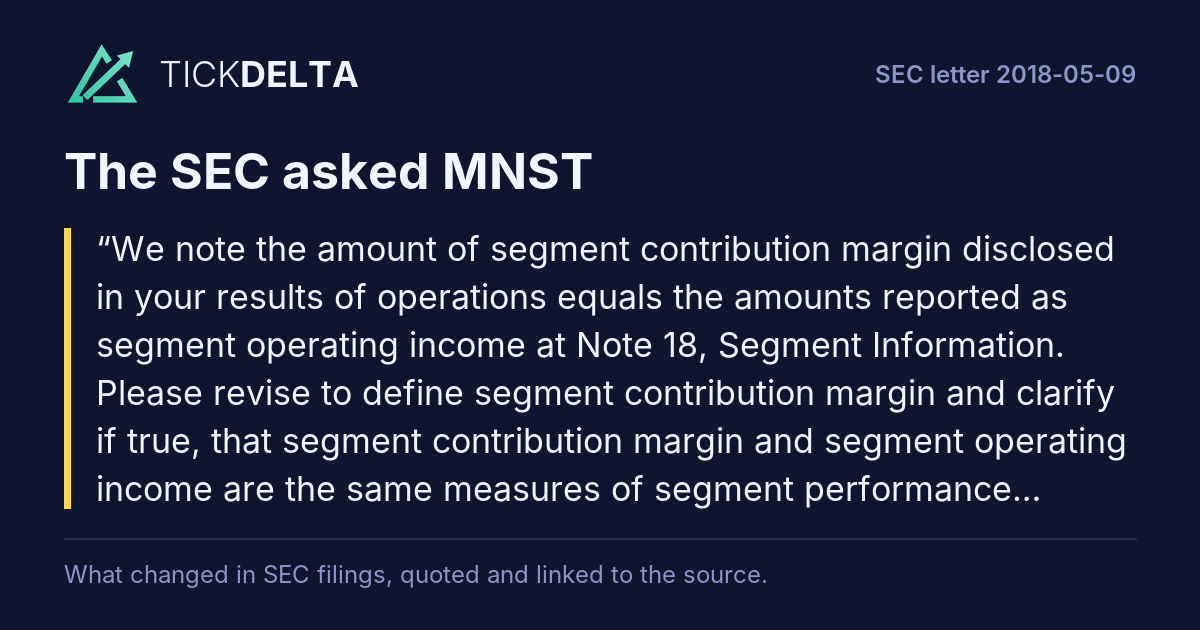
SEC asked (1)
We note the amount of segment contribution margin disclosed in your results of operations equals the amounts reported as segment operating income at Note 18, Segment Information. Please revise to define segment contribution margin and clarify if true, that segment contribution margin and segment operating income are the same measures of segment performance.
Rest of the question

Alternatively, revise your disclosure in MD&A to discuss the segment performance measures disclosed in Note 18. Notes to Consolidated Financial Statements 1. Organization and Summary of Significant Accounting Policies

MNST answered
In response to the Staff’s comment, the Company advises the Staff that segment contribution margin and segment operating income are the same measures of segment performance. In the Company’s most recent Quarterly Report on Form 10-Q for the quarter ended March 31, 2018, filed with the Commission on May 10, 2018 (“Form 10-Q”), operating income was consistently used as a measure of segment performance in both the footnotes to the condensed consolidated financial statements as well as in MD&A.
Rest of the answer

In future filings, where applicable, the Company will consistently refer to segment operating income as a measure of segment performance.

Notes to Consolidated Financial Statements

1. Organization and Summary of Significant Accounting Policies

Read in the reply ↗
In its next report

First report after the company's reply of 2018-05-18: 10-Q filed 2018-08-09 ↗, against the 10-Q filed 2017-11-09 ↗.

Tickdelta does not hold the text of both reports, so they are not compared here.
Cost of Sales, page 84
SEC asked (2)
Please disclose whether you allocate a portion of your payroll costs and depreciation and amortization to cost of sales. Refer to ASC 330-10-30-1 through 30-8. In this regard, please refer to your letter dated April 13, 2017 in response to comment 1 of our letter dated March 31, 2017.
MNST answered
In response to the Staff’s comment, the Company advises the Staff that a portion of its payroll costs, depreciation and amortization related to the direct manufacture of certain flavors by American Fruits & Flavors LLC, a subsidiary of the Company, is allocated to cost of sales.

The Company advises the Staff that the Company inadvertently did not update its Form 10-K as indicated in the Company’s letter dated April 13, 2017 (response to comment 1).
Rest of the answer

In future filings, where applicable, the Company will revise the disclosure of significant accounting policies set forth in the notes to the Company’s financial statements. Below is an example of our proposed revised disclosure:

Cost of Sales — Cost of sales consists of the costs of concentrates and/or beverage bases, the costs of raw materials utilized in the manufacture of products, co-packing fees, repacking fees, in-bound freight charges, as well as certain internal transfer costs, warehouse expenses incurred prior to the manufacture of the Company’s finished products and certain quality control costs. In addition, the Company includes certain costs such as depreciation, amortization and payroll costs that relate to the direct manufacture by the Company of certain flavors. Raw materials account for the largest portion of the cost of sales. Raw materials include cans, bottles, other containers, flavors, ingredients and packaging materials.

Read in the reply ↗
In its next report

First report after the company's reply of 2018-05-18: 10-Q filed 2018-08-09 ↗, against the 10-Q filed 2017-11-09 ↗.

Tickdelta does not hold the text of both reports, so they are not compared here.

Form 8-K Filed February 28, 2018 · Exhibit 99.1
SEC asked (3)
We note you present gross sales as a non-GAAP measure for the fourth quarter and year ended December 31, 2017. Please provide the quantitative reconciliations of your non- GAAP measures to the most directly comparable GAAP measures as required by Item 10(e)(i) of Regulation S-K or tell us why this guidance does not apply to you. Please revise or advise.
MNST answered
In response to the Staff’s comment, the Company advises the Staff that both its Form 10-K and Form 10-Q included a quantitative reconciliation of gross sales (a non-GAAP measure) to net sales (the most directly comparable GAAP measure) under the heading “Non-GAAP Financial Measures.”

The Company acknowledges the Staff’s comment with respect to press releases and will include quantitative reconciliations in future press releases which contain non GAAP financial measures.

As requested by the Staff, the following table reconciles the non-GAAP financial measure of gross sales with the most
Rest of the answer

directly comparable GAAP financial measure of net sales for the threeand twelve-months ended:

Three-Months Ended

December 31,

Read in the reply ↗
In its next report

First report after the company's reply of 2018-05-18: 10-Q filed 2018-08-09 ↗, against the 10-Q filed 2017-11-09 ↗.

Tickdelta does not hold the text of both reports, so they are not compared here.

Also in this review: closing letter, 2018-05-21
Form 10-K for the Year Ended December 31, 2013

2014-07-09 to 2014-08-21 · 5 questions · 1 letter from the SEC, 1 from the company
Review closed 2014-08-21
SegmentsResults discussion (MD&A)Liquidity and cashIncome taxesExecutive pay
Management’s Discussion and Analysis of Financial Condition and Results of Operations, page · Liquidity and Capital Resources, page 49
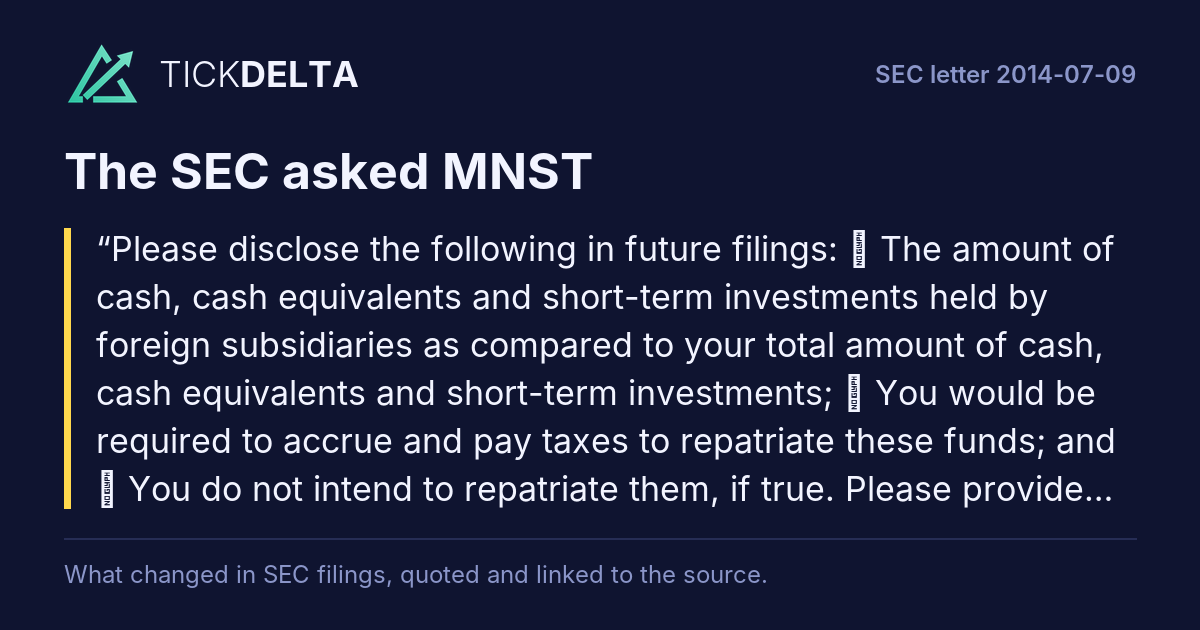
SEC asked (1)
Please disclose the following in future filings:  The amount of cash, cash equivalents and short-term investments held by foreign subsidiaries as compared to your total amount of cash, cash equivalents and short-term investments;  You would be required to accrue and pay taxes to repatriate these funds; and  You do not intend to repatriate them, if true. Please provide us with your proposed disclosure.
MNST answered
In response to the Staff’s comment, the Company advises the Staff that in future filings, if applicable, it will disclose (i) the amount of cash, cash equivalents and short-term investments held by its foreign subsidiaries as compared to its total amounts of cash, cash equivalents and short-term investments, (ii) that the Company would be required to accrue and pay taxes to repatriate such funds, and (iii) that the Company does not intend to repatriate such funds, if true, in each case, consistent with the following disclosure:

Of our $211.3 million of cash and cash equivalents held at
Rest of the answer

December 31, 2013, $69.8 million was held by our foreign subsidiaries. No short-term or long-term investments were held by our foreign subsidiaries at December 31, 2013. We do not intend, nor do we foresee a need, to repatriate undistributed earnings of our foreign subsidiaries other than to repay certain intercompany debt owed to our U.S. operations. Under current tax laws, if funds in excess of intercompany amounts owed were repatriated to our U.S. operations, we would be required to accrue and pay additional income taxes on such excess funds at the tax rates then in effect.

Read in the reply ↗
In its next report

First report after the company's reply of 2014-08-01: 10-Q filed 2014-08-08 ↗, against the 10-Q filed 2014-05-12 ↗.

Tickdelta does not hold the text of both reports, so they are not compared here.

Notes to the Consolidated Financial Statements, page 76 · Note 13. Income Taxes, page 99
SEC asked (2)
In future filings, please disclose the domestic and foreign components of income (loss) before income taxes. Refer to Rule 4-08(h)(1)(i) of Regulation S-X. Please provide us your proposed disclosure.
MNST answered
In response to the Staff’s comment, the Company advises the Staff that in future filings, if applicable, it will disclose the domestic and foreign components of income (loss) before income taxes, consistent with the following disclosure:

The domestic and foreign components of the Company’s income (loss) before provision for income taxes are as follows:

Years Ended December 31,

2013

2012

2011

Domestic*

$ 596,899

$ 568,225

$ 468,370

Foreign*

(33,005

)

(19,071

(11,100

Income before provision for income taxes

$ 563,894

$ 549,154

$ 457,270

*After intercompany royalties,
Rest of the answer

management fees and interest charges from the Company’s domestic to foreign entities of $25.9 million, $22.9 million and $20.0 million for the years ended December 31, 2013, 2012 and 2011, respectively.

Read in the reply ↗
In its next report

First report after the company's reply of 2014-08-01: 10-Q filed 2014-08-08 ↗, against the 10-Q filed 2014-05-12 ↗.

Tickdelta does not hold the text of both reports, so they are not compared here.

Note 16. Segment Information, page 102
SEC asked (3)
In future filings, please disclose whether your operating segments have been aggregated in arriving at your reportable segments as required by FASB ASC 280-10-50-21. Please provide us your proposed disclosure.
MNST answered
In response to the Staff’s comment, the Company advises the Staff that in future filings, if applicable, it will disclose whether its operating segments have been aggregated in arriving at the Company’s reportable segments, consistent with the following disclosure:

The Company has two operating and reportable segments, namely Direct Store Delivery (“DSD”), whose principal products comprise energy drinks, and Warehouse (“Warehouse”), whose principal products comprise juice-based and soda beverages.
Rest of the answer

The DSD segment develops, markets and sells products primarily through an exclusive distributor network, whereas the Warehouse segment develops, markets and sells products primarily direct to retailers. Corporate and unallocated amounts that do not relate to DSD or Warehouse segments specifically have been allocated to “Corporate & Unallocated.” No asset information has been provided for the Company’s reportable segments as management does not measure or allocate assets on a segment basis.

Read in the reply ↗
In its next report

First report after the company's reply of 2014-08-01: 10-Q filed 2014-08-08 ↗, against the 10-Q filed 2014-05-12 ↗.

Tickdelta does not hold the text of both reports, so they are not compared here.

Note 16. Segment Information, page 102
SEC asked (4)
In future filings, please define contribution margin and disclose how it is meaningful in evaluating your segment performance. Please provide us your proposed disclosure.
MNST answered
In response to the Staff’s comment, the Company advises the Staff that in future filings, if applicable, it will define contribution margin and disclose how meaningful it is in evaluating the Company’s segment performance, consistent with the following disclosure:

*Contribution margin is defined as gross profit less certain operating expenses deemed by management to be directly attributable to the respective reportable segment. Contribution margin is used by management as a key indicator of reportable segment profitability. Read in the reply ↗
In its next report

First report after the company's reply of 2014-08-01: 10-Q filed 2014-08-08 ↗, against the 10-Q filed 2014-05-12 ↗.

Tickdelta does not hold the text of both reports, so they are not compared here.

Definitive Proxy Statement on Schedule 14A filed April 21, 2014 · Long-Term Incentive Program, page 21
SEC asked (5)
We note that total compensation for your named executive officers increased significantly for 2013 primarily as a result of option awards that were provided to each NEO. We also note your disclosure on page 21 that such awards were designed to reward for and align with the company’s continued strong performance…particularly in terms of global growth and financial performance.
Rest of the question

Please confirm that in future filings you will revise your compensation discussion and analysis to address how you determined to award each executive officer the amount of compensation that he or she actually received. For example, if the company used any specific performance target in awarding compensation, you should disclose the target, and describe whether the target was met and how your compensation committee considered this in determining the amount of compensation to award your NEOs. Your disclosure should provide this information for the Long-Term Incentive Program compensation that was awarded based on performance, and it should provide investors with enough information to understand the material period-on-period changes in your compensation reflected in your Summary Compensation Table. See Items 402(b)(2)(v), (vii) and (ix) of Regulation S-K. Please provide draft disclosure in your response.

MNST answered
In response to the Staff’s comment, the Company respectfully notes that, as disclosed in the Company’s proxy statement, the Company consulted with an independent firm of compensation consultants, Exequity, LLP (“Exequity”), to provide competitive market pay data and make recommendations with respect to compensation provided to its named executive officers.
Rest of the answer

The Company does not use specific performance targets in awarding compensation to the named executive officers.

The Company advises the Staff that in future filings, if and to the extent the Company sets specific performance goals (including numerical targets), the Company will revise its compensation discussion and analysis to address (i) the specific items of corporate performance taken into account in setting such compensation policies and making such compensation decisions, (ii) the structure and implementation of specific forms of compensation reflecting each named executive officer’s individual performance and/or contribution to specific items of the Company’s performance and (iii) the factors considered in decisions to increase or decrease compensation materially, as required by Regulation S-K Items 402(b)(2)(v), (vii) and (ix), respectively.

In addition, in future filings, the Company intends to expand its current disclosure to include additional information consistent with the following:

Decisions regarding the 2013 named executive officers’ compensation were based, in part, on Exequity’s competitive market analysis relative to a comparative group of similarly sized, similarly high performing companies in the consumer products and services industry, as identified in the Proxy Statement.

Based on the competitive market pay data and in alignment with the Company’s strong operational and financial performance, the Company’s competitive pay positioning for Mr. Sacks and Mr. Schlosberg, in the aggregate, was in the low end of the top quartile; with salary and annual bonus in the bottom quartile and long-term incentive opportunities in the top quartile. The competitive pay positioning was consistent with the Company’s philosophy to provide a highly leveraged pay opportunity aligned with the Company’s generally top quartile performance relative to the market analysis.

With respect to the material period-on-period changes in compensation for Mr. Sacks and Mr. Schlosberg from 2012 to 2013, the Company historically has not automatically granted equity awards annually, but instead has provided equity awards periodically to align compensation with performance on a discretionary basis. No equity awards were granted to Mr. Sacks or Mr. Schlosberg in 2012. Equity awards were granted to Mr. Sacks and Mr. Schlosberg in 2013 to reward for and align with the Company’s continued strong performance in 2011 and 2012. In advance of approving the 2013 stock option awards to Mr. Sacks and Mr. Schlosberg, the Compensation Committee reviewed Exequity’s competitive compensation benchmarking study and targeted the stock option awards in the top quartile of market practice to provide alignment with the Company’s generally top quartile performance. Recent equity awards granted to Mr. Sacks and Mr. Schlosberg typically vest over a three-year period.

Compensation decisions for Mr. Kelly and Mr. Hall were discretionary and not based on specific performance targets. However, the Company considered Exequity’s competitive market analysis for guidance in determining the total compensation for Mr. Kelly and Mr. Hall.

***

The Company acknowledges that (i) it is responsible for the adequacy and accuracy of the disclosure in the filing; (ii) Staff comments or changes to disclosure in response to Staff comments do not foreclose the Commission from taking any action with respect to the filing; and (iii) the Company may not assert Staff comments as a defense in any proceedings initiated by the Commission or any person under the federal securities laws of the United States.

We hope that the foregoing has been responsive to the Staff’s comments. If you have any further questions or need any additional information, please feel free to contact the undersigned at (951) 739-6200 at your convenience.

Read in the reply ↗
In its next report

First report after the company's reply of 2014-08-01: 10-Q filed 2014-08-08 ↗, against the 10-Q filed 2014-05-12 ↗.

Tickdelta does not hold the text of both reports, so they are not compared here.

Also in this review: closing letter, 2014-08-21

From the SEC's correspondence on EDGAR: staff letters (form UPLOAD) and company letters (form CORRESP), 30 letters filed since 2014-07-09. Questions and answers are matched by their numbers; topics come from words in each question. The reports are compared word for word (same form, before the first SEC letter against the first report after the company's reply). No AI.

Work on MNST in a spreadsheet: Excel workbook (a sheet per section, ten years by column, charts, links to the filings) · CSV. For a Google Sheet that stays up to date, paste =IMPORTDATA("https://tickdelta.com/company/MNST/export.csv") into a cell.