Screener / SEC EDGAR /CIK 0000067347 /10-K filed May 27, 2026, compared with May 21, 2025 /Numbers from the XBRL of the 10-Ks
NYSE Consumer discretionary · Auto Parts

Modine Manufacturing Co MOD

Compare with peers Embed
SEC comment letters, last 20 years

2 reviews of MOD's filings by SEC staff

UPLOAD and CORRESP
Reviews 2 latest letter Jan 22, 2025
Questions asked 5 each answered in the company's own letter
No closing letter 0 reviews without a letter saying the staff completed it

When the SEC's staff reviews a filing, it writes to the company with numbered questions, and the company answers each one in a letter. SEC publishes the exchange once the review is over, at least 20 business days later. A question is not an accusation; most reviews end with the company adding detail to its next filing.

How the reviews went

Every review on EDGAR, from the first staff letter to the letter that closes it

  1. 1. Staff letters 2 UPLOAD
  2. 2. Questions in them 5 numbered comments
  3. 3. Company replies 2 CORRESP
  4. 4. Reviews closed 2 of 2 closing letter

Half the closed reviews took 27 days or less from the first letter to the closing letter.

Form 10-K for the Fiscal Year Ended March 31, 2024

2025-01-22 to 2025-02-10 · 1 question · 1 letter from the SEC, 1 from the company
Review closed 2025-02-10
Non-GAAP measures
After reviewing your response to this letter, we may have additional comments. Exhibit 99.1, page 1
SEC asked
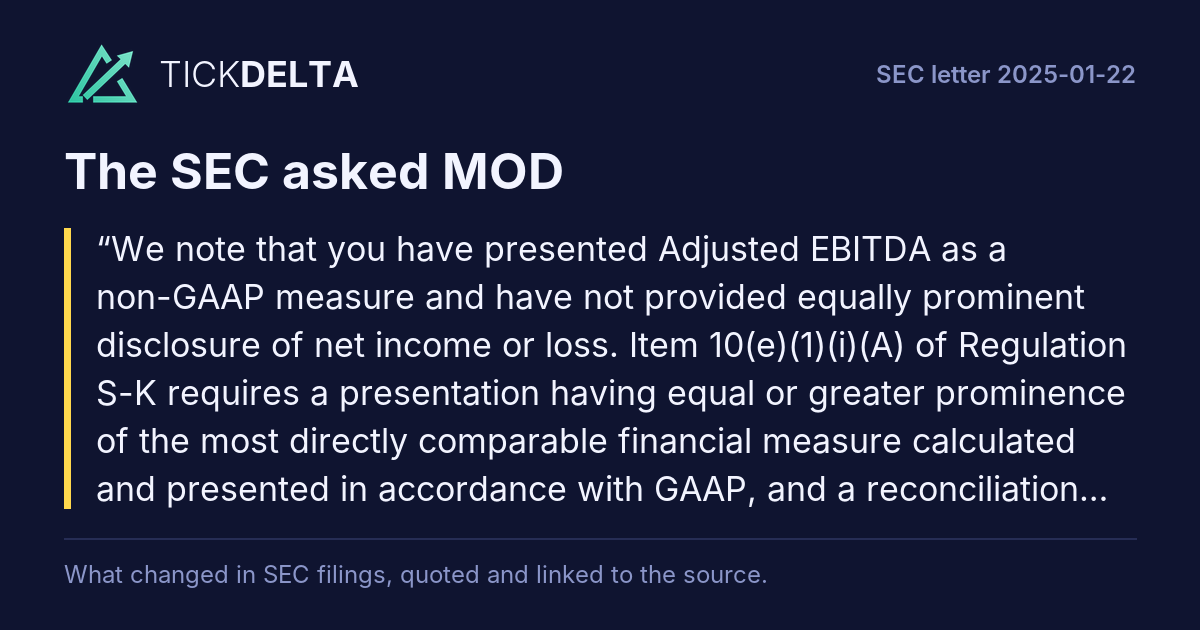
We note that you have presented Adjusted EBITDA as a non-GAAP measure and have not provided equally prominent disclosure of net income or loss. Item 10(e)(1)(i)(A) of Regulation S-K requires a presentation having equal or greater prominence of the most directly comparable financial measure calculated and presented in accordance with GAAP, and a reconciliation between this measure and your non-GAAP measure.
Rest of the question

Refer to C&DI 102.10 and revise your Adjusted EBITDA presentation accordingly.

MOD answered
The Company acknowledges the Staff’s comment and has reviewed the guidance contained in Item 10(e)(1)(i)(A) of Regulation S-K and C&DI 102.10. The Company recognizes that net earnings is the most directly comparable U.S. GAAP financial measure for Adjusted EBITDA. The Company confirms, that in future earnings press releases furnished on Form 8-K, it will present net earnings directly above Adjusted EBITDA or in a similar manner that will ensure equal or greater prominence is given to the U.S. GAAP financial measure.
Rest of the answer

The Company plans to furnish its upcoming third quarter earnings press release, with net earnings appropriately presented, on February 4, 2025. The Company has included an example of its proposed modified disclosure below, with the additions shown in bold blue font:

“Second Quarter Highlights:

· Net sales of $658.0 million increased 6 percent from the prior year

· Operating income of $75.3 million increased 15 percent from the prior year

· Net earnings of $46.4 million decreased $0.5 million, or 1 percent, from the prior year

· Adjusted EBITDA of $99.8 million increased $18.6 million, or 23 percent, from the prior year

· Earnings per share of $0.86 decreased $0.01 from the prior year

· Adjusted earnings per share of $0.97 increased $0.08, or 9 percent, from the prior year

Second Quarter Financial Results

Net sales increased 6 percent to $658.0 million, compared with $620.5 million in the prior year. Organic sales increased 1 percent compared with the prior year.

Gross profit increased 23 percent to $165.6 million and gross margin improved by 340 basis points to 25.2 percent, which was primarily driven by favorable sales mix, including sales from the recently-acquired Scott Springfield Manufacturing business and organic data center sales growth, and higher average selling prices.

Selling, general and administrative (“SG&A”) expenses increased $16.9 million to $85.8 million. The increase was primarily due to higher compensation-related expenses, including increased incentive compensation resulting from improved financial results, and SG&A expenses of the acquired Scott Springfield business, including

$4.7 million of incremental amortization expense for acquired intangible assets.

Operating income was $75.3 million, compared to $65.7 million in the prior year, an increase of 15 percent. The increase was driven by higher gross profit as compared to the prior year, partially offset by higher SG&A and restructuring expenses. The Company recorded $4.5 million of restructuring expenses during the second quarter of fiscal 2025, primarily for severance-related expenses in Europe within the Performance Technologies segment and product line transfer costs. Net earnings of $46.4 million decreased $0.5 million, or 1 percent, compared with $46.9 million in the prior year. Adjusted EBITDA, which excludes restructuring expenses, certain other charges, and depreciation and amortization expense, was $99.8 million, an increase of $18.6 million, or 23 percent, compared with $81.2 million in the prior year.”

Read in the reply
In its next report

First report after the company's reply of Jan 24, 2025: 10-Q filed Feb 5, 2025 ↗, against the 10-Q filed Oct 30, 2024 ↗.

Tickdelta does not hold the text of both reports, so they are not compared here.

Also in this review: closing letter, 2025-02-10
Form 10-K for the Year Ended March 31, 2019

2019-09-05 to 2019-10-02 · 4 questions · 1 letter from the SEC, 1 from the company
Review closed 2019-10-02
SegmentsResults discussion (MD&A)RevenueLiquidity and cashLegal and contingencies
Consolidated Results of Operations and · Segment Results of Operations, page 27
SEC asked (1)
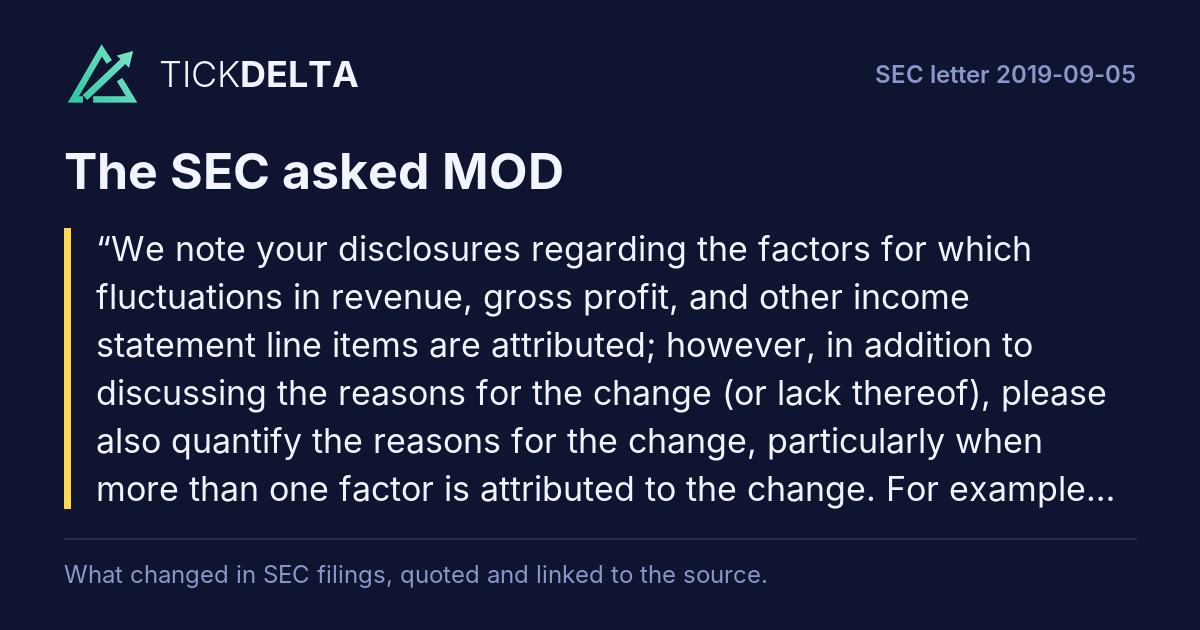
We note your disclosures regarding the factors for which fluctuations in revenue, gross profit, and other income statement line items are attributed; however, in addition to discussing the reasons for the change (or lack thereof), please also quantify the reasons for the change, particularly when more than one factor is attributed to the change.
Rest of the question

For example, you state that certain increases were “primarily” attributed to one factor, and “partially offset” by another factor, or, you indicate, that “additionally”, an increase was attributed to more than one factor without quantifying each. For a company with the size and breadth of operations as yours, these disclosures should be presented in a manner so as to allow investors to discern the relative contribution of each of the multiple components cited to the total change. Beginning with the next Form 10-Q, please revise to separately quantify each significant factor contributing to the change for each of the line items discussed within the results of operations section. As part of your response, please provide us with an example of the disclosure to be included in future filings.

MOD answered
The Company acknowledges the Staff’s comment and confirms that, in future filings, it will modify the disclosures to separately quantify the significant factors contributing to the fluctuations of each of the line items discussed within the results of operations to the extent practicable. When each individual factor is individually immaterial, the Company will describe the components in order of magnitude in order to provide the reader a sense of the relative contribution of each to the total change, as is the Company’s current practice.
Rest of the answer

The Company has included an example of a modified disclosure within its response to comment #2 below.

Read in the reply
In its next report

First report after the company's reply of Sep 30, 2019: 10-Q filed Nov 8, 2019 ↗, against the 10-Q filed Aug 1, 2019 ↗.

Tickdelta does not hold the text of both reports, so they are not compared here.

Consolidated Results of Operations and · Segment Results of Operations, page 27
SEC asked (2)
We note a discussion of gross profit and no discussion of cost of revenues . Given the significance of such costs to your results of operations for each period presented as well as the size of your operations, please revise and expand your MD&A in future filings to separately quantify and discuss factors responsible for changes in the levels of the Company’s cost of sales , at both the consolidated and the segment
Rest of the question

level during all periods presented in the Company’s financial statements as required by Item 303 of Regulation S- K. As part of your revised disclosure, please revise to quantify and discuss the impact of each significant component of costs comprising cost of sales that caused cost of revenues to materially vary (or not vary when expected to). In this regard we believe materiality should be assessed in relation to operating profit. This disclosure should be presented in a manner so as to allow investors to discern the relative contribution of each of multiple components cited to the total change in cost of revenues and resultant operating profit. Please note that even when total amounts of costs of revenues do not materially vary from period to period, the impacts of material variances in components of cost of revenues that offset each other should be separately disclosed, quantified, and discussed (not netted).

MOD answered
The Company acknowledges the Staff’s comment and confirms that, in future filings, it will modify the disclosures to include a discussion of cost of sales, both at the consolidated and segment level. In addition, the Company will modify its future disclosures to quantify and discuss the impact of each significant component that caused cost of sales to materially vary (or not vary when expected to), as well as the impacts of material variances in components of cost of sales even when total cost of sales may not vary materially from period to period, to the extent practicable.
Rest of the answer

The Company has included an example of its modified Form 10-K disclosure below, which also incorporates modifications made in response to comment #1 above, for certain components of its consolidated results and for one of its segments.

Consolidated Results of Operations

Fiscal 2019 net sales increased $110 million, or 5 percent, from the prior year, primarily due to higher sales in each of our operating segments, partially offset by a $28 million unfavorable impact of foreign currency exchange rate changes. Sales in our VTS, CIS, and BHVAC segments increased $56 million, $32 million and $21 million, respectively.

Fiscal 2019 cost of sales increased $100 million, or 6 percent, from the prior year, primarily due to increased sales volume, partially offset by a $24 million favorable impact of foreign currency exchange rate changes. As a percentage of sales, cost of sales increased 50 basis points to 83.5 percent and was negatively impacted by 120 basis points due to unfavorable material costs, including the impacts of tariffs, and, to a lesser extent, temporary operating inefficiencies largely resulting from increased volumes and new program launches at certain VTS segment facilities. These unfavorable factors were partially offset by improved fixed-cost absorption on the higher sales volume.

As a result of the increased sales and cost of sales, as described above, gross profit increased $9 million from the prior year and gross margin declined 50 basis points to 16.5 percent.

Fiscal 2019 SG&A expenses of $244 million decreased $2 million, or 70 basis points as a percentage of sales, from the prior year. The decrease in SG&A expenses was primarily due to integration costs associated with our November 2016 acquisition of the Luvata HTS business, which were $4 million lower than the prior year, and a $3 million favorable impact of foreign currency exchange rate changes, partially offset by third-party strategic advisory costs recorded at Corporate and environmental charges within our VTS segment, which increased $3 million and $2 million, respectively, compared with the prior year. During fiscal 2019, we recorded $7 million of costs, primarily consisting of third-party consulting fees, related to our evaluation of strategic alternatives for our VTS segment’s automotive business.

Operating income of $110 million in fiscal 2019 increased $18 million compared with the prior year, primarily due to higher earnings in the

CIS and BHVAC segments, which increased $24 million and $7 million, respectively, partially offset by lower earnings in the VTS segment, which decreased $19 million.

Segment Results of Operations

VTS net sales increased $56 million, or 4 percent, in fiscal 2019 compared with the prior year, primarily due to higher sales volume. Sales to off-highway customers increased $27 million in Asia and $14 million in North America. Sales to automotive customers increased $20 million in North America and $9 million in Asia. These sales increases were partially offset by lower sales to customers in Europe, which decreased $27 million, and a $21 million unfavorable impact of foreign currency exchange rate changes. VTS cost of sales increased $70 million, or 6 percent, in fiscal 2019 compared with the prior year, primarily due to higher sales volume, partially offset by an $18 million favorable impact of foreign currency exchange rate changes. As a percentage of sales, cost of sales increased 170 basis points to 86.2 percent and was negatively impacted by 150 basis points due to unfavorable material costs, including the impact of tariffs, and, to a lesser extent, temporary operating inefficiencies largely related to increased volumes and new program launches at certain manufacturing facilities. As a result of the increased sales and cost of sales, gross profit decreased $14 million and gross margin declined 170 basis points to 13.8 percent. SG&A expenses increased $3 million compared with the prior year, yet decreased 10 basis points as a percentage of sales. The increase in SG&A expenses primarily resulted from higher environmental charges related to previously-owned manufacturing facilities in the U.S., which increased $2 million, and, to a lesser extent, higher compensation-related expenses. These increases in SG&A were partially offset by a $2 million favorable impact of foreign currency exchange rate changes. Restructuring expenses increased $2 million, primarily due to higher severance expenses. Operating income decreased $19 million to $65 million, primarily due to lower gross profit and higher SG&A and restructuring expenses.

Read in the reply
In its next report

First report after the company's reply of Sep 30, 2019: 10-Q filed Nov 8, 2019 ↗, against the 10-Q filed Aug 1, 2019 ↗.

Tickdelta does not hold the text of both reports, so they are not compared here.

Note 1. Significant Accounting Policies · Assets Held for Sale, page 45
SEC asked (3)
We note your disclosure on page 14 of your Form 10K that you are evaluating strategic alternatives for your automotive business within your VTS segment which includes the potential sale of this business. We also note from your Q4 2019 earnings call held on May 23, 2019 that you indicate you were currently in discussions with potential customers.
Rest of the question

Further, your disclosure on page 22 of your Form 10-Q for the quarter ended June 30, 2019 discloses that you are currently engaged in a formal sales process with potential buyers. Please explain to us why it appears you have not accounted for this business as assets (disposal group) held for sale as of March 31, 2019 or June 30, 2019. Please refer to the accounting guidance in ASC 360-10-45-9 in your response.

MOD answered
While the Company has made significant progress in its review of strategic alternatives for the automotive business and is currently engaged in a formal sale process with potential buyers, the Company did not classify assets related to its automotive business as held for sale at either March 31, 2019 or June 30, 2019 because all of the criteria under ASC 360 were not met to qualify for held for sale classification.
Rest of the answer

Specifically, for the reasons described below, the Company concluded the following criteria were not achieved as of either balance sheet date:

•

ASC 360-10-45-9(a), which states: Management, having the authority to approve the action, commits to a plan to sell the asset (disposal group).

o

While the Company’s Board of Directors (the “Board”) has authorized management to negotiate with potential buyers, any definitive transaction remains subject to Board approval in accordance with the Company’s policies.

ASC 360-10-45-9(b), which states: The asset (disposal group) is available for immediate sale in its present condition subject only to terms that are usual and customary for sales of such assets (disposal groups).

The Company’s automotive business is fully integrated with the Company’s other vehicular businesses. Many of the assets used for the automotive business, including, among others, manufacturing facilities and production equipment, are extensively integrated within the Company’s VTS segment operations and used to support operations for both the Company’s automotive business and other vehicular businesses. Prior to reaching any definitive agreement, extensive negotiation will still be required to define precisely the specific assets to be included in a potential sale.

ASC 360-10-45-9(d), which states: The sale of the asset (disposal group) is probable, and transfer of the asset (disposal group) is expected to qualify for recognition as a completed sale, within one year, except as permitted by paragraph 360-10-45-11.

Although negotiations with multiple potential buyers are ongoing, a definitive agreement has not yet been reached. In addition, the negotiations may not result in a sales price acceptable to management and the Board. If a sales price is not agreed upon, the Company may choose to pursue different strategic alternatives for its automotive business in order to maximize long-term value for its shareholders.

Read in the reply
In its next report

First report after the company's reply of Sep 30, 2019: 10-Q filed Nov 8, 2019 ↗, against the 10-Q filed Aug 1, 2019 ↗.

Tickdelta does not hold the text of both reports, so they are not compared here.

Note 20. Contingencies and Litigation, page 68
SEC asked (4)
We note your disclosure under “Other Litigation” that in the normal course of business, you are named as defendants in various lawsuits and enforcement proceedings by private parties, governmental agencies and/or others in which claims are asserted against Modine.
Rest of the question

You also disclose that in the opinion of management, the liabilities, if any, which may ultimately result from such lawsuits or proceedings are not expected to have a material adverse effect on your financial position. Please note that ASC 450-20-50-3 requires that if there is at least a reasonable possibility that a loss or additional loss may be incurred, and an accrual has not been recorded or the exposure to the loss is in excess of the amount accrued, disclosure of the nature of the contingency should be made in the notes to the financial statements. Please revise, or alternatively, disclose that you do not believe that any additional loss would not be material to your results of operations, statement of financial position and cash flows. Your disclosure in the Form 10-Q should be similarly revised.

MOD answered
The Company acknowledges the Staff’s comment and confirms that in future filings, provided that it remains true, it will modify the disclosure to read as follows:

Other Litigation

In the normal course of business, the Company and its subsidiaries are named as defendants in various lawsuits and enforcement proceedings by private parties, governmental agencies and/or others in which claims are asserted against Modine.
Rest of the answer

The Company believes that any additional loss in excess of amounts already accrued would not have a material effect on the Company’s consolidated balance sheet, results of operations, and cash flows. In addition, management expects that the liabilities which may ultimately result from such lawsuits or proceedings, if any, would not have a material adverse effect on the Company’s financial position.

Read in the reply
In its next report

First report after the company's reply of Sep 30, 2019: 10-Q filed Nov 8, 2019 ↗, against the 10-Q filed Aug 1, 2019 ↗.

Tickdelta does not hold the text of both reports, so they are not compared here.

Also in this review: closing letter, 2019-10-02

Letters without questions

Other letters

UPLOAD and CORRESP
2 other letters: notices that a filing will not be reviewed, requests to declare a registration effective, and the like

From the SEC's correspondence on EDGAR: staff letters (form UPLOAD) and company letters (form CORRESP), 8 letters filed since 2017-06-21. Questions and answers are matched by their numbers; topics come from words in each question. The reports are compared word for word (same form, before the first SEC letter against the first report after the company's reply). No AI.

Sources

The SEC's correspondence on EDGAR: staff letters (form UPLOAD) and company letters (form CORRESP), matched question by question. No AI.

Also

Filings: the letters in the filing list.

Work with it

Excel workbook · CSV. Google Sheet that stays up to date: paste =IMPORTDATA("https://tickdelta.com/company/MOD/export.csv") into a cell.

Next in Owners and insiders:Insider trades
Esc

Type a ticker such as AAPL, a name, an investor such as Buffett, or a topic such as tariffs. ↑ ↓ to move, Enter to open.