Paragraph 19 · 49% changed
Every version of it
Screener
/
SEC EDGAR
/CIK 0001179929
/10-K filed Feb 10, 2026, compared with Feb 11, 2025
/Numbers from the XBRL of the 10-Ks
NYSE
Financials · Health Insurance
Molina Healthcare, Inc. MOH
The 10-K against last year's
172 changes: 29 added, 22 removed, 118 reworded, 3 quiet changes
10-K Feb 10, 2026 vs Feb 11, 2025
Risk Factors
19.3%
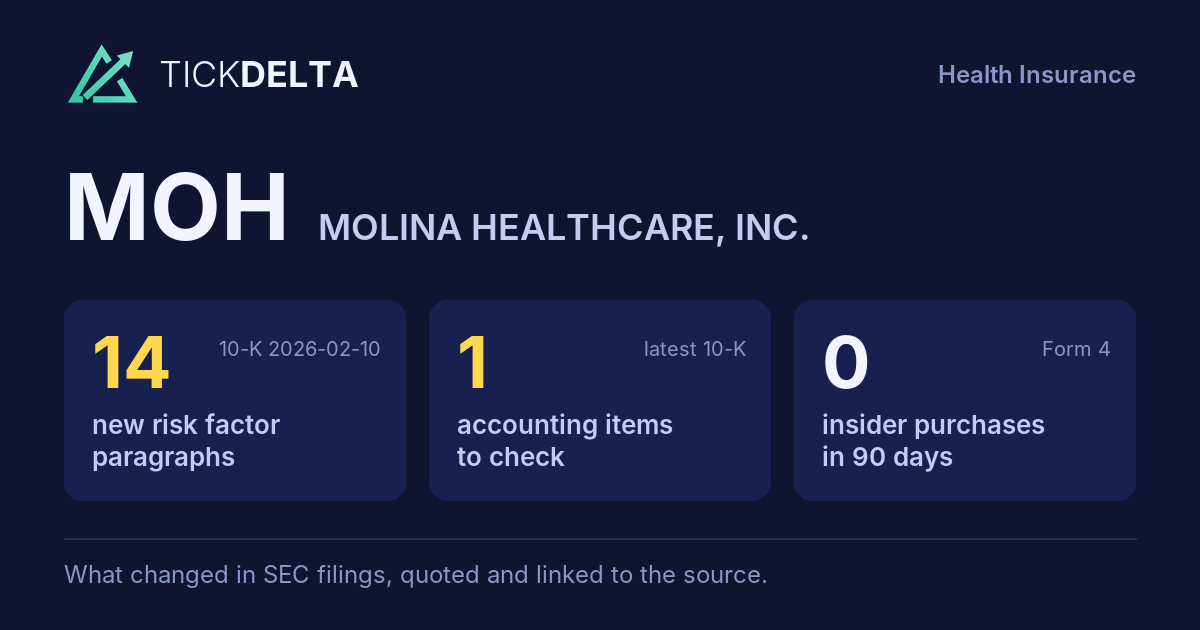
of the text changed · 13,562 words now · 14 new paragraphs, 6 gone
MD&A
27.2%
of the text changed · 6,975 words now · 15 new paragraphs, 16 gone
Legal Proceedings
42.2%
of the text changed · 913 words now
Accounting Policies
15.5%
of the text changed · 4,710 words now
10-K 0001179929-26-000005 (Feb 10, 2026) vs 10-K 0001179929-25-000023 (Feb 11, 2025)
Every paragraph, and how much of it changed
One bar per paragraph, in the order of the 10-K. Height and colour show the share of its words not in the closest paragraph a year earlier; the tallest bars are new paragraphs.
Risk Factors
141 paragraphs · 14 new · 59 reworded · 6 gone · 10-K Feb 10, 2026 against Feb 11, 2025
New paragraph
Reworded (5% of its words or more)
Same or nearly
Paragraph 105 · 48% changed
Every version of it
Paragraph 133 · 48% changed
Every version of it
Paragraph 35 · 47% changed
Every version of it
•Unforeseen expenses or delays associated with the acquisition and/or integration; integration, including the unexpected emergence of liabilities of the acquired entity that had not previously been disclosed or foreseen;
Paragraph 95 · 47% changed
Every version of it
Paragraph 24 · 38% changed
Every version of it
Paragraph 26 · 36% changed
Every version of it
Paragraph 25 · 33% changed
Every version of it
As part of our normal operations, we and certain of our third-party service providers routinely collect, process, store (both onsite and in the cloud), and transmit large amounts of data, including sensitive personal information Personal Information as well as proprietary or confidential information relating to our business members, employees, business, or other third parties. Our information technology systems and safety control systems that parties (collectively, “Confidential Information”). Additionally, we rely upon on computer systems, hardware, software, technology infrastructure and online sites and networks for both internal and external operations that are subject critical to our business (collectively, “IT Systems”). We own and manage some of these IT Systems but also rely on third parties for a growing number range of threats, IT Systems and related products and services, including but not limited to cloud computing services. We and our third-party suppliers and service providers face numerous and evolving cybersecurity risks that threaten the confidentiality, integrity and availability of IT Systems and Confidential Information, including from diverse threat actors, such as state-sponsored organizations, opportunistic hackers and hacktivists, as well as through diverse attack vectors, such as social engineering/phishing, malware (including ransomware), malfeasance by insiders, human or technological error, and as a result of malicious code embedded in open-source software, or misconfigurations, bugs or other vulnerabilities in commercial software that is integrated into our (or our suppliers’ or service providers’) IT systems, Systems, products or services. Such threats may result in the penetration of our network or that of our vendors or suppliers, and the misappropriation of our confidential information, Confidential Information, system disruptions, damage to our information systems, or shutdowns of our information technology environment. They also may be able to develop and deploy viruses, worms, and other malicious software programs that attack our systems or otherwise exploit security vulnerabilities. We may also face increased cybersecurity risks due to our reliance on internet technology and our remote working environment, which may create additional opportunities for cybercriminals to exploit vulnerabilities. These same risks are also faced by our significant vendors who are also in possession of sensitive confidential information. Because the techniques used to circumvent, gain access to, or sabotage security systems can be highly sophisticated, may use advanced technologies (such as artificial intelligence) and change frequently, they often are not recognized until launched against a target, and may originate from less regulated and remote areas around the world. We may be unable to anticipate these techniques or implement adequate preventive measures, resulting in potential inappropriate access, breach, or data loss and damage to our systems. Our systems are also subject to compromise from internal threats such as improper action by employees, including malicious insiders, or by vendors, counterparties, and other third parties with otherwise legitimate access to our systems. Our policies, employee training (including phishing prevention training),
Paragraph 19 · 49% changed
Every version of it
10-K Feb 11, 2025We currently derive our premium revenues from health plans that operate in 21 states. Our Medicaid premium revenue constituted 79% of our consolidated premium revenue in the year ended December 31, 2024. Measured by Medicaid premium revenue by health plan, our top four health plans were in California, New York, Texas, and Washington, with aggregate Medicaid premium revenue of $15.6 billion, or approximately 51% of total Medicaid premium revenue, in the year ended December 31, 2024. If we are unable to continue to operate in any of our existing jurisdictions, or if our current operations in those jurisdictions or any portions of those jurisdictions are significantly curtailed or terminated entirely, our revenues could decrease materially.
10-K Feb 10, 2026
existing jurisdictions, or if our current operations in those jurisdictions or any portions of those jurisdictions are significantly curtailed or terminated entirely, our revenues could decrease materially.
Paragraph 105 · 48% changed
Every version of it
10-K Feb 11, 2025dissemination, use, privacy, confidentiality, security, availability, and integrity of personally identifiable information (“PII”), including protected health information (“PHI”). HIPAA establishes basic privacy and security standards for protection of PHI by covered entities and business associates, including health plans such as ours. HIPAA requires covered entities like us to develop and maintain policies and procedures regarding PHI, and to adopt administrative, physical, and technical safeguards to protect PHI.
10-K Feb 10, 2026
Furthermore, depending on the circumstance, we may act as either a covered entity and/or a business associate under HIPAA. HIPAA establishes breach notification obligations and basic privacy and security standards for protection of PHI by certain healthcare providers, health plans, and healthcare clearinghouses, known as covered entities, as well as their business associates that perform certain services that involve creating, receiving, maintaining or transmitting PHI for or on behalf of such covered entities, and their covered subcontractors. HIPAA requires covered entities and business associates to develop and maintain policies and procedures regarding PHI, and to adopt administrative, physical and technical safeguards to protect PHI.
Paragraph 133 · 48% changed
Every version of it
10-K Feb 11, 2025We are dependent on the leadership of our chief executive officer and other executive officers and key employees.
10-K Feb 10, 2026
The success of our business and the ability to execute our strategy are highly dependent on the leadership of Mr. Zubretsky, our chief executive officer, and that of our other key executive officers and employees. The loss of their leadership, expertise, and experience could negatively impact our operations. In addition, recently the threat
Paragraph 35 · 47% changed
Every version of it
10-K Feb 11, 2025
•Unforeseen expenses or delays associated with the acquisition and/or integration;
10-K Feb 10, 2026
•Unforeseen expenses or delays associated with the acquisition and/or integration, including the unexpected emergence of liabilities of the acquired entity that had not previously been disclosed or foreseen;
Paragraph 95 · 47% changed
Every version of it
10-K Feb 11, 2025We are periodically subject to government audits, including CMS RADV audits of our Medicare D-SNP plans to validate diagnostic data, patient claims, and financial reporting. These audits could result in significant adjustments in payments made to our health plans, particularly if it is an audit which involves extrapolation, which could adversely affect our financial condition and results of operations. If errors are identified during a RADV audit, or it is otherwise determined that we fail to comply with applicable laws and regulations, we could be subject to fines, civil penalties or other sanctions, which could have a material adverse effect on our ability to participate in these programs, and on our financial condition, cash flows and results of operations. In addition, if a D-SNP or MMP plan pays minimum medical loss ratio (“MLR”) rebates for three consecutive years, such plan will become ineligible to enroll new members.
10-K Feb 10, 2026
programs, and on our financial condition, cash flows, or results of operations. In addition, if a D-SNP or MMP plan pays minimum medical loss ratio (“MLR”) rebates for three consecutive years, such plan will become ineligible to enroll new members.
Paragraph 24 · 38% changed
Every version of it
10-K Feb 11, 2025If we or one of our vendors sustain a cyber-attack or suffer a data privacy or security breach, we could suffer operational impact, increased costs, exposure to significant liability, reputational harm, loss of business, and other serious negative consequences.
10-K Feb 10, 2026
We and our third-party service providers are exposed to cybersecurity risks, which may result in operational impact, increased costs, exposure to significant legal liability, reputational harm, loss of business, and other serious negative consequences.
Paragraph 26 · 36% changed
Every version of it
10-K Feb 11, 2025As part of our normal operations, we routinely collect, process, store (both onsite and in the cloud), and transmit large amounts of data, including sensitive personal information as well as proprietary or confidential information relating to our business or third parties. Our information technology systems and safety control systems that we rely upon are subject to a growing number of threats, such as state-sponsored organizations, opportunistic hackers and hacktivists, as well as through diverse attack vectors, such as social engineering/phishing, malware (including ransomware), malfeasance by insiders, human or technological error, and as a result of malicious code embedded in open-source software, or misconfigurations, bugs or other vulnerabilities in commercial software that is integrated into our (or our suppliers’ or service providers’) IT systems, products or services. Such threats may result in the penetration of our network or that of our vendors or suppliers, and the misappropriation of our confidential information, system disruptions, damage to our information systems, or shutdowns of our information technology environment. They also may be able to develop and deploy viruses, worms, and other malicious software programs that attack our systems or otherwise exploit security vulnerabilities. We may also face increased cybersecurity risks due to our reliance on internet technology and our remote working environment, which may create additional opportunities for cybercriminals to exploit vulnerabilities. These same risks are also faced by our significant vendors who are also in possession of sensitive confidential information. Because the techniques used to circumvent, gain access to, or sabotage security systems can be highly sophisticated, may use advanced technologies (such as artificial intelligence) and change frequently, they often are not recognized until launched against a target, and may originate from less regulated and remote areas around the world. We may be unable to anticipate these techniques or implement adequate preventive measures, resulting in potential inappropriate access, breach, or data loss and damage to our systems. Our systems are also subject to compromise from internal threats such as improper action by employees, including malicious insiders, or by vendors, counterparties, and other third parties with otherwise legitimate access to our systems. Our policies, employee training (including phishing prevention training),
10-K Feb 10, 2026
internet technology and our remote working environment, which may create additional opportunities for cybercriminals to exploit vulnerabilities. These same risks are also faced by our significant vendors who are also in possession of sensitive Confidential Information. Because the techniques used to circumvent, gain access to, or sabotage security systems can be highly sophisticated, may use advanced technologies (such as artificial intelligence) and change frequently, they often are not recognized until launched against a target, and may originate from less regulated and remote areas around the world. We may be unable to anticipate these techniques, which can circumvent security controls, evade detection and remove forensic evidence, or implement adequate preventive measures, resulting in potential inappropriate access, breach, or data loss and damage to our IT Systems, Confidential Information, or business. Additionally, any integration of artificial intelligence in our or any service providers’ operations, products or services is expected to pose new or unknown cybersecurity risks and challenges. Our IT Systems are also subject to compromise from internal threats such as improper action by employees, including malicious insiders, or by vendors, counterparties, and other third parties with otherwise legitimate access to our systems. We have acquired and may in the future acquire companies that may contain cybersecurity vulnerabilities and/or unsophisticated security measures, which can expose us to cybersecurity, operational, and financial risks. There can also be no assurance that our cybersecurity risk management program and processes, including our policies, employee training (including phishing prevention training), procedures, and technical safeguards will be fully implemented and complied with or effective in preventing all improper access to our IT Systems or Confidential Information by employees, vendors, counterparties, or other third parties. Our facilities and IT Systems, or those of our service providers, may also be vulnerable to security incidents or security attacks, acts of vandalism or theft, misplaced or lost data, human errors, or other similar events that could negatively affect our systems or our members’ data, or could cause interruptions to our operations.
Paragraph 25 · 33% changed
Every version of it
10-K Feb 11, 2025
As part of our normal operations, we routinely collect, process, store (both onsite and in the cloud), and transmit large amounts of data, including sensitive personal information as well as proprietary or confidential information relating to our business or third parties. Our information technology systems and safety control systems that we rely upon are subject to a growing number of threats, such as state-sponsored organizations, opportunistic hackers and hacktivists, as well as through diverse attack vectors, such as social engineering/phishing, malware (including ransomware), malfeasance by insiders, human or technological error, and as a result of malicious code embedded in open-source software, or misconfigurations, bugs or other vulnerabilities in commercial software that is integrated into our (or our suppliers’ or service providers’) IT systems, products or services. Such threats may result in the penetration of our network or that of our vendors or suppliers, and the misappropriation of our confidential information, system disruptions, damage to our information systems, or shutdowns of our information technology environment. They also may be able to develop and deploy viruses, worms, and other malicious software programs that attack our systems or otherwise exploit security vulnerabilities. We may also face increased cybersecurity risks due to our reliance on internet technology and our remote working environment, which may create additional opportunities for cybercriminals to exploit vulnerabilities. These same risks are also faced by our significant vendors who are also in possession of sensitive confidential information. Because the techniques used to circumvent, gain access to, or sabotage security systems can be highly sophisticated, may use advanced technologies (such as artificial intelligence) and change frequently, they often are not recognized until launched against a target, and may originate from less regulated and remote areas around the world. We may be unable to anticipate these techniques or implement adequate preventive measures, resulting in potential inappropriate access, breach, or data loss and damage to our systems. Our systems are also subject to compromise from internal threats such as improper action by employees, including malicious insiders, or by vendors, counterparties, and other third parties with otherwise legitimate access to our systems. Our policies, employee training (including phishing prevention training),
10-K Feb 10, 2026
As part of our normal operations, we and certain of our third-party service providers routinely collect, process, store (both onsite and in the cloud), and transmit large amounts of data, including sensitive Personal Information as well as proprietary or confidential information relating to our members, employees, business, or other third parties (collectively, “Confidential Information”). Additionally, we rely on computer systems, hardware, software, technology infrastructure and online sites and networks for both internal and external operations that are critical to our business (collectively, “IT Systems”). We own and manage some of these IT Systems but also rely on third parties for a range of IT Systems and related products and services, including but not limited to cloud computing services. We and our third-party suppliers and service providers face numerous and evolving cybersecurity risks that threaten the confidentiality, integrity and availability of IT Systems and Confidential Information, including from diverse threat actors, such as state-sponsored organizations, opportunistic hackers and hacktivists, as well as through diverse attack vectors, such as social engineering/phishing, malware (including ransomware), malfeasance by insiders, human or technological error, and as a result of malicious code embedded in open-source software, or misconfigurations, bugs or other vulnerabilities in commercial software that is integrated into our (or our suppliers’ or service providers’) IT Systems, products or services. Such threats may result in the penetration of our network or that of our vendors or suppliers, and the misappropriation of our Confidential Information, system disruptions, damage to our information systems, or shutdowns of our information technology environment. They also may be able to develop and deploy viruses, worms, and other malicious software programs that attack our systems or otherwise exploit security vulnerabilities. We may also face increased cybersecurity risks due to our reliance on
MD&A
114 paragraphs · 15 new · 64 reworded · 16 gone · 10-K Feb 10, 2026 against Feb 11, 2025
New paragraph
Reworded (5% of its words or more)
Same or nearly
Paragraph 12 · 49% changed
Paragraph 47 · 49% changed
The Medicare MCR decreased increased to 92.4% in 2025, from 89.1% in 2024, or 330 basis points. The increase resulted mainly from 90.7% higher-than-expected utilization among our high-acuity duals populations, particularly for LTSS benefits and high-cost pharmacy drugs, and margin compression in 2023, or 160 basis points, primarily driven our MAPD business. These increases were partially offset by higher risk adjustment premiums that are commensurate with the acuity of our membership, pricing and benefit design changes adjustments implemented for 2025 and the impact of exiting from MAPD in 2024 and operational improvements, partially offset by elevated LTSS and pharmacy costs and higher outpatient utilization within our D-SNP population. thirteen states. The Medicare MCR for the year ended December 31, 2024 2025 is higher than we expected and is above our long-term target range.
Paragraph 85 · 47% changed
Paragraph 21 · 46% changed
The premium tax ratio (premium tax as a percentage of premium revenue plus premium tax revenue) increased to 4.1% in 2025, compared with 3.7% in 2024, compared with 3.2% in 2023, due mainly to the reinstatement of the California MCO tax by the state’s Department of Health Care Services effective April 1, 2023, and state mix changes in business mix. our Medicaid segment.
Paragraph 22 · 46% changed
Investment income increased decreased to $420 million in 2025, compared with $452 million in 2024, compared with $394 million 2024. The decrease was mainly attributable to a decline in 2023. The increase was primarily driven by an increase in invested assets. prevailing interest rates and investment yields.
Paragraph 15 · 46% changed
Paragraph 17 · 46% changed
Paragraph 24 · 45% changed
The G&A ratio was 6.6% in 2025, compared to 6.7% in 2024, compared to 7.2% 2024. The decrease in 2023. The G&A ratio in 2024 reflects operating discipline, including labor cost management and vendor management, and the continued benefit of fixed cost operating leverage as we grow our business, partially offset by new business implementation costs associated with the Nebraska and California Medicaid contracts that started in January 2024 reduced incentive compensation tied to lower actual and the New Mexico Medicaid contract that started on July 1, 2024. expected performance.
Paragraph 12 · 49% changed
10-K Feb 11, 2025Connecticut Acquisition—Marketplace and Medicare. Effective February 1, 2025, we closed on our acquisition of 100% of the issued and outstanding capital stock of ConnectiCare Holding Company, Inc. The purchase price for the transaction was $350 million.
10-K Feb 10, 2026
On February 1, 2025, we closed our acquisition of ConnectiCare Holding Company, Inc. (“ConnectiCare”), and our acquisition pipeline contains a growing number of actionable opportunities.
Paragraph 47 · 49% changed
10-K Feb 11, 2025
The Medicare MCR decreased to 89.1% in 2024, from 90.7% in 2023, or 160 basis points, primarily driven by higher risk adjustment premiums that are commensurate with the acuity of our membership, pricing and benefit design changes implemented in 2024 and operational improvements, partially offset by elevated LTSS and pharmacy costs and higher outpatient utilization within our D-SNP population. The Medicare MCR for the year ended December 31, 2024 is above our long-term target range.
10-K Feb 10, 2026
The Medicare MCR increased to 92.4% in 2025, from 89.1% in 2024, or 330 basis points. The increase resulted mainly from higher-than-expected utilization among our high-acuity duals populations, particularly for LTSS benefits and high-cost pharmacy drugs, and margin compression in our MAPD business. These increases were partially offset by pricing and benefit adjustments implemented for 2025 and the impact of exiting from MAPD in thirteen states. The Medicare MCR for 2025 is higher than we expected and is above our long-term target range.
Paragraph 85 · 47% changed
10-K Feb 11, 2025Dividends from Subsidiaries. When available and as permitted by applicable regulations, cash in excess of the capital needs of our regulated health plans is generally paid in the form of dividends to our unregulated parent company to be used for general corporate purposes. For more information on our regulatory capital requirements and dividend restrictions, refer to Notes to Consolidated Financial Statements, Note 15, “Commitments and Contingencies—Regulatory Capital Requirements and Dividend Restrictions,” and Note 17, “Condensed Financial Information of Registrant—Note C - Dividends and Capital Contributions.”
10-K Feb 10, 2026
to Consolidated Financial Statements, Note 15, “Commitments and Contingencies—Regulatory Capital Requirements and Dividend Restrictions,” and Note 17, “Condensed Financial Information of Registrant—Note C - Dividends and Capital Contributions.”
Paragraph 21 · 46% changed
10-K Feb 11, 2025
The premium tax ratio increased to 3.7% in 2024, compared with 3.2% in 2023, due mainly to the reinstatement of the California MCO tax by the state’s Department of Health Care Services effective April 1, 2023, and changes in business mix.
10-K Feb 10, 2026
The premium tax ratio (premium tax as a percentage of premium revenue plus premium tax revenue) increased to 4.1% in 2025, compared with 3.7% in 2024, due mainly to state mix changes in our Medicaid segment.
Paragraph 22 · 46% changed
10-K Feb 11, 2025
Investment income increased to $452 million in 2024, compared with $394 million in 2023. The increase was primarily driven by an increase in invested assets.
10-K Feb 10, 2026
Investment income decreased to $420 million in 2025, compared with $452 million in 2024. The decrease was mainly attributable to a decline in prevailing interest rates and investment yields.
Paragraph 15 · 46% changed
10-K Feb 11, 2025(2)G&A ratio represents general and administrative expenses as a percentage of total revenue.
10-K Feb 10, 2026
(3)Pre-tax margin represents income before income tax expense as a percentage of total revenue.
Paragraph 17 · 46% changed
10-K Feb 11, 2025Operating income was $1,707 million in 2024, compared with $1,573 million in 2023. The increase in operating income was mainly due to the impact of increased premiums and medical margin stemming from our membership growth, improved G&A expense ratio, and increased investment income, partially offset by an increase in the consolidated MCR. In addition, the 2023 results reflect a $41 million credit loss related to 2022 Marketplace risk adjustment receivables.
10-K Feb 10, 2026
The decline in net income in 2025 reflects a decline in operating income, which totaled $781 million in 2025, compared with $1,707 million in 2024. The decrease in operating income was mainly attributable to an increase in the MCR across all our segments, higher interest expense and lower investment income, partially offset by the benefit of higher premium revenues, and G&A expense efficiencies.
Paragraph 24 · 45% changed
10-K Feb 11, 2025
The G&A ratio was 6.7% in 2024, compared to 7.2% in 2023. The G&A ratio in 2024 reflects operating discipline, including labor cost management and vendor management, and the continued benefit of fixed cost leverage as we grow our business, partially offset by new business implementation costs associated with the Nebraska and California Medicaid contracts that started in January 2024 and the New Mexico Medicaid contract that started on July 1, 2024.
10-K Feb 10, 2026
The G&A ratio was 6.6% in 2025, compared to 6.7% in 2024. The decrease in G&A ratio reflects operating discipline, the continued benefit of operating leverage as we grow our business, and reduced incentive compensation tied to lower actual and expected performance.
A paragraph is matched with the one last year that shares the most of its words; under half in common makes it new. The paragraphs shown are the 8 reworded the most in each section.
The paragraph that changed most in each section
The redline
Marked against last year's 10-K: cut words struck through, new words highlighted.
Risk Factors322 words changed in this paragraph; it is 30% similar to last year's version.
internet technology and our remote working environment, which may create additional opportunities for cybercriminals to exploit vulnerabilities. These same risks are also faced by our significant vendors who are also in possession of sensitive Confidential Information. Because the techniques used to circumvent, gain access to, or sabotage security systems can be highly sophisticated, may use advanced technologies (such as artificial intelligence) and change frequently, they often are not recognized until launched against a target, and may originate from less regulated and remote areas around the world. We may be unable to anticipate these techniques, which can circumvent security controls, evade detection and remove forensic evidence, or implement adequate preventive measures, resulting in potential inappropriate access, breach, or data loss and damage to our IT Systems, Confidential Information, or business. Additionally, any integration of artificial intelligence in our or any service providers’ operations, products or services is expected to pose new or unknown cybersecurity risks and challenges. Our IT Systems are also subject to compromise from internal threats such as improper action by employees, including malicious insiders, or by vendors, counterparties, and other third parties with otherwise legitimate access to our systems. We have acquired and may in the future acquire companies that may contain cybersecurity vulnerabilities and/or unsophisticated security measures, which can expose us to cybersecurity, operational, and financial risks. There can also be no assurance that our cybersecurity risk management program and processes, including our policies, employee training (including phishing prevention training), procedures, and technical safeguards may not prevent will be fully implemented and complied with or effective in preventing all improper access to our network IT Systems or proprietary or confidential information Confidential Information by employees, vendors, counterparties, or other third parties. Our facilities and IT systems, Systems, or those of our service providers, may also be vulnerable to security incidents or security attacks, acts of vandalism or theft, misplaced or lost data, human errors, or other similar events that could negatively affect our systems and our and or our members’ data. For example, in July 2024, a software update by CrowdStrike Holdings, Inc. (“CrowdStrike”), a cybersecurity technology company, data, or could cause widespread crashes of Windows systems into which it was integrated. Although we did not experience any material impacts as a result of the CrowdStrike software update, we could in the future experience similar third-party software-induced interruptions to our operations.
Source: Item 1A, 10-K 0001179929-26-000005 vs Item 1A, 10-K 0001179929-25-000023
MD&A182 words changed in this paragraph; it is 36% similar to last year's version.
The Medicaid MCR increased 160 150 basis points to 91.8% in 2025, compared to 90.3% in 2024, from 88.7% in 2023. 2024. The increase was mainly attributable to the continued impact of redetermination-related acuity shifts, driven by higher medical trend from an increase in utilization among our continuing population, particularly population that was higher than we expected, and changes in the second half of the year, member acuity and a temporal dislocation between premium rates product mix. The increased utilization includes behavioral health services, high-cost drugs, long-term services and medical trend. Also, approximately 30 basis points of the supports (“LTSS”) and broader utilization pressure in inpatient and outpatient settings. The increase is driven by the higher initial in MCR associated with the start of new contracts and the My Choice acquisition, and approximately 20 basis points was due to a prior year also reflects unfavorable retroactive premium rate reduction items in our California business. market that were recognized in the fourth quarter of 2025. The increase was increases to the MCR were partially offset by minimum MLR and premium rate increases, but the rate increases have lagged the increase in medical cost corridors, trend, resulting in a rate and medical cost management. Excluding new contracts and the My Choice acquisition, our legacy trend imbalance that we believe to be temporary. The Medicaid MCR for the year ended December 31, 2024 2025 is higher than we expected and is above our long-term target range.
Source: Item 7, 10-K 0001179929-26-000005 vs Item 7, 10-K 0001179929-25-000023
Accounting Policies140 words changed in this paragraph; it is 57% similar to last year's version.
Our Marketplace premiums are also subject to increases based on the health status of members. Our health plans’ composite risk scores are compared with the overall average risk score for the relevant state and market pool. Generally, our health plans will make a risk adjustment payment into the pool if their composite risk scores are below the average risk score (risk adjustment payable), and will receive a risk adjustment payment from the pool if their composite risk scores are above the average risk score (risk adjustment receivable). We estimate our ultimate premium based on insurance policy year-to-date experience, and recognize estimated premiums relating to the risk adjustment program as an adjustment to premium revenue in our consolidated statements of income. As of December 31, 2025, Marketplace risk adjustment payables amounted to $517 million and related receivables amounted to $106 million, for a net payable of $411 million. As of December 31, 2024, Marketplace risk adjustment payables amounted to $290 million and related receivables amounted to $192 million, for a net payable of $98 million. As of December 31, 2023, Marketplace risk adjustment payables amounted to $201 million and related receivables amounted to $241 million, for a net receivable of $40 million. Marketplace risk adjustment receivables at December 31, 2023 are net of a $41 million credit loss allowance recognized in the third quarter of 2023 on 2022 Marketplace risk adjustment receivables due to the insolvency of an issuer in the Texas risk pool. This charge is included in other operating expenses in the accompanying consolidated statements of income.
Source: Item 8, Note 2 – Significant Accounting Policies, 10-K 0001179929-26-000005 vs Item 8, Note 2 – Significant Accounting Policies, 10-K 0001179929-25-000023
Legal Proceedings48 words changed in this paragraph; it is 66% similar to last year's version.
The healthcare industry is subject to numerous laws and regulations of federal, state, and local governments, as well as various contractual provisions, governing our operations. Compliance with these laws, regulations, and contractual provisions can be subject to government audit, review, and interpretation, as well as regulatory actions. Penalties associated with violations of these laws, regulations, and contractual provisions can include significant fines and penalties, temporary or permanent exclusion from participating in publicly funded programs, a limitation on our ability to market or sell products, the repayment of previously billed and collected revenues, and reputational damage.
Source: Item 3, via Note 15 – Commitments and Contingencies, 10-K 0001179929-26-000005 vs Item 3, via Note 15 – Commitments and Contingencies, 10-K 0001179929-25-000023
Sentences and paragraphs added, removed or reworded
Every change, by type
Sentences and paragraphs of MOH's Risk Factors and MD&A, 10-K Feb 10, 2026 against 10-K Feb 11, 2025. Each links to the text at sec.gov.
Quiet changes are sentences kept from last year with one to four words changed, at least one of them a hedge, a modal or a qualifier (may, could, will, not, significant, material…). A year or date rolling forward is not counted.
The full word list
adverse, adversely, all, although, anticipate, anticipates, any, approximately, believe, believes, can, cannot, certain, could, expect, expects, generally, however, if, intend, intends, largely, likely, many, material, materially, may, might, most, must, never, no, not, possible, primarily, probable, should, significant, significantly, some, substantial, substantially, unlikely, will, would
AddedRisk Factors
The Medicaid rates paid to us by states may be insufficient to cover our rising medical care costs.
Read it in 10-K Feb 10, 2026 at sec.gov
AddedRisk Factors
Our Marketplace business has been volatile and unpredictable, and has been subject to annual programmatic changes that are difficult to price for actuarially.
Read it in 10-K Feb 10, 2026 at sec.gov
AddedRisk Factors
•new medical technologies or new pharmaceutical treatments or other innovative therapies; and
Read it in 10-K Feb 10, 2026 at sec.gov
AddedRisk Factors
ability to accurately estimate claims for our newer lines of business or populations is negatively impacted by the more limited experience we have had with those newer lines of business or populations.
Read it in 10-K Feb 10, 2026 at sec.gov
AddedRisk Factors
Premium payments to our health plans are based upon eligibility lists produced by state governments. From time to time, states require us to reimburse them for premiums paid to us based on an eligibility list that a state later
Read it in 10-K Feb 10, 2026 at sec.gov
AddedRisk Factors
Our contracts require the submission of complete and correct encounter data. The accurate and timely reporting of
Read it in 10-K Feb 10, 2026 at sec.gov
AddedRisk Factors
CMS has now ended the MMP program, which programmatic change could impact our premium revenues.
Read it in 10-K Feb 10, 2026 at sec.gov
AddedRisk Factors
us, the fact that these actions were filed against us, even if ultimately determined to be without merit, could result in expensive defense costs, and also could have an adverse impact on our reputation and our ability to obtain regulatory approval for acquisitions that we may pursue.
Read it in 10-K Feb 10, 2026 at sec.gov
Show the other 61
AddedRisk Factors
In connection with running our business, we receive, store, use and otherwise process information that relates to individuals and/or constitutes “personal data,” “personal information,” “personally identifiable information,” or similar terms under applicable data privacy laws (collectively, “Personal Information”), including from and about actual and prospective customers, as well as our employees and business contacts. We also depend on a number of third-party service providers in relation to the operation of our business, a number of which process Personal Information on our behalf. We and our third-party service providers are therefore subject to a variety of federal, state data privacy laws, rules, regulations, industry standards and other requirements, including those that apply generally to the processing of Personal Information, and those that are specific to certain industries, sectors, contexts, or locations. For example, HIPAA, the California Consumer Privacy Act (the “CCPA”), the California Privacy Rights Act (the “CPRA”), and the Gramm-Leach-Bliley Act (“GLBA”), govern the collection, dissemination, transmission, use, privacy, confidentiality, security, availability, and integrity of Personal Information and protected health information (“protected health information” or “PHI”).
Read it in 10-K Feb 10, 2026 at sec.gov
AddedRisk Factors
Additionally, under HIPAA, covered entities must notify affected individuals of breaches of unsecured PHI without unreasonable delay following discovery of the breach by a covered entity. Notification also must be made to the U.S. Department of Health and Human Services Office for Civil Rights, or OCR, and, in certain circumstances involving large breaches, to the media. Business associates must report breaches of unsecured PHI to covered entities within 60 days of discovery of the breach by the business associate. We have experienced HIPAA breaches in the past, including breaches affecting over 500 individuals.
Read it in 10-K Feb 10, 2026 at sec.gov
AddedRisk Factors
Entities that experience HIPAA violations as the result of a breach of unsecured PHI, a complaint about privacy practices or an audit by the HHS may be subject to civil monetary penalties and/or additional reporting and oversight obligations if required to enter into a resolution agreement and corrective action plan with HHS to settle allegations of HIPAA non-compliance. In certain circumstances, entities or individuals may be subject to criminal penalties for HIPAA violations. HIPAA authorizes state Attorneys General to file suit under HIPAA on behalf of state residents. Courts can award damages, costs, and attorneys’ fees related to violations of HIPAA in such cases. While HIPAA does not create a private right of action allowing individuals to sue us in civil court for violations of HIPAA, its standards have been used as the basis for duty of care in state civil suits such as those for negligence or recklessness in the misuse or breach of PHI.
Read it in 10-K Feb 10, 2026 at sec.gov
AddedRisk Factors
unfair or deceptive acts or practices in or affecting commerce in violation of the FTC Act or similar state laws. Individually identifiable health information is considered sensitive data that merits stronger safeguards.
Read it in 10-K Feb 10, 2026 at sec.gov
RemovedRisk Factors
RemovedRisk Factors
RemovedRisk Factors
RemovedRisk Factors
RemovedRisk Factors
RemovedRisk Factors
RewordedRisk Factors
Our use and disclosure of personally identifiable personal information and other non-public information, including protected health information, is subject to federal and state privacy and security laws, regulations, and requirements relating to the privacy, security, and processing of personal information, and any actual or perceived failure by us or our failure or the failure of our vendors third-party service providers to comply with those ever-evolving regulations or to adequately secure the information we hold may result in significant liability, negative publicity, and/or an erosion of trust, which could materially adversely affect our business, results of operations, or financial condition.
Read it in 10-K Feb 10, 2026 at sec.gov
RewordedRisk Factors
RewordedRisk Factors
If the premiums do paid to us are not increase when increased at a rate that is commensurate with the rate at which medical expenses related to healthcare services rise, or the rate at which health care utilization rates increase, our medical margins will be compressed, compressed or eliminated, and our earnings will be negatively affected.
Read it in 10-K Feb 10, 2026 at sec.gov
RewordedRisk Factors
RewordedRisk Factors
Impairment indicators may include experienced declines, or expected declines, in operating cash-flow deterioration performance or losses, cash-flows, significant losses of membership, loss of state funding, loss of or state contracts, and adverse regulatory changes, or other factors. declines in market conditions, such as a decline in the company’s market capitalization.
Read it in 10-K Feb 10, 2026 at sec.gov
RewordedRisk Factors
We are subject to a variety of legal actions that may affect our business, including but not limited to provider claims, employment related disputes and employee benefit claims, breach of contract actions, qui tam Qui Tam or False Claims Act actions, Civil Investigative Demands, class actions of various kind, including securities law class actions, derivative actions, administrative matters before government agencies, tort claims, and intellectual property-related litigation, and class actions of various kind. litigation.
Read it in 10-K Feb 10, 2026 at sec.gov
RewordedRisk Factors
In addition, a state could increase hospital or other provider rates reimbursement without making a commensurate increase in the rates reimbursement paid to us, could lower our rates without making a commensurate reduction in the rates paid to hospitals or other providers, or could delay the processing of rate changes. changes, or could even make a retroactive rate adjustment or recoupment with regard to a period where we thought the payment amount was final.
Read it in 10-K Feb 10, 2026 at sec.gov
RewordedRisk Factors
The complexity of some of our Medicaid contract provisions, imprecise language in those contracts, the desire of state Medicaid agencies in some circumstances to retroactively adjust for the acuity of the medical needs of our members, and rates that they have paid to us or otherwise recoup premium amounts that we reasonably believed to be final, or state delays in processing rate changes, can create uncertainty around the amount of revenue we should recognize.
Read it in 10-K Feb 10, 2026 at sec.gov
RewordedRisk Factors
For example, the FTC expects and state regulators enforce a variety of data privacy and security issues, such as promises made in privacy policies or a company’s data security measures failing to be reasonable and appropriate in light of the sensitivity and volume of consumer information it holds, the size and complexity of its business, and the cost of available tools to improve security and reduce vulnerabilities. vulnerabilities, which may be deemed as
Read it in 10-K Feb 10, 2026 at sec.gov
RewordedRisk Factors
RewordedRisk Factors
We are party to a credit agreement (as amended, dated as of November 20, 2025 ( the “Credit “New Credit Agreement”) which replaced our prior credit Agreement dated as of June 8, 2020 (the “Prior Credit Agreement”), and includes a revolving credit facility (“Credit Facility”) of $1.25 billion, among other provisions.
Read it in 10-K Feb 10, 2026 at sec.gov
RewordedRisk Factors
Quiet changesRisk Factors
Given these low profit margins, small changes in operating performance or slight changes to our accounting estimates could have a disproportionate impact on our reported net income and adversely affect our business.
Read it in 10-K Feb 10, 2026 at sec.gov
Quiet changesRisk Factors
Periodic redeterminations on a state by state basis will have now resume resumed as before the pandemic.
Read it in 10-K Feb 10, 2026 at sec.gov
Quiet changesRisk Factors
The discretion of the state regulators, if any, regulators in approving or disapproving a dividend is not clearly defined.
Read it in 10-K Feb 10, 2026 at sec.gov
AddedMD&A
•Consolidated medical care ratio (“MCR”) of 91.7%, compared to 89.1% in 2024, reflecting a challenging medical cost trend environment in all our segments;
Read it in 10-K Feb 10, 2026 at sec.gov
AddedMD&A
Despite margin challenges, we had another strong year executing on our growth strategy.
Read it in 10-K Feb 10, 2026 at sec.gov
AddedMD&A
In 2025, we continued our successful track record of winning renewal and new Medicaid state procurements.
Read it in 10-K Feb 10, 2026 at sec.gov
AddedMD&A
•In November 2025, the Florida Agency for Health Care Administration (“AHCA”) announced its intent to award us the sole contract to provide Statewide Medicaid Managed Care and Children’s Health Insurance Program services. This contract is expected to cover approximately 120,000 enrollees and yield $6 billion in annual premium revenue and is expected to commence in the fourth quarter of 2026.
Read it in 10-K Feb 10, 2026 at sec.gov
AddedMD&A
•The award in Florida complements our previously announced contract win in Wisconsin, where we renewed our Wisconsin MyChoice LTSS contract in Regions 2 and 7, and our previously announced Georgia and Texas Star-Chip wins. Collectively, the new RFP wins in 2025 represent over $9 billion of incremental annual Medicaid premium revenue.
Read it in 10-K Feb 10, 2026 at sec.gov
AddedMD&A
•General market contraction in Medicaid enrollment due to eligibility redeterminations;
Read it in 10-K Feb 10, 2026 at sec.gov
AddedMD&A
•The remaining higher-acuity risk population mix, and higher utilization, has contributed to elevated cost trends that began in the second half of 2024 and continued to rise in 2025, and have significantly outpaced rates in 2025; and
Read it in 10-K Feb 10, 2026 at sec.gov
AddedMD&A
•Results will continue to be challenged, as state rate updates continue to lag increased cost trends and risk corridor protection is now limited.
Read it in 10-K Feb 10, 2026 at sec.gov
AddedMD&A
Medicaid premium revenue increased $1.7 billion, or 5%, in 2025, when compared with 2024. The higher premium revenue was mainly due to changes in member mix, premium rate increases, and revenue from contract wins that commenced in late 2024 and in 2025, partially offset by the impact of lower membership due to general market contraction stemming from redeterminations that extended into 2025, expiration of the Virginia contract, and unfavorable retroactive premium items in our California market. Also contributing to the net increase in premium revenue is a lower impact of minimum MLRs and medical cost corridor offsets, when compared to the prior year.
Read it in 10-K Feb 10, 2026 at sec.gov
AddedMD&A
The Medicaid MCR increased 150 basis points to 91.8% in 2025, compared to 90.3% in 2024. The increase was driven by higher medical trend from an increase in utilization among our continuing population that was higher than we expected, and changes in member acuity and product mix. The increased utilization includes behavioral health services, high-cost drugs, long-term services and supports (“LTSS”) and broader utilization pressure in inpatient and outpatient settings. The increase in MCR also reflects unfavorable retroactive premium items in our California market that were recognized in the fourth quarter of 2025. The increases to the MCR were partially offset by premium rate increases, but the rate increases have lagged the increase in medical cost trend, resulting in a rate and trend imbalance that we believe to be temporary. The Medicaid MCR for 2025 is higher than we expected and is above our long-term target range.
Read it in 10-K Feb 10, 2026 at sec.gov
AddedMD&A
•Our exit from MAPD in thirteen states, placing more focus on the higher acuity dual-eligible population;
Read it in 10-K Feb 10, 2026 at sec.gov
AddedMD&A
•Higher medical trend and utilization across the national Marketplace population relative to the risk adjustment revenue that we needed;
Read it in 10-K Feb 10, 2026 at sec.gov
RemovedMD&A
RemovedMD&A
RemovedMD&A
RemovedMD&A
RemovedMD&A
RemovedMD&A
RemovedMD&A
RemovedMD&A
RemovedMD&A
RemovedMD&A
RemovedMD&A
RemovedMD&A
RewordedMD&A
The higher premium revenue mainly reflects the impact ConnectiCare acquisition that closed in the first quarter of a balanced combination of the new 2025, Medicaid contract wins, acquisitions, rate increases, an increase in Marketplace membership resulting from our product and pricing strategy, and growth in our current footprint, partially offset by the impact of Medicaid redeterminations. lower membership in Medicaid.
Read it in 10-K Feb 10, 2026 at sec.gov
RewordedMD&A
Premium tax revenue 1,863 1,486 1,069 Investment income 420 452 394 Other revenue 91 85 80 General and administrative expenses 3,009 2,743 2,462 G&A ratio (2) 6.6 % 6.7 % 7.2 % Premium tax expenses 1,863 1,486 1,069 Depreciation and amortization 195 186 171 Other 90 100 128 Operating income 781 1,707 1,573 Interest expense 192 118 109 Income before income tax expense 589 1,589 1,464 Income tax expense 117 410 373 Net income $ 472 $ 1,179 $ 1,091 Net income per diluted share $ 8.92 $ 20.42 $ 18.77 Diluted weighted average shares outstanding 52.9 57.7 58.1 Other Key Statistics:
Read it in 10-K Feb 10, 2026 at sec.gov
RewordedMD&A
Year Ended December 31, 2025 2024 2023 Change (In millions) Net cash (used in) provided by operating activities $ (535) $ 644 $ 1,662 $ (1,018) (1,179) Net cash used in provided by (used in) investing activities 312 (464) (744) 280 776 Net cash used in financing activities (170) (347) (58) (289) 177 Net (decrease) increase decrease in cash, cash equivalents, and restricted cash and cash equivalents $ (393) $ (167) $ 860 $ (1,027) (226)
Read it in 10-K Feb 10, 2026 at sec.gov
RewordedMD&A
In 2024, financing activity included common stock purchases of $1.0 billion and $300 million in repayment under the Credit Facility, partially offset by $740 million of net proceeds from the issuance of the $750 million 6.250% Notes due 2033, offset by common stock purchases of $1,000 million 2033 and $300 million in gross borrowings and payments under the Credit Facility.
Read it in 10-K Feb 10, 2026 at sec.gov
RewordedMD&A
For more information on our regulatory capital requirements and dividend restrictions, refer to Notes to Consolidated Financial Statements, Note 15, “Commitments and Contingencies—Regulatory “Regulatory Capital Requirements and Dividend Restrictions,” and Note 17, “Condensed Financial Information of Registrant—Note C - Dividends and Capital Contributions.” Restrictions” discussion presented above, Notes
Read it in 10-K Feb 10, 2026 at sec.gov
RewordedMD&A
Actuarial standards of practice generally require a level of confidence provision for adverse deviation in the IBNP liability estimates such that our overall best estimate of the IBNP liability has a greater probability of being adequate versus being insufficient, where the liability is sufficient to account for moderately adverse conditions. insufficient.
Read it in 10-K Feb 10, 2026 at sec.gov
RewordedMD&A
Other relevant factors also include, but are not limited to, healthcare service utilization and unit cost trends, claim inventory levels, changes in membership, product mix, seasonality, benefit changes or changes in fee schedules, provider contract changes, prior authorizations and the incidence of catastrophic or pandemic cases.
Read it in 10-K Feb 10, 2026 at sec.gov
RewordedMD&A
The difference in the effective tax rate is primarily due to an increase in tax benefits related to transferable federal tax credits, decreases in nondeductible expenses and state and local income taxes taxes, and differences in discrete tax benefits items recognized in the respective periods, net of a decrease in nondeductible expenses. periods.
Read it in 10-K Feb 10, 2026 at sec.gov
RewordedMD&A
The Marketplace medical margin increased $118 decreased $194 million in 2024, 2025, primarily due to the impact of MCR changes discussed below, partially offset by the growth in premiums and margin associated with the higher membership and the impact of MCR changes discussed below. membership.
Read it in 10-K Feb 10, 2026 at sec.gov
RewordedMD&A
Net unrealized losses gains on our investments classified as current and available for sale decreased increased to $20 million at December 31, 2025 compared to net unrealized losses of $75 million at December 31, 2024 compared to $108 million at December 31, 2023. 2024.
Read it in 10-K Feb 10, 2026 at sec.gov
RewordedMD&A
Additionally, we include our medical claims and benefit liability includes an estimate for the cost of settling claims incurred but not yet paid through the reporting date in our medical claims and benefits payable liability. date.
Read it in 10-K Feb 10, 2026 at sec.gov
RewordedMD&A
The Other segment, which is insignificant to our consolidated results of operations, includes long-term services and supports consultative services in Wisconsin. Wisconsin and the commercial portion of the business acquired in connection with the ConnectiCare transaction that closed effective February 1, 2025.
Read it in 10-K Feb 10, 2026 at sec.gov
Sources
The two latest 10-Ks on EDGAR, section by section. Each change links to the text at sec.gov.
Also
New risk factors: paragraphs with nothing like them last year, quoted in full.
Work with it
Excel workbook · CSV. Google Sheet that stays up to date: paste =IMPORTDATA("https://tickdelta.com/company/MOH/export.csv") into a cell.