Morningstar, Inc. MORN
New risk paragraphs, branching off last year
Each branch is a paragraph in Risk Factors with nothing like it in the 10-K filed Feb 28, 2025. A box jumps to the paragraph as filed, below.
Paragraphs with nothing like them in last year's 10-K
16 paragraphs in Risk Factors of the 10-K filed Feb 13, 2026 with nothing like them in the 10-K filed Feb 28, 2025. Quoted exactly. Paragraphs that were only edited are under 10-K change.
Failure to effectively and successfully navigate these independence and reputational challenges could adversely affect our business, operating results, and financial condition.
If we fail to continuously innovate and effectively incorporate or deploy new datasets, research, AI technologies, content, or software to meet evolving customer needs, our competitive position may suffer. Our reputation would be harmed if we are seen as slow to adapt to meet the changing needs of investors or their financial advisors, especially as customers expect more personalized advice and greater data security. Increased interest in alternative assets, such as private market offerings, require new expertise and data. Competitors who innovate faster or offer broader solutions may outpace us. Our investments in new products, especially those involving AI technologies, carry execution risks and challenges and may not deliver expected benefits, such as generating revenue or cost savings, or creating efficiencies in our processes. Additionally, we cannot guarantee we will successfully adapt or seamlessly transition to new product offerings. Failure to successfully manage these transitions and investments would materially and adversely affect our reputation, operating results and financial condition.
As financial intermediary customers further automate their processes, demand for our products may shift, making technological flexibility and system interoperability increasingly important. Clients increasingly expect technology solutions that address specific needs, such as integrated wealth management capabilities. Our technology heavily relies on the quality and comprehensiveness of our data and our ability to build valuable analytics, research, and intellectual property around it. Delivering personalized advice that clients value requires collecting, organizing, and analyzing large, diverse datasets. If we fail to adequately allocate resources to meet client demands, we may lose our competitive advantage, which could adversely impact our business, operating results, and financial condition.
Our business performance is influenced by external factors such as economic and financial market trends, credit availability, changing laws or trade policy, currency fluctuations, and geopolitical uncertainties. Extended economic or market downturns, or volatility, interest and inflation rate shifts, and stagflation, among other factors, may dampen investment activity, thereby reducing demand for our products and services. In recent years, uncertain economic conditions, including those caused by tariffs and retaliatory trade measures, have decreased asset values under management and may do so again in the future. Further, market sentiment regarding the impact of AI on software an data company growth prospects has driven meaningful recent sector-wide stock price declines, including Morningstar's. We cannot predict the timing or duration of economic cycles, sector-focused market downturns or the direct and indirect effects or duration of trade or other economic policy impacts on our business, assets, operating results, and financial condition.
Changing economic conditions or market trends could affect demand for products and services or asset values, which may have a material and adverse effect on our business, operating results, and financial condition.
We may also be subject to specific legal or contractual obligations relating to personal information and personal financial information, as in certain cases our products and services handle, store, and transmit personal information. Due to the global nature of our business, personal information is routinely moved from one jurisdiction to another, subjecting us and our customers to complex and evolving federal, state and foreign privacy, cybersecurity, and data protection laws, which may vary across geographies. Restrictions on cross-border data transfers and conflicting regulations may enhance compliance obligations and associated costs.
Show the other 8
While we maintain recovery capabilities intended to restore operations and data integrity following a cybersecurity incident, these capabilities are not absolute and are subject to similar limitations and uncertainties as our preventive measures. Accordingly, we cannot guarantee that all attack vectors can be fully mitigated or that recovery will be complete or timely in all circumstances.
We use, and may expand our use of, AI technologies across our products, internal tools, and third‑party SaaS platforms. While AI offers opportunities to improve efficiency and innovation, it also introduces risks. If we fail to keep pace with AI advancements, or if competitors adopt AI more effectively, our competitive position may be harmed. Slow internal adoption could reduce operational effectiveness, while AI‑generated errors may be incorporated into our processes or products. Our use of AI technologies may require investment of resources and costs to develop, test, and maintain related products and services, and there is no assurance that these investments will be successful. The rapid evolution and adoption of AI may create operational risks that may be difficult to anticipate or control, particularly where we rely on third‑party platforms. These risks could lead to operational inefficiencies, reputational harm, or compliance challenges.
The pace of adoption and use of AI technologies, including generative AI, in our products and processes may increase compliance obligations, regulatory scrutiny, litigation exposure, ethical concerns, and confidentiality or security risks. For example, AI systems may generate content that appears correct but is inaccurate, misleading, biased, or discriminatory, which, if relied upon and attributed to us, could harm our reputation and expose us to liability. We may also face risks relating to data privacy or cybersecurity incidents stemming from our use of AI technologies. Emerging laws and regulations governing AI - such as the EU Artificial Intelligence Act and other evolving global frameworks - may impose burdensome requirements or restrict the deployment of certain AI capabilities in our offerings, and regulations on AI are developing at varying paces, meaning the global regulatory landscape is uncertain and could potentially require significant changes to comply with emerging laws, which could have significant costs. As regulators introduce new or updated AI‑related rules, we may incur substantial compliance costs or be required to adjust our business practices, and failure to timely or adequately address these evolving obligations could result in significant costs, liabilities, or fines. Because AI is complex and rapidly developing, it is not possible to predict all of the legal, operational, or technological risks that may arise relating to our use of AI.
We could face liability stemming from the accuracy and use of our research, ratings, and published data, and our dependence on ingested third-party data, licensed content, and open-source components.
We have been and may continue to be subject to claims by third parties alleging infringement of their intellectual property rights. Such claims can also be alleged against clients, customers, or distributors of our products and services with whom we have agreed to provide indemnification protection. The defense of such claims can be costly, time consuming, and disruptive and lead to unfavorable outcomes requiring us to pay damages, enter disadvantageous licensing or royalty agreements, incur litigation and settlement costs, or suspend affected products or services, any of which could materially adversely affect our business, operating results, or financial condition.
Our reputation, financial condition, and operating results may be adversely impacted by any failure by us to successfully assert or enforce our intellectual property rights or by any alleged intellectual property infringement claims by a third party. In addition, unauthorized third parties may attempt to imitate or fraudulently use our brand, websites, or other digital assets, such as through website spoofing or phishing attacks, which could result in reputational harm, financial loss for individuals, or impede our ability to attract and retain customers.
We are also subject to certain anti-corruption laws in the jurisdictions where we do business, which prohibit the improper offering, promising, authorizing, or giving anything of value to foreign government officials, or business employees for the purpose of directing, obtaining, or retaining business. We conduct business in countries and regions with varying anti-corruption laws and that have experienced government corruption to some degree, which may increase the pressure and risk of inadvertent violations by our employees or agents, despite our policies and training. Any violation of anti-corruption laws could lead to regulatory penalties, government investigations, administrative, civil or criminal penalties, government investigations, and/or other remedial measures, which could adversely affect our business, operating results, and financial condition, and also cause reputational and brand damage.
These and new restrictions could further impact our operations, increase compliance costs, and expose us to fines or investigations, which could adversely affect our business, operating results, and financial condition.
Morningstar Sustainalytics may face increased regulation of its research, ratings, and data activities. EU rules for ESG ratings providers, which become effective in 2026, will require significant investment in governance, internal controls, and compliance processes. We have established a regulatory readiness program, and we continue to make significant investments in governance, internal controls, and compliance processes. Many jurisdictions have already established regulations regarding the provision and distribution of ESG data and ratings. Others, such as the UK, are developing similar frameworks, which may differ from EU requirements. The final form of these regulations remains uncertain, but they could impose substantial compliance burdens and risk of inadvertent noncompliance. As Sustainalytics operates globally, future regulations may be inconsistent across markets. Conversely, deregulation could reduce demand for our products. Failure to address this evolving landscape adequately and promptly could adversely affect our business, operating results, and financial condition.
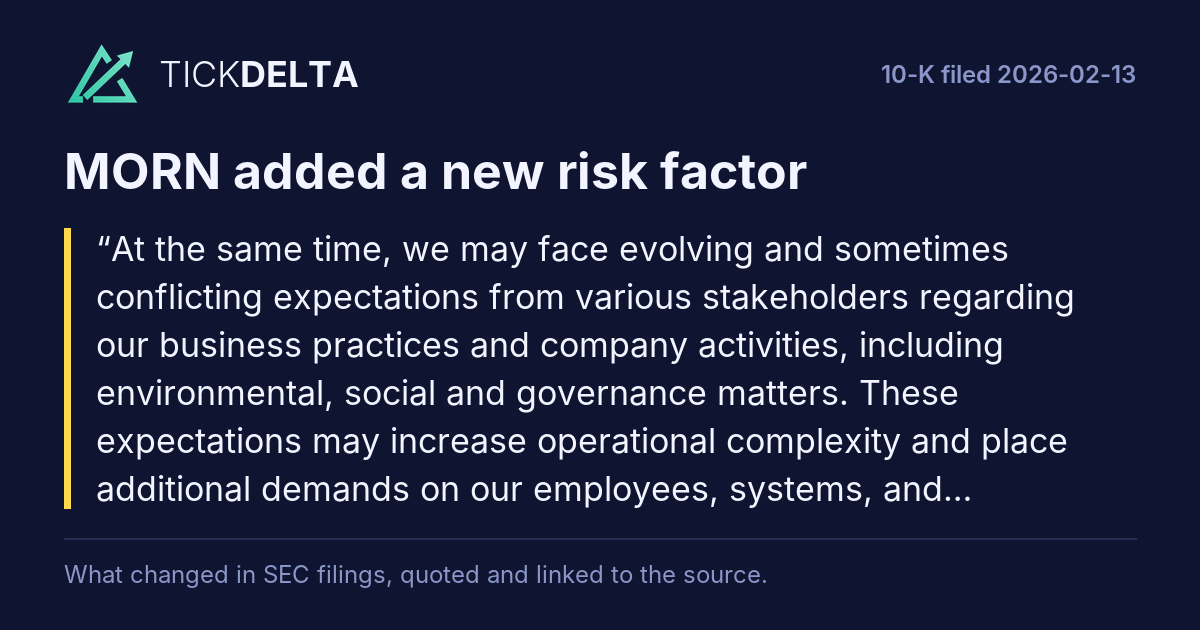
At the same time, we may face evolving and sometimes conflicting expectations from various stakeholders regarding our business practices and company activities, including environmental, social and governance matters. These expectations may increase operational complexity and place additional demands on our employees, systems, and resources. Different stakeholders may hold differing views on such matters, increasing the risk that actions we take, or fail to take, are perceived negatively by certain groups. Public sentiment and the broader sociopolitical environment may shift rapidly and unpredictably, and we may not be able to anticipate or respond to such changes within expected timeframes or without incurring significant costs. If we do not effectively manage such evolving expectations, we could experience reputational harm, stakeholder disengagement, litigation, or other adverse consequences, which may adversely impact our business, operating results, and financial condition.
Paragraphs in the 10-Q filed Oct 28, 2026 that were not in the one before
New in the latest 10-Q
4 paragraphs in the 10-Q filed Oct 28, 2026 with nothing like them in the 10-Q filed Jul 29, 2026 (at least half the words must differ; new numbers alone do not count). Quoted exactly, grouped by the item heading above them. This is text that changed, not a judgement of how serious it is.
Financial statements and notes
(in millions, except share amounts) As of September 30, 2026 As of December 31, 2025
Read in the 10-Q
As of September 30, 2026, the Company had executed operating lease agreements for office space in London, Frankfurt, and Chicago that had not yet commenced. These leases represent aggregate future lease obligations of approximately $ 178.0 million. The London lease is expected to commence in the fourth quarter of 2026 with an initial lease term of approximately 12 years, and the Frankfurt lease is expected to commence in the first quarter of 2028 with an initial lease term of approximately 10 years. The Chicago lease is subject to substantial completion of landlord construction and will commence when the premises are made available for the company's use. The company expects to obtain access to and take possession of the Chicago office space in the second quarter of 2027, resulting in an initial lease term of approximately 17 years. Accordingly, the operating lease assets and liabilities as of September 30, 2026 do not reflect the amounts for these leases.
Read in the 10-Q
The company has entered into lease agreements for office space in various jurisdictions that have not yet commenced. Refer to Note 10 for further information.
Read in the 10-Q
As of September 30, 2026, the company had executed operating lease agreements for office space in London, Chicago, and Frankfurt that had not yet commenced. These leases represent aggregate future lease obligations of approximately $178.0 million. For further information, see Note 10 of the Notes to our Unaudited Consolidated Financial Statements.
Read in the 10-Q
The 10-Q's risk factors against the 10-K
Item 1A of the 10-Q filed Oct 28, 2026 against Item 1A of the 10-K filed Feb 13, 2026.
A 10-Q repeats only the risks that changed, so a 10-K paragraph that is missing from it is not counted as removed.
Added is a paragraph with nothing like it in the 10-K, Reworded a sentence that is in both with several words changed,
Quiet changes a sentence in both where one to four words changed and one is a hedge or a modal
(cut words struck through, new words highlighted).
Text on the page, not a score; each links to the filing at sec.gov.
This 10-Q has no Item 1A (Risk Factors) text of its own, so there is nothing to compare. Many companies leave it out when their risks have not changed.
Phrases used for the first time
Two-word phrases in Risk Factors of the 10-K filed Feb 13, 2026 that are in none of the 1 earlier 10-Ks stored, back to Feb 28, 2025
Where each one is used
- credit facilities: For an overview of our current outstanding indebtedness, refer to Item 7 - Management's Discussion and Analysis of Financial Condition and Results of Operations - Liquidity and Capital Resources below. Our long-term debt was $1,072.6 million on December 31, 2025. While our business has historically generated strong...
- face claims: We may face claims related to securities law violations, defamation, negligence, or other issues arising from the information we publish, including our research and ratings. For example, investors could take legal action against us if they rely on published information that contains an error, or companies may claim...
- economic conditions: Changing economic conditions, including prolonged volatility, recessions, or downturns affecting the financial sector and global financial markets, fluctuating interest rates, and the impacts of global trade policies, may negatively impact our business.
- effectively incorporate: If we fail to continuously innovate and effectively incorporate or deploy new datasets, research, AI technologies, content, or software to meet evolving customer needs, our competitive position may suffer. Our reputation would be harmed if we are seen as slow to adapt to meet the changing needs of investors or...
- personalized advice: If we fail to continuously innovate and effectively incorporate or deploy new datasets, research, AI technologies, content, or software to meet evolving customer needs, our competitive position may suffer. Our reputation would be harmed if we are seen as slow to adapt to meet the changing needs of investors or...
- allocate resources: As financial intermediary customers further automate their processes, demand for our products may shift, making technological flexibility and system interoperability increasingly important. Clients increasingly expect technology solutions that address specific needs, such as integrated wealth management...
- changing economic: Changing economic conditions, including prolonged volatility, recessions, or downturns affecting the financial sector and global financial markets, fluctuating interest rates, and the impacts of global trade policies, may negatively impact our business.
- market downturns: Our business performance is influenced by external factors such as economic and financial market trends, credit availability, changing laws or trade policy, currency fluctuations, and geopolitical uncertainties. Extended economic or market downturns, or volatility, interest and inflation rate shifts, and...
Used at least twice, small words left out. Counted, not picked: a phrase can be new because the company renamed something.
What was taken out
31 paragraphs of last year's Risk Factors with nothing like them now. The longest are quoted.
Sources
Item 1A of each 10-K and 10-Q on EDGAR, quoted exactly. Each paragraph links to the filing at sec.gov.
Also
10-K change: what was reworded or cut, section by section.
Work with it
Excel workbook · CSV. Google Sheet that stays up to date: paste =IMPORTDATA("https://tickdelta.com/company/MORN/export.csv") into a cell.