Paragraph 14 · 50% changed
Every version of it
Screener
/
SEC EDGAR
/CIK 0001289419
/10-K filed Feb 13, 2026, compared with Feb 28, 2025
/Numbers from the XBRL of the 10-Ks
Nasdaq
Financials · Asset Management
Morningstar, Inc. MORN
The 10-K against last year's
270 changes: 39 added, 57 removed, 173 reworded, 1 quiet changes
10-K Feb 13, 2026 vs Feb 28, 2025
Risk Factors
50.9%
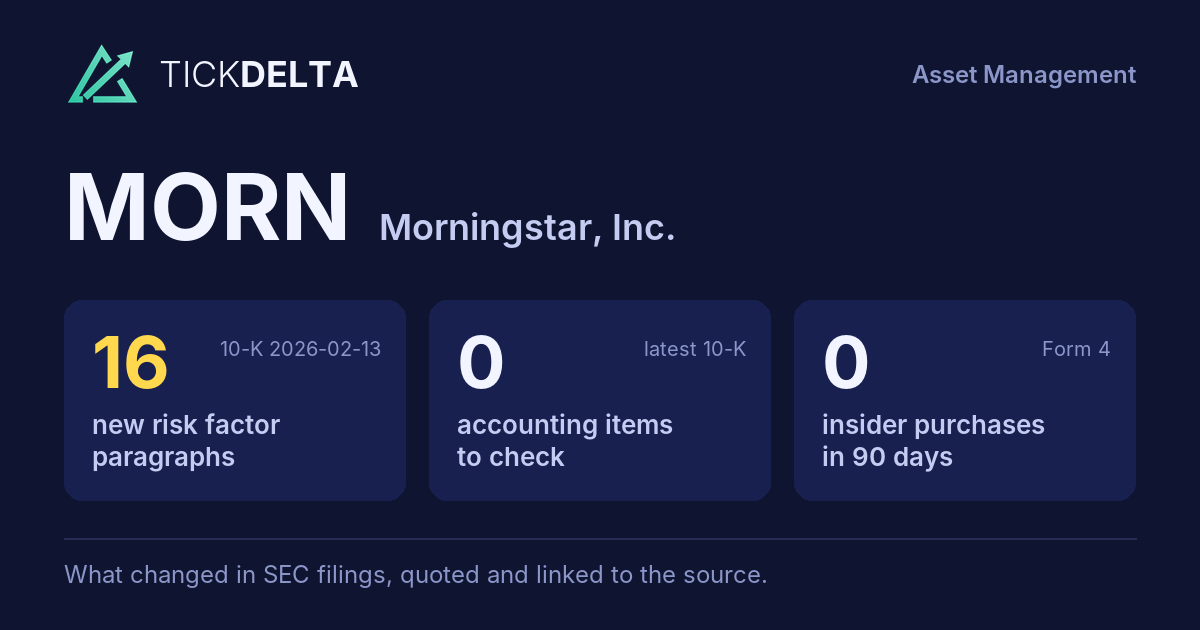
of the text changed · 8,910 words now · 16 new paragraphs, 31 gone
MD&A
30.2%
of the text changed · 9,140 words now · 23 new paragraphs, 26 gone
Legal Proceedings
0.6%
of the text changed · 477 words now
Accounting Policies
12.4%
of the text changed · 2,655 words now
10-K 0001289419-26-000013 (Feb 13, 2026) vs 10-K 0001289419-25-000041 (Feb 28, 2025)
Every paragraph, and how much of it changed
One bar per paragraph, in the order of the 10-K. Height and colour show the share of its words not in the closest paragraph a year earlier; the tallest bars are new paragraphs.
Risk Factors
101 paragraphs · 16 new · 71 reworded · 31 gone · 10-K Feb 13, 2026 against Feb 28, 2025
New paragraph
Reworded (5% of its words or more)
Same or nearly
Paragraph 66 · 50% changed
Every version of it
As a global business with a broad workforce location strategy, distributed workforce, we have experienced and may continue to experience face recruiting challenges in nearly all our global across many locations. Maintaining a global workforce also Managing employees across geographies introduces inherent challenges, complexities, including the ability to effectively manage employees over large geographic distances, as well implementing systems, policies, benefits, and compliance programs, and addressing external factors such as geopolitical unrest in countries where our employees work, resulting in the need to implement appropriate systems, policies, benefits and compliance programs. Additionally, we have been and may continue to be exposed to rising unrest. Rising wage scales in many of the employment markets in which our facilities are located, which negatively affect our compensation costs. Inflationary key markets, inflationary pressures, strong sector stock performance in our sector, the sectors where we focus hiring efforts, immigration policy, policies, regulatory changes changes, and skill shortages of applicants with certain skills put upward pressure on wages increase compensation costs and may can make it difficult harder to attract and retain and attract adequately skilled and qualified employees.
Paragraph 71 · 50% changed
Every version of it
We utilize rely on numerous third-party service providers in our operations, providers, including for the provision of contract labor in several locations labor, SaaS, and data backup facilities for our data. A failure facilities. Failure by a third-party service provider could expose us disrupt our ability to an inability to provide contractual deliver products and services to our clients in a timely manner. Additionally, if a third-party service provider is unable to provide these services, we may incur and require significant costs to either internalize some of these services functions or find a suitable alternative. We adequate alternatives. For limited products and regions, we are subject to regulatory expectations for the vendor oversight of vendors and service providers, including regulations, such as the EU’s Digital Operational Resilience Act, which further increase our increases compliance obligations and costs. A failure in the performance of our Inadequate due diligence processes and controls related relating to the supervision and or oversight of these firms in detecting and addressing third parties, such as failing to detect conflicts of interest, fraudulent activity, fraud, data breaches and cyberattacks breaches, cyberattacks, or noncompliance with relevant securities and other laws legal noncompliance, could cause us to suffer result in financial loss, expose us to regulatory sanctions sanctions, or damage to our reputation. reputational harm.
Paragraph 3 · 48% changed
Every version of it
We believe that our reputation, brand, and the reputation of our company and our brand generally, as well as the perception of our research and ratings products and services, is based on the trust that users value of our products and services are built on the trust that our users have in our commitment to our mission to empower empowering investor success underscored by principles of through independence, transparency transparency, and a long-term focus. Any failures by us to instill in our employees the expectation of independence and integrity may devalue our reputation over time and negatively affect both hiring and retention efforts. Any real or perceived failure to uphold these standards, and any principles, including lapses in employee integrity or independence, may harm our reputation. Additionally, real or perceived failure of errors in our customers to have consistently positive products or negative customer or employee experiences with us could further damage our reputation. Our reputation may and brand could also be harmed if any errors are found in impacted by factors beyond our control, such as negative news about our clients, suppliers, employees, consultants, or competitors, regulatory scrutiny, and adverse publicity about our products or services. industries that we operate in. Expanding our brand to less mission-aligned products may also harm our reputation or dilute our brand.
Paragraph 80 · 48% changed
Every version of it
Our ability to acquire or dispose of other businesses or technologies, businesses, make strategic investments investments, or integrate acquired businesses effectively acquisitions may be impaired hindered by trade tensions and increased global heightened scrutiny of foreign investments and acquisitions and investments investments, particularly in the technology sector. For example, several technology. Several countries, including the US United States, Europe, and countries in Europe and the Asia-Pacific region, Asia-Pacific, have adopted or are considering or have adopted restrictions of varying kinds on transactions involving foreign investments. Antitrust such transactions, and antitrust authorities are reviewing technology deals with greater rigor. Our business strategy includes expanding into new and adjacent product lines, but regulatory requirements across different Morningstar businesses may limit our ability to pursue these opportunities. Regulatory sanctions in a number of countries have also reviewed acquisitions one area could affect operations in unrelated regulated sectors, and investments in the technology industry with increased scrutiny. Governments sharing intellectual property across product lines may continue to adopt or tighten restrictions of this nature, and such be restricted by regulatory concerns. Future restrictions or government actions could also limit acquisition and investment opportunities and negatively impact our acquisition and investment opportunities, business and financial results. Acquisitions or divestitures may also expose us to litigation from our shareholders shareholder or other third parties, which, even if unsuccessful, third-party litigation, which could be costly to defend and serve as a distraction to management. distract management even if unsuccessful.
Paragraph 63 · 48% changed
Every version of it
We seek to constantly innovate and improve continually enhance our retirement services offering, for example to add new services, adding capabilities around such as modeling and advising on income generating income-generating products, and in doing so, we regularly release new versions of the technology updates and update our methodology. Additional customer methodology changes. Clients may require additional support may be needed to ensure that clients implement the new versions and updates properly and understand the implications for their plan participants, implications, including issues concerning suitability of certain strategies. More strategy suitability. We also allocate resources may also be required to continue to support legacy versions of the Wealth Forecasting Engine that continue to be used by certain clients. If we make an error, we may be subject to potentially large liabilities for still in use. Errors in updates or methodology could result in significant liabilities, including make-whole payments and/or or litigation.
Paragraph 5 · 48% changed
Every version of it
Certain of our product offerings such as products and methodologies, including those offered by of Morningstar Sustainalytics have, Sustainalytics, have placed, and may in the future, put place us at the center of public debate over a variety of issues surrounding on sustainability, social concerns, and corporate governance. Scrutiny over sustainability, social concerns social, and corporate governance issues, or result in scrutiny of our clients. This scrutiny may impact the affect product demand for our products. This could lead to and may result in negative media coverage, reputational harm harm, or increased government or regulatory scrutiny. Failure to successfully navigate these issues as they arise may have an adverse effect on our reputation and our business. In addition our methodology may be scrutinized or may attract negative publicity. attention.
Paragraph 15 · 47% changed
Every version of it
Paragraph 14 · 50% changed
Every version of it
10-K Feb 28, 2025For our license-based businesses, many of our customers are asset management and financial advisory firms and other financial-services companies, who are also subject to global market trends. The ascendance of passive investment strategies may affect both the profitability of asset managers that focus on actively managed strategies, on whose success we in part depend, and the perceived value of our research regarding actively managed such strategies. A sustained global recession or other financial downturn or crisis would likely lead to material spending cutbacks among certain of our clients, and create longer sales cycles. Consolidation in the financial services sector reduces the number of potential clients for our products and services. Further, clients may discontinue their use of our products and services should they fail and/or merge with or become acquired by other entities that are not our clients or that use fewer of our products and services. These trends could impact demand for our products and services or change the financial services landscape in which we operate, resulting in lower revenue and operating income.
10-K Feb 13, 2026
Many of our license-based customers are asset management and financial advisory firms, whose businesses may be impacted by global market trends. The rise of passive investment strategies may diminish the perceived value of our research on active strategies. Prolonged recessions, financial crises, and other economic uncertainties have in the past and could in the future prompt significant spending cuts and lengthen sales cycles among clients. Industry consolidation has the potential to reduce our client base, and clients may discontinue using our products and services if they fail, merge, or are acquired by non-clients or firms using fewer of our services. These factors may decrease demand for our offerings.
Paragraph 66 · 50% changed
Every version of it
10-K Feb 28, 2025
As a global business with a broad workforce location strategy, we have experienced and may continue to experience recruiting challenges in nearly all our global locations. Maintaining a global workforce also introduces inherent challenges, including the ability to effectively manage employees over large geographic distances, as well external factors such as geopolitical unrest in countries where our employees work, resulting in the need to implement appropriate systems, policies, benefits and compliance programs. Additionally, we have been and may continue to be exposed to rising wage scales in many of the employment markets in which our facilities are located, which negatively affect our compensation costs. Inflationary pressures, strong stock performance in our sector, immigration policy, regulatory changes and shortages of applicants with certain skills put upward pressure on wages and may make it difficult to retain and attract adequately skilled and qualified employees.
10-K Feb 13, 2026
As a global business with a distributed workforce, we face recruiting challenges across many locations. Managing employees across geographies introduces complexities, including implementing systems, policies, benefits, and compliance programs, and addressing external factors such as geopolitical unrest. Rising wage scales in key markets, inflationary pressures, strong sector stock performance in the sectors where we focus hiring efforts, immigration policies, regulatory changes, and skill shortages increase compensation costs and can make it harder to attract and retain qualified employees.
Paragraph 71 · 50% changed
Every version of it
10-K Feb 28, 2025
We utilize numerous third-party service providers in our operations, including for the provision of contract labor in several locations and backup facilities for our data. A failure by a third-party service provider could expose us to an inability to provide contractual services to our clients in a timely manner. Additionally, if a third-party service provider is unable to provide these services, we may incur significant costs to either internalize some of these services or find a suitable alternative. We are subject to regulatory expectations for the oversight of vendors and service providers, including the EU’s Digital Operational Resilience Act, which further increase our compliance obligations and costs. A failure in the performance of our due diligence processes and controls related to the supervision and oversight of these firms in detecting and addressing conflicts of interest, fraudulent activity, data breaches and cyberattacks or noncompliance with relevant securities and other laws could cause us to suffer financial loss, expose us to regulatory sanctions or damage to our reputation.
10-K Feb 13, 2026
We rely on numerous third-party service providers, including for contract labor, SaaS, and data backup facilities. Failure by a provider could disrupt our ability to deliver products and services and require significant costs to internalize functions or find adequate alternatives. For limited products and regions, we are subject to vendor oversight regulations, such as the EU’s Digital Operational Resilience Act, which increases compliance obligations and costs. Inadequate due diligence relating to or oversight of third parties, such as failing to detect conflicts of interest, fraud, data breaches, cyberattacks, or legal noncompliance, could result in financial loss, regulatory sanctions, or reputational harm.
Paragraph 3 · 48% changed
Every version of it
10-K Feb 28, 2025
We believe that the reputation of our company and our brand generally, as well as the perception of our research and ratings products and services, is based on the trust that users of our products and services have in our commitment to our mission to empower investor success underscored by principles of independence, transparency and long-term focus. Any failures by us to instill in our employees the expectation of independence and integrity may devalue our reputation over time and negatively affect both hiring and retention efforts. Any failure to uphold these standards, and any real or perceived failure of our customers to have consistently positive experiences with us could damage our reputation. Our reputation may also be harmed if any errors are found in our products or services.
10-K Feb 13, 2026
We believe our reputation, brand, and the value of our products and services are built on the trust that our users have in our commitment to empowering investor success through independence, transparency, and a long-term focus. Any real or perceived failure to uphold these principles, including lapses in employee integrity or independence, may harm our reputation. Additionally, real or perceived errors in our products or negative customer or employee experiences could further damage our reputation. Our reputation and brand could also be impacted by factors beyond our control, such as negative news about our clients, suppliers, employees, consultants, or competitors, regulatory scrutiny, and adverse publicity about our products or industries that we operate in. Expanding our brand to less mission-aligned products may also harm our reputation or dilute our brand.
Paragraph 80 · 48% changed
Every version of it
10-K Feb 28, 2025
Our ability to acquire or dispose of other businesses or technologies, make strategic investments or integrate acquired businesses effectively may be impaired by trade tensions and increased global scrutiny of foreign investments and acquisitions and investments in the technology sector. For example, several countries, including the US and countries in Europe and the Asia-Pacific region, are considering or have adopted restrictions of varying kinds on transactions involving foreign investments. Antitrust authorities in a number of countries have also reviewed acquisitions and investments in the technology industry with increased scrutiny. Governments may continue to adopt or tighten restrictions of this nature, and such restrictions or government actions could negatively impact our acquisition and investment opportunities, business and financial results. Acquisitions or divestitures may expose us to litigation from our shareholders or other third parties, which, even if unsuccessful, could be costly to defend and serve as a distraction to management.
10-K Feb 13, 2026
Our ability to acquire or dispose of businesses, make strategic investments, or integrate acquisitions may be hindered by trade tensions and heightened scrutiny of foreign investments, particularly in technology. Several countries, including the United States, Europe, and Asia-Pacific, have adopted or are considering restrictions on such transactions, and antitrust authorities are reviewing technology deals with greater rigor. Our business strategy includes expanding into new and adjacent product lines, but regulatory requirements across different Morningstar businesses may limit our ability to pursue these opportunities. Regulatory sanctions in one area could affect operations in unrelated regulated sectors, and sharing intellectual property across product lines may be restricted by regulatory concerns. Future restrictions or government actions could also limit acquisition and investment opportunities and negatively impact our business and financial results. Acquisitions or divestitures may also expose us to shareholder or third-party litigation, which could be costly and distract management even if unsuccessful.
Paragraph 63 · 48% changed
Every version of it
10-K Feb 28, 2025
We seek to constantly innovate and improve our retirement services offering, for example to add new capabilities around modeling and advising on income generating products, and in doing so, we regularly release new versions of the technology and update our methodology. Additional customer support may be needed to ensure that clients implement the new versions and updates properly and understand the implications for their plan participants, including issues concerning suitability of certain strategies. More resources may also be required to continue to support legacy versions of the Wealth Forecasting Engine that continue to be used by certain clients. If we make an error, we may be subject to potentially large liabilities for make-whole payments and/or litigation.
10-K Feb 13, 2026
We seek to continually enhance our retirement services, adding capabilities such as modeling and advising on income-generating products, and regularly release technology updates and methodology changes. Clients may require additional support to implement updates and understand their implications, including strategy suitability. We also allocate resources to support legacy versions of the Wealth Forecasting Engine still in use. Errors in updates or methodology could result in significant liabilities, including make-whole payments or litigation.
Paragraph 5 · 48% changed
Every version of it
10-K Feb 28, 2025
Certain of our product offerings such as those offered by Morningstar Sustainalytics have, and may in future, put us at the center of public debate over a variety of issues surrounding sustainability, social concerns, and corporate governance. Scrutiny over sustainability, social concerns and corporate governance may impact the demand for our products. This could lead to negative media coverage, reputational harm or increased government or regulatory scrutiny. Failure to successfully navigate these issues as they arise may have an adverse effect on our reputation and our business. In addition our methodology may be scrutinized or may attract negative publicity.
10-K Feb 13, 2026
Certain of our products and methodologies, including those of Morningstar Sustainalytics, have placed, and may in the future, place us at the center of public debate on sustainability, social, and corporate governance issues, or result in scrutiny of our clients. This scrutiny may affect product demand and may result in negative media coverage, reputational harm, or increased regulatory attention.
Paragraph 15 · 47% changed
Every version of it
10-K Feb 28, 2025Our credit ratings business, as well as our SPO business, have been, and may again be, impacted by volatility in US and international financial markets due to their dependence on the number and dollar volume of debt securities issued in the capital markets. Market disruptions, rising interest rates, widening credit spreads, and economic slowdowns historically have impacted and may in the future impact the volume of debt securities issued in global capital markets and the demand for credit ratings. Demand for credit ratings can also be negatively affected by negative publicity about the credit ratings business, regulatory and political developments, growth in the use of alternative sources of credit, and defaults by significant issuers. Our ability to reduce costs in the event of such adverse developments can be negatively impacted by, among other things, our obligations to monitor and maintain outstanding ratings. Declines or other changes in the markets for debt securities may materially and adversely affect our business, operating results, and financial condition.
10-K Feb 13, 2026
Fluctuations in interest rates and central bank decisions have reduced credit issuance in the past and may do so in the future, negatively impacting our credit ratings business. For example, our credit ratings business depends on the volume and value of debt securities issued, making it vulnerable to market volatility, rising interest rates, widening credit spreads, and economic slowdowns. Demand for credit ratings may also decline due to negative publicity, regulatory or political changes, increased use of alternative credit sources, or defaults by major issuers. Our ability to reduce costs in adverse conditions may be limited by our obligations to monitor and maintain outstanding ratings.
MD&A
172 paragraphs · 23 new · 83 reworded · 26 gone · 10-K Feb 13, 2026 against Feb 28, 2025
New paragraph
Reworded (5% of its words or more)
Same or nearly
Paragraph 115 · 49% changed
Morningstar Sustainalytics revenue decreased $0.9 $5.3 million or 0.8%. 4.5%. Organic revenue decreased 0.9% which was 7.1%, largely driven by lower revenues for ESG Risk Ratings and SPOs. Revenue was also negatively impacted by the continued streamlining of the licensed-ratings offering. offering as the company transitions to a model focused on licensing the use and distribution of existing ratings and underlying data, as well as softness in second-party opinions.
Paragraph 136 · 49% changed
On May 6, 2022, October 31, 2025, the company terminated the 2022 Credit Agreement and entered into a new senior credit agreement (the 2022 2025 Credit Agreement), providing Agreement). The 2025 Credit Agreement provides the company with a five-year multi-currency credit facility with an initial a borrowing capacity of up to $1.1 $1.5 billion, including a $650.0 million term loan and a $450.0 five-year $750.0 million revolving credit facility. facility (the 2025 Revolving Credit Facility), a five-year delayed draw term facility of up to $375.0 million (the 2025 A-1 Facility), and a three-year term facility of up to $375.0 million (the 2025 A-2 Facility and, together with the 2025 A-1 Facility, the 2025 Term Facility; and, together with the 2025 Revolving Credit Facility, the 2025 Facility). The 2022 2025 Credit Agreement also provided provides for the issuance of up to $50.0 million of letters of credit and a swingline facility. The 2022 Credit Agreement was amended twice in September 2022 and again most recently in June 2024 (Amended 2022 Credit Agreement) to, among other items, eliminate the options $100.0 million sublimit for a second term loan draw and increase both the term loan and revolving credit swingline facility to $650.0 million each, raising the total borrowing capacity to $1.3 billion (Amended 2022 Term Facility and Amended 2022 Revolving Credit Facility, respectively), and to update the reference rate for credit extensions in Canadian dollars. Aside from the increased borrowing capacity, the Amended 2022 Credit Agreement left the 2022 Credit Agreement terms largely unchanged. As of December 31, 2024, our total outstanding debt under the Amended 2022 Credit Agreement was $349.8 million, net of debt issuance costs, with borrowing availability of $650.0 million under the 2022 2025 Revolving Credit Facility.
Paragraph 96 · 48% changed
Paragraph 71 · 47% changed
Paragraph 99 · 47% changed
Morningstar Data and Analytics Credit total revenue increased $40.9 $63.3 million, or 5.5%, 21.7%, in 2024. 2025. Revenue grew 5.8% increased 20.9% on an organic basis, driven primarily basis. Revenue grew across asset classes and geographies supported by increases a healthy issuance market, with particular strength in Morningstar Direct US commercial mortgage- and Morningstar Data. asset-backed securities ratings revenue and Canadian and European corporate ratings revenue. Organic revenue growth excludes revenue associated with the Commodity and Energy Data business beginning Dealview Technologies Limited (DealX) acquisition, which was completed in the fourth first quarter of 2025, and foreign currency impact.
Paragraph 52 · 45% changed
We define present adjusted operating income as operating income excluding all mergers (loss) and acquisitions (M&A)-related expenses and gains (related to merger, acquisition, and divestiture activity including earn-outs), intangible amortization, and expenses related to the significant reduction and shift of the company's operations in China. We define adjusted operating margin as operating margin excluding all M&A-related expenses and gains, intangible amortization, and expenses related to the significant reduction and shift of the company's operations in China. We present these measures because we believe they better reflect period-over-period comparisons and improves improve overall understanding of the underlying performance of the business absent the impact of M&A intangible amortization expense, M&A-related expenses, and the shift of the company's operations in China. certain other one-time, non-recurring items.
Paragraph 78 · 45% changed
Paragraph 93 · 44% changed
Morningstar Data and Analytics Direct Platform adjusted operating income increased $15.6 $14.0 million, or 4.6%, 3.9%, and adjusted operating margin decreased 0.4 0.6 percentage points in 2024. Increased revenue was partially offset by 2025. The decline in adjusted operating margin reflected higher compensation costs due to annual merit increases and severance costs, reflecting growth in bonuses, merit increases, and higher headcount; increased spending on sales and marketing; and the impact of the sale of the company's company’s Commodity and Energy Data business. business in 2024, and higher depreciation related to capitalized software costs for prior-period product enhancements. Morningstar Direct Platform's adjusted operating income includes the impact of $4.3 million in severance costs primarily related to targeted reorganizations.
Paragraph 115 · 49% changed
10-K Feb 28, 2025
Morningstar Sustainalytics revenue decreased $0.9 million or 0.8%. Organic revenue decreased 0.9% which was largely driven by lower revenues for ESG Risk Ratings and SPOs. Revenue was also negatively impacted by the streamlining of the licensed-ratings offering.
10-K Feb 13, 2026
Morningstar Sustainalytics revenue decreased $5.3 million or 4.5%. Organic revenue decreased 7.1%, largely driven by the continued streamlining of the licensed-ratings offering as the company transitions to a model focused on licensing the use and distribution of existing ratings and underlying data, as well as softness in second-party opinions.
Paragraph 136 · 49% changed
10-K Feb 28, 2025
On May 6, 2022, the company entered into a senior credit agreement (the 2022 Credit Agreement), providing the company with a five-year multi-currency credit facility with an initial borrowing capacity of up to $1.1 billion, including a $650.0 million term loan and a $450.0 million revolving credit facility. The 2022 Credit Agreement also provided for the issuance of letters of credit and a swingline facility. The 2022 Credit Agreement was amended twice in September 2022 and again most recently in June 2024 (Amended 2022 Credit Agreement) to, among other items, eliminate the options for a second term loan draw and increase both the term loan and revolving credit facility to $650.0 million each, raising the total borrowing capacity to $1.3 billion (Amended 2022 Term Facility and Amended 2022 Revolving Credit Facility, respectively), and to update the reference rate for credit extensions in Canadian dollars. Aside from the increased borrowing capacity, the Amended 2022 Credit Agreement left the 2022 Credit Agreement terms largely unchanged. As of December 31, 2024, our total outstanding debt under the Amended 2022 Credit Agreement was $349.8 million, net of debt issuance costs, with borrowing availability of $650.0 million under the 2022 Revolving Credit Facility.
10-K Feb 13, 2026
On October 31, 2025, the company terminated the 2022 Credit Agreement and entered into a new senior credit agreement (the 2025 Credit Agreement). The 2025 Credit Agreement provides the company with a multi-currency credit facility with a borrowing capacity of up to $1.5 billion, including a five-year $750.0 million revolving credit facility (the 2025 Revolving Credit Facility), a five-year delayed draw term facility of up to $375.0 million (the 2025 A-1 Facility), and a three-year term facility of up to $375.0 million (the 2025 A-2 Facility and, together with the 2025 A-1 Facility, the 2025 Term Facility; and, together with the 2025 Revolving Credit Facility, the 2025 Facility). The 2025 Credit Agreement also provides for the issuance of up to $50.0 million of letters of credit and a $100.0 million sublimit for a swingline facility under the 2025 Revolving Credit Facility.
Paragraph 96 · 48% changed
10-K Feb 28, 2025Revenue for the PitchBook platform, direct data, and Leveraged Commentary & Data (LCD) combined contributed $66.7 million to PitchBook revenue growth, with revenue increasing 12.3%, or 12.4% on an organic basis. Growth was primarily driven by the PitchBook platform with licensed users growing 16.4%, reflecting both new client users and expansion with existing clients, as well as variability driven by user maintenance activities and updates to user lists when enterprise clients renew. PitchBook clients who were not previously LCD clients drove the majority of the increase in licensed users, although growth continued to reflect the impact of legacy LCD clients who have moved to the PitchBook platform and are now reflected in licensed user counts. PitchBook platform growth drivers reflected strength in PitchBook's core investor and advisor client segments, including venture capital, private equity, and investment banks. This was partially offset by continued softness in the corporate client segment, especially with smaller firms with more limited use cases.
10-K Feb 13, 2026
Growth was primarily driven by the PitchBook platform with contributions from the small-but-growing direct data business. PitchBook platform growth drivers reflected strength in PitchBook's core investor and advisor client segments. This was partially offset by continued softness in the corporate client segment, especially with smaller firms with more limited use cases. PitchBook licensed users were relatively flat compared to the prior-year period, reflecting the addition of new logos offset by churn.
Paragraph 71 · 47% changed
10-K Feb 28, 2025Transaction-based revenue increased 31.2%, or 28.8% on an organic basis, during 2024. Reported and organic revenue was primarily driven by Morningstar Credit.
10-K Feb 13, 2026
Organic revenue increased 8.0% in 2025, driven primarily by strong performance from Morningstar Credit, PitchBook, and Morningstar Direct Platform.
Paragraph 99 · 47% changed
10-K Feb 28, 2025
Morningstar Data and Analytics total revenue increased $40.9 million, or 5.5%, in 2024. Revenue grew 5.8% on an organic basis, driven primarily by increases in Morningstar Direct and Morningstar Data. Organic revenue growth excludes revenue associated with the Commodity and Energy Data business beginning in the fourth quarter and foreign currency impact.
10-K Feb 13, 2026
Morningstar Credit total revenue increased $63.3 million, or 21.7%, in 2025. Revenue increased 20.9% on an organic basis. Revenue grew across asset classes and geographies supported by a healthy issuance market, with particular strength in US commercial mortgage- and asset-backed securities ratings revenue and Canadian and European corporate ratings revenue. Organic revenue growth excludes revenue associated with the Dealview Technologies Limited (DealX) acquisition, which was completed in the first quarter of 2025, and foreign currency impact.
Paragraph 52 · 45% changed
10-K Feb 28, 2025
We define adjusted operating income as operating income excluding all mergers and acquisitions (M&A)-related expenses and gains (related to merger, acquisition, and divestiture activity including earn-outs), intangible amortization, and expenses related to the significant reduction and shift of the company's operations in China. We define adjusted operating margin as operating margin excluding all M&A-related expenses and gains, intangible amortization, and expenses related to the significant reduction and shift of the company's operations in China. We present these measures because we believe they better reflect period-over-period comparisons and improves overall understanding of the underlying performance of the business absent the impact of M&A and the shift of the company's operations in China.
10-K Feb 13, 2026
We present adjusted operating income (loss) and adjusted operating margin because we believe they better reflect period-over-period comparisons and improve overall understanding of the underlying performance of the business absent the impact of intangible amortization expense, M&A-related expenses, and certain other one-time, non-recurring items.
Paragraph 78 · 45% changed
10-K Feb 28, 2025Sales and marketing expense increased $17.2 million, or 4.1%, in 2024. Higher compensation expense of $5.5 million was the largest contributor, primarily due to the factors noted above relating to cost of revenue. Advertising and marketing costs increased $5.4 million during 2024 due to higher advertising and marketing campaign expense.
10-K Feb 13, 2026
General and administrative expense increased $6.8 million, or 2.1%, in 2025. Higher compensation expense was the largest contributor to the increase, driven primarily by higher company-sponsored benefits and salaries.
Paragraph 93 · 44% changed
10-K Feb 28, 2025
Morningstar Data and Analytics adjusted operating income increased $15.6 million, or 4.6%, and adjusted operating margin decreased 0.4 percentage points in 2024. Increased revenue was partially offset by higher compensation costs, reflecting growth in bonuses, merit increases, and higher headcount; increased spending on sales and marketing; and the impact of the sale of the company's Commodity and Energy Data business.
10-K Feb 13, 2026
Morningstar Direct Platform adjusted operating income increased $14.0 million, or 3.9%, and adjusted operating margin decreased 0.6 percentage points in 2025. The decline in adjusted operating margin reflected higher compensation costs due to annual merit increases and severance costs, the impact of the sale of the company’s Commodity and Energy Data business in 2024, and higher depreciation related to capitalized software costs for prior-period product enhancements. Morningstar Direct Platform's adjusted operating income includes the impact of $4.3 million in severance costs primarily related to targeted reorganizations.
A paragraph is matched with the one last year that shares the most of its words; under half in common makes it new. The paragraphs shown are the 8 reworded the most in each section.
The paragraph that changed most in each section
The redline
Marked against last year's 10-K: cut words struck through, new words highlighted.
Risk Factors310 words changed in this paragraph; it is 33% similar to last year's version.
If we fail to continuously innovate, incorporate, innovate and effectively incorporate or deploy and develop, as applicable, new datasets, research, methodologies, AI technologies, content content, or software to meet the needs of our customers, or fail to successfully communicate such innovations and developments in our offerings to our customers, evolving customer needs, our competitive position and business results may suffer. In addition, our Our reputation could would be harmed if we are perceived seen as not moving quickly enough slow to adapt to meet the changing needs of investors or their financial advisors advisors, especially as customers expect more personalized advice and may sacrifice new business opportunities or renewals from existing customers. These changing needs include a greater expectation that advice be delivered with a high degree of personalization. Investors are also increasingly focused on the security of data we collect from them, as well as the sharing of their data with third parties. security. Increased interest in alternative asset classes, including a focus on assets, such as private market offerings, has also created a need for applicable datasets, research require new expertise and analytical expertise. data. Competitors who innovate faster or offer broader solutions may outpace us. Our competitive position and business results may suffer if other companies have greater breadth of product offerings or are able to successfully and more quickly introduce innovative, proprietary research tools and software, including through the application of investments in new products, especially those involving AI technologies. Further, despite our investments in, and commitment of resources to, leveraging AI in our products and activities, we may not be successful in generating revenues, creating efficiencies in our processes or generating cost savings from these efforts. The development of any new or updated products or capabilities can involve material investment, technologies, carry execution risks and challenges and may not deliver expected benefits, such as generating revenue or cost savings, or creating efficiencies in our processes. Additionally, we cannot guarantee that we will successfully adapt our product offerings to meet evolving customer needs or that the seamlessly transition to such new offerings will be seamless. If we are unable product offerings. Failure to successfully manage these transitions and investments and transitions successfully, our business, financial condition, and results of operations could be would materially and adversely affected. affect our reputation, operating results and financial condition.
Source: Item 1A, 10-K 0001289419-26-000013 vs Item 1A, 10-K 0001289419-25-000041
MD&A226 words changed in this paragraph; it is 32% similar to last year's version.
Source: Item 7, 10-K 0001289419-26-000013 vs Item 7, 10-K 0001289419-25-000041
Accounting Policies149 words changed in this paragraph; it is 45% similar to last year's version.
For identified operating leases, we recognize a lease liability and right-of-use asset on the consolidated balance sheet. The right-of-use asset represents our right to use an underlying asset for the lease term, and the operating lease liability represents our obligation to make lease payments. Right-of-use assets and operating lease liabilities are measured at the commencement date using the present value of future lease payments over the lease term. For initial measurement of the present value of lease term at payments and for subsequent measurement of lease modifications, we are required to use the rate implicit in the lease, if available. However, as most of our leases do not provide an implicit rate, we use our incremental borrowing rate based on the information available on the commencement date. date of the lease. Right-of-use assets also include initial direct costs incurred by the company, net of prepayments and lease incentives. In the absence of an explicit rate in the lease agreement, the discount rate used to calculate present value is equal to the company's incremental borrowing rate. Operating lease expense is recognized on a straight-line basis over the life of the lease and is included in general and administrative expenses are recognized as lease expense on the Consolidated Statements of Income.
Source: Item 8, Note 2 – Summary of Significant Accounting Policies, 10-K 0001289419-26-000013 vs Item 8, Note 2 – Summary of Significant Accounting Policies, 10-K 0001289419-25-000041
Legal Proceedings6 words changed in this paragraph; it is 98% similar to last year's version.
Our ratings and related research activities, including credit ratings, ESG risk environmental, social, and governance ratings, managed investment, and equity ratings, are or may in the future become subject to regulation or increased scrutiny from executive, legislative, regulatory, and private parties. As a result, those activities may be subject to governmental, regulatory, and legislative investigations, regulatory examinations in the ordinary course of business, subpoenas, and other forms of legal process, which may lead to claims and litigation that are based on these ratings and related research activities. Our regulated businesses are generally subject to periodic reviews, inspections, examinations, and investigations by regulators in the jurisdictions in which they operate, any of which may result in claims, legal proceedings, assessments, fines, penalties, disgorgement, or restrictions on business activities. While it is difficult to predict the outcome of any particular investigation or proceeding, we do not believe the result of any of these matters will have a material adverse effect on our business, operating results, or financial position.
Source: Item 3, via Note 17 – Contingencies, 10-K 0001289419-26-000013 vs Item 3, via Note 17 – Contingencies, 10-K 0001289419-25-000041
Sentences and paragraphs added, removed or reworded
Every change, by type
Sentences and paragraphs of MORN's Risk Factors and MD&A, 10-K Feb 13, 2026 against 10-K Feb 28, 2025. Each links to the text at sec.gov.
Quiet changes are sentences kept from last year with one to four words changed, at least one of them a hedge, a modal or a qualifier (may, could, will, not, significant, material…). A year or date rolling forward is not counted.
The full word list
adverse, adversely, all, although, anticipate, anticipates, any, approximately, believe, believes, can, cannot, certain, could, expect, expects, generally, however, if, intend, intends, largely, likely, many, material, materially, may, might, most, must, never, no, not, possible, primarily, probable, should, significant, significantly, some, substantial, substantially, unlikely, will, would
AddedRisk Factors
Failure to effectively and successfully navigate these independence and reputational challenges could adversely affect our business, operating results, and financial condition.
Read it in 10-K Feb 13, 2026 at sec.gov
AddedRisk Factors
If we fail to continuously innovate and effectively incorporate or deploy new datasets, research, AI technologies, content, or software to meet evolving customer needs, our competitive position may suffer. Our reputation would be harmed if we are seen as slow to adapt to meet the changing needs of investors or their financial advisors, especially as customers expect more personalized advice and greater data security. Increased interest in alternative assets, such as private market offerings, require new expertise and data. Competitors who innovate faster or offer broader solutions may outpace us. Our investments in new products, especially those involving AI technologies, carry execution risks and challenges and may not deliver expected benefits, such as generating revenue or cost savings, or creating efficiencies in our processes. Additionally, we cannot guarantee we will successfully adapt or seamlessly transition to new product offerings. Failure to successfully manage these transitions and investments would materially and adversely affect our reputation, operating results and financial condition.
Read it in 10-K Feb 13, 2026 at sec.gov
AddedRisk Factors
As financial intermediary customers further automate their processes, demand for our products may shift, making technological flexibility and system interoperability increasingly important. Clients increasingly expect technology solutions that address specific needs, such as integrated wealth management capabilities. Our technology heavily relies on the quality and comprehensiveness of our data and our ability to build valuable analytics, research, and intellectual property around it. Delivering personalized advice that clients value requires collecting, organizing, and analyzing large, diverse datasets. If we fail to adequately allocate resources to meet client demands, we may lose our competitive advantage, which could adversely impact our business, operating results, and financial condition.
Read it in 10-K Feb 13, 2026 at sec.gov
AddedRisk Factors
Our business performance is influenced by external factors such as economic and financial market trends, credit availability, changing laws or trade policy, currency fluctuations, and geopolitical uncertainties. Extended economic or market downturns, or volatility, interest and inflation rate shifts, and stagflation, among other factors, may dampen investment activity, thereby reducing demand for our products and services. In recent years, uncertain economic conditions, including those caused by tariffs and retaliatory trade measures, have decreased asset values under management and may do so again in the future. Further, market sentiment regarding the impact of AI on software an data company growth prospects has driven meaningful recent sector-wide stock price declines, including Morningstar's. We cannot predict the timing or duration of economic cycles, sector-focused market downturns or the direct and indirect effects or duration of trade or other economic policy impacts on our business, assets, operating results, and financial condition.
Read it in 10-K Feb 13, 2026 at sec.gov
AddedRisk Factors
Changing economic conditions or market trends could affect demand for products and services or asset values, which may have a material and adverse effect on our business, operating results, and financial condition.
Read it in 10-K Feb 13, 2026 at sec.gov
AddedRisk Factors
We may also be subject to specific legal or contractual obligations relating to personal information and personal financial information, as in certain cases our products and services handle, store, and transmit personal information. Due to the global nature of our business, personal information is routinely moved from one jurisdiction to another, subjecting us and our customers to complex and evolving federal, state and foreign privacy, cybersecurity, and data protection laws, which may vary across geographies. Restrictions on cross-border data transfers and conflicting regulations may enhance compliance obligations and associated costs.
Read it in 10-K Feb 13, 2026 at sec.gov
AddedRisk Factors
While we maintain recovery capabilities intended to restore operations and data integrity following a cybersecurity incident, these capabilities are not absolute and are subject to similar limitations and uncertainties as our preventive measures. Accordingly, we cannot guarantee that all attack vectors can be fully mitigated or that recovery will be complete or timely in all circumstances.
Read it in 10-K Feb 13, 2026 at sec.gov
AddedRisk Factors
We use, and may expand our use of, AI technologies across our products, internal tools, and third‑party SaaS platforms. While AI offers opportunities to improve efficiency and innovation, it also introduces risks. If we fail to keep pace with AI advancements, or if competitors adopt AI more effectively, our competitive position may be harmed. Slow internal adoption could reduce operational effectiveness, while AI‑generated errors may be incorporated into our processes or products. Our use of AI technologies may require investment of resources and costs to develop, test, and maintain related products and services, and there is no assurance that these investments will be successful. The rapid evolution and adoption of AI may create operational risks that may be difficult to anticipate or control, particularly where we rely on third‑party platforms. These risks could lead to operational inefficiencies, reputational harm, or compliance challenges.
Read it in 10-K Feb 13, 2026 at sec.gov
Show the other 65
AddedRisk Factors
The pace of adoption and use of AI technologies, including generative AI, in our products and processes may increase compliance obligations, regulatory scrutiny, litigation exposure, ethical concerns, and confidentiality or security risks. For example, AI systems may generate content that appears correct but is inaccurate, misleading, biased, or discriminatory, which, if relied upon and attributed to us, could harm our reputation and expose us to liability. We may also face risks relating to data privacy or cybersecurity incidents stemming from our use of AI technologies. Emerging laws and regulations governing AI - such as the EU Artificial Intelligence Act and other evolving global frameworks - may impose burdensome requirements or restrict the deployment of certain AI capabilities in our offerings, and regulations on AI are developing at varying paces, meaning the global regulatory landscape is uncertain and could potentially require significant changes to comply with emerging laws, which could have significant costs. As regulators introduce new or updated AI‑related rules, we may incur substantial compliance costs or be required to adjust our business practices, and failure to timely or adequately address these evolving obligations could result in significant costs, liabilities, or fines. Because AI is complex and rapidly developing, it is not possible to predict all of the legal, operational, or technological risks that may arise relating to our use of AI.
Read it in 10-K Feb 13, 2026 at sec.gov
AddedRisk Factors
We could face liability stemming from the accuracy and use of our research, ratings, and published data, and our dependence on ingested third-party data, licensed content, and open-source components.
Read it in 10-K Feb 13, 2026 at sec.gov
AddedRisk Factors
We have been and may continue to be subject to claims by third parties alleging infringement of their intellectual property rights. Such claims can also be alleged against clients, customers, or distributors of our products and services with whom we have agreed to provide indemnification protection. The defense of such claims can be costly, time consuming, and disruptive and lead to unfavorable outcomes requiring us to pay damages, enter disadvantageous licensing or royalty agreements, incur litigation and settlement costs, or suspend affected products or services, any of which could materially adversely affect our business, operating results, or financial condition.
Read it in 10-K Feb 13, 2026 at sec.gov
AddedRisk Factors
Our reputation, financial condition, and operating results may be adversely impacted by any failure by us to successfully assert or enforce our intellectual property rights or by any alleged intellectual property infringement claims by a third party. In addition, unauthorized third parties may attempt to imitate or fraudulently use our brand, websites, or other digital assets, such as through website spoofing or phishing attacks, which could result in reputational harm, financial loss for individuals, or impede our ability to attract and retain customers.
Read it in 10-K Feb 13, 2026 at sec.gov
RemovedRisk Factors
RemovedRisk Factors
RemovedRisk Factors
RemovedRisk Factors
RemovedRisk Factors
RemovedRisk Factors
RemovedRisk Factors
RemovedRisk Factors
RemovedRisk Factors
RemovedRisk Factors
RemovedRisk Factors
RemovedRisk Factors
RewordedRisk Factors
Any failure to safeguard protect confidential information or any material significant cybersecurity failures or incidents incident, whether in our systems (or the systems or those of a customer, vendor, or service provider which stores or processes confidential information for which we are responsible, including cloud providers) third parties handling our data, could result in lead to reputational harm, damage, operational challenges, loss of customers, regulatory actions, sanctions sanctions, or other statutory penalties, litigation, or financial losses losses, and increased expenses related to addressing or mitigating the risks associated with any such material cybersecurity failures or incidents, mitigation costs, which could have a material adverse effect on our business, operating results results, and financial condition.
Read it in 10-K Feb 13, 2026 at sec.gov
RewordedRisk Factors
RewordedRisk Factors
Use of our products or services as part of the investment process processes and other activities creates the risk that activities, by our customers, investors, the companies that we rate or assess across our products, assess, or the their shareholders of those companies, may pursue could subject us to claims against us based on even a small error for errors in our data, calculations, methodologies, input, or inputs, analysis, or a malfunction or failure in our systems, products or services. system failures.
Read it in 10-K Feb 13, 2026 at sec.gov
RewordedRisk Factors
In addition, in our business unit containing our credit ratings offerings, business, we have access to significant amounts of material nonpublic non-public information on issuers of securities securities, and if any inadvertent disclosure or real or perceived misuse of such information is inadvertently disclosed or misappropriated by employees or others, we could be exposed expose us to various liabilities under securities and other laws. legal liability.
Read it in 10-K Feb 13, 2026 at sec.gov
RewordedRisk Factors
RewordedRisk Factors
RewordedRisk Factors
New laws, regulations, policies, and international agreements relating to evolving environmental, social social, and governance matters regulations are being developed, formalized and amended introduced, amended, or revoked in the EU, the US, and elsewhere globally, which requires us to comply other jurisdictions, requiring compliance with specific, target-driven frameworks, specific frameworks and disclosure and other requirements in jurisdictions. obligations.
Read it in 10-K Feb 13, 2026 at sec.gov
RewordedRisk Factors
RewordedRisk Factors
RewordedRisk Factors
Certain of our product offerings such as products and methodologies, including those offered by of Morningstar Sustainalytics have, Sustainalytics, have placed, and may in the future, put place us at the center of public debate over a variety of issues surrounding on sustainability, social concerns, social, and corporate governance. governance issues, or result in scrutiny of our clients.
Read it in 10-K Feb 13, 2026 at sec.gov
RewordedRisk Factors
For instance, example, the European Union EU Corporate Sustainability Reporting Directive (CSRD), in its current form, (CSRD) applies to both EU and non-EU in-scope entities in scope and requires such entities to provide expansive mandates extensive disclosures on various sustainability topics including such as climate change, biodiversity, workforce, supply chain, and business ethics. ethics, and may apply to our operations based on recent legal developments.
Read it in 10-K Feb 13, 2026 at sec.gov
RewordedRisk Factors
These restraints restrictions have impacted, impacted and may in the future impact our ability to continue to market and/or and sell our products and services in these geographies, resulting in loss in revenue, and subject us to significant fines and penalties or cause us to incur expenses relating to government investigations, inquiries, or subpoenas if we fail to comply. of revenue.
Read it in 10-K Feb 13, 2026 at sec.gov
AddedMD&A
•failing to achieve the anticipated benefits of the Center for Research in Security Prices, LLC (CRSP) acquisition;
Read it in 10-K Feb 13, 2026 at sec.gov
AddedMD&A
•changing economic and market conditions, including prolonged volatility, recessions, or downturns affecting the financial, data and software sectors and global financial markets, fluctuating interest rates, and the impacts of global trade policies, may negatively impact our financial results, including those of our asset-based businesses;
Read it in 10-K Feb 13, 2026 at sec.gov
AddedMD&A
Our strategy is to deliver insights and experiences that make us essential to the investor workflow.
Read it in 10-K Feb 13, 2026 at sec.gov
AddedMD&A
To supplement our consolidated financial statements presented in accordance with US Generally Accepted Accounting Principles (GAAP), we use the following non-GAAP measures:
Read it in 10-K Feb 13, 2026 at sec.gov
AddedMD&A
•"Organic Revenue" is consolidated revenue before (1) acquisitions and divestitures, (2) adoption of new accounting standards or revisions to accounting practices (accounting changes), and (3) the effect of foreign currency translations.
Read it in 10-K Feb 13, 2026 at sec.gov
AddedMD&A
•"Adjusted Operating Income (Loss)" is consolidated operating income (loss) excluding (1) intangible amortization expense, (2) the impact of merger, acquisition, and divestiture-related activity which, when applicable, may include certain non-recurring expenses such as pre-deal due diligence, transaction costs, contingent consideration, severance, and post-close integration costs (M&A-related expenses), and (3) certain other one-time, non-recurring items which management does not consider when evaluating ongoing performance (other non-recurring items).
Read it in 10-K Feb 13, 2026 at sec.gov
AddedMD&A
•"Adjusted Operating Margin" is operating margin excluding (1) intangible amortization expense, (2) M&A-related expenses, and (3) other non-recurring items.
Read it in 10-K Feb 13, 2026 at sec.gov
AddedMD&A
•"Free Cash Flow" is cash provided by or used for operating activities less capital expenditures.
Read it in 10-K Feb 13, 2026 at sec.gov
AddedMD&A
These non-GAAP measures may not be comparable to similarly titled measures reported by other companies and should not be considered an alternative to any measure of performance promulgated under GAAP.
Read it in 10-K Feb 13, 2026 at sec.gov
AddedMD&A
Global Anti-Money Laundering (AML) and Know Your Customer (KYC) regulations are expanding. For example, the EU’s enactment of its 6th AML Directive, enhanced beneficial‑ownership verification under the US Corporate Transparency Act, and instituted stricter risk‑based standards from the Financial Action Task Force (FATF). These developments increase compliance complexity for financial services providers and their affiliates. For Morningstar, this may require additional investment in technology, data quality, and due‑diligence processes, as well as increased oversight of third‑party vendors. Morningstar is actively monitoring all relevant updates to AML and KYC regulation to ensure compliance with its obligations.
Read it in 10-K Feb 13, 2026 at sec.gov
AddedMD&A
The table below shows a reconciliation of organic revenue to the most directly comparable GAAP financial measure.
Read it in 10-K Feb 13, 2026 at sec.gov
AddedMD&A
As discussed in How We Evaluate Our Business, we calculate revenue renewal rates to assess our success in retaining business for products and services with renewable revenue streams. The renewal rate for license‑based products reflects several factors, including the impact of price changes, increases in the number of users or client bases at renewal, client cancellations, and other changes to contract value upon renewal. As a result, renewal rates may be above or below 100%. In 2025, we revised our annual renewal rate methodology as discussed in more detail in How We Evaluate Our Business. In addition, the revenue renewal rate for Morningstar Advisor Workstation was not available in 2025 due to ongoing updates to our billing system and a product transition.
Read it in 10-K Feb 13, 2026 at sec.gov
RemovedMD&A
RemovedMD&A
RemovedMD&A
RemovedMD&A
RemovedMD&A
RemovedMD&A
RemovedMD&A
RemovedMD&A
RemovedMD&A
RemovedMD&A
RemovedMD&A
RemovedMD&A
RewordedMD&A
RewordedMD&A
(in millions) 2025 2024 2023 Interest income $ 11.4 $ 12.2 $ 9.0 Interest expense (40.0) (49.9) (60.7) Net realized gains (losses) on sale of investments, reclassified from other comprehensive income 3.8 2.9 Gain on sale of business — 45.3 — Expense from equity method transaction, net — (11.8) Other income (expense), net (4.9) 11.5 1.0 (1.1) Non-operating income (expense), net $ (27.6) $ 6.5 $ (49.1)
Read it in 10-K Feb 13, 2026 at sec.gov
RewordedMD&A
Reported AUMA, calculated using the most recently available average quarterly or monthly data, increased 12.3% 16.9% to $62.3 $72.8 billion compared with the prior year, helped by strong market performance which drove higher asset values and positive net flows to Morningstar Model Portfolios on third-party platforms and to the International Wealth Platform. year.
Read it in 10-K Feb 13, 2026 at sec.gov
RewordedMD&A
We present these measures adjusted operating income (loss) and adjusted operating margin because we believe they better reflect period-over-period comparisons and improves improve overall understanding of the underlying performance of the business absent the impact of M&A intangible amortization expense, M&A-related expenses, and the shift of the company's operations in China. certain other one-time, non-recurring items.
Read it in 10-K Feb 13, 2026 at sec.gov
RewordedMD&A
Consolidated operating income increased $254.2 million $41.8 million, or 8.6%, in 2024, or a 110.2% increase from 2023, 2025, reflecting an increase in revenue of $236.5 $170.4 million and a $64.0 $22.7 million contingent payment gain related to the company's sale of US TAMP assets in 2024, partially offset by an $89.5 million increase in operating expense of $46.3 million. expense.
Read it in 10-K Feb 13, 2026 at sec.gov
RewordedMD&A
For the year ended December 31, 2024, 2025, we repurchased a total of 33,300 1,873,729 shares for $11.6 million. $487.0 million under the prior share repurchase program, thereby completing the program, and 1,402,849 shares for $300.0 million under the new share repurchase program.
Read it in 10-K Feb 13, 2026 at sec.gov
RewordedMD&A
(in millions) 2025 2024 2023 Change Consolidated revenue $ 2,445.5 $ 2,275.1 $ 2,038.6 11.6% 7.5% Acquisitions (3.4) — — —% NMF Divestitures (1.3) (5.3) (11.3) (36.5) NMF Accounting changes — — —% Effect of foreign currency translations (1.3) (12.7) — NMF Organic revenue $ 2,272.5 2,418.1 $ 2,033.3 11.8% 2,238.6 8.0%
Read it in 10-K Feb 13, 2026 at sec.gov
RewordedMD&A
Morningstar Direct contributed $22.1 $19.3 million to Morningstar Data and Analytics Direct Platform revenue growth, with revenue increasing 10.9%, 6.9%, or 10.8%, 5.8%, on an organic basis, basis reflecting growth across all major geographies. geographies supported by increased revenue per license and expansion with existing clients in reporting solutions.
Read it in 10-K Feb 13, 2026 at sec.gov
RewordedMD&A
Adjusted operating income and margin growth in 2024 2025 was driven by increased higher revenue, partially offset by higher bonus expense in the year reflecting strong performance versus plan targets and the comparison to relatively low bonus expense in 2023. compensation costs.
Read it in 10-K Feb 13, 2026 at sec.gov
RewordedMD&A
Organic revenue growth excludes platform revenue from the associated with US TAMP from prior year starting in December, assets sold to AssetMark, interim service fees received from AssetMark associated with the sale of US TAMP assets, AssetMark, and foreign currency impact.
Read it in 10-K Feb 13, 2026 at sec.gov
RewordedMD&A
Each of the Amended 2022 2025 Credit Agreement and the 2030 Notes include customary representations, warranties, and covenants, including financial covenants, that require us to maintain specified ratios of consolidated earnings before interest, taxes, depreciation, and amortization (EBITDA) to consolidated interest charges and consolidated net funded indebtedness (in the case of the 2025 Credit Agreement) or consolidated funded indebtedness (in the case of the 2030 Notes) to consolidated EBITDA, which are evaluated on a quarterly basis.
Read it in 10-K Feb 13, 2026 at sec.gov
RewordedMD&A
The 2022 2025 Credit Agreement also provided provides for the issuance of up to $50.0 million of letters of credit and a $100.0 million sublimit for a swingline facility. facility under the 2025 Revolving Credit Facility.
Read it in 10-K Feb 13, 2026 at sec.gov
Quiet changesMD&A
Revenue grew 5.8% 5.7% on an organic basis, driven primarily by increases in Morningstar Direct and Morningstar Data.
Read it in 10-K Feb 13, 2026 at sec.gov
Sources
The two latest 10-Ks on EDGAR, section by section. Each change links to the text at sec.gov.
Also
New risk factors: paragraphs with nothing like them last year, quoted in full.
Work with it
Excel workbook · CSV. Google Sheet that stays up to date: paste =IMPORTDATA("https://tickdelta.com/company/MORN/export.csv") into a cell.