tickdelta
Sign in

Tickdelta is free for now. Sign up and get Pro free

← Screener

MOSMosaic

Materials · Fertilizers · NYSE

The Mosaic Company is the world’s leading producer and marketer of concentrated phosphate and potash crop nutrients. 10-K, Item 1

Employees
13,249
Headquarters
Tampa, FL
CEO
Bruce M. Bodine
Next results
around Feb 23, 2027
Compare with peers → Embed

When the SEC's staff reviews a filing, it writes to the company with numbered questions, and the company answers each one in a letter. SEC publishes the exchange once the review is over, at least 20 business days later. Below: what the staff asked MOS, and the company's answer to each question, quoted from the letters. A question is not an accusation; most reviews end with the company adding detail to its next filing.

Form 10-K for the year ended December 31, 2022

2023-10-24 to 2023-11-14 · 4 questions · 1 letter from the SEC, 1 from the company
Review closed 2023-11-14
RevenueReserves and insurance
Consolidated Financial Statements · Note 2. Revenue Recognition, page F-43
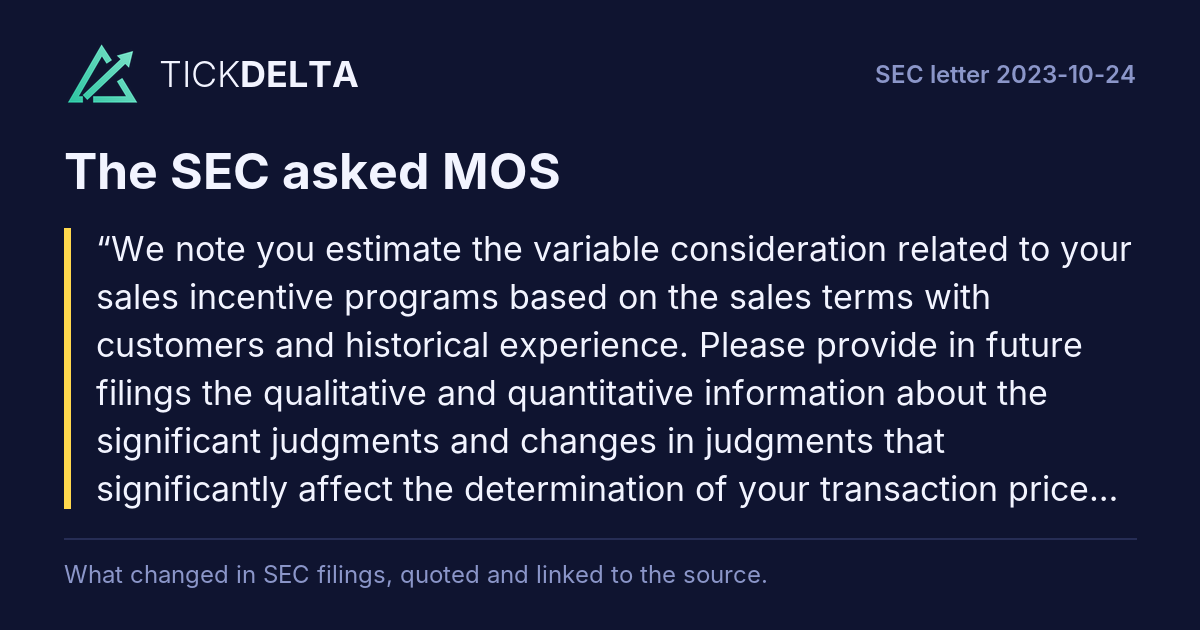
SEC asked (1)
We note you estimate the variable consideration related to your sales incentive programs based on the sales terms with customers and historical experience. Please provide in future filings the qualitative and quantitative information about the significant judgments and changes in judgments that significantly affect the determination of your transaction price, as set forth in ASC 606-10-50-1(b), 50-17(b), and
Rest of the question

50-20(a). Provide us any intended revisions and the calculations used to determine variable consideration.

MOS answered
On behalf of The Mosaic Company (the “Company” or “Mosaic” or “we”), we hereby submit our response to comments received from the Staff of the Securities and Exchange Commission (the “Commission”) by letter dated October 24, 2023. Form 10-K for the Fiscal Year Ended December 31, 2022, filed February 23, 2023 Notes to the Consolidated Financial Statements We note you estimate the variable consideration related to your sales incentive programs based on the sales terms with customers and historical experience.
Rest of the letter

Please provide in future filings the qualitative and quantitative information about the significant judgments and changes in judgments that significantly affect the determination of your transaction price, as set forth in ASC 606-10-50-1(b), 50-17(b), and 50-20(a). Provide us any intended revisions and the calculations used to determine variable consideration. Sales incentives are volumetric based annual programs with key customers and are recorded as a reduction of revenue at the time of sale. Significant judgment for accruing sales incentives is not required due to their non-complex nature and the fact that the incentive is volumetric based. Accordingly, there have not been significant changes in the amounts recorded for sale incentive programs. Historically, sales incentives have accounted for 1% or less of total sales revenue and therefore have not been material to total sales revenue. Further quantitative and qualitative disclosure on sales incentives as set forth in ASC 606-10-50-1(b), 50-17(b), and 50-20(a) is considered immaterial. Set forth below is proposed wording to include in future filings to the significant accounting policy on Revenue Recognition: “Sales incentives are volumetric based annual programs and recorded as a reduction of revenue at the time of sale. Historically, sales incentives have represented 1% or less of total revenue and there have not been significant adjustments to such estimates in the financial statements.” Note 6. Property, Plant and Equipment, page F-51 Please tell us whether any of the mineral properties and rights relate to mines in the exploration and evaluation phase or development and construction phase, and provide us a brief analysis related to separately disclosing the amounts for these components in future filings, if applicable. The nature of Mosaic’s mining operations is well established and does not involve material exploration activities due to our mature industry and the nature of our potash and phosphate mining techniques. We currently have no material new mine development projects. When we transition to new mining areas within our current properties, we incur minimal pre-mining costs related to the permitting process and surface land preparation activities such as water management control and construction of roads and access points. These costs are capitalized as part of our mineral properties and rights. Mineral properties and rights at our operations include mineral reserves and mineral resources. Mineral reserves are scheduled to be mined and are subject to depletion. Mineral resources have not yet been scheduled in formal mine plans and therefore are not subject to depletion. At the end of 2022 and 2021, the carrying value of mineral resources was approximately 5% of net Property, Plant and Equipment. We do not separately provide quantitative information about our resources and reserves because such information is not material. As noted above, substantially all mining properties are classified as production stage. Araxa/Patrocinio is a small operating mine in Brazil that currently does not meet the economic criteria for mineral reserves under Regulation S-K 1300 and therefore is required to be classified as an exploration stage mine. The classification of Araxa/Patrocinio as an exploration stage mine does not impact the financial statements as we apply depletion expense at this site to reflect the exhaustion of the natural mineral deposits. Set forth below is proposed language to be included in future filings (with proposed additional language bolded) to the significant accounting policy on Property, Plant and Equipment: “Currently, we do not have any material exploration or development stage mining projects. When we transition to new mining areas within our current properties, we incur minimal pre-mining costs related to the permitting process and land preparation activities such as water management control and construction of roads and access points. These costs are capitalized as part of our mineral properties and rights. Mineral properties and rights at our operations include mineral reserves and mineral resources. Mineral resources have not yet been scheduled in formal mine plans and therefore are not subject to depletion. Depletion expenses for mining operations, including mineral reserves, are generally determined using the units-of-production method based on estimates of proven and probable reserves.” Please provide us and disclose in future filings your accounting policy related to mining operations or clarify why additional disclosure is not necessary. For example, identify and describe (i) the different stages of your mining operations, (ii) the types of costs incurred in each stage, and (iii) the accounting for the costs incurred in each stage. The different phases of our mining operations are exploration, mine development and production. As discussed in Comment 2, substantially all our mining properties are in the production stage, and we currently have no material exploration activities or mine development projects. Exploration costs are not material and are expensed as incurred. Mine development costs such as stripping activities are capitalized as part of our mineral properties and rights, and amortization of such costs begins when the mine enters the production phase. The production phase is our commercial extraction operation and costs in this phase are reflected in cost of goods sold. Depletion expenses for mining operations, including mineral reserves, are generally determined using the units-of-production method based on estimates of proven and probable reserves. Please refer to Comment 2 for the proposed language to be included in future filings to the significant accounting policy on Property, Plant and Equipment and Recoverability of Long-Lived Assets. As it relates to your disclosure on page F-44, please clarify for us and in future filings your reference to recoverable reserves. That is, address whether recoverable reserves refer to proven and probable mineral reserves or something greater or less than proven and probable reserves. We believe that the terminology of “recoverable reserves” is synonymous with the term “proven and probable reserves.” In future filings, we will refer to reserves as “proven and probable reserves”. We hope that the Commission Staff finds this letter to be fully responsive to the matters raised in your October 24, 2023 letter. Should you have any further questions or comments, please contact the undersigned at 610-737-7718 or email at russ.flugel@mosaicco.com.

One letter for all the questions, without numbered answers. Read the reply ↗
In its next report

First report after the company's reply of 2023-11-02: 10-Q filed 2023-11-08 ↗, against the 10-Q filed 2023-08-02 ↗.

Tickdelta does not hold the text of both reports, so they are not compared here.
Note 6. Property, Plant and Equipment, page F-51
SEC asked (2)
Please tell us whether any of the mineral properties and rights relate to mines in the exploration and evaluation phase or development and construction phase, and provide us a brief analysis related to separately disclosing the amounts for these components in future filings, if applicable.
MOS answered

See the reply above.

In its next report

First report after the company's reply of 2023-11-02: 10-Q filed 2023-11-08 ↗, against the 10-Q filed 2023-08-02 ↗.

Tickdelta does not hold the text of both reports, so they are not compared here.

Note 6. Property, Plant and Equipment, page F-51
SEC asked (3)
Please provide us and disclose in future filings your accounting policy related to mining operations or clarify why additional disclosure is not necessary. For example, identify and describe (i) the different stages of your mining operations, (ii) the types of costs incurred in each stage, and (iii) the accounting for the costs incurred in each stage.
MOS answered

See the reply above.

In its next report

First report after the company's reply of 2023-11-02: 10-Q filed 2023-11-08 ↗, against the 10-Q filed 2023-08-02 ↗.

Tickdelta does not hold the text of both reports, so they are not compared here.

Note 6. Property, Plant and Equipment, page F-51
SEC asked (4)
As it relates to your disclosure on page F-44, please clarify for us and in future filings your reference to recoverable reserves. That is, address whether recoverable reserves refer to proven and probable mineral reserves or something greater or less than proven and probable reserves.
MOS answered

See the reply above.

In its next report

First report after the company's reply of 2023-11-02: 10-Q filed 2023-11-08 ↗, against the 10-Q filed 2023-08-02 ↗.

Tickdelta does not hold the text of both reports, so they are not compared here.

Also in this review: closing letter, 2023-11-14
Form 10-K for the Fiscal Year Ended December 31, 2019

2020-05-27 to 2020-09-02 · 5 questions · 2 letters from the SEC, 2 from the company
Review closed 2020-09-02
Reserves and insuranceSegmentsRevenueLiquidity and cashResults discussion (MD&A)Inventory
Form 10-K for the Fiscal Year Ended December 31, 2019 Filed February 20, 2020 · Item 1. Business, page 1
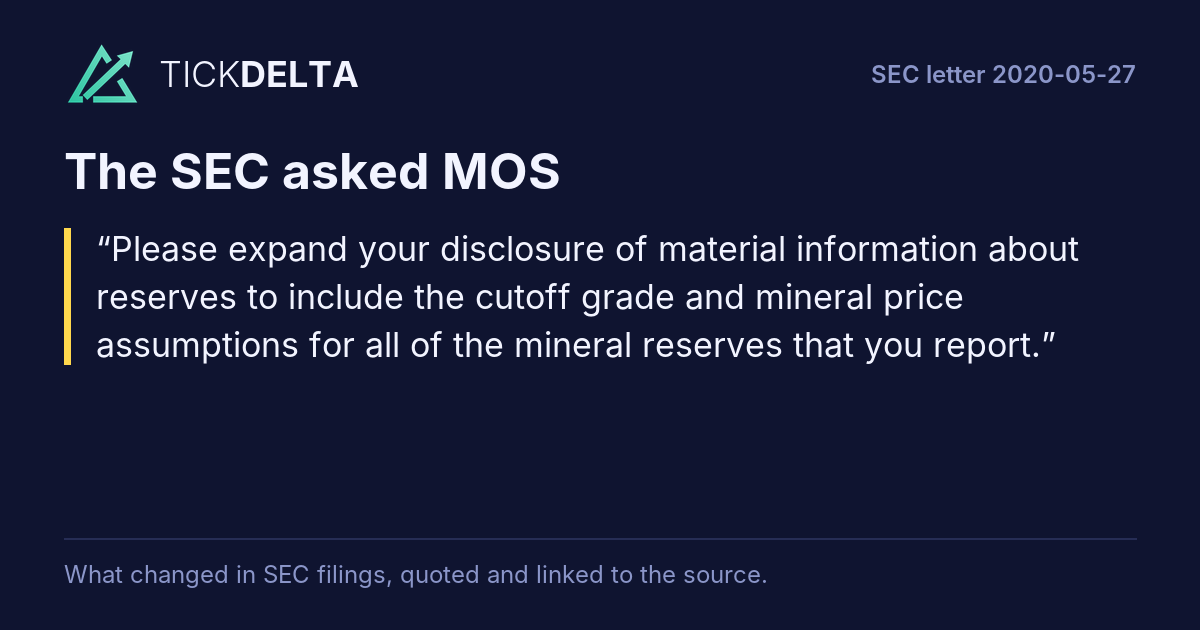
SEC asked (1)
Please expand your disclosure of material information about reserves to include the cutoff grade and mineral price assumptions for all of the mineral reserves that you report.
MOS answered
As requested by the Staff on June 16, 2020, during a telephone conversation with John Coleman, George Schuler, and Craig Arakawa, the following is a brief summary of why Mosaic does not report cutoff grades and mineral price assumptions.

Mosaic’s Potash segment is vertically integrated and the mined product is used to manufacture potash fertilizer. The potash beds in Saskatchewan are very extensive, covering dozens of kilometers. Our exploration techniques for calculating reserves and resources include vertical drill holes and tightly spaced “3D” seismic surveys.
Rest of the answer

Areas within 1 mile radius of the drill holes are considered reserve, and the 3D seismic surveys provide proof of continuity of the beds over large distances. These seismic coverage areas outside of drill hole coverage are considered resources. We have over 50 years of experience determining reserve and resource areas, as well as avoiding anomalous geology. The potash is mined on one level, and we are always able to mine within the appropriate grade range required for the production of potash fertilizer with minimal waste created. Due to the extensive nature of the beds, and relatively consistent grades, the calculation of a cutoff grade is not necessary.

Mosaic’s Phosphate segment is vertically integrated. The phosphate mined is used internally for the manufacture of phosphate fertilizers and animal feed ingredients. Therefore, the determination of phosphate rock value is not as straightforward as, for example, a base metal. In that case a clearer connection exists between cutoff grade and mineral price assumptions. Consistent with other past and present producers in Florida, Mosaic reports reserves on a product or beneficiated basis and not in-situ as substantial amounts of phosphate exist within the finest size fractions and, when beneficiated, are lost in waste streams. This methodology is consistent with over 30 years of US Geological Survey reporting. Reserve determinations are not solely based on the concentration of phosphate. Impurities such as MgO, Fe2O3 and Al2O3 exist in phosphate rock and, in high enough concentrations, are detrimental to the fertilizer manufacturing process. As such, even areas of high phosphate concentration can be deemed unminable if these impurities exceed certain thresholds. Other factors including mining depth, stripping ratio and accessibility are also considered in the reserving process.

The Mosaic Fertilizantes segment is also vertically integrated. Similar to the Phosphates segment, the phosphates mined is used internally for the manufacture of phosphate fertilizer and animal feed ingredients and the determination of phosphate rock value is not as straightforward as, for example, a base metal. A clear connection does not exist between cutoff grade and mineral price assumptions. However, unlike the Phosphates segment, cutoff grades are used by the Mosaic Fertilizantes segment to determine mineral reserves. The mineralization of the phosphate ore varies based on the weathering profile at these mine sites and based on this variation, a cutoff grade of 5% P2O5 or 7% P2O5 (in situ, based on site) is used. The P2O5 cutoff grade is used in conjunction with limits for the Calcium-to-Phosphate Ratio (CPR), MgO content, and various other metal contents when determining the mineral reserves. These cutoff grades are set to ensure the phosphate concentrate grade limitations required by the chemical plants to produce fertilizer products is met. Mosaic Fertilizantes’ Potash mine also uses a cutoff grade that was adopted as a minimum feed grade required to manufacture fertilizer products. Therefore, in future Form 10-K filings we will include in the Mosaic Fertilizantes Segment under the reserve table on page 20, footnote (d) that notes phosphates cutoff grades and on page 21, under the discussion of Reserves related to the potash mine the potash cutoff grade, as shown in the response to question number 3 below.

Read in the reply ↗
In its next report

First report after the company's reply of 2020-06-23: 10-Q filed 2020-08-04 ↗, against the 10-Q filed 2020-05-05 ↗.

Tickdelta does not hold the text of both reports, so they are not compared here.

Mosaic Fertilizantes Segment, page 16
SEC asked (2)
We note your disclosure of mineral reserves for your Brazilian phosphate and potash mines. Please forward to our engineer as supplemental information and not as part of your filing, the information that establishes the legal, technical, and economic feasibility of your materials designated as reserves, as required by paragraph (c) of Industry Guide 7.
Rest of the question

The information requested includes, but is not limited to: • Property and geologic maps • Description of your sampling and assaying procedures • Drill-hole maps showing drill intercepts • Representative geologic cross-sections and drill logs • Description and examples of your cut-off calculation procedures • Cutoff grades used for each category of your reserves and resources • Justifications for the drill hole spacing used to classify and segregate proven and probable reserves • A detailed description of your procedures for estimating reserves • Copies of any pertinent engineering or geological reports, and executive summaries of feasibility studies or mine plans including the cash flow analyses • A detailed permitting and government approval schedule for the project, particularly identifying the primary environmental or construction approval(s) and your current location on that schedule. Please provide the name and phone number for a technical person our engineer may call if he has technical questions about your reserves. You may ask to have this information returned by making a written request at the time it is furnished, as provided in Rule 12b-4 of Regulation 12B.

MOS answered
On June 16, 2020, we advised the Staff in a telephone conversation with John Coleman, George Schuler, and Craig Arakawa, that the Company will submit to the Staff the requested supplemental information on or before June 23, 2020. We hereby inform the Staff that on June 23, 2020 we provided to Messrs. Coleman, Schuler and Arakawa the requested supplemental information through access to a secure data site pursuant to Rule 12b-4 of Regulation 12B under the Securities Exchange Act of 1934, as amended.

For technical questions concerning Mosaic Fertilizantes reserves please call Brian Ball,
Rest of the answer

Director Mine Strategy – North America Operations, who can be reached at 863-559-2021.

Read in the reply ↗
In its next report

First report after the company's reply of 2020-06-23: 10-Q filed 2020-08-04 ↗, against the 10-Q filed 2020-05-05 ↗.

Tickdelta does not hold the text of both reports, so they are not compared here.

Mosaic Fertilizantes Segment, page 16
SEC asked (3)
Please separate your mineral reserves into individual proven or probable categories unless the difference in degree of assurance between the two classes of reserves cannot be readily defined. See the Instructions to paragraph (b)(5) of Industry Guide 7. Notes to the Consolidated Financial Statements 26. Business Segments, page F-88
MOS answered
The Company acknowledges the Staff’s comment and in accordance with paragraph (b) (5) of Industry Guide 7, in future Form 10-K filings we will include in the Mosaic Fertilizantes Segment under the reserve table on page 20, footnote (c) that separates our proven and probable phosphates reserves as noted below. This treatment is similar to how it is reported for the Phosphates and Potash segments.
Rest of the answer

Revised material or additions to the current material are italicized.

The following table sets forth our proven and probable phosphates reserves as of December 31, 2019:

(tonnes in millions)

Reserve Tonnes (a)(b)(c)(d)

%

P2O5

Active Mines

Catalão

71.4

11.1

Tapira

619.5

7.6

Araxá

15.6

11.8

Patrocínio(e)

478.4

12.1

Cajati

70.8

5.1

Total Mines

1,255.7

9.4

______________________________

(a)Tonnage is stated in millions of run of mine dry metric tons and Grade is % P205, after adjustments for depletion, mining dilution and recovery.

(b)Mineral reserves were audited by external consulting firms.

(c)Of the reserves shown, 507.4 million tonnes are proven reserves, while probably reserves totaled 748.3 million tonnes.

(d)The cutoff grade for mineral reserves for each deposit is: Araxá - 5.0% P2O5; Cajati - 3.0% P2O5; Catalão - 7.0% P2O5; Patrocínio - 5.0% P2O5; and Tapira - 5.0% P2O5.

(e)The declared reserves correspond to the original scope of the Patrocinio project.

In addition, on page 21, under the discussion of Reserves related to our Brazilian potash mine, we would revise our disclosure as follows:

Reserves

Our estimate of potash reserves is based on exploration drill hole data, seismic data and actual mining results. We believe that all reserves are potentially recoverable using existing production and refinery locations. As of December 31, 2019, we had proven reserves of 5.5 million tonnes and probable reserves of 4.0 million tonnes with an average KCL grade of 23.75%. The cutoff grade is 20% KCI. Based on current estimates, we believe the reserves will be exhausted in 2023.

Notes to the Consolidated Financial Statements

26. Business Segments, page F-88

Read in the reply ↗
In its next report

First report after the company's reply of 2020-06-23: 10-Q filed 2020-08-04 ↗, against the 10-Q filed 2020-05-05 ↗.

Tickdelta does not hold the text of both reports, so they are not compared here.

Mosaic Fertilizantes Segment, page 16
SEC asked (4)
You state on page F-22 that you sell most of your export sales of potash crop nutrients through a North American export association, Canpotex. On page F-89 you disclose that you recorded Canpotex sales of $952 million in 2019, which appears to be included in your Net Sales line item on your Statements of Operations.
Rest of the question

You also state on pages F-56- F-57 that you account for your 36.2% interest in Canpotex under the equity method of accounting. Please clarify for us your accounting treatment relating to your interest in Canpotex. In this respect, tell us why your net sales relating to Canpotex do not appear to be included in the line item "Equity in net earnings (loss) of nonconsolidated companies" on your Statements of Operations. If you believe the presentation of the $952 million in Net Sales is appropriate, please clarify how your accounting treatment for the Canpotex sales complies with ASC 606.

MOS answered
As disclosed on page F-45 in Note 1 to our consolidated financial statements included in our Form 10-K, Mosaic is a member of Canpotex Limited (“Canpotex”), who is in the business of purchasing Potash from its two Canadian Potash producing members and selling such Potash for export to destinations outside the United States and Canada. Canpotex is a stand-alone entity with its own assets and employees.

Our 36.2% membership interest in Canpotex provides us with the ability to exercise significant influence over the operating and financial decisions of the business.
Rest of the answer

As such, we apply the equity method of accounting under ASC 323 to account for our investment. The design of Canpotex, however, is to break even and therefore the carrying value of Mosaic’s investment balance and equity earnings or loss is immaterial.

As a member company, we sell Canadian sourced potash to Canpotex. In accordance with ASC 606 and ASC 323, we recognize revenue from these sales upon delivery by Canpotex to the unrelated third party customer. Sales of potash to Canpotex, once delivered to the unrelated third party customer, are recognized as a component of Net Sales within our Consolidated Statements of Earnings.

To clarify our accounting policies related to our equity investment in Canpotex, in future Form 10-K filings we will expand the disclosure in the note discussing Investments in Non-Consolidated Companies to include the following statement:

Canpotex is the export association of the Saskatchewan potash producers and operates as a break-even entity selling potash acquired generally from its members to unrelated third party customers at market prices. Any equity earnings or loss, which have historically been immaterial, are recorded in the equity in net earnings or loss line within the Consolidated Statement of Earnings.

We will also be more descriptive of how we record sales to Canpotex and expand the disclosure in the note discussing Business Segments to read as follows:

Canpotex is the export association of the Saskatchewan potash producers. The net sales of potash from Mosaic to Canpotex included in our consolidated financial statements in the Net Sales line represent Mosaic’s sales of potash to Canpotex, and are recognized upon delivery to the unrelated third party customer. Canpotex sales to the ultimate third party customers are approximately; 25% to customers based in Brazil, 22% to customers based in China, 10% to customers based in India, 8% to customers based in Indonesia and 35% to customers based in the rest of the world.

We hope that the Commission Staff finds this letter to be fully responsive to the matters raised in your May 27, 2020 letter. Should you have any further questions or comments, please contact the undersigned at 763-258-3714 or email at lydia.burke@mosaicco.com.

Read in the reply ↗
In its next report

First report after the company's reply of 2020-06-23: 10-Q filed 2020-08-04 ↗, against the 10-Q filed 2020-05-05 ↗.

Tickdelta does not hold the text of both reports, so they are not compared here.

Form 10-K for the Fiscal Year Ended December 31, 2019 Filed February 20, 2020 · Notes to the Consolidated Financial Statements
SEC asked
Investments in Non-Consolidated Companies, page F-56 1. We refer to your response to our comment number 4. Please address the following: • You state that you carry your investment in Canpotex under the equity method. Per ASC 323-10-35-8 the equity method is a one-line consolidation.
Rest of the question

Tell us why it is appropriate to record the sales to Canpotex and related cost of sales in your financial statements instead of in the line item Equity in net (loss) earnings of nonconsolidated companies. • Tell us how the adoption of ASC 606 by you and Canpotex affected your accounting treatment for your sales. o Tell us why Canpotex is not considered the customer under ASC 606. It appears that upon sale to Canpotex, a distributor, you should determine the transaction price and record the sale following the guidance in ASC 606 and ASC 323-10-35. In this regards, please tell us if you have a contract with Cantopex and what, if any, contracts exist between you and the unrelated third parties. Refer to ASC 606-10-25-1 through 25-8. o You state on page F-56 that "the effects of material intercompany transactions with the equity-method investments are eliminated, including the gross profit on sales to and purchases from your equity-method investments which is deferred until the time of sale to the final third party customer. " You appear to be using the sell-through method in recording your sales through Canpotex. Upon adoption of ASC 606, the sell-through method is no longer appropriate. Please clarify why your revenue recognition when the sales are made to third parties is consistent with ASC 606. o Tell us why you do not recognize your sales to Canpotex at a point in time. Please tell us why the criteria in ASC 606-10-25-30 has not been met. In this respect, we understand that occasionally Canpotex pays Mosaic prior to the third party sales due to your 90-day payment terms, which appears to indicate that Canpotex has control of the inventory. o Tell us what estimates are made in determining the variable consideration relating to your sales and provide us a roll-forward of the changes in those estimates for the periods presented. • Please tell us if Canpotex distributes potash for companies other than its two shareholders. • You state that Canpotex is a stand-alone entity with its own assets and employees. As Canpotex appears to be a worldwide distributor of potash, with multiple offices and investments in warehouses and shipment equipment, please help us understand why Canpotex's results of operations are designed to be break-even. • Tell us why you carry your investment in Canpotex at zero and how that is consistent with ASC 323. • You state on page 13 that you owned 38.1% of Canpotex in the first half of 2017 and that on July 1, 2017, it decreased to 36.2%. Please reconcile your disclosure with the discussion on Canpotex's website, which appears to indicate you owned 50% since 2018. Clarify why using your proven peak capacity for determining equity ownership is consistent with ASC 323-10. Tell us what percentage is used to determine your significant influence over operating and financing policies of Canpotex.

MOS answered
We understand that a sales transaction with an equity method investee is within the scope of ASC 606 so long as it meets the relevant criteria to be defined as a contract with a customer. Canpotex has agreed to obtain potash from Mosaic in exchange for monetary consideration and Canpotex meets the definition of a customer as defined in ASC 606-10-20 and further discussed in question 3 below.
Rest of the answer

Therefore, we have concluded that Canpotex meets the definition of a customer and the Canpotex agreement and sales orders executed under the Canpotex agreement meet the requirements to be considered contracts and accounted for under the provisions of ASC 606. The net sales of Mosaic potash included in our consolidated financial statements in the Net Sales line represent Mosaic’s sales of potash to Canpotex that do not include an intra-entity profit element that is required by ASC 323-10-35-7 to be eliminated. Intra-entity profit is only eliminated on assets still remaining with an investee. Therefore, when Canpotex no longer has control of the related inventory, the Company recognizes the profit and presents the transaction in Net Sales. Canpotex no longer has control of the related inventory upon delivery to Canpotex’ unrelated third party customers. The Net Sales amount does not represent our 36.2% interest in the Canpotex legal entity. Our share of any equity earnings or loss, which historically have been insignificant as Canpotex operates as a break-even distribution/selling entity, are recorded in the equity in net earnings or loss line within the consolidated statement of earnings.

Question 2

•Tell us how the adoption of ASC 606 by you and Canpotex affected your accounting treatment for your sales.

Response:

The adoption of ASC 606 by Mosaic did not affect our recognition of revenue related to potash sales to Canpotex as control is transferred to Canpotex under ASC 606 at the same time as the recognition of revenue under previous guidance. Additionally, we applied the guidance in ASC 323 to eliminate intra-company transactions in a consistent manner both before and after the adoption of ASC 606. However, Canpotex was affected by their adoption of the new revenue standard, as they concluded that control does not transfer until it is delivered to the end customer. This affected the amount of the Company’s intra-entity profit elimination because the change increases the amount of Canpotex inventory at the end of a reporting period. Because the Company cannot record intra-entity profit on sales to Canpotex when Canpotex still controls the inventory, Canpotex’ adoption of ASC 606 has the effect of deferring profits in our consolidated statement of earnings as of adoption at January 1, 2018. This resulted in an initial deferral on approximately 400,000 tonnes as of adoption, as we noted in our first quarter 2018 Form 10-Q filing.

Question 3

•Tell us why Canpotex is not considered the customer under ASC 606. It appears that upon sale to Canpotex, a distributor, you should determine the transaction price and record the sale following the guidance in ASC 606 and ASC 323-10-35. In this regards, please tell us if you have a contract with Canpotex and what, if any, contracts exist between you and the unrelated third parties. Refer to ASC 606-10-25-1 through 25-8.

Response:

A customer is defined in ASC 606-10-20 as “...A party that has contracted with an entity to obtain goods or services that are an output of the entity’s ordinary activities in exchange for consideration.” Given that Mosaic’s ordinary activities include the mining of potash and combined with the terms of the contract, we have concluded that Canpotex meets the definition of a customer.

Sales to Canpotex are governed by the Canpotex Producer agreement, an annual Product Supply Agreement and individual sales orders executed under the Canpotex agreement which, in combination, meet the criteria defined in ASC 606-10-25-1(a) through (e) to be accounted for under the provisions of ASC 606. Mosaic does not have any contracts, written, oral, or implied based on customary business practices, with Canpotex’s unrelated third party customers.

We recognize revenue related to the sale of potash to Canpotex in accordance with the 5-step process identified in ASC 606. Revenue under ASC 606 is earned when control of the inventory transfers to Canpotex. However, at the end of the reporting period, we eliminate profits in accordance with the guidance in ASC 323-10-35 by presenting the intra-entity profit elimination as a reduction of revenue and costs of goods sold for inventory not yet sold to Canpotex’s third party customers, as we described above.

Question 4

•You state on page F-56 that "the effects of material intercompany transactions with the equity-method investments are eliminated, including the gross profit on sales to and purchases from your equity-method investments which is deferred until the time of sale to the final third party customer." You appear to be using the sell-through method in recording your sales through Canpotex. Upon adoption of ASC 606, the sell-through method is no longer appropriate. Please clarify why your revenue recognition when the sales are made to third parties is consistent with ASC 606.

Response:

The Company does not recognize revenue under the sell-through method. Rather, Mosaic initially recognizes revenue related to Canpotex sales at a point in time when control of the product is transferred to Canpotex, as determined based on the indicators identified in ASC 606-10-25-30(a) through (e). However, Mosaic has concluded that because of its relationship and arrangements with Canpotex, sales to Canpotex are not at arm’s length and are subject to intra-entity eliminations in accordance with ASC 323-10-35-10. The effect of this intra-entity elimination (as described above) is that sales related to inventory Canpotex still controls at the end of the reporting period, are not presented in Net Sales. The profit (and related revenue and cost of sales as described above) is recognized under ASC 323 when the sale has been recognized by Canpotex upon delivery to the unrelated third party customers.

Question 5

•Tell us why you do not recognize your sales to Canpotex at a point in time. Please tell us why the criteria in ASC 606-10-25-30 has not been met. In this respect, we understand that occasionally Canpotex pays Mosaic prior to the third party sales due to your 90-day payment terms, which appears to indicate that Canpotex has control of the inventory.

Response:

As discussed in question 4, we recognize revenue at a point in time when control of the product is transferred to Canpotex, as determined based on the indicators identified in ASC 606-10-25-30(a) through (e). We believe that the recognition criteria has been met at the point of shipment and we acknowledge that Canpotex does have control of the inventory at that time.

Question 6

•Tell us what estimates are made in determining the variable consideration relating to your sales and provide us a roll-forward of the changes in those estimates for the periods presented.

Response:

The variable consideration related to Canpotex sales is insignificant. There are sales incentives in certain circumstances, however they do not apply to Canpotex.

Question 7

•Please tell us if Canpotex distributes potash for companies other than its two shareholders.

Response:

Canpotex does not distribute potash for any companies other than its two shareholders.

Question 8

•You state that Canpotex is a stand-alone entity with its own assets and employees. As Canpotex appears to be a worldwide distributor of potash, with multiple offices and investments in warehouses and shipment equipment, please help us understand why Canpotex's results of operations are designed to be break-even.

Response:

Canpotex was formed to create value for the shareholders by pooling the resources needed to efficiently supply offshore markets with potash from Canada and compete with other international suppliers of potash products. Canpotex manages and operates a fleet of customized railcars, port terminal facilities, ocean vessels and more assets which are required to distribute potash products. The shareholders did not intend it to be a profit-making entity. The objective of Canpotex is to break-even and all profits from the sales of potash products are recognized by the shareholders. This is one reason why the Company believes the sales transactions with Canpotex are not at arm’s length and therefore full intra-entity profit elimination is required by ASC 323.

Question 9

•Tell us why you carry your investment in Canpotex at zero and how that is consistent with ASC 323.

Response:

Mosaic’s investment in Canpotex is insignificant due to Canpotex’s net equity position being essentially zero. The Company measured their initial investment in Canpotex in accordance with ASC 323-10-30-02, and we recorded adjustments to reflect our share of their equity position. There was no investment required from the producer shareholders upon formation of Canpotex and as noted in the above response, Canpotex operates on a break-even basis, with insignificant equity earnings.

Question 10

•You state on page 13 that you owned 38.1% of Canpotex in the first half of 2017 and that on July 1, 2017, it decreased to 36.2%. Please reconcile your disclosure with the discussion on Canpotex's website, which appears to indicate you owned

50% since 2018. Clarify why using your proven peak capacity for determining equity ownership is consistent with ASC 323-10. Tell us what percentage is used to determine your significant influence over operating and financing policies of Canpotex.

Response:

Under ASC 323-10-15-6 and 15-7, the percentage used to determine Mosaic’s significant influence over operating and financing policies of Canpotex is the 50% joint ownership. Each shareholder, in accordance with the shareholder agreement, has equal power to direct the activities of Canpotex that impact its economic performance. However, the economic benefits from Canpotex, how much potash product (volumes) is purchased by Canpotex, is determined based upon the members’ respective proven peaking capacities for producing potash. When a Canpotex member expands its production capacity, the new capacity may be added to that member’s proven peaking capacity based on a proving run at the maximum production level if certain criteria are met that are identified in the Producer Agreement. Mosaic’s economic share of Canpotex’s purchases was 38.1% in the first half of 2017 and, on July 1, 2017, it decreased to 36.2% (and has remained at that level) as a result of the other member’s expanded capacity. The 36.2% is Mosaic’s economic interest in Canpotex, although given Canpotex operates on a break-even basis, equity earnings are insignificant.

We hope that the Commission Staff finds this letter to be fully responsive to the matters raised in your July 22, 2020 letter. Should you have any further questions or comments, please contact the undersigned at 763-258-3714 or email at lydia.burke@mosaicco.com.

Read in the reply ↗

Also in this review: request for more time, 2020-06-02, request for more time, 2020-07-31, closing letter, 2020-09-02

Form 10-K

2015-04-20 to 2015-05-18 · 2 questions · 1 letter from the SEC, 1 from the company
Review closed 2015-05-18
SegmentsRevenue
Business Segment Information · Phosphates Segment page 9
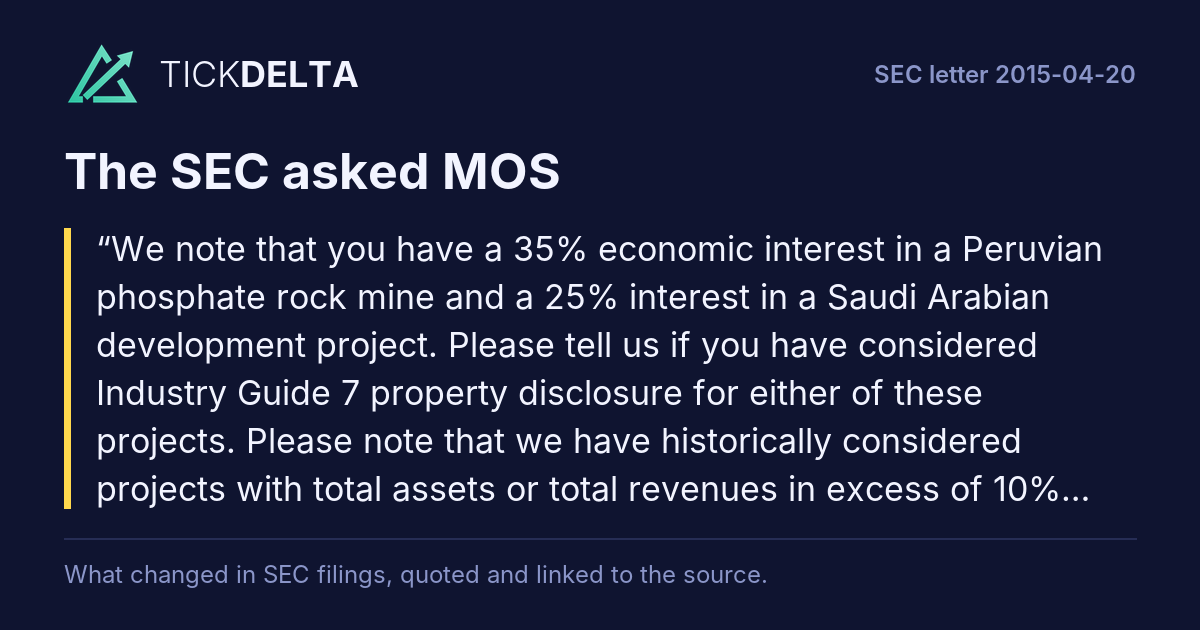
SEC asked (1)
We note that you have a 35% economic interest in a Peruvian phosphate rock mine and a 25% interest in a Saudi Arabian development project. Please tell us if you have considered Industry Guide 7 property disclosure for either of these projects.
Rest of the question

Please note that we have historically considered projects with total assets or total revenues in excess of 10% of total assets or total revenues to be significant when considering Industry Guide 7 property disclosure.

MOS answered
We have considered Industry Guide 7 property disclosure for both the Peruvian phosphate rock mine and the Saudi Arabian development project and have determined such disclosure is not required for either project. On an individual basis, each project represents less than 5% of total assets and less than 5% of total revenues. Read in the reply ↗
In its next report

First report after the company's reply of 2015-05-12: 10-Q filed 2015-08-04 ↗, against the 10-Q filed 2014-10-30 ↗.

Tickdelta does not hold the text of both reports, so they are not compared here.

Potash Segment page 16
SEC asked (2)
We note your disclosure of 3,695 million tonnes of potash mineralization and the boundary associated with this mineralization. Please tell us if this number includes inferred mineral resources. Please note that measured and indicated resources labeled as mineralized materials have historically been permitted to be disclosed in US filings. However inferred resources should not be combined with these estimates.
MOS answered
By way of background, the Company was incorporated in March 2004 and serves as the parent company of the business that was formed through the October 2004 combination of IMC Global Inc. (“IMC”) and the fertilizer businesses of Cargill, Incorporated.

The disclosure referenced in the 2015 Comment Letter regarding our potash mineralization and the boundary associated with this mineralization is based on and is substantially similar to disclosure regarding IMC’s potash mineralization and the boundary associated with that mineralization (the “2004 Disclosure”) that was included in an amendment to
Rest of the answer

IMC’s Form 10-K for the fiscal year ended December 31, 2003 (the “2003 10-K”) in response to comments received by IMC in connection with the Staff (the “Staff”) of the Securities and Exchange Commission’s (“SEC”) review (the “2004 Review”) of a Registration Statement on Form S-4 filed by IMC in 2004, as well as the 2003 10-K.

During the 2004 Review process and before filing its 2003 10-K amendment, IMC provided the 2004 Disclosure to the Staff as proposed disclosure responsive to the Staff’s comments. The proposed disclosure reflected IMC's reclassification of certain previously reported reserves as non-reserve potash mineralization based on correspondence and conversations with the Staff. Once IMC understood that the Staff had no further comments, the 2003 10-K amendment was filed. Since that time, the Company’s annual reports on Form 10-K filed with the Commission have contained substantially similar disclosure regarding our non-reserve potash mineralization. As we indicated during our telephone conference with John Coleman, Mining Engineer, we also confirm that our methods of estimating our non-reserve potash mineralization are substantially the same now as they were at the time of the 2004 Review.

********

As requested in the 2015 Comment Letter, we hereby acknowledge that:

the Company is responsible for the adequacy and accuracy of the disclosure in its filings;

Staff comments or changes to disclosure in response to Staff comments do not foreclose the Commission from taking any action with respect to the filing; and the Company may not assert Staff comments as a defense in any proceeding initiated by the Commission or any person under the federal securities laws of the United States.

If you have any additional questions or comments, please contact me at 763/577-2829, or email me at Tony.Brausen@mosaicco.com.

Read in the reply ↗
In its next report

First report after the company's reply of 2015-05-12: 10-Q filed 2015-08-04 ↗, against the 10-Q filed 2014-10-30 ↗.

Tickdelta does not hold the text of both reports, so they are not compared here.

Also in this review: request for more time, 2015-05-01, closing letter, 2015-05-18

From the SEC's correspondence on EDGAR: staff letters (form UPLOAD) and company letters (form CORRESP), 14 letters filed since 2015-04-20. Questions and answers are matched by their numbers; topics come from words in each question. The reports are compared word for word (same form, before the first SEC letter against the first report after the company's reply). No AI.

Work on MOS in a spreadsheet: Excel workbook (a sheet per section, ten years by column, charts, links to the filings) · CSV. For a Google Sheet that stays up to date, paste =IMPORTDATA("https://tickdelta.com/company/MOS/export.csv") into a cell.