Paragraph 157 · 42% changed
Every version of it
Screener
/
SEC EDGAR
/CIK 0001522540
/10-K filed Feb 24, 2026, compared with Feb 26, 2025
/Numbers from the XBRL of the 10-Ks
Nasdaq
Technology · Software
Marqeta, Inc. MQ
The 10-K against last year's
118 changes: 18 added, 8 removed, 91 reworded, 1 quiet changes
10-K Feb 24, 2026 vs Feb 26, 2025
Risk Factors
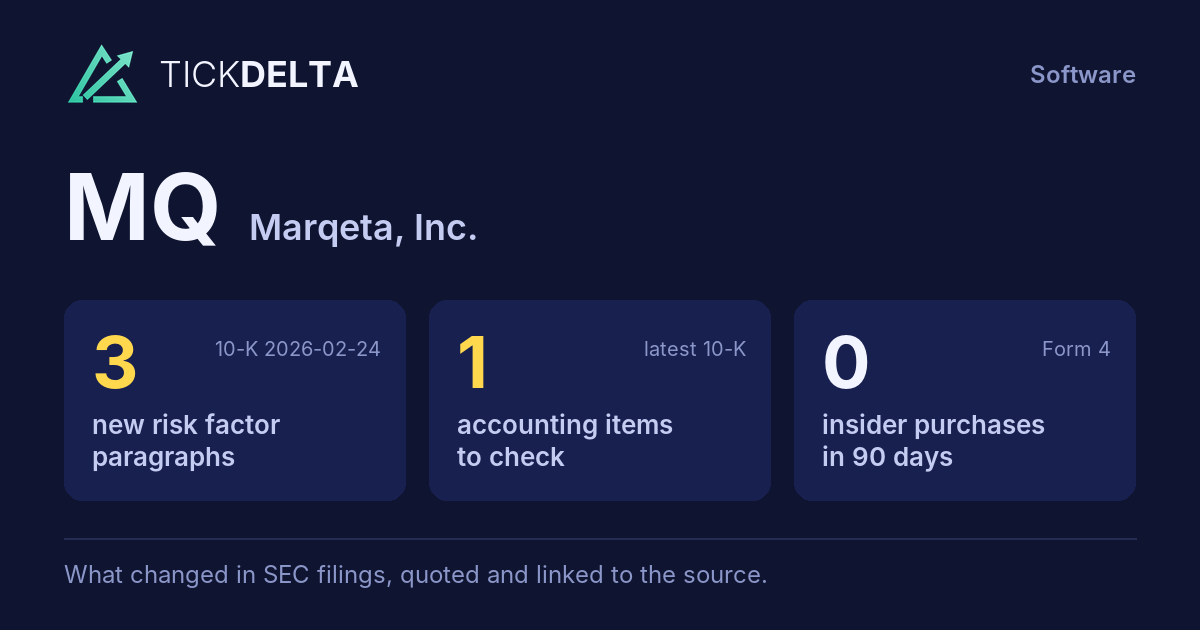
6.1%
of the text changed · 19,397 words now · 3 new paragraphs, 1 gone
MD&A
32.7%
of the text changed · 6,109 words now · 15 new paragraphs, 7 gone
Legal Proceedings
29.8%
of the text changed · 594 words now
Accounting Policies
27.4%
of the text changed · 5,377 words now
10-K 0001522540-26-000017 (Feb 24, 2026) vs 10-K 0001628280-25-008232 (Feb 26, 2025)
Every paragraph, and how much of it changed
One bar per paragraph, in the order of the 10-K. Height and colour show the share of its words not in the closest paragraph a year earlier; the tallest bars are new paragraphs.
Risk Factors
237 paragraphs · 3 new · 47 reworded · 1 gone · 10-K Feb 24, 2026 against Feb 26, 2025
New paragraph
Reworded (5% of its words or more)
Same or nearly
Paragraph 176 · 42% changed
Every version of it
Additionally, successful assertion by one or more states, or foreign jurisdictions, requiring us to collect sales, value added, or similar indirect taxes where we presently do not do so, or to collect more of such indirect taxes in a jurisdiction in which we currently do collect some indirect taxes, could result in substantial tax liabilities, including taxes on past sales, as well as penalties and interest. Also, any change to applicable tax laws or successful challenge to how or where our profits are currently recognized, could increase our overall taxes, and our business, financial condition, or results of operations may be adversely impacted. For example, the Organization for Economic Co-operation and Development (the "OECD") has proposed a global minimum tax rate of 15% ("Pillar Two"), which has been, and is being adopted by multiple jurisdictions. On January 5, 2026, the OECD announced a “side-by-side” elective safe harbor that exempts U.S.-parented multinational entities (like us) from certain provisions of Pillar Two for fiscal years beginning on or after January 1, 2026.
Paragraph 175 · 31% changed
Every version of it
We are subject to income taxes in the United States and numerous foreign jurisdictions. Our domestic and international tax liabilities are dependent upon the location of earnings among these different jurisdictions. Any changes in tax legislation, regulations, policies, or practices in the jurisdictions in which we operate could increase our effective tax rate and materially increase the amount of taxes we owe, thereby negatively impacting our results of operations as well as our cash flows from operations. For example, on July 4, 2025, H.R. 1, also known as the “One Big Beautiful Bill Act,” was enacted into law, making a number of changes to U.S. federal income tax law, including permanently suspending the requirement to capitalize and amortize domestic research and development expenditures and permitting such deductions on a current basis. However, due to our full valuation allowance on our deferred tax assets, these changes did not have a significant impact on our financial position or results of operations.
Paragraph 85 · 30% changed
Every version of it
Paragraph 235 · 28% changed
Every version of it
Weak economic conditions may make it more difficult to collect on outstanding accounts receivable. The global credit and financial markets have from time to time experienced extreme volatility and disruptions, including severely diminished liquidity and credit availability, rising interest and inflation rates, declines in consumer confidence, declines in economic growth, increases in unemployment rates, and uncertainty about economic stability. The bank closures and failures in 2023 created bank-specific and broader financial institution liquidity risk and concerns. Future adverse developments with respect to specific financial institutions or the broader financial services industry may lead to market-wide liquidity shortages, impair the ability of companies to access near-term working capital needs, and create additional market and economic uncertainty.
Paragraph 111 · 27% changed
Every version of it
Changes in our executive management team may also disrupt our business. Any employment agreements we have with our executive officers or other key personnel do not require them to continue to work for us for any specified period and, therefore, they could terminate their employment with us at any time. We have in the past, recently experienced, and may in the future, experience continue to experience, high attrition and turnover rates across the Company, including executive officers and other key personnel. For example, we recently appointed a new Chief Financial Officer, effective February 9, 2026. At that time, Mr. Milotich, the Company’s Chief Executive Officer and Chief Financial Officer, ceased serving in the Chief Financial Officer role and no longer serves as the Company’s principal financial officer. Mr. Milotich continues to serve as the Chief Executive Officer and as a member of the board of directors. Additionally, we have in the past and may continue in the future to periodically reorganize the Company’s departments in an effort to increase efficiencies or better serve our customers. The loss of these employees executive officers and key personnel may lead to a decrease in institutional knowledge which may adversely affect our business. Additionally, we do not maintain any key person insurance policies.
Paragraph 84 · 26% changed
Every version of it
We have incorporated and may continue to incorporate AI solutions and features into our platform or other offerings, and otherwise within our business, and these solutions and features may become more important to our operations or to our future growth over time. There can be no assurance that we will realize the desired or anticipated benefits from AI and we may fail to properly develop, implement or market our AI solutions and features or to do so in a cost-effective manner. Additionally, we may fail to offer the AI solutions and features that our customers and potential customers expect or adopt. Our competitors or other third parties may incorporate AI into their products, offerings, and solutions more quickly or more successfully than we do, which could impair our ability to compete effectively, and adversely affect our results of operations. Additionally, our AI solutions and features may expose us to additional claims, demands, and proceedings by private parties and regulatory authorities and subject us to legal liability as well as brand and reputational harm. For example, if AI models used in our products or other offerings are incorrectly designed, the data we use to train them is incomplete or inadequate, the outputs (including any analysis or recommendations) are or are deemed to be inaccurate or discriminatory, or we do not have sufficient rights to use the data on which our models rely, the performance of our AI solutions and features, as well as our reputation, could suffer or we could incur liability through the violation of contractual or regulatory obligations.
Paragraph 139 · 23% changed
Every version of it
As our business and platform continue to develop and expand, we continue to become subject to additional laws, rules, regulations, and industry standards, including possible additional examination and supervision, in the United States and internationally. For example, in Canada, the Retail Payment Activities Act (the “RPAA”) will subject subjects payment service providers (“PSPs”), including a Marqeta subsidiary, (“PSPs”) to supervision by the Bank of Canada. One of our subsidiaries submitted an application for registration under the RPAA in November 2024, Canada and we and other requires PSPs must to establish, implement, and maintain a risk management and incident response framework that complies with the RPAA RPAA. A Marqeta subsidiary, Marqeta Payments LLC, is registered as a PSP and is subject to these regulatory requirements and supervision. Additionally, TransactPay operates under an EMI license in the UK, Gibraltar, and the EEA. As a result, TransactPay is subject to stringent requirements related to capital adequacy, anti-fraud measures, data security, and transaction monitoring, as well as oversight by September 8, 2025. relevant European financial authorities. New or expanded regulation or changes in interpretation or enforcement of existing regulations may have an adverse effect on our business, results of operations, and financial condition due to increased compliance costs and new restrictions affecting the offering of our platform, products and services.
Paragraph 157 · 42% changed
Every version of it
10-K Feb 26, 2025A portion of our net revenue is derived from Interchange Fees and the amount of Interchange Fees we earn is highly dependent on the interchange rates that the Card Networks set and adjust. Interchange Fees and assessments are subject to change from time to time by the Card Networks and due to government regulation. Interchange Fees have historically been, and continue be, the subject of intense legal and regulatory scrutiny and competitive pressures in the electronic payments industry in the United States and internationally. For example, in the United States, the Durbin Amendment may restrict or otherwise impact the way we do business or limit our ability to charge certain fees to customers. Issuing Banks that are exempt from the Interchange Fee restrictions in the Durbin Amendment are able to access higher interchange rates on debit and prepaid card transactions. As a result, to maximize our Interchange Fees in the United States, we generally only contract with Issuing Banks that are subject to this exemption from the Durbin Amendment when we provide services for debit and prepaid card programs. While these Issuing Banks are currently exempt from the limitations on debit and prepaid card Interchange Fees, and we expect them to continue to be exempt, we can offer no assurance or guarantee that they will remain exempt, and various events outside our control may cause these Issuing Banks to become subject to the interchange fee limits under the Durbin Amendment. In addition, new laws or regulations related to interchange fees may be enacted. For example, Illinois passed the Interchange Fee Prohibition Act (“IFPA”), which prohibits the collection of debit and credit card interchange fees in Illinois for the portion of a card transaction that is attributable to sales taxes, excise taxes and gratuities if the merchant informs the acquiring bank of the amount of these taxes and gratuities. The IFPA is expected to be effective on July 1, 2025, pending ongoing litigation. While any potential reduction in our revenue from the new law in Illinois is not expected to be material, if any additional legislation regulating Interchange Fees is enacted in other jurisdictions, then the portion of our net revenue derived from Interchange Fees may be adversely affected. Further, complying with a patchwork of state laws governing Interchange Fees may create compliance burdens for our Issuing Banks and us, which may adversely affect our business, financial condition, and results of operations.
10-K Feb 24, 2026
Interchange Fees have historically been, and continue to be, the subject of intense legal and regulatory scrutiny and competitive pressures in the payments industry in the United States and internationally. For example, in the UK, the Interchange Fee Regulations may restrict or place caps on the interchange fees which can be charged on a transaction, and in the United States, the Durbin Amendment may restrict or otherwise impact the way we do business or limit our ability to charge certain fees to customers. Issuing Banks that are exempt from the Interchange Fee restrictions in the Durbin Amendment are able to access higher interchange rates on debit and prepaid card transactions, if those transactions meet certain requirements. As a result, to maximize our Interchange Fees in the United States, we generally only contract with Issuing Banks that currently qualify for this exemption from the Durbin Amendment when we provide services for debit and prepaid card programs.
Paragraph 176 · 42% changed
Every version of it
10-K Feb 26, 2025
Additionally, successful assertion by one or more states, or foreign jurisdictions, requiring us to collect sales, value added, or similar indirect taxes where we presently do not do so, or to collect more of such indirect taxes in a jurisdiction in which we currently do collect some indirect taxes, could result in substantial tax liabilities, including taxes on past sales, as well as penalties and interest.
10-K Feb 24, 2026
Additionally, successful assertion by one or more states, or foreign jurisdictions, requiring us to collect sales, value added, or similar indirect taxes where we presently do not do so, or to collect more of such indirect taxes in a jurisdiction in which we currently do collect some indirect taxes, could result in substantial tax liabilities, including taxes on past sales, as well as penalties and interest. Also, any change to applicable tax laws or successful challenge to how or where our profits are currently recognized, could increase our overall taxes, and our business, financial condition, or results of operations may be adversely impacted. For example, the Organization for Economic Co-operation and Development (the "OECD") has proposed a global minimum tax rate of 15% ("Pillar Two"), which has been, and is being adopted by multiple jurisdictions. On January 5, 2026, the OECD announced a “side-by-side” elective safe harbor that exempts U.S.-parented multinational entities (like us) from certain provisions of Pillar Two for fiscal years beginning on or after January 1, 2026.
Paragraph 175 · 31% changed
Every version of it
10-K Feb 26, 2025
We are subject to income taxes in the United States and numerous foreign jurisdictions. Our domestic and international tax liabilities are dependent upon the location of earnings among these different jurisdictions. Any changes in tax legislation, regulations, policies, or practices in the jurisdictions in which we operate could increase our effective tax rate and materially increase the amount of taxes we owe, thereby negatively impacting our results of operations as well as our cash flows from operations.
10-K Feb 24, 2026
We are subject to income taxes in the United States and numerous foreign jurisdictions. Our domestic and international tax liabilities are dependent upon the location of earnings among these different jurisdictions. Any changes in tax legislation, regulations, policies, or practices in the jurisdictions in which we operate could increase our effective tax rate and materially increase the amount of taxes we owe, thereby negatively impacting our results of operations as well as our cash flows from operations. For example, on July 4, 2025, H.R. 1, also known as the “One Big Beautiful Bill Act,” was enacted into law, making a number of changes to U.S. federal income tax law, including permanently suspending the requirement to capitalize and amortize domestic research and development expenditures and permitting such deductions on a current basis. However, due to our full valuation allowance on our deferred tax assets, these changes did not have a significant impact on our financial position or results of operations.
Paragraph 85 · 30% changed
Every version of it
10-K Feb 26, 2025We have incorporated and may continue to incorporate AI solutions and features into our platform or other offerings, and otherwise within our business, and these solutions and features may become more important to our operations or to our future growth over time. There can be no assurance that we will realize the desired or anticipated benefits from AI and we may fail to properly develop, implement or market our AI solutions and features or to do so in a cost-effective manner. Additionally, we may fail to offer the AI solutions and features that our customers and potential customers expect or adopt. Our competitors or other third parties may incorporate AI into their products, offerings, and solutions more quickly or more successfully than we do, which could impair our ability to compete effectively, and adversely affect our results of operations. Additionally, our AI solutions and features may expose us to additional claims, demands, and proceedings by private parties and regulatory authorities and subject us to legal liability as well as brand and reputational harm. For example, if AI models used in our products or other offerings are incorrectly designed, the data we use to train them is incomplete or inadequate, the outputs (including any analysis or recommendations) are or are deemed to be inaccurate or discriminatory, or we do not have sufficient rights to use the data on which our models rely, the performance of our AI solutions and features, as well as our reputation, could suffer or we could incur liability through the violation of contractual or regulatory obligations.
10-K Feb 24, 2026
Additionally, our AI solutions and features may expose us to additional claims, demands, and proceedings by private parties and regulatory authorities and subject us to legal liability as well as brand and reputational harm. For example, if AI models used in our products or other offerings, whether developed internally or otherwise, are incorrectly designed, the data we use to train them is incomplete or inadequate, the outputs (including any analysis or recommendations) are or are deemed to be inaccurate or discriminatory, or we do not have sufficient rights to use the data on which our models rely, the performance of our AI solutions and features, as well as our reputation, could suffer, may expose us to additional claims, demands, and proceedings by private parties and regulatory authorities, or we could incur liability through the violation of contractual or regulatory obligations. The AI solutions we build or use may be based on or otherwise leverage offerings of third party providers who can suffer impacts to confidentiality, integrity, and availability on their end.
Paragraph 235 · 28% changed
Every version of it
10-K Feb 26, 2025
Weak economic conditions may make it more difficult to collect on outstanding accounts receivable. The global credit and financial markets have from time to time experienced extreme volatility and disruptions, including severely diminished liquidity and credit availability, rising interest and inflation rates, declines in consumer confidence, declines in economic growth, increases in unemployment rates, and uncertainty about economic stability. The bank closures and failures in 2023 created bank-specific and broader financial institution liquidity risk and concerns. Future adverse developments with respect to specific financial institutions or the broader financial services industry may lead to market-wide liquidity shortages, impair the ability of companies to access near-term working capital needs, and create additional market and economic uncertainty.
10-K Feb 24, 2026
Weak economic conditions may make it more difficult to collect on outstanding accounts receivable. The global credit and financial markets have from time to time experienced extreme volatility and disruptions, including severely diminished liquidity and credit availability, rising interest and inflation rates, declines in consumer confidence, declines in economic growth, increases in unemployment rates, and uncertainty about economic stability.
Paragraph 111 · 27% changed
Every version of it
10-K Feb 26, 2025
Changes in our executive management team may also disrupt our business. Any employment agreements we have with our executive officers or other key personnel do not require them to continue to work for us for any specified period and, therefore, they could terminate their employment with us at any time. We have in the past, and may in the future, experience high attrition and turnover rates across the Company, including executive officers and other key personnel. The loss of these employees may lead to a decrease in institutional knowledge which may adversely affect our business. Additionally, we do not maintain any key person insurance policies.
10-K Feb 24, 2026
Changes in our executive management team may also disrupt our business. Any employment agreements we have with our executive officers or other key personnel do not require them to continue to work for us for any specified period and, therefore, they could terminate their employment with us at any time. We have recently experienced, and may continue to experience, high attrition and turnover rates across the Company, including executive officers and other key personnel. For example, we recently appointed a new Chief Financial Officer, effective February 9, 2026. At that time, Mr. Milotich, the Company’s Chief Executive Officer and Chief Financial Officer, ceased serving in the Chief Financial Officer role and no longer serves as the Company’s principal financial officer. Mr. Milotich continues to serve as the Chief Executive Officer and as a member of the board of directors. Additionally, we have in the past and may continue in the future to periodically reorganize the Company’s departments in an effort to increase efficiencies or better serve our customers. The loss of executive officers and key personnel may lead to a decrease in institutional knowledge which may adversely affect our business. Additionally, we do not maintain any key person insurance policies.
Paragraph 84 · 26% changed
Every version of it
10-K Feb 26, 2025
We have incorporated and may continue to incorporate AI solutions and features into our platform or other offerings, and otherwise within our business, and these solutions and features may become more important to our operations or to our future growth over time. There can be no assurance that we will realize the desired or anticipated benefits from AI and we may fail to properly develop, implement or market our AI solutions and features or to do so in a cost-effective manner. Additionally, we may fail to offer the AI solutions and features that our customers and potential customers expect or adopt. Our competitors or other third parties may incorporate AI into their products, offerings, and solutions more quickly or more successfully than we do, which could impair our ability to compete effectively, and adversely affect our results of operations. Additionally, our AI solutions and features may expose us to additional claims, demands, and proceedings by private parties and regulatory authorities and subject us to legal liability as well as brand and reputational harm. For example, if AI models used in our products or other offerings are incorrectly designed, the data we use to train them is incomplete or inadequate, the outputs (including any analysis or recommendations) are or are deemed to be inaccurate or discriminatory, or we do not have sufficient rights to use the data on which our models rely, the performance of our AI solutions and features, as well as our reputation, could suffer or we could incur liability through the violation of contractual or regulatory obligations.
10-K Feb 24, 2026
We have incorporated and may continue to incorporate AI solutions and features into our platform or other offerings, and otherwise within our business, and these solutions and features may become more important to our operations or to our future growth over time. There can be no assurance that we will realize the desired or anticipated benefits from AI and we may fail to properly develop, implement or market our AI solutions and features or to do so in a cost-effective manner. Additionally, we may fail to offer the AI solutions and features that our customers and potential customers expect or adopt. Our competitors or other third parties may incorporate AI into their products, offerings, and solutions more quickly or more successfully than we do, which could impair our ability to compete effectively, and adversely affect our results of operations.
Paragraph 139 · 23% changed
Every version of it
10-K Feb 26, 2025
As our business and platform continue to develop and expand, we continue to become subject to additional laws, rules, regulations, and industry standards, including possible additional examination and supervision, in the United States and internationally. For example, in Canada, the Retail Payment Activities Act (the “RPAA”) will subject payment service providers (“PSPs”), including a Marqeta subsidiary, to supervision by the Bank of Canada. One of our subsidiaries submitted an application for registration under the RPAA in November 2024, and we and other PSPs must establish, implement, and maintain a risk management and incident response framework that complies with the RPAA by September 8, 2025. New or expanded regulation or changes in interpretation or enforcement of existing regulations may have an adverse effect on our business, results of operations, and financial condition due to increased compliance costs and new restrictions affecting the offering of our platform, products and services.
10-K Feb 24, 2026
As our business and platform continue to develop and expand, we continue to become subject to additional laws, rules, regulations, and industry standards, including possible additional examination and supervision, in the United States and internationally. For example, in Canada, the Retail Payment Activities Act (the “RPAA”) subjects payment service providers (“PSPs”) to supervision by the Bank of Canada and requires PSPs to establish, implement, and maintain a risk management and incident response framework that complies with the RPAA. A Marqeta subsidiary, Marqeta Payments LLC, is registered as a PSP and is subject to these regulatory requirements and supervision. Additionally, TransactPay operates under an EMI license in the UK, Gibraltar, and the EEA. As a result, TransactPay is subject to stringent requirements related to capital adequacy, anti-fraud measures, data security, and transaction monitoring, as well as oversight by relevant European financial authorities. New or expanded regulation or changes in interpretation or enforcement of existing regulations may have an adverse effect on our business, results of operations, and financial condition due to increased compliance costs and new restrictions affecting the offering of our platform, products and services.
MD&A
94 paragraphs · 15 new · 51 reworded · 7 gone · 10-K Feb 24, 2026 against Feb 26, 2025
New paragraph
Reworded (5% of its words or more)
Same or nearly
Paragraph 6 · 50% changed
Paragraph 41 · 49% changed
Paragraph 57 · 49% changed
Other income, net is largely comprised of interest income, and remained relatively flat decreased by $19.4 million, or 37% for the year ended December 31, 2024 2025 compared to the year ended December 31, 2023, 2024. This decrease was primarily driven by lower interest income on our short-term investment portfolio and cash balances, reflecting lower average balances primarily due to $391.4 million of share repurchases completed during the year ended December 31, 2025, as higher well as lower average yields were largely offset by lower average investment balances. during the year ended December 31, 2025 compared to the prior year.
Paragraph 82 · 48% changed
Net cash provided by flows from investing activities consists primarily consist of proceeds from maturities and sales of our investments in short-term investments and sale of equity method investments. Net cash used in investing activities consists primarily of investments, offset by purchases of short-term investments, purchases acquisitions of property and equipment, capitalized internal-use software development costs, and equity method investments. cash consideration for business combinations.
Paragraph 51 · 46% changed
Occupancy expense increased decreased by $1.6 $2.2 million, or 37%, for the year ended December 31, 2024 2025 compared to the year ended December 31, 2023. 2024. The increase was driven by the $1.4 million decrease primarily resulted from a non-recurring impairment of charge related to the right-of-use assets associated for our Oakland office recorded in the fourth quarter of 2024, with no comparable charge in 2025, as well as lower ongoing lease costs resulting from the Company's Oakland office. downsizing of our operating lease footprint.
Paragraph 58 · 46% changed
Paragraph 81 · 44% changed
Net cash provided by operating activities was $58.2 $162.6 million for the year ended December 31, 2024 2025 compared to $21.1 $58.2 million in the year ended December 31, 2023. 2024. The increase in net cash provided year-over-year improvement was primarily driven by operating activities during fiscal year 2024 was due mainly to higher gross profit and lower operating expenses that improved net income year-over-year and profit, reflecting stronger operational performance, as well favorable changes in working capital, which included the timing of settlement receivable collections. These benefits were partially offset by the unfavorable timing of settlements related to revenue share payables. payable, accrued expenses and other liabilities, and network incentive receivables.
Paragraph 83 · 44% changed
Net cash provided by investing activities was $70.8 increased to $271.1 million for the year ended December 31, 2024 compared to $38.5 2025, from $70.8 million in the year ended December 31, 2023. The increase 2024. This year-over-year improvement was primarily driven by $229.7 million in restricted cash acquired as part of the TransactPay acquisition and $28.9 million in additional proceeds from maturities of short-term investments. These inflows were partially offset by $45.7 million in net cash provided by investing activities is primarily due to used for the Power Finance acquisition which occurred in 2023, partially offset by a decrease in cash inflows from the maturities TransactPay acquisition, as well as ongoing capital expenditures for property, equipment, and sales of short-term investments and higher capitalization of internal-use-software in the current year. internal-use software.
Paragraph 6 · 50% changed
10-K Feb 26, 2025•Powered By Marqeta: With Powered By Marqeta, Marqeta also provides customers access to the Marqeta dashboard via our APIs, provides payment processing, and assists with certain configuration elements that enable the customer to use the platform independently. Generally, our PxM customers are responsible for other elements of the card program, including defining and managing the program with the Card Networks and Issuing Bank as well as managing compliance with applicable regulations, the Issuing Bank, and Card Network rules.
10-K Feb 24, 2026
•Processing: Marqeta provides all of its customers with issuer processor services as our core offering. Payment processing provides customers with access to the Marqeta dashboard via our APIs and webhooks, our JIT Funding feature, and assists with certain configuration elements that enable customers to use the platform independently.
Paragraph 41 · 49% changed
10-K Feb 26, 2025Other services revenue increased $3.7 million, or 17%, for the year ended December 31, 2024 compared to the year ended December 31, 2023. This growth was driven by a rise in card-related fulfillments, which included both one-time replacements and an overall increase in customer card shipments compared to the prior period.
10-K Feb 24, 2026
Total platform services, net revenue increased by $112.5 million, or 23%, for the year ended December 31, 2025 compared to the year ended December 31, 2024. The overall increase in platform services revenue was primarily driven by a 31% increase in TPV, partially offset by unfavorable shifts in our card program mix, particularly the expansion of programs where we provide processing services with minimal or no program management services.
Paragraph 57 · 49% changed
10-K Feb 26, 2025
Other income, net is largely comprised of interest income, and remained relatively flat for the year ended December 31, 2024 compared to the year ended December 31, 2023, as higher average yields were largely offset by lower average investment balances.
10-K Feb 24, 2026
Other income, net decreased by $19.4 million, or 37% for the year ended December 31, 2025 compared to the year ended December 31, 2024. This decrease was primarily driven by lower interest income on our short-term investment portfolio and cash balances, reflecting lower average balances primarily due to $391.4 million of share repurchases completed during the year ended December 31, 2025, as well as lower average yields during the year ended December 31, 2025 compared to the prior year.
Paragraph 82 · 48% changed
10-K Feb 26, 2025
Net cash provided by investing activities consists primarily of maturities and sales of our investments in short-term investments and sale of equity method investments. Net cash used in investing activities consists primarily of purchases of short-term investments, purchases of property and equipment, and equity method investments.
10-K Feb 24, 2026
Net cash flows from investing activities primarily consist of proceeds from maturities of short-term investments, offset by purchases of short-term investments, acquisitions of property and equipment, capitalized internal-use software development costs, and cash consideration for business combinations.
Paragraph 51 · 46% changed
10-K Feb 26, 2025
Occupancy expense increased by $1.6 million, or 37%, for the year ended December 31, 2024 compared to the year ended December 31, 2023. The increase was driven by the $1.4 million impairment of the right-of-use assets associated with the Company's Oakland office.
10-K Feb 24, 2026
Occupancy expense decreased by $2.2 million, or 37%, for the year ended December 31, 2025 compared to the year ended December 31, 2024. The decrease primarily resulted from a non-recurring impairment charge related to the right-of-use assets for our Oakland office recorded in the fourth quarter of 2024, with no comparable charge in 2025, as well as lower ongoing lease costs resulting from the downsizing of our operating lease footprint.
Paragraph 58 · 46% changed
10-K Feb 26, 2025Other operating expenses decreased by $1.2 million, or 7%, for the year ended December 31, 2024 compared to the year ended December 31, 2023. The decrease was primarily due to cost optimization initiatives in the current year.
10-K Feb 24, 2026
Income tax expense decreased by $0.2 million or 25% for the year ended December 31, 2025 compared to the year ended December 31, 2024 primarily due to an increase in research and development tax credits generated in Canada.
Paragraph 81 · 44% changed
10-K Feb 26, 2025
Net cash provided by operating activities was $58.2 million for the year ended December 31, 2024 compared to $21.1 million in the year ended December 31, 2023. The increase in net cash provided by operating activities during fiscal year 2024 was due mainly to higher gross profit and lower operating expenses that improved net income year-over-year and favorable timing of settlement receivable collections. These benefits were partially offset by the unfavorable timing of revenue share payables.
10-K Feb 24, 2026
Net cash provided by operating activities was $162.6 million for the year ended December 31, 2025 compared to $58.2 million in the year ended December 31, 2024. The year-over-year improvement was primarily driven by higher gross profit, reflecting stronger operational performance, as well favorable changes in working capital, which included the timing of settlements related to revenue share payable, accrued expenses and other liabilities, and network incentive receivables.
Paragraph 83 · 44% changed
10-K Feb 26, 2025
Net cash provided by investing activities was $70.8 million for the year ended December 31, 2024 compared to $38.5 million in the year ended December 31, 2023. The increase in net cash provided by investing activities is primarily due to the Power Finance acquisition which occurred in 2023, partially offset by a decrease in cash inflows from the maturities and sales of short-term investments and higher capitalization of internal-use-software in the current year.
10-K Feb 24, 2026
Net cash provided by investing activities increased to $271.1 million for the year ended December 31, 2025, from $70.8 million in the year ended December 31, 2024. This year-over-year improvement was primarily driven by $229.7 million in restricted cash acquired as part of the TransactPay acquisition and $28.9 million in additional proceeds from maturities of short-term investments. These inflows were partially offset by $45.7 million in net cash used for the TransactPay acquisition, as well as ongoing capital expenditures for property, equipment, and internal-use software.
A paragraph is matched with the one last year that shares the most of its words; under half in common makes it new. The paragraphs shown are the 8 reworded the most in each section.
The paragraph that changed most in each section
The redline
Marked against last year's 10-K: cut words struck through, new words highlighted.
Risk Factors316 words changed in this paragraph; it is 43% similar to last year's version.
Source: Item 1A, 10-K 0001522540-26-000017 vs Item 1A, 10-K 0001628280-25-008232
Accounting Policies172 words changed in this paragraph; it is 32% similar to last year's version.
Source: Item 8, Note 2 – Summary of Significant Accounting Policies, 10-K 0001522540-26-000017 vs Item 8, Note 2 – Summary of Significant Accounting Policies, 10-K 0001628280-25-008232
MD&A172 words changed in this paragraph; it is 31% similar to last year's version.
Source: Item 7, 10-K 0001522540-26-000017 vs Item 7, 10-K 0001628280-25-008232
Legal Proceedings109 words changed in this paragraph; it is 69% similar to last year's version.
On December 10, 2024, a second putative securities class action lawsuit, captioned Ford v. Marqeta, Inc., et al., Case No. 24-cv-08892 (N.D. Cal.), was filed in the same Court against the same Defendants alleging violations of the same federal securities laws. The second lawsuit asserts similar theories of liability as the first lawsuit but alleges a broader putative class period of between May 7, 2024 and November 4, 2024 and some additional and/or different allegations on which the claims are based. Both lawsuits (collectively, the “Securities Actions”) seek to recover damages on behalf of shareholders who acquired shares of the Company’s common stock during their respective putative class periods. Several individuals filed motions to consolidate the The Securities Actions have been consolidated into one consolidated securities litigation captioned In re Marqeta, Inc. Securities Litigation, Case No. 24-08874-YGR (N.D. Cal) and for appointment as lead plaintiff, which are scheduled for a hearing on March 18, 2025. We expect that the Securities Actions will be consolidated and proceed as one lawsuit after the Court appoints has appointed a lead plaintiff for and lead plaintiff’s counsel in the matter. On April 10, 2025, the lead plaintiff filed a consolidated amended complaint, which alleges a putative class. class period of between February 28, 2024 and November 4, 2024. We and the other Defendants filed a motion to dismiss the consolidated amended complaint on May 15, 2025.
Source: Item 3, 10-K 0001522540-26-000017 vs Item 3, 10-K 0001628280-25-008232
Sentences and paragraphs added, removed or reworded
Every change, by type
Sentences and paragraphs of MQ's Risk Factors and MD&A, 10-K Feb 24, 2026 against 10-K Feb 26, 2025. Each links to the text at sec.gov.
Quiet changes are sentences kept from last year with one to four words changed, at least one of them a hedge, a modal or a qualifier (may, could, will, not, significant, material…). A year or date rolling forward is not counted.
The full word list
adverse, adversely, all, although, anticipate, anticipates, any, approximately, believe, believes, can, cannot, certain, could, expect, expects, generally, however, if, intend, intends, largely, likely, many, material, materially, may, might, most, must, never, no, not, possible, primarily, probable, should, significant, significantly, some, substantial, substantially, unlikely, will, would
AddedRisk Factors
Certain of our subsidiaries (for example, TransactPay) have obligations related to managing restricted cash funded by customers for card and e-money programs, which must be segregated and safeguarded pursuant to applicable regulatory requirements. While these funds are client-deposited and offset by corresponding liabilities and thus does not directly restrict our own cash, rapid growth in customer balances, regulatory changes requiring higher reserves, or operational shortfalls could necessitate additional capital to ensure compliance, cover potential gaps, or enhance safeguarding mechanisms (e.g., insurance or trusts). This could indirectly strain our funding needs if mismatches arise. This function creates a risk of financial loss, operational disruptions, and/or reputational harm arising from, among other things, fraud by employees or third parties, execution of unauthorized transactions, cybersecurity events or security breaches, any failure to maintain proper segregation, errors relating to transaction processing, or any failure to comply with safeguarding rules.
Read it in 10-K Feb 24, 2026 at sec.gov
AddedRisk Factors
A portion of our net revenue is derived from Interchange Fees and the amount of Interchange Fees we earn is highly dependent on the interchange rates that the Card Networks set and adjust. Interchange Fees and assessments are subject to change from time to time by the Card Networks and due to government regulation. Most recently, effective October 2025, Visa implemented a new interchange program, Commercial Enhanced Data Program (CEDP) which reduces some interchange rates as a merchant incentive to provide robust transaction details (Level 3 data) on Commercial and Business Card programs which results in lower interchange revenue to Marqeta and our Commercial and Business Card customers. The CEDP program will also sunset Level 2 interchange programs effective April 2026, and will cause transactions to either clear at a higher or the new lower CEDP interchange rate.
Read it in 10-K Feb 24, 2026 at sec.gov
AddedRisk Factors
Our Board of Directors has periodically authorized share repurchase programs for repurchases of shares of our Class A common stock, including most recently the authorization on December 4th, 2025, for the repurchase of up to an aggregate of $100 million of our Class A common stock (the “December 2025 Share Repurchase Program”). The actual timing, manner, number, and value of shares repurchased under the December 2025 Share Repurchase Program will depend on a number of factors, including the availability
Read it in 10-K Feb 24, 2026 at sec.gov
RemovedRisk Factors
RewordedRisk Factors
Supply chain disruption, a global labor shortage, increased inflation, uncertainty in global regulatory and economic conditions, including as a result of uncertainty in global trade from actual and potential tariffs and counter tariffs, and higher interest rates have at times adversely affected our business, results of operations, and business outlook and may continue to could create uncertainty as to our and our customers’, vendors’ and other counterparties’ financial results, operations, and business outlook. outlook now or in the future.
Read it in 10-K Feb 24, 2026 at sec.gov
RewordedRisk Factors
RewordedRisk Factors
For example, in Canada, the Retail Payment Activities Act (the “RPAA”) will subject subjects payment service providers (“PSPs”), including a Marqeta subsidiary, (“PSPs”) to supervision by the Bank of Canada. Canada and requires PSPs to establish, implement, and maintain a risk management and incident response framework that complies with the RPAA.
Read it in 10-K Feb 24, 2026 at sec.gov
RewordedRisk Factors
While these Issuing Banks are currently exempt qualify for this exemption from the limitations on debit and prepaid card Interchange Fees, and we expect them to continue to be exempt, qualify for the exemption, we can offer no assurance or guarantee that they will remain exempt, and various events outside our control may cause these Issuing Banks Banks, or some of the debit and prepaid card transactions processed on cards they issue, to become subject to the interchange fee limits under the Durbin Amendment.
Read it in 10-K Feb 24, 2026 at sec.gov
Show the other 40
RewordedRisk Factors
This includes, for example, regulations relating to cybersecurity, such as Europe’s the EU’s Digital Operational Resilience Act and Cyber Resilience Act, other EU regimes such as the EU’s Data Act, regulations relating to the EMI license held by TransactPay, U.S. federal and state-specific data broker legislation, and laws, regulations, and advisory opinions pertaining to the development and use of AI.
Read it in 10-K Feb 24, 2026 at sec.gov
RewordedRisk Factors
For example, if AI models used in our products or other offerings offerings, whether developed internally or otherwise, are incorrectly designed, the data we use to train them is incomplete or inadequate, the outputs (including any analysis or recommendations) are or are deemed to be inaccurate or discriminatory, or we do not have sufficient rights to use the data on which our models rely, the performance of our AI solutions and features, as well as our reputation, could suffer suffer, may expose us to additional claims, demands, and proceedings by private parties and regulatory authorities, or we could incur liability through the violation of contractual or regulatory obligations.
Read it in 10-K Feb 24, 2026 at sec.gov
RewordedRisk Factors
For example, in the UK, the Interchange Fee Regulations may restrict or place caps on the interchange fees which can be charged on a transaction, and in the United States, the Durbin Amendment may restrict or otherwise impact the way we do business or limit our ability to charge certain fees to customers.
Read it in 10-K Feb 24, 2026 at sec.gov
RewordedRisk Factors
Our total net revenue was $624.9 million, $507.0 million, and $676.2 million, and $748.2 million for the years ended December 31, 2025, 2024, and 2023, respectively, a increase of 23% and 2022, respectively, a decrease of 25% and a decrease of 10% from the prior years, respectively.
Read it in 10-K Feb 24, 2026 at sec.gov
RewordedRisk Factors
We are also subject to U.S. federal legislation such as the Gramm-Leach-Bliley Act and regulatory oversight in this area, including by the CFPB which has shown an increased interest in the governance of personal data. area.
Read it in 10-K Feb 24, 2026 at sec.gov
RewordedRisk Factors
RewordedRisk Factors
Net revenue growth attributed to these our new technologies technologies, such as portfolio migration, UX Toolkit, and the development of Marqeta Hub is dependent on increasing the number of existing customers or new customers who use our platform and these capabilities.
Read it in 10-K Feb 24, 2026 at sec.gov
RewordedRisk Factors
Quiet changesRisk Factors
The CFPB, for example, has indicated it has may use dormant authority to examine certain companies whose services may pose risk to consumers, which may include our company.
Read it in 10-K Feb 24, 2026 at sec.gov
AddedMD&A
•Program Management: Marqeta provides additional program management services that are required as part of a card program, including chargebacks and dispute resolution, reconciliation, and card fulfillment.
Read it in 10-K Feb 24, 2026 at sec.gov
AddedMD&A
•Value Added Services: Marqeta provides value added services that provide a more seamless experience for our customers, which include tokenization, real-time decisioning and fraud management, digital banking, and other customer experience services.
Read it in 10-K Feb 24, 2026 at sec.gov
AddedMD&A
We are unable to predict the impact macroeconomic factors, including various geopolitical conflicts, uncertainty related to global elections, changes in inflation and interest rates, and uncertainty in global regulatory and economic conditions, including as a result of uncertainty in global trade from potential
Read it in 10-K Feb 24, 2026 at sec.gov
AddedMD&A
amount per transaction. Card fulfillment costs include physical cards, packaging, and other fulfillment costs.
Read it in 10-K Feb 24, 2026 at sec.gov
AddedMD&A
Prior to the second quarter of fiscal year 2025, we recognized network incentives in the period when cumulative transaction volume thresholds were met, due to insufficient data to reliably estimate the amount of incentives Card Networks would ultimately earn over the respective annual period. This approach resulted in fluctuations in Card Network incentives, particularly when thresholds were reached, as higher incentive rates were applied retroactively to the entire annual measurement period. Historically, we have earned the highest incentive rates in the first quarter of our fiscal year, when annual measurement periods are nearing completion and higher cumulative transaction volume thresholds are achieved. Conversely, the second quarter generally reflected the lowest incentive rates, as the annual measurement periods and cumulative transaction volume thresholds reset to lower levels.
Read it in 10-K Feb 24, 2026 at sec.gov
AddedMD&A
Effective in the second quarter of fiscal year 2025, we revised our accounting policy for estimating and recognizing network incentives. We now estimate and recognize network incentives based on the cumulative incentive rate we expect to earn over the annual measurement period. We estimate the cumulative incentive rates based on our forecasts for the annual measurement periods, which incorporates both historical experience and our expectations of future events, in addition to other qualitative considerations. The estimated cumulative incentive rates are applied to the volume and/or number of transactions processed during the reporting period to calculate the quarterly network incentives recognized. As a result of this policy revision, the Card Network incentives recognized during the year ended December 31, 2025 were $1.5 million higher compared to the amount that would have been recognized under the previous policy.
Read it in 10-K Feb 24, 2026 at sec.gov
AddedMD&A
In July 2025, the One Big Beautiful Bill Act (H.R. 1, the “Tax Act”) was signed into law, reinstating certain provisions from the 2017 Tax Cuts and Jobs Act, including 100% bonus depreciation under Section 168(k) and immediate expensing of U.S.-based research costs under Section 174. Due to the full valuation allowance on our deferred tax assets, the Tax Act did not have a material impact on our overall tax expense or effective tax rate for the year ended December 31, 2025.
Read it in 10-K Feb 24, 2026 at sec.gov
AddedMD&A
Share-based compensation decreased by $31.8 million, or 23%, for the year ended December 31, 2025 compared to the year ended December 31, 2024. This decrease was mainly due to higher year-over-year forfeitures of stock based awards, including those related to the departure of our former CEO in the first quarter of 2025, as well as the full vesting of older stock option grants outpacing the expense from newer restricted stock unit awards.
Read it in 10-K Feb 24, 2026 at sec.gov
AddedMD&A
(3) Restructuring and other one-time costs consist primarily of severance expenses and other one-time expenses related to executive transitions. For the year ended December 31, 2025, these costs were associated with the transition of our former CEO and other key executives and retention bonuses given to certain key employees. Retention bonuses are subject to service requirements and are recognized as expense ratably over the requisite service period. For the year ended December 31, 2023, these costs were incurred in connection with an approved restructuring plan. See Note 13, “Restructuring” for additional information.
Read it in 10-K Feb 24, 2026 at sec.gov
AddedMD&A
(4) Non-recurring litigation expense includes a legal contingency expense related to the Securities Actions. See Note 10, “Commitments and Contingencies” for additional information.
Read it in 10-K Feb 24, 2026 at sec.gov
AddedMD&A
We have historically financed our operations primarily through the issuance of equity securities, including net proceeds of approximately $1.3 billion from our IPO, and cash generated from operations. In recent years, we have achieved positive cash flows from operations, and a significant portion of our current cash, cash equivalents and short-term investments consists of remaining IPO proceeds supplemented by cash generated from our ongoing business activities.
Read it in 10-K Feb 24, 2026 at sec.gov
AddedMD&A
As of December 31, 2025, we had $771.9 million of cash, cash equivalents and short-term investments, a decrease of $330.5 million from December 31, 2024. This decrease was primarily driven by cash used for share repurchases under our authorized repurchase programs, a business acquisition, and capital expenditures, partially offset by cash generated from operations.
Read it in 10-K Feb 24, 2026 at sec.gov
RemovedMD&A
RemovedMD&A
RemovedMD&A
RemovedMD&A
RemovedMD&A
RemovedMD&A
RemovedMD&A
RewordedMD&A
Salaries, bonus, benefits, and payroll taxes $ 235,631 $ 261,033 $ 318,856 $ (57,823) (18)% (25,402) (10)% Share-based compensation 104,788 136,562 127,525 9,037 7% (31,774) (23)% Total compensation and benefits 340,419 397,595 446,381 (48,786) (11)% (57,176) (14)% Percentage of net revenue 54 % 78 % 66 % Technology 65,005 60,059 55,612 4,447 4,946 8% Percentage of net revenue 10 % 12 % 8 % Professional services 21,879 20,057 21,679 (1,622) (7)% 1,822 9% Percentage of net revenue 4 % 3 4 % Occupancy 3,766 5,995 4,361 1,634 37% (2,229) (37)% Percentage of net revenue 1 % 1 % Depreciation and amortization 27,163 17,460 10,741 6,719 63% 9,703 56% Percentage of net revenue 4 % 3 % 2 % Marketing and advertising 5,073 2,986 2,566 420 16% 2,087 70% Percentage of net revenue 1 % — 1 % Other operating expenses 20,397 16,780 17,975 (1,195) (7)% 3,617 22% Percentage of net revenue 3 % 3 % Executive chairman long-term performance award — (144,617) 53,214 (197,831) (372)% 144,617 (100)% Percentage of net revenue — (29) % 8 % Total operating expenses $ 483,702 $ 376,315 $ 612,529 $ (236,214) (39)% 107,387 29% Percentage of net revenue 77% 74% 91%
Read it in 10-K Feb 24, 2026 at sec.gov
RewordedMD&A
Adjusted EBITDA - Adjusted EBITDA is a non-GAAP financial measure that is calculated as Net (loss) income (loss) adjusted to exclude depreciation and amortization; share-based compensation expense; executive chairman long-term performance award; payroll tax related to share-based compensation; restructuring charges; and other one-time costs; acquisition related expenses which consist of due diligence costs, transaction costs and integration costs related to potential or successful acquisitions and cash and non-cash postcombination compensation expenses; non-recurring litigation expense; income tax expense (benefit); and other income, net, which consists primarily of interest income from our short-term investments, investments and cash deposits, impairment of financial instruments and realized foreign currency gains and losses, our share of equity method investments’ profit or loss, impairment of equity method investments or other financial instruments, and gain from sale of equity method investments. losses.
Read it in 10-K Feb 24, 2026 at sec.gov
RewordedMD&A
RewordedMD&A
RewordedMD&A
Other income, net is largely comprised of interest income, and remained relatively flat decreased by $19.4 million, or 37% for the year ended December 31, 2024 2025 compared to the year ended December 31, 2023, as higher average yields were largely offset by lower average investment balances. 2024.
Read it in 10-K Feb 24, 2026 at sec.gov
RewordedMD&A
RewordedMD&A
The timing of settlement settlements of certain operating assets and liabilities, including such as revenue share payments, bonus payments, prepayments made to cloud-computing service providers, settlement receivables, settlements receivable, and network incentive receivables can affect incentives receivable, may impact the amounts reported as Net net cash provided by or used in or provided by operating activities on in the Consolidated Statement Statements of Cash Flows.
Read it in 10-K Feb 24, 2026 at sec.gov
RewordedMD&A
Net cash used in flows from investing activities consists primarily consist of proceeds from maturities of short-term investments, offset by purchases of short-term investments, purchases acquisitions of property and equipment, capitalized internal-use software development costs, and equity method investments. cash consideration for business combinations.
Read it in 10-K Feb 24, 2026 at sec.gov
RewordedMD&A
Net cash used in financing activities consists primarily of net payments related to the share-based compensation activities and activities, repurchases under our share repurchase programs. program, and the net impact of changes in funds payable and amounts due to customers arising from the TransactPay acquisition.
Read it in 10-K Feb 24, 2026 at sec.gov
RewordedMD&A
Costs of revenue decreased increased by $191.5 $32.5 million, or 55%, 21%, for the year ended December 31, 2024 2025 compared to the year ended December 31, 2023. 2024, primarily driven by higher Card Network and Issuing Bank fees related to the 31% growth in TPV.
Read it in 10-K Feb 24, 2026 at sec.gov
RewordedMD&A
Marketing and advertising expenses increased by $0.4 $2.1 million, or 16%, 70%, for the year ended December 31, 2024 2025 compared to the year ended December 31, 2023. 2024, which was driven by our continued investment in brand awareness and customer acquisition initiatives to support business growth.
Read it in 10-K Feb 24, 2026 at sec.gov
RewordedMD&A
Sources
The two latest 10-Ks on EDGAR, section by section. Each change links to the text at sec.gov.
Also
New risk factors: paragraphs with nothing like them last year, quoted in full.
Work with it
Excel workbook · CSV. Google Sheet that stays up to date: paste =IMPORTDATA("https://tickdelta.com/company/MQ/export.csv") into a cell.