MRKMerck & Co.
Merck & Co., Inc. (Merck or the Company) is a global health care company that delivers innovative health solutions through its prescription medicines, including biologic therapies, vaccines and animal health products. 10-K, Item 1
- Employees
- 75,000
- Headquarters
- Rahway, NJ
- CEO
- Robert M. Davis
- Next results
- around Feb 2, 2027
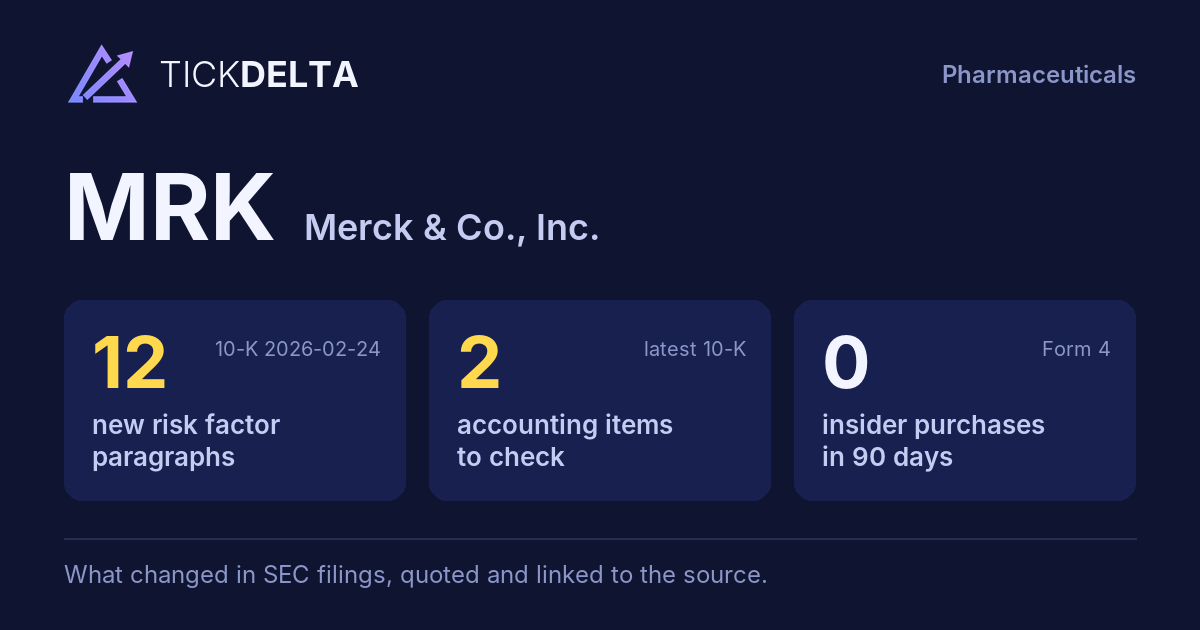
12 paragraphs in Risk Factors of the 10-K filed Feb 24, 2026 with nothing like them in the 10-K filed Feb 25, 2025. Quoted exactly. Paragraphs that were only edited are under 10-K change.
Compared with the Risk Factors in the latest 10-K of the other 59 Health care companies: a paragraph with at least half its words the same at another company is called similar, and the companies are listed under it. A paragraph most of them have is marked boilerplate. No line means no other company has one like it. This counts text; it does not say how serious a risk is.
•The Company faces continued pricing pressure with respect to its products in the public and private sectors.
Read in the 10-K ↗
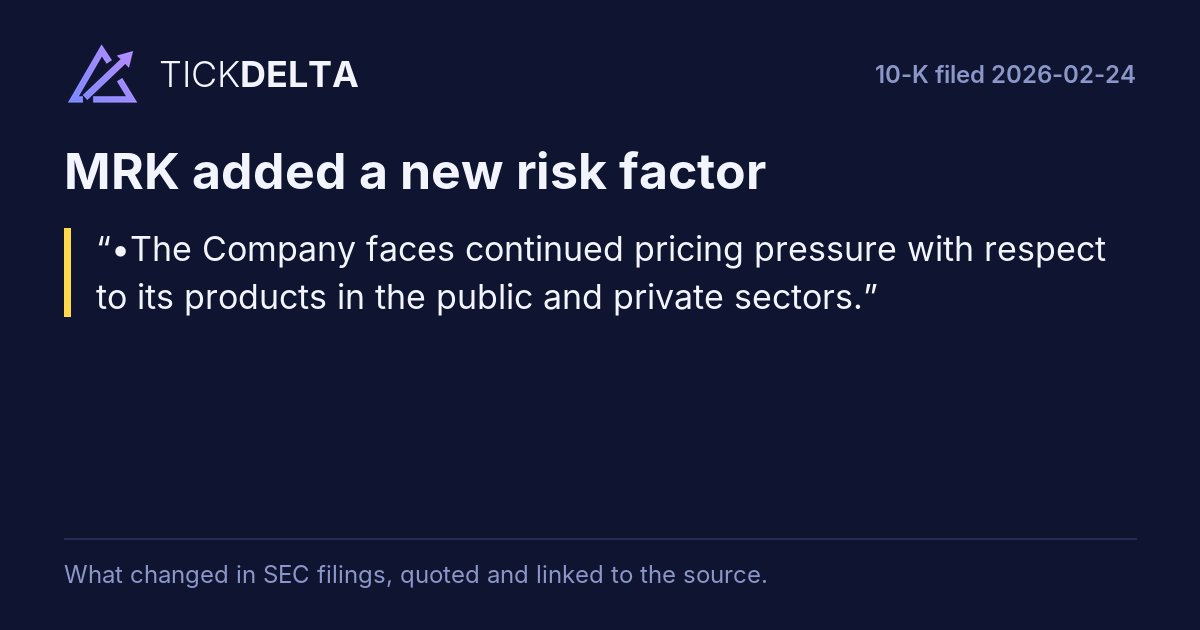
•changes in clinical preferences or standards of care, including competitor innovations, that diminish the value of the product;
Read in the 10-K ↗
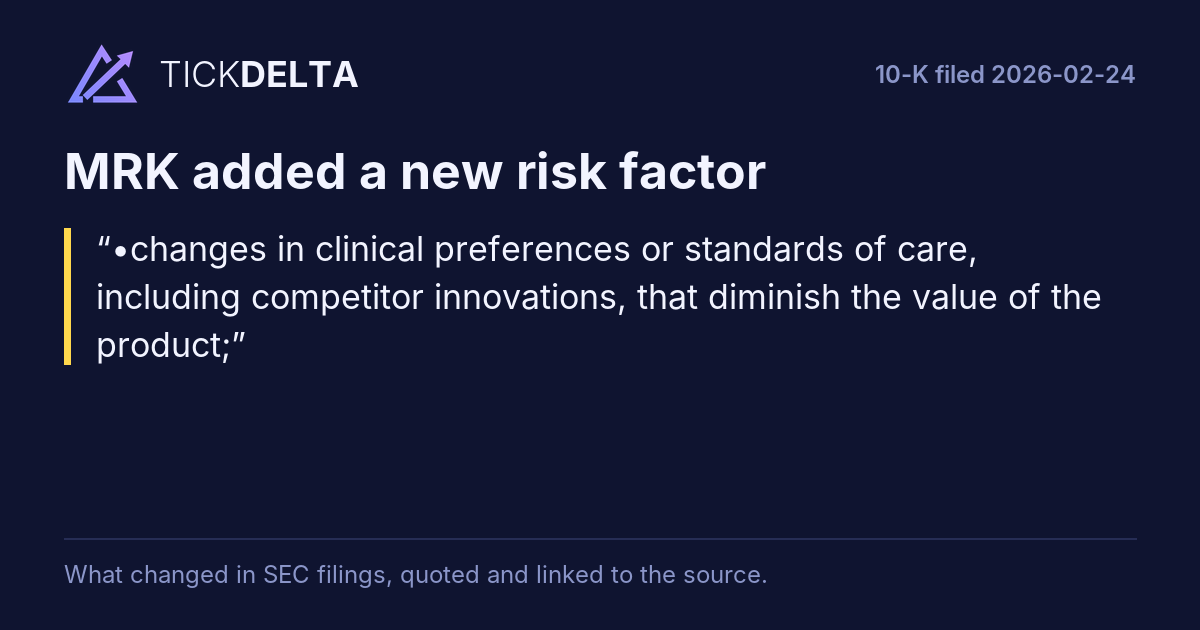
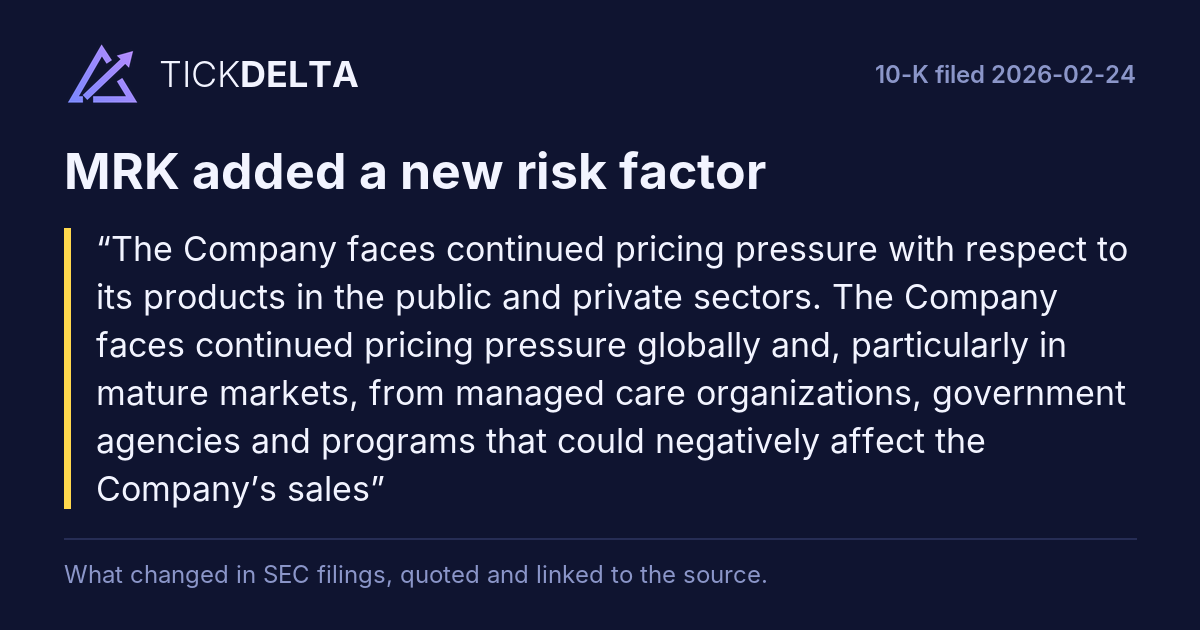
The Company faces continued pricing pressure with respect to its products in the public and private sectors.
The Company faces continued pricing pressure globally and, particularly in mature markets, from managed care organizations, government agencies and programs that could negatively affect the Company’s sales
Read in the 10-K ↗
Also, as noted above, in December 2025, the Company entered into the MFN Agreement with the U.S. government pursuant to which the Company will provide key products through a direct-to-patient program at affordable prices for eligible patients in the U.S. This currently includes Januvia, Janumet, and Janumet XR, and will be expanded in the future to include enlicitide decanoate pending FDA approval. The Company also agreed to offer its existing medicines at discounted prices to Medicaid, excluding certain products. In addition, the Company has agreed that products launched during the term of the MFN Agreement (with certain exceptions) will be subject to “most-favored-nation” pricing in reference to prices for such products in the MFN Countries.
In addition, in the U.S., larger customers have received higher rebates on drugs in certain highly competitive categories. The Company must also compete to be placed on formularies of managed care organizations. Exclusion of a product from a formulary can lead to reduced usage in the managed care organization. The Company is also facing pricing pressure from purchasers of certain vaccines in highly competitive categories. Also, the Company expects that U.S. states will continue their focus on pharmaceutical pricing and may shift to more aggressive price control tools.
Read in the 10-K ↗
In addition, it is possible that as a consequence of the MFN Agreement, certain of the Company’s products may not be launched in the MFN Countries or their launch may be delayed and as a result, the MFN Countries may take actions that adversely impact the Company.
Read in the 10-K ↗
The Company’s business in China experienced significantly lower sales of Gardasil/Gardasil 9 in 2025. Due to above normal inventory levels at the Company’s commercialization partner in China, the Company made a decision to pause shipments to China beginning in February 2025 and has not resumed shipments to date. The Company will not resume shipments until inventory levels return to normal levels and it cannot predict when shipments to China will resume nor the levels of sales that the Company will achieve and as a result, the Company expects that sales of Gardasil/Gardasil 9 in China will not materially increase in 2026. In June 2025, a nine-valent HPV vaccine produced by a local manufacturer received regulatory approval in China for use in females 9-45 years of age.
Read in the 10-K ↗
$1.1 billion, which represented 18% of the Company’s Animal Health segment sales. Any negative event with respect to the Bravecto family of products could have a material adverse effect on the Company’s Animal Health sales. If the Animal Health segment of the Company’s business becomes more significant, the impact of any such events on future results of operations could also become more significant.
Read in the 10-K ↗
•Biologics and vaccines require long manufacturing lead times, sometimes requiring planning years in advance of demand, which could increase the risk of inventory write-downs if that demand does not materialize.
Read in the 10-K ↗
2 more
failure to maintain approval in any jurisdiction will prevent it from selling the products in that jurisdiction and realizing sales.
Read in the 10-K ↗
The Company is subject to evolving and complex tax laws in the jurisdictions in which it operates. Significant judgment is required for determining the Company’s tax liabilities, and the Company’s tax returns are
Read in the 10-K ↗
New in the latest 10-Q
20 paragraphs in the 10-Q filed Nov 4, 2026 with nothing like them in the 10-Q filed Aug 7, 2026 (at least half the words must differ; new numbers alone do not count). Quoted exactly, grouped by the item heading above them. This is text that changed, not a judgement of how serious it is.
Financial statements and notes
In July 2025, the technology transfer for MK-2010 (LM-299), a novel investigational PD-1/vascular endothelial growth factor (VEGF) bispecific antibody that was licensed from LaNova Medicines Ltd (LaNova) in 2024, was completed. Accordingly, Merck made a $ 300 million payment to LaNova (which has been acquired by Sino Biopharmaceutical Limited) that was recorded as a charge to Research and development expenses in the third quarter and first nine months of 2025.
Read in the 10-Q ↗
As previously disclosed, in June 2023, Merck filed a complaint in the U.S. District Court for the District of Columbia against the U.S. government regarding the Inflation Reduction Act’s “Drug Price Negotiation Program” for Medicare (Program). This litigation sought relief from the Program by challenging its constitutionality as violative of the First and Fifth Amendments to the U.S. Constitution. On August 24, 2026, the U.S. District Court for the District of Columbia granted summary judgment for the U.S. Government.
Read in the 10-Q ↗
As previously disclosed, in January 2020, the Company was served with a complaint in the U.S. District Court for the District of New Jersey. Following motion practice, the plaintiffs filed a third amended complaint in August 2024, seeking to certify a nationwide class as well as five statewide classes of purchasers or users of Bravecto (fluralaner) products from its launch through the present. Plaintiffs contend Bravecto causes neurological events in dogs and cats and alleges violations of the consumer fraud statutes of certain of their home states (Connecticut, New York, Florida and Texas), Breach of Warranty, Product Liability, and related theories. The Company moved to dismiss or, alternatively, to strike the class allegations from the third amended complaint, and that motion was granted in part and denied in part. The plaintiffs served a motion for class certification in May 2026 seeking certification of several statewide classes of Bravecto purchasers and the Company has served an opposition to that motion. The plaintiffs’ motion remains pending. A similar case was filed in Quebec, Canada in May 2019. The Superior Court certified a class of dog owners in Quebec who gave Bravecto Chew to their dogs between February 16, 2017 and November 2, 2018 whose dogs experienced one of the conditions in the post-marketing adverse reactions section of the labeling approved on November 2, 2018. The Company and plaintiffs each appealed the class certification decision. The Court of Appeal of Quebec amended the class period to start July 2, 2014, allowed the second plaintiff to serve as a class representative, and modified the list of conditions in the class definition. The Company sought leave to appeal to the Supreme Court of Canada, which was denied. The case is proceeding in the Superior Court.
Read in the 10-Q ↗
condition. However, the resolution of, or an increase in accruals for, one or more of these matters may have a material adverse effect on the Company’s results of operations and/or cash flows in the period recorded.
Read in the 10-Q ↗
would become effective on January 1, 2029; a pending CMS proposed rule may subject Keytruda Qlex (pembrolizumab and berahyaluronidase alfa) to price setting at the same time. Government price setting may also impact pricing in the private market negatively affecting the Company’s performance.
Read in the 10-Q ↗
• Growth in the oncology franchise was largely due to the performance of Keytruda/Keytruda Qlex and Welireg (belzutifan), offset in part by lower alliance revenue related to Koselugo (selumetinib) resulting from an amendment to the collaboration agreement with AstraZeneca PLC (AstraZeneca).
Read in the 10-Q ↗
• Growth in the cardiometabolic, respiratory and specialty franchise was largely attributable to the continued uptake of Winrevair (sotatercept-csrk), as well as the inclusion of sales of Ohtuvayre (ensifentrine), which was obtained as part of the October 2025 acquisition of Verona Pharma plc (Verona Pharma), partially offset by lower sales of Januvia and Janumet.
Read in the 10-Q ↗
• Animal health sales growth was due to the performance of both livestock and companion animal products.
Read in the 10-Q ↗
• Lower revenue in the vaccines and infectious diseases franchise was primarily due to lower sales of Lagevrio (molnupiravir), Bridion (sugammadex), Dificid (fidaxomicin), and Vaxneuvance (Pneumococcal 15-valent Conjugate Vaccine), partially offset by growth in Prevymis (letermovir), Enflonsia (clesrovimab-cfor), Capvaxive (Pneumococcal 21-valent Conjugate Vaccine) and Gardasil (Human Papillomavirus Quadrivalent [Types 6, 11, 16 and 18] Vaccine Recombinant) / Gardasil 9 (Human Papillomavirus 9-valent Vaccine, Recombinant). The overall U.S. vaccines market has experienced a contraction negatively affecting sales.
Read in the 10-Q ↗
September 2026 Japan’s MHLW approval for all indications approved in Japan for Keytruda, based on the MK-3475A-D77 trial.
Read in the 10-Q ↗
September 2026 China's NMPA approval for nineteen solid tumor indications, based on the MK-3475A-D77 trial.
Read in the 10-Q ↗
In January 2026, the acting director of the U.S. Centers for Disease Control and Prevention (CDC) announced changes to the child and adolescent immunization schedule (January announcement), reducing the number of routinely recommended vaccinations and creating three new categories: immunizations recommended for all children; immunizations
Read in the 10-Q ↗
In August 2026, the U.S. presidential administration issued an EO describing proposed federal policy for “Gold Standard Childhood Vaccine Recommendations.” Among other things, the EO included categories of childhood immunization
Read in the 10-Q ↗
recommendations, recommended administration of the combined measles, mumps and rubella vaccine as three separate single-disease shots, recommended that all childhood immunizations be administered at separate medical visits to the maximum extent feasible, and advised U.S. states and territories to consider updating relevant laws and regulations concerning school immunization requirements. There currently are no approved U.S. monovalent measles, mumps or rubella single-antigen vaccines. Numerous medical, health and patient advocacy groups have voiced concerns with and/or opposition to the EO. The EO requires an HHS task force to present plans within 90 days of issuance to effectuate certain of its provisions, such as offering single-antigen alternatives to combination vaccines, reassessing vaccine timing and sequencing, developing alternatives to aluminum adjuvants, and improving safety monitoring and transparency.
Read in the 10-Q ↗
Restructuring costs of $184 million and $47 million for the third quarter of 2026 and 2025, respectively, and $530 million and $676 million in the first nine months of 2026 and 2025, respectively, primarily include separation and other costs
Read in the 10-Q ↗
October 2024, respectively. The IRS is also currently conducting examinations of the Company’s tax returns for the years 2021 and 2022. In addition, various state and foreign tax examinations are in progress.
Read in the 10-Q ↗
MK-2870, sacituzumab tirumotecan (sac-TMT), an investigational TROP2-directed ADC, is under priority review by the FDA for the treatment of adult patients with endometrial cancer who have previously received platinum containing chemotherapy and a PD-1 or PD-L1 inhibitor, separately or in combination, The application is based on data from the Phase 3 TroFuse-005 trial. The FDA set a Prescription Drug User Fee Act (PDUFA) date of June 15, 2027. In December 2025, the FDA selected sac-TMT to receive a Commissioner’s National Priority Voucher under a pilot program offering the ability to seek expedited approval based on alignment with one or more critical national health priorities. The Company is in discussions with the FDA and is hopeful for an approval before the PDUFA date.
Read in the 10-Q ↗
MK-1654, Enflonsia, is an extended half-life monoclonal antibody indicated for passive immunization for the prevention of RSV LRTD in newborns and infants who are born during or entering their first RSV season. Enflonsia is under review in the U.S., the EU and Japan to expand the approved indication to include prevention of RSV LRTD in children under two years of age at increased risk for severe RSV disease through their second RSV season. In the U.S., the FDA set a PDUFA date of March 22, 2027.
Read in the 10-Q ↗
MK-1022 (patritumab deruxtecan)(1) Hypercholesterolemia HIV-1 Infection (Treatment Naive)
Read in the 10-Q ↗
MK-1026 (nemtabrutinib) Previously Treated Endometrial Cancer Respiratory Syncytial Virus (Second Season)
Read in the 10-Q ↗
The 10-Q's risk factors against the 10-K
Item 1A of the 10-Q filed Nov 4, 2026 against Item 1A of the 10-K filed Feb 24, 2026.
A 10-Q repeats only the risks that changed, so a 10-K paragraph that is missing from it is not counted as removed.
Added is a paragraph with nothing like it in the 10-K, Reworded a sentence that is in both with several words changed,
Quiet changes a sentence in both where one to four words changed and one is a hedge or a modal
(cut words struck through, new words highlighted and underlined).
Text on the page, not a score; each links to the filing at sec.gov.
This 10-Q has no Item 1A (Risk Factors) text of its own, so there is nothing to compare. Many companies leave it out when their risks have not changed.
Work on MRK in a spreadsheet:
Excel workbook (a sheet per section, ten years by column, charts, links to the filings) ·
CSV.
For a Google Sheet that stays up to date, paste =IMPORTDATA("https://tickdelta.com/company/MRK/export.csv") into a cell.