Screener / SEC EDGAR /CIK 0002017206 /10-K filed Mar 2, 2026, compared with Mar 31, 2025 /Numbers from the XBRL of the 10-Ks
NYSE Real estate · Real Estate

Millrose Properties, Inc. MRP

Compare with peers Embed
New in the 10-K 106 paragraphs with nothing like them in the 10-K filed Mar 31, 2025 New in the 10-Q 80 paragraphs not in the 10-Q filed Aug 4, 2026 10-Q against the 10-K 2 risk factor paragraphs and sentences added or reworded

New risk paragraphs, branching off last year

Each branch is a paragraph in Risk Factors with nothing like it in the 10-K filed Mar 31, 2025. A box jumps to the paragraph as filed, below.

106 new

Paragraphs with nothing like them in last year's 10-K

Quoted exactly

106 paragraphs in Risk Factors of the 10-K filed Mar 2, 2026 with nothing like them in the 10-K filed Mar 31, 2025. Quoted exactly. Paragraphs that were only edited are under 10-K change.

amount of capital Millrose has available for transactions with counterparties other than Lennar or Lennar Related Ventures, which may make it difficult to provide our homesite option platform to such counterparties. For additional information regarding Lennar’s rights, see “Part I, Item 1. Business—Operational Agreements with Lennar—Founder’s Rights Agreement.”

Read in the 10-K

•We have a limited history of operating our homesite option platform. Our ability to grow depends on being a preferred partner with our counterparties for funding land acquisition and development, as well as securing additional counterparty agreements. If we are unable to achieve these objectives, our growth prospects could be adversely affected.

Read in the 10-K

Our business consists primarily of owning and selling assets in connection with providing our homesite option platform to Lennar and Other Counterparties. Lennar is currently our largest counterparty and our business was initially formed to engage in land bank transactions with Lennar as well as potential Lennar Related Ventures and Other Counterparties. We do not currently intend to diversify our business operations beyond growing our homesite option platform and continuing to provide development loans to our developers. Risks associated with a highly concentrated portfolio include, but are not limited to, the following:

•Although we have diversified our counterparty base since the Spin-Off and intend to continue doing so, there is no assurance that we will successfully attract or retain additional counterparties in the near term. Even as we attract new counterparties, the scope of our business operations will likely be limited to providing the homesite option platform and providing development loans.

•Our Real Estate Portfolio is concentrated in three states (California, Florida and Texas), with a substantial portion located in Florida and Texas. This geographic concentration may increase our exposure to market fluctuations and environmental risks, as discussed elsewhere in this “Risk Factors” section.

Read in the 10-K

•Under the Lennar Agreements, Millrose may not enter into third-party financing arrangements that would cause the combined debt-to-equity ratio of Millrose and its affiliates to exceed 1:1 without Lennar’s prior approval. This restriction may limit our ability to provide funding to counterparties who prefer to structure their relationships with us through debt issuances.

•Maintaining land assets is costly and exposes us to significant risks. Because we do not intend to diversify beyond the homesite option platform and similar operations, we cannot offset these risks through other business lines. If the costs associated with maintaining land assets exceed the capital resources available to us, our ability to sustain our business could be adversely affected.

Read in the 10-K

We entered into the Lennar Agreements and Management Agreement simultaneous with the Spin-Off from Lennar. These agreements were prepared at Lennar’s direction, in consultation with its strategic advisor, Kennedy Lewis. Because Lennar’s and Millrose’s interests may have differed when these agreements were negotiated, the agreements may not have fully reflected Millrose’s best interests. Risks associated with conflicts of interest in our agreements with Lennar include, but are not limited to, the following:

•Because we lacked independent management prior to the Spin-Off, the agreements we entered into were not negotiated at arm’s length, and we did not independently confirm that their terms were consistent with market standards. As a result, the terms of these agreements may be more favorable to Lennar than if Lennar had negotiated with an unaffiliated third party, and we cannot assure you that they are as favorable to Millrose as would have resulted from arm’s-length negotiations.

•Certain Lennar Agreements, including the Founder’s Right Agreement, include rights exclusive to Lennar that we cannot offer to Other Counterparties, which may reduce our negotiating leverage with Other Counterparties. These rights may not align with the interests of our stockholders now that we are a publicly traded company and may differ from terms (and Bylaws provisions) that we could have obtained through arm’s-length negotiations with unaffiliated third parties. As a result, these rights could limit our flexibility, deter potential investors and counterparties, and adversely affect the market price of our Class A Common Stock and in turn the value of our Class B Common Stock.

•Certain terms in the Lennar Agreements may hinder our ability to expand our business, attract new counterparties to use our homesite option platform, or negotiate competitive terms with counterparties other than Lennar.

•Some terms in the Lennar Agreements make it difficult for us to amend them without significant cost and effort, and without obtaining Lennar’s written consent. We cannot assure you that we will be able to renegotiate, amend, or terminate any agreements, or specific provisions, that we consider unfavorable or adverse to our interests. Our continued obligations under these agreements could materially and adversely affect our business, growth opportunities, financial condition, and results of operations.

•Certain of the rights granted to Lennar in the Founder’s Rights Agreement are exclusive to Lennar, which will require our Board to enforce such rights.

Read in the 10-K
Show the other 28

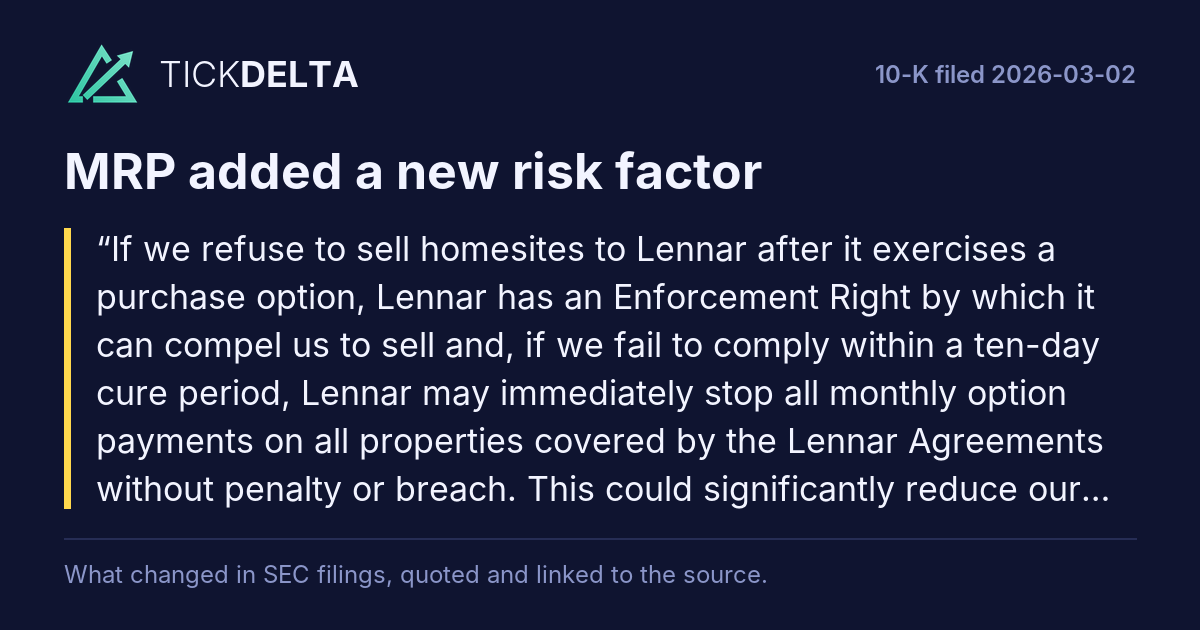
If we refuse to sell homesites to Lennar after it exercises a purchase option, Lennar has an Enforcement Right by which it can compel us to sell and, if we fail to comply within a ten-day cure period, Lennar may immediately stop all monthly option payments on all properties covered by the Lennar Agreements without penalty or breach. This could significantly reduce our cash flow and jeopardize our ability to maintain working capital and make required distributions to qualify as a REIT. Even if we dispute Lennar’s right to purchase based on pooling cross-termination provisions, we must still sell the homesites and then pursue litigation to recover losses. Such litigation could be costly, time-consuming, and may not be economically viable. As a result, these Enforcement Rights create strong financial pressure to comply with Lennar’s option exercises even when we believe we are not legally obligated, which could materially and adversely affect our operations and liquidity.

Read in the 10-K

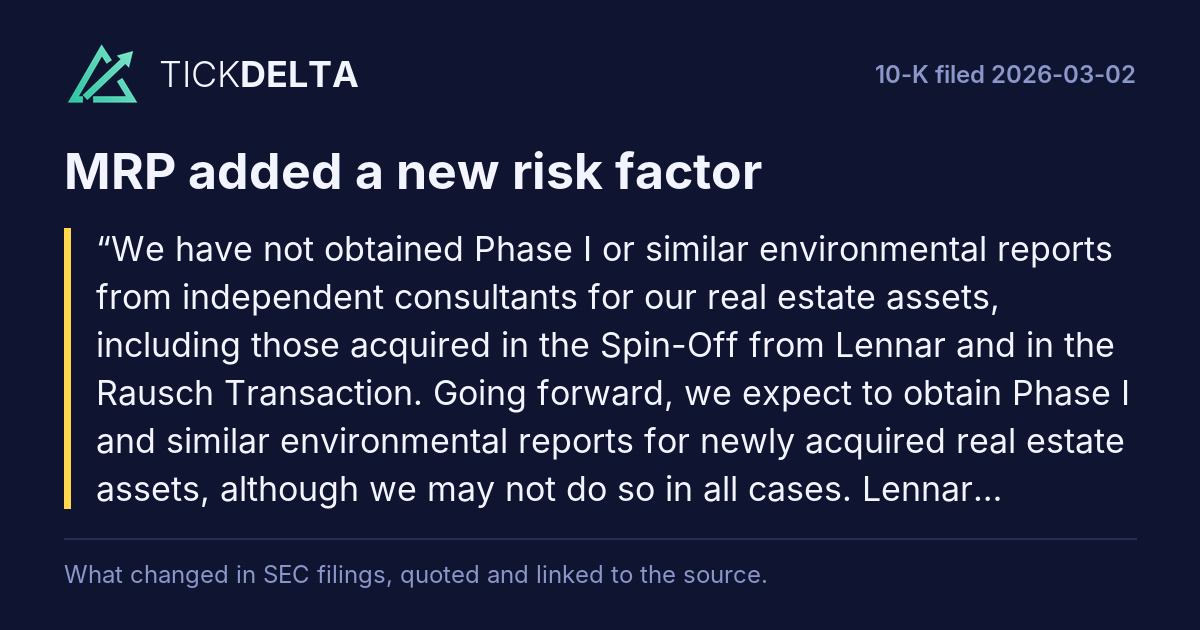
We have not obtained Phase I or similar environmental reports from independent consultants for our real estate assets, including those acquired in the Spin-Off from Lennar and in the Rausch Transaction. Going forward, we expect to obtain Phase I and similar environmental reports for newly acquired real estate assets, although we may not do so in all cases. Lennar subsidiaries provided certain representations and warranties regarding title and environmental condition for assets acquired in the Spin-Off, and Lennar agreed to indemnify us for the assets acquired in the Rausch Transaction. While we obtain certain representations and warranties from sellers at

Read in the 10-K

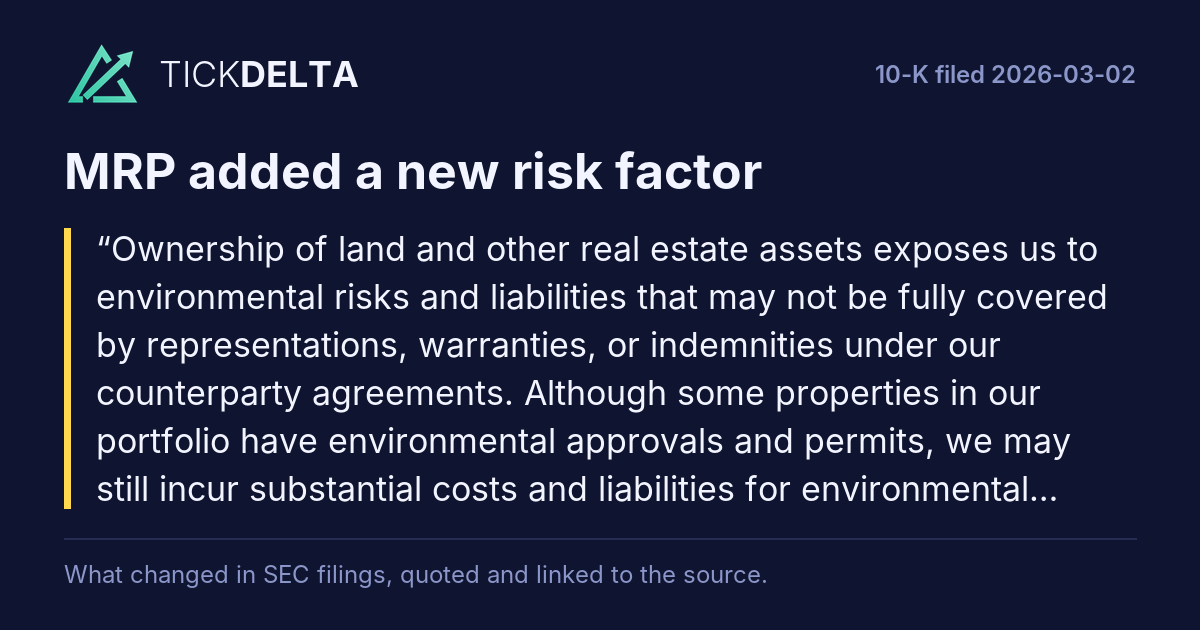
Ownership of land and other real estate assets exposes us to environmental risks and liabilities that may not be fully covered by representations, warranties, or indemnities under our counterparty agreements. Although some properties in our portfolio have environmental approvals and permits, we may still incur substantial costs and liabilities for environmental matters. Representations and warranties provided by homebuilders, including Lennar, generally cover only known conditions at the time of the applicable agreement. We remain responsible for any newly discovered issues or conditions missed during prior reviews. We cannot assure you that properties we acquire will be fully entitled or have all required approvals and permits. If we cannot negotiate to shift liability to counterparties, we will likely bear these risks.

Under various laws, property owners may be required to investigate, clean up, and remove hazardous substances and may be held liable for property damage or personal injuries caused by such substances. We could also be liable to government agencies or third parties for costs and damages they incur in connection with hazardous substances. These costs can be substantial and difficult to estimate due to uncertainties about contamination, remediation methods, local regulations, and timing. In addition, environmental laws impose ongoing operational, maintenance, and reporting requirements that may require significant compliance costs. Any remediation or compliance actions could materially and adversely affect our business, financial condition, and results of operations.

Read in the 10-K

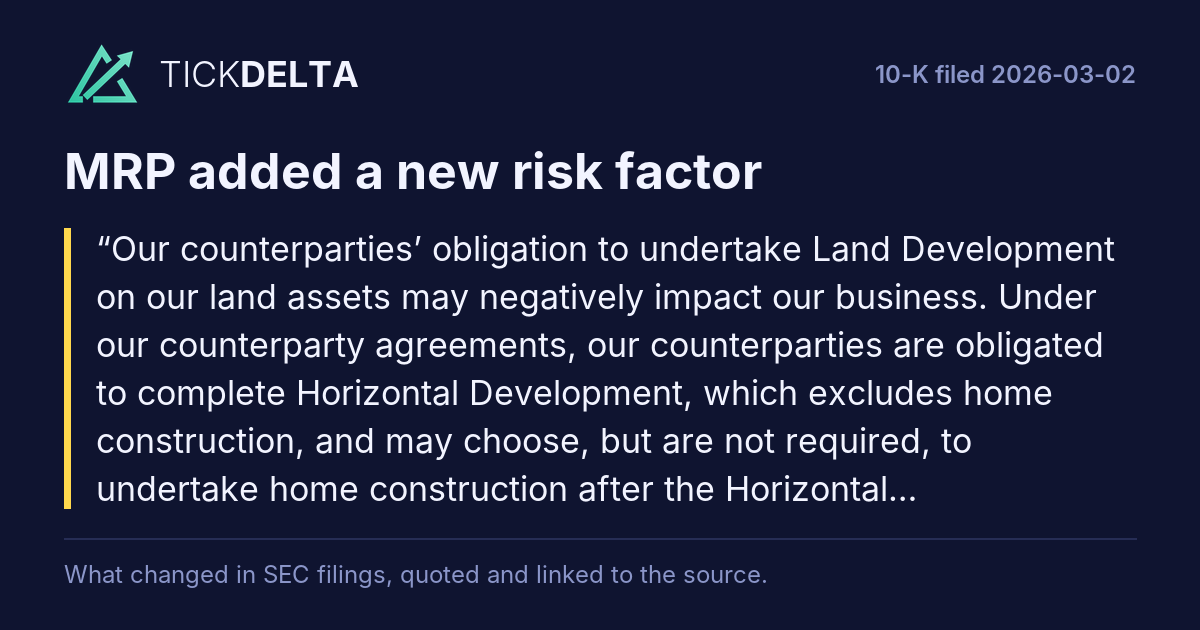
Our counterparties’ obligation to undertake Land Development on our land assets may negatively impact our business.

Under our counterparty agreements, our counterparties are obligated to complete Horizontal Development, which excludes home construction, and may choose, but are not required, to undertake home construction after the

Horizontal Development is completed. We have also, in certain circumstances, extended development to Vertical Development on certain owned homesites. Pursuant to the counterparty agreements, Millrose provides capital for land within predetermined budgets but does not perform development activities itself. All construction work is carried out by counterparties and their third-party contractors. Risks associated with our counterparties construction activities include, but are not limited to, the following:

•Predetermined development budgets do not cover liabilities arising from construction, and construction activity could result in environmental consequences that we may be required to remediate, which could significantly reduce our available cash and adversely affect our business, financial condition, and results of operations.

•While Lennar completed Phase I environmental reports for the assets we acquired in the Spin-Off and may have defenses under the All Appropriate Inquiries process, we do not have similar protections and could face significant environmental liabilities which could result in significant adverse impacts to our business, financial condition or results of operations.

•The indemnities provided by our counterparties may not be sufficient to cover every liability that may be incurred. Additionally, we could be held jointly and severally liable for environmental issues, and the value of any indemnity depends on our counterparty’s creditworthiness. We cannot assure you that we will be able to negotiate similar indemnities with future counterparties.

•Notwithstanding our counterparty’s work, our counterparties could decide at any time not to continue or complete Land Development or home construction they have started. While the counterparty construction agreements are guaranteed by our counterparties and require specific performance for Land Development, the counterparty agreements do not obligate them to complete home construction. As a result, we would have no remedies or monetary penalties if our counterparties stop home construction.

•If our counterparties default or do not exercise their purchase option on homesites with unfinished home construction, it may be difficult to sell those homesites to other buyers, who may be unwilling or unable to complete the work. If the partially completed construction must be removed before a sale, we could incur significant additional costs that we may not have the financial capacity to cover, which could adversely affect our operations and limit our ability to maintain sufficient capital reserves for future property asset acquisitions.

Read in the 10-K

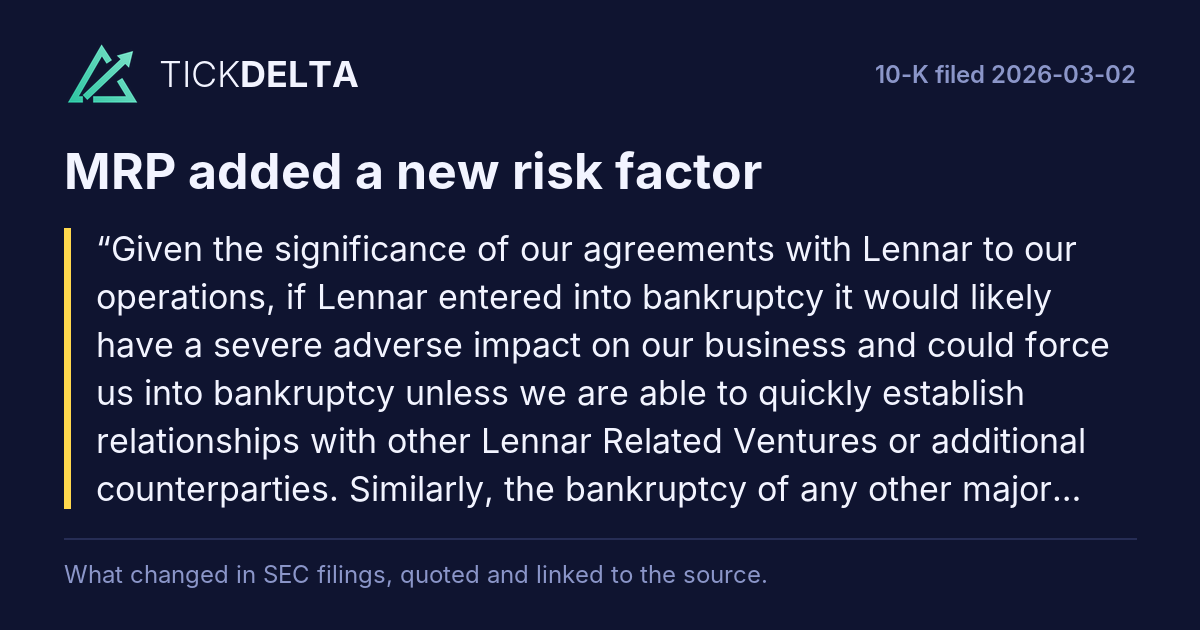
Given the significance of our agreements with Lennar to our operations, if Lennar entered into bankruptcy it would likely have a severe adverse impact on our business and could force us into bankruptcy unless we are able to quickly establish relationships with other Lennar Related Ventures or additional counterparties. Similarly, the bankruptcy of any other major counterparty could materially and adversely affect our liquidity, growth prospects, and financial condition.

Read in the 10-K

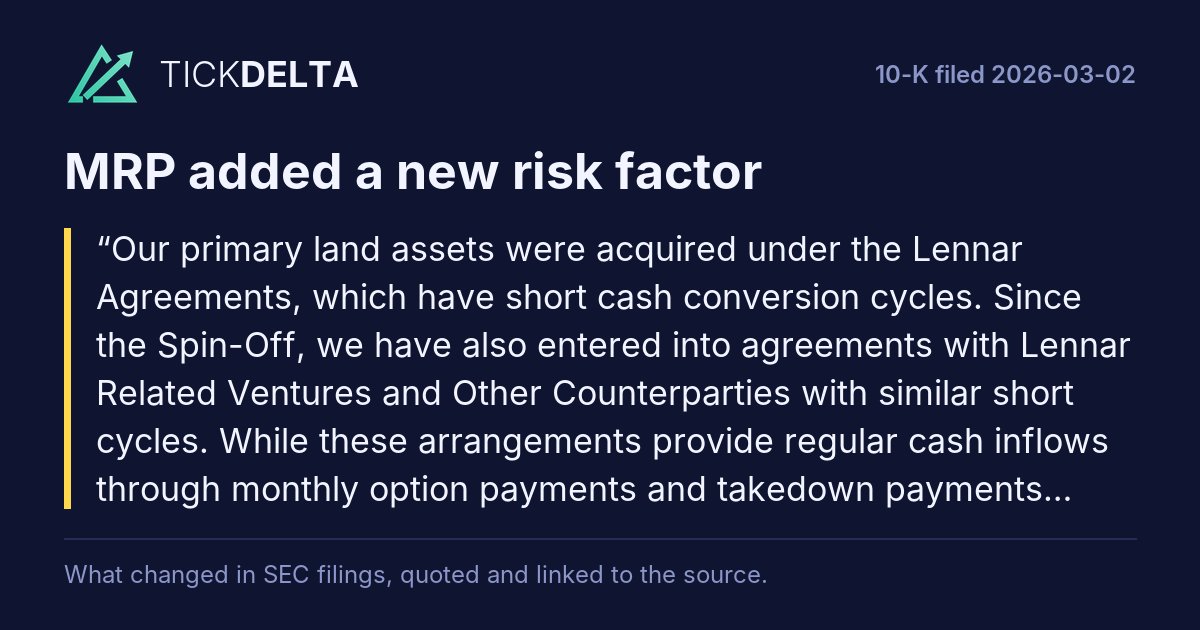
Our primary land assets were acquired under the Lennar Agreements, which have short cash conversion cycles. Since the Spin-Off, we have also entered into agreements with Lennar Related Ventures and Other Counterparties with similar short cycles. While these arrangements provide regular cash inflows through monthly option payments and takedown payments, these inflows may decline or cease once the assets under our current counterparty agreements are fully sold. If our current counterparties do not offer us additional business and we cannot secure new agreements with Other Counterparties, our sources of income could be significantly reduced. Several factors could limit our ability to maintain or grow our business, including:

Read in the 10-K

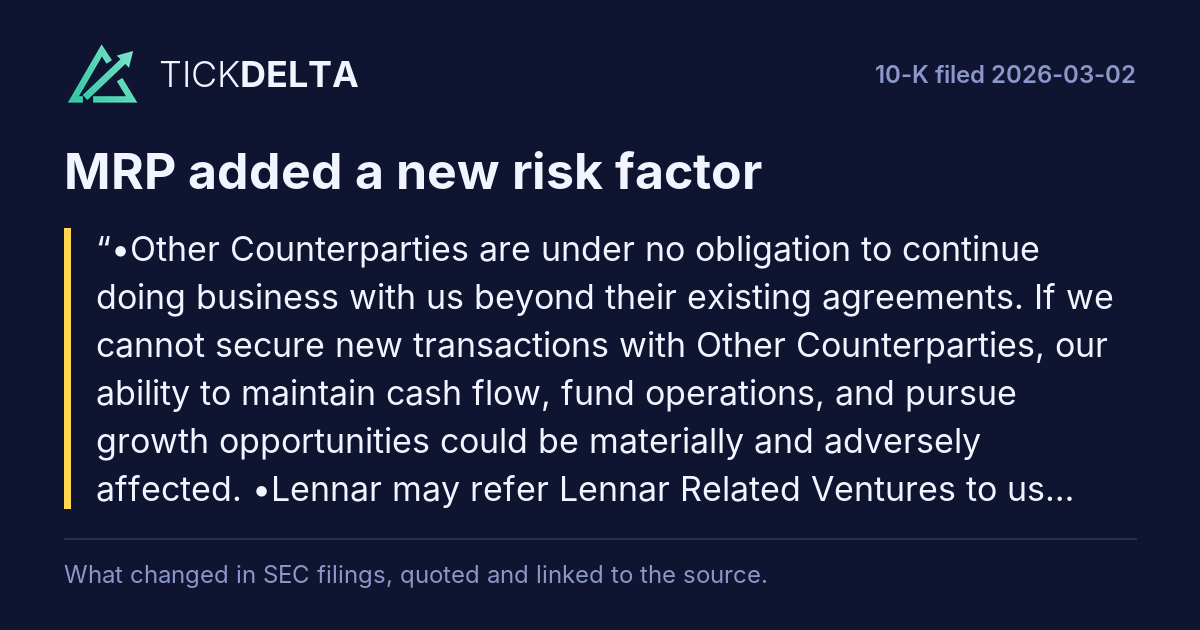
•Other Counterparties are under no obligation to continue doing business with us beyond their existing agreements. If we cannot secure new transactions with Other Counterparties, our ability to maintain cash flow, fund operations, and pursue growth opportunities could be materially and adversely affected.

•Lennar may refer Lennar Related Ventures to us, and we are obligated to enter into homesite option platform agreements with them on terms substantially similar to those in the Lennar Agreements if they meet the requirements specified therein. However, Lennar is under no obligation to make such referrals, and we cannot guarantee that we will contract with any Lennar Related Ventures beyond those we are required to accept.

•Under the Management Agreement, our Manager is responsible for sourcing, evaluating, and negotiating with potential counterparties who may wish to engage Millrose for the homesite option platform. However, Lennar’s Capital Priority Right and Founder’s Rights may limit our ability to attract Other Counterparties, as these rights are reserved exclusively for Lennar and will not be offered to Other Counterparties.

•Our Manager may face limitations in negotiating competitive fee structures with Other Counterparties because Lennar has the right to adjust its monthly option payment rate for future proposed projects to match any lower rate we agree to with a non-Lennar counterparty. This could restrict our ability to offer flexible pricing and remain competitive.

•Many of our competitors in the traditional land banking market have longer operating histories, established reputations, and significant market presence. By contrast, we are a recently formed company with a limited operating history and brand recognition. Although our Manager has extensive experience managing land banking entities, we cannot assure you that the market will attribute credibility to Millrose solely because of our Manager’s experience.

Read in the 10-K

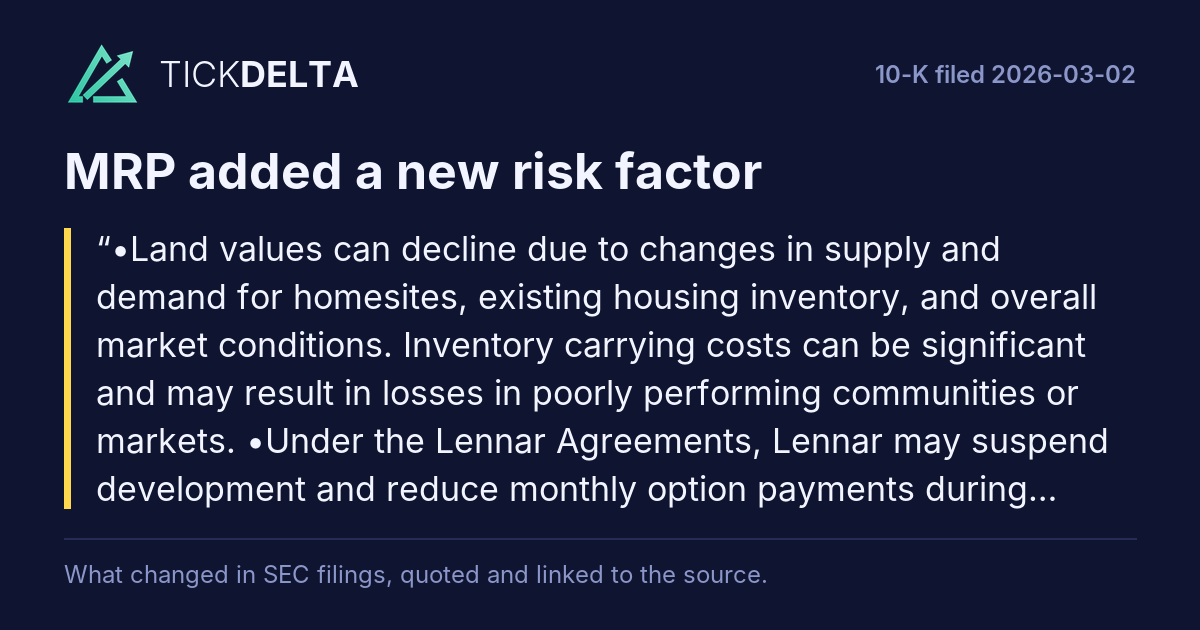
•Land values can decline due to changes in supply and demand for homesites, existing housing inventory, and overall market conditions. Inventory carrying costs can be significant and may result in losses in poorly performing communities or markets.

•Under the Lennar Agreements, Lennar may suspend development and reduce monthly option payments during specified pause periods triggered by market conditions. For example, Lennar may pause its Horizontal Development and option windows for two periods of up to six months and reduce its monthly option payment rate to 50% of the applicable rate. Similar provisions in other counterparty

agreements could also delay takedowns and reduce cash inflows. See “Part I, Item 1. Business—Operational Agreements with Lennar—Master Option Agreement.”

•If homebuilders fail to exercise or terminate purchase options, we could lose anticipated monthly option payments and takedown proceeds. Pooling and cross-termination provisions may not provide sufficient incentive for builders to maintain commitments, and exceptions apply. As a result, we may be forced to hold land assets for extended periods without a buyer or sell them at prices below the original option terms, which could materially and adversely affect our business, financial condition, and results of operations.

Read in the 10-K

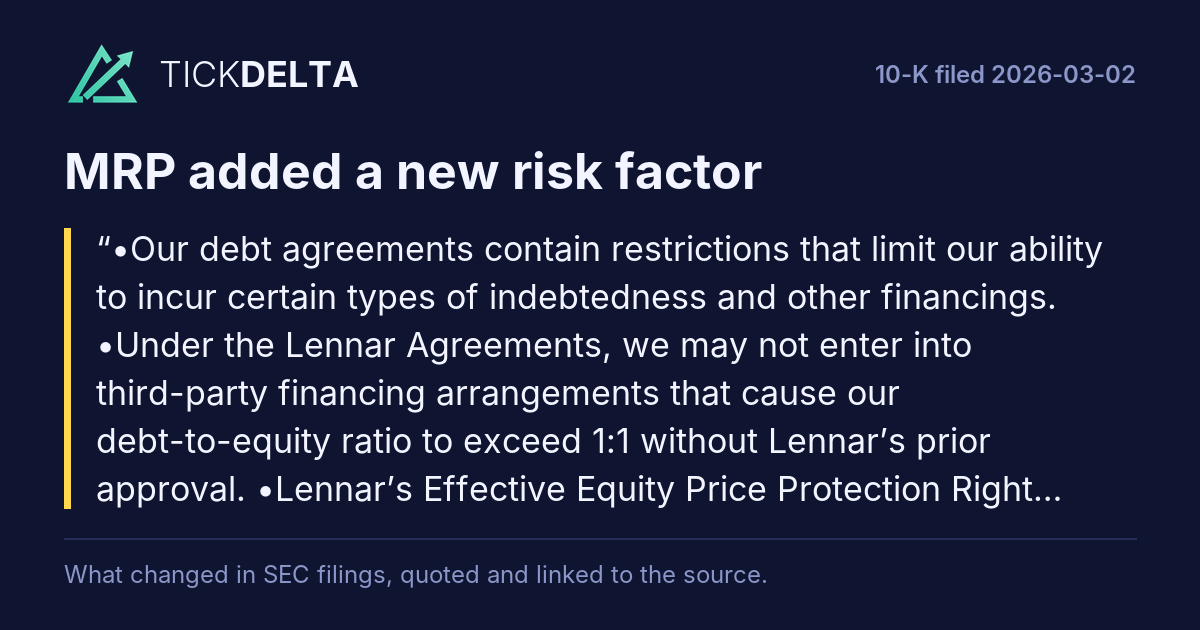
•Our debt agreements contain restrictions that limit our ability to incur certain types of indebtedness and other financings.

•Under the Lennar Agreements, we may not enter into third-party financing arrangements that cause our debt-to-equity ratio to exceed 1:1 without Lennar’s prior approval.

•Lennar’s Effective Equity Price Protection Right may limit equity raises during the first 18 months following the Spin-Off, which could result in dilution and downward pressure on our Class A Common Stock price.

Read in the 10-K

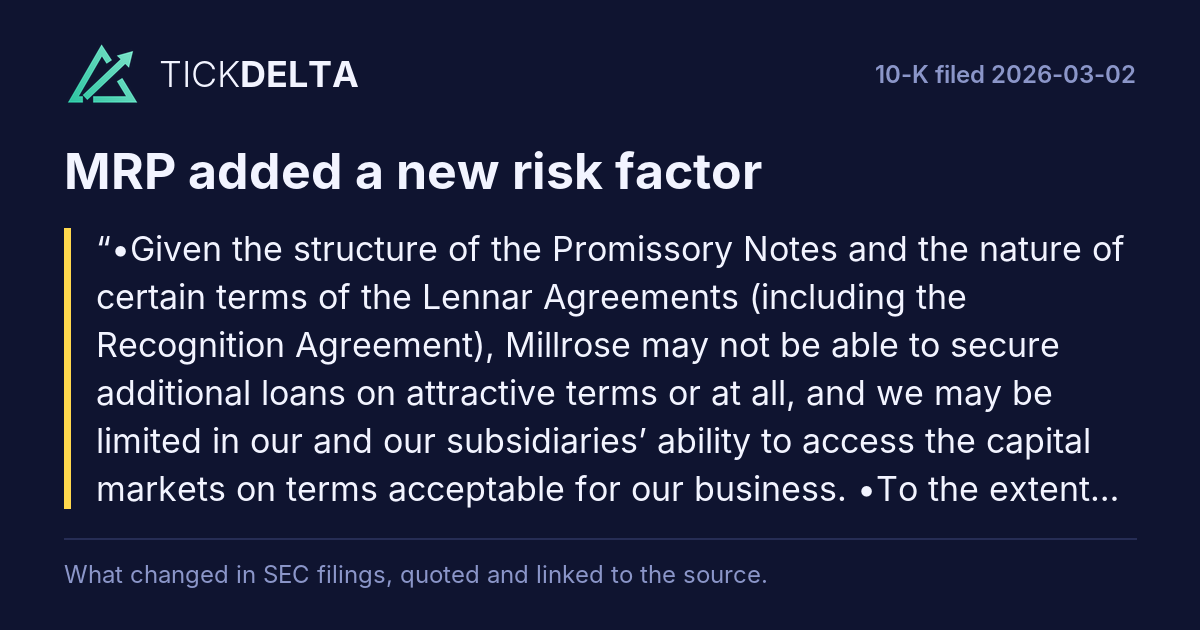
•Given the structure of the Promissory Notes and the nature of certain terms of the Lennar Agreements (including the Recognition Agreement), Millrose may not be able to secure additional loans on

attractive terms or at all, and we may be limited in our and our subsidiaries’ ability to access the capital markets on terms acceptable for our business.

•To the extent that we raise additional capital through the sale of equity or convertible debt securities, the ownership interest of our existing stockholders may be diluted, and the terms of such financing transactions may include liquidation or other preferences that adversely affect the rights of our stockholders.

•Such capital raises would also impact how we are able to use our available capital, given Lennar’s Capital Priority Right. Debt and receivables financings may be coupled with an equity component, such as warrants to purchase shares of our Common Stock, which could also result in dilution of our existing stockholders’ ownership.

•Debt or equity financing may include restrictive covenants, unfavorable terms, or equity components such as warrants, which could dilute existing stockholders. Issuing equity or convertible debt may also impact the stock price or value of our Class A Common Stock, and if the stock price is suppressed, we may not be able to raise the capital we need through equity issuances.

•If financing is unavailable or available only on unfavorable terms, we may be unable to efficiently manage our Real Estate Portfolio, perform obligations under the Lennar Agreements, complete property acquisitions, or pursue growth opportunities.

Read in the 10-K

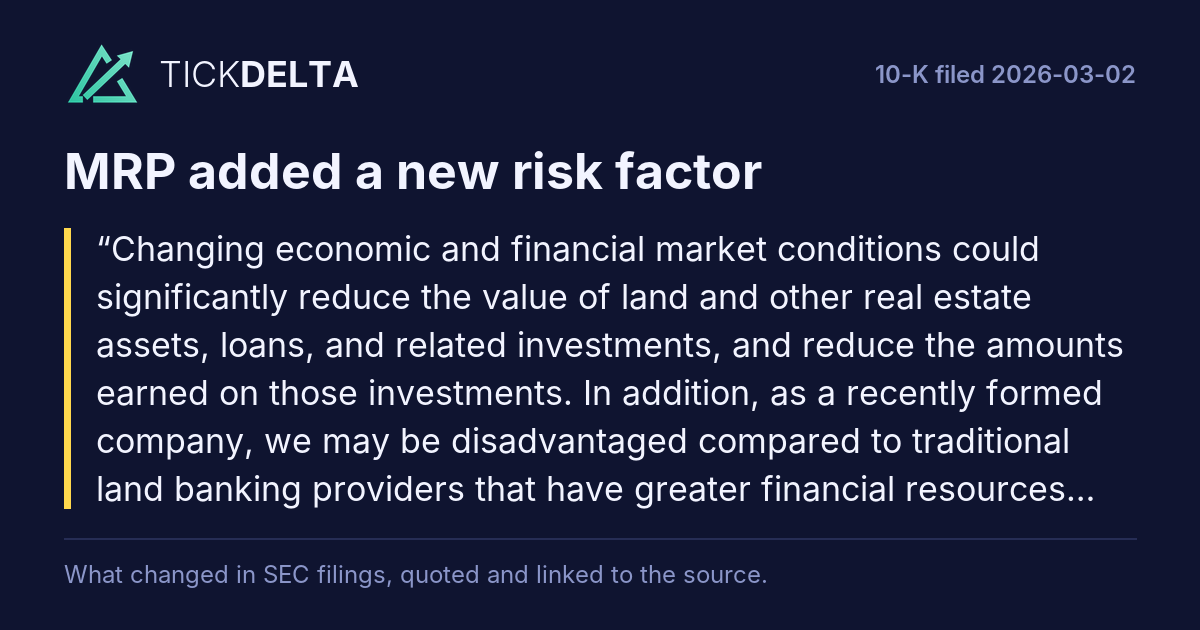
Changing economic and financial market conditions could significantly reduce the value of land and other real estate assets, loans, and related investments, and reduce the amounts earned on those investments. In addition, as a recently formed company, we may be disadvantaged compared to traditional land banking providers that have greater financial resources, established counterparty relationships, and stronger ability to withstand adverse or volatile market conditions.

Read in the 10-K

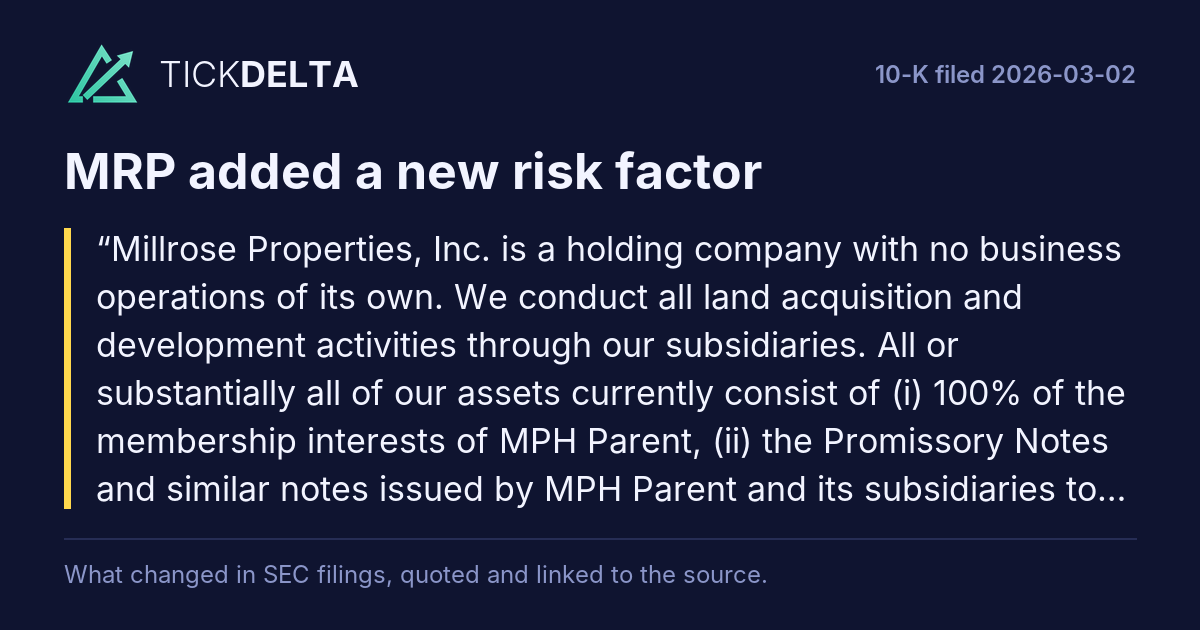
Millrose Properties, Inc. is a holding company with no business operations of its own. We conduct all land acquisition and development activities through our subsidiaries. All or substantially all of our assets currently consist of (i) 100% of the membership interests of MPH Parent, (ii) the Promissory Notes and similar notes issued by MPH Parent and its subsidiaries to Millrose, and (iii) the development loans held by SPE LLC and its subsidiaries.

Our ability to pay obligations depends on dividends, interest payments, and other distributions from these subsidiaries, which in turn depend on counterparties performing under their homesite option platform agreements and developer loan agreements. Several factors could limit our subsidiaries’ ability to distribute cash to us, including:

•The ability of Millrose’s operating subsidiaries, including MPH Parent and Millrose Holdings, to pay dividends to Millrose is expected to be restricted by REIT Requirements, applicable Maryland law and the terms of any outstanding debt or credit facilities, and Millrose’s reliance on our counterparties to continue providing Millrose with more deals.

•Each subsidiary’s sustainability depends on the counterparty it serves. If a counterparty defaults on its obligations, that subsidiary could face credit defaults or bankruptcy, which may negatively impact our other subsidiaries and overall operations.

•If a significant counterparty, such as Lennar, fails to perform, our entire operations could be materially affected, and we may be forced to seek bankruptcy protection.

Because we rely entirely on our subsidiaries for cash flow, any inability of our subsidiaries to generate or distribute sufficient funds could materially and adversely affect our business, financial condition, and results of operations.

Read in the 10-K

Disruptions to our technology platform could impair our ability to execute transactions and recycle capital.

Our homesite option platform is a technology enabled system that supports the acquisition and disposition of homesites, administration of option agreements, and the continuous recycling of capital that underpins our business model. The platform’s effectiveness depends on the reliability, availability, security, and accuracy of the systems used to process transactions and manage data. We rely on our Manager to perform these functions. In the event we decide to internalize our management function or terminate the Management Agreement, we will lose access to the homesite option platform. In addition, cybersecurity incidents could compromise the homesite option platform’s functionality or data integrity. Although safeguards and controls are in place, no technology system is entirely secure, and disruptions to our homesite option platform could materially and adversely affect our business and results of operations.

We have a substantial amount of indebtedness. Our substantial indebtedness could adversely affect our ability to raise additional capital to fund our operations, limit our ability to react to changes in the economy or our industry, reduce our funds available for discretionary purposes, and increase the risk that we might default on our indebtedness.

As of December 31, 2025, we had approximately $2.1 billion of outstanding indebtedness, including $2.0 billion of Senior Notes and outstanding borrowings of $0.1 billion with $1.225 billion of availability under our Revolving Credit Facility.

Our substantial indebtedness could have important consequences for us. For example, it could:

•adversely affect our ability to raise additional capital for working capital, capital expenditures, operations, debt service requirements, strategic initiatives or other purposes;

•limit our ability to react to changes in the economy or our industry, and restrict us from engaging in development activities or exploiting business opportunities;

•limit our flexibility in planning for, or reacting to, changes in our operations or business;

•limit, along with the financial and other restrictive covenants in our debt agreements, among other things, our ability to borrow additional funds;

•require us to dedicate a substantial portion of our cash flow from operations to the repayment of our indebtedness, thereby reducing funds available to us for discretionary purposes, including the payment of dividends and investing in business opportunities;

•make it more difficult for us to satisfy our obligations with respect to our indebtedness, and any failure to comply with the obligations of any of our debt instruments, including restrictive covenants, could result in an event of default under the Indentures (as defined below) and the Revolving Credit Agreement;

•make us more highly leveraged than some of our competitors, which may place us at a competitive disadvantage; or

We may not be able to generate sufficient cash to service all of our indebtedness.

Our ability to pay principal and interest on our debt obligations will depend upon, among other things:

•our future financial and operating performance, which will be affected by prevailing economic, industry and competitive conditions and financial, business, legislative, regulatory and other factors, many of which are beyond our control;

•our future ability to borrow under the Revolving Credit Facility, the availability of which depends on, among other things, our complying with the covenants in the Revolving Credit Facility; and

•our future ability to raise funds by issuances of debt or equity securities or sales of assets.

We cannot assure you that our business will generate cash flow from operations, that we will be able to draw under the Revolving Credit Facility, or that we will be able to issue debt or equity securities or sell assets in amounts sufficient to fund our liquidity needs, including the payment of principal and interest on our indebtedness.

Despite our current indebtedness levels, we may still be able to incur substantially more debt, including secured indebtedness, and other obligations.

We may incur substantial additional indebtedness, including secured indebtedness, in the future, as well as other obligations. Although covenants under the Indentures and the Revolving Credit Facility limit our ability to incur certain types of additional indebtedness, these restrictions are subject to a number of qualifications and exceptions and, under certain circumstances, debt incurred in compliance with these restrictions could be substantial. If new debt is added to our existing debt levels, the related risks that we face would increase and may make it more difficult to satisfy our existing financial obligations. In addition, the Indentures and the Revolving Credit Facility do not limit us from incurring obligations that do not constitute indebtedness as defined therein.

Our debt agreements contain restrictions that limit our flexibility in operating our business.

The Revolving Credit Facility and the Indentures contain, and any other existing or future indebtedness of ours would likely contain, a number of covenants that will impose significant operating and financial restrictions on us, including restrictions on our and our subsidiaries’ ability to, among other things:

•incur certain types of additional indebtedness, including guarantees of indebtedness;

•effect certain mergers or consolidations, or sell all or substantially all of our assets; and

As a result of these covenants, we may be limited in the manner in which we conduct our business, and we may be unable to engage in favorable business activities or finance future operations or capital needs.

A breach of any of these covenants could result in a default under all or certain of our debt instruments. In the event of any such event of default, the lenders thereunder could elect to:

•declare all amounts outstanding, together with accrued and unpaid interest, to be immediately due and payable; and

Borrowings under the Revolving Credit Facility are at variable rates of interest, and therefore expose us to interest rate risk. If interest rates increase, our debt service obligations on the variable rate indebtedness will increase even though the amount borrowed remains the same, and our net income and cash flows, including cash available for servicing our indebtedness, will correspondingly decrease.

The indebtedness under the Indentures is at fixed rates of interest and is subject to call protection, which means that in certain circumstances we would have to pay a premium if we redeemed the indebtedness before its maturity. If interest rates drop, our debt service obligations on the fixed rate indebtedness would stay the same, and our cost of capital would be greater than if we had borrowed at a variable rate of interest. Or if interest rates drop and we elect to refinance our fixed rate indebtedness with variable rate indebtedness, we might have to pay the call protection premium, which in some circumstances could be significant. In either case, our cost of capital might be greater than that of our competitors, which could place us at a competitive disadvantage.

Read in the 10-K

In accordance with our counterparty agreements, counterparties are required to maintain certain types of insurance for land assets acquired under those agreements. Our Manager is responsible for confirming that these assets are insured consistent with industry standards and for securing additional coverage for risks not otherwise covered by counterparty insurance. Although our Manager seeks to ensure that our Real Estate Portfolio is adequately insured, there is no guarantee that coverage will always be complete. Gaps in coverage may exist or may not be identified in time by our Manager, and the scope and quality of counterparty-provided insurance is outside our control because we are not sourcing and vetting the insurance provided by our counterparties. In addition, if any counterparty provided insurance lapses, whether intentionally or inadvertently, we may be negatively impacted if we cannot obtain adequate replacement coverage on suitable terms in a timely manner. Any failure to maintain sufficient insurance coverage could result in significant losses and materially and adversely affect our business, financial condition, and results of operations.

Read in the 10-K

Under our counterparty agreements, counterparties are responsible for all Land Development on the homesites, including any damage during development, and must maintain property insurance coverage for such

Read in the 10-K

Our future operating results depend on our ability to acquire land assets in desirable locations. Although we maintain transaction agreements with multiple counterparties, there is no guarantee when, if, or to what extent they will offer us new business opportunities or land asset transactions. We cannot assure that an adequate supply of land assets will be available to us on favorable terms or that suitable land assets will meet the requirements of our homesite option platform.

Additionally, even if our Manager identifies appropriate land assets, those assets may not be presented to Millrose’s counterparties under the Allocation Policy and could instead be allocated to traditional land banking entities managed by Kennedy Lewis, who may compete with us in the market.

Read in the 10-K

We cannot assure that our growth strategies will succeed and we may incur significant costs without delivering the anticipated benefits.

Although we have entered into agreements with additional counterparties since the Spin-Off, our business operations and investment portfolio remain significantly concentrated with Lennar. This lack of diversification limits how well we compete with traditional land banking entities and our ability to establish a sustainable market share independent of our counterparties. While we have Other Counterparties, we have only a limited number of definitive arrangements to acquire additional assets, form or acquire subsidiaries, or secure other business beyond the Lennar Agreements, and there is no guarantee that we will attract additional counterparties or expand these relationships. Furthermore, Lennar’s Capital Priority Right may limit the amount of capital available to provide our homesite option platform to counterparties other than Lennar.

Read in the 10-K

The acquisition of land assets involves risks, including the possibility that acquired assets will not perform as expected or be suitable for their intended purpose. Under our counterparty agreements, counterparties evaluate and vet any future property assets they choose to present to us; however, when we acquire new land assets, we may face challenges associated with entering new markets, such as limited local market knowledge, unfamiliarity with permitting procedures, and the need to establish new business relationships.

KL, while experienced in land banking, does not have expertise as a homebuilder or real estate developer. If a homebuilder defaults or fails to exercise its purchase option after Land Development, we may need to construct homes ourselves, engage a third-party builder, or sell homesites without completing construction to recover our investment. These alternatives could involve significant costs and require real estate development expertise that KL does not possess. Hiring personnel with the necessary skills would require substantial expense, which may not be covered by the Management Fee, and KL may not be well-positioned to oversee third-party builders effectively. Selling assets without completing home construction would likely reduce their value, particularly because counterparties would be unlikely to let purchase options expire unless property values have declined significantly.

Any failure to recoup our investment in developing and selling such assets would negatively impact our financial results. Additionally, we face significant competition for land assets that meet predetermined criteria that future property assets must meet, and may encounter challenges in obtaining financing for future acquisitions of land assets.

We operate in a competitive and evolving industry, which could adversely affect our growth and profitability

Land banking is highly competitive and continues to evolve. Many of our competitors are significant market participants with substantial financial resources, established relationships with homebuilders and land developers, and the ability to offer a variety of land acquisition and development financing structures. As competition intensifies, participants may engage in aggressive pricing, deploy alternative transaction structures, or pursue strategic acquisitions, any of which could reduce our market share, pressure returns, or limit our ability to identify and execute attractive investment opportunities.

We believe we operate within a more specialized and less crowded niche focused on land banking solutions for residential homebuilders. Nevertheless, we compete with a limited number of private investment funds, real estate platforms, and asset managers that provide land banking or comparable asset light solutions. While we believe that high barriers to entry exist due to the operational complexity, administrative infrastructure, and long‑term capital commitments required to support these strategies, new entrants or existing competitors may overcome these barriers by deploying additional capital, developing new technologies, or forming strategic partnerships.

We believe that our homesite option platform, recycled capital model, and perpetual funding approach differentiate us from traditional private‑market land banking solutions. However, there can be no assurance that such competitive advantages will be maintained over time. Changes in market conditions, increased competition, regulatory developments, or challenges in accessing capital could impair our ability to continuously deploy and redeploy capital, fund land acquisition and horizontal development opportunities, or provide consistency of funding to our counterparties.

If we are unable to compete effectively, maintain our relationships with homebuilders and land developers, or adapt to changes in competitive dynamics within the land banking and residential housing finance markets, our business, financial condition, results of operations, and growth prospects could be materially and adversely affected.

Read in the 10-K

Our Real Estate Portfolio currently primarily consists of the lands assets acquired under the Lennar Agreements and Other Agreements, under which the properties have a relatively short cash conversion cycle. There can be no assurance that the profile of our Real Estate Portfolio will always be similar to that of our current land assets. There is no certainty that Millrose will be able to successfully negotiate with regard to land assets that share similar characteristics to our current land assets. Although we expect some of its future land assets to generally match the profile of our current land assets, we expect that many of our future land assets may have a different profile.

Read in the 10-K

We are an externally managed company and do not have, nor will we develop, internal management capacity or employees. As a result, we rely heavily on the experience, diligence, and network of business contacts of KL’s management team and other key personnel, all of whom may be difficult to replace. Under the Management Agreement, KL is obligated to provide substantially all of our senior management functions, including sourcing, evaluating, negotiating, structuring, closing, and monitoring our Real Estate Portfolio. KL also operates our homesite option platform pursuant to counterparty agreements. If KL fails to attract, retain, or adequately compensate qualified personnel, or if there is any disruption in KL’s ability to provide these services, our ability to execute our business strategy could be materially and adversely impacted.

Read in the 10-K

We pay substantial fees to KL which reduce funds we have available for distribution to stockholders.

Read in the 10-K

There is no guarantee that KL will successfully identify and consummate new business opportunities, which may impede our growth and reduce stockholder returns.

We rely on KL to identify, consummate, and manage new business opportunities for us. There is no guarantee that KL can successfully manage new projects added to our portfolio in the future. Our ability to make investments on favorable terms may be constrained by contractual restrictions, competition from traditional land banking providers (including other publicly traded REITs and institutional investment funds), which may significantly

Read in the 10-K

In serving in these multiple capacities, Kennedy Lewis and its affiliates may have obligations to other counterparties or investors that conflict with our interests. For example, KL’s management team also manages investment funds, accounts, or other vehicles sponsored by Kennedy Lewis or its affiliates, whose business objectives may overlap with ours. This overlap may create conflicts in allocating business opportunities among us and other affiliated funds or accounts. Although KL does not directly manage other entities, Kennedy Lewis owns subsidiaries substantially similar to KL that manage other companies, including potential competitors in the residential real estate industry. These conflicts could adversely affect our ability to pursue attractive opportunities and may materially impact our business, financial condition, and results of operations.

Read in the 10-K

Under the Management Agreement, KL’s responsibilities are limited to providing the services specified in that agreement, and KL is not liable for any action taken by our Board in following or declining to follow KL’s advice or recommendations. While officers recommended by KL and appointed by our Board owe duties under Maryland law, including duties of care, loyalty, good faith, and candid disclosure, KL itself, as Manager, maintains a contractual rather than fiduciary relationship with us.

Read in the 10-K

KL’s fee structure under the Management Agreement may create conflicts of interests that are not aligned with stockholders’ long-term interests.

Read in the 10-K

Cybersecurity threats may also originate from internal sources, including employee or contractor misconduct, intentional or inadvertent misuse of authorized access, social engineering, credential compromise, human error, or failures to comply with established security policies, procedures, and controls. Individuals with legitimate access to our systems may be uniquely positioned to cause or facilitate data breaches, system disruptions, or the unauthorized disclosure or manipulation of sensitive information, whether intentionally or unintentionally. Our Manager maintains a cybersecurity program designed to mitigate these internal risks through a combination of administrative, technical, and physical safeguards, including role based access controls, segregation of duties, continuous monitoring and logging of system activity, incident detection and response protocols, and mandatory cybersecurity awareness training for employees. The program also includes policies governing acceptable use, data classification and protection, and periodic access reviews. However, no internal controls or training programs can fully eliminate the risk of insider threats, human error, or policy noncompliance.

Read in the 10-K

Millrose’s Charter provides that, except as specifically exempted by Millrose’s Charter or the Board, no person may own more than 9% of Millrose’s outstanding stock. Millrose’s Charter provides an excepted holder limit for the Miller Family to own, beneficially or by virtue of the applicable constructive ownership provisions of the Code, up to 12.8% in the aggregate, in value or in number of shares, whichever is more restrictive, of the outstanding shares of our Common Stock or the outstanding shares of all classes or series of Millrose stock. In addition, the Board has authorized Lennar’s retention of 20% of Millrose’s outstanding Common Stock and may in the future approve other stockholders to own more than 9% of Millrose’s outstanding stock. This makes it almost impossible for somebody to acquire control of Millrose without the approval of the Board.

Read in the 10-K

Prospective investors are urged to consult their tax advisors regarding potential future changes to the U.S. federal tax laws on an investment in our stock.
Read in the 10-K

Paragraphs in the 10-Q filed Nov 4, 2026 that were not in the one before

New in the latest 10-Q

80 paragraphs in the 10-Q filed Nov 4, 2026 with nothing like them in the 10-Q filed Aug 4, 2026 (at least half the words must differ; new numbers alone do not count). Quoted exactly, grouped by the item heading above them. This is text that changed, not a judgement of how serious it is.

Financial statements and notes

The Company may acquire single-family residential properties which are accounted for as asset acquisitions. The allocation of the purchase price between land and building components is a critical accounting estimate developed through a purchase price allocation analysis that estimates the relative fair values of the acquired land and building assets. This estimate requires significant judgment in evaluating valuation assumptions and methodologies used to determine such relative fair values. The evaluation of single-family residential properties for impairment also requires judgment in assessing recoverability and, when necessary, estimating future cash flows and fair value.

Read in the 10-Q

As of September 30, 2026, the Company operates as a single operating and reportable segment in accordance with ASC 280, Segment Reporting. See Note 17. Segment Reporting for additional information.

Read in the 10-Q

As of September 30, 2026, Preferred instruments, net consisted of the Company's purchase of a preferred instrument issued by Dream Finders Homes, Inc. (“Dream Finders”), as described in Note 6. Preferred Instruments, net. The instrument is accounted for as an equity security in accordance with ASC 321, Investments - Equity Securities. As the preferred instrument does not have a readily determinable fair value, the Company elected the measurement alternative under ASC 321 and measures the investment at cost, less impairment, if any, adjusted for observable price changes in orderly transactions for an identical or similar investment of the same issuer.

Read in the 10-Q

The preferred instrument is a perpetual security with no stated maturity date or mandatory redemption feature. Pursuant to the terms and conditions of the certificate of designations, Dream Finders may redeem the preferred instrument beginning on the third anniversary of issuance at specified redemption prices. The Company may also convert the preferred instrument into shares of Dream Finders common stock beginning on the sixth anniversary of issuance, subject to the terms of the certificate of designations. The preferred instrument also includes certain holder redemption and conversion rights upon the occurrence of specified events as defined in the certificate of designations.

Read in the 10-Q

Original issue discounts associated with preferred instruments are recorded as a reduction to the carrying value of the instrument and are accreted into Income from preferred instruments in the Company’s condensed consolidated statements of operations over the estimated life of the instrument which is the earliest redemption date to Dream Finders. Commitment fees received in connection with future funding obligations are initially recorded as deferred liabilities within Other liabilities in the Company’s condensed consolidated balance sheets and are recognized into Income from preferred instruments in the Company’s condensed consolidated statements of operations over the life of the instrument which is the earliest redemption date to Dream Finders.

Read in the 10-Q
Show the other 75

Single-family residential properties, net consist of residential properties acquired by the Company for lease as rental properties, including properties that are substantially complete and properties undergoing activities necessary to prepare the properties for rental operations. Single-family residential properties, net are carried at cost, less accumulated depreciation.

Read in the 10-Q

The Company accounts for acquisitions of Single-family residential properties, net as asset acquisitions in accordance with ASC 805, Business Combinations. The properties are recorded at their purchase price, including acquisition costs and other directly attributable costs. The purchase price, including capitalized acquisition costs, is allocated to land and buildings based on their relative fair values at the acquisition date. Relative fair values are determined through a purchase price allocation analysis utilizing management's assumptions and, when applicable, third-party valuation specialists.

Read in the 10-Q

The Company capitalizes costs directly attributable to the acquisition of residential properties. The Company also capitalizes costs incurred to prepare acquired properties for rental, as well as interest and certain carrying costs incurred during the period prior to the property being substantially complete. When the properties are substantially complete, capitalization of such costs ceases and the costs of operations, including repairs and maintenance, are expensed as incurred. Expenditures that improve or extend the useful life of a property are capitalized.

Read in the 10-Q

Single-family residential properties that are not substantially complete are not depreciated. Depreciation commences when properties are substantially complete. Depreciation of single-family residential properties in operation is recognized on a straight-line basis over the estimated useful lives of the related assets. Land is not depreciated.

Read in the 10-Q

The Company reviews single-family residential properties for impairment in accordance with ASC 360, Property, Plant and Equipment, whenever events or changes in circumstances indicate that the carrying amount of a property may not be recoverable. If indicators of impairment exist, the Company compares the estimated undiscounted future cash flows expected to be generated by the property to the carrying amount of the property. If the carrying amount of a property is not recoverable, the Company recognizes an impairment charge to the extent the carrying amount exceeds the property’s estimated fair value.

Read in the 10-Q

See Note 7. Single-Family Residential Properties, net for additional information.

Read in the 10-Q

Amount, less the aggregate amount by which actual development costs exceed the budgeted development costs for the Guaranteed Assets or such lesser amounts as may be designated in writing by Rausch. As of September 30, 2026 and December 31, 2025, the holdback liability was $100 million.

Read in the 10-Q

Pursuant to the Management Agreement, the Company pays KL a management fee in an amount equal to 1.25% per annum (0.3125% per quarter) of Tangible Assets, as defined in the Management Agreement (the “Management Fee”). The Management Fee is due and payable quarterly in advance as of the first day of each quarter and is reviewed by the Company's Board of Directors (the “Board”).

Read in the 10-Q

Certain operating and maintenance costs incurred in connection with the Company's single-family residential properties are capitalized as a component of Single-family residential properties, net until the related properties are available for lease. Thereafter, such costs are generally recognized as incurred and will be recorded as Property Operating and Maintenance Expenses in the Company’s condensed consolidated statements of operations.

Read in the 10-Q

See Note 7. Single-Family Residential Properties, net for additional information.

Read in the 10-Q

The estimated fair value of the Company's Senior Notes are classified within Level 1 of the fair value hierarchy because it is based on quoted market prices for identical securities in active markets. The carrying value and estimated fair value of the Senior Notes as of September 30, 2026 were as follows:

Read in the 10-Q

On August 5, 2026, the Company entered into Amendment No. 1 to the Credit Agreement. The Credit Agreement was amended pursuant to Amendment No.1 to, among other things, reduce the rate at which the loans bear interest by 0.25% per annum. See Note 11. Debt for further description of Amendment No. 1 to the Credit Agreement.

Read in the 10-Q

On September 21, 2026, the Company and the guarantors entered into the Commitment and Acceptance, by and among the Company, the guarantors, JPMorgan Chase Bank, N.A., as administrative agent for the lenders, and Flagstar Bank, N.A., under which the Company exercised the accordion feature under the Credit Agreement to increase the aggregate amount of commitments of the Revolving Credit Facility by $50 million to $1.385 billion.

Read in the 10-Q

During the third quarter of 2026, the Company provided acquisition funding of $170.6 million to support Dream Finders’ acquisition of Beazer Homes USA, Inc. (“Beazer Homes”). The funding was provided through the purchase of a preferred instrument issued by Dream Finders.

Read in the 10-Q

See Note 6. Preferred Instruments, net and Note 18. Subsequent Events for additional information.

Read in the 10-Q

During the third quarter of 2026, the Company acquired 1,233 single-family residential rental properties from Lennar for approximately $333 million, inclusive of acquisition costs and capitalized property costs, which was financed with borrowings of approximately $213 million under the SFR Secured Credit Facility and cash on hand. The Company has engaged a third-party service provider to support property management, real estate development, and asset management activities for these properties.

Read in the 10-Q

On September 30, 2026, certain subsidiaries of the Company entered into a credit agreement (the “SFR Secured Credit Facility”) with Goldman Sachs Bank USA, as administrative agent and initial lender. The SFR Secured Credit Facility provides for a revolving credit facility with commitments in an aggregate amount of up to $235.0 million. Lenders may agree to (a) increase the aggregate commitments up to $1.0 billion, or (b) make advances in excess of the committed amount but not to exceed a total outstanding balance of $1.0 billion. As of September 30, 2026, the Company had $213.1 million of outstanding borrowings under the SFR Secured Credit Facility.

Read in the 10-Q

On September 14, 2026, the Company entered into an agreement with Dream Finders to purchase a preferred instrument in two closings in connection with Dream Finders' acquisition of Beazer Homes. At the initial closing on September 14, 2026, the Company purchased a preferred instrument for $170.6 million, net of a $4.4 million original issue discount. The preferred instrument provides for cumulative dividends at a rate of 12.0% per annum, payable quarterly in arrears.

Read in the 10-Q

On October 20, 2026, upon the completion of Dream Finders' acquisition of Beazer Homes, the Company completed the second closing and purchased an additional preferred instrument for $316.9 million, net of original issue discount. See Note 18. Subsequent Events for additional information.

Read in the 10-Q

For the three and nine months ended September 30, 2026, the Company recognized approximately $0.045 million of original issue discount accretion related to the preferred instrument, which was recorded within Income from preferred instruments in the condensed consolidated statements of operations.

Read in the 10-Q

Preferred instruments consist of a preferred instrument issued by Dream Finders.

Read in the 10-Q

Original issue discount, net of accretion includes cumulative accretion of $ 0.045 million.

Read in the 10-Q

ended September 30, (in thousands) 2026 Balance at December 31, 2025 $ - ────────────────────────────────────────────────────────────────────────────────────────────────────────────── Investments in preferred instruments, net of original issue discount 170,625 Original issue discount accretion 45 Preferred instruments, net at September 30, 2026 $ 170,670 As of September 30, 2026, the Company had not identified any impairment indicators or observable price changes requiring an adjustment to the carrying value of the preferred instrument.

Read in the 10-Q

Note 7. Single-Family Residential Properties, net During the third quarter of 2026, the Company acquired 1,233 single-family residential properties from Lennar. Single-family residential properties, net as of September 30, 2026 and December 31, 2025 were as follows: September 30, December 31, (in thousands) 2026 2025 Land $ 82,245 $ ───────────────────────────────────────────────────────────────────────────────────────────────── Buildings and improvements 250,406 Single-family residential properties, gross 332,651 Less: Accumulated depreciation - Single-family residential properties, net $ 332,651 $ The following table summarizes activity in the Company's Single-family residential properties, net for the nine months ended September 30, 2026: Nine months

Read in the 10-Q

ended September 30, (in thousands) 2026 Balance at December 31, 2025 $ - ───────────────────────────────────────────────────────────────────────────────────────────────────────── Acquisitions of single-family residential properties 318,513 Acquisition related and capitalized costs (1) 14,138 Depreciation expense - Single-family residential properties, net at September 30, 2026 $ 332,651 (1) Includes acquisition related costs and costs incurred to prepare residential properties for rental operations, as well as capitalized interest and certain carrying costs incurred during the lease-up and stabilization period. As of September 30, 2026, the Company's single-family residential properties were not yet substantially complete. Accordingly, no depreciation expense was recognized during the three and nine months ended September 30, 2026.

Read in the 10-Q

On September 21, 2026, the Company and the guarantors entered into the Commitment and Acceptance, by and among the Company, the guarantors, JPMorgan Chase Bank, N.A., as administrative agent for the lenders, and Flagstar Bank, N.A., under which the Company exercised the accordion feature under the Credit Agreement to increase the aggregate amount of commitments of the Revolving Credit Facility by $50 million to $1.385 billion.

Read in the 10-Q

Senior Notes The following senior notes, issued by the Company during the year ended December 31, 2025, were outstanding as of September 30, 2026 (together, the “Senior Notes”): • $1.25 billion of 6.375% senior notes due 2030 (the “2030 Notes”), and • $750 million of 6.250% senior notes due 2032 (the “2032 Notes”). The Senior Notes are senior unsecured obligations of the Company and are fully and unconditionally guaranteed by SPE LLC and MPSAB. The Senior Notes bear interest at fixed annual rates of 6.375% and 6.250%, respectively, payable semi-annually in arrears. Interest on the 2030 Notes is payable on February 15 and August 15 of each year, beginning on February 15, 2026. Interest on the 2032 Notes is payable on March 15 and September 15 of each year, beginning on March 15, 2026. The Senior Notes contain customary restrictive covenants, optional redemption provisions, change-of-control repurchase rights, and customary events of default. The Senior Notes rank (i) pari passu with all existing and future senior unsecured indebtedness, (ii) senior to any future subordinated indebtedness, (iii) effectively subordinated to existing and future secured indebtedness to the extent of the value of the collateral securing such indebtedness, and (iv) structurally subordinated to all existing and future indebtedness of subsidiaries that do not guarantee the Senior Notes. There were no modifications to the Senior Notes during the three and nine months ended September 30, 2026. The Company was in compliance with all applicable covenants and there were no events of default under the indentures governing the Senior Notes. As of September 30, 2026, the combined carrying amount of the Senior Notes, net of unamortized issuance costs of $26.3 million, was $1.974 billion. Interest expense related to the Senior Notes for the three months ended September 30, 2026 was $33.2 million, including $31.6 million of interest and $1.6 million of amortized issuance costs. Interest expense related to the Senior Notes for the nine months ended September 30, 2026 was $99.5 million, including $94.9 million of interest and $4.6 million of amortized issuance costs. Interest payments related to the Senior Notes for the three months ended September 30, 2026 were $63.3 million. Interest payments related to the Senior Notes for the nine months ended September 30, 2026 were $128.9 million. The outstanding interest payable as of September 30, 2026 was $12.4 million and is included in other liabilities in the Company’s condensed consolidated balance sheets. Purchase Money Mortgages During 2025, the Company acquired two land parcels totaling $33 million which were financed through property-level, purchase-money arrangements which are fully indemnified by a counterparty. Both obligations are non-recourse to the Company and are secured solely by the respective underlying properties. The counterparty is responsible for all debt service related to the interest on the purchase money mortgages until their respective maturity dates, at which time the Company intends to enter into an option agreement on these properties with the counterparty. Principal payments of $4 million are due during the fourth quarter of 2026, and $29 million are due in 2027. The land acquired under the purchase money mortgages is recorded within homesites under option contracts in the Company's condensed consolidated balance sheets. As of September 30, 2026, the outstanding balance under the purchase money mortgages was $33 million. Single-Family Residential Secured Credit Facility SFR Secured Credit Facility as of September 30, 2026 and December 31, 2025 was as follows: September 30, December 31, (in thousands) 2026 2025 Debt issuance costs (1) (2,551) ──────────────────────────────────────────────────────────────────────────────────────────────────────────────── SFR Secured Credit Facility maturing on September 29, 2028 $ 213,147 $ Single-family residential secured credit facility, net $ 210,596 $ On September 30, 2026, certain subsidiaries of the Company entered into a credit agreement (the "SFR Secured Credit Facility") with Goldman Sachs Bank USA, as administrative agent and initial lender. The SFR Secured Credit Facility provides for a limited recourse revolving credit facility with commitments in an aggregate amount of up to $235.0 million. Lenders may agree to (a) increase the aggregate commitments up to $1.0 billion, or (b) make advances in excess of the committed amount but not to exceed a total outstanding balance of $1.0 billion. Borrowings under the SFR Secured Credit Facility are subject to compliance with a borrowing base. The SFR Secured Credit Facility matures on September 29, 2028, subject to a one-year extension option. The SFR Secured Credit Facility is secured by, among other things, a pledge of equity in the subsidiary borrowers, cash derived from eligible financed properties and, upon certain events, mortgages on the financed properties themselves. The SFR Secured Credit Facility also benefits from a limited guaranty provided by the Company.

Read in the 10-Q

Borrowings under the SFR Secured Credit Facility bear interest at a rate equal to one-month Term SOFR (as defined in the SFR Secured Credit Facility) plus an applicable margin of 1.20% per annum, subject to a 0.50% floor and adjustments upon certain events. The SFR Secured Credit Facility contains customary affirmative and negative covenants and customary events of default. The Company was in compliance with all applicable covenants and there were no events of default under the SFR Secured Credit Facility as of September 30, 2026.

Read in the 10-Q

As of September 30, 2026, the Company had total future land development commitments of $6.7 billion, of which approximately 73% relate to option contracts with Lennar.

Read in the 10-Q

As of September 30, 2026, the Company had a remaining commitment to purchase up to an additional $350.0 million of the Dream Finders’ preferred instrument, subject to the satisfaction of certain closing conditions, including the completion of Dream Finders' acquisition of Beazer Homes. On October 20, 2026, upon completion of Dream Finders' acquisition of Beazer Homes, the Company purchased an additional $316.9 million preferred instrument issued by Dream Finders and satisfied its remaining commitment.

Read in the 10-Q

As of September 30, 2026, the Company had entered into agreements with Lennar to acquire 620 additional single-family residential properties for approximately $150.3 million, with an expected net investment of approximately $50.0 million after anticipated asset-level limited recourse financing. In the event that the Company elects not to acquire some or all of the properties, the Company may incur certain payment obligations in connection there-with, including potential loss of deposits.

Read in the 10-Q

amounts as dividends are declared, with corresponding amounts recorded as additional paid‑in capital. As of September 30, 2026, the Company accrued approximately $0.1 million related to these DERs.

Read in the 10-Q

Prior to the Spin-Off, the Predecessor Millrose Business did not operate as a separate reportable segment. Following the Spin-Off, the Company derives revenue primarily from its portfolio of homesites under option contracts.

Read in the 10-Q

The Company identifies its operating segments based on the business activities for which discrete financial information is available and regularly reviewed by the Company's Chief Operating Decision Maker (the "CODM") for purposes of evaluating performance and allocating resources.

Read in the 10-Q

The accounting policies of the Reporting Segment are the same as those described in Note 2. Basis of Presentation and Significant Accounting Policies.

Read in the 10-Q

Note 18. Subsequent Events The Company has evaluated subsequent events through the issuance of these financial statements and determined that there have been no events that require adjustment or disclosure in the condensed consolidated financial statements except for the following. October 2026 Offering of Senior Notes On October 6, 2026, the Company completed its previously announced private offering of the 2026 Senior Notes. Net proceeds from the offering, together with borrowings under the DDTL Credit Facility, were used for general corporate purposes, including the acquisition of homesites associated with Dream Finders' acquisition of Beazer Homes and the repayment of borrowings outstanding under the Revolving Credit Facility. Completion of Dream Finders Commitment On October 20, 2026, Dream Finders completed its previously announced acquisition of Beazer Homes. As a result of the transaction, the Company completed the second purchase of an additional $316.9 million preferred instrument issued by Dream Finders, net of original issue discount, and funded approximately $580 million for the acquisition of homesites subject to option agreements with Dream Finders. Including the $170.6 million preferred instrument purchased during the third quarter of 2026, the Company's aggregate funding provided to Dream Finders was approximately $1.068 billion. Share Repurchase Program

Read in the 10-Q

On October 26, the Board approved a share repurchase program whereby, from time to time, the Company may repurchase up to $250 million of the Company’s Class A common stock.
Read in the 10-Q

We are externally managed and advised by KL pursuant to the management agreement entered into on February 7, 2025 between Millrose and KL (as amended from time to time, the “Management Agreement”).

Read in the 10-Q

On August 5, 2026, the Company entered into Amendment No. 1 to the Credit Agreement. The Credit Agreement was amended pursuant to Amendment No.1 to, among other things, reduce the rate at which the loans bear interest by 0.25% per annum. See Note 11. Debt for further description of Amendment No. 1 to the Credit Agreement.

Read in the 10-Q

On September 21, 2026, the Company and the guarantors entered into the Commitment and Acceptance, by and among the Company, the guarantors, JPMorgan Chase Bank, N.A., as administrative agent for the lenders, and Flagstar Bank, N.A., under which the Company exercised the accordion feature under the Credit Agreement to increase the aggregate amount of commitments of the Revolving Credit Facility by $50 million to $1.385 billion.

Read in the 10-Q

During the third quarter of 2026, the Company provided acquisition funding of $170.6 million to support Dream Finders’ acquisition of Beazer Homes USA, Inc. (“Beazer Homes”). The funding was provided through the purchase of a preferred instrument issued by Dream Finders. Subsequent to the third quarter of 2026, upon the completion of Dream Finders' acquisition of Beazer Homes, the Company provided an additional $896.9 million funding through the purchase of a preferred instrument issued by Dream Finders for $316.9 million, net of original issue discount, and through the acquisition of homesites

Read in the 10-Q

subject to option agreements with Dream Finders for $580.0 million. Total funding provided by the Company to Dream Finders was approximately $1.068 billion.

Read in the 10-Q

On July 30, 2026, the Company announced the closing of the first acquisition in a new land banking facility established by JPI, a premier developer of multifamily communities and subsidiary of Sumitomo Forestry Co., Ltd., and Kennedy Lewis Investment Management, to fund Class A multifamily land acquisition and development across JPI’s target markets. The land banking facility represents the Company’s first multifamily land banking partnership, under which it will acquire and fund development of homesites and execute option agreements with JPI during the development period.

Read in the 10-Q

During the third quarter of 2026, the Company acquired 1,233 single-family residential properties from Lennar for approximately $333 million, inclusive of acquisition costs and capitalized property costs, which was financed with borrowings of approximately $213 million under our SFR Secured Credit Facility and cash on hand. The Company has engaged a third-party service provider to support property management, real estate development, and asset management activities for these properties.

Read in the 10-Q

The Company has entered into agreements with Lennar to acquire 620 additional single-family residential properties for an aggregate purchase price of approximately $150.3 million, with an expected net investment of approximately $50 million after anticipated asset-level limited recourse financing. In the event that the Company elects not to acquire some or all of the properties, the Company may incur certain payment obligations in connection there-with, including potential loss of deposits.

Read in the 10-Q

On September 30, 2026, certain subsidiaries of the Company entered into the SFR Secured Credit Facility. The SFR Secured Credit Facility provides for a revolving credit facility with commitments in an aggregate amount of up to $235.0 million. Lenders may agree to (a) increase the aggregate commitments up to $1.0 billion, or (b) make advances in excess of the committed amount but not to exceed a total outstanding balance of $1.0 billion. As of September 30, 2026, the Company had $213.1 million of outstanding borrowings under the SFR Secured Credit Facility.

Read in the 10-Q

On September 22, 2026, the Company announced a private offering (the “October 2026 Offering”) of $1.0 billion aggregate principal amount of senior notes in two separate tranches, one consisting of $500.0 million aggregate principal amount of 6.500% senior notes due 2029 (the “2029 Notes”) and the other consisting of $500.0 million aggregate principal amount of 6.750% senior notes due 2031 (the “2031 Notes” and, together with the 2029 Notes, the “2026 Senior Notes”), which closed on October 6, 2026. Net proceeds from the offering, together with borrowings under the DDTL Credit Facility (as defined below), were used for general corporate purposes, including the acquisition of homesites associated with Dream Finders’ acquisition of Beazer Homes, and to repay borrowings outstanding under the Revolving Credit Facility. The Company received the net proceeds from the October 2026 Offering upon the closing of the offering on October 6, 2026.

Read in the 10-Q

Certain operating and maintenance costs incurred in connection with the Company's single-family residential properties are capitalized as a component of Single-family residential properties, net until the properties are substantially complete. Thereafter, such costs are generally recognized as operating expenses. Our operating expenses also will include depreciation expense related to single-family residential properties. Single-family residential properties that are not substantially complete are not depreciated. Once properties are substantially complete, capitalization of costs associated with preparing the property for rental operations ceases, and depreciation commences. As of September 30, 2026, the Company's single-family residential properties were not yet substantially complete. Accordingly, no depreciation expense was recognized during the three and nine months ended September 30, 2026.

Read in the 10-Q

Our operating expenses include stock-based compensation for restricted stock units (“RSUs”) granted to each member of the Board through the quarter ended September 30, 2026. The Company records the RSU award costs on a straight-line basis over the RSU vesting period as stock-based compensation in operating expenses. The Company also records a provision for (benefit from) credit losses in accordance with ASC 326 Financial Instruments - Credit Losses.

Read in the 10-Q

Three Months Ended September 30, 2026 Versus Three Months Ended September 30, 2025

Read in the 10-Q

Nine Months Ended September 30, 2026 Versus Nine Months Ended September 30, 2025

Read in the 10-Q

As of September 30, 2026, we had $64.5 million cash on hand and approximately $750 million capacity under our Revolving Credit Facility, $3.1 million capacity under our DDTL Credit Facility and $21.9 million capacity under our SFR Secured Credit Facility. Our primary sources of liquidity are cash flows from operations and debt financing under our Revolving Credit Facility of $1.385 billion, our DDTL Credit Facility of $500 million, our Senior Notes of $2.0 billion, and our SFR Secured Credit Facility of $235 million. As discussed under "Our Business and Recent Transactions" and Note 11. Debt to our condensed consolidated financial statements included in "Part I, Item 1. Financial Statements" of this Form 10-Q, on October 6, 2026, we completed the issuance of an additional $1.0 billion aggregate principal amount of senior notes, which further enhanced our liquidity and capital resources.

Read in the 10-Q

On October 26, 2026, our Board approved a share repurchase program whereby, from time to time, the Company may repurchase up to $250 million of the Company’s Class A common stock.

Read in the 10-Q

Our cash flows for the nine months ended September 30, 2026 and 2025 were as follows:

Read in the 10-Q

On August 5, 2026, the Company entered into Amendment No. 1 to the Credit Agreement (“Amendment No. 1”). Amendment No. 1 amended the Credit Agreement to, among other things, reduce each of the applicable margins used to determine the interest rate on loans thereunder by 0.25% per annum. Accordingly, effective August 5, 2026, the applicable

Read in the 10-Q

On September 21, 2026, the Company and the guarantors entered into the Commitment and Acceptance, by and among the Company, the guarantors, JPMorgan Chase Bank, N.A., as administrative agent for the lenders, and Flagstar Bank, N.A., under which the Company exercised the accordion feature under the Credit Agreement to increase the aggregate amount of commitments of the Revolving Credit Facility by $50 million to $1.385 billion.

Read in the 10-Q

On September 30, 2026, certain subsidiaries of the Company entered into the SFR Secured Credit Facility with Goldman Sachs Bank USA, as administrative agent and initial lender. The SFR Secured Credit Facility provides for a revolving credit facility with commitments in an aggregate amount of up to $235.0 million. Lenders may agree to (a) increase the aggregate commitments up to $1.0 billion, or (b) make advances in excess of the committed amount but not to exceed a total outstanding balance of $1.0 billion. The SFR Secured Credit Facility matures on September 29, 2028, subject to a one-year extension option. Borrowings under the SFR Secured Credit Facility bear interest at a rate equal to one-month Term SOFR plus an applicable margin of 1.20% per annum, subject to a 0.50% floor and adjustments upon certain events.

Read in the 10-Q

The SFR Secured Credit Facility is secured by, among other things, a pledge of equity in the subsidiary borrowers, cash derived from eligible financed properties and, upon certain events, mortgages on the financed properties themselves. The SFR Secured Credit Facility also benefits from a limited guaranty provided by the Company.

Read in the 10-Q

The October 2026 Offering closed on October 6, 2026. Accordingly, the 2026 Senior Notes were not outstanding as of September 30, 2026 and were not reflected in the Company's condensed consolidated balance sheets as of that date.

Read in the 10-Q

both assets acquired from Lennar and homesites of Other Counterparties (i.e., mixing the assets into one collateral pool) without Lennar’s prior written consent.

Read in the 10-Q

The purchase price allocation for single-family residential properties is a critical accounting estimate because it requires judgment in evaluating the assumptions and methodologies used to determine the relative allocation of cost between land and building components. Differences in these assumptions or methodologies could result in a different allocation between land and building assets and, accordingly, affect the amount of depreciation expense recognized over the lives of the acquired properties. The Company engaged a third-party valuation specialist to assist in the purchase price allocation analysis used to allocate the portfolio's cost basis between non-depreciable land and depreciable building assets.

Read in the 10-Q

Legal proceedings

On October 9, 2026, a securities class action complaint was filed against the Company and certain of its officers in the United States District Court for the Southern District of Florida by Leon Rubenstein and Sylvia Rubenstein, individually and on behalf of a putative class of purchasers of the Company's securities between February 7, 2025 and October 2, 2026. The complaint alleges violations of Section 10(b) of the Exchange Act and Rule 10b-5 promulgated thereunder and Section 20(a) of the Exchange Act with respect to claims concerning the Company's business activities and objectives. According to the filed complaint, the plaintiffs are seeking certification of the matter as a class action under Rule 23 of the Federal Rules of Civil Procedure, unspecified damages, attorneys’ fees and other costs incurred related to the lawsuit, and such other relief as the court may deem just and proper. The Company believes the claims are without merit and intends to defend the matter vigorously.

Read in the 10-Q

Item 6

Inc., the subsidiary guarantors party thereto and Citibank, N.A., as trustee (incorporated by reference to Exhibit

Read in the 10-Q

4.1 to Millrose's Current Report on Form 8-K filed with the SEC on October 6, 2026)

Read in the 10-Q

4.2 Indenture relating to the 6.750% senior notes due 2031, dated as of October 6, 2026, among Millrose Properties, Inc., the subsidiary guarantors party thereto and Citibank, N.A., as trustee (incorporated by reference to Exhibit 4.2 to Millrose's Current Report on Form 8-K filed with the SEC on October 6, 2026)

Read in the 10-Q

10.1 Amendment No. 1 to Amended and Restated Credit Agreement, dated as of August 5, 2026, among Millrose Properties, Inc., the guarantors party thereto, the lenders and issuing banks party thereto and JPMorgan Chase Bank, N.A., as administrative agent (incorporated by reference to Exhibit 10.1 to Millrose’s Current Report on Form 8-K filed with the SEC on August 5, 2026)

Read in the 10-Q

10.2 Amendment to Founder’s Rights Agreement, dated as of August 27, 2026, by and among Millrose Properties, Inc., U.S. Home, LLC, Lennar Homes Holding, LLC and CalAtlantic Group, LLC (incorporated by reference to Exhibit 10.1 to Millrose’s Current Report on Form 8-K filed with the SEC on September 1, 2026)

Read in the 10-Q

10.3 Amendment to Management Agreement, dated as of August 27, 2026, by and between Millrose Properties, Inc. and Kennedy Lewis Land and Residential Advisors LLC (incorporated by reference to Exhibit 10.2 to Millrose’s Current Report on Form 8-K filed with the SEC on September 1, 2026)

Read in the 10-Q

10.4 Commitment and Acceptance, dated as of September 21, 2026, by and among the Company, Millrose Properties SPE LLC, a Delaware limited liability company, MPSAB, LLC, a Delaware limited liability company, JPMorgan Chase Bank, N.A., as administrative agent, and Flagstar Bank, N.A. (incorporated by reference to Exhibit 10.1 to Millrose’s Current Report on Form 8-K filed with the SEC on September 21, 2026)

Read in the 10-Q

31.1* Certification of the Chief Executive Officer pursuant to Section 302 of the Sarbanes-Oxley Act of 2002

Read in the 10-Q

31.2* Certification of the Principal Financial Officer pursuant to Section 302 of the Sarbanes-Oxley Act of 2002

Read in the 10-Q

32.1** Certification of Chief Executive Officer Pursuant to 18 U.S.C. Section 1350, as Adopted Pursuant to Section 906 of the Sarbanes-Oxley Act of 2002

Read in the 10-Q

32.2** Certification of Principal Financial Officer Pursuant to 18 U.S.C. Section 1350, as Adopted Pursuant to Section 906 of the Sarbanes-Oxley Act of 2002

Read in the 10-Q

101. INS Inline XBRL Instance Document – the instance document does not appear in the Interactive Data File because its XBRL tags are embedded within the Inline XBRL document.

Read in the 10-Q

104 Cover Page Interactive Data File (formatted in Inline XBRL and contained in Exhibit 101)

Read in the 10-Q

The 10-Q's risk factors against the 10-K

Item 1A of the 10-Q filed Nov 4, 2026 against Item 1A of the 10-K filed Mar 2, 2026. A 10-Q repeats only the risks that changed, so a 10-K paragraph that is missing from it is not counted as removed. Added is a paragraph with nothing like it in the 10-K, Reworded a sentence that is in both with several words changed, Quiet changes a sentence in both where one to four words changed and one is a hedge or a modal (cut words struck through, new words highlighted). Text on the page, not a score; each links to the filing at sec.gov.

Phrases used for the first time

Two-word phrases in Risk Factors of the 10-K filed Mar 2, 2026 that are in none of the 1 earlier 10-Ks stored, back to Mar 31, 2025

homesite option ×20counterparty agreements ×19option platform ×19mph parent ×16operational agreements ×8new counterparties ×7rausch transaction ×7recently formed ×6additional counterparties ×6option exercises ×5millrose’s charter ×5assets transferred ×4growth prospects ×4secure new ×4rate indebtedness ×4current counterparty ×3
Where each one is used
  • homesite option: amount of capital Millrose has available for transactions with counterparties other than Lennar or Lennar Related Ventures, which may make it difficult to provide our homesite option platform to such counterparties. For additional information regarding Lennar’s rights, see “Part I, Item 1. Business—Operational...
  • counterparty agreements: •Since the Spin-Off, our primary business and source of revenues have been and will continue to be from Lennar pursuant to the Lennar Agreements. While Millrose has acquired other homebuilders as new counterparties, there is no guarantee that Millrose will continue to be successful in negotiating agreements with...
  • option platform: amount of capital Millrose has available for transactions with counterparties other than Lennar or Lennar Related Ventures, which may make it difficult to provide our homesite option platform to such counterparties. For additional information regarding Lennar’s rights, see “Part I, Item 1. Business—Operational...
  • mph parent: Millrose Properties, Inc. is a holding company with no business operations of its own. We conduct all land acquisition and development activities through our subsidiaries. All or substantially all of our assets currently consist of (i) 100% of the membership interests of MPH Parent, (ii) the Promissory Notes and...
  • operational agreements: amount of capital Millrose has available for transactions with counterparties other than Lennar or Lennar Related Ventures, which may make it difficult to provide our homesite option platform to such counterparties. For additional information regarding Lennar’s rights, see “Part I, Item 1. Business—Operational...
  • new counterparties: •Since the Spin-Off, our primary business and source of revenues have been and will continue to be from Lennar pursuant to the Lennar Agreements. While Millrose has acquired other homebuilders as new counterparties, there is no guarantee that Millrose will continue to be successful in negotiating agreements with...
  • rausch transaction: The Rausch Transaction included properties outside of the geographies in which Lennar has historically operated, and property values in those geographies may be different from those in which Lennar has operated.
  • recently formed: We are a recently formed company with limited operating history, and you have a limited basis on which to evaluate our ability to achieve our business objectives or to perform as a standalone and separate business.

The 10-K at sec.gov

Used at least twice, small words left out. Counted, not picked: a phrase can be new because the company renamed something.

What was taken out

69 paragraphs of last year's Risk Factors with nothing like them now. The longest are quoted.

Across all companies
Even as we attract new customers other than Lennar, the scope of our business operations will likely be limited to providing the HOPP’R (either the Recycled Capital HOPP’R or any tailored forms of the HOPP’R with individually negotiated features, which may not be the same features as the Recycled Capital HOPP’R) or similar operations. We entered into the Credit Agreement, which provides for a revolving credit facility with commitments in an aggregate amount of $1.335 billion, and may also seek to pursue additional debt financing, all of which may be available to manage cash needs and...
In the 10-K filed Mar 31, 2025
Our significant lack of diversification in our business operations and investment portfolio and our customer base severely limits how well we can compete against traditional Land Banking entities, such that we are not able to carve out a sustainable market share for ourselves and sustain our operations independently from Lennar. Currently, Lennar is our largest customer. Although we seek to identify and negotiate with additional potential Other Customers, as of the date of this Form 10-K, we only have a limited number of definitive arrangements to acquire additional assets, to form or...
In the 10-K filed Mar 31, 2025
Our Manager, on behalf of Millrose and Millrose Holdings (including any of its Property LLCs), maintains general liability insurance policies for common liability claims from third parties, including slip and fall accidents and other common third-party risks. Our Manager may also purchase specific insurance policies for individual investments or blanket policies covering multiple investments and participants and their respective affiliates. Additionally, in accordance with the terms of the Lennar Agreements, Lennar is required to maintain certain types of insurance for the Transferred...
In the 10-K filed Mar 31, 2025
Ownership of land and other real estate assets is subject to risks associated with environmental hazards. Although most of the Transferred Assets have all approvals and permits, including all environmental approvals and permits, we may incur substantial liabilities and costs for environmental matters. Specifically, although Lennar, which owned the Transferred Assets prior to the Spin-Off, made certain representations and warranties (including with respect to title and environmental condition) with respect to the Transferred Assets and entered into an agreement with Millrose making certain...
In the 10-K filed Mar 31, 2025

Sources

Item 1A of each 10-K and 10-Q on EDGAR, quoted exactly. Each paragraph links to the filing at sec.gov.

Also

10-K change: what was reworded or cut, section by section.

Work with it

Excel workbook · CSV. Google Sheet that stays up to date: paste =IMPORTDATA("https://tickdelta.com/company/MRP/export.csv") into a cell.

Next:10-K change
Esc

Type a ticker such as AAPL, a name, an investor such as Buffett, or a topic such as tariffs. ↑ ↓ to move, Enter to open.