RemovedMD&A
The 10-K against last year's
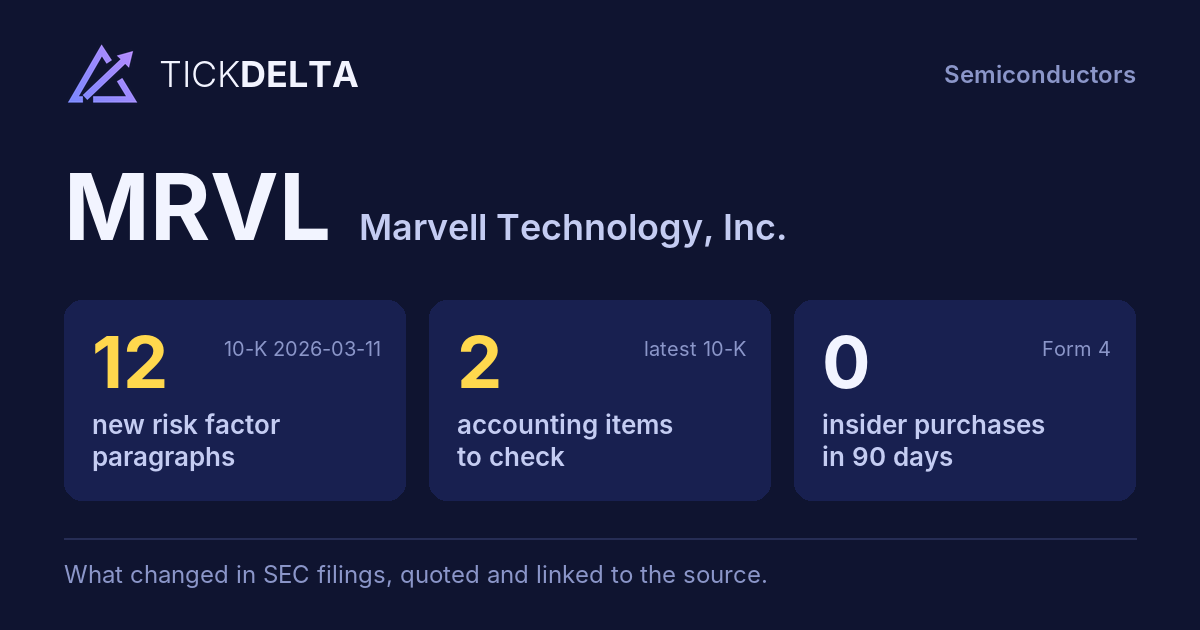
115 changes: 25 added, 2 removed, 88 reworded
10-K 0001835632-26-000011 (Mar 11, 2026) vs 10-K 0001835632-25-000057 (Mar 12, 2025)
The redline
The paragraph that changed most in each section
Marked against last year's 10-K:
cut words struck through, new words highlighted and underlined.
Risk Factors 195 words changed in this paragraph; it is 78% similar to last year's version.
Concerns that semiconductors are necessary for national security, manufacturing and critical infrastructure, as well as concerns of their potential use to restrict human rights, has led to increased U.S. export restrictions impacting sales of semiconductors and semiconductor technology to China or specific customers in China. While most of our products that are shipped to China are processed and placed into larger systems, after which they are distributed to customers in global markets outside of China, a small portion of our products are shipped into China and remain there. For example, the addition of certain companies to the Entity List, which places export restrictions on certain foreign persons or entities by the U.S. Department of Commerce’s Bureau of Industry and Security, Security (the “BIS”), has dampened demand for our products. Due to the U.S. government restricting sales to certain customers in China, sales to some customers require licenses for us to export our products; however, in the past some of these licenses have been delayed or denied and there can be no assurances that requests for future licenses will be approved by the U.S. government. In addition, certain existing export licenses to China may be revoked due to changes in U.S. government policy. In February 2022, the U.S. National Science and Technology Council published an updated list of critical and emerging technologies, which includes semiconductors, as part of an ongoing effort to identify advanced technologies that are potentially significant to U.S. national security, which could result in more stringent export controls or a greater number of our products requiring a license for export to China. In addition, the U.S. Department of Commerce Bureau of Industry and Security recently BIS released new controls on the export of advanced computing and semiconductor manufacturing items to China as well as transactions related to supercomputer end-uses in China with the aim of addressing U.S. national security and foreign policy concerns. The regulations published in October 2022 include included new restrictions on U.S. persons with respect to activities that are not subject to the Export Administration Regulations (“EAR”), which differs from the agency’s historical approach of controlling items that are subject to the EAR, and the regulations published in October 2023 impose 2023, November 2024, and January 2025 expanded the October 2022 rule imposing additional licensing requirements for exports to China (and certain other countries) of integrated circuits exceeding certain performance thresholds. thresholds, expanding the jurisdiction of the EAR to more foreign made items in certain cases, amending the definition of advanced node, and adding further entities to the Entity List. In January 2025, the AI Diffusion Rule was issued. Then in May 2025, the BIS said it intends to cancel the AI Diffusion Rule and release new rules. The BIS announcement creates uncertainty about what products, technologies, or software might be covered by future rules. Export restrictions reducing our sales of products to China, have in the past and may in the future adversely impact our revenues, profits and results of operations. In January 2025, the AI Diffusion Rule and the Foundry Due Diligence Rule were issued. While we do not expect these January 2025 restrictions to materially impact us, any export restrictions reducing our ability to manufacture our products can adversely impact our revenues, profits and results of operations.
Source: Item 1A, 10-K 0001835632-26-000011 vs Item 1A, 10-K 0001835632-25-000057
MD&A 156 words changed in this paragraph; it is 65% similar to last year's version.
Net cash provided by operating activities was $1.4 $1.8 billion for fiscal 2024 2026 compared to net cash provided by operating activities of $1.3 $1.7 billion for fiscal 2023. 2025. We had a net loss income of $933.4 million $2.7 billion adjusted for the following non-cash items: gain on sale of our automotive ethernet business of $1.8 billion, amortization of acquired intangible assets of $1.1 billion, $942.0 million, stock-based compensation expense of $609.8 $590.8 million, depreciation and amortization of $299.8 $348.6 million, deferred income tax expense of $150.8 $42.2 million, restructuring related impairment charges gains of $32.9 $14.0 million, and $54.9 $109.5 million net loss from other non-cash items. Cash inflow outflow from working capital of $57.8 million $1.1 billion for fiscal 2024 2026 was primarily driven by a decrease increases in accounts receivable, inventories, and a decrease in inventories, partially offset by cash outflows due to an increase in prepaid expenses and other assets, partially offset by increases in accrued liabilities and a decrease in other non-current liabilities, and accounts payable. The decrease increase in accounts receivable was primarily due to timing higher sales in the last two months of billing and collections and the impact of factoring of receivables. fiscal 2026. The decrease increase in inventory was a result of utilizing previously built buffers. inventories is aligned with expected revenue growth. The increase in prepaid expenses and other assets was primarily driven by higher prepaid ship and debits due to prepayments on supply capacity reservation agreements net of refunds, higher inventory balances at distributors, and from receivables for government incentives earned. The increase in accrued liabilities and other non-current liabilities was primarily driven by an increase in income taxes payable mainly from taxes on gain from sale of business, and higher ship and debit reserve. claims accrual. The decrease increase in accounts payable was primarily due to the timing of payments.
Source: Item 7, 10-K 0001835632-26-000011 vs Item 7, 10-K 0001835632-25-000057
Accounting Policies 125 words changed in this paragraph; it is 45% similar to last year's version.
In November December 2023, the Financial Accounting Standards Board (“FASB”) issued Accounting Standards Update (“ASU”) 2023-07, Segment Reporting 2023-09, Income Taxes (Topic 280) 740): Improvements to Income Tax Disclosures to improve reportable segment disclosures. The update requires disclosure income tax disclosures to enhance transparency and decision usefulness of incremental segment information on an annual income tax disclosure. This standard results in enhanced cash tax and interim basis. The ASU is effective tax rate disclosures in the Notes to Consolidated Financial Statements. This standard became effective for the Company’s annual reporting for fiscal years beginning after December 15, 2023, 2026 and interim periods within fiscal years beginning after December 15, 2024, and requires retrospective application the Company elected to all prior periods presented in adopt the financial statements. The Company adopted this standard for the fiscal year ended February 1, 2025. See on a prospective basis. "See “Note 14 12 – Segment and Geographic Information” Income Taxes” for further information. The adoption of this standard did not have a significant effect on the Company’s results of operations or financial condition.
Source: Item 8, Note 2 – Significant Accounting Policies, 10-K 0001835632-26-000011 vs Item 8, Note 2 – Significant Accounting Policies, 10-K 0001835632-25-000057
Legal Proceedings 45 words changed in this paragraph; it is 86% similar to last year's version.
The Company entered into manufacturing supply capacity reservation agreements with foundries and test & and assembly suppliers during the current and in prior fiscal years. Under these arrangements, the Company agreed to pay capacity fees or refundable deposits to the suppliers in exchange for reserved manufacturing production capacity over the term of the agreements, which ranges from 4 to 10 years. In addition, the Company committed to certain purchase levels that were in line with the capacity reserved. During the first and second quarters of fiscal 2025, the Company worked with its foundry and test and assembly suppliers to amend certain manufacturing supply capacity reservation agreements, which resulted in reducing the Company’s related purchase level commitments. The Company currently estimates that it has agreed to purchase level commitments of at least $544.6 $458.2 million of wafers, substrates, and other manufacturing products for fiscal 2026 2027 through fiscal 2033 under the capacity reservation agreements. In addition, total fees and refundable deposits payable under these arrangements are $47.1 $23.1 million in fiscal 2026 2027 through fiscal 2028. Such purchase commitments are summarized in the preceding table.
Source: Item 3, via Note 8 – Commitments and Contingencies, 10-K 0001835632-26-000011 vs Item 3, via Note 8 – Commitments and Contingencies, 10-K 0001835632-25-000057
Every change, by type
Sentences and paragraphs added, removed or reworded
Sentences and paragraphs of MRVL's Risk Factors and MD&A, 10-K Mar 11, 2026 against 10-K Mar 12, 2025. Each links to the text at sec.gov.
RemovedMD&A