MSMorgan Stanley
- Employees
- 83,000
- Headquarters
- New York, NY
- CEO
- Edward Pick
- Next results
- around Jan 14, 2027
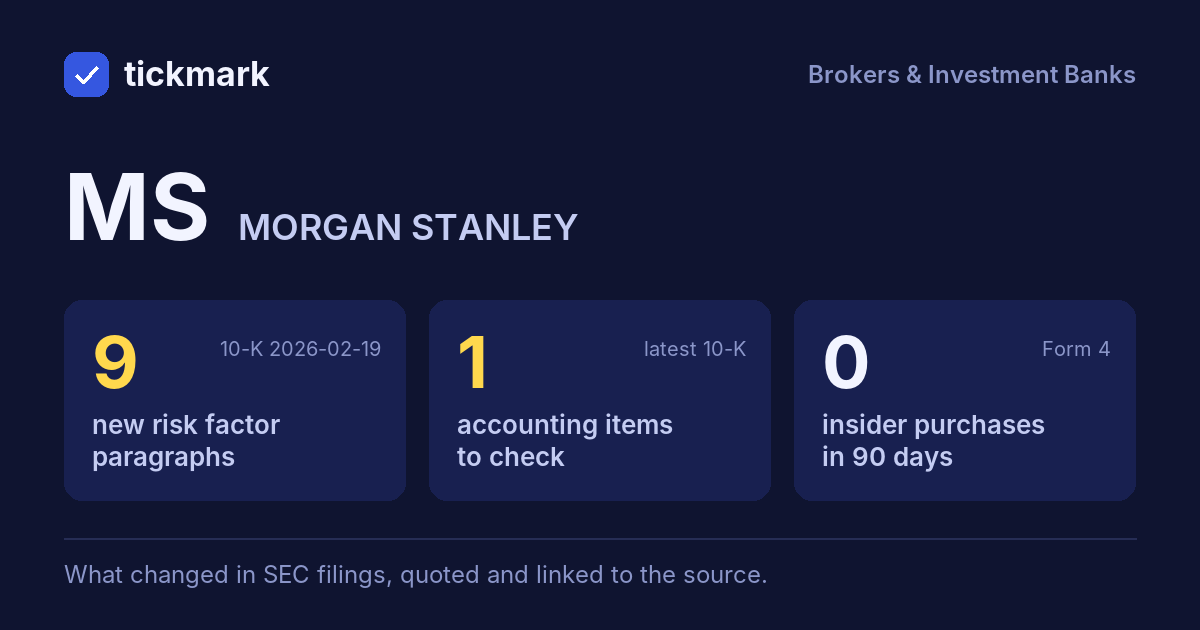
Facts from the latest 10-K that are worth reading about. They are not a verdict on the company.
!
Critical audit matters changed
New this year: Our audit procedures related to the valuation of Level 3 financial assets and Level 3 trading liabilities, borrowings, other secured (“borrowings, and securities sold under agreements to repurchase carried at fair value on a recurring basis and Level 3 loans held for sale included the following, among others:”)
✓
Auditor change
Same auditor in both 10-Ks: Deloitte & Touche LLP
Source: 10-K 0000895421-26-000086: auditor Deloitte & Touche LLP; 10-K 0000895421-25-000304: auditor Deloitte & Touche LLP; no 8-K item 4.01 in the last 2 years
✓
Going concern language
No statement of substantial doubt about going concern
✓
Restatement (8-K item 4.02)
No 8-K item 4.02 in the last 2 years
Source: Filing index, 8-Ks since 2024-11-10
✓
Late filing notice (NT 10-K or NT 10-Q)
No NT 10-K or NT 10-Q in the last 2 years
Source: Filing index since 2024-11-10
✓
Material weakness in internal control
No sentence in the 10-K concludes that controls were not effective because of a material weakness
✓
Material impairment (8-K item 2.06)
No 8-K item 2.06 in the last 2 years
Source: Filing index, 8-Ks since 2024-11-10
✓
Bankruptcy (8-K item 1.03)
No 8-K item 1.03 in the last 2 years
Source: Filing index, 8-Ks since 2024-11-10
–
Receivables growing faster than revenue not applicable
The 10-K does not report receivables for both years.
–
Cash from operations lower than net income not applicable
Not used for financial companies (cash from operations −$17.9B, net income $16.9B)
–
Inventory growing faster than revenue not applicable
The 10-K does not report inventory for both years.
How each check works
what it measures, the threshold, what it does not mean
| Check | What it measures | When it is marked | What it does not mean |
|---|---|---|---|
| Receivables growing faster than revenue | Whether customers owe more, relative to sales, than a year ago. | Receivables grew more than 10 percentage points faster than revenue, and grew. | Not proof that revenue is overstated. A large deal at year end, longer payment terms or an acquisition can do the same. |
| Cash from operations lower than net income | Whether reported profit is backed by cash from the business. | Cash from operations is below net income. Not computed for banks and other financial companies. | Common in fast-growing or seasonal companies. It is a question to ask, not a failure. |
| Inventory growing faster than revenue | Whether stock is piling up relative to sales. | Inventory grew more than 10 percentage points faster than revenue, and grew. | May be a planned build ahead of a product launch or a supply-chain change. |
| Auditor change | Whether the company changed its auditor. | An 8-K item 4.01 in the last 2 years, or a different auditor name in the two latest 10-Ks. | Often routine: rotation, a tender, or an audit firm merger. |
| Going concern language | Whether the 10-K states substantial doubt about continuing as a going concern. | A sentence to that effect is found in the 10-K text. Quoted as filed. | The wording is the company's, not our estimate. It can also appear in a sentence saying the doubt was removed. |
| Restatement (8-K item 4.02) | Whether the company said earlier financial statements should no longer be relied on. | An 8-K item 4.02 in the last 2 years. | Some restatements are small and do not change the picture. |
| Late filing notice | Whether the company asked for more time to file a 10-K or 10-Q. | An NT 10-K or NT 10-Q in the last 2 years. | Delays can be technical and one-off. |
| Critical audit matters changed | Which topics the auditor singled out as most difficult, and whether they changed. | A matter is new in the latest 10-K compared with the one before. | A new matter shows where the auditor spent its effort, not that something is wrong. |
| Material weakness in internal control | Whether the 10-K concludes that internal control over financial reporting was not effective because of a material weakness. | A sentence in the 10-K text concludes that controls were not effective because of a material weakness, quoted as filed. Sentences that say there is none, that one could occur, or that an earlier one was fixed are not marked. | It is the company's or the auditor's own wording, not our estimate. Many are about one account or process and are fixed within a year. It does not say the numbers are wrong. |
| Material impairment (8-K item 2.06) | Whether the company told the SEC it expects a material charge for impaired assets, such as goodwill. | An 8-K item 2.06 in the last 2 years. | A non-cash write-down. It says an earlier value was too high, not that the business is failing or that cash ran out. |
| Bankruptcy (8-K item 1.03) | Whether the company filed for bankruptcy or receivership. | An 8-K item 1.03 in the last 2 years. | The filing is the company's own and is a fact. It does not say what shareholders will get or whether the business continues. |
The 10-point threshold is our choice, not an academic result. Every check cites the filing and the line items it used.
Work on MS in a spreadsheet:
Excel workbook (a sheet per section, ten years by column, charts, links to the filings) ·
CSV.
For a Google Sheet that stays up to date, paste =IMPORTDATA("https://tickdelta.com/company/MS/export.csv") into a cell.