Morgan Stanley Direct Lending Fund MSDL
New risk paragraphs, branching off last year
Each branch is a paragraph in Risk Factors with nothing like it in the 10-K filed Feb 27, 2025. A box jumps to the paragraph as filed, below.
Paragraphs with nothing like them in last year's 10-K
20 paragraphs in Risk Factors of the 10-K filed Feb 26, 2026 with nothing like them in the 10-K filed Feb 27, 2025. Quoted exactly. Paragraphs that were only edited are under 10-K change.
Our financial condition and results of operations depend on our ability to manage future growth effectively.
other investors, the availability of investment opportunities generally will be subject to market conditions as well as, in many cases, the prevailing regulatory or political climate. We can offer no assurance that we will be successful in obtaining suitable investments, or that if we make such investments, our objectives will be achieved.
In connection with the 2025-1 Debt Securitization (and any other CLO we may form in the future), we depend (or will depend) in part on distributions from the CLO’s assets out of its earnings and cash flows to enable us to make distributions to shareholders. The ability of a CLO to make distributions will be, and in connection with the 2025-1 Debt Securitization is, subject to various limitations, including the terms and covenants of the debt it issues. The Subordinated Notes and that portion of the Class D Notes (each as defined in Note 6. “Debt” in the notes to the accompanying consolidated financial statements) issued by North Haven Private Credit CLO 1 LLC (“CLO 2025-1 Issuer”) and retained by us are the most junior classes of notes issued by CLO 2025-1 Issuer, are subordinated in priority of payment to the other CLO 2025-1 Debt (as defined in Note 6. “Debt” in the notes to the accompanying consolidated financial statements) issued by CLO 2025-1 Issuer and are subject to certain payment restrictions set forth in the indenture governing the CLO 2025-1 Senior Secured Notes (as defined in Note 6. “Debt” in the notes to the accompanying consolidated financial statements) and Subordinated Notes issued by CLO 2025-1 Issuer. Therefore, we only receive cash distributions on the Subordinated Notes and those Class D Notes retained by us if CLO 2025-1 Issuer has made all cash interest payments to all other CLO 2025-1 Senior Secured Notes it has issued.
Also, a CLO may take actions to retain cash or other assets to satisfy asset coverage requirements or other tests commonly provided for holders of the CLO’s debt, which could impact our ability to receive distributions from the CLO. With respect to the 2025-1 Debt Securitization, if CLO 2025-1 Issuer does not meet the asset coverage tests or the interest coverage test set forth in the documents governing the 2025-1 Debt Securitization, cash would be diverted from the Subordinated Notes and/or Class D Notes that we hold to first pay the more senior CLO 2025-1 Notes issued by CLO 2025-1 Issuer in amounts sufficient to cause such tests to be satisfied. If we do not receive cash flow from any such CLO, including in connection with the 2025-1 Debt Securitization, that is necessary to satisfy the annual distribution requirement for maintaining RIC status, and we are unable to obtain cash from other sources necessary to satisfy this requirement, we may not maintain our qualification as a RIC, which would have a material adverse effect on an investment in the shares.
In addition, a decline in the credit quality of loans in a CLO due to poor operating results of the relevant borrower or increases in defaults, among other things, may result in a reduction of earnings and, in turn, cash potentially available for distribution to us for distribution to shareholders. To the extent that any losses are incurred by the CLO in respect of any collateral, including, with respect to the 2025-1 Debt Securitization, the value of the portfolio of loan investments held by CLO 2025-1 Issuer, such losses will be borne first by us as owner of equity interests in the CLO and, in the case of the 2025-1 Debt Securitization, the value of the Subordinated Notes and Class D Notes that we have retained could be reduced at their redemption and could not be paid in full or at all.
We may invest in derivatives or other assets that expose us to certain risks, including market risk, liquidity risk and other risks similar to those associated with the use of leverage.
We may invest in derivatives and other assets that are subject to many of the same types of risks related to the use of leverage. Derivative transactions, if any, will generally create leverage for us and involve significant risks. The primary risks related to derivative transactions include counterparty, correlation, liquidity, leverage, volatility, over-the-counter trading, operational and legal risks. In addition, a small investment in derivatives could have a large potential impact on our performance, effecting a form of investment leverage on our portfolio. In certain types of derivative transactions, we could lose the entire amount of our investment; in other types of derivative transactions the potential loss is theoretically unlimited.
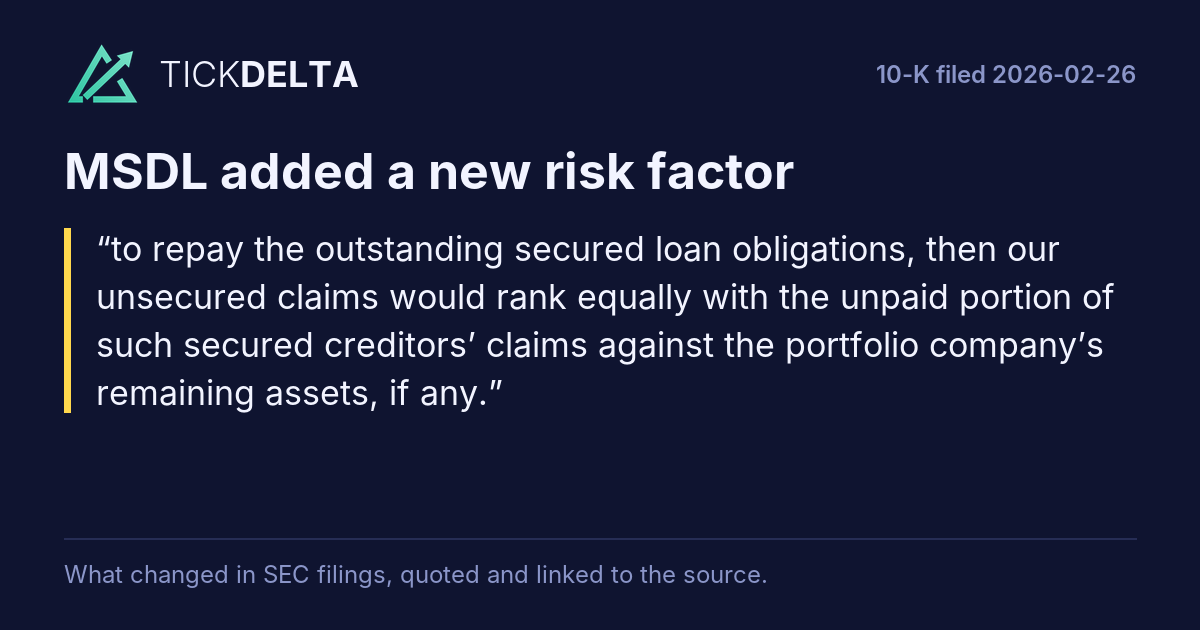
to repay the outstanding secured loan obligations, then our unsecured claims would rank equally with the unpaid portion of such secured creditors’ claims against the portfolio company’s remaining assets, if any.
Show the other 4
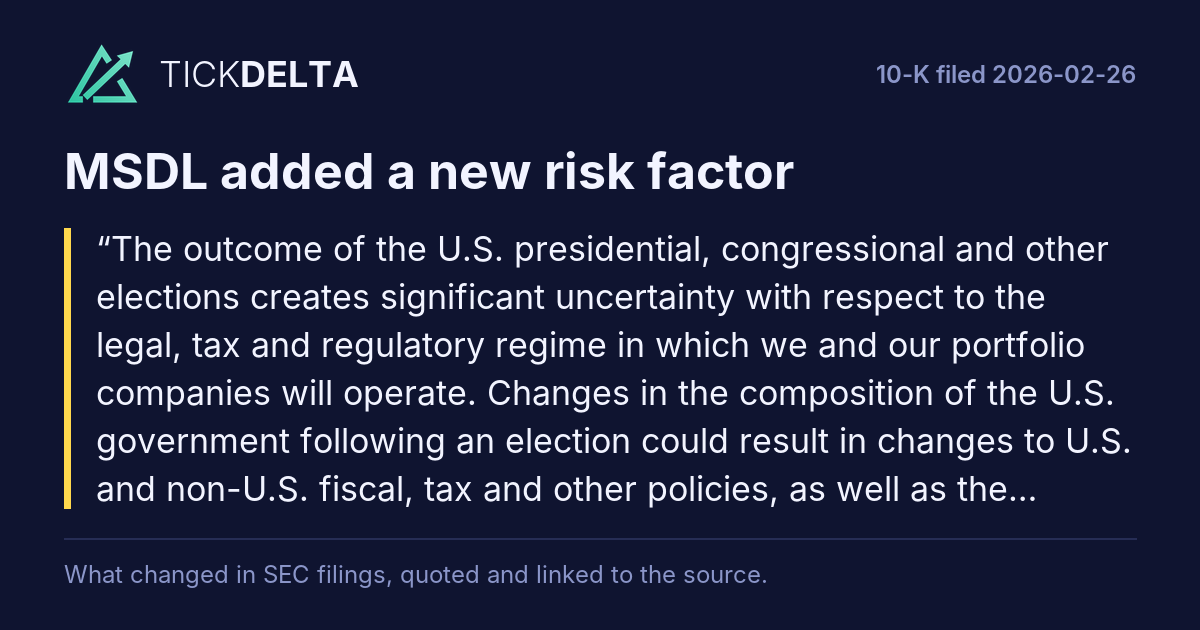
The outcome of the U.S. presidential, congressional and other elections creates significant uncertainty with respect to the legal, tax and regulatory regime in which we and our portfolio companies will operate.
Changes in the composition of the U.S. government following an election could result in changes to U.S. and non-U.S. fiscal, tax and other policies, as well as the global financial markets generally. Any significant changes in economic policy, the regulation of the asset management industry, international trade policy and/or tax law, among other things, could have a material adverse impact on us and our investments. General fluctuations in the market prices of securities and interest rates could affect our investment opportunities and the value of our investments. We could also be affected by difficult conditions in the capital markets and any overall weakening of the financial services industry. Ongoing disruptions in the global credit markets could affect issuers’ ability to pay debts and obligations on a timely basis. If defaults occur, we could lose both invested capital in, and anticipated profits from, any affected investments.
While the current U.S. administration has signaled a reduced emphasis on regulation, past U.S. administrations supported an enhanced regulatory agenda. Changes in regulation can impose greater costs on certain sectors, including financial services, or otherwise impact the competitive environment for obligors, which could adversely impact us and our clients.
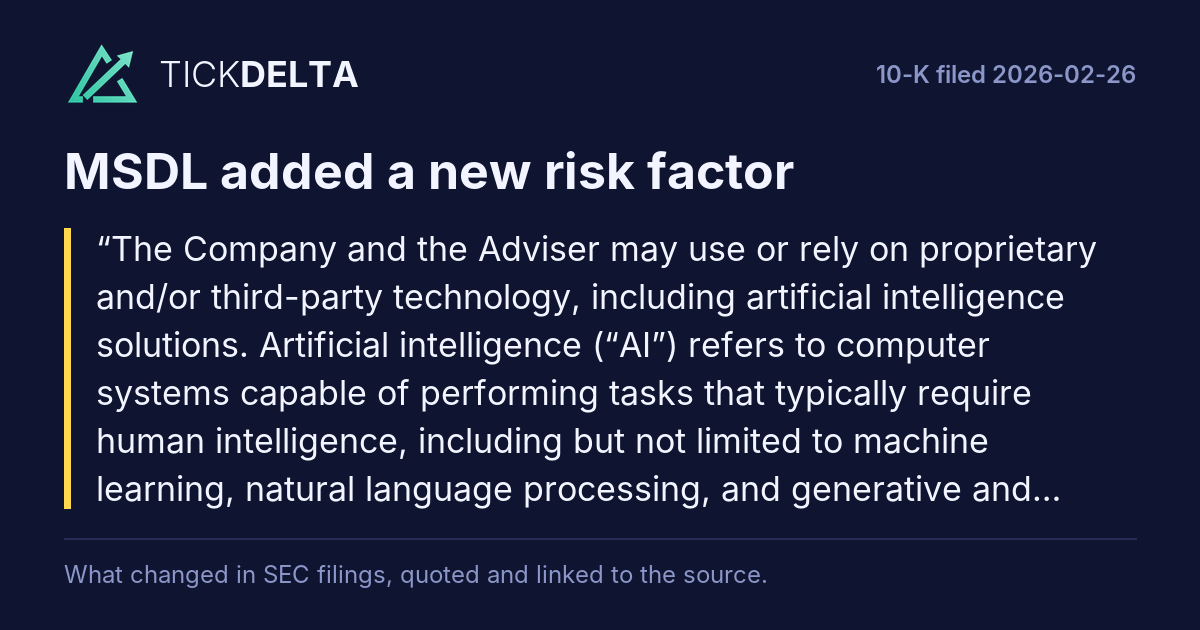
The Company and the Adviser may use or rely on proprietary and/or third-party technology, including artificial intelligence solutions. Artificial intelligence (“AI”) refers to computer systems capable of performing tasks that typically require human intelligence, including but not limited to machine learning, natural language processing, and generative and agentic AI technologies. These systems are designed to analyze data, learn from patterns, make decisions and solve problems. Actual usage of AI will vary and is likely to change over time. Investors should be aware that the use of AI tools, while potentially beneficial, presents a range of risks and may result in material adverse consequences (including the risks discussed in further detail below) for the Company or its third-party service providers or counterparties, and no assurance can be given that any controls adopted to govern the use of AI will fully mitigate the risks associated with AI technologies.
AI tools may produce inaccurate, biased, insufficient, discriminatory, misleading, incomplete, undetectable manipulative or otherwise flawed responses due to (among other things) limitations in training data, algorithmic design or operational oversight. Such deficiencies may result in operational errors, investment losses, reputational, financial, or social harm, legal liability, regulatory scrutiny or other adverse effects. The deployment and supervision of AI tools may increase operational and compliance risks. Inappropriate use of AI tools or overreliance on AI outputs without adequate human oversight may further exacerbate these risks.
The legal and regulatory environment relating to AI is uncertain and evolving and future changes, such as those related to privacy, data protection and intellectual property, could have an impact on the use of AI and existing or emerging technologies that could impact the Company. It is possible that future changes in applicable legal and regulatory requirements could increase compliance costs. Any of these risks could adversely affect the Company. Additionally, regulatory actions or legal challenges may impose restrictions or obligations that affect operational efficiency or compliance posture.
The misuse of AI tools, whether intentional or inadvertent, may expose the Company to additional risks. In addition, AI tools and technology are evolving rapidly and the integration of AI in systems and operations create new risks that can be difficult to assess and anticipate.
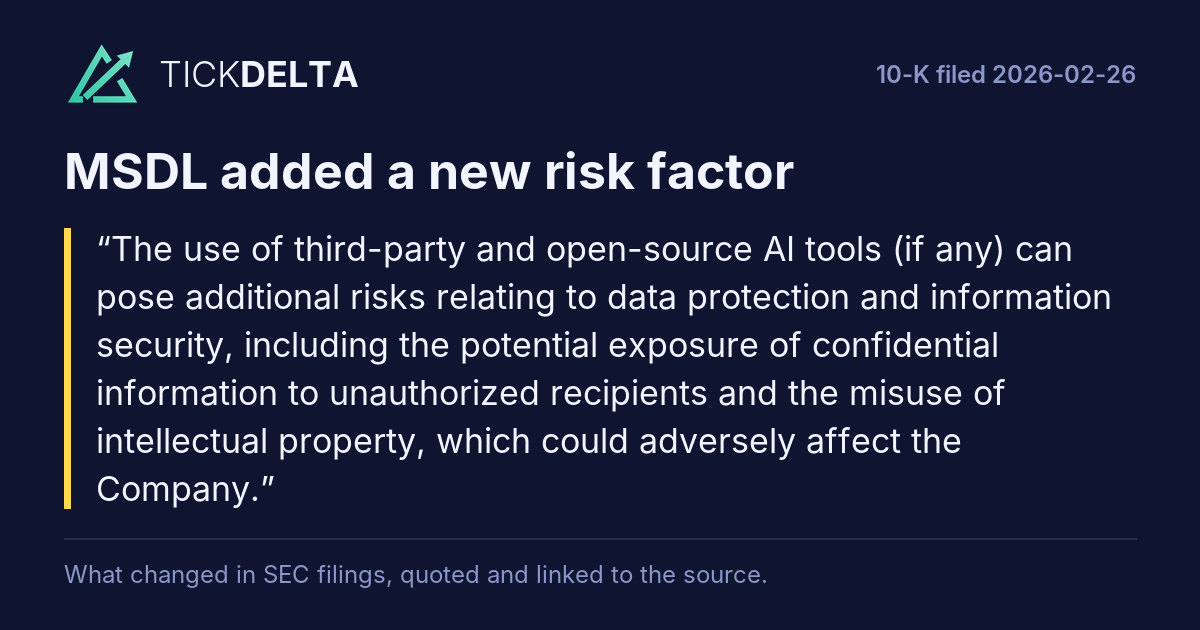
The use of third-party and open-source AI tools (if any) can pose additional risks relating to data protection and information security, including the potential exposure of confidential information to unauthorized recipients and the misuse of intellectual property, which could adversely affect the Company.
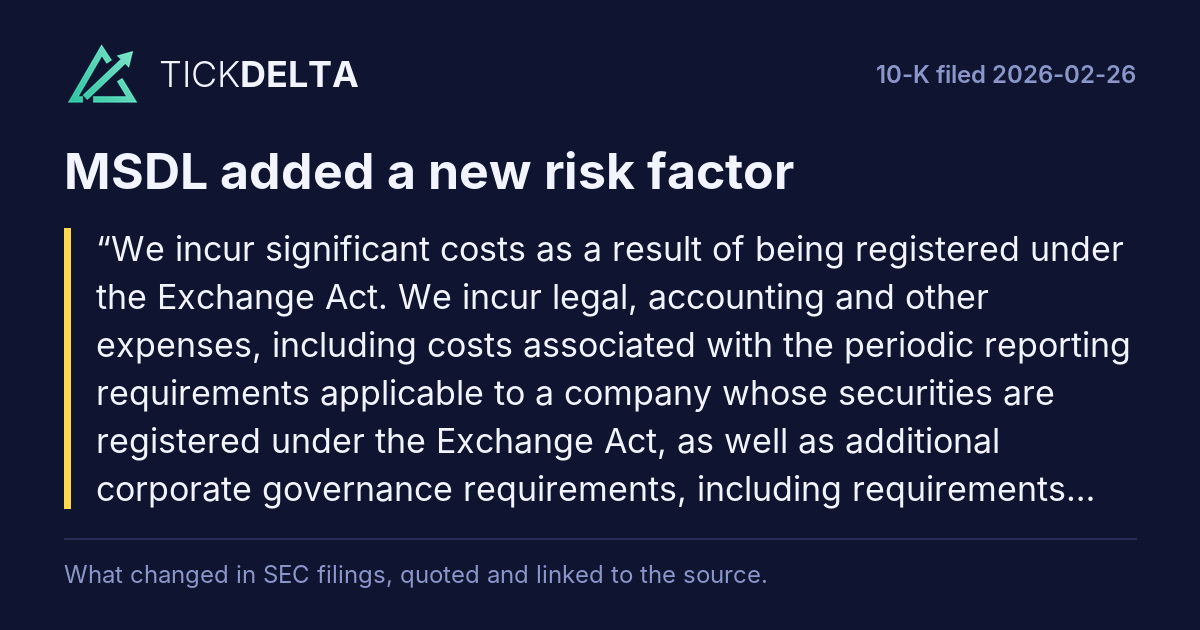
We incur significant costs as a result of being registered under the Exchange Act.
We incur legal, accounting and other expenses, including costs associated with the periodic reporting requirements applicable to a company whose securities are registered under the Exchange Act, as well as additional corporate governance requirements, including requirements under the Sarbanes-Oxley Act and other rules implemented by the SEC.
We invest through a joint venture and could enter into additional joint ventures in the future.
We have entered into a joint venture and from time to time, we could hold a portion of our investments through partnerships, additional joint ventures, securitization vehicles or other entities with third-party investors (collectively, “joint ventures”). Joint venture investments involve various risks, including the risk that we will not be able to implement investment decisions or exit strategies because of limitations on our control under applicable agreements with joint venture partners, the risk that a joint venture partner could become bankrupt or could at any time have economic or business interests or goals that are inconsistent with those of us, the risk that a joint venture partner could be in a position to take action contrary to our objectives, the risk of liability based upon the actions of a joint venture partner and the risk of disputes or litigation with such partner and the inability to enforce fully all rights (or the incurrence of additional risk in connection with enforcement of rights) one partner could have against the other, including in connection with foreclosure on partner loans, because of risks arising under state law. In addition, we could, in certain cases, be liable for actions of our joint venture partners. The joint venture in which we participate could sometimes be allocated investment opportunities that might have otherwise gone entirely to us, which could reduce our return on equity. Additionally, our joint venture investments could be held on an unconsolidated basis and at times could be highly leveraged. Such leverage would not count toward the investment limits imposed on us by the 1940 Act. We do not intend to create or acquire primary control of any entity that primarily engages in investment activities in securities and other assets other than joint ventures or entities wholly owned by us.
Paragraphs in the 10-Q filed Nov 5, 2026 that were not in the one before
New in the latest 10-Q
7 paragraphs in the 10-Q filed Nov 5, 2026 with nothing like them in the 10-Q filed Aug 6, 2026 (at least half the words must differ; new numbers alone do not count). Quoted exactly, grouped by the item heading above them. This is text that changed, not a judgement of how serious it is.
Financial statements and notes
(Increase) decrease in investments in unaffiliated money market fund 1,760 (1,075)
Read in the 10-Q
Shares(4) Equity Investments - non-controlled/non-affiliated Aerospace & Defense AA&D Holdings, LP (6) (15) (16) Common Equity 11/14/2025 508 687 722 0.05 Automobile Components
Read in the 10-Q
On November 3, 2026, the Board declared a distribution of $0.45 per share, which is payable on or around January 22, 2027 to shareholders of record as of December 31, 2026. On November 3, 2026, the Board also declared a supplemental distribution of $0.0150 per share, which is payable on or around December 15, 2026 to shareholders of record as of November 30, 2026. Second Amended and Restated Investment Advisory Agreement On November 5, 2026, the Company and the Adviser entered into the Second Amended and Restated Investment Advisory Agreement, effective January 1, 2027. The Second Amended and Restated Investment Advisory Agreement (i) reduces the base management fee from 1.00% to 0.75% of gross assets at the end of the two most recently completed calendar quarters and (ii) reduces the incentive fee on income and capital gains from 17.5% to 15.0% (and a corresponding reduction of the incentive fee cap from 17.5% to 15.0%).
Read in the 10-Q
• the impact of information technology system failures, data security breaches, data privacy compliance, network disruptions, and cybersecurity attacks, and the increasing use of artificial intelligence and machine learning technology;
Read in the 10-Q
On November 5, 2026, we and our Adviser entered into the Second Amended and Restated Investment Advisory Agreement, effective January 1, 2027. The Second Amended and Restated Investment Advisory Agreement (i) reduces the base management fee from 1.00% to 0.75% of gross assets at the end of the two most recently completed calendar quarters and (ii) reduces the incentive fee on income and capital gains from 17.5% to 15.0% (and a corresponding reduction of the incentive fee cap from 17.5% to 15.0%).
Read in the 10-Q
Show the other 2
Other information
On November 5, 2026, the Company and the Adviser entered into the Second Amended and Restated Investment Advisory Agreement, effective as of January 1, 2027, which amended and restated the Amended and Restated Investment Advisory Agreement, dated as of January 24, 2024. The Second Amended and Restated Investment Advisory Agreement (i) reduces the base management fee from 1.00% to 0.75% of gross assets at the end of the two most recently completed calendar quarters and (ii) reduces the incentive fee on income and capital gains from 17.5% to 15.0% (and a corresponding reduction of the incentive fee cap from 17.5% to 15.0%). The foregoing description is only a summary of the material provisions of the Second Amended and Restated Investment Advisory Agreement and is qualified in its entirety by reference to a copy of the Second Amended and Restated Investment Advisory Agreement, which is filed as Exhibit 10.1 to this report.
Read in the 10-Q
Item 6
10.1* Second Amended and Restated Investment Advisory Agreement, dated as of November 5, 2026.
Read in the 10-Q
The 10-Q's risk factors against the 10-K
Item 1A of the 10-Q filed Nov 5, 2026 against Item 1A of the 10-K filed Feb 26, 2026.
A 10-Q repeats only the risks that changed, so a 10-K paragraph that is missing from it is not counted as removed.
Added is a paragraph with nothing like it in the 10-K, Reworded a sentence that is in both with several words changed,
Quiet changes a sentence in both where one to four words changed and one is a hedge or a modal
(cut words struck through, new words highlighted).
Text on the page, not a score; each links to the filing at sec.gov.
This 10-Q has no Item 1A (Risk Factors) text of its own, so there is nothing to compare. Many companies leave it out when their risks have not changed.
Phrases used for the first time
Two-word phrases in Risk Factors of the 10-K filed Feb 26, 2026 that are in none of the 1 earlier 10-Ks stored, back to Feb 27, 2025
Where each one is used
- joint venture: To the extent that we do not hold controlling equity interests in portfolio companies, we will have a limited ability to protect our position in such portfolio companies. We may also co-invest with third parties through partnerships, joint ventures or other entities. Such investments may involve risks in connection...
- clo issuer: In connection with the 2025-1 Debt Securitization (and any other CLO we may form in the future), we depend (or will depend) in part on distributions from the CLO’s assets out of its earnings and cash flows to enable us to make distributions to shareholders. The ability of a CLO to make distributions will be, and in...
- subordinated notes: In connection with the 2025-1 Debt Securitization (and any other CLO we may form in the future), we depend (or will depend) in part on distributions from the CLO’s assets out of its earnings and cash flows to enable us to make distributions to shareholders. The ability of a CLO to make distributions will be, and in...
- note debt: We have in the past and may in the future enter into CLOs through a direct or indirect subsidiary of ours (any such subsidiary, an “MS Issuer”). As a result of these CLOs, including the 2025-1 Debt Securitization (as defined in Note 6. “Debt” in the notes to the accompanying consolidated financial statements), we...
- accompanying consolidated: We have in the past and may in the future enter into CLOs through a direct or indirect subsidiary of ours (any such subsidiary, an “MS Issuer”). As a result of these CLOs, including the 2025-1 Debt Securitization (as defined in Note 6. “Debt” in the notes to the accompanying consolidated financial statements), we...
- class notes: In connection with the 2025-1 Debt Securitization (and any other CLO we may form in the future), we depend (or will depend) in part on distributions from the CLO’s assets out of its earnings and cash flows to enable us to make distributions to shareholders. The ability of a CLO to make distributions will be, and in...
- derivative transactions: We may invest in derivatives and other assets that are subject to many of the same types of risks related to the use of leverage. Derivative transactions, if any, will generally create leverage for us and involve significant risks. The primary risks related to derivative transactions include counterparty,...
- venture partner: We have entered into a joint venture and from time to time, we could hold a portion of our investments through partnerships, additional joint ventures, securitization vehicles or other entities with third-party investors (collectively, “joint ventures”). Joint venture investments involve various risks, including...
Used at least twice, small words left out. Counted, not picked: a phrase can be new because the company renamed something.
What was taken out
16 paragraphs of last year's Risk Factors with nothing like them now. The longest are quoted.
Sources
Item 1A of each 10-K and 10-Q on EDGAR, quoted exactly. Each paragraph links to the filing at sec.gov.
Also
10-K change: what was reworded or cut, section by section.
Work with it
Excel workbook · CSV. Google Sheet that stays up to date: paste =IMPORTDATA("https://tickdelta.com/company/MSDL/export.csv") into a cell.